

 Download PDF
Market Overview
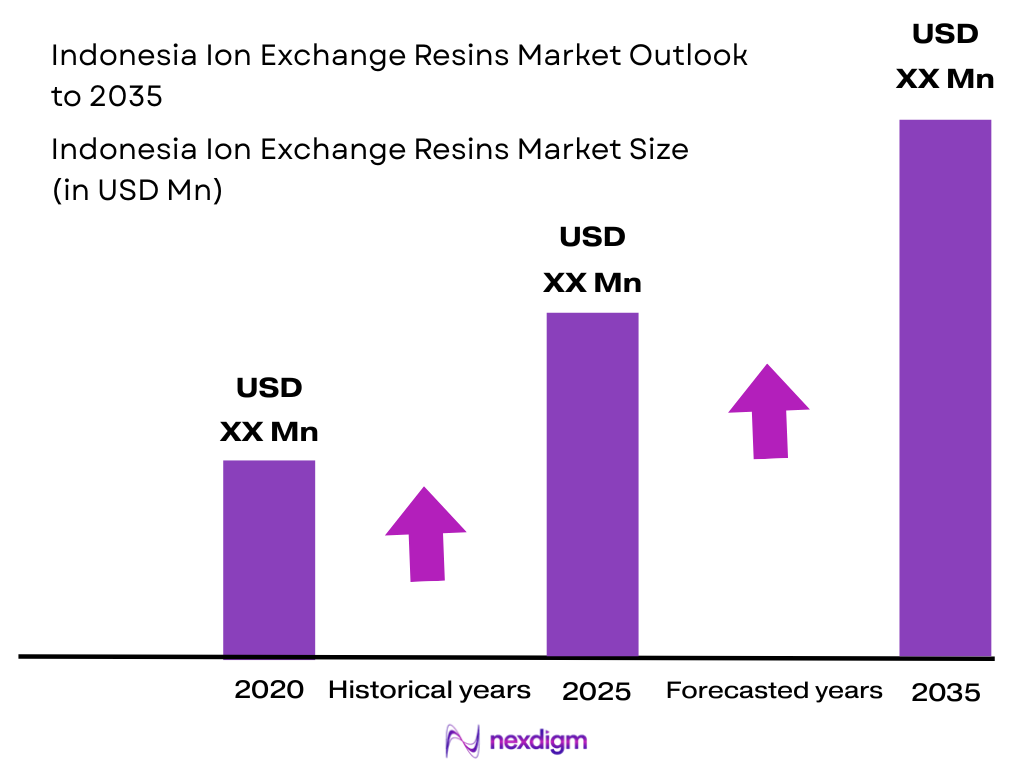
The Indonesia Ion Exchange Resins market is valued at ~USD 2.73 million, supported by demand from industrial water treatment, power generation, chemicals and petrochemicals, food and beverage, pharmaceuticals, electronics, and mining. Published industry research identifies Indonesia as an import-dependent ion exchange resin market and tracks demand across cationic, anionic and other resin categories, as well as water and non-water applications. Import activity increased by 1.17% between 2023 and 2024, while the broader Indonesian industrial water-treatment chemicals market generated USD 264.8 million in 2024, demonstrating the substantial downstream treatment ecosystem supporting resin demand.
Indonesia’s ion exchange resin demand is concentrated around Jakarta, West Java, Banten, East Java, Riau and East Kalimantan, reflecting the location of manufacturing, petrochemical, power, mining, food-processing and water-treatment activities. West Java is particularly important because Cikarang hosts local ion-exchange-resin manufacturing and industrial customers, while Banten and East Java contain major chemical and manufacturing clusters. Indonesia’s import infrastructure also supports Jakarta and Surabaya as important supply nodes. The market therefore follows industrial water demand rather than residential geography.
Market Segmentation
By Resin Type
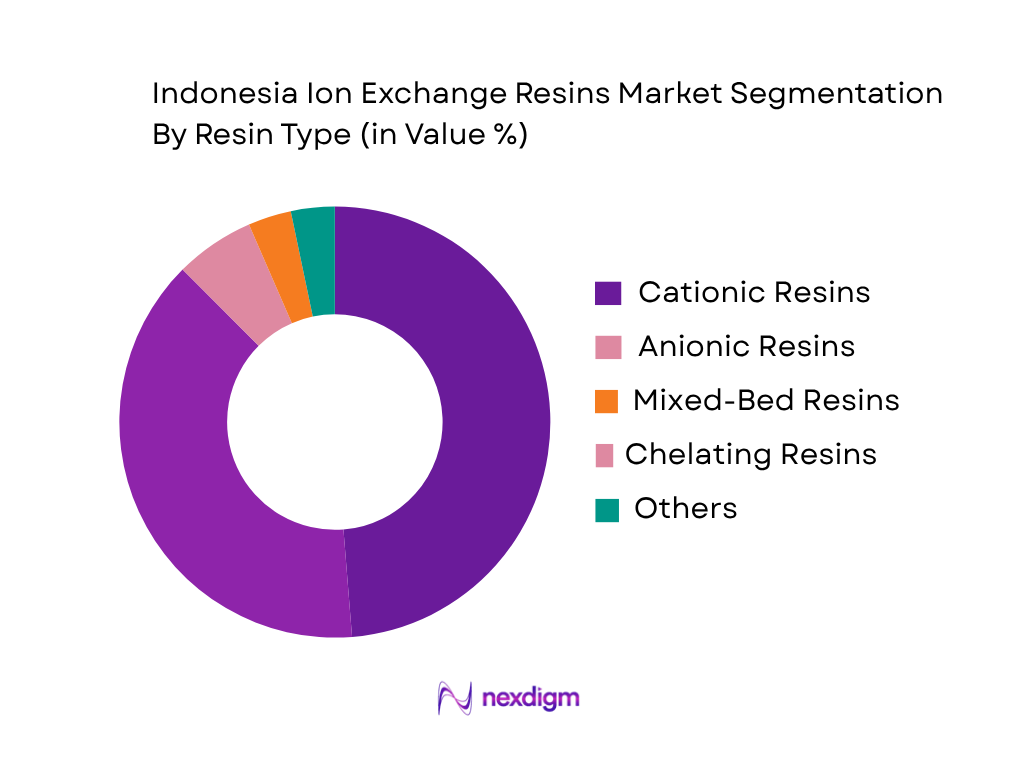
The Indonesia Ion Exchange Resins market is segmented by resin type into cationic resins, anionic resins, mixed-bed resins, chelating resins and other specialty resins. Cationic resins are expected to represent the dominant sub-segment, supported by their widespread use in water softening and the cation stage of demineralization. Indonesian industrial users require cation exchange for calcium and magnesium removal before downstream anion treatment or polishing. Cationic resins are also used across power, manufacturing, food and beverage and chemical-processing applications. Local distributors offer strong-acid cation grades specifically for softening and demineralization, demonstrating established demand for this chemistry. TRILITE KC-08 and KH-80, for example, are supplied in Indonesia for softening and cation-stage demineralization, while mixed-bed products are used where higher treated-water quality is required. The market’s extensive industrial water-treatment base therefore supports recurring replacement demand for conventional cationic resin, while anionic, mixed-bed and specialty grades increasingly serve higher-purity and application-specific requirements.
By Application
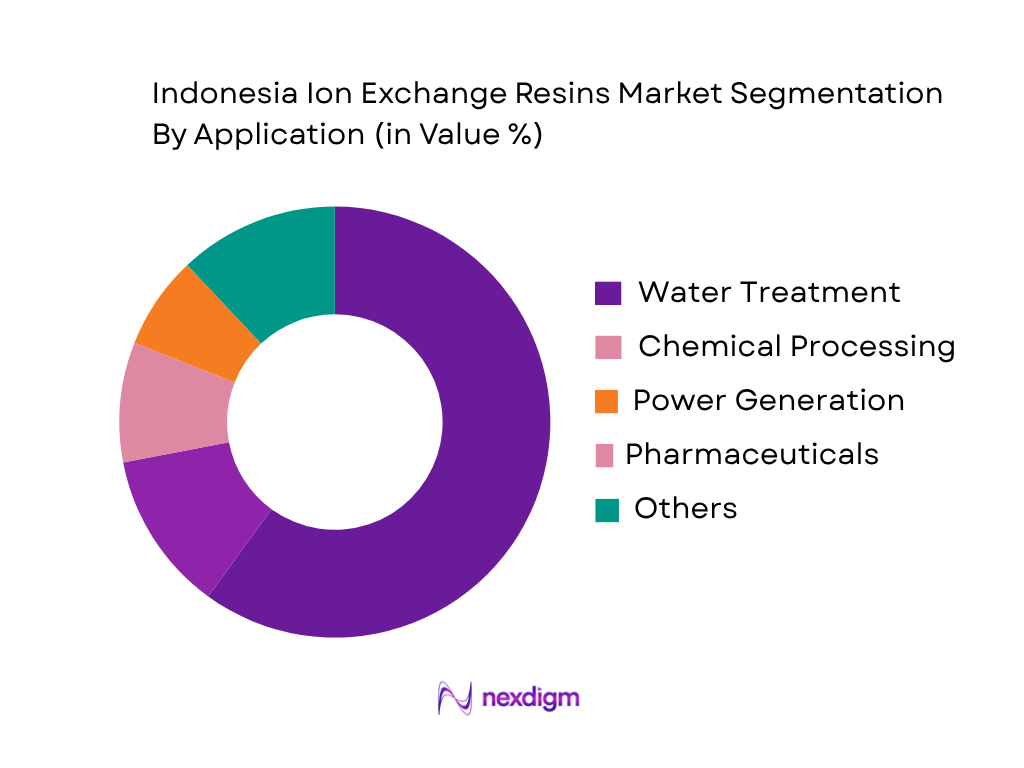
The Indonesia Ion Exchange Resins market is segmented by application into water treatment, chemical processing, power generation, pharmaceuticals, food and beverage, and electronics and other applications. Water treatment is the dominant application, supported by industrial demand for softening, demineralization, deionization, mixed-bed polishing and wastewater treatment. Published Indonesia market research specifically separates ion exchange resin demand into water and non-water applications, while broader industrial water-treatment data show substantial demand across raw-water, cooling-and-boiler and effluent-treatment applications. The Indonesian industrial water-treatment chemicals market generated USD 264.8 million in 2024, with cooling and boiler applications representing the largest application category, illustrating the scale of the downstream industrial treatment ecosystem. Ion exchange is particularly important where dissolved ions must be removed after pretreatment or membrane processes. Demand is consequently reinforced by power plants, chemical facilities, food processors, pharmaceutical manufacturers and other industrial users requiring controlled water chemistry.
Competitive Landscape
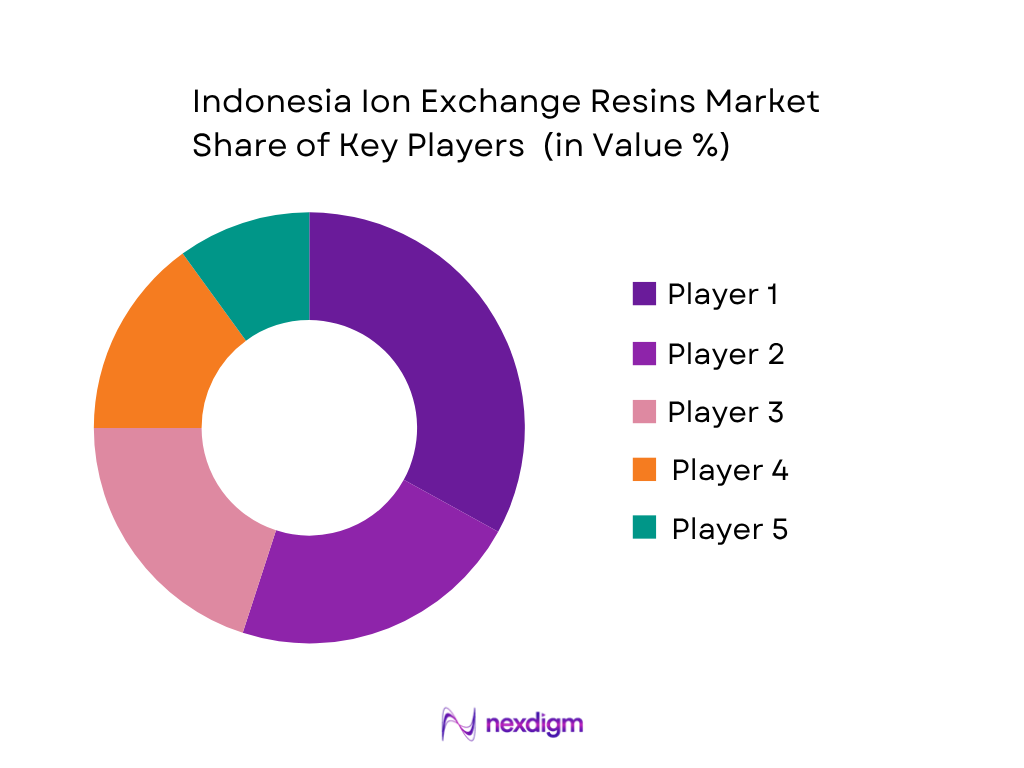
The Indonesia Ion Exchange Resins market consists of international resin manufacturers, regional technology suppliers and Indonesian distributors serving industrial water-treatment customers. The market remains substantially dependent on imported resin technologies, creating competition around product availability, technical specifications, lead times, application engineering and local service coverage. Major suppliers compete across conventional cation and anion resins as well as mixed-bed, high-purity and specialty products. Import data also indicate a geographically concentrated international supply base, reinforcing the importance of distributor relationships and inventory management in Indonesia.
| Company | Establishment Year | Headquarters | Resin Portfolio | Key Applications | Indonesia Supply Model | Specialty Capability | Technical Service | Competitive Focus |
| DuPont | 1802 | Wilmington, USA | ~ | ~ | ~ | ~ | ~ | ~ |
| LANXESS | 2004 | Cologne, Germany | ~ | ~ | ~ | ~ | ~ | ~ |
| Purolite | 1981 | King of Prussia, USA | ~ | ~ | ~ | ~ | ~ | ~ |
| Mitsubishi Chemical Group | 1933 | Tokyo, Japan | ~ | ~ | ~ | ~ | ~ | ~ |
| Samyang Corporation | 1924 | Seoul, South Korea | ~ | ~ | ~ | ~ | ~ | ~ |
Indonesia Ion Exchange Resins market Analysis
Growth Drivers
Industrial Water Demand and Expansion of Manufacturing
Indonesia’s large and expanding industrial base creates a broad requirement for treated process water, softened water, demineralized water and high-purity water, supporting recurring demand for ion exchange resins. The World Bank reports that industry, including construction, contributed 39.3% of Indonesia’s GDP in 2024, while Indonesia’s GDP reached IDR 22,139.0 trillion, according to Statistics Indonesia (BPS). BPS also recorded approximately 30,000 medium- and large-scale manufacturing establishments in the country, creating a substantial installed base of industrial facilities requiring water-treatment systems. Manufacturing applications relevant to ion exchange include chemicals, food and beverage, pharmaceuticals, textiles, pulp and paper, metals and electronics. BPS data further show that food and beverage manufacturing contributed 36.44% of manufacturing value added, while chemical, pharmaceutical and botanical-product manufacturing contributed 9.40% and coal-product and oil-and-gas refining contributed 9.60%. These industries require water for production, utilities, boilers, cooling systems and cleaning, while dissolved minerals can cause scaling and corrosion in process equipment. The scale and diversity of Indonesian manufacturing therefore support demand for cationic and anionic resins for softening and demineralization, as well as mixed-bed and specialty grades for higher-purity applications. The continued development of industrial estates, particularly across Java, further concentrates potential resin consumption around manufacturing clusters.
Power Generation Development and Oil & Gas Processing
Indonesia’s power and energy infrastructure provides another important demand base for ion exchange resins because electricity generation, refining and gas processing require treated water for boilers, steam cycles, cooling systems and other utility operations. The Ministry of Energy and Mineral Resources reported 100.6 GW of installed power-generation capacity in 2024, with electricity generation reaching 371.6 TWh and peak electricity load reaching 61.3 GW. Renewable-energy generation contributed 67.23 TWh, while renewable installed capacity reached 14.3 GW. Thermal generation remained particularly important for industrial water-treatment applications because steam-cycle systems require demineralized boiler feedwater and, in some facilities, condensate polishing. The oil and gas sector also creates resin demand: Indonesia produced 212 million barrels of crude oil in 2024, refinery input reached 311.5 million barrels, and refined-fuel production reached 248.9 million barrels, according to ESDM. Natural-gas production reached 2.48 BSCF per day, while domestic gas utilization reached 3,881 BBTUD. These operating volumes indicate substantial activity across refineries, petrochemical facilities, gas-processing infrastructure and associated utility systems. Ion exchange resins are relevant to demineralization, condensate polishing and process-water treatment within these facilities, creating recurring replacement demand as resin capacity declines through exhaustion and regeneration cycles.
Market Challenges
Imported Specialty Resin Dependency and Limited Local Resin Manufacturing
Indonesia’s ion exchange resin market faces a supply-side challenge because advanced resin grades and specialized chemistries are predominantly sourced through international manufacturers and import-oriented distribution channels. This is particularly important for high-purity, pharmaceutical, electronics, mixed-bed, chelating and high-selectivity applications where resin specifications can be considerably more demanding than conventional softening media. Indonesia’s manufacturing structure demonstrates both the scale of the potential domestic market and the challenge of developing specialized local supply. BPS identifies approximately 30,000 medium- and large-scale manufacturing companies in Indonesia, while the World Bank records industry, including construction, at 39.3% of GDP in 2024. Yet advanced resin manufacturing requires polymer-matrix engineering, functional-group modification, controlled bead-size distribution, chemical conditioning and stringent quality control. The country’s downstream industrial base is consequently much larger than its specialized resin-production ecosystem. This creates dependence on imported products, international technical specifications and overseas supply chains for applications where domestic alternatives may be limited. The issue is particularly relevant for semiconductor, pharmaceutical and advanced industrial-water applications because changes in resin quality can affect conductivity, exchange capacity and treated-water specifications. Local manufacturers and distributors therefore face the challenge of developing domestic technical capabilities while maintaining reliable access to imported specialty grades. The opportunity for localization exists, but moving from distribution toward advanced resin manufacturing requires chemistry, process-control and quality-assurance capabilities rather than simple downstream packaging or trading.
Resin Fouling, Regeneration Chemical Consumption and Spent-Resin Management
Operational performance is a significant challenge for Indonesian ion exchange resin users because resin capacity can decline when feedwater contains organic matter, suspended solids, iron, oils or other contaminants. Regeneration is then required to restore exchange capacity, creating additional requirements for acids, alkalis or salt depending on resin chemistry. This issue becomes more significant in industrial environments where feedwater quality varies between locations and production cycles. Indonesia’s broad water and industrial infrastructure creates a large but technically diverse treatment requirement: the country recorded 371.6 TWh of electricity generation in 2024, 311.5 million barrels of refinery input, and 836 million tonnes of coal production, according to ESDM. These sectors operate treatment systems under different feedwater conditions and therefore require different resin-selection and regeneration strategies. Improper regeneration can accelerate capacity loss, increase chemical consumption and shorten resin operating life. Spent resin creates another management requirement because exhausted material cannot simply be discarded without considering its contamination history and applicable waste-management requirements. For industrial users, the challenge is therefore not only the initial purchase of resin but the complete operating cycle covering pretreatment, loading, regeneration, backwashing, fouling control, capacity monitoring, replacement and disposal. Suppliers that provide resin-selection support, operating guidance and regeneration optimization can reduce these risks. Consequently, technical service becomes an important competitive differentiator, particularly for large power, refinery, chemical and pharmaceutical customers.
Market Opportunities
Industrial Water Reuse, Zero Liquid Discharge and High-Purity Water
Industrial water reuse creates a significant opportunity for advanced ion exchange resin technologies because Indonesian manufacturers increasingly need to manage water quality across multiple treatment stages rather than rely solely on fresh-water intake. The country’s manufacturing base includes approximately 30,000 medium- and large-scale manufacturing establishments, while industry including construction accounted for 39.3% of GDP in 2024, according to BPS and the World Bank. This creates a substantial installed base of industrial facilities where water recovery, process-water recycling and wastewater polishing can be incorporated into existing treatment systems. Ion exchange can operate alongside filtration, reverse osmosis, ultrafiltration and electrodeionization, particularly where dissolved ions need to be selectively removed or where final polishing is required. High-purity water provides an additional opportunity because pharmaceutical, electronics and specialized chemical facilities require tighter ionic specifications than conventional industrial users. Indonesia’s manufacturing structure is particularly relevant: chemical, pharmaceutical and botanical manufacturing contributed 9.40% of manufacturing value added, while food and beverage manufacturing contributed 36.44%, according to BPS. These industries create different but complementary requirements for process-water purification. ZLD configurations can further increase the relevance of selective and high-capacity resins because dissolved contaminants become more concentrated as water is recovered. Future opportunity therefore centers on high-capacity, fouling-resistant, selective and high-purity resin grades capable of operating within integrated water-reuse architectures rather than only conventional standalone softening systems.
Mining, Nickel and Battery-Material Processing, Pharmaceutical Expansion and Local Resin Manufacturing
Indonesia’s mineral-processing and downstream battery-material industries create a particularly strong opportunity for specialty ion exchange resins. The Ministry of Energy and Mineral Resources reported that Indonesia’s nickel resources reached 17 billion tonnes, with reserves of 5 billion tonnes, while the government stated that Indonesia accounted for approximately 40–45% of global nickel reserves in its 2024 mining-sector communication. Nickel processing and hydrometallurgy can require selective separation and purification of dissolved metals, creating applications for chelating and high-selectivity resins beyond conventional water treatment. ESDM also reported a 2024 nickel production RKAB allocation of approximately 240 million tonnes, compared with smelter requirements of about 220 million tonnes, illustrating the scale of the domestic processing ecosystem. Pharmaceutical and chemical manufacturing adds another high-value opportunity because BPS reports that chemical, pharmaceutical and botanical-product manufacturing contributed 9.40% of manufacturing value added. These applications can require high-purity and tightly specified resin products. The combination of mineral downstreaming, pharmaceutical manufacturing and industrial water demand creates a pathway for domestic resin localization, particularly for specialty grades currently supplied through imports. Local production could address supply continuity while allowing Indonesian manufacturers to develop products specifically for nickel hydrometallurgy, pharmaceutical water treatment and industrial wastewater reuse. The opportunity therefore extends beyond conventional cation and anion resins toward selective, chelating, high-purity and application-engineered resin technologies.
Future Outlook
The Indonesia Ion Exchange Resins market is expected to demonstrate sustained growth as industrial water-treatment requirements expand across manufacturing, power, mining, petrochemicals, food processing and pharmaceuticals. Increasing wastewater-reuse requirements and stricter environmental management are expected to support demand for specialized treatment technologies. Growth in electronics and high-purity manufacturing should create additional demand for advanced resin grades. Domestic distributors and water-treatment integrators are expected to remain important because Indonesia continues to rely substantially on imported resin technologies.
Major Players
- DuPont
- LANXESS
- Purolite
- Mitsubishi Chemical Group Corporation
- Samyang Corporation
- Thermax Limited
- Ion Exchange (India) Limited
- Ecolab
- ResinTech Inc.
- Sunresin New Materials Co., Ltd.
- PT Watermart Perkasa
- PT Aquatech Indonesia
- PT Delta Puro Indonesia
- PT Visco Prima Indonesia
- Ion Exchange Asia Pacific
Key Target Audience
- Ion exchange resin manufacturers and specialty resin suppliers
- Industrial water-treatment companies, OEMs and EPC contractors
- Power generation companies and utility operators
- Oil & gas, refinery, petrochemical and chemical companies
- Mining and metals processing companies
- Pharmaceutical, food & beverage and industrial manufacturers
- Investments and venture capitalist firms (Water technology investors, industrial technology funds, environmental technology investors)
- Government and regulatory bodies (Ministry of Environment and Forestry, Ministry of Industry, Ministry of Energy and Mineral Resources, Ministry of Public Works and Housing)
Research Methodology
Step 1: Identification of Key Variables
The initial phase involves mapping the Indonesian Ion Exchange Resins ecosystem across resin manufacturers, importers, distributors, water-treatment OEMs, EPC contractors and industrial end users. The assessment identifies resin chemistry, application, end-use industry, manufacturing capacity, import dependence and replacement cycles as core variables. Secondary research is used to establish the market’s structural framework.
Step 2: Market Analysis and Construction
Historical market information is compiled by combining resin imports, domestic supply, manufacturer activity, industrial water-treatment demand and end-use industry expansion. The analysis separates cationic, anionic, mixed-bed and specialty resin demand and evaluates water and non-water applications. Import-export data are reconciled with distributor and manufacturer information to avoid double counting.
Step 3: Hypothesis Validation and Expert Consultation
Market hypotheses are validated through interviews with resin suppliers, water-treatment companies, EPC contractors, industrial procurement teams and technical specialists. Discussions focus on resin replacement frequency, exchange capacity, regeneration practices, feedwater chemistry, product qualification and imported-versus-local supply. These consultations are used to validate market assumptions and competitive positioning.
Step 4: Research Synthesis and Final Output
The final stage integrates primary interviews, manufacturer information, trade data, industrial project activity and secondary research. Bottom-up calculations are cross-checked against supply-side indicators and downstream water-treatment demand. The resulting model provides estimates for market revenue, resin volume, segmentation, competitive positioning and future growth opportunities.

- Executive Summary
- Research Methodology (Market Definition and Scope, Ion Exchange Resin Classification, Indonesia Market Boundary, Market Sizing Framework, Top-Down Revenue Assessment, Bottom-Up Resin Consumption Assessment, Domestic Production Assessment, Import-Export Reconciliation, End-Use Demand Mapping, Resin Replacement-Cycle Analysis, Manufacturer and Distributor Interviews, Water-Treatment Project Mapping, Capacity and Utilization Assessment, Data Triangulation, Forecasting Framework, Scenario Analysis, Assumptions and Limitations)

- Definition and Scope
- Indonesia Ion Exchange Resin Industry Evolution
- Development of Indonesia’s Industrial Water Treatment Ecosystem
- Ion Exchange Resin Technology and Application Evolution
- Indonesia Ion Exchange Resin Value Chain

- Market Growth Drivers (Industrial Water Demand, Expansion of Manufacturing, Power Generation Development, Oil and Gas Processing, Mining and Mineral Processing, Pharmaceutical Manufacturing, Food and Beverage Production)
- Market Challenges (Imported Specialty Resin Dependency, Limited Local Resin Manufacturing, Resin Fouling, Regeneration Chemical Consumption, Spent Resin Management, Feedwater Variability, Technical Qualification Requirements)
- Market Opportunities (Industrial Water Reuse, Zero Liquid Discharge, High-Purity Water, Mining Process-Water Treatment, Nickel and Battery-Material Processing, Pharmaceutical Expansion, Specialty Chelating Resins, High-Selectivity Resins, Local Resin Manufacturing)
- Market Trends (Mixed-Bed Polishing, High-Capacity Resins, Macroporous Resins, Uniform Particle Size Resins, Low-Regeneration-Chemical Technologies, Fouling-Resistant Resins, High-Purity Grades, Resin Life Optimization)
- Government Policies and Regulatory Framework (Indonesia Environmental Protection and Management Framework, Industrial Effluent Standards, Wastewater Discharge Requirements, Water Quality Standards, Hazardous Waste Management, Industrial Water Reuse Regulations)
- SWOT Analysis
- Porter’s Five Forces Analysis
- PESTLE Analysis

- By Market Value (2020-2025)
- By Resin Consumption Volume (2020-2025)
- By Average Selling Price (2020-2025)
- By Domestic Production Volume (2020-2025)
- By Import Volume (2020-2025)
- By Export Volume (2020-2025)
- By Industrial Resin Consumption (2020-2025)
- By Installed Ion Exchange Treatment Capacity (2020-2025)

- By Resin Type (In Value %)
Strong Acid Cation Resins
Weak Acid Cation Resins
Strong Base Anion Resins
Weak Base Anion Resins
Mixed-Bed Resins
Chelating Resins
Adsorbent and Specialty Resins - By Matrix Type (In Value %)
Styrene-Divinylbenzene Matrix
Acrylic Matrix
Methacrylic Matrix
Polystyrene-Based Matrix
Polyacrylic-Based Matrix
Specialty Polymer Matrices - By Physical Structure (In Value %)
Gel-Type Resins
Macroporous Resins
Microporous Resins
Uniform Particle Size Resins
Powdered Ion Exchange Resins - By Functional Group (In Value %)
Sulfonic Acid Functionalized Resins
Carboxylic Acid Functionalized Resins
Quaternary Ammonium Functionalized Resins
Tertiary Amine Functionalized Resins
Chelating Functional Groups
Specialty Functional Groups - By Application (In Value %)
Water Softening
Demineralization and Deionization
Condensate Polishing
Boiler Feedwater Treatment
Ultrapure Water Generation
Wastewater Treatment and Reuse
Metal Recovery and Selective Separation
Sugar and Food Processing
Chemical Purification - By End-Use Industry (In Value %)
Power Generation
Oil and Gas
Petrochemicals and Chemicals
Mining and Metals
Food and Beverage
Pharmaceuticals
Textiles
Electronics and Electrical Manufacturing
Pulp and Paper
Municipal and Industrial Water Treatment

- Market Share of Major Players (By Revenue, Resin Volume, Resin Type, Application, End-Use Industry, Region, Domestic Supply, Imported Resin Sales)
- Cross Comparison Parameters (Resin Portfolio Breadth, Manufacturing and Supply Capacity, Exchange Capacity Range, Specialty Resin Capability, Industrial Application Coverage, Local Distribution Reach, Technical Service Capability, Resin Regeneration and Process Support)
- Pricing and Commercial Benchmarking (By Resin Type, Matrix, Functional Group, Grade, Application, Packaging, Imported versus Locally Supplied Resin)
- SWOT Analysis of Major Players
- Detailed Profiles of Major Companies
Ion Exchange Asia Pacific
Thermax Chemicals
DuPont
LANXESS
Purolite
Mitsubishi Chemical Group
Samyang Corporation
ResinTech
Ecolab
Sunresin New Materials Co., Ltd.
PT Watermart Perkasa
PT Aquatech Indonesia
PT Delta Puro Indonesia
PT Visco Prima Indonesia

- Industrial Buyer Profile
- Resin Consumption Behavior
- Application-Based Purchasing Behavior
- Domestic versus Imported Resin Preference
- Price versus Performance Assessment
- Replacement and Repurchase Behavior

- By Market Value (2026-2035)
- By Resin Consumption Volume (2026-2035)
- By Average Selling Price (2026-2035)
- By Domestic Production Volume (2026-2035)
- By Import Volume (2026-2035)
- By Export Volume (2026-2035)
- By Industrial Resin Consumption (2026-2035)
- By Installed Ion Exchange Treatment Capacity (2026-2035)


 Request a Sample
 Ask for Customization
 Get a Quote
 Enquire Now