

 Download PDF
Market Overview
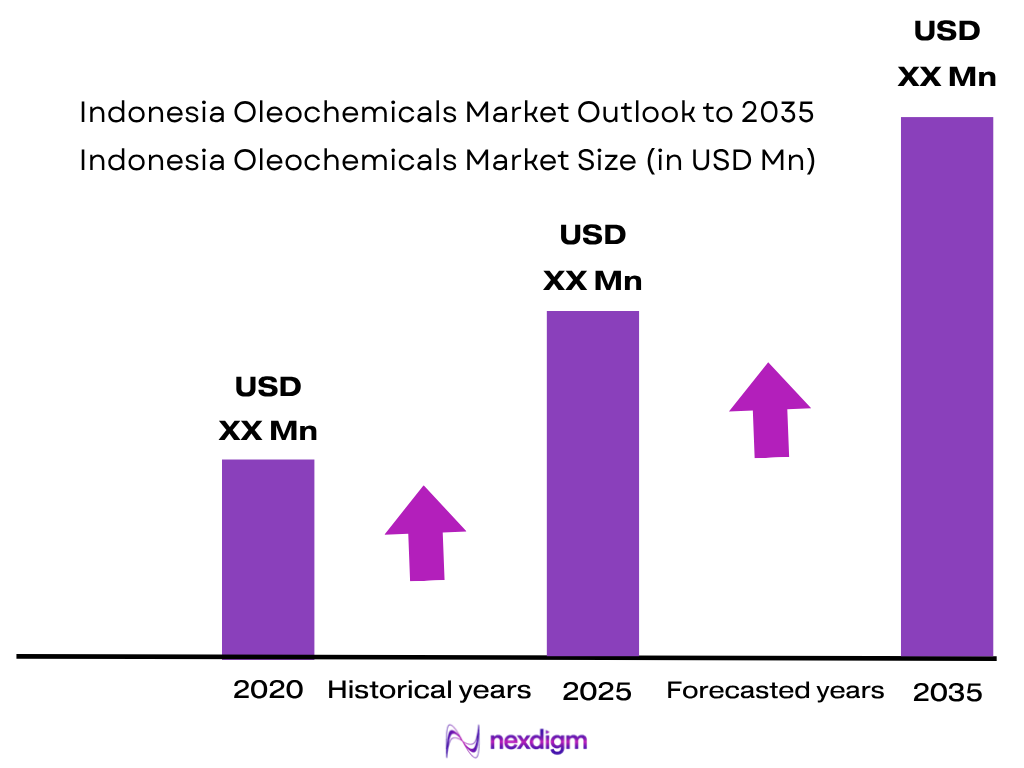
The Indonesia oleochemicals market generated USD 1,593.2 million in 2025, with a USD 1,728.4 million estimate for 2026 and a published 6.9% CAGR for 2026–2033. On the same source’s historical series, the implied 2024 value is approximately USD 1.49 billion. The market is supported by Indonesia’s exceptionally large palm-based feedstock ecosystem: BPS recorded 16.01 million hectares of oil-palm plantations and 45.44 million tonnes of palm-oil production in 2024. Palm-derived feedstock supports fatty acids, fatty alcohols, glycerine, methyl esters and specialty derivatives.
Indonesia’s oleochemical production is concentrated around Sumatra and Java, particularly North Sumatra, Riau, the Riau Islands, Banten and East Java, because these areas combine palm feedstock, refineries, ports and downstream chemical manufacturing. Riau is the country’s largest palm-producing province, with 3.37 million hectares of oil-palm plantations and 9.14 million tonnes of palm-oil production in 2024. Major industrial locations include Medan, Dumai, Batam, Kuala Tanjung, Gresik and Tangerang, supported by refinery, port and chemical infrastructure. APOLIN’s member base confirms substantial oleochemical activity across these production clusters.
Market Segmentation
By Product Type
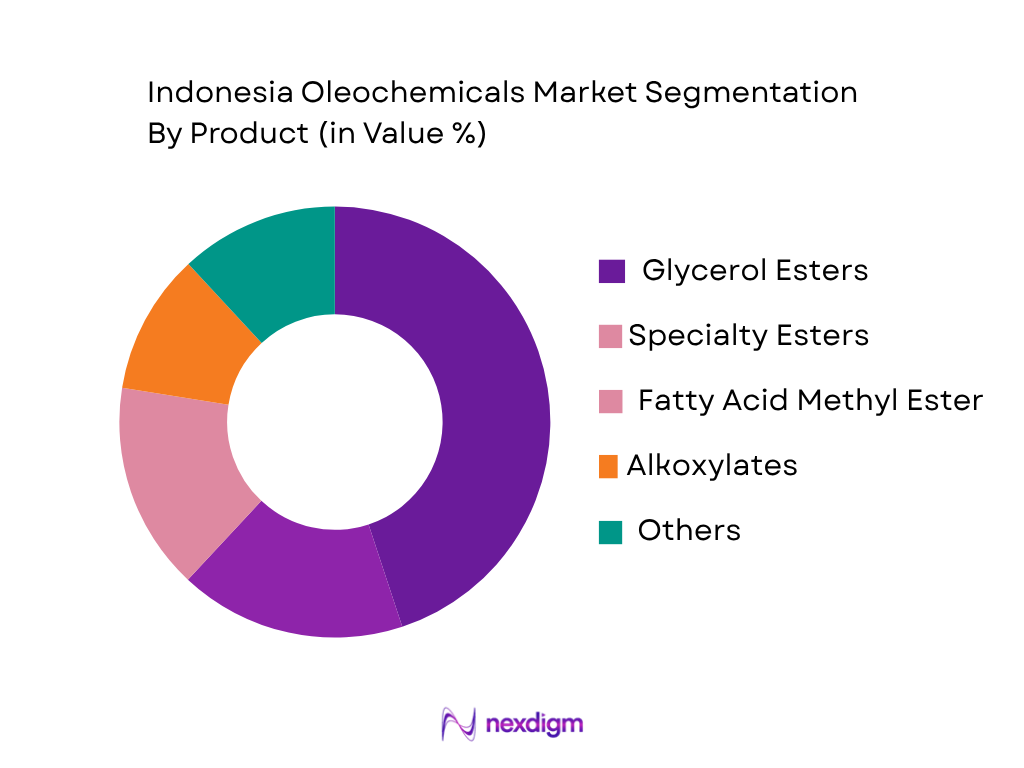
The Indonesia oleochemicals market is segmented by product type into glycerol esters, specialty esters, fatty acid methyl esters, alkoxylates, fatty amines and other oleochemical derivatives. Glycerol esters are the dominant product category, accounting for 41.08% of Indonesia’s oleochemicals revenue in 2025, according to the published country-level dataset. Their leadership reflects broad application across food processing, personal care, consumer products, pharmaceuticals and industrial formulations. Fatty acid methyl ester represents the fastest-growing product category, supported by its use in biodiesel, surfactants and renewable chemical intermediates. Indonesia’s product leadership is underpinned by its enormous palm feedstock base. BPS recorded 45.44 million tonnes of palm-oil production in 2024, while palm plantations covered 16.01 million hectares. Domestic manufacturers including Ecogreen Oleochemicals, Musim Mas, Soci Mas and other APOLIN members manufacture fatty alcohols, fatty acids and glycerine using palm, palm-kernel and other vegetable-oil feedstocks. The combination of domestic feedstock, integrated refining and export infrastructure gives glycerol esters and related derivatives a broad customer base across consumer and industrial applications.
By Application
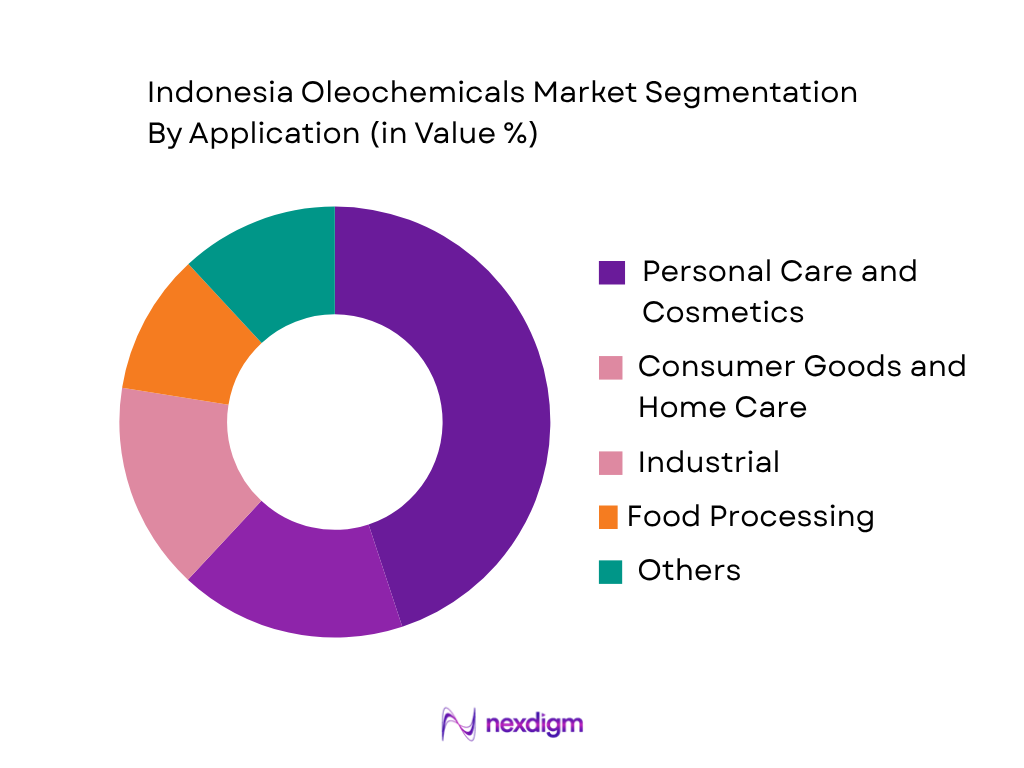
The Indonesia oleochemicals market is segmented by application into personal care and cosmetics, consumer goods and home care, food processing, healthcare and pharmaceuticals, industrial applications, polymer and plastic additives, textiles, paints and inks, and other applications. Personal care and cosmetics represent a leading downstream demand pool because Indonesian and international formulators use fatty alcohols, glycerine, esters, fatty acids and surfactant intermediates in skin care, hair care, cleansing and colour-cosmetic formulations. The importance of the category is reinforced by the expansion of Indonesia’s cosmetics manufacturing ecosystem and rising product registrations. Home-care products create another recurring demand base through detergents, household cleaners and fabric-care formulations. Industrial applications remain important for lubricants, plastics, coatings and specialty chemical formulations. Indonesia’s enormous consumer population, extensive manufacturing sector and position as a major palm-oil producer allow domestic oleochemical manufacturers to serve both captive Indonesian demand and export customers. The downstream ecosystem is therefore differentiated by the combination of mass-market consumer applications and export-oriented specialty chemical manufacturing, rather than dependence on a single end-use industry
Competitive Landscape
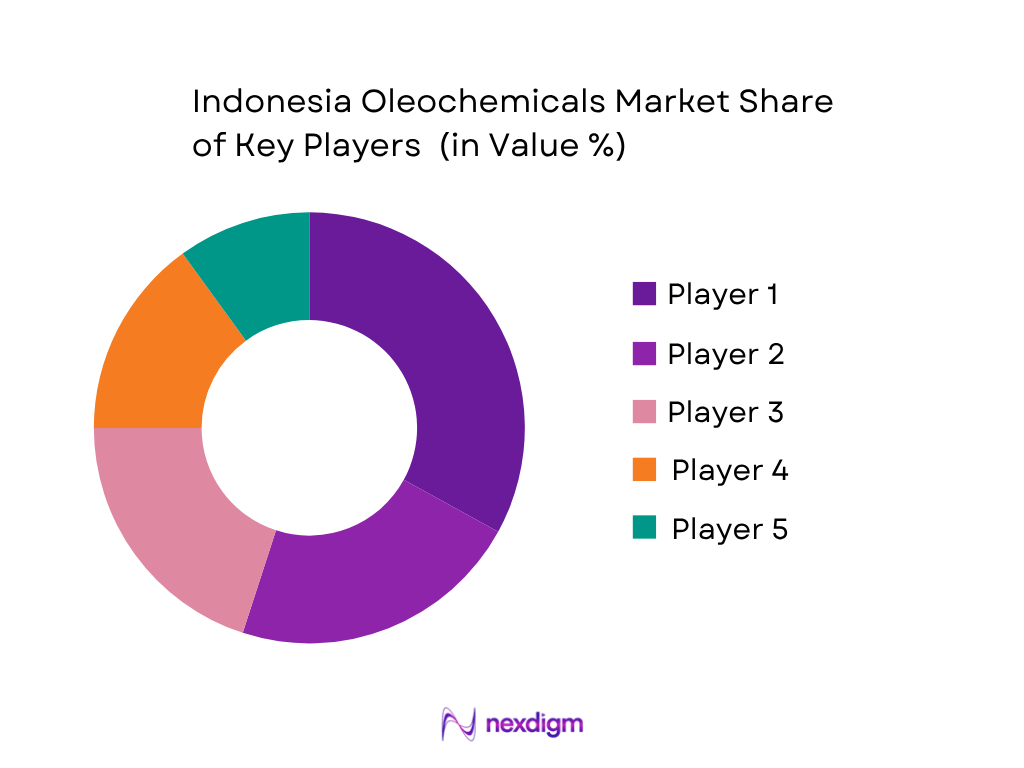
The Indonesia oleochemicals market is characterized by integrated palm-based groups, specialist oleochemical producers and multinational companies with downstream manufacturing capabilities. Competition is concentrated around feedstock integration, fatty-acid and fatty-alcohol capacity, glycerine purification, specialty derivative capabilities, sustainability certification, export infrastructure and customer qualification. APOLIN’s current membership includes 12 major Indonesian oleochemical producers, including Ecogreen Oleochemicals, Musim Mas, Permata Hijau Palm Oleo, Soci Mas, Sumi Asih, Unilever Oleochemical Indonesia and Wilmar Nabati Indonesia.
| Major Player | Establishment | Headquarters | Core Product Portfolio | Feedstock Integration | Specialty Capability | Sustainability Position | Main End Uses | Geographic Reach |
| Musim Mas | 1932 | Medan, Indonesia | ~ | ~ | ~ | ~ | ~ | ~ |
| Ecogreen Oleochemicals | 1990 / Indonesian operations 1991 | Batam, Indonesia | ~ | ~ | ~ | ~ | ~ | ~ |
| Wilmar International | 1991 | Singapore | ~ | ~ | ~ | ~ | ~ | ~ |
| Sumi Asih | 1970s | Jakarta, Indonesia | ~ | ~ | ~ | ~ | ~ | ~ |
| Unilever Oleochemical Indonesia | 2011* | Sei Mangkei, North Sumatra | ~ | ~ | ~ | ~ | ~ | ~ |
Indonesia Oleochemicals Market Analysis
Growth Drivers
Abundant Palm Oil Feedstock
Indonesia’s large palm-oil production base provides the primary structural advantage for its oleochemicals industry, supplying CPO and downstream lipid streams for fatty acids, fatty alcohols, glycerine, methyl esters and specialty derivatives. The Ministry of Agriculture reports 45.44 million tonnes of CPO production and 16.83 million hectares of oil-palm area in 2024, with more than 3 million households dependent on the palm sector. Riau alone produced 9.14 million tonnes of CPO, while Central Kalimantan and West Kalimantan produced 7.46 million tonnes and 4.96 million tonnes, respectively. World Bank data show Indonesia’s economy reached USD 1.396 trillion of GDP in 2024 and expanded by 5.0%, providing a supportive macroeconomic environment for processing industries. World Bank WITS data also record USD 20.05 billion of Indonesian exports of palm oil and its non-chemically modified fractions in 2024, demonstrating the scale of the underlying palm-value chain. For oleochemical producers, this resource base supports domestic feedstock procurement while reducing dependence on imported vegetable oils. It also creates opportunities to convert a greater proportion of Indonesia’s palm output into higher-value fatty acids, fatty alcohols, glycerine, esters and specialty ingredients rather than exporting predominantly upstream products.
Integrated Palm Processing and Export-Oriented Manufacturing
Indonesia’s integrated palm-processing ecosystem supports oleochemical manufacturing by connecting plantations, mills, refineries, kernel crushers, biodiesel plants and chemical-processing facilities. The Ministry of Agriculture recorded 45.44 million tonnes of CPO production in 2024, while the Ministry of Energy and Mineral Resources reported 13.15 million kilolitres of biodiesel utilization under the B35 program. This creates a large domestic downstream-processing ecosystem in which palm-derived feedstocks can be converted into energy products and chemical intermediates. World Bank data show Indonesia’s goods-and-services exports equivalent to 22.3% of GDP in 2024, while GDP reached USD 1.396 trillion, illustrating the importance of internationally oriented production. World Bank WITS records USD 17.33 billion of exports of refined palm oil and liquid fractions in 2024 and USD 1.54 billion of palm-kernel oil exports, reinforcing the country’s established export logistics and international buyer relationships. These conditions benefit oleochemical manufacturers because export infrastructure developed for palm products can also support fatty acids, fatty alcohols, glycerine and specialty derivatives. The combination of feedstock availability, domestic downstream demand, ports and established international trading channels creates a scalable platform for Indonesia to deepen its position in ASEAN and global oleochemical supply chains.
Market Challenges
Biodiesel Feedstock Competition
Competition for palm-derived feedstock from Indonesia’s biodiesel program is an important structural challenge for oleochemical manufacturers because both industries depend on palm-based raw materials and downstream derivatives. The Ministry of Energy and Mineral Resources reports that Indonesia distributed 13.15 million kilolitres of biodiesel in 2024, equivalent to approximately 98% of the 13.4 million kilolitre allocation under the B35 program. The ministry also reported USD 9.33 billion in foreign-exchange savings from biodiesel utilization, demonstrating the economic importance of domestic palm-based fuel consumption. The program therefore creates a policy-supported domestic demand channel that can compete with export-oriented oleochemical applications for available palm-derived feedstock. The issue is particularly relevant because Indonesia’s palm sector supports more than 3 million households, according to the Ministry of Agriculture, making palm downstreaming an important national economic priority. World Bank data show Indonesia’s GDP reached USD 1.396 trillion in 2024, while the country’s industry sector represented 39.3% of GDP, underscoring the importance of industrial feedstock allocation. The challenge for oleochemical producers is consequently not simply raw-material availability but allocation between biodiesel, food, exports and higher-value chemical applications. Manufacturers need stronger feedstock contracts, diversified lipid sourcing and greater specialization to protect production continuity when domestic energy-policy requirements absorb larger volumes of palm-derived inputs.
Sustainability, Traceability and International Compliance Requirements
Sustainability and traceability requirements create increasing operational complexity for Indonesian oleochemical producers serving international personal-care, pharmaceutical, detergent and industrial customers. Indonesia’s palm sector covered 16.83 million hectares in 2024 and supported more than 3 million households, according to the Ministry of Agriculture, making traceability across plantations, smallholders, mills and processors a large-scale supply-chain requirement. The same source reports 45.44 million tonnes of CPO production, meaning that sustainability controls must operate across a very large agricultural and industrial network. World Bank data show Indonesia exported USD 20.05 billion of palm oil and its non-chemically modified fractions in 2024, illustrating the country’s substantial exposure to international buyers and their procurement requirements. World Bank WITS also records USD 17.33 billion of exports of refined palm oil and liquid fractions, reinforcing the importance of international market access. The challenge extends beyond certification: producers increasingly need documented origin, segregation, chain-of-custody information, deforestation-risk controls and consistent sustainability documentation for downstream customers. Compliance can be particularly demanding for specialty oleochemicals because pharmaceutical, cosmetics and multinational consumer-goods buyers impose additional quality and supplier-qualification requirements. For Indonesian manufacturers, maintaining competitiveness therefore requires investment in digital traceability, certified sourcing, supplier auditing and documentation systems while simultaneously preserving access to large international markets.
Market Opportunities
Specialty Fatty Acids and High-Purity Oleochemicals
The expansion of specialty fatty acids and high-purity oleochemicals offers Indonesia an opportunity to capture greater downstream value from its exceptionally large renewable feedstock base. The Ministry of Agriculture records 45.44 million tonnes of CPO production and 16.83 million hectares of oil-palm area in 2024, while more than 3 million households depend on the sector. This provides a substantial foundation for manufacturing differentiated fatty acids, pharmaceutical-grade glycerine, cosmetic ingredients, specialty esters and high-purity intermediates. World Bank data show Indonesia generated USD 1.396 trillion of GDP in 2024 and recorded 5.0% economic growth, supporting an expanding domestic industrial customer base. World Bank WITS records USD 20.05 billion of palm-oil and fraction exports and USD 1.54 billion of palm-kernel-oil exports in 2024, demonstrating established international trade channels that can be leveraged for higher-value derivatives. Specialty processing can also reduce the industry’s dependence on commodity products by targeting customers that require controlled carbon-chain profiles, high purity, low colour, low odour and consistent technical specifications. Applications include cosmetics, pharmaceuticals, food ingredients, biolubricants, surfactants and industrial formulations. The opportunity is therefore to use Indonesia’s existing feedstock and export infrastructure to move further downstream, particularly where product qualification, technical performance and traceable renewable content create stronger barriers to entry than basic commodity oleochemicals.
Cosmetic Esters, Sustainable Surfactants and Downstream Specialty Manufacturing
Indonesia’s expanding consumer and manufacturing economy creates an opportunity for oleochemical producers to increase supply of cosmetic esters, sustainable surfactants and other specialty ingredients used by personal-care and home-care manufacturers. World Bank data show Indonesian GDP reached USD 1.396 trillion in 2024, with 5.0% annual economic growth, while industry represented 39.3% of GDP. These conditions provide a substantial domestic manufacturing platform for consumer products that use fatty alcohols, glycerine, esters and surfactant intermediates. Indonesia’s palm sector supplies 45.44 million tonnes of CPO, while World Bank WITS records USD 20.05 billion in exports of palm oil and its fractions in 2024, demonstrating the scale of feedstock and export infrastructure available for downstream conversion. The opportunity is particularly relevant to cosmetics because BPOM recorded 115,974 cosmetic notifications in 2024, compared with 86,335 in 2023, indicating a rapidly expanding registered-product ecosystem. Sustainable surfactants can similarly serve detergents and household-care manufacturers seeking renewable alternatives. For oleochemical producers, this creates a pathway from commodity fatty acids and alcohols toward higher-value emollients, ester blends, mild surfactants and application-specific ingredients. Domestic formulators can provide an initial customer base while ASEAN export markets offer additional routes for specialty products.
Future Outlook
The Indonesia oleochemicals market is expected to expand as manufacturers capitalize on the country’s extensive palm feedstock base and established downstream chemical infrastructure. Growth is expected to increasingly shift toward specialty fatty acids, high-purity glycerine, cosmetic esters, sustainable surfactants and renewable industrial chemicals. Biodiesel demand will remain an important factor in the allocation of palm-derived feedstocks, while personal care, home care and pharmaceutical applications provide opportunities for higher-value derivatives. Export diversification across Asia, Europe and North America should support Indonesian producers as they move beyond commodity oleochemical products.
The published Indonesia market assessment forecasts revenue of USD 2,759.6 million by 2033 from USD 1,728.4 million in 2026, representing a 6.9% CAGR. Extending the same rate through 2035 produces a calculated value of approximately USD 3.08 billion. (Grand View Research) The feedstock foundation remains substantial. Indonesia recorded 16.01 million hectares of oil-palm plantation area and 45.44 million tonnes of palm-oil production in 2024. Riau alone accounted for 3.37 million hectares and 9.14 million tonnes of production, supporting major refining and downstream processing clusters. The future competitive advantage will therefore depend not simply on additional palm-oil availability but on the ability to convert that feedstock into higher-purity and application-specific oleochemicals, establish traceable sustainable supply chains and expand direct relationships with multinational formulators.
Major Players
- Musim Mas
- Ecogreen Oleochemicals
- Wilmar Nabati Indonesia
- Permata Hijau Palm Oleo
- Sumi Asih
- Soci Mas
- Unilever Oleochemical Indonesia
- Energi Sejahtera Mas
- Sari Dumai Oleo
- Domas Agrointi Prima
- Cisadane Raya Chemicals
- Energi Oleo Persada
- Vance Bioenergy
- IOI Corporation
- KLK OLEO
Key Target Audience
- Oleochemical manufacturers and palm-based chemical producers
- Palm oil plantation companies, mills, refineries and kernel crushers
- Personal care, cosmetics, home-care and detergent manufacturers
- Pharmaceutical, food ingredient and specialty formulation manufacturers
- Lubricant, polymer, rubber, coating and industrial chemical manufacturers
- Investments and venture capitalist firms (Renewable Chemicals Funds, Bioeconomy Funds, Sustainable Materials Investors)
- Government and regulatory bodies (Ministry of Industry, Ministry of Trade, Ministry of Agriculture, Indonesian Sustainable Palm Oil Certification Agency)
- Chemical distributors, exporters, specialty ingredient suppliers and industrial procurement organizations
Research Methodology
Step 1: Identification of Key Variables
The initial phase involves constructing an Indonesia-specific oleochemical ecosystem covering plantations, smallholders, mills, refineries, kernel crushers, biodiesel producers, oleochemical plants, distributors and downstream formulators. BPS data are used to establish the feedstock baseline, including 16.01 million hectares of oil-palm area and 45.44 million tonnes of palm-oil production in 2024.
Step 2: Market Analysis and Construction
The market model combines published market revenue with domestic production, trade, company operations and downstream application indicators. The analysis separates glycerol esters, specialty esters, methyl esters, alkoxylates, fatty amines and other derivatives while mapping production against domestic consumption and exports. The 2025 market baseline is USD 1,593.2 million, with the 2026 estimate at USD 1,728.4 million.
Step 3: Hypothesis Validation and Expert Consultation
Market hypotheses are validated through interviews with oleochemical producers, palm processors, specialty chemical distributors, cosmetic formulators, detergent manufacturers, pharmaceutical companies and industrial buyers. Discussions focus on feedstock procurement, product specifications, capacity utilization, customer qualification, sustainability certification, export demand and the transition from commodity products toward specialty derivatives.
Step 4: Research Synthesis and Final Output
The final phase triangulates company information, official plantation and trade statistics, industry association information and market-level revenue data. Supply-side findings are reconciled with demand from personal care, home care, pharmaceuticals, food, lubricants, plastics and industrial applications. Competitive benchmarking then evaluates product breadth, feedstock integration, specialty capabilities, sustainability credentials and international distribution.

- Executive Summary
- Research Methodology (Market Definition and Scope, Oleochemical Product Taxonomy, Indonesia Market Boundary, Top-Down Market Sizing, Bottom-Up Company Assessment, Feedstock-to-Product Mapping, Production Capacity Assessment, Domestic Consumption Reconstruction, Export-Import Reconciliation, End-Use Demand Assessment, Primary Industry Interviews, Company-Level Validation, Data Triangulation, Forecasting Framework, Scenario Analysis, Research Limitations)

- Definition and Scope
- Evolution of Indonesia’s Oleochemical Industry
- Development Milestones of the Indonesian Oleochemical Industry
- Indonesia Oleochemical Industry Ecosystem
- Oleochemical Value Chain

- Growth Drivers (Abundant Palm Oil Feedstock, Palm Kernel Availability, Integrated Palm Processing, Export-Oriented Oleochemical Manufacturing, Downstream Biodiesel Development, Growing Personal Care Manufacturing, Home Care and Detergent Demand, ASEAN Chemical Trade Integration)
- Market Challenges (Palm Oil Feedstock Volatility, Plantation Productivity Risk, Sustainability and Traceability Requirements, Competition with Malaysia, Biodiesel Feedstock Competition, Energy and Utilities Intensity, Commodity Product Margin Pressure, European Market Compliance)
- Market Opportunities (Specialty Fatty Acids, Pharmaceutical-Grade Glycerine, Cosmetic Esters, Bio-Based Lubricants, Sustainable Surfactants, Palm Waste Valorization, Used Cooking Oil Processing, High-Purity Oleochemicals, Downstream Specialty Manufacturing, ASEAN Export Expansion)
- Market Trends (Palm-Based Value Addition, Downstream Integration, Specialty Oleochemical Premiumization, Renewable Feedstock Adoption, Circular Oleochemistry, Sustainable Palm Certification, Bio-Based Surfactants, Pharmaceutical-Grade Derivatives, Cosmetic Ingredient Localization, Export Diversification)
- Government Policies and Regulatory Framework (Indonesian Palm Oil Plantation Regulations, Ministry of Agriculture Requirements, Ministry of Industry Policies, Indonesian Sustainable Palm Oil Standards, Biodiesel Mandate, Environmental Protection Requirements, Chemical Management Regulations, Export Policies, Downstream Palm Oil Policies)
- SWOT Analysis
- Porter’s Five Forces Analysis
- PESTLE Analysis

- By Market Value (2020-2025)
- By Production Volume (2020-2025)
- By Domestic Consumption Volume (2020-2025)
- By Export Volume (2020-2025)
- By Import Volume (2020-2025)
- By Export Revenue (2020-2025)
- By Production Capacity (2020-2025)
- By Capacity Utilization (2020-2025)

- By Product Type
Fatty Acids
Lauric Acid
Myristic Acid
Palmitic Acid
Stearic Acid
Oleic Acid
Other Specialty Fatty Acids
Fatty Alcohols - By Feedstock Type
Crude Palm Oil
Palm Kernel Oil
Palm Fatty Acid Distillate
Palm Kernel Fatty Acid
Coconut Oil
Soybean Oil
Rapeseed Oil
Animal Fats - By Application
Personal Care and Cosmetics
Skin Care
Hair Care
Bath and Body Care
Colour Cosmetics
Fragrances
Emollients - By Grade
Industrial Grade
Technical Grade
Cosmetic Grade
Food Grade
Pharmaceutical Grade
High-Purity Specialty Grade
Sustainable and Certified Grade - By Production Process
Fat Splitting and Hydrolysis
Fatty Acid Distillation
Fractionation
Hydrogenation
Esterification
Transesterification
Glycerine Refining - By Distribution Channel
Direct Industrial Sales
Specialty Chemical Distributors
Chemical Trading Companies
Regional Distributors
Contract Manufacturing
Toll Processing
Export-Oriented Sales

- Market Share of Major Players (By Revenue, Production Volume, Production Capacity, Product Type, Application, Feedstock, Domestic Sales, Export Sales)
- Cross Comparison Parameters (Production Capacity, Palm Feedstock Integration, Fatty Acid Portfolio Breadth, Fatty Alcohol Manufacturing Capability, Glycerine Refining Capability, Specialty Derivative Portfolio, Sustainable Certification Coverage, Export Market Reach)
- Competitive Positioning Matrix (Manufacturing Scale, Feedstock Integration, Product Specialization, Specialty Chemistry Capability, Sustainability Positioning, Geographic Reach)
Pricing and Realization Analysis (By Product Type, Grade, Application, Contract Type, Domestic Market, Export Market) - SWOT Analysis of Major Players
- Detailed Profiles of Major Companies
Musim Mas
Wilmar Nabati Indonesia
Ecogreen Oleochemicals
Sinar Mas Agro Resources and Technology / SMART
Unilever Oleochemical Indonesia
Permata Hijau Palm Oleo
Energi Sejahtera Mas
Sari Dumai Oleo
Soci Mas
Sumi Asih
Cisadane Raya Chemicals
Domas Agrointi Prima
Vance Bioenergy
IOI Corporation / IOI Oleochemical Industries
KLK OLEO

- Consumer and End-User Demand Structure
- Personal Care and Cosmetics Consumption Behavior
- Home Care and Detergent Consumption Behavior
- Pharmaceutical Consumption and Formulation Demand
- Food and Beverage Consumption Influence

- By Market Value (2026-2035)
- By Production Volume (2026-2035)
- By Domestic Consumption Volume (2026-2035)
- By Export Volume (2026-2035)
- By Import Volume (2026-2035)
- By Export Revenue (2026-2035)
- By Production Capacity (2026-2035)
- By Capacity Utilization (2026-2035)


 Request a Sample
 Ask for Customization
 Get a Quote
 Enquire Now