

 Download PDF
Market Overview
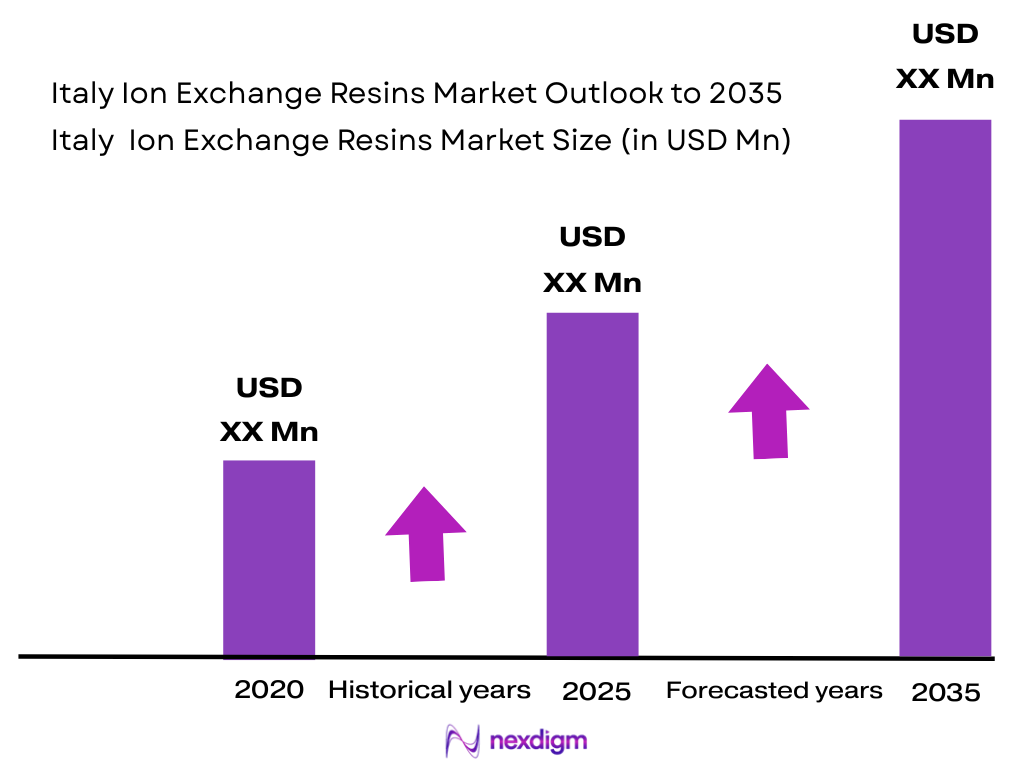
The Italy Ion Exchange Resins Market is valued at approximately USD 39.9 million in the latest reported period, compared with a preceding-period placeholder benchmark of USD ~XX million. Grand View Research identifies cationic resins as the leading product category, while demand is supported by industrial water demineralization, boiler-water treatment, pharmaceutical purification, food processing, and wastewater recycling. Italy’s large installed industrial base creates recurring replacement demand as exhausted resin beds require regeneration, replenishment, or complete rebedding.
Lombardy, Emilia-Romagna, Veneto, Piedmont and Lazio represent the most important Italian demand clusters. Their dominance reflects concentration of pharmaceuticals, chemicals, food processing, utilities and advanced manufacturing. Italian pharmaceutical production expanded from EUR 52 billion to more than EUR 56 billion across the two latest reported annual periods, strengthening high-purity-water requirements. Lombardy is particularly important because Binasco near Milan hosts Resindion’s ion exchange resin manufacturing operation, while northern Italy contains dense industrial water-treatment infrastructure.
Market Segmentation
By Resin Type
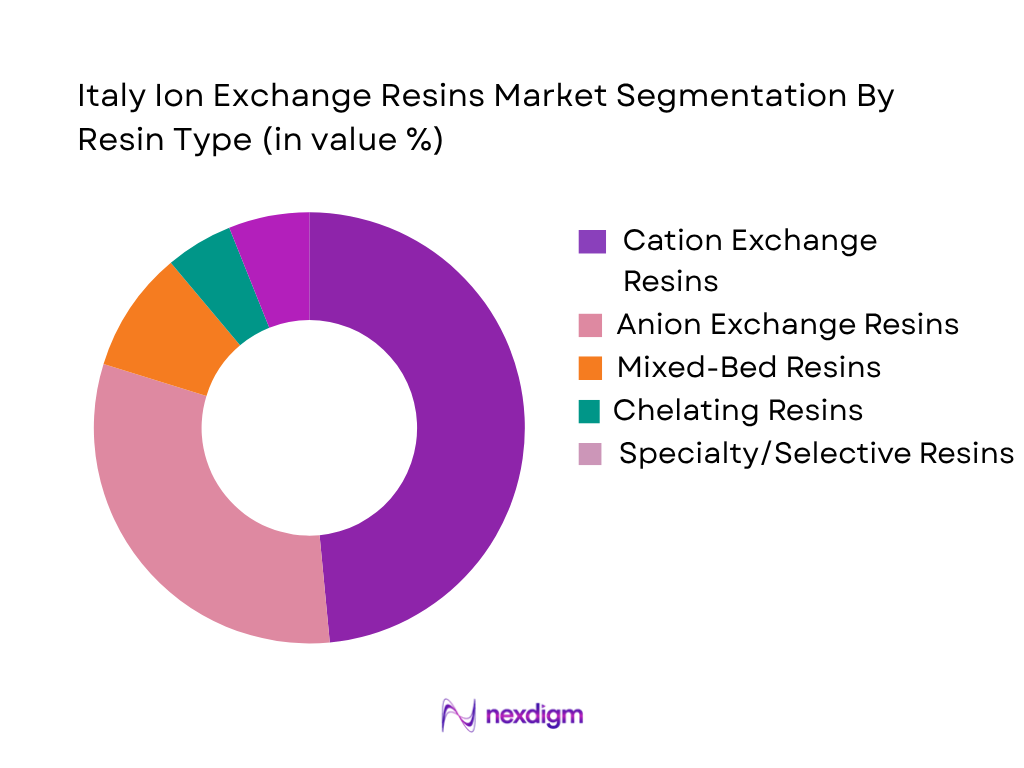
The Italy Ion Exchange Resins Market is segmented by resin type into cation exchange resins, anion exchange resins, mixed-bed resins, chelating resins, and specialty/selective resins. Cation exchange resins currently represent the dominant category because they are extensively employed for water softening, demineralization, hardness removal, boiler-feed preparation and industrial process-water treatment. Strong-acid cation resins have a particularly broad installed base because their sulfonic functional groups enable removal of calcium, magnesium and other positively charged ions across wide operating conditions. Replacement requirements from existing industrial treatment systems reinforce recurring consumption. Grand View Research identifies cationic resin as Italy’s leading product category, reporting a 48.37% revenue share within its country analysis. Specialty and chelating resins are smaller in volume but increasingly important in high-value pharmaceutical purification, metal recovery and selective contaminant-removal applications.
By Application
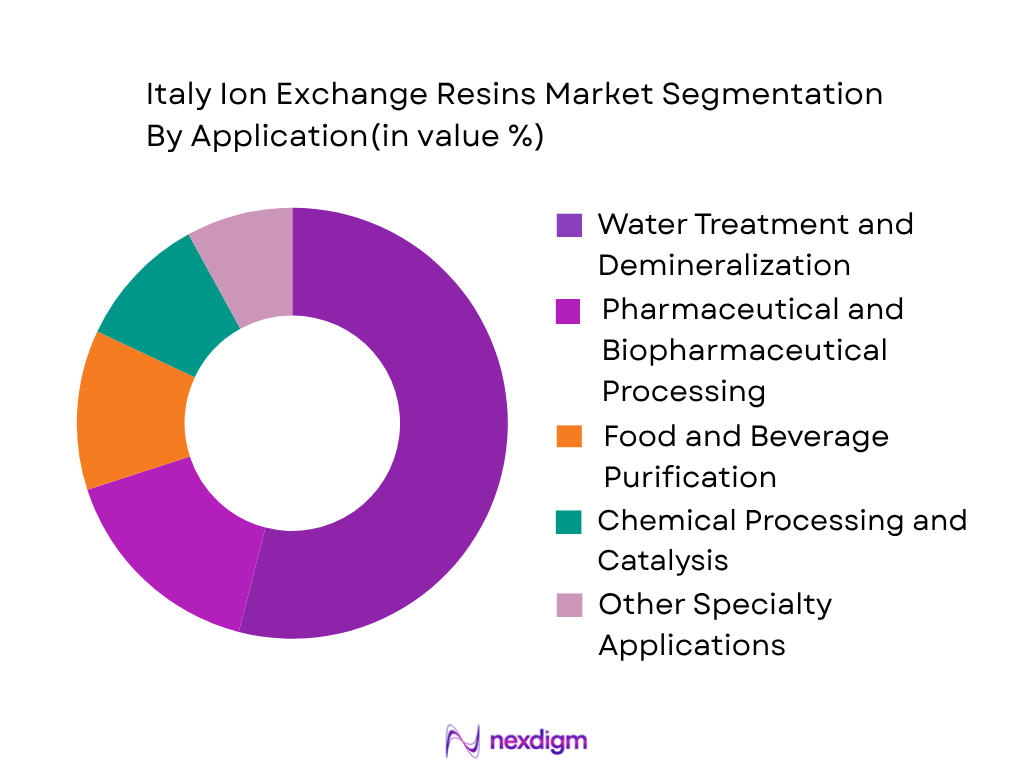
The Italy Ion Exchange Resins Market is segmented by application into water treatment and demineralization, pharmaceutical and biopharmaceutical processing, food and beverage purification, chemical processing, and other specialty applications. Water treatment and demineralization constitute the dominant application because ion exchange technology remains extensively installed in industrial softening, boiler-feedwater preparation, condensate polishing, deionization and process-water systems. Italy’s chemical, pharmaceutical, food-processing, metal-finishing and manufacturing sectors create a broad recurring requirement for controlled water chemistry. Industrial users also combine ion exchange with reverse osmosis and electrodeionization where very low conductivity or high-purity water is required. Water and wastewater treatment is identified as Italy’s largest-volume ion exchange resin application, while pharmaceutical and food processing provide attractive premium-grade opportunities due to more demanding purity and regulatory requirements.
Competitive Landscape
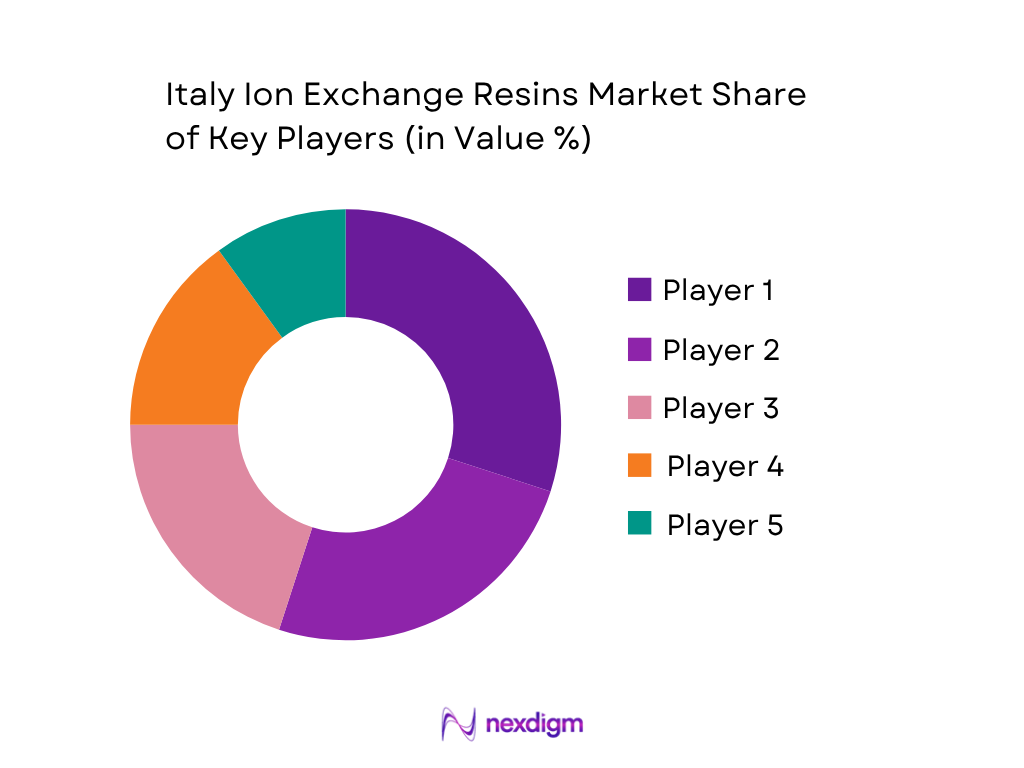
The Italy Ion Exchange Resins Market combines a strong locally embedded producer with major multinational resin suppliers serving the country through European manufacturing locations, direct sales teams, distributors and water-treatment system integrators. Competition is driven less by basic resin availability and increasingly by exchange capacity, bead uniformity, fouling resistance, purity, technical qualification, regeneration economics and application support. Resindion/Mitsubishi Chemical, LANXESS, DuPont, Ecolab/Purolite and Samyang form an important competitive group spanning commodity and specialty applications. Resindion provides a distinctive domestic manufacturing presence through its Binasco facility, where ion exchange resin production began in Italy in 1959.
| Company | Establishment Year | Headquarters | Major Resin Brand | Core Resin Portfolio | Key Applications | Polymer/Technology Capability | Italy Market Presence | Specialty Capability |
| Resindion S.r.l. / Mitsubishi Chemical Group | 1959 | Binasco, Italy | ~ | ~ | ~ | ~ | ~ | ~ |
| LANXESS AG | 2004 | Cologne, Germany | ~ | ~ | ~ | ~ | ~ | ~ |
| DuPont de Nemours, Inc. | 1802* | Wilmington, United States | ~ | ~ | ~ | ~ | ~ | ~ |
| Ecolab Inc. / Purolite | 1923 | St. Paul, United States | ~ | ~ | ~ | ~ | ~ | ~ |
| Samyang Corporation | 1924 | Seoul, South Korea | ~ | ~ | ~ | ~ |
Italy Ion Exchange Resins Market Analysis
Growth Drivers
Expansion of Pharmaceutical and High-Purity Process Water Applications
Italy’s pharmaceutical manufacturing base is creating sustained demand for ion exchange resins used in demineralization, polishing, purified-water systems, ingredient purification and high-purity process streams. Farmindustria reports that Italian pharmaceutical production reached EUR 56 billion in 2024, with EUR 54 billion of output exported and EUR 4 billion invested in research, development and production facilities. The industry directly employed 71,000 people, while employment across the broader pharmaceutical supply chain reached approximately 300,000 workers. These production facilities require tightly controlled water chemistry for manufacturing, cleaning, formulation, utilities and laboratory operations, supporting demand for strong-acid cation, strong-base anion, mixed-bed and low-leachable specialty resins. ISTAT additionally reported that pharmaceutical exports represented EUR-linked shipments accounting for 8.7 units out of every 100 units of national export flows in 2024, demonstrating the scale of manufacturing activity requiring sophisticated water infrastructure. The wider macroeconomic environment supports this industrial base: World Bank data place Italy’s 2024 GDP at USD 2.381 trillion, making it the world’s eighth-largest economy. This combination of large pharmaceutical output, substantial capital investment and an extensive manufacturing ecosystem directly supports recurring resin replacement and high-purity treatment requirements. Sources: World Bank, Farmindustria, ISTAT.
Large Industrial Water Treatment and Water Infrastructure Requirement
Italy’s substantial water abstraction, treatment infrastructure and industrial production base underpin recurring consumption of ion exchange resins for softening, demineralization, process-water preparation, wastewater polishing and water reuse. ISTAT reports that 8.87 billion cubic metres of water were abstracted for potable use in Italy during 2024, equivalent to approximately 150 cubic metres per resident, placing the country among Europe’s highest freshwater users. Water-system modernization is also accelerating: ARERA reports that Italy’s National Plan of Infrastructure and Water Sector Safety Measures contained more than 418 eligible projects with a combined value exceeding EUR 12 billion, while integrated water-service infrastructure supported through major public programmes exceeded EUR 4 billion across the current investment cycle. Industrial demand is reinforced by Italy’s extensive chemical manufacturing base. Federchimica records approximately 2,800 chemical companies, 3,700 operating sites and more than 113,000 employees, with chemical production valued at EUR 65 billion in 2024. These facilities depend on treated boiler feedwater, cooling-water conditioning and purified process water. World Bank data record Italian GDP at USD 2.381 trillion in 2024, highlighting the scale of the industrial economy generating these water-treatment requirements. Sources: World Bank, ISTAT, ARERA, Federchimica.
Market Challenges
Energy-Intensive Regeneration and Pressure on Italy’s Chemical Manufacturing Base
Ion exchange treatment remains dependent on pumping, water circulation, pretreatment and regeneration processes, while resin regeneration commonly requires chemically intensive operating procedures involving acids, alkalis or salt solutions. These requirements are challenging in Italy’s energy-sensitive industrial environment. Terna recorded national electricity demand of 312,285 GWh in 2024, with domestic net electricity production totaling approximately 263,500 GWh. Italy consequently remained dependent on imported electricity to balance demand, while ISTAT recorded a national energy trade deficit of EUR 49.555 billion in 2024. These conditions matter for resin-intensive chemical, pharmaceutical, food and industrial-water facilities because treatment systems operate continuously and must periodically regenerate or replace exhausted beds. The pressure is visible within the chemical sector that supplies and consumes many water-treatment materials: Federchimica reports EUR 65 billion of chemical production from more than 2,800 companies and 3,700 production sites, with more than 113,000 employees. Maintaining competitive manufacturing operations while meeting high-purity water specifications therefore requires customers to optimize resin loading, regeneration frequency, pretreatment and lifecycle management. World Bank data place Italy’s 2024 GDP at USD 2.381 trillion, illustrating that these cost pressures affect ion exchange resin demand within one of Europe’s largest industrial economies. Sources: World Bank, Terna, ISTAT, Federchimica.
Competition from Membrane Technologies and Increasing Technical Performance Requirements
Italy’s ion exchange resin suppliers face increasing technical pressure as industrial customers combine reverse osmosis, electrodeionization, ultrafiltration and ion exchange rather than relying on conventional resin beds alone. Ion exchange therefore needs to demonstrate advantages in selective removal, final polishing, contaminant capture and process-specific purification. The scale of Italy’s electricity and industrial infrastructure makes treatment efficiency particularly important: Terna recorded 312,285 GWh of electricity demand and 263,500 GWh of domestic net production in 2024, supporting numerous power, manufacturing and utility facilities that require treated process and boiler water. Pharmaceutical manufacturing imposes even tighter specifications. Farmindustria reports EUR 56 billion of pharmaceutical production, EUR 54 billion of exports and EUR 4 billion of investment in research, production and facility development in 2024. Such plants increasingly require low-organic-leachable resins, carefully controlled particle sizes and high-purity mixed-bed products that can integrate with advanced membrane systems. Meanwhile, AIFA maintains national authorization frameworks for medicine-production and active-pharmaceutical-ingredient manufacturing sites, reinforcing demanding process controls. Italy’s wider industrial capacity is supported by a USD 2.381 trillion GDP in 2024, according to the World Bank. Suppliers therefore face a market where basic commodity resin performance alone is insufficient for many high-value applications. Sources: World Bank, Terna, Farmindustria, AIFA.
Market Opportunities
PFAS Removal and Advanced Drinking Water Purification
Italy’s ion exchange resin market has a clear opportunity in selective contaminant removal as European drinking-water controls increasingly address per- and polyfluoroalkyl substances. The European Commission’s technical guidelines establish 0.50 micrograms per litre for the PFAS Total parameter and 0.10 micrograms per litre for the Sum of PFAS parameter covering 20 designated PFAS substances, with compliance requirements taking effect in January 2026. These standards increase the relevance of selective strong-base anion resins capable of capturing difficult ionic contaminants in drinking-water and groundwater treatment systems. The addressable treatment infrastructure is substantial: ISTAT reports that Italy abstracted 8.87 billion cubic metres of water for potable purposes in 2024, or approximately 150 cubic metres per resident. More than 1 million residents in provincial capitals and metropolitan cities were also affected by water-rationing measures, demonstrating the strategic importance of both water availability and quality. ARERA reports more than 418 eligible projects in Italy’s national water-infrastructure plan, collectively exceeding EUR 12 billion. Against a World Bank-recorded economy of USD 2.381 trillion in 2024, stricter contaminant control creates room for high-selectivity resins, polishing systems and replacement media across municipal and industrial treatment facilities. Sources: World Bank, European Commission, ISTAT, ARERA.
Industrial Water Reuse, Wastewater Polishing and Hybrid Treatment Systems
Industrial water reuse represents an important expansion route for ion exchange resins as Italy invests in reducing freshwater losses, upgrading wastewater treatment and increasing resilience of its water infrastructure. ARERA reports that more than EUR 1.024 billion of additional resources were allocated in 2024 under measures aimed at water-network loss reduction and digitalization, while infrastructure investment associated with major Integrated Water Service programmes exceeded EUR 4 billion across the current investment cycle. The National Plan of Infrastructure and Water Sector Safety Measures includes more than 418 eligible projects valued above EUR 12 billion, providing a broad infrastructure base from which advanced purification technologies can expand. Ion exchange resins are particularly relevant after biological treatment or membrane filtration when reclaimed water requires removal of residual hardness, nitrate, metals, silica or other dissolved ions before industrial reuse. Potential industrial customers are extensive: Federchimica reports more than 2,800 chemical companies, 3,700 operating sites and over 113,000 employees, while Italian chemical production reached EUR 65 billion in 2024. World Bank data show national GDP of USD 2.381 trillion in 2024. These current indicators support future adoption of resin-based polishing within reverse-osmosis, wastewater-recovery and closed-loop industrial water systems. Sources: World Bank, ARERA, Federchimica.
Future Outlook
The Italy Ion Exchange Resins Market is expected to expand steadily over the long term, supported by tightening water-quality requirements, industrial water reuse, pharmaceutical manufacturing, food-processing demand and replacement of installed resin beds. The market is forecast to register a CAGR of approximately ~X.X% during the forecast period. For reference, Grand View Research currently projects Italy’s market to expand at 4.7% CAGR over its published forecast window, indicating a structurally positive medium-term demand environment. Future growth is expected to shift progressively from basic commodity softening resins toward higher-value products with improved selectivity, longer service life and lower extractables. Pharmaceutical and biotechnology manufacturers increasingly require validated high-purity process-water systems, while food processors need resins suitable for decolorization, purification and ingredient processing. Italy’s pharmaceutical industry is particularly important: reported production has surpassed EUR 56 billion, providing a substantial downstream manufacturing base for high-purity water and separation technologies.
Industrial water recycling will provide another structural opportunity. Ion exchange is increasingly positioned downstream or upstream of membrane systems rather than functioning solely as a standalone technology. RO–ion exchange–EDI combinations enable manufacturers to achieve demanding conductivity, silica and ionic-contamination specifications while optimizing regeneration frequency. Ion exchange also remains relevant for targeted removal applications where membranes alone may not provide sufficient selectivity.
Major Players
- Resindion S.r.l. – Mitsubishi Chemical Group
- LANXESS AG – Lewatit™
- DuPont de Nemours, Inc. – AmberLite™
- Ecolab Inc. / Purolite – Purolite™
- Samyang Corporation – TRILITE™
- Thermax Limited – Tulsion™
- Ion Exchange (India) Limited – INDION™
- Sunresin New Materials Co., Ltd.
- ResinTech, Inc.
- Jacobi Carbons Group / Jacobi Resins
- Graver Technologies LLC
- Tosoh Corporation
- Jiangsu Suqing Water Treatment Engineering Group
- Zhengguang Industrial Co., Ltd.
- Aldex Chemical Company Limited
Key Target Audience
- Ion Exchange Resin Manufacturers and Specialty Resin Producers
- Industrial Water Treatment Equipment Manufacturers and EPC Companies
- Pharmaceutical, Biopharmaceutical, Chemical and Food Processing Companies
- Water Treatment Chemical Distributors and Ion Exchange Resin Importers
Municipal and Industrial Water Utilities - Power Generation, Electronics, Metal Processing and Advanced Manufacturing Companies
- Investments and Venture Capitalist Firms
- Government and Regulatory Bodies (Ministry of Environment and Energy Security – MASE, Istituto Superiore di Sanità – ISS, Italian Institute for Environmental Protection and Research – ISPRA, ARERA and Regional Environmental Protection Agencies – ARPA)
Research Methodology
Step 1: Identification of Key Variables
The initial phase involves developing an ecosystem map covering ion exchange resin manufacturers, importers, distributors, EPC contractors, regeneration-service providers and major industrial end users in Italy. Extensive desk research is conducted using company publications, industry associations, trade databases and regulatory information to identify variables including resin type, installed bed volume, replacement cycle, application mix, pricing and import dependence.
Step 2: Market Analysis and Construction
Historical market information is compiled through both top-down and bottom-up approaches. The top-down assessment reviews European resin demand, Italian industrial activity and key end-user sectors, while the bottom-up model evaluates resin consumption by industrial plants, installed treatment systems, average resin loading, replacement frequency and supplier sales. Import data and domestic manufacturing activity are then reconciled to establish the market structure.
Step 3: Hypothesis Validation and Expert Consultation
Initial market hypotheses are validated through structured interviews with resin producers, distributors, industrial-water EPC companies, technical service providers and procurement professionals. Computer-assisted telephone interviews and direct discussions are used to assess actual resin purchasing patterns, typical replacement intervals, price positioning, qualification requirements, regeneration practices and competitive dynamics. Contradictory responses are cross-checked against secondary information before incorporation into the model.
Step 4: Research Synthesis and Final Output
The final stage triangulates demand-side, supply-side and trade-based calculations. Manufacturer and distributor insights are matched against end-user consumption, water-treatment applications and country-level industrial indicators. The resulting dataset is reviewed for consistency across resin types and applications before forecast scenarios are constructed using industrial production, pharmaceutical manufacturing, water reuse, regulatory developments, replacement demand and specialty-resin adoption as key forecasting variables.

- Executive Summary
- Research Methodology (Market Definition and Scope, Ion Exchange Resin Classification, Market Boundary Assessment, Abbreviations, Market Sizing Methodology, Top-Down Market Estimation, Bottom-Up Market Validation, Demand-Side Assessment, Supply-Side Assessment, Domestic Production Assessment, Import-Based Market Reconstruction, Distributor Sales Assessment, Installed Resin Bed Assessment, Resin Replacement Cycle Analysis, End-User Consumption Assessment)

- Definition and Scope
- Evolution of Italy Ion Exchange Resins Industry
- Ion Exchange Resin Industry Genesis and Market Development
- Italy Ion Exchange Resins Industry Ecosystem Analysis
- Italy Ion Exchange Resins Value Chain Analysis
- Resin Regeneration and Replacement Ecosystem
- High-Purity and Ultrapure Water Treatment Ecosystem

- Market Growth Drivers (Expansion of Pharmaceutical and Biopharmaceutical Manufacturing, Growing Industrial Water Treatment Investment, Increasing High-Purity Process Water Requirements, Strong Food and Beverage Processing Base, Rising Demand for Demineralized Water, Expansion of Chemical and Specialty Chemical Production, Increasing Industrial Water Reuse, Tightening Drinking Water Quality Requirements, Increasing PFAS Treatment Requirements, Industrial Wastewater Treatment and Recycling, Replacement Demand from Existing Ion Exchange Installations)
- Market Challenges (Volatility in Styrene-Divinylbenzene and Acrylic Feedstock Prices, Energy Cost Pressure, Resin Price Volatility, Competition from Reverse Osmosis and Electrodeionization, Resin Fouling from Organic and Metal Contaminants, Regeneration Chemical Cost, Disposal of Spent Regenerants and Resins, Technical Skill Requirements, Imported Specialty Resin Dependence, Long Qualification Cycles for Pharmaceutical, Food and High-Purity Water Applications)
- Market Opportunities (Ultrapure Water Resins for Pharmaceutical and Electronics Applications, Pharmaceutical Grade Mixed Bed Resins, PFAS-Selective Anion Exchange Resins, Industrial Wastewater Recycling, Heavy Metal and Selective Chelating Resins, High-Purity Pharmaceutical Resins, Food and Beverage Purification Resins, Condensate Polishing Resins, Resin Replacement Services, Regeneration Optimization Solutions, High-Capacity Uniform Particle Size Resins, Specialty Separation Resin Applications, Green Hydrogen Water Purification Applications)
- Ion Exchange Performance Benchmarking
- Regeneration Economics Analysis
- SWOT Analysis of Major Players
- Porter’s Five Forces Analysis
- PESTLE Analysis

- By Market Value (2020-2025)
- By Consumption Volume (2020-2025)
- By Average Selling Price (2020-2025)
- By Domestic Production Value (2020-2025)
- By Import Value (2020-2025)
- By Import Volume (2020-2025)
- By Installed Resin Bed Volume (2020-2025)
- By Fresh Resin Consumption versus Replacement Resin Demand (2020-2025)

- By Resin Type
Strong Acid Cation Resins
Weak Acid Cation Resins
Strong Base Anion Resins – Type I
Strong Base Anion Resins – Type II
Weak Base Anion Resins
Mixed Bed Resins
Chelating Resins
Selective Ion Exchange Resins
Adsorbent and Specialty Separation Resins
Ultrapure Water Grade Resins
Food and Pharmaceutical Grade Resins
Condensate Polishing Resins - By Polymer Matrix
Styrene-Divinylbenzene Resins
Acrylic Resins
Polystyrenic Resins
Macroporous Resins
Gel-Type Resins
Specialty Polymeric Matrices - By Application
Water Softening
Demineralization and Deionization
Condensate Polishing
Ultrapure Water Production
Boiler Feedwater Treatment
Process Water Purification
Drinking and Municipal Water Treatment
Wastewater Treatment and Water Reuse
PFAS Removal
Nitrate Removal
Heavy Metal Removal
Boron and Selective Contaminant Removal
Food and Beverage Purification
Pharmaceutical Purification and Separation
Biopharmaceutical Process Water Treatment
Chemical Processing and Catalysis
Metal Recovery and Hydrometallurgy - By Supply Source
Italy
Germany
China
South Korea
Japan
India
United States
Other European Markets
Other Asia-Pacific Markets
Domestic and Locally Repacked Supply - By Geography
Lombardy
Piedmont
Veneto
Emilia-Romagna
Tuscany
Lazio
Campania
Puglia
Sicily
Other Industrial and Manufacturing Clusters

- Market Share Analysis of Major Players
- Cross Comparison Parameters (Product Portfolio Breadth, Ion Exchange Capacity and Resin Performance Range, Ultrapure Water and Pharmaceutical Grade Capability, Italy Manufacturing–Distributor and Inventory Coverage, Industrial–Chemical–Food and Pharmaceutical Application Coverage, Resin Qualification and Technical Support Capability, Price Positioning and Total Cost of Ownership, Regeneration Efficiency and Expected Resin Service Life)
- Competitive Benchmarking Analysis (Product Innovation Capability, Pricing Strategy, Italy Market Presence, Supply Chain Efficiency, Customer Base Strength, Product Grade Coverage, Application-Specific Resin Capability, Distribution and Technical Service Strength)
- SWOT Analysis of Major Players
- Pricing Analysis (Cation Resin Pricing, Anion Resin Pricing, Mixed-Bed Resin Pricing, Chelating Resin Pricing, Ultrapure Water Grade Premium, Country-of-Origin Price Differential, Distributor Margin, Bulk Procurement Pricing)
- Major Companies
Resindion S.r.l. – Mitsubishi Chemical Group
LANXESS AG – Lewatit™
DuPont de Nemours, Inc. – AmberLite™
Ecolab Inc. / Purolite – Purolite™
Samyang Corporation – TRILITE™
Thermax Limited – Tulsion™
Ion Exchange (India) Limited – INDION™
Sunresin New Materials Co., Ltd.
ResinTech, Inc.
Jacobi Carbons Group / Jacobi Resins
Graver Technologies LLC
Tosoh Corporation
Jiangsu Suqing Water Treatment Engineering Group
Zhejiang Zhengguang Industrial Co., Ltd.
Aldex Chemical Company Limited

- End-User Industry Demand Assessment
- Application-Based Consumption Analysis
- Procurement Behavior Analysis
- Buyer Preference Assessment
- Domestic versus Imported Resin Sourcing Analysis
- Pricing Sensitivity Analysis
- Italy Ion Exchange Resins Supply-Demand Analysis
- Domestic Resin Availability and Distribution Assessment
- Import Dependency Analysis
- Domestic Consumption Assessment

- By Market Value (2026-2035)
- By Consumption Volume (2026-2035)
- By Average Selling Price (2026-2035)
- By Domestic Production Value (2026-2035)
- By Import Value (2026-2035)
- By Import Volume (2026-2035)
- By Installed Resin Bed Volume (2026-2035)
- By Fresh Resin Consumption versus Replacement Resin Demand (2026-2035)


 Request a Sample
 Ask for Customization
 Get a Quote
 Enquire Now