

 Download PDF
Market Overview
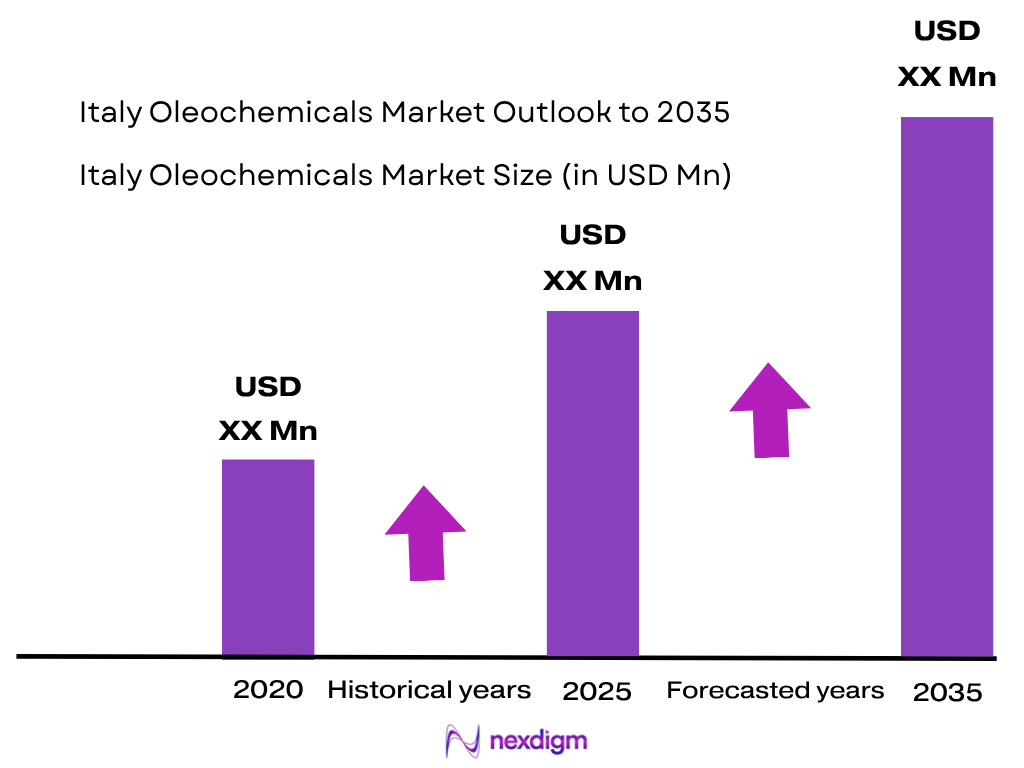
The Italy oleochemicals market was valued at USD 787.07 million in 2024, according to Reed Intelligence, with fatty acids representing the largest product category. The market is supported by Italy’s established chemical manufacturing base, demand from pharmaceuticals, cosmetics, detergents, plastics, lubricants, and food applications, and increasing use of renewable feedstocks. Italy’s chemical exports also remained significant, while chemical-product exports increased by 9.7% year-on-year in December 2024, according to Istat.
Italy’s principal oleochemical activity is concentrated across Cremona, Carasco, Genoa, Milan, Naples, and Spoleto, where specialized manufacturers and chemical-processing facilities connect renewable feedstocks with high-value downstream industries. Green Oleo operates a 64,000-square-metre production site in Cremona, while FACI operates its Italian production facility in Carasco and Italmatch maintains manufacturing and R&D operations in Arese, Qualiano, and Spoleto. Italy’s cosmetics industry generated more than €7.9 billion of exports in 2024, reinforcing demand for oleochemical ingredients.
Market Segmentation
By Product Type
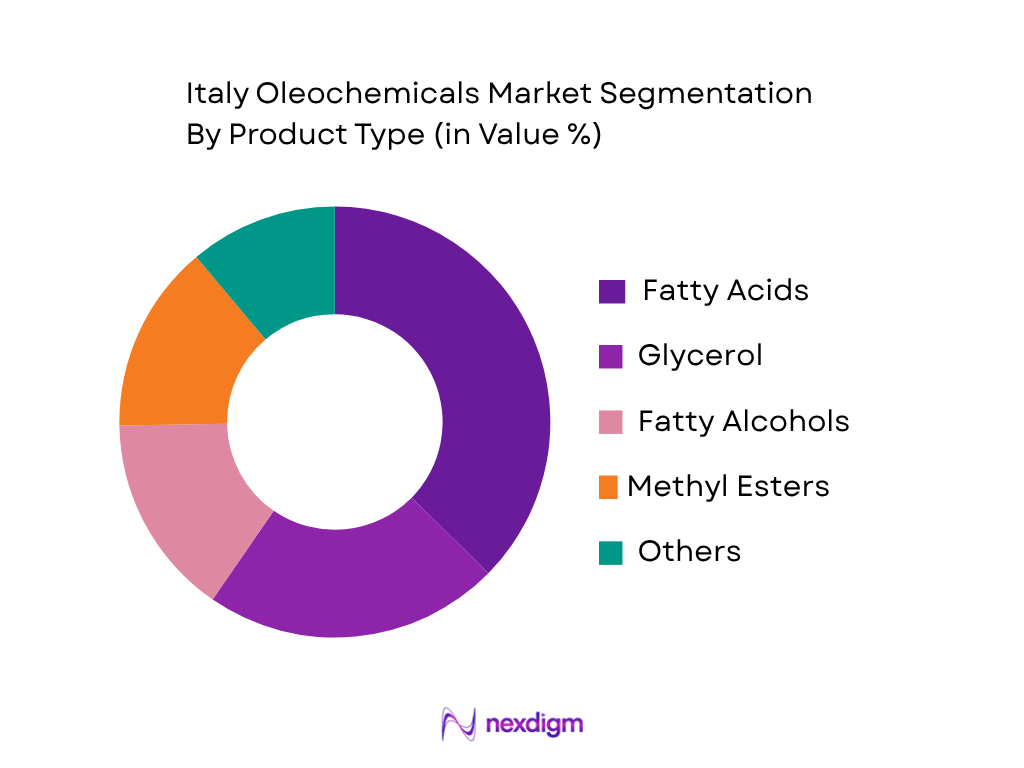
The Italy oleochemicals market is segmented by product type into fatty acid, fatty alcohol, methyl ester, glycerol and other oleochemical derivatives. Fatty acid is the dominant segment, representing 36.92% of the 2024 market, calculated from the source-reported fatty-acid revenue of USD 290.66 million against total market revenue of USD 787.07 million. Fatty acids maintain their leading position because they function as versatile intermediates across pharmaceuticals, cosmetics, soaps and detergents, plastics, lubricants and industrial formulations. Italy also has established domestic fatty-acid production capabilities, including manufacturers producing C16–C18 fatty acids from renewable vegetable and animal feedstocks. The segment benefits from broad downstream applicability and the ability to serve both commodity and specialty formulations. Methyl ester is positioned as the fastest-growing product category in the Italy-specific market assessment, supported by its role as an intermediate for renewable chemical applications and downstream specialty derivatives.
By Feedstock Type
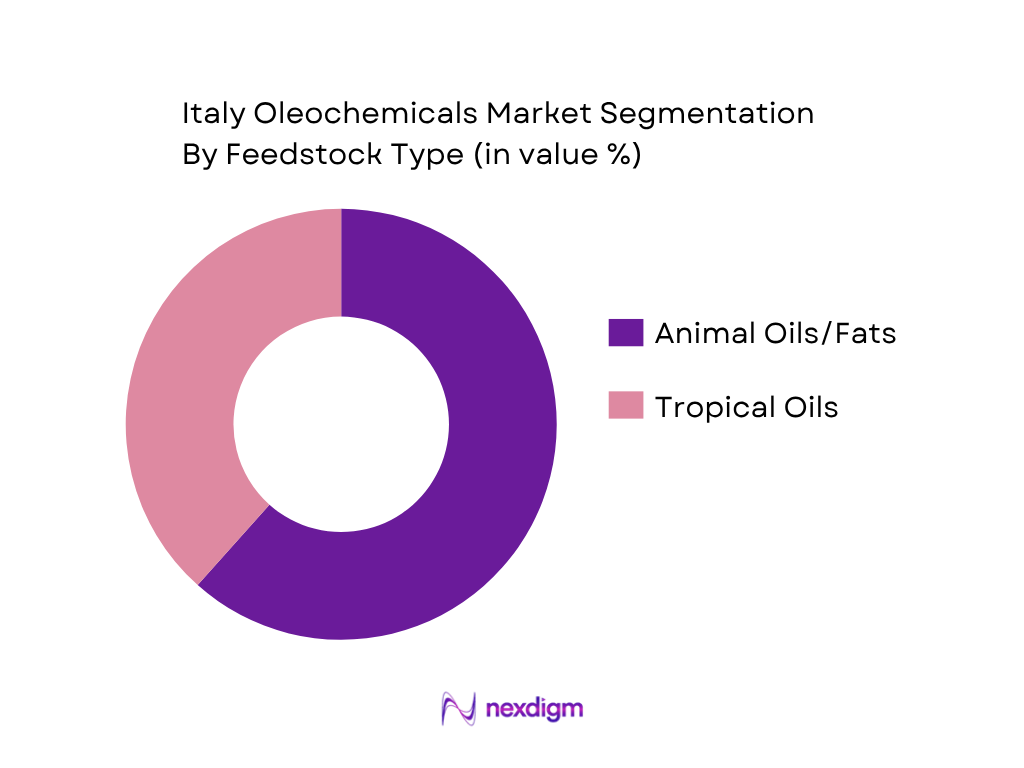
The Italy Oleochemicals Market can be segmented by feedstock into animal oils/fats and tropical vegetable oils, with the broader commercial landscape also incorporating olive-oil by-products and other European vegetable-oil streams. Animal-derived oils and fats constitute the dominant published feedstock category, reflecting Italy’s established rendering and food-processing ecosystem and the ability of domestic manufacturers to convert locally sourced fats into fatty acids, glycerine and derivatives. Published market data assign USD 484.68 million of the market to animal-oil-derived products. Green Oleo specifically reports the utilization of locally sourced food-industry by-products, including olive acidic oils and animal fats, processed through splitting, distillation, separation, fractionation and hydrogenation. FACI likewise manufactures stearic-acid derivatives from both animal and vegetable origins. This flexible feedstock model reduces dependence on a single imported tropical oil stream and gives Italian producers scope to compete through circular sourcing, product customization and renewable-material positioning.
Competitive Landscape
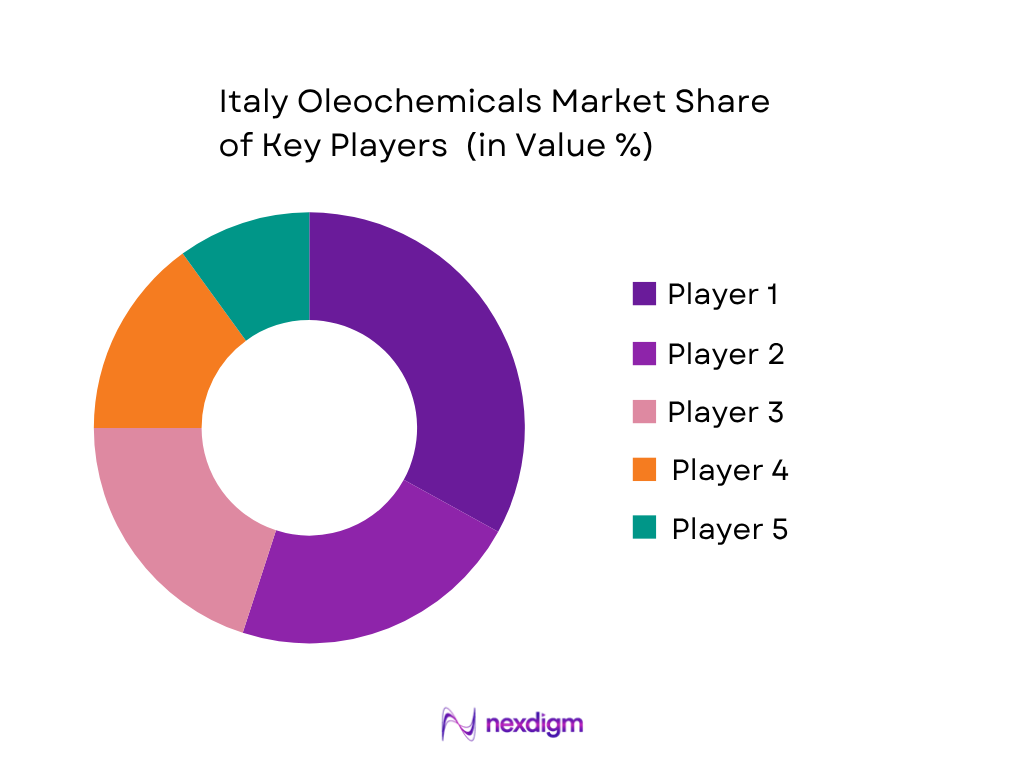
The Italy oleochemicals market includes established Italian specialty producers alongside multinational oleochemical groups with European manufacturing and distribution networks. Competition is shaped less by commodity scale alone and more by feedstock flexibility, fatty-acid processing expertise, specialty derivative capabilities, purity specifications, regulatory compliance, renewable-feedstock sourcing, circularity, and proximity to downstream formulators. Green Oleo, FACI, Ambrogio Pagani, and Italmatch provide significant Italian manufacturing capabilities, while international companies such as KLK OLEO, Oleon, BASF, Croda, and Wilmar compete through broader European portfolios and integrated supply chains.
| Company | Establishment | Headquarters | Core Oleochemical Portfolio | Feedstock Position | Manufacturing Footprint | Production/Scale Indicator | Major End Uses | Sustainability / Technical Position |
| Green Oleo S.p.A. | 1925 | Cremona, Italy | ~ | ~ | ~ | ~ | ~ | ~ |
| KLK Temix S.p.A. | 2002* | Milan, Italy | ~ | ~ | ~ | ~ | ~ | ~ |
| FACI S.p.A. | 1943 | Carasco, Italy | ~ | ~ | ~ | ~ | ~ | ~ |
| Oleon NV | 1957** | Ertvelde, Belgium | ~ | ~ | ~ | ~ | ~ | ~ |
| IOI Oleo GmbH | 2016*** | Hamburg, Germany | ~ | ~ | ~ | ~ | ~ | ~ |
Italy Oleochemicals Market Analysis
Growth Drivers
Italian Cosmetics Manufacturing Strength
Italy’s cosmetics manufacturing ecosystem provides a substantial downstream demand base for oleochemical ingredients, particularly fatty acids, glycerol, fatty acid esters, emollients, emulsifiers and surfactants used in skin care, hair care, colour cosmetics and fragrance formulations. The Italian cosmetics industry generated €16.5 billion in turnover in 2024, while cosmetics exports reached €7.9 billion, according to Cosmetica Italia. The sector directly employed more than 63,000 people, and its wider value chain generated €41.2 billion in turnover and €30.8 billion in added value, according to Cosmetica Italia and TEHA. Italy was the fifth-largest cosmetics exporter globally, with the United States, France, Germany, Spain and the United Kingdom among its principal destination markets. These figures are directly relevant to oleochemicals because cosmetic manufacturers require functional lipid-derived ingredients that provide emolliency, texture, conditioning, cleansing and formulation stability. The scale of Italian cosmetics production therefore creates a diversified domestic customer base for specialty oleochemical manufacturers and encourages suppliers to develop higher-purity, traceable and renewable ingredients rather than relying exclusively on commodity fatty acids. Italy’s total economy reached USD 2.38 trillion in GDP in 2024, while real GDP expanded by 0.7, providing a large industrial and consumer economy supporting formulation-intensive manufacturing.
Rising Bio-Based Ingredient Demand
The transition toward renewable and circular ingredients is creating a structural demand driver for Italy’s oleochemical industry because fatty acids, glycerol, esters and related derivatives can replace or complement fossil-derived ingredients in cosmetics, detergents, lubricants, plastics and industrial formulations. Italy recorded a 21.6% circular material use rate in 2024, placing it among the stronger circular-economy performers in the European Union, according to Eurostat. The Italian cosmetics value chain generated €41.2 billion in turnover in 2024 and €30.8 billion in added value, demonstrating the scale of industries capable of absorbing renewable and circular raw materials. Italy’s broader chemical industry is also highly export-oriented, with more than €40 billion in chemical exports and more than 117,000 employees according to Federchimica’s latest industry assessment. At the macroeconomic level, Italy recorded USD 2.38 trillion GDP and USD 40,385 GDP per capita in 2024, according to the World Bank, indicating a sizeable industrial and consumer base for higher-value sustainable formulations. The European transition toward lower-carbon manufacturing further encourages Italian producers to valorize vegetable oils, animal fats, food-industry residues and recovered oils as oleochemical feedstocks. This supports development of bio-based surfactants, specialty esters, cosmetic ingredients and industrial derivatives.
Market Challenges
Vegetable Oil Price Volatility
Feedstock volatility remains a significant challenge for Italy’s oleochemical industry because manufacturers depend on vegetable oils and fats to produce fatty acids, glycerol, esters and other derivatives. Italy’s domestic agricultural base does not eliminate exposure to international vegetable-oil supply conditions, particularly where oleochemical production requires specific fatty-acid profiles that cannot be obtained economically from locally available oils. Olive oil illustrates the variability of Italy’s renewable-oil supply: ISMEA reported 328,000 tonnes of Italian olive-oil production for the 2023/24 campaign and estimated only 224,000 tonnes for the 2024/25 campaign, representing a decline of 104,000 tonnes between the two campaigns. Although olive oil is not the sole oleochemical feedstock, the movement demonstrates the sensitivity of Italy’s oilseed and oil-producing ecosystem to agricultural conditions. At the macroeconomic level, Italy’s real GDP expanded by only 0.7% in 2024, while gross fixed capital formation contracted by 2.3%, according to the IMF, limiting the ability of some industrial companies to absorb sustained feedstock disruptions through rapid capacity expansion or large inventory buffers. For oleochemical producers, volatile renewable-feedstock availability can complicate procurement planning, formulation consistency and long-term supply agreements. Diversification across vegetable oils, animal fats, recovered oils and food-industry by-products is therefore increasingly important for maintaining manufacturing resilience.
High European Energy and Industrial Cost Pressure
Energy intensity and weak industrial demand create a significant competitive challenge for Italian oleochemical manufacturers because processes such as fat splitting, distillation, hydrogenation, esterification and glycerol refining require heat, steam and electricity. Istat reported that Italy’s total net domestic energy use fell to 6.1 million terajoules in 2024, while national greenhouse-gas emissions amounted to 386 million tonnes of CO₂ equivalent. At the same time, industrial producer prices in Italy declined by 4.2% in 2024, but energy-related movements remained an important driver of industrial price changes; in December 2024, domestic electricity and gas supply prices were still 3.6% higher year-on-year. Istat also reported that Italy’s industrial turnover declined 7.2% year-on-year in value terms in December 2024, with intermediate-goods turnover down 8.9%, illustrating the difficult demand environment faced by industrial suppliers. The IMF recorded only 0.7% real GDP growth in 2024, reinforcing the broader picture of restrained industrial expansion. For oleochemical manufacturers, this combination creates pressure to improve energy efficiency, maximize plant utilization and shift toward specialty derivatives where technical differentiation is stronger. The challenge is particularly relevant for European producers competing against large Asian manufacturing platforms with extensive feedstock integration and substantial production scale.
Market Opportunities
Olive-Derived Oleochemicals and Locally Sourced Renewable Ingredients
Italy has an opportunity to develop differentiated oleochemical ingredients from locally available renewable resources, particularly olive-derived streams, because the country possesses an established olive-oil processing ecosystem and strong downstream demand for natural and traceable ingredients. ISMEA reported 328,000 tonnes of Italian olive-oil production in the 2023/24 campaign, while the 2024/25 production estimate stood at 224,000 tonnes, demonstrating the scale of the domestic olive resource even amid agricultural variability. Italy’s cosmetics sector provides a particularly attractive outlet: the industry generated €16.5 billion in turnover in 2024, exported €7.9 billion, and generated €4.7 billion in positive trade balance, according to Cosmetica Italia. Italian cosmetics already promote locally distinctive ingredients such as olive, bergamot, lemon and aloe, creating an established market narrative around territorial sourcing. The opportunity for oleochemical producers is to convert suitable olive-processing fractions and associated by-products into specialty fatty acids, emollient esters, surfactant intermediates and other functional ingredients with documented origin and traceability. Italy’s circular-material-use rate reached 21.6% in 2024, according to Eurostat, providing further evidence of an ecosystem receptive to resource-efficiency strategies. The combination of domestic agricultural identity, specialty cosmetics manufacturing and circular-economy infrastructure creates a differentiated route for Italian producers to move beyond commodity oleochemicals.
Upcycled Cosmetic Ingredients and Circular Animal-Fat Feedstocks
The development of upcycled oleochemical ingredients represents an important opportunity because Italy combines a large cosmetics manufacturing base with an established circular-economy ecosystem and specialized producers capable of processing renewable animal and vegetable feedstocks. Italy’s cosmetics industry generated €41.2 billion across its broader value chain in 2024, including raw materials, formulation, packaging and distribution, while more than 63,000 people were directly employed in the sector. Cosmetics exports reached €7.9 billion, demonstrating the international reach of manufacturers that increasingly require differentiated ingredients. Italy’s circular material use rate reached 21.6% in 2024, according to Eurostat, providing a favorable resource-efficiency context for converting animal fats, food-industry residues, recovered oils and other secondary lipid streams into fatty acids, glycerol, esters and specialty emollients. Green Oleo, for example, identifies food-industry by-products among its renewable feedstock sources, demonstrating that circular feedstock processing is already commercially relevant in the Italian oleochemical ecosystem. At the national level, Italy recorded 386 million tonnes of CO₂-equivalent greenhouse-gas emissions in 2024, while manufacturing emissions declined by 2.2%, according to Istat, strengthening the strategic rationale for lower-carbon industrial inputs. The opportunity is therefore to combine upcycling, traceability and specialty formulation performance to create differentiated ingredients for Italian and European cosmetics, pharmaceuticals, detergents and lubricants.
Future Outlook
The Italy oleochemicals market is expected to maintain a positive growth trajectory as manufacturers increasingly substitute petrochemical inputs with renewable and circular alternatives. Demand from pharmaceuticals, cosmetics, detergents, food processing, lubricants, plastics and specialty formulations is expected to remain diversified. The market’s future development will increasingly depend on specialty oleochemical derivatives, circular feedstocks, high-purity ingredients, renewable-carbon chemistry and regulatory compliance. Italy is particularly well positioned for higher-value oleochemistry because its chemical ecosystem combines specialized manufacturers with sophisticated pharmaceutical, cosmetics and industrial formulation industries.
The Italy oleochemicals market is expected to expand at a working CAGR of approximately 8.02% during 2026–2035. Applying that CAGR mechanically to the 2024 base of USD 787.07 million would imply approximately USD 1.71 billion by 2035; this is a derived forecast, not a directly published source figure. The published Italy-specific source reports USD 1,583.47 million by 2033. The strongest opportunities are expected in methyl esters, specialty esters, pharmaceutical-grade glycerol, cosmetic ingredients, bio-based lubricants and waste-derived oleochemicals, with circular feedstock utilization becoming an increasingly important competitive differentiator.
Major Players
- Green Oleo S.p.A.
- FACI Group
- Ambrogio Pagani S.p.A.
- Italmatch Chemicals S.p.A.
- KLK OLEO
- Oleon NV
- Wilmar International Limited
- IOI Corporation Berhad
- Emery Oleochemicals
- BASF SE
- Croda International Plc
- Evonik Industries AG
- Kao Corporation
- Godrej Industries Limited
- Musim Mas Holdings Pte. Ltd.
Key Target Audience
- Oleochemical manufacturers and specialty derivative producers
- Personal care, cosmetics and formulation manufacturers
- Pharmaceutical ingredient and excipient manufacturers
- Home care, detergent and surfactant manufacturers
- Lubricant, plastics, rubber, coatings and industrial chemical manufacturers
- Investments and venture capitalist firms (Renewable Chemicals Funds, Bioeconomy Investment Funds, Sustainable Materials Investment Firms)
- Government and regulatory bodies (Ministry of Enterprises and Made in Italy, Ministry of Environment and Energy Security, Italian Medicines Agency, Italian National Institute for Environmental Protection and Research)
- Chemical distributors, ingredient distributors and industrial procurement organizations
Research Methodology
Step 1: Identification of Key Variables
The initial phase involves mapping Italy’s oleochemical ecosystem across vegetable-oil processors, animal-fat renderers, agro-food by-product suppliers, oleochemical manufacturers, specialty derivative producers, distributors, formulators, and downstream industries. Secondary research incorporates Istat, Eurostat, company disclosures, customs statistics, regulatory publications, and industry-specific production datasets to establish the variables governing supply, demand, trade, and application consumption.
Step 2: Market Analysis and Construction
Historical market construction combines product-level production, import and export flows, company-level operating information, downstream consumption indicators, and application demand. The model separates fatty acids, fatty alcohols, methyl esters, glycerol, and other derivatives while reconciling supply with demand across pharmaceuticals, personal care, detergents, food, plastics, rubber, lubricants, coatings, and other industrial applications.
Step 3: Hypothesis Validation and Expert Consultation
Market hypotheses are validated through discussions with oleochemical producers, feedstock suppliers, specialty chemical distributors, formulators, and procurement professionals. Interviews focus on feedstock availability, product specifications, capacity utilization, customer qualification, substitution between petrochemical and bio-based ingredients, sustainability requirements, and changes in European procurement strategies.
Step 4: Research Synthesis and Final Output
The final stage integrates supply-side and demand-side evidence through data triangulation. Company information is cross-checked against official trade and industrial datasets, while application-level estimates are tested against downstream industry indicators. Competitive benchmarking then evaluates product breadth, feedstock flexibility, specialty capability, manufacturing footprint, sustainability credentials, and customer coverage.

- Executive Summary
- Research Methodology (Oleochemical Market Definition and Boundaries, Primary vs Secondary Oleochemicals Classification, HS/CN Code Mapping, Feedstock-to-Product Conversion Factors, Apparent Consumption Approach, Domestic Production Assessment, Import-Export Reconciliation, Producer Revenue Analysis, Distributor and Trader Assessment, End-use Industry Demand Modeling, Top-Down Market Sizing, Bottom-Up Plant-Level Capacity Assessment, Fatty Acid/Glycerine/Ester Mass-Balance Analysis, Primary Interviews with Producers/Distributors/End Users, Price Benchmarking, Data Triangulation, Forecast Modeling, Scenario Analysis, Assumptions and Limitations)

- Definition and Scope of the Italy Oleochemicals Market
- Evolution of the Italian Oleochemical Industry
- Structure of Primary and Specialty Oleochemicals Industry
- Position of Italy within the European Oleochemicals Industry
- Oleochemicals Manufacturing Cluster and Production Footprint in Italy
- Italy Oleochemicals Industry Ecosystem

- Growth Drivers (Italian Cosmetics Manufacturing Strength, Rising Bio-based Ingredient Demand, Petrochemical Substitution, Growth of Specialty Esters, Sustainable Lubricant Adoption, Circular Feedstock Utilization, Premium Cosmetic Ingredient Demand, European Bioeconomy Transition)
- Market Challenges (Vegetable Oil Price Volatility, Palm Feedstock Import Exposure, Asian Import Competition, High European Energy Costs, Feedstock Competition with Biofuels, Regulatory Compliance Costs, Commodity Oleochemical Margin Pressure, Industrial Demand Weakness)
- Market Opportunities (Olive-Derived Oleochemicals, Upcycled Cosmetic Ingredients, High-Purity Glycerine, Bio-lubricant Esters, Circular Animal-Fat Feedstocks, Specialty Emollients and Emulsifiers, Locally Sourced Renewable Ingredients, Import Substitution)
- Market Trends (Mediterranean Feedstock Positioning, Upcycling of Food-Industry By-products, Specialty Oleochemical Premiumization, Traceable Feedstock Procurement, Palm-Free Formulations, Low-Carbon Oleochemicals, Multi-feedstock Production Flexibility, Customized Ester Development)
- Regulatory and Sustainability Landscape (REACH Compliance, CLP Classification, Detergent/Surfactant Requirements, EUDR Exposure, Renewable Energy Rules, Food/Cosmetic Specifications, Sustainability Certification, Carbon Reporting)
- SWOT Analysis
- Porter’s Five Forces Analysis
- PESTLE Analysis

- By Market Value (2020-2025)
- By Domestic Consumption Volume (2020-2025)
- By Domestic Production Volume (2020-2025)
- By Average Realized Price (2020-2025)
- By Domestic Production versus Import-Supplied Consumption (2020-2025)
- By Primary versus Specialty Oleochemicals (2020-2025)

- By Product (in value %)
Fatty Acids
Fatty Alcohols
Glycerine
Fatty Acid Esters
Fatty Acid Derivatives - By Feedstock (in value %)
Olive Oil and Olive-Oil Processing By-products
Palm Oil and Palm-Based Fractions
Palm Kernel Oil
Sunflower Oil
Soybean Oil
Rapeseed Oil - By Feedstock Origin (in value %)
Virgin Vegetable-Based Oleochemicals
Animal-Fat-Based Oleochemicals
Recycled and Upcycled Feedstock-Based Oleochemicals
Food-Industry By-product-Based Oleochemicals
Mediterranean/Locally Sourced Feedstock-Based Oleochemicals
Imported Tropical Oil-Based Oleochemicals - By Application (in value %)
Personal Care and Cosmetic
Home Care, Detergents and Institutional Cleaning
Plastics, Rubber and Elastomers
Paints, Coatings, Resins and Inks
Pharmaceuticals and Nutraceuticals
Food and Food Additives - By Grade (in value %)
Technical/Industrial Grade
Cosmetic Grade
Food Grade
Pharmaceutical Grade
High-Purity/Specialty Grade
Bio-based and Sustainability-Certified Grade - By Sales Route
Direct Sales to Industrial End Users
Chemical Distributors
Specialty Ingredient Distributors
Traders and Importers
Contract Manufacturing/Toll Processing
Intercompany and Captive Consumption

- Market Share of Major Players (By Revenue, Production Capacity, Product Type, Application, Feedstock, Domestic Sales, Export Sales)
- Cross Comparison Parameters (Product Portfolio Breadth, Fatty Acid Production Capability, Glycerin Refining Capability, Specialty Ester Portfolio, Renewable Feedstock Integration, Circular Feedstock Utilization, European Manufacturing Footprint, Downstream Application Coverage)
- Pricing and Realization Analysis (By Product Type, Grade, Application, Domestic Sales, Export Sales, Contract Sales)
- SWOT Analysis of Major Players
- Detailed Profiles of Major Companies
Green Oleo S.p.A.
Italmatch Chemicals S.p.A.
Ambrogio Pagani S.p.A.
FACI S.p.A.
Gioma Varo S.r.l.
Wilmar International Limited
KLK OLEO
IOI Corporation Berhad
Oleon NV
Emery Oleochemicals
BASF SE
Evonik Industries AG
Croda International Plc
Kao Corporation
Godrej Industries Limited

- Personal Care and Cosmetics Demand Analysis
- Home Care and Detergents Demand Analysis
- Pharmaceutical Demand Analysis
- Food and Nutraceutical Demand Analysis
- Plastics and Rubber Demand Analysis

- By Market Value (2026-2035)
- By Domestic Consumption Volume (2026-2035)
- By Domestic Production Volume (2026-2035)
- By Average Realized Price (2026-2035)
- By Domestic Production versus Import-Supplied Consumption (2026-2035)
- By Primary versus Specialty Oleochemicals (2026-2035)


 Request a Sample
 Ask for Customization
 Get a Quote
 Enquire Now