

 Download PDF
Market Overview
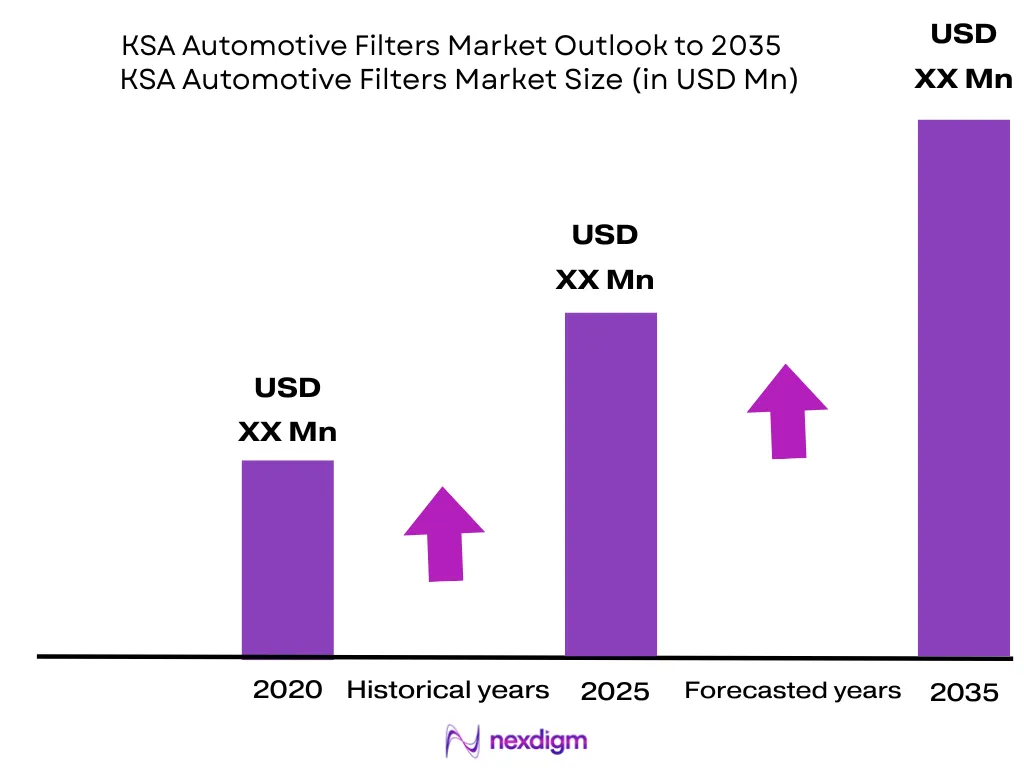
The KSA Automotive Filters Market is valued at approximately ~ million, compared with ~ million in the preceding reporting period. Demand is supported by new-vehicle sales increasing from 758,791 units to 805,034 units, including passenger-car sales rising from 645,723 units to 705,527 units. The growing service population, severe desert exposure, high SUV usage, commercial fleets, turbocharged engines, and recurring preventive maintenance sustain demand for air, oil, fuel, cabin, and emission filters. Riyadh, Jeddah, Dammam, Al Khobar, Makkah, Madinah, and King Abdullah Economic City dominate the KSA Automotive Filters Market because they combine dense vehicle ownership, dealership networks, parts warehouses, industrial activity, commercial fleets, and workshop infrastructure. Riyadh is the principal administrative and fleet-procurement centre, Jeddah supports port-linked parts distribution and pilgrimage transport, while Dammam–Khobar serves oil, petrochemical, logistics, and heavy-equipment operators requiring severe-duty filtration. Saudi Arabia is the Arab region’s largest automotive market and one of the world’s leading vehicle-import destinations. Its filter ecosystem covers passenger cars, SUVs, pickups, vans, trucks, buses, luxury vehicles, construction machinery, mining equipment, agricultural vehicles, oilfield fleets, hybrids, and battery-electric vehicles.
Market Segmentation
By Filter Type
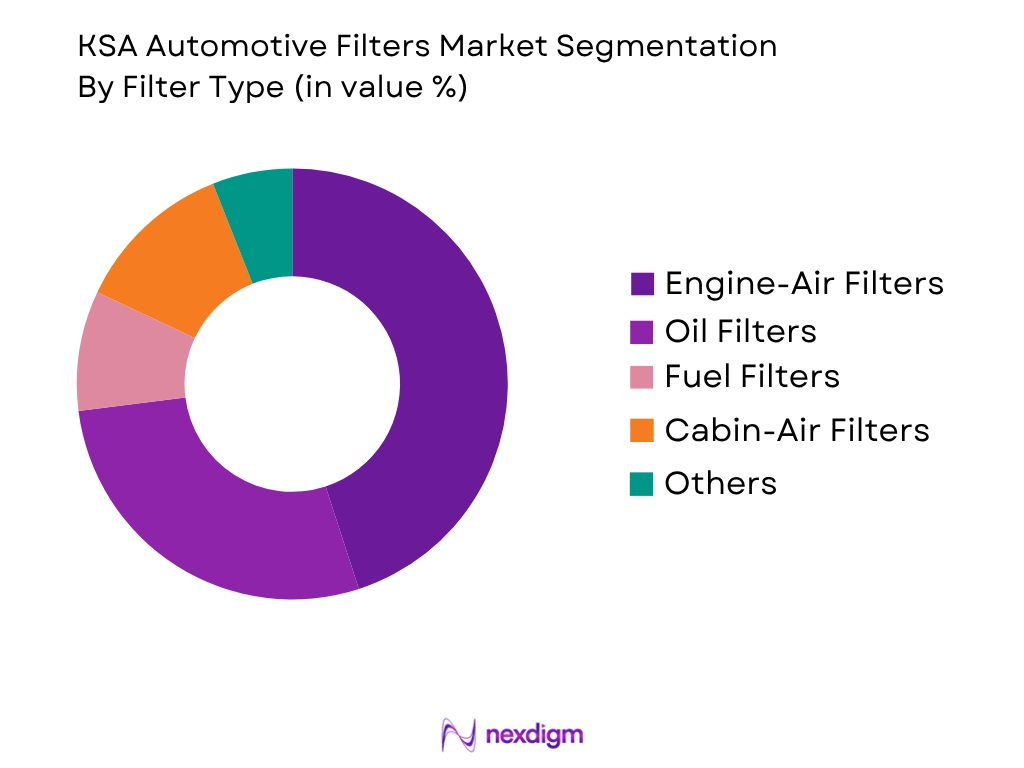
By filter type, the KSA Automotive Filters Market is segmented into engine-air filters, oil filters, cabin-air filters, fuel filters, transmission and hydraulic filters, emission-control filters, and electric-vehicle or other filters. Engine-air filters hold the dominant market share because Saudi Arabia’s dry desert environment creates persistent sand and fine-dust exposure across urban, motorway, industrial, construction, and off-road applications. Engine-air filters protect cylinders, pistons, turbochargers, and airflow sensors from abrasive contamination. SUVs and pickups used for desert driving face concentrated sand exposure, while trucks, mining equipment, and oilfield vehicles require primary and safety elements with greater dust-holding capacity. Restricted airflow can reduce engine performance, increase fuel consumption, raise soot production, and accelerate turbocharger stress. These conditions support radial-seal filters, cyclonic pre-cleaners, synthetic media, nanofibre coatings, and shorter inspection intervals. Passenger cars also require frequent air-filter checks because dust accumulation occurs even during normal urban driving.
By Vehicle Type
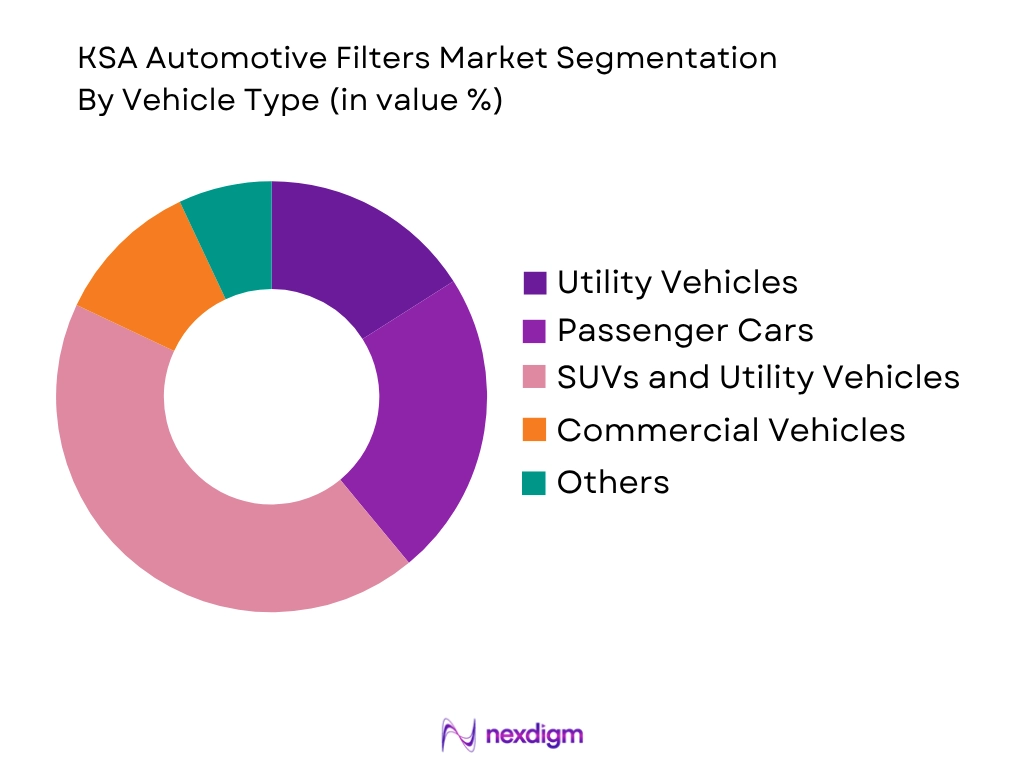
By vehicle type, the KSA Automotive Filters Market is segmented into SUVs and crossovers, passenger cars, pickups and utility vehicles, light commercial vehicles, heavy commercial vehicles, buses, off-highway equipment, and electric or hybrid vehicles. SUVs and crossovers hold the dominant market share because they are widely used by households, rental companies, corporate fleets, government entities, construction operators, and drivers travelling across long intercity routes. SUVs typically use larger engines, automatic transmissions, advanced cabin systems, turbochargers, and all-wheel-drive configurations, creating several filtration revenue streams per vehicle. Their exposure to desert driving increases demand for engine-air and cabin filters, while high ambient temperatures raise the importance of oil and transmission filtration. Premium SUVs also support activated-carbon cabin filters, synthetic-media oil filters, genuine parts, and complete service kits. Passenger cars remain a broad volume category, while trucks and off-highway equipment generate higher expenditure per vehicle through fuel-water, hydraulic, coolant, crankcase, air-dryer, and emission-system products.
Competitive Landscape
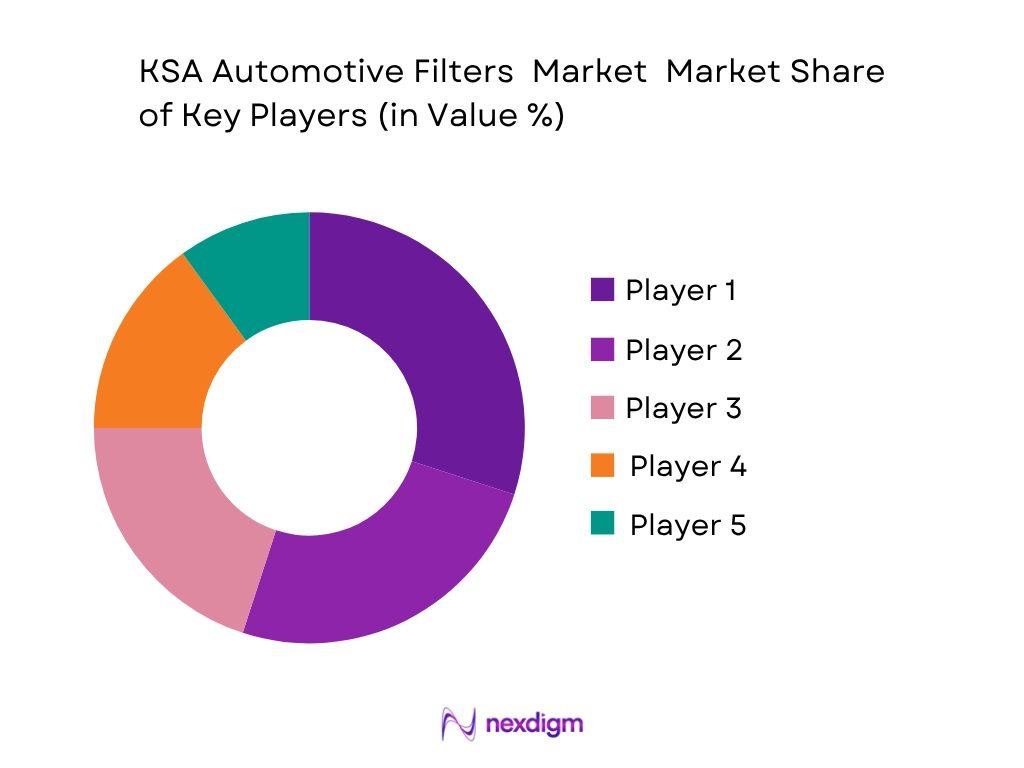
The KSA Automotive Filters Market includes global filtration specialists, European and Japanese automotive suppliers, heavy-duty filter manufacturers, OEM genuine-parts networks, regional distributors, and economy aftermarket brands. MANN+HUMMEL, Bosch, MAHLE, Donaldson, and Fleetguard hold strong positions because of their product breadth, OEM relationships, technical performance, commercial-vehicle coverage, and established Middle East distribution. Competition is shaped by sand-holding capacity, filtration efficiency, pressure drop, service life, heat resistance, fuel-water separation, GCC-specification fitment, SKU availability, warranty support, and access to quick-service, fleet, dealership, and heavy-equipment channels.
| Company | Establishment Year | Headquarters | Core Filter Portfolio | Vehicle Coverage | Saudi Channel Position | Severe-Duty Capability | Media Capability | EV Readiness |
| MANN+HUMMEL | 1941 | Ludwigsburg, Germany | ~ | ~ | ~ | ~ | ~ | ~ |
| Robert Bosch | 1886 | Gerlingen, Germany | ~ | ~ | ~ | ~ | ~ | ~ |
| MAHLE | 1920 | Stuttgart, Germany | ~ | ~ | ~ | ~ | ~ | ~ |
| Donaldson Company | 1915 | Bloomington, United States | ~ | ~ | ~ | ~ | ~ | ~ |
| Fleetguard | 1958 heritage | Columbus, United States | ~ | ~ | ~ | ~ | ~ | ~ |
KSA Automotive Filters Market Analysis
Growth Drivers
Desert Dust Exposure and Severe-Duty Filter Replacement
Saudi Arabia’s desert environment creates sustained replacement demand for engine-air, cabin-air, oil, fuel, and heavy-duty filtration products. Fine sand and airborne dust enter vehicle intake and HVAC systems during urban driving, intercity travel, construction activity, mining operations, and oilfield work. Engine-air filters with inadequate dust-holding capacity can restrict airflow, increase turbocharger loading, accelerate abrasive engine wear, and contribute to soot accumulation. Commercial and off-highway vehicles often require primary filters, safety elements, radial-seal designs, and cyclonic pre-cleaners because their engines operate for long periods in exposed environments. High temperatures also place additional stress on lubricants, filter seals, adhesives, and plastic housings. Saudi Arabia’s real economy expanded by 1.3% in 2024, while transport, storage, and communication activity increased by 4.5%, according to the General Authority for Statistics. The IMF projects a national population of 36.726 million people in 2026, supporting continued passenger mobility, freight movement, public transport, and vehicle servicing. These conditions favour synthetic and nanofibre media, reinforced pleat structures, high-temperature seals, and filters engineered for shorter severe-duty inspection cycles. Suppliers offering documented filtration efficiency, low pressure drop, high sand capacity, and accurate GCC vehicle fitment can secure premium positions in passenger, commercial, construction, mining, and oilfield applications.
Growth of Logistics, Industrial Projects, and High-Utilisation Fleets
Saudi Arabia’s expansion of logistics, construction, mining, tourism, pilgrimage transport, and industrial activity is increasing the utilisation of trucks, buses, vans, pickups, municipal vehicles, construction machinery, and material-handling equipment. These assets require broader and higher-value filtration packages than ordinary passenger vehicles, including fuel-water separators, heavy-duty air filters, lube filters, coolant filters, crankcase filters, hydraulic elements, air-dryer cartridges, and diesel after-treatment filters. High annual mileage and long engine operating hours shorten practical replacement cycles, while fleet operators prioritise reliability because roadside failures can interrupt freight schedules or industrial projects. Official GDP revisions showed a 25.6% increase in transportation, storage, and communications activity within the updated national economic structure, while construction activity increased by 61% and wholesale, retail, restaurant, and hotel activity by 29.8%. Saudi logistics infrastructure also included 23 activated logistics centres in 2024, creating additional vehicle movement around ports, warehouses, industrial zones, and distribution corridors. The IMF projects consumer-price growth of 2.3% in 2026, increasing pressure on operators to control maintenance expenditure without sacrificing equipment uptime. This environment supports extended-service filters, connected restriction monitoring, scheduled fleet replacement contracts, automatic replenishment, and mobile maintenance services tailored to long-haul, municipal, pilgrimage, construction, mining, and oilfield fleets.
Market Challenges
Electric Vehicle Localisation and Declining Conventional Filter Content
Saudi Arabia’s emerging electric-vehicle manufacturing ecosystem presents a long-term structural challenge for suppliers concentrated in engine-air, oil, fuel, crankcase, and exhaust-filtration products. Battery-electric vehicles do not require combustion-air filters, engine-oil filters, petrol or diesel fuel filters, crankcase separators, or tailpipe particulate filters. The Kingdom is developing domestic EV production through Lucid, Ceer, and related automotive investments, requiring conventional filter manufacturers to reassess future product portfolios. The National Industrial Development and Logistics Program previously stated that Lucid’s Saudi facility was designed around potential production exceeding 155,000 electric vehicles, while the Vision 2030 Annual Report identifies Ceer, Lucid, Hyundai, and Pirelli manufacturing projects within an automotive investment pipeline exceeding USD 166 billion. This transition will not remove filtration demand entirely. Electric vehicles continue to require cabin filters and may use battery-cooling filters, vent membranes, electric-drive lubrication filters, desiccants, and thermal-management fluid filtration. However, suppliers must maintain large inventories for Saudi Arabia’s existing petrol and diesel parc while funding new EV-specific engineering and fitment programmes. The IMF expects real GDP growth of 1.7% in 2026 and a population of 36.726 million, indicating continued vehicle demand but a progressively different filtration mix. Companies that fail to diversify may face reduced filter content per newly produced vehicle and increasing inventory obsolescence across legacy engine applications.
Import Dependence, Counterfeit Filters, and GCC Fitment Complexity
Saudi Arabia’s automotive filter supply chain remains exposed to imported finished products, specialised filter media, resins, adhesives, metal canisters, valves, and moulded housings. International shipping disruption, insurance costs, customs delays, and supplier concentration can therefore affect availability and inventory planning. The IMF reported in June 2026 that higher shipping and insurance costs were adding upward pressure to domestic prices, with average inflation expected at about 2.3%. The market also contains Japanese, Korean, American, European, Chinese, and GCC-configured vehicles, generating a large number of filter dimensions, engine codes, bypass settings, seal designs, and model-year variations. An incorrect oil filter can produce leakage or improper bypass operation; an unsuitable fuel filter can restrict flow or fail to separate water; and an incorrect air filter can permit unfiltered air around the sealing edge. Counterfeit and grey-market filters intensify these risks because exterior packaging may resemble established brands while the internal media, adhesive, spring, valve, or gasket does not meet technical requirements. SASO’s technical framework requires vehicles and relevant products to comply with Saudi standards, and vehicle maintenance centres are subject to classification requirements intended to control service quality and contamination risks. Organised suppliers must respond through VIN-based fitment systems, QR authentication, accredited test documentation, tamper-resistant packaging, technician training, and regional warehouses capable of supporting long-tail applications without excessive obsolete stock.
Market Opportunities
Premium Cabin Filtration for Dust, Odours, and Continuous HVAC Use
Cabin-air filtration represents a major growth opportunity because it remains applicable to petrol, diesel, hybrid, battery-electric, and fuel-cell vehicles. Saudi drivers operate air-conditioning systems for extended periods because of high temperatures, creating continuous airflow through cabin filters and increasing exposure to fine sand, road dust, pollen, traffic particles, odours, and industrial contaminants. Standard particulate products can be upgraded to activated-carbon, electrostatic, antimicrobial, allergen-reduction, and multilayer filters. Premium SUVs, luxury cars, taxis, ride-hailing vehicles, buses, corporate fleets, and electric vehicles provide attractive demand because passenger comfort and interior air quality influence maintenance decisions. The Kingdom recorded a population base moving toward 36.726 million people in 2026, while updated national accounts showed wholesale, retail, restaurant, and hotel activity increasing by 29.8%, indicating a larger mobility, tourism, and service economy. Transport, storage, and communications activity also expanded by 4.5% in 2024, supporting higher utilisation of taxis, rental vehicles, buses, and commercial fleets. Filter suppliers can convert current vehicle activity into future demand through cabin inspections during routine service, seasonal replacement reminders, fleet subscriptions, and product tiers differentiated by fine-particle capture, activated-carbon loading, airflow resistance, odour adsorption, and service life. EV manufacturing also strengthens this opportunity because cabin filtration remains necessary even as combustion-engine filters disappear.
Connected Heavy-Duty Filtration and Domestic Manufacturing Localisation
Saudi Arabia offers a significant opportunity to combine severe-duty filtration, connected maintenance, and domestic automotive-component localisation. Trucks, buses, mining machinery, construction equipment, oilfield vehicles, generators, and industrial equipment require reliable air, fuel, oil, coolant, crankcase, hydraulic, and emission-control filtration. Sensors that monitor air restriction, differential pressure, water in fuel, oil condition, or particulate-filter loading can support replacement based on actual operating conditions rather than fixed schedules. This reduces premature filter changes while lowering the risk of injector damage, turbocharger stress, excessive soot, hydraulic contamination, or unplanned downtime. Official statistics show transport, storage, and communication activity increasing by 4.5% in 2024, while Saudi Arabia had 23 activated logistics centres with a combined area exceeding 34 million square metres. Simultaneously, the Vision 2030 industrial pipeline includes Ceer, Lucid, Hyundai, and Pirelli projects, creating potential demand for locally produced filter elements, housings, cabin modules, coolant filtration, battery vents, and thermal-management components. Suppliers can begin localisation through media conversion, pleating, moulding, gasket production, assembly, testing, private-label packaging, and regional warehousing before investing in complete filtration modules. Connected service contracts, automatic fleet replenishment, DPF cleaning, core exchange, and Saudi-based engineering support can transform one-time filter sales into recurring fleet-availability and cost-per-kilometre programmes.
Future Outlook
The KSA Automotive Filters Market is forecast to expand at approximately ~ CAGR during the forecast period. Growth will be supported by vehicle sales, retention of older vehicles, desert-duty maintenance, non-oil economic activity, commercial transport, construction, mining, tourism, pilgrimage traffic, and development of a domestic automotive manufacturing ecosystem. Conventional engine-air, oil, and fuel filters will remain the largest replacement categories because Saudi Arabia continues to operate a substantial petrol and diesel vehicle population. However, product development will increasingly shift toward premium cabin filtration, connected fleet monitoring, electric-vehicle thermal systems, and locally engineered filtration modules. The new-vehicle service base continues to expand. Total sales reached 805,034 vehicles, compared with 758,791 vehicles, while passenger-car sales rose from 645,723 units to 705,527 units. These additions will enter authorised servicing first and progressively migrate into independent aftermarket channels as warranties expire. Saudi Arabia’s macroeconomic environment will support automotive utilisation, although exposure to oil output and regional conditions remains relevant. Real GDP expanded by 1.3% in 2024, following a 0.8% contraction in 2023, while non-oil activities grew by 4.3%. The IMF’s current Saudi country page projects 1.7% real GDP growth, 2.3% consumer-price growth, and a population of 36.726 million for 2026.
Major Players
- MANN+HUMMEL Middle East
- Robert Bosch Saudi Arabia
- MAHLE Aftermarket Middle East
- DENSO Saudi Arabia
- Donaldson Middle East
- Parker Hannifin Saudi Arabia
- Atmus Filtration Technologies
- Hengst Filtration
- UFI Filters Middle East
- Sogefi Filtration
- Fleetguard
- Baldwin Filters
- ACDelco Saudi Arabia
- K&N Engineering
- FRAM
Key Target Audience
- Automotive filter and filtration-module manufacturers
- Passenger, commercial, off-highway, and electric-vehicle manufacturers
- Automotive-parts importers, distributors, and retailers
- Authorised dealerships, quick-service centres, and independent garages
- Logistics, taxi, rental, bus, mining, construction, and oilfield fleets
- Filter-media, activated-carbon, housing, seal, and monitoring-sensor suppliers
- Investments and venture capitalist firms
- Government and regulatory bodies (Ministry of Industry and Mineral Resources, Ministry of Transport and Logistic Services, Saudi Standards, Metrology and Quality Organization, Saudi Center for Energy Efficiency, National Center for Environmental Compliance, Transport General Authority, Saudi Authority for Industrial Cities and Technology Zones, and Zakat, Tax and Customs Authority)
Research Methodology
Step 1: Identification of Key Variables
The initial phase constructs an ecosystem map covering filter manufacturers, vehicle importers, domestic assemblers, media suppliers, distributors, workshops, fleets, regulators, and recyclers. Critical variables include vehicle sales, installed parc, vehicle age, filter count per vehicle, replacement intervals, dust exposure, propulsion type, service channel, and product quality tier.
Step 2: Market Analysis and Construction
Historical vehicle sales, imports, registrations, servicing activity, fleet utilisation, and workshop transactions are compiled. Top-down analysis evaluates filtration revenue within the automotive-components ecosystem, while bottom-up analysis applies vehicle populations, filter quantities, severe-duty replacement intervals, and average selling values.
Step 3: Supply-Side Assessment
Suppliers are assessed by product portfolio, regional warehousing, OEM relationships, GCC fitment, severe-duty capability, media technology, local assembly, and distributor reach. Company catalogues, trade records, conformity documentation, and private-label participation are used to reconstruct organised supply.
Step 4: Demand-Side Assessment
Passenger owners, SUV users, dealerships, independent garages, taxi operators, logistics fleets, pilgrimage transport operators, mining companies, construction businesses, and oilfield contractors are assessed by mileage, duty cycle, maintenance frequency, brand preference, and downtime sensitivity.

- Executive Summary
- Research Methodology (Market Definitions and Assumptions, Automotive Filter Market Boundary, Abbreviations, Market Sizing Approach, Top-Down Analysis, Bottom-Up Analysis, Vehicle Parc–Based Demand Modelling, Filter Replacement Interval Assessment, OEM Installation Assessment, Aftermarket Sell-Out Assessment, Fleet Maintenance Assessment, Import and Local Manufacturing Assessment, Primary Industry Interviews, Data Triangulation, Forecasting Framework, Limitations and Future Conclusions)

- Definition and Scope
- Market Evolution and Industry Genesis
- Timeline of Major Industry Developments
- Automotive Filtration Technology Evolution
- Passenger, Commercial and Off-Highway Vehicle Filtration Ecosystem

- Growth Drivers (High Vehicle Ownership, SUV Penetration, Desert Exposure, Commercial Fleet Utilisation, Preventive Maintenance, Automotive Localisation)
- Market Challenges (EV Transition, Import Dependence, Counterfeit Products, Fitment Complexity, Extended Service Intervals, Price Competition)
- Market Opportunities (Premium Cabin Filtration, Severe-Duty Air Filters, Connected Fleets, EV Manufacturing, Localisation, Sustainable Materials)
- Market Trends (Digital Fitment, Premium Cabin Filtration, Severe-Duty Media, Connected Maintenance, Localisation, Sustainable Design)
- Government Regulations (Vehicle Emission Standards, SASO Conformity, Product Safety, Vehicle Inspection, Waste Management, Import Compliance)
- SWOT Analysis
- Porter’s Five Forces Analysis
- PESTLE Analysis

- By Market Value (2020-2025)
- By Filter Unit Sales (2020-2025)
- By Original Equipment Revenue (2020-2025)

- By Filter Type (In Value %)
Engine Air Filters
Oil Filters
Fuel Filters
Cabin Air Filters
Transmission Filters - By Vehicle Type (In Value %)
Passenger Cars
Sports Utility Vehicles
Crossovers
Luxury Vehicles
Performance Vehicles - By Sales Channel (In Value %)
Vehicle Manufacturers
Tier-One Filtration System Suppliers
Authorised Vehicle Dealerships
Company-Owned Service Networks
National Automotive Parts Distributors - By Geographic Region (In Value %)
Central Region
Western Region
Eastern Region
Northern Region
Southern Region

- Market Share of Major Players (By Value, Unit Volume, Filter Type, Vehicle Application, Sales Channel)
- Cross Comparison Parameters (Engine Air–Oil–Fuel–Cabin–Transmission–Emission Filter Portfolio Breadth, Passenger–SUV–Pickup–Commercial–Mining–Oilfield Vehicle Coverage, GCC-Specification Fitment and Saudi OEM-Localisation Capability, Sand Capture–Filtration Efficiency–Pressure Drop–Dirt-Holding Capacity Performance, KSA Distributor–Garage–Fleet–Heavy Equipment Dealer Network Reach, Synthetic–Nanofibre–Activated Carbon–High-Temperature Media Capability, DPF–SCR–Crankcase–Fuel-Water Separation Capability, EV Battery Cooling–Connected Monitoring–Local Manufacturing–Sustainable Product Readiness)
- SWOT Analysis of Major Players
- Detailed Profiles of Major Companies
MANN+HUMMEL Middle East
Robert Bosch Saudi Arabia
MAHLE Aftermarket Middle East
DENSO Saudi Arabia
Donaldson Middle East
Parker Hannifin Saudi Arabia
Atmus Filtration Technologies
Hengst Filtration
UFI Filters Middle East
Sogefi Filtration
Fleetguard
Baldwin Filters
ACDelco Saudi Arabia
K&N Engineering
FRAM

- Individual Passenger Car Owner Analysis
- SUV and Off-Road Vehicle Owner Analysis
- Luxury and Performance Vehicle Owner Analysis
- Battery Electric Vehicle Owner Analysis
- Hybrid Vehicle Owner Analysis

- By Market Value (2026-2035)
- By Filter Unit Sales (2026-2035)
- By Original Equipment Revenue (2026-2035)


 Request a Sample
 Ask for Customization
 Get a Quote
 Enquire Now