

 Download PDF
Market Overview
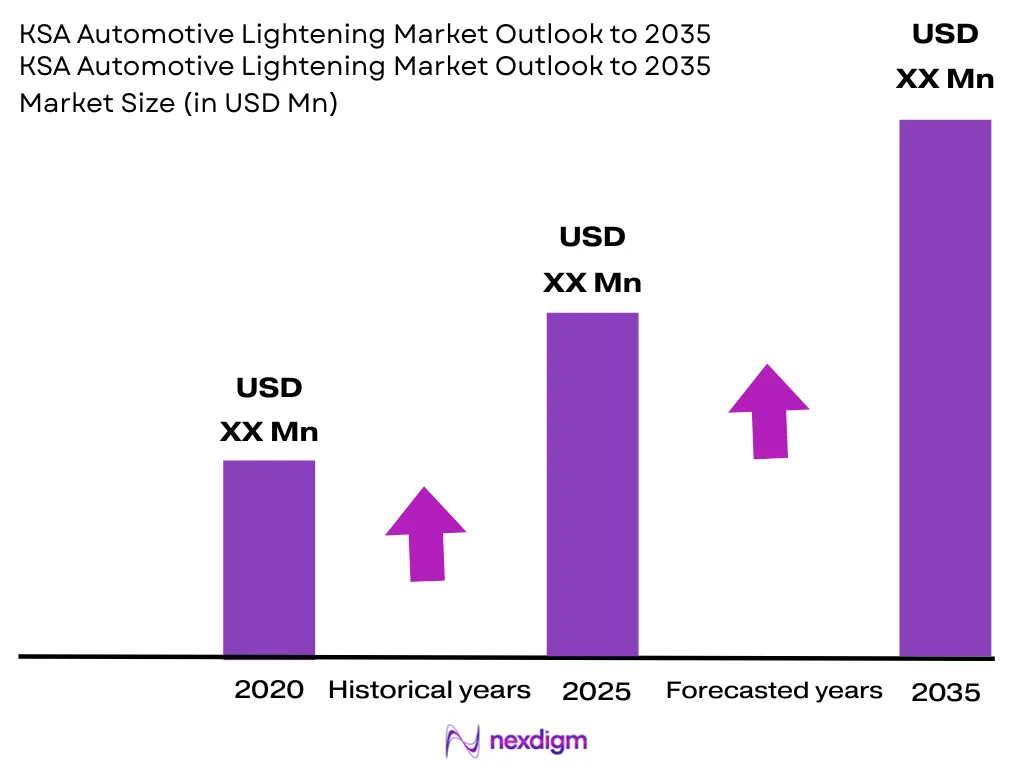
The KSA Automotive Lightening Market is valued at USD ~ Million in 2024 based on a five-year historical assessment, driven by record new-vehicle registrations, the Kingdom’s Vision 2030-led push toward automotive localisation, and rapid consumer migration toward LED and adaptive lighting technologies. Saudi Arabia recorded new-vehicle registrations exceeding one million units in 2024, marking a historic milestone that has meaningfully expanded both OEM-fitment and aftermarket replacement demand for lighting systems. The market remains predominantly import-driven, with global Tier-1 lighting suppliers serving Saudi OEM assembly operations and a fast-growing independent aftermarket, though emerging domestic manufacturing initiatives linked to Vision 2030 and the National Industrial Development and Logistics Program (NIDLP) are beginning to localise select component production. The convergence of giga-projects such as NEOM, The Line, Qiddiya, and Red Sea Global continues to generate substantial demand for commercial and fleet vehicle lighting, while the entry of domestically assembled brands such as Ceer and Lucid Arabia is accelerating adoption of advanced LED and adaptive driving beam technologies across the Kingdom’s expanding vehicle parc.
Market Segmentation
By Vehicle Type
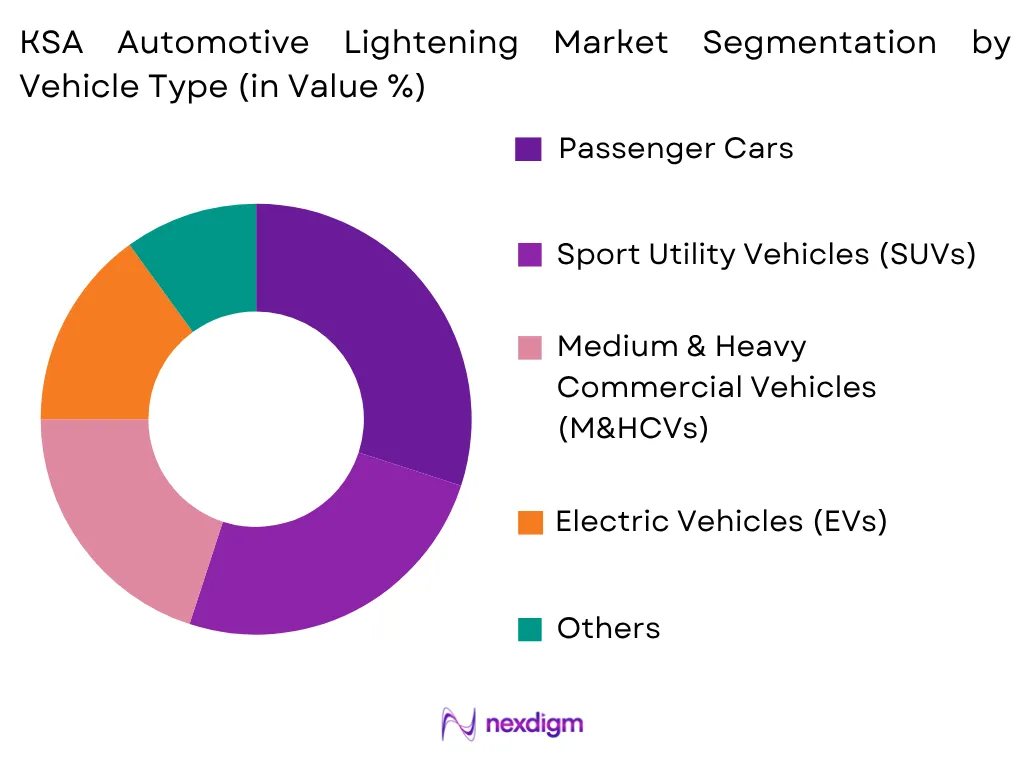
The Passenger Cars segment dominates the KSA Automotive Lightening Market, supported by passenger vehicles accounting for the largest share of the Kingdom’s vehicle parc and new registrations. Rising disposable incomes, expanding urban centres, and growing preference for SUVs and premium sedans have driven strong demand for styling-differentiated LED headlamps, signature daytime running lights, and ambient interior lighting. Saudi consumers increasingly view lighting as a key styling and safety differentiator, prompting OEMs to equip even mid-priced trims with full-LED lighting packages. The rapid growth of Saudi Arabia’s electric vehicle segment, supported by domestic assembly of the Ceer brand and Lucid Arabia’s Jeddah-area production facility, is further reinforcing demand for specially engineered lighting systems that balance energy efficiency with the higher electrical loads and styling requirements of EV platforms. Continuous innovation in matrix-LED and adaptive driving beam technology further reinforces the dominance of the passenger car segment within the market.
By Sales Channel
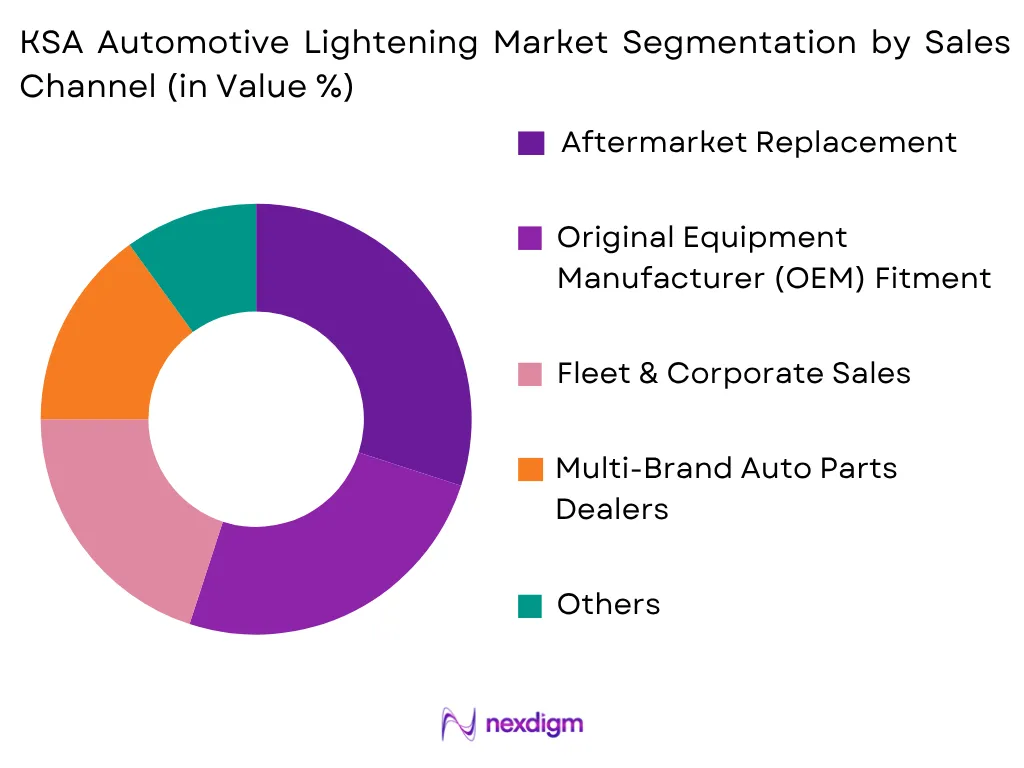
The Aftermarket Replacement segment holds a substantial share of the KSA Automotive Lightening Market, driven by the Kingdom’s large and ageing vehicle parc, extreme desert climate conditions that accelerate lighting component wear, and a high incidence of accident-related and collision-driven replacement demand. Saudi Arabia’s harsh operating environment, characterised by intense heat, dust, and UV exposure, shortens the effective service life of headlamp housings, seals, and LED modules relative to more temperate markets, sustaining recurring replacement cycles. Commercial fleet operators serving the logistics, construction, and mega-project sectors linked to NEOM, Qiddiya, and Red Sea Global increasingly prioritise durable, high-visibility lighting systems to meet safety compliance and minimise vehicle downtime. The expansion of organised auto parts retail chains, authorised distributor networks, and online automotive parts platforms has further strengthened aftermarket penetration, while the continued presence of counterfeit and grey-market lighting products remains a persistent competitive dynamic within this channel.
Competitive Landscape
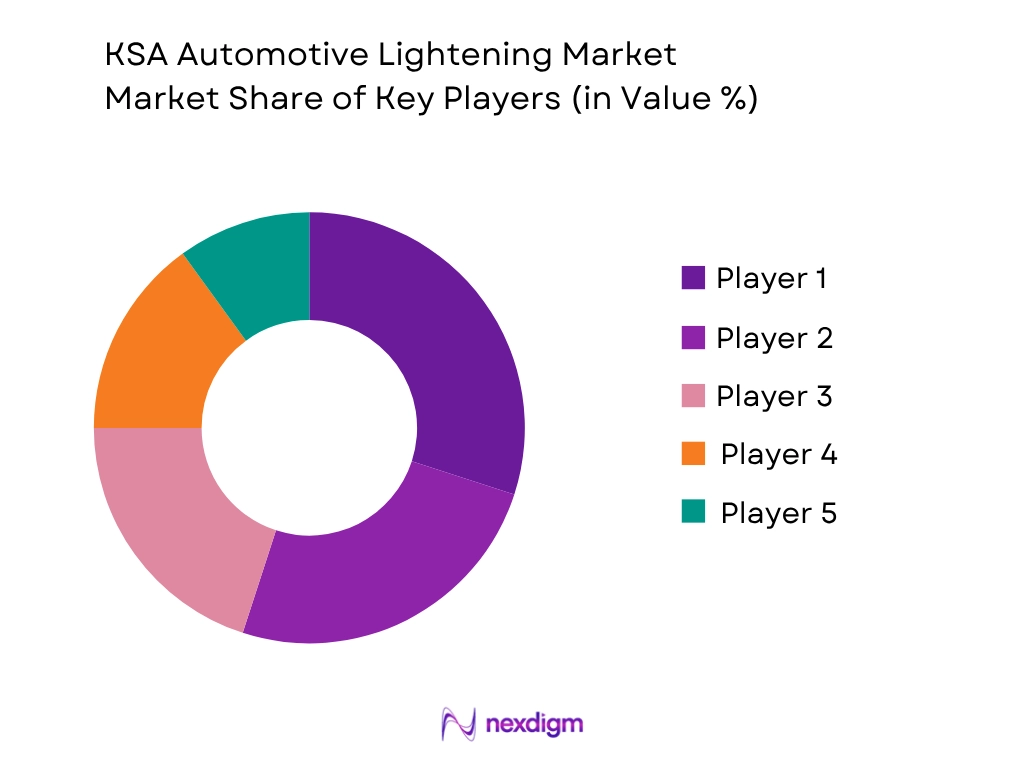
The KSA Automotive Lightening Market exhibits moderate competitive intensity, characterised by the strong presence of global Tier-1 lighting suppliers alongside a growing base of distributors handling both OEM-fitment and aftermarket products. The market remains predominantly import-driven, with global manufacturers supplying Saudi OEM assembly plants and independent distributors through regional hubs in the UAE, Europe, and East Asia, though Vision 2030’s automotive localisation agenda is encouraging early-stage domestic manufacturing and assembly initiatives. Competition is shaped by technology leadership in LED, matrix-LED, and adaptive driving beam systems, OEM partnership depth, distributor network reach, and the ability to service the Kingdom’s extreme climate durability requirements. Leading suppliers continue to invest in localisation studies, regional warehousing, and distributor partnerships aligned with the Kingdom’s mega-project pipeline and expanding domestic vehicle assembly base, while affordable Chinese and East Asian lighting brands are steadily increasing their share of the price-sensitive aftermarket segment.
| Company | Establishment Year | Headquarters | OEM Partnerships | LED/Adaptive Lightening Portfolio
|
Manufacturing Presence in KSA | Major End-Use Industries | Key Strategic Focus | Certifications & Compliance |
| FORVIA HELLA GmbH & Co. KGaA | 1899 | ~ | ~ | ~ | ~ | ~ | ~ | ~ |
| Koito Manufacturing Co., Ltd. | 1915 | ~ | ~ | ~ | ~ | ~ | ~ | ~ |
| Valeo SA | 1923 | ~ | ~ | ~ | ~ | ~ | ~ | ~ |
| Marelli Holdings Co., Ltd. | 1919 | ~ | ~ | ~ | ~ | ~ | ~ | ~ |
| ams OSRAM AG | 1919 | ~ | ~ | ~ | ~ | ~ | ~ | ~ |
KSA Automotive Lightening Market Analysis
Growth Drivers
Record Vehicle Registrations and Vision 2030-Led Automotive Localisation
Saudi Arabia’s automotive sector has experienced substantial development under Vision 2030, with new-vehicle registrations exceeding one million units in 2024, marking a historic milestone that fundamentally reshapes lighting component demand across the OEM and aftermarket value chain. Major global lighting suppliers are investing in manufacturing facilities and distribution partnerships to support the Kingdom’s growing appetite for advanced lighting technologies, while the National Industrial Development and Logistics Program (NIDLP) continues to encourage localisation of automotive component manufacturing, including lighting sub-assemblies. The emergence of domestically assembled vehicle brands, including Ceer and Lucid Arabia’s Jeddah-area production facility, is creating direct opportunities for local and regional lighting suppliers to establish long-term OEM supply relationships. These structural and policy-driven dynamics continue to create sustained demand for advanced lighting technologies across both new-vehicle and replacement channels.
Mega-Project-Driven Commercial Fleet Expansion
The convergence of infrastructure mega-projects, including NEOM, The Line, Qiddiya, and Red Sea Global, is generating unprecedented demand for commercial and off-road vehicle lighting as construction, logistics, and tourism-linked fleets expand rapidly across the Kingdom. Saudi Arabia’s logistics sector, valued at over USD 52 billion in 2024 and projected to grow substantially through 2033, continues to drive commercial vehicle fleet expansion, requiring high-durability, high-visibility lighting systems capable of withstanding continuous operation in extreme desert conditions. The tourism sector’s rapid growth, with the Kingdom welcoming 116 million domestic and international visitors in 2024, is further amplifying vehicle utilisation and associated lighting replacement demand across rental, ride-hailing, and tour operator fleets. As mega-project construction accelerates through the remainder of the decade, demand for robust commercial and heavy-vehicle lighting solutions is expected to strengthen considerably across the Saudi market.
Market Challenges
High Import Dependence and Counterfeit Product Penetration
The KSA Automotive Lightening Market remains predominantly import-driven, with the large majority of lighting components, LED modules, and finished assemblies sourced from global manufacturing hubs in Europe, Japan, Korea, and China. This exposes distributors and OEM assembly operations to fluctuations in component costs, semiconductor availability, freight rates, and currency movements. The market also faces significant disruption from counterfeit and low-grade lighting products, which undercut legitimate products on price while creating serious safety concerns such as inadequate illumination, premature failure, and non-compliance with GSO and SASO technical standards. This dynamic reduces consumer trust, increases market uncertainty for authorised distributors, and forces aggressive discounting practices across distribution networks that make it difficult for premium brands to expand value share even as overall demand rises.
Extreme Climate Durability and Localisation Constraints
Saudi Arabia’s extreme desert climate, characterised by prolonged high temperatures, intense UV exposure, and frequent dust and sandstorms, places significant durability demands on lighting housings, seals, connectors, and LED thermal management systems, often requiring region-specific product validation beyond standard global specifications. Despite Vision 2030’s localisation ambitions, the Kingdom’s domestic lighting component manufacturing base remains nascent, with most Tier-1 suppliers continuing to import finished or semi-finished assemblies rather than establishing full local production. Building a resilient local supply chain requires substantial capital investment in tooling, testing infrastructure, and technical workforce development, which smaller regional distributors are often unable to independently support. These factors continue to constrain the pace of localisation and keep the market structurally dependent on international sourcing despite strong underlying demand growth.
Market Opportunities
Localisation of Lighting Component Manufacturing under Vision 2030
Vision 2030’s automotive localisation agenda, supported by the National Industrial Development and Logistics Program (NIDLP) and efforts to develop the Dammam manufacturing ecosystem, presents significant opportunities for global lighting suppliers to establish local production, assembly, and testing facilities within the Kingdom. The entry of domestically assembled vehicle brands such as Ceer and Lucid Arabia creates direct anchor demand for local or regional lighting supply partnerships, reducing import dependence and lead times while qualifying suppliers for preferential domestic content requirements. Government incentives supporting foreign direct investment in advanced manufacturing, combined with the Kingdom’s strategic position as a re-export hub for the wider Gulf Cooperation Council (GCC) region, create favourable conditions for lighting manufacturers to expand their footprint beyond distribution into local value-added production over the coming decade.
Growth in Adaptive and Smart Lighting Technology Adoption
Rising consumer preference for full-LED, matrix-LED, and adaptive driving beam (ADB) systems presents substantial opportunities for suppliers offering technologically advanced lighting solutions in the Saudi market. Premium and SUV segments, which continue to grow faster than the overall passenger vehicle market, increasingly demand signature lighting, ambient interior illumination, and connected lighting features as key differentiators. The Kingdom’s western corridor connected-road pilots and growing interest in autonomous shuttle concepts linked to NEOM are also creating early-stage demand for lighting modules capable of vehicle-to-infrastructure communication and programmable signalling. As Saudi consumers and fleet operators increasingly prioritise safety, energy efficiency, and styling differentiation, suppliers with strong LED, adaptive lighting, and smart lighting portfolios are well positioned to capture disproportionate growth across both OEM and aftermarket channels.
Future Outlook
The KSA Automotive Lightening Market is expected to witness steady and sustained growth over the coming years, supported by continued new-vehicle registration growth, Vision 2030-led automotive localisation, mega-project-driven commercial fleet expansion, and accelerating consumer adoption of LED and adaptive lighting technologies. OEM assembly operations, including the domestically produced Ceer and Lucid Arabia brands, are expected to progressively increase local content requirements for lighting systems, while distributors continue to expand organised retail and digital channels to counter counterfeit product penetration in the aftermarket. The Kingdom’s continued positioning as a regional automotive hub for the wider GCC, combined with sustained investment in giga-projects and tourism infrastructure, is expected to further reinforce long-term market growth through 2035.
Major Players
- FORVIA HELLA GmbH & Co. KGaA
- Koito Manufacturing Co., Ltd.
- Valeo SA
- Marelli Holdings Co., Ltd.
- Stanley Electric Co., Ltd.
- ZKW Group GmbH
- ams OSRAM AG
- Varroc Engineering Ltd.
- Hyundai Mobis Co., Ltd.
- SL Corporation
- TYC Brother Industrial Co., Ltd.
- DEPO Auto Parts Ind. Co., Ltd.
- Robert Bosch GmbH
- Petromin Corporation
- Abdul Latif Jameel Company Ltd.
Key Target Audience
- Vehicle OEMs and Domestic Assembly Plants (Ceer, Lucid Arabia)
- Commercial Vehicle and Fleet Operators
- Automotive Lighting Manufacturers and Regional Distributors
- Fleet Management and Mega-Project Logistics Companies
- Automotive Component Distributors and Auto Parts Retail Chains
- Investment and Venture Capital Firms
- Government and Regulatory Bodies (Ministry of Transport and Logistic Services, Saudi Standards, Metrology and Quality Organization (SASO), Gulf Standardization Organization (GSO), National Industrial Development and Logistics Program (NIDLP))
- Electric Vehicle Manufacturers and Mobility Solution Providers
Research Methodology
Step 1: Identification of Key Variables
The initial phase involves constructing a comprehensive ecosystem map covering all major stakeholders operating within the KSA Automotive Lightening Market. Extensive desk research is undertaken using government publications, vehicle registration databases, automotive component distribution reports, company annual reports, trade associations, and proprietary industry sources. The primary objective is to identify and define the critical variables influencing market dynamics, including vehicle registration and parc trends, OEM localisation initiatives, aftermarket replacement demand, LED and adaptive lighting technology adoption, import dependence, safety regulations, electric vehicle penetration, and consumer purchasing behaviour.
Step 2: Market Analysis and Construction
In this phase, historical market data relating to the KSA Automotive Lightening Market are compiled and analysed to estimate market size and identify growth patterns. Both top-down and bottom-up approaches are employed to evaluate lighting demand across passenger vehicles, commercial vehicles, SUVs, and electric vehicles. Market segmentation is validated by analysing OEM fitment, aftermarket replacement demand, distributor warehousing capacity, vehicle parc composition, sales channel performance, and regional demand across Saudi Arabia’s administrative regions. Revenue estimates are cross-verified through import volumes, trade data, and end-user consumption patterns to ensure accuracy.
Step 3: Hypothesis Validation and Expert Consultation
Market hypotheses are developed using secondary research findings and subsequently validated through Computer-Assisted Telephone Interviews (CATI) and structured consultations with industry experts. Respondents include lighting component distributors, OEM assembly plant representatives, regional manufacturer representatives, auto parts dealers, fleet operators, workshop chains, automotive engineers, and regulatory stakeholders. These discussions provide valuable commercial, operational, and technical insights that help validate market assumptions, assess technology adoption, understand purchasing trends, and refine future market projections across OEM and aftermarket channels.
Step 4: Research Synthesis and Final Output
The final phase integrates findings from secondary research, primary interviews, and quantitative analysis to develop a comprehensive assessment of the KSA Automotive Lightening Market. Data obtained through the bottom-up methodology are cross-validated using top-down analysis and multiple independent information sources to ensure consistency and reliability. The report is further verified through consultations with leading lighting distributors, OEM representatives, and industry experts regarding product innovation, distribution capacity, competitive developments, consumer preferences, and regulatory trends before publication, ensuring a robust and accurate market assessment.

- Executive Summary
- Research Methodology (Market Definitions and Assumptions, Abbreviations, Market Sizing Approach, Top-Down Analysis, Bottom-Up Analysis, Demand-Side Assessment, Supply-Side Assessment, Primary Industry Interviews, Data Triangulation, Forecasting Framework, Limitations and Future Conclusions)

- Definition and Scope
- Market Evolution and Industry Genesis
- Timeline of Major Industry Developments
- Low Rolling Resistance Tire Value Chain Analysis
- Raw Material Supply Chain Analysis
- OEM and Replacement Tire Ecosystem Analysis
- Tire Manufacturing and Distribution Framework

- Growth Drivers (Rising New-Vehicle Registrations, Vision 2030-Led Automotive Localisation, Growth of Domestic Vehicle Assembly (Ceer, Lucid Arabia), Shift Towards LED and Adaptive Lighting, Mega-Project-Driven Fleet Expansion (NEOM, The Line, Qiddiya, Red Sea Global), Rising Road Safety Regulations, Growing Premium and SUV Vehicle Sales, Expanding Aftermarket Replacement Demand)
- Market Challenges (High Dependence on Imported Components, Counterfeit and Grey-Market Lighting Products, Currency and Freight Cost Volatility, Limited Local Manufacturing Base, Extreme Desert Climate Durability Requirements, Price Sensitivity in Mass-Market Segment, Technical Complexity of Adaptive Lighting Systems, Supply Chain Disruptions)
- Market Opportunities (Localisation of Lighting Component Manufacturing under Vision 2030, Growth of Electric Vehicle Parc, Adaptive Driving Beam and Matrix LED Adoption, Smart and Connected Lighting Systems, Aftermarket Digitalisation, Fleet Modernisation Programmes, Expansion of Auto Parts Retail Networks, Mega-Project-Linked Commercial Vehicle Demand)
- Market Trends (Full-LED and Matrix-LED Headlamp Adoption, Adaptive Driving Beam (ADB) Systems, Laser High-Beam Technology, Signature and Ambient Lighting Integration, Miniaturisation and Micro-LED Development, Vehicle-to-Infrastructure Lighting Communication, Localisation of Tier-1 Supply, Sustainable and Energy-Efficient Lighting Materials)
- Government Regulations (Saudi Standards, Metrology and Quality Organization (SASO) Vehicle Lighting Standards, Gulf Standardization Organization (GSO) Technical Regulations, Ministry of Transport and Logistic Services Vehicle Safety Requirements, Vision 2030 Automotive Localisation Programme, Saudi Green Initiative, National Industrial Development and Logistics Program (NIDLP), UN ECE Regulations Adopted via GCC Framework)
- SWOT Analysis
- PESTLE Analysis
- Porter’s Five Forces Analysis
- Stakeholder Ecosystem
- Competition Ecosystem

- By Market Value (2020-2025)
- By Tire Volume (Units) (2020-2025)
- By Average Selling Price (2020-2025)

- By Vehicle Type (In Value %)
Passenger Cars
Sport Utility Vehicles (SUVs)
Light Commercial Vehicles (LCVs)
Medium & Heavy Commercial Vehicles (M&HCVs)
Electric Vehicles (EVs)
Two-Wheelers - By Technology (In Value %)
Halogen Lighting
Light Emitting Diode (LED) Lighting
Xenon/High-Intensity Discharge (HID) Lighting
Laser and Matrix/Adaptive LED Lighting - By Application (In Value %)
Front Lighting (Headlamps, Daytime Running Lights)
Rear Lighting (Tail Lamps, Stop Lamps)
Side Lighting (Fog Lamps, Turn Indicators)
Interior & Ambient Lighting - By Sales Channel (In Value %)
Original Equipment Manufacturer (OEM) Fitment
Aftermarket Replacement
Fleet & Corporate Sales
Online Auto Parts Retail
Multi-Brand Auto Parts Dealers - By Region (In Value %)
Central Region (Riyadh)
Western Region (Makkah & Madinah)
Eastern Province
Southern Region
Northern Region

- Market Share of Major Players (By Revenue, Unit Shipments, Vehicle Type, Sales Channel, OEM Partnerships)
- Cross Comparison Parameters (OEM & Assembly-Plant Supply Partnerships, LED/Adaptive Lighting Portfolio, Regional Distribution Capacity, Localisation Initiatives, EV Lighting Portfolio, Distribution & Dealer Network, R&D Capability, Regional Manufacturing Footprint)
- SWOT Analysis of Major Players
- Pricing Analysis (Passenger Car Lighting SKU, Commercial Vehicle Lighting SKU, EV Lighting Pricing, OEM Fitment Pricing, Aftermarket Replacement Pricing)
- Detailed Profiles of Major Companies
FORVIA HELLA GmbH & Co.
KGaA Koito Manufacturing Co., Ltd.
Valeo SA Marelli Holdings Co., Ltd.
Stanley Electric Co., Ltd.
ZKW Group GmbH
ams OSRAM AG
Varroc Engineering Ltd.
Hyundai Mobis Co., Ltd.
SL Corporation TYC Brother Industrial Co., Ltd.
DEPO Auto Parts Ind. Co., Ltd.
Robert Bosch GmbH
Petromin Corporation
Abdul Latif Jameel Company Ltd.

- Fleet Utilization Assessment (Vehicle Kilometers Travelled, Replacement Cycle, Fleet Lighting Maintenance, Fleet Safety Compliance)
- Consumer Purchase Behavior (Styling and Brand Preference, Technology Preference, Replacement Frequency, Price Sensitivity)
- Technology Adoption Analysis (LED Penetration, Adaptive Lighting Awareness, Smart Lighting Integration, Aftermarket Upgrade Trends)
- Investment and Budget Allocation Analysis (OEM Component Sourcing Budget, Aftermarket Procurement Strategy, Lifecycle Cost Analysis, ROI Expectations)
- Needs, Desires and Pain Point Analysis (Visibility and Safety Performance, Durability in Desert Conditions, Styling Differentiation, Maintenance Cost, Energy Efficiency)
- Vendor Selection Criteria (Brand Reputation, OEM Approval, Warranty Coverage, Distributor Network, Product Availability)
- Decision-Making Process (Performance Evaluation, Cost Analysis, Dealer Recommendation, Vehicle Compatibility)

- By Market Value (2026-2035)
- By Tire Volume (Units) (2026-2035)
- By Average Selling Price (2026-2035)


 Request a Sample
 Ask for Customization
 Get a Quote
 Enquire Now