

 Download PDF
Market Overview
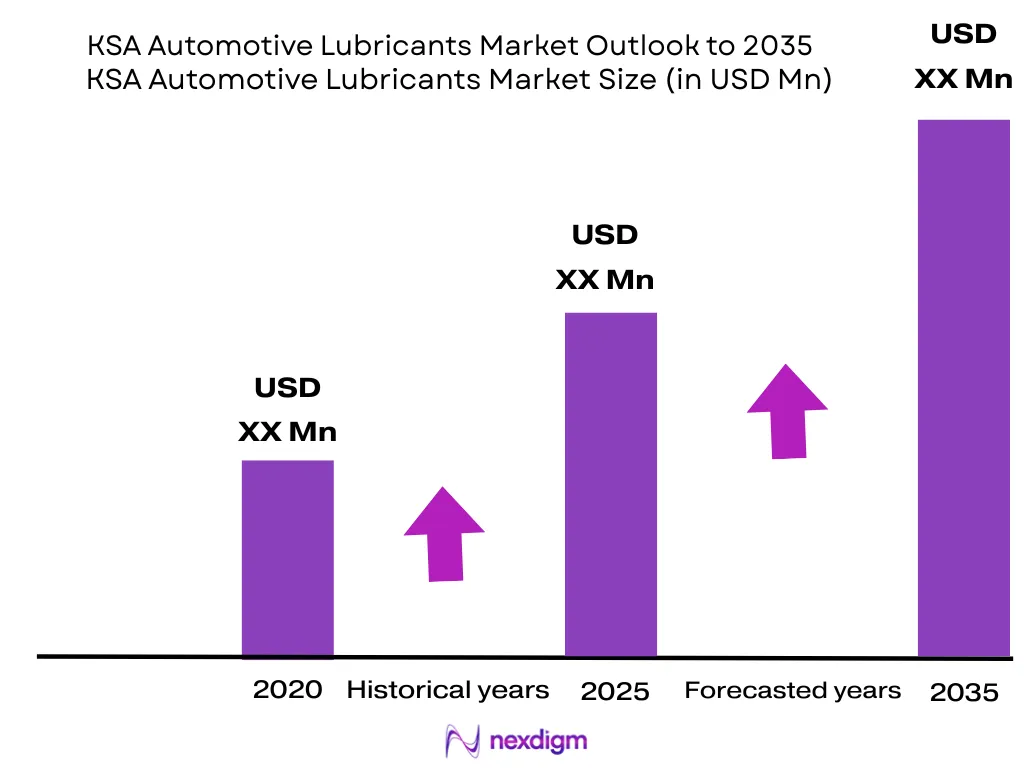
The KSA Automotive Lubricants Market is valued at approximately ~ million, supported by registered and roadworthy vehicles increasing from 14.8 million to 15.8 million, while newly registered vehicles rose from 878,100 units to 1,025,700 units. The large installed internal-combustion vehicle base creates recurring requirements for passenger-car motor oil, heavy-duty diesel oils, transmission fluids, gear oils, greases and coolants across dealerships, workshops, quick-lube centres and commercial fleet maintenance networks. Riyadh, Jeddah and the Eastern Province represent the principal demand centres because they combine dense vehicle populations, logistics activity, commercial fleets, workshops and lubricant distribution infrastructure. Road freight imports through land ports increased from 11.4 million tonnes to 12.2 million tonnes, while activated logistics centres increased from 22 to 23, covering 34.6 million square metres. Makkah Region alone hosts 6 logistics centres covering 20.4 million square metres, reinforcing western Saudi Arabia’s commercial mobility ecosystem.
Market Segmentation
By Product Type
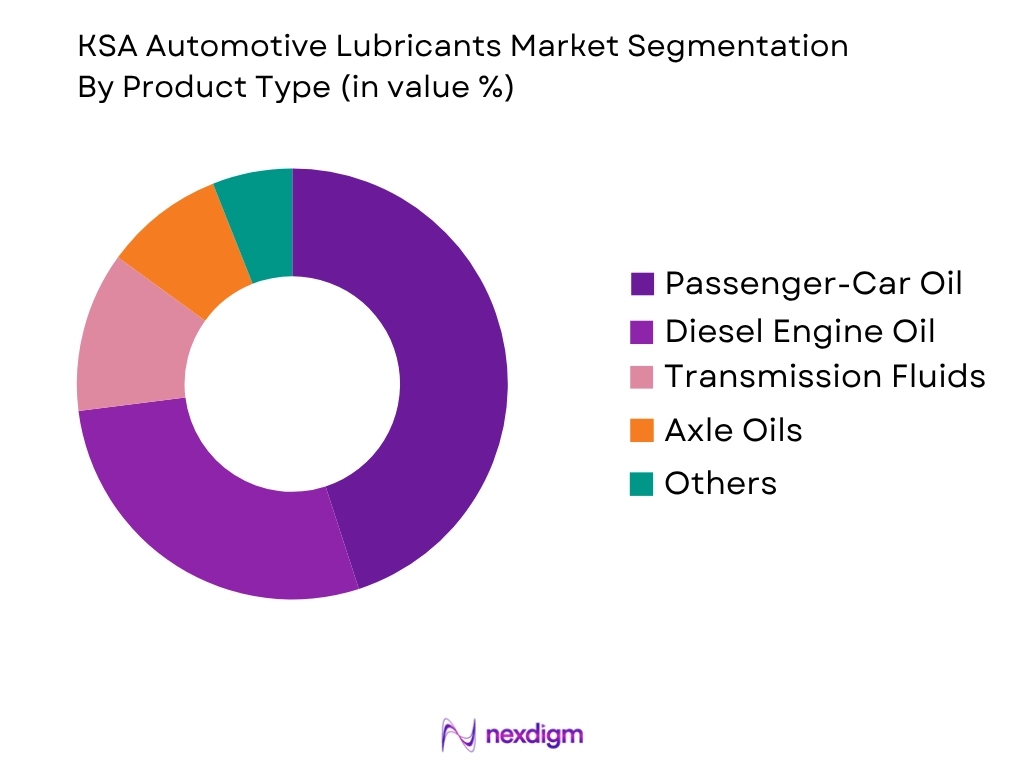
The KSA Automotive Lubricants Market is segmented into passenger-car motor oil, heavy-duty diesel engine oil, transmission fluids, gear and axle oils, automotive greases, coolants and functional fluids, and emerging EV fluids. Passenger-car motor oil dominates this segmentation because Saudi Arabia operates more than 15.8 million registered and roadworthy vehicles, while more than 1.02 million vehicles entered registration as new issues during the latest reporting period. Passenger vehicles, SUVs and pickups constitute a broad service-fill base and require periodic crankcase lubrication throughout their operating lives. Extreme ambient temperatures strengthen demand for thermally stable synthetic and semi-synthetic formulations, while newer Japanese, Korean, European and Chinese vehicles increasingly require low-viscosity API-, ACEA- and OEM-approved products. Heavy-duty diesel oils remain strategically significant because freight, logistics, construction and distribution fleets have larger sump capacities and intensive utilisation, but passenger-car engine oils benefit from the widest installed vehicle population and aftermarket service footprint.
By Lubricant Technology
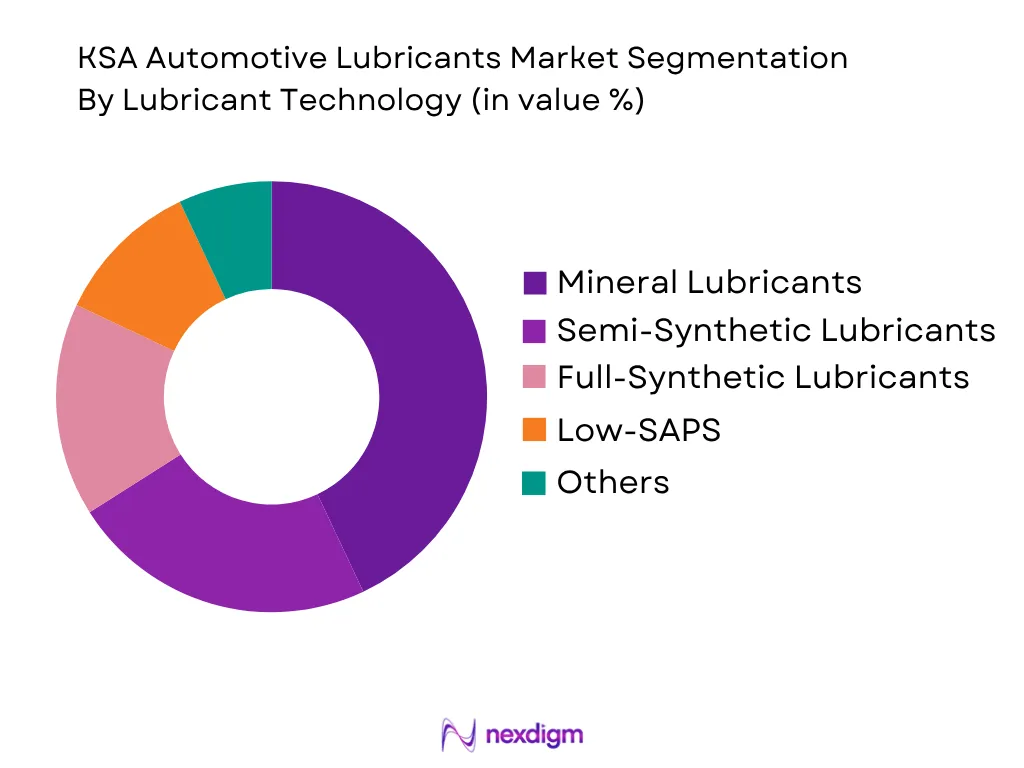
The KSA Automotive Lubricants Market is segmented into mineral, semi-synthetic, full-synthetic, low-SAPS and extended-drain lubricants, re-refined products, and hybrid/EV-specific fluids. Full-synthetic and semi-synthetic products collectively form the dominant technology group, supported by harsh climatic conditions, increasing vehicle sophistication and stronger OEM lubricant specifications. New registrations exceeded 1,025,700 vehicles, compared with 878,100 vehicles in the preceding period, continuously adding newer engines and transmissions that frequently require lower-viscosity and higher-performance products. Synthetic formulations provide stronger oxidation stability, viscosity retention and turbocharger protection under high-temperature operating conditions, making them particularly relevant to Saudi passenger vehicles, SUVs and commercial fleets. Mineral lubricants nevertheless retain a meaningful role in older vehicles and price-sensitive applications. EV-specific fluids remain relatively small but are strategically important as Saudi Arabia develops domestic electric-vehicle manufacturing through Lucid, Ceer and wider Vision 2030 automotive localisation initiatives.
Competitive Landscape
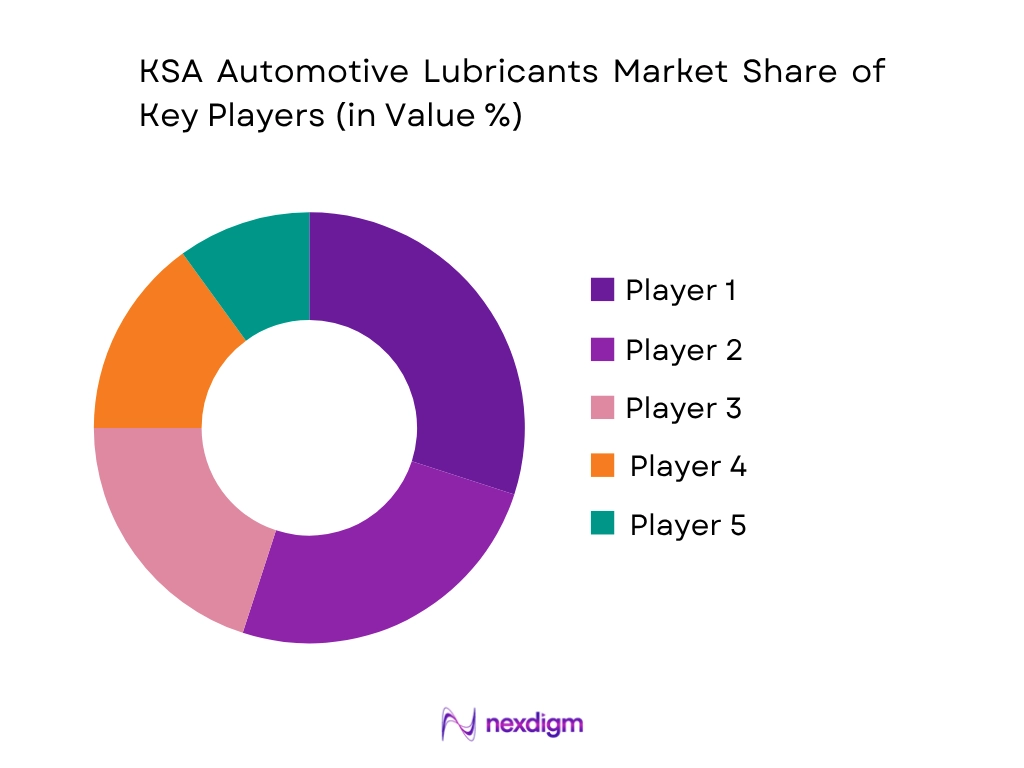
The KSA Automotive Lubricants Market combines a strong domestic production base with established multinational lubricant brands. Petromin’s Petrolube business holds substantial local manufacturing infrastructure, while Shell, Castrol, TotalEnergies and FUCHS compete through synthetic engine oils, heavy-duty lubricants, OEM specifications and fleet solutions. Petromin operates lubricant plants with 165,000 metric tonnes per annum in Jeddah and 60,000 metric tonnes per annum in Riyadh, alongside 12,000 metric tonnes of grease production capacity, giving local production an important competitive role.
| Company | Established | Headquarters | Passenger-Car Portfolio | Heavy-Duty Portfolio | Synthetic Capability | Local Manufacturing / Supply | Distribution Strength | EV / Specialty Fluid Readiness |
| Petromin Corporation | 1968 | Jeddah, Saudi Arabia | ~ | ~ | ~ | ~ | ~ | ~ |
| Shell | 1907 | London, UK | ~ | ~ | ~ | ~ | ~ | ~ |
| Castrol | 1899 | UK | ~ | ~ | ~ | ~ | ~ | ~ |
| TotalEnergies | 1924 | Paris, France | ~ | ~ | ~ | ~ | ~ | ~ |
| FUCHS | 1931 | Mannheim, Germany | ~ | ~ | ~ | ~ | ~ | ~ |
KSA Automotive Lubricants Market Analysis
Growth Drivers
Expanding Vehicle Parc and Intensifying Road Mobility
Saudi Arabia’s expanding vehicle population is creating a structurally larger service-fill base for engine oils, transmission fluids, axle lubricants, coolants and greases. The General Authority for Statistics recorded approximately 15.8 million registered and roadworthy vehicles in 2024, up from about 14.8 million vehicles in 2023, while newly registered vehicles increased from approximately 878,100 units to 1,025,700 units. This addition of more than 1 million newly registered vehicles is particularly relevant for premium automotive lubricants because newer engines increasingly specify low-viscosity synthetic oils, advanced automatic-transmission fluids and manufacturer-approved formulations. Saudi Arabia’s physical scale further reinforces vehicle utilisation: the Kingdom covers roughly 2.15 million square kilometres, making road mobility central to passenger movement, freight transportation and intercity commerce. Macroeconomic conditions provide additional support. The World Bank recorded Saudi Arabia’s nominal GDP at approximately USD 1.24 trillion in 2024 and population at about 35.3 million people, while GDP per capita stood at approximately USD 35,122. The IMF recorded real GDP growth of 2.0 in 2024, with non-oil GDP expanding by 4.5, demonstrating continued activity across trade, transport, construction and consumer services. For lubricant suppliers, these conditions create a diversified demand structure extending beyond private cars into SUVs, pickups, taxis, rental fleets and commercial vehicles. Saudi driving conditions also expose engines and drivetrains to elevated ambient temperatures and long-distance travel, strengthening requirements for oxidation stability, viscosity retention and thermal protection. Consequently, growth is increasingly shifting from basic mineral engine oils toward semi-synthetic and full-synthetic formulations, while the expansion of newer vehicle registrations increases demand for SAE 0W-20, 5W-30 and other OEM-specified grades.
Non-Oil Economic Expansion, Logistics Activity and Commercial Fleets
Expansion of Saudi Arabia’s non-oil economy is strengthening lubricant consumption among trucks, light commercial vehicles, delivery fleets, construction vehicles and other high-utilisation automotive assets. The IMF reported non-oil GDP growth of 4.5 in 2024, substantially exceeding overall real GDP growth of 2.0, demonstrating the continuing expansion of economic activities that depend heavily on road transportation. The same institution projected non-oil activity to expand by 3.4 in 2025 and 3.5 in 2026, while total real GDP was projected at 3.6 and 3.9, respectively. These indicators matter to automotive lubricant demand because logistics, warehousing, retail distribution, tourism, construction and industrial projects generate considerably greater annual vehicle kilometres than privately owned cars. Saudi road-transport infrastructure is already supporting this movement: GASTAT reported roughly 13.4 million tonnes of road-freight exports through land ports and 12.2 million tonnes of imports in 2024, alongside 23 activated logistics centres covering around 34.6 million square metres. The Kingdom also had more than 12,200 licensed commercial warehouses, creating substantial last-mile and intercity delivery requirements. Commercial vehicles operating in such environments consume heavy-duty diesel engine oils, gear lubricants, transmission fluids, differential oils, greases and coolants in larger quantities per maintenance cycle than passenger vehicles. Vision 2030 investment is reinforcing this demand by expanding logistics, industrial manufacturing and infrastructure activity. The IMF noted that domestic demand remained supported by government-led projects and private investment, while Saudi Arabia entered 2026 after GDP expanded strongly during 2025. For lubricant suppliers, this creates an opportunity to move from individual packaged-oil sales toward integrated fleet contracts involving bulk delivery, scheduled lubricant replacement, oil-condition monitoring and preventive maintenance. Heavy-duty applications also support higher-specification API CK-4, low-SAPS and extended-drain products, allowing suppliers to compete on equipment reliability and total operating efficiency rather than basic product availability.
Market Challenges
Increasing Complexity of Vehicle and Lubricant Specifications
The increasing technological diversity of Saudi Arabia’s vehicle fleet creates a significant operational challenge for lubricant manufacturers, distributors and workshops because a rapidly expanding vehicle parc requires a much broader range of technically differentiated products. Saudi Arabia had approximately 15.8 million registered and roadworthy vehicles in 2024, while more than 1.025 million newly registered vehicles entered the fleet. These additions increasingly include turbocharged petrol engines, modern diesel engines, hybrids and vehicles equipped with continuously variable, dual-clutch and multi-speed automatic transmissions. As a result, workshops can no longer rely on a limited assortment of conventional engine oils. Newer vehicles require SAE 0W-20, 0W-30, 5W-30 and other low-viscosity products alongside API SP, ACEA categories and manufacturer-specific approvals, while older vehicles continue to require 10W-40, 15W-40, 20W-50 and legacy specifications. The vehicle base therefore creates simultaneously expanding requirements for both advanced and traditional lubricants. SASO’s dedicated Technical Regulation for Lubricating Oils adds another compliance layer because products marketed in Saudi Arabia must conform to applicable performance, labeling and conformity requirements. This becomes particularly important as the Kingdom’s automotive manufacturing strategy broadens the mix of Asian, European, American and locally assembled vehicles. Macroeconomic expansion compounds inventory pressure: the World Bank placed national GDP at approximately USD 1.24 trillion in 2024, while the IMF recorded non-oil GDP growth of 4.5, supporting additional commercial vehicle activity and therefore further product differentiation. Distributors must maintain sufficient stocks across engine oils, automatic-transmission fluids, CVT fluids, gear oils, coolants and greases without allowing slow-moving SKUs to tie up working capital. Workshops simultaneously require technical training to prevent misapplication, since the wrong viscosity or transmission fluid can affect fuel efficiency, emissions equipment and component durability. The challenge therefore is not lack of demand but managing an increasingly fragmented demand pool while maintaining technical compliance and availability across Saudi Arabia’s geographically dispersed service network.
Electrification and Gradual Reduction in Conventional Lubricant Intensity
Saudi Arabia’s development of a domestic electric-vehicle manufacturing ecosystem presents a long-term structural challenge for conventional automotive lubricant suppliers because battery-electric vehicles eliminate routine crankcase engine-oil changes and use substantially different fluid architectures. Vision 2030 identifies Ceer, Lucid and Hyundai-related automotive investments as part of the Kingdom’s broader automotive localisation strategy, while Lucid has already established manufacturing operations in the country. These investments do not immediately threaten the existing aftermarket because Saudi Arabia still operates approximately 15.8 million registered and roadworthy vehicles, overwhelmingly supported by conventional petrol and diesel powertrains. However, every incremental electric vehicle entering the fleet changes the lifetime fluid-consumption profile from engine oil toward e-drive fluids, reduction-gear lubricants, thermal-management coolants and electrically compatible greases. The challenge is therefore one of portfolio transition rather than immediate volume displacement. Manufacturers must continue supplying millions of internal-combustion vehicles while investing simultaneously in products for emerging electric architectures. This adds formulation, laboratory testing, OEM approval and technical-training requirements. The macroeconomic environment indicates that the transition can continue receiving investment support. World Bank data places Saudi Arabia’s nominal GDP around USD 1.24 trillion in 2024, while the IMF reported non-oil economic expansion of 4.5 in 2024 and projected continued non-oil growth in 2025 and 2026. Vision 2030 programmes are specifically designed to build domestic manufacturing capacity, making automotive electrification part of a broader industrial strategy rather than only an imported consumer trend. Conventional lubricant companies consequently face a capital-allocation problem: they must preserve competitiveness across high-volume ICE oils while preparing for lower-volume but technically demanding electric drivetrain fluids. Companies that delay adaptation risk losing OEM and dealer relationships as local vehicle manufacturing matures, whereas excessive early investment may precede meaningful aftermarket demand. Maintaining both portfolios efficiently will therefore become one of the industry’s central strategic challenges through the coming decade.
Market Opportunities
Synthetic Lubricants, Fleet Solutions and Predictive Maintenance
Saudi Arabia’s rapidly renewing vehicle fleet creates a strong future opportunity for premium synthetic oils and technology-enabled fleet lubrication services. More than 1.025 million vehicles were newly registered in 2024, compared with approximately 878,100 vehicles in 2023, continuously increasing the population of engines and transmissions designed around modern lubricant specifications. The total registered and roadworthy fleet reached approximately 15.8 million vehicles, providing a substantial installed base from which suppliers can segment products according to vehicle age, duty cycle and drivetrain technology. Newer passenger vehicles create demand for low-viscosity full-synthetic engine oils and sophisticated automatic-transmission fluids, whereas commercial fleets generate opportunities for API CK-4 diesel oils, extended-drain lubricants, differential fluids, greases and coolants. The logistics environment makes the commercial opportunity particularly significant. Saudi Arabia operated 23 activated logistics centres spanning around 34.6 million square metres, while more than 12,200 licensed commercial warehouses supported national distribution activity. These facilities depend on trucks, vans and last-mile delivery vehicles whose high annual utilisation intensifies lubricant replacement requirements. Macroeconomic indicators reinforce the opportunity: the IMF recorded Saudi non-oil GDP growth of 4.5 in 2024 and projected continued expansion during 2025 and 2026, while World Bank data placed national economic output at approximately USD 1.24 trillion in 2024. Rather than merely supplying lubricant containers, manufacturers can use this fleet concentration to develop multi-year maintenance agreements incorporating bulk oil supply, lubricant consolidation, used-oil analysis, contamination monitoring and optimized drain intervals. Digital oil-condition monitoring can identify viscosity degradation, coolant contamination, wear metals and abnormal engine conditions before mechanical failures occur. Such services strengthen customer retention and transform lubricant providers into equipment-reliability partners. Consequently, the strongest future opportunity lies in combining premium synthetic formulations with technical services, particularly for logistics, rental, ride-hailing, government and construction fleets that operate vehicles intensively and place a high value on uptime.
Local Automotive Manufacturing and Next-Generation EV Fluid Development
Saudi Arabia’s emerging automotive manufacturing ecosystem creates a future growth avenue for factory-fill lubricants, locally approved service-fill products and specialised electric-vehicle fluids. Vision 2030 identifies the development of domestic automotive manufacturing through companies including Ceer, Lucid and Hyundai, establishing a foundation for greater localisation of vehicles and components. Lucid’s Saudi manufacturing presence and Ceer’s development as the Kingdom’s first domestic electric-vehicle brand indicate that lubricant suppliers will increasingly have opportunities to participate earlier in vehicle-development and assembly programmes rather than competing only in aftermarket distribution. Such relationships can generate demand for factory-fill engine oils, transmission fluids, greases and coolants for conventional and hybrid vehicles, while electric vehicles create requirements for e-axle fluids, reduction-gear oils, motor-bearing greases and battery thermal-management fluids. The scale of the existing automotive ecosystem makes localisation commercially relevant: Saudi Arabia recorded approximately 15.8 million registered and roadworthy vehicles in 2024, with more than 1.025 million new vehicle registrations during the year. Macroeconomic conditions also support continued industrial investment. World Bank data records GDP of approximately USD 1.24 trillion in 2024, while the IMF reported non-oil GDP growth of 4.5 in 2024 and projected additional expansion through 2025 and 2026. The IMF also reported that the Saudi economy entered 2026 with strong momentum following substantial overall economic expansion in 2025. Domestic lubricant manufacturing already demonstrates industrial capability, meaning future growth can increasingly involve specialised formulation, OEM validation, private-label manufacturing and GCC distribution rather than basic finished-product imports. Suppliers establishing local laboratories and technical-development capabilities could work directly with vehicle assemblers to optimise fluids for Saudi thermal conditions. This positions localisation as more than a production opportunity: it can move the KSA Automotive Lubricants Market toward technically differentiated, higher-performance and export-capable products while creating an early foothold in the next generation of automotive fluid requirements.
Future Outlook
The KSA Automotive Lubricants Market is projected to grow at approximately ~XX% CAGR during 2026-2035, supported by vehicle-parc expansion, commercial mobility, logistics activity, automotive manufacturing localisation and continued replacement demand from Saudi Arabia’s large internal-combustion fleet. The most important shift will be from basic mineral oils toward semi-synthetic, full-synthetic, low-viscosity and OEM-approved lubricants. Newer turbocharged engines and advanced automatic transmissions require increasingly precise specifications, strengthening value growth even when oil-drain intervals become longer. Commercial transport will remain a major consumption pillar. Saudi Arabia handled 13.4 million tonnes of road freight exports and 12.2 million tonnes of road freight imports through land ports, while the wider logistics ecosystem includes 12,234 licensed commercial warehouses and more than 290 million fulfilled delivery orders. These activities support high-utilisation vans, trucks and delivery fleets requiring engine oils, transmission fluids, axle lubricants and greases. Local manufacturing should also become more influential. Saudi Vision 2030’s automotive strategy encompasses Lucid, Ceer, Hyundai and related automotive industrial investments, creating longer-term opportunities in factory-fill lubricants, local OEM approvals, thermal-management fluids and technically specialised service-fill products.
Major Players
- Petromin Corporation – Petrolube
- Saudi Aramco / Valvoline
- Shell Saudi Arabia
- Castrol Saudi Arabia
- TotalEnergies Saudi Arabia
- ExxonMobil – Mobil
- FUCHS Saudi Arabia
- Gulf Oil Middle East
- PETRONAS Lubricants International
- Motul Middle East
- LIQUI MOLY Saudi Arabia
- Repsol Lubricants
- Chevron – Caltex Lubricants
- ENEOS
- Ravenol
Key Target Audience
- Automotive lubricant manufacturers and lubricant blenders
- Base-oil and lubricant additive suppliers
- Passenger and commercial vehicle OEMs
- Automotive distributors, workshops and quick-lube operators
- Logistics, rental, ride-hailing and commercial fleet operators
- Automotive component and transmission-system manufacturers
- Investments and venture capitalist firms
- Government and regulatory bodies (Saudi Standards, Metrology and Quality Organization; Ministry of Industry and Mineral Resources; Ministry of Transport and Logistic Services; Saudi Authority for Industrial Cities and Technology Zones)
Research Methodology
Step 1: Identification of Key Variables
The initial phase involves developing an ecosystem map covering base-oil producers, lubricant blenders, additive suppliers, automotive OEMs, distributors, workshops, quick-lube centres, logistics fleets and government stakeholders. Core variables include registered vehicle population, newly registered vehicles, annual mileage, sump capacities, drain intervals, viscosity grades, synthetic penetration, commercial fleet utilisation and regional distribution intensity.
Step 2: Market Analysis and Construction
Historical demand is constructed through bottom-up assessment of passenger cars, SUVs, pickups, light commercial vehicles, heavy trucks, buses and specialist fleets. GASTAT’s administrative records provide the vehicle and road-transport foundation, including 15.8 million registered and roadworthy vehicles and 1.0257 million newly registered vehicles. Supply-side assessment integrates blending capacity, finished lubricant availability, aftermarket penetration and local production.
Step 3: Hypothesis Validation and Expert Consultation
Market hypotheses are validated through computer-assisted telephone interviews with lubricant manufacturers, distributors, OEM dealerships, independent workshop operators, quick-lube businesses and commercial fleet managers. Interviews assess oil-change frequency, SAE-grade preferences, synthetic conversion, brand selection, bulk procurement, OEM approvals, fleet maintenance contracts and willingness to adopt technologically advanced lubricants.
Step 4: Research Synthesis and Final Output
Demand-side calculations are triangulated against vehicle registrations, freight movement, logistics infrastructure and lubricant production capacity. Petromin’s plants provide a domestic supply benchmark through 165,000 metric tonnes of annual capacity in Jeddah, 60,000 metric tonnes in Riyadh and 12,000 metric tonnes of grease capacity, while SASO standards provide the product-compliance framework used to validate market boundaries.

- Executive Summary
- Research Methodology (Market Definitions and Assumptions, Abbreviations, Market Sizing Approach, Top-Down Analysis, Bottom-Up Analysis, Vehicle Parc Assessment, Vehicle Sales Assessment, Annual Mileage Mapping, Sump Capacity Analysis, Oil Drain Interval Assessment, Passenger Vehicle Demand Assessment, Commercial Fleet Demand Assessment, Workshop and Quick-Service Assessment, Lubricant Blending and Import Analysis, Primary Industry Interviews, Distributor Interviews, Fleet Operator Interviews, Data Triangulation, Forecasting Framework, Limitations and Future Conclusions)

- Definition and Scope
- Market Evolution and Industry Genesis
- Evolution of Passenger Vehicle Lubrication Demand
- Development of Commercial Vehicle Lubrication Ecosystem
- Evolution of Synthetic and Semi-Synthetic Lubricants

- Growth Drivers (Large Vehicle Base, High Annual Mileage, SUV Penetration, Logistics Expansion, Harsh Climate)
- Market Challenges (Base Oil Volatility, Specification Complexity, EV Transition, Counterfeit Risk, Longer Drain Intervals)
- Market Opportunities (Synthetic Oils, Fleet Contracts, Local Blending, EV Fluids, Circular Lubricants)
- Market Trends (Synthetic Migration, OEM Approvals, Quick-Lube Growth, Digital Oil Selection, EV Fluids)
- Government Regulations (SASO Compliance, Lubricating Oil Standards, Workshop Classification, Product Conformity, Waste Management)
- SWOT Analysis
- Porter’s Five Forces Analysis
- PESTLE Analysis

- By Market Value (2020-2025)
- By Lubricant Consumption Volume (2020-2025)
- By Passenger Vehicle Lubricant Value (2020-2025)

- By Product Type (In Value %)
Passenger Car Motor Oil
Heavy-Duty Diesel Engine Oil
Automatic Transmission Fluid
Continuously Variable Transmission Fluid
Dual-Clutch Transmission Fluid - By Lubricant Technology (In Value %)
Mineral Lubricants
Semi-Synthetic Lubricants
Full-Synthetic Lubricants
Low-Viscosity Synthetic Lubricants
Low-SAPS Lubricants - By Vehicle Type (In Value %)
Passenger Cars
SUVs and Crossovers
Pickup Trucks
Light Commercial Vehicles
Medium Commercial Vehicles - By Region (In Value %)
Riyadh Region
Makkah Region
Eastern Province
Madinah Region
Qassim Region
Asir Region

- Market Share of Major Players (By Value, Volume, Vehicle Type, Product Type, Distribution Channel)
- Cross Comparison Parameters (Automotive and Heavy-Duty Lubricant Portfolio Breadth, API–ACEA–OEM Approval Portfolio, Full-Synthetic and Low-Viscosity Product Strength, Domestic Blending and Production Capacity, Quick-Lube–Workshop–Fuel Station Network Reach, Commercial Fleet and Heavy-Duty Lubricant Capability, Oil Analysis and Technical Service Capability, EV Fluid–Used Oil–Circular Lubricant Readiness)
- SWOT Analysis of Major Players
- Detailed Profiles of Major Companies
Petromin Corporation – Petrolube
Saudi Aramco / Valvoline
Shell Saudi Arabia
Castrol Saudi Arabia
TotalEnergies Saudi Arabia
ExxonMobil – Mobil
FUCHS Saudi Arabia
Gulf Oil Middle East
PETRONAS Lubricants International
Motul Middle East
LIQUI MOLY Saudi Arabia
Repsol Lubricants
Chevron – Caltex Lubricants
ENEOS
Ravenol

- Passenger Car Owner Analysis
- SUV and Pickup Owner Analysis
- Taxi and Ride-Hailing Operator Analysis
- Rental Vehicle Fleet Analysis
- Commercial Fleet Analysis
- Heavy Truck Fleet Analysis

- By Market Value (2026-2035)
- By Lubricant Consumption Volume (2026-2035)
- By Passenger Vehicle Lubricant Value (2026-2035)


 Request a Sample
 Ask for Customization
 Get a Quote
 Enquire Now