

 Download PDF
Market Overview
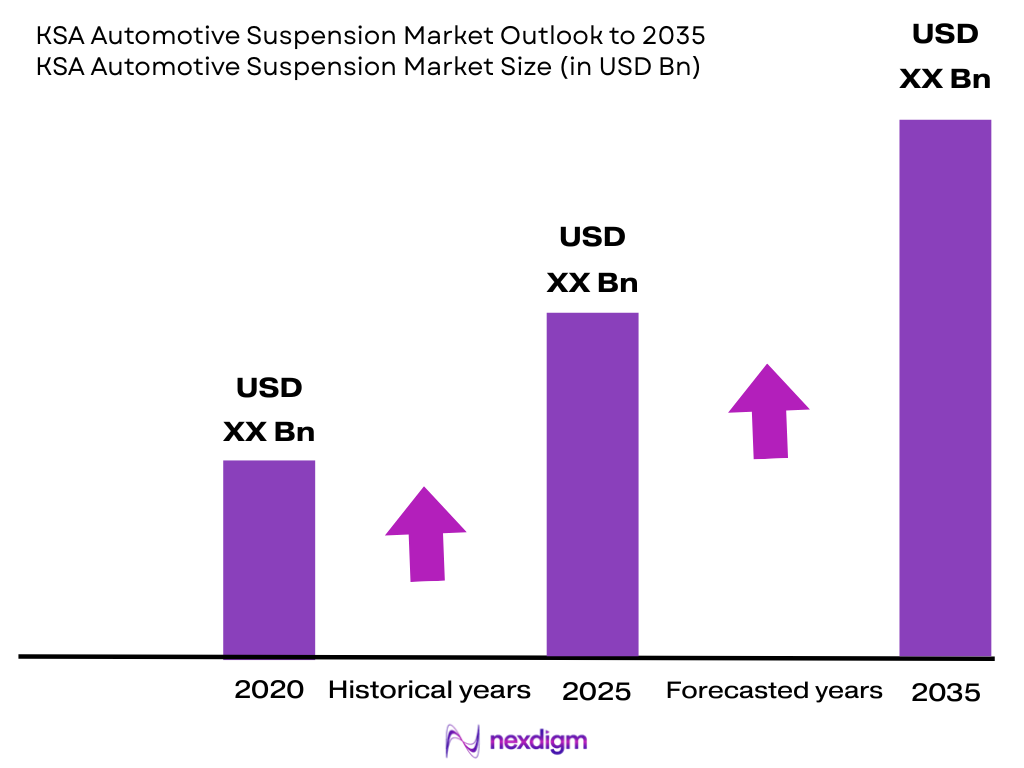
The KSA Automotive Suspension Market is valued at approximately USD ~ billion, compared with USD ~ billion in the preceding annual benchmark. Saudi Arabia’s registered and roadworthy vehicle base expanded from 14.8 million vehicles to 15.8 million vehicles, while newly issued vehicle registrations increased from 878,100 units to 1,025,700 units. This expanding installed base supports OE and replacement demand for shocks, struts, springs, control arms, bushings, air suspension and electronic ride-control components. Riyadh, Jeddah, King Abdullah Economic City and the Eastern Province dominate the KSA Automotive Suspension Market because they combine the largest automotive retail and service ecosystems with fleet activity, logistics operations and emerging domestic manufacturing. KAEC established Saudi Arabia’s first automotive assembly facility with initial capacity of 5,000 vehicles annually, followed by a SAR 5 billion construction contract for Ceer’s EV manufacturing complex, materially strengthening suspension and chassis localization opportunities around the western automotive corridor.
Saudi Arabia’s automotive suspension ecosystem is shifting from a predominantly import-and-aftermarket model toward a mixed manufacturing, localization and replacement-demand market. The General Authority for Statistics reports more than 15.8 million registered and roadworthy vehicles, with more than 1.02 million newly registered vehicles entering the fleet in the latest base period. This creates continuing demand for safety-critical suspension components even before the emerging domestic vehicle manufacturing sector is considered. The market has particularly strong exposure to SUVs, full-size 4x4s and pickup trucks because Saudi mobility patterns involve extensive highway travel, desert terrain, high ambient temperatures and recreational off-road driving. These vehicle categories use larger dampers, stronger coil springs, reinforced suspension linkages and, increasingly, adaptive air suspension. Premium European and American SUVs add high-value replacement demand for electronically controlled dampers, ride-height sensors, air compressors and active chassis components.
Market Segmentation
By Vehicle Type
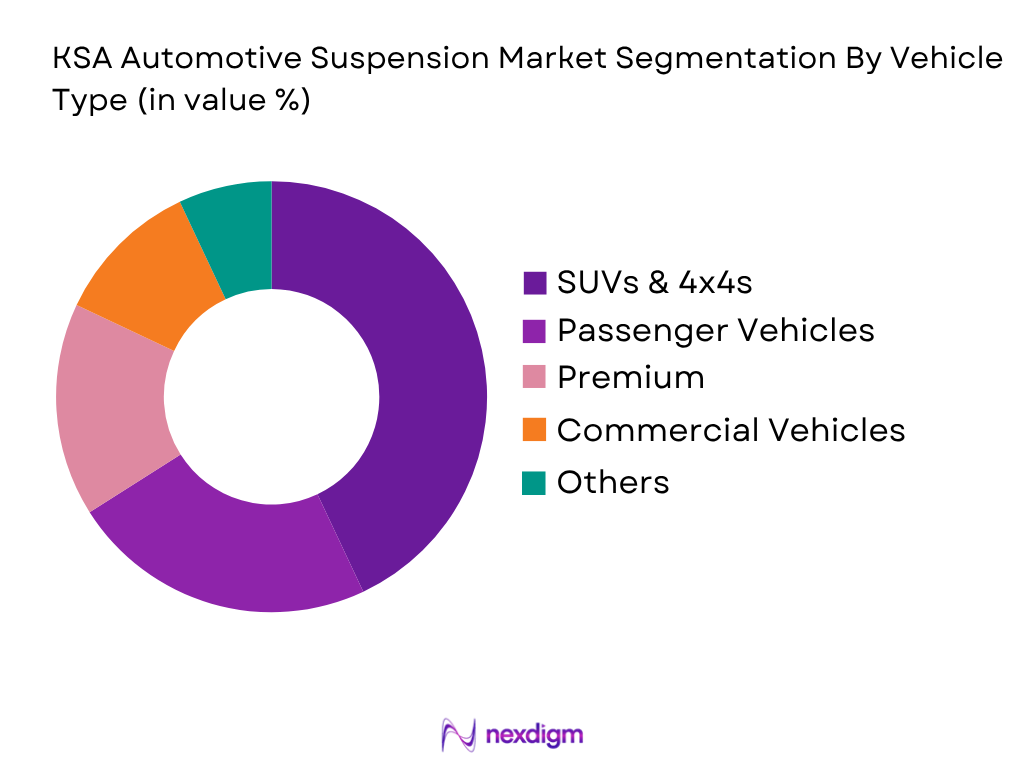
The KSA Automotive Suspension Market is segmented into SUVs and 4x4s, passenger cars, premium and luxury vehicles, commercial vehicles, and electric vehicles. SUVs and 4x4s represent the dominant market segment because Saudi operating conditions strongly favour vehicles with elevated ground clearance, heavy-duty chassis architecture and higher payload capability. Large SUVs require higher-capacity dampers, stronger springs and robust control arms, while desert and dune users create a secondary upgrade market for remote-reservoir shocks, long-travel systems and lift kits. Luxury SUVs compound this value through adaptive air suspension and electronically variable damping. Passenger cars retain substantial volume because Saudi Arabia has more than 15.8 million vehicles in operation, while commercial vehicles generate intensive replacement demand due to freight mileage and axle loading.
By Suspension Technology
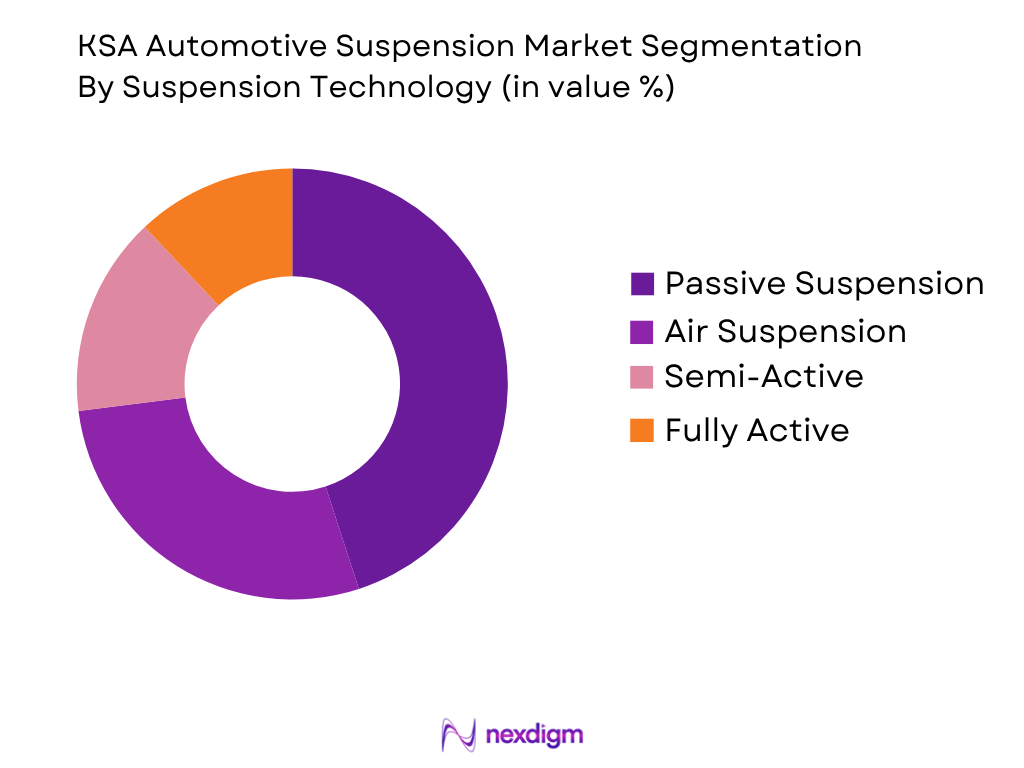
The KSA Automotive Suspension Market is segmented into passive suspension, air suspension, semi-active/electronically controlled suspension and fully active suspension. Passive suspension retains the dominant market position because conventional hydraulic dampers, coil springs and leaf springs remain installed across most Japanese SUVs, passenger cars, pickups and commercial vehicles. Air suspension nevertheless represents an unusually important Saudi replacement category due to the popularity of high-specification luxury SUVs. Semi-active suspension is gaining relevance as premium vehicles and EVs increasingly integrate electronically variable damping. Lucid’s local manufacturing expansion and Ceer’s planned EV portfolio strengthen the future addressable base for electronically controlled ride systems specifically calibrated for battery mass and high-temperature regional operation.
Competitive Landscape
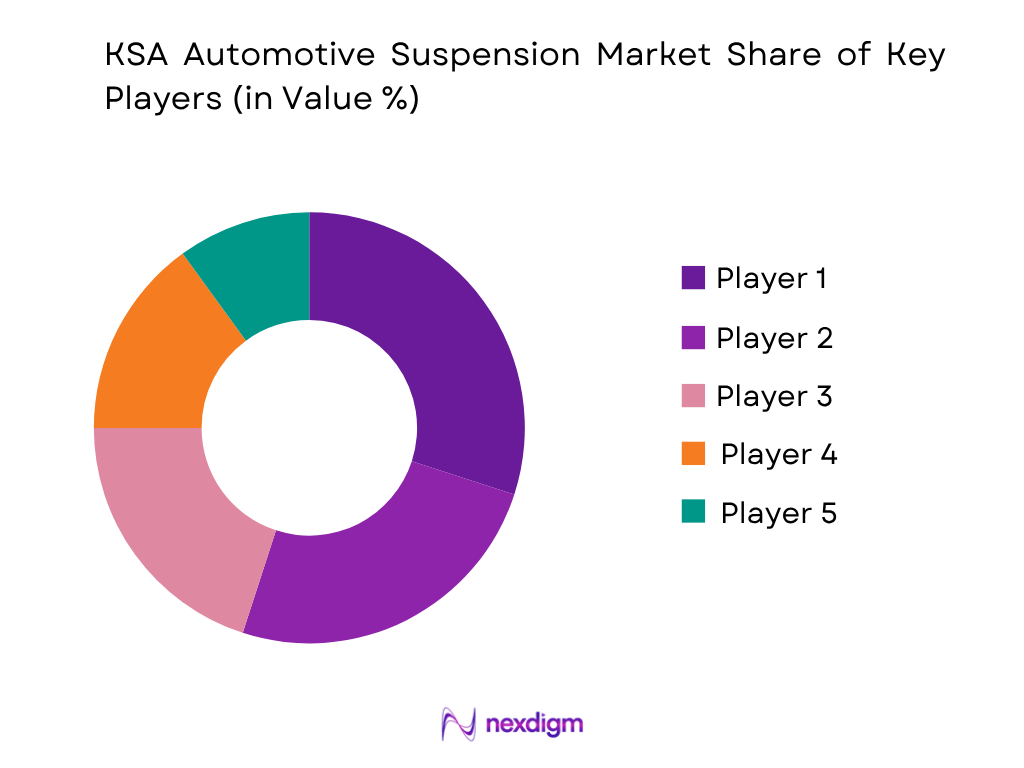
The KSA Automotive Suspension Market is served by global OE chassis suppliers, Japanese shock-absorber manufacturers, European premium suspension brands and specialist off-road companies. Competition varies significantly by application: ZF and Tenneco/Monroe compete through OE-equivalent and advanced chassis technologies; KYB has strong relevance across Japanese vehicle applications; BILSTEIN targets premium and performance users; and ARB/Old Man Emu serves heavy-duty 4×4 and desert applications. ZF’s Middle East aftermarket infrastructure supplies genuine parts and repair solutions across the region, while BILSTEIN maintains an international suspension specialist and installation network.
| Major Player | Establishment | Headquarters | Core Suspension Portfolio | KSA-Relevant Vehicle Coverage | Electronic / Air Suspension Capability | Desert / Heavy-Duty Capability | Aftermarket Strength | Strategic Position |
| ZF Friedrichshafen AG | 1915 | Friedrichshafen, Germany | ~ | ~ | ~ | ~ | ~ | ~ |
| KYB Corporation | 1919 | Tokyo, Japan | ~ | ~ | ~ | ~ | ~ | ~ |
| Tenneco / Monroe | 1999 current structure | Northville, USA | ~ | ~ | ~ | ~ | ~ | ~ |
| thyssenkrupp BILSTEIN | 1873 heritage | Ennepetal, Germany | ~ | ~ | ~ | ~ | ~ | ~ |
| ARB / Old Man Emu | 1975 | Melbourne, Australia | ~ | ~ | ~ | ~ | ~ | ~ |
KSA Automotive Suspension Market Analysis
Growth Drivers
Expanding Vehicle Parc, SUV Usage and Road-Freight Activity
Saudi Arabia’s expanding vehicle base is directly increasing demand for shock absorbers, struts, coil springs, leaf springs, control arms, ball joints and suspension bushings. General Authority for Statistics data show 15.8 million registered and roadworthy vehicles in 2024, compared with 14.8 million vehicles in 2023, while new registrations increased from 878,100 vehicles to 1,025,700 vehicles. This means more than one million additional vehicles entered the registration system during the year, continuously expanding the future replacement pool for suspension suppliers and workshops. The Saudi operating environment also favours SUVs, pickups and large vehicles designed for highway and desert use. These platforms typically require larger dampers, stronger springs, greater suspension travel and more robust joints than compact passenger cars. Commercial transport adds another high-utilisation demand stream. Road-freight imports through Saudi land ports reached 12.2 million tons in 2024, compared with 11.4 million tons in 2023, while road-freight exports reached 13.4 million tons. Heavy trucks and delivery vehicles supporting these freight flows experience repeated axle loading and long-distance operation, creating recurring requirements for heavy-duty dampers, leaf springs, torque rods and bushings. More than 1.27 million new driving licences were also issued during 2024, compared with 1.19 million in 2023, indicating continued expansion of the driving population. The macroeconomic environment reinforces this mobility demand. World Bank data place Saudi Arabia’s GDP at approximately USD 1.24 trillion in 2024, while its population reached 35,300,280 people and GDP per capita stood at USD 35,121.7. The IMF separately recorded non-oil real GDP expansion of 4.5 units for every 100 units of output in 2024, supported by construction, hospitality, retail and other domestic sectors. These economic activities generate passenger travel, construction fleets and logistics movements that directly expose suspension systems to mileage and loading cycles. For the KSA Automotive Suspension Market, the important implication is that replacement demand is supported simultaneously by growth in the registered parc, high SUV utilisation, commercial freight activity and an expanding driver base rather than relying only on new vehicle sales.
Automotive Industrialisation and Emerging Domestic EV Manufacturing
Saudi Arabia’s transition toward domestic vehicle manufacturing is creating a new original-equipment growth driver for the automotive suspension industry. The Public Investment Fund announced the King Salman Automotive Cluster in King Abdullah Economic City in 2025, bringing together Lucid, Ceer, Hyundai and related suppliers within an integrated automotive manufacturing ecosystem. Lucid’s AMP-2 facility already has installed semi-knocked-down assembly capacity of 5,000 vehicles annually, while construction started in 2024 on a complete-build expansion adding 150,000 vehicles of annual installed capacity. Hyundai’s Saudi joint venture is designed around 50,000 vehicles annually, covering both internal-combustion and electric vehicles. These manufacturing programmes create potential domestic demand for dampers, coil springs, control arms, knuckles, bushings, stabiliser systems and chassis electronics that previously entered Saudi Arabia mainly within fully imported vehicles. Ceer is adding a particularly important localisation pathway. In February 2026, the company signed 16 commercial agreements valued above SAR 3.7 billion, after agreements worth SAR 5.5 billion in the preceding private-sector forum. Ceer also reports partnerships with 263 local companies that have been awarded approximately SAR 6.6 billion of business, while global Tier-1 suppliers including Benteler, Lear and Forvia are participating in the developing automotive ecosystem. This matters for suspension because Benteler and comparable Tier suppliers possess capability in chassis structures, suspension modules and lightweight automotive systems, providing a pathway for technology transfer and local sourcing. Lucid’s complete-build expansion is especially relevant because its vehicle architecture requires advanced suspension systems capable of controlling substantial battery mass while providing premium ride quality. Such vehicles create demand for lightweight aluminium components, electronic dampers, high-performance bushings and potentially air-suspension technologies rather than conventional low-content suspension alone. Macroeconomic diversification supports the industrial shift: the IMF recorded Saudi non-oil GDP growth of 4.5 units per 100 units of output in 2024, while the World Bank reports national output of approximately USD 1.28 trillion in 2025. Saudi Arabia’s automotive strategy is therefore changing the market from a largely imported aftermarket into a hybrid OE-and-replacement ecosystem. Suppliers that establish local machining, spring production, damper assembly, chassis casting or engineering capability can compete for platform nominations while simultaneously serving the Kingdom’s large installed vehicle parc.
Market Challenges
Dependence on Imported Suspension Technology and High OEM Qualification Requirements
The KSA Automotive Suspension Market remains heavily dependent on imported components even as domestic vehicle manufacturing begins to expand. Saudi Arabia already has 15.8 million registered and roadworthy vehicles, but these vehicles represent a broad mix of Japanese, Korean, American, German and other international platforms, creating thousands of suspension fitments across shocks, struts, springs, bushings and electronic chassis components. Moving from imported replacement products to locally manufactured OE suspension involves significantly higher technical requirements. Lucid’s own filings state that each vehicle contains thousands of parts sourced through supplier qualification processes assessing technical capability, quality, cost and manufacturing footprint. Its Saudi AMP-2 facility entered semi-knocked-down assembly with 5,000 vehicles of installed annual capacity, but the complete-build expansion requires new tooling, manufacturing equipment, supply-chain development and engineering personnel. Lucid also notes that the workforce around its Saudi facility, although highly trained, may have limited prior EV-manufacturing experience. Suspension suppliers face the same industrial challenge: mechanical parts such as coil springs or simple brackets can be localised more quickly than semi-active dampers, ride-height sensors, precision valves and aluminium suspension structures. Ceer’s localisation programme illustrates the scale of supplier development required. The company has formed relationships with 263 local companies, while 16 additional agreements worth more than SAR 3.7 billion were announced in 2026. Building an automotive supply base from this foundation requires quality-management systems, fatigue testing, damper dynamometers, metallurgical control, traceability and production approval procedures that satisfy global OEM standards. EV programmes raise the threshold further because heavier battery platforms require precise suspension calibration around axle loads, pitch, roll, wheel control and NVH. Macroeconomic conditions provide substantial industrial resources but do not eliminate the qualification challenge. World Bank data show Saudi GDP of approximately USD 1.24 trillion in 2024 and a population exceeding 35.3 million people, while IMF data show strong non-oil activity. However, large economic scale cannot substitute for vehicle-specific validation experience. Local suspension manufacturers must demonstrate consistent damping curves, spring fatigue life, dimensional precision and reliability under Saudi heat and dust before receiving high-volume platform nominations. Consequently, localisation represents both an opportunity and a restraint: Saudi suppliers can capture domestic manufacturing programmes, but firms lacking automotive-grade engineering, testing and certification capability may remain confined to lower-value mechanical components or aftermarket production.
Extreme Heat, Desert Operation and Increasing Electronic-Suspension Complexity
Saudi Arabia’s operating environment creates significant durability and service challenges for suspension systems because vehicles routinely face high temperatures, airborne sand, long highway distances, heavy payloads and recreational desert use. These conditions affect conventional and electronic suspension differently but increase maintenance demands across both. Hydraulic dampers convert suspension movement into heat, meaning repeated high-speed operation or dune driving can elevate damper-fluid temperatures and reduce damping consistency if components are not designed for severe thermal loads. Rubber suspension bushings, bump stops and sealing elements also experience prolonged heat ageing, while sand and dust increase abrasion risks around exposed shafts and seals. The scale of road use magnifies these stresses: Saudi Arabia had 15.8 million registered vehicles in 2024, while road-freight movements through land ports included 12.2 million tons of imports and 13.4 million tons of exports. Commercial vehicles supporting these freight flows are subjected to high mileage and substantial axle loads, accelerating wear on springs, dampers and suspension joints. Premium SUVs introduce another layer of complexity because adaptive air suspension and electronically controlled dampers rely on compressors, valve blocks, ride-height sensors, acceleration sensors and chassis-control software. An air leak can overwork the compressor, while a faulty height sensor can create incorrect ride height and wheel alignment. Correct repair therefore requires diagnostic equipment rather than only visual inspection. The challenge will grow as local EV manufacturing develops. Lucid’s AMP-2 expansion adds 150,000 vehicles of installed annual complete-build capacity beyond the existing 5,000-unit SKD operation, while Ceer is building an EV supplier base involving hundreds of local companies. Battery-electric vehicles introduce heavier curb weights and quieter cabins, making suspension NVH, damper control and bushing performance more noticeable. Workshops must therefore understand mechanical wear while also diagnosing electronic faults and software-related suspension warnings. Saudi Arabia’s expanding population and non-oil economy increase the number of vehicles and fleets requiring service: World Bank data place the population at 35,300,280 people in 2024, while the IMF reports 36.726 million people in its 2026 country snapshot. The market challenge is consequently shifting from simple component availability toward technical service capability. Suppliers that sell advanced dampers or air-suspension systems increasingly need to provide electronic diagnostic information, installation procedures, calibration support and products validated for extreme-temperature operation.
Market Opportunities
Localisation of EV-Specific Suspension and Advanced Chassis Systems
Saudi Arabia’s emerging automotive manufacturing base creates one of the clearest future opportunities for suspension suppliers because current industrial investments already provide a platform for localised chassis production. Lucid’s AMP-2 facility has 5,000 vehicles of installed SKD capacity, and the company began expansion in 2024 for an additional 150,000 vehicles of annual complete-build capacity. Hyundai’s Saudi joint venture is structured around 50,000 vehicles annually, while Ceer is developing a domestic EV manufacturing and supplier ecosystem inside the King Salman Automotive Cluster. Ceer’s supply-chain localisation programme provides concrete evidence of addressable component opportunities: 16 agreements worth more than SAR 3.7 billion were signed in 2026, following SAR 5.5 billion of agreements announced previously, and 263 Saudi companies have already received approximately SAR 6.6 billion of business from Ceer. These present-day investments can support future local manufacturing of coil springs, forged and cast control arms, suspension knuckles, bushings, anti-roll bars and eventually electronic dampers. EV-specific suspension is particularly attractive because battery packs add mass and alter front-to-rear weight distribution, making conventional suspension calibration unsuitable without modification. Saudi-produced EVs will require springs designed around specific axle loads, damping curves optimised for battery mass, structural parts engineered for weight reduction and elastomer systems tuned for low drivetrain NVH. Lightweight aluminium control arms and knuckles could offset some additional battery weight, while semi-active damping offers premium ride control without the full complexity of fully active systems. The developing Saudi automotive cluster also supports broader technology transfer. PIF explicitly identifies local supply-chain participation opportunities around Ceer, Lucid and Hyundai, while Tier-1 groups are establishing relationships with the domestic ecosystem. Macroeconomic conditions support the industrial investment needed to make localisation commercially viable: the World Bank recorded Saudi GDP at approximately USD 1.24 trillion in 2024, while output increased to about USD 1.28 trillion in 2025. The IMF reported 4.5 units of non-oil real GDP growth per 100 units of output in 2024, reflecting diversification activity relevant to manufacturing. Suspension suppliers can therefore pursue a staged localisation strategy: begin with springs, stamped structures, rubber products and damper assembly; progress into precision valves and aluminium chassis components; and ultimately develop electronic damping, sensors and integrated vehicle-motion systems. This progression would allow Saudi plants to serve local OEM programmes while potentially becoming regional suppliers to GCC vehicle platforms.
Organised Replacement, Fleet Maintenance and Desert-Performance Suspension
Saudi Arabia’s existing vehicle parc provides a major current foundation for future aftermarket expansion. General Authority for Statistics data show 15.8 million registered and roadworthy vehicles in 2024, compared with 14.8 million vehicles in 2023, while 1,025,700 vehicles received new registrations during the year, compared with 878,100 vehicles in the preceding period. Every annual vehicle cohort expands the future replacement base for shocks, struts, bushings, control arms, springs and ball joints. Commercial fleets create particularly attractive recurring demand because road-freight imports through land ports reached 12.2 million tons and exports reached 13.4 million tons in 2024. Trucks supporting these flows operate under repeated axle loads and long-distance conditions, making preventive suspension maintenance commercially important for tyre wear, vehicle stability and fleet uptime. The passenger side creates a different opportunity centred on SUVs and 4x4s. Saudi owners frequently operate large vehicles on highways and desert terrain, creating demand for heavy-duty monotube dampers, remote-reservoir shocks, progressive springs, lift systems and reinforced control arms. Unlike basic replacement components, these products can address specific thermal and suspension-travel requirements associated with dune use. Premium vehicles create another specialised pool for air springs, compressors, electronic dampers and ride-height sensors as vehicles move beyond manufacturer warranty periods. Organised suppliers can differentiate through correct fitment and product authentication rather than competing solely on availability. Saudi Arabia’s diverse imported vehicle parc means accurate digital catalogues are increasingly necessary to match model, trim, axle specification and suspension technology. Workshop training can also improve conversion toward branded components where air suspension or electronically controlled damping requires diagnostic procedures. Macroeconomic conditions provide a strong demand environment for formalised aftermarket services. World Bank figures show GDP per capita of USD 35,121.7 in 2024, while the population reached 35,300,280 people; the IMF’s 2026 country profile records 36.726 million people. The growing driver base is equally relevant: 1.27 million new driving licences were issued during 2024. These current indicators provide a substantial foundation for future replacement demand without relying on speculative forecasts. The strongest opportunity for suspension manufacturers is to segment the market into OE-equivalent products for mainstream vehicles, high-durability systems for commercial fleets, premium electronic replacement for luxury vehicles and specialised desert-performance products for SUVs and pickups, supported by regional warehousing and trained workshop networks.
Future Outlook
The KSA Automotive Suspension Market is forecast to expand at approximately ~ CAGR during 2026–2035. The market is expected to transition from an overwhelmingly imported replacement-component business toward a more diversified ecosystem combining locally manufactured OE components, premium aftermarket products, EV-specific suspension and conventional replacement demand. Domestic automotive manufacturing will be one of the most important structural changes. Lucid’s expanded AMP-2 complete-build facility is scheduled around a designed capacity approaching 150,000 vehicles annually, while PIF’s automotive strategy identifies Lucid and Ceer together as potentially exceeding 300,000 vehicles of annual production. This creates a potential local customer base for springs, dampers, knuckles, control arms, bushings, subframes and suspension electronics.
Ceer will increase this localization opportunity further. Its manufacturing complex is being constructed under a SAR 5 billion contract and is intended to produce electric sedans and SUVs. Ceer has simultaneously expanded commercial agreements with Saudi private-sector suppliers, indicating that supplier localization is moving from policy ambition toward actual sourcing activity. Hyundai represents another future manufacturing anchor. PIF and Hyundai Motor Company established a joint venture targeting production of 50,000 vehicles annually, covering both internal-combustion and electric vehicles. The facility adds another potential OE platform through which suspension manufacturers can enter domestic Saudi production rather than serving the Kingdom solely through imports. The economic backdrop is supportive of automotive demand and industrial investment. The IMF reports that Saudi Arabia’s non-oil real GDP expanded by 4.5% in 2024, while overall economic growth strengthened to 4.6% in 2025. The Kingdom entered 2026 with continued momentum from domestic demand and non-oil activity, reinforcing the environment for automotive manufacturing, logistics fleets and vehicle servicing.
Major Players
- ZF Friedrichshafen AG
- KYB Corporation
- Tenneco / Monroe Ride Solutions
- thyssenkrupp BILSTEIN
- HL Mando Corporation
- BWI Group
- Astemo Ltd. / SHOWA–TOKICO
- Gabriel / MAT Holdings
- Sogefi Group
- BENTELER International
- Magna International
- Fox Factory Holding Corp.
- ARB / Old Man Emu
- KW automotive
- Eibach
Key Target Audience
- Automotive Suspension and Chassis Component Manufacturers
- Passenger Vehicle, SUV and EV Manufacturers
- Automotive Spare Parts Importers and Distributors
- Premium, Luxury and Off-Road Vehicle Dealer Groups
- Commercial Vehicle and Fleet Operators
- Automotive Workshops and Service Networks
- Investments and Venture Capitalist Firms
- Government and Regulatory Bodies (Ministry of Industry and Mineral Resources, Ministry of Investment, Ministry of Transport and Logistic Services, Saudi Standards, Metrology and Quality Organization, Saudi Industrial Development Fund, Public Investment Fund)
Research Methodology
Step 1: Identification of Key Variables
The initial phase involves developing a comprehensive ecosystem map covering Saudi vehicle OEMs, emerging local manufacturers, global suspension Tier-1 suppliers, automotive-parts importers, distributors, workshops and fleet operators. Critical variables include the registered vehicle parc, new registrations, SUV penetration, suspension content per vehicle, replacement intervals, localization and technology adoption.
Secondary research incorporates GASTAT road-transport records, PIF automotive initiatives, Lucid and Ceer manufacturing disclosures and global suspension-supplier information. Separate analytical frameworks are developed for conventional passenger cars, SUVs, commercial vehicles and emerging EV production.
Step 2: Market Analysis and Construction
The top-down methodology evaluates Saudi automotive-component demand before isolating suspension and chassis expenditure. The bottom-up model applies suspension-component content to the 15.8 million-plus registered vehicle parc and more than 1.02 million newly registered vehicles, while modelling shocks, struts, springs and electronic components separately.
OE demand from Lucid, Ceer and future Hyundai production is assessed separately from aftermarket replacement. Passive suspension, premium air suspension, off-road systems and electronically controlled damping are also modelled independently due to materially different component values and replacement behaviour.
Step 3: Hypothesis Validation and Expert Consultation
Market hypotheses are validated through computer-assisted telephone interviews with automotive-parts distributors, global suspension suppliers, dealer groups, fleet operators, independent garages and off-road specialists.
Primary discussions validate suspension replacement intervals, vehicle-brand coverage, heat-related failure characteristics, product-origin preferences, air-suspension replacement patterns, local inventory requirements and the commercial potential for Saudi-manufactured suspension components.
Step 4: Research Synthesis and Final Output
Primary findings are triangulated against GASTAT vehicle statistics, PIF automotive-cluster information, OEM manufacturing announcements and global supplier disclosures. The final model estimates the KSA Automotive Suspension Market by vehicle type, technology, component, channel and manufacturing source.
The forecast framework incorporates vehicle-parc expansion, domestic automotive manufacturing, EV localization, SUV concentration, commercial-fleet utilization, air-suspension penetration and aftermarket replacement. Alternative scenarios test accelerated Ceer/Lucid output and faster localization of suspension components.

- Executive Summary
- Research Methodology (Market Definitions and Assumptions, Suspension Market Vehicle Registration Assessment, Domestic Vehicle Manufacturing Assessment, Suspension Units per Vehicle, OE Fitment Analysis, Replacement-Cycle Modelling, SUV and 4×4 Demand Assessment, EV Platform Assessment, Commercial Fleet Assessment, Suspension Import Assessment, Distributor and Workshop Interviews, OEM and Tier-1 Interviews, Demand-Side Assessment, Supply-Side Assessment, Data Triangulation, Forecasting Framework, Scenario Analysis, Limitations and Future Conclusions)

- Definition and Scope
- Market Evolution and Industry Genesis
- Evolution of Saudi Automotive Manufacturing
- Evolution of Automotive Suspension Technology
- KSA Vehicle Parc and Mobility Ecosystem

- Growth Drivers (SUV and 4×4 Demand, Vision 2030 Automotive Localisation, Lucid Manufacturing, Ceer Manufacturing, Fleet Activity, EV Adoption, Replacement Cycles, Premium Vehicles)
- Market Challenges (Import Dependency, Electronic Complexity, Heat Stress, Counterfeit Parts, Local Supplier Capability, SKU Fragmentation, OEM Qualification, Skilled Technicians)
- Market Opportunities (Localisation, EV Suspension, Air Suspension, Electronic Damping, Off-Road Systems, Fleet Maintenance, Lightweighting, Export Manufacturing)
- Market Trends (Localisation, Adaptive Damping, Air Suspension, Off-Road Upgrades, EV Calibration, Chassis Software, Lightweighting, Digital Diagnostics)
- SWOT Analysis
- Porter’s Five Forces Analysis
- PESTLE Analysis

- By Market Value (2020-2025)
- By Suspension Component Units (2020-2025)
- By Shock Absorber and Strut Units (2020-2025)

- By Suspension Technology (In Value %)
Passive Suspension Systems
Semi-Active Suspension Systems
Fully Active Suspension Systems
Air Suspension Systems
Adaptive Air Suspension Systems - By Vehicle Type (In Value %)
Compact SUVs
Mid-Size SUVs
Large SUVs
Luxury SUVs
Passenger Sedans - By Customer Type (In Value %)
Private Passenger Vehicle Owners
SUV and 4×4 Owners
Luxury and Premium Vehicle Owners
Off-Road Enthusiasts
Performance Vehicle Owners - By Region (In Value %)
Central Region
Western Region
Eastern Region
Northern Region
Southern Region

- Market Share of Major Players by Market Value
- Cross Comparison Parameters (KSA OEM and EV Platform Wins, SUV–4×4–Commercial Vehicle Suspension Portfolio, Passive–Semi-Active–Air Suspension Technology Breadth, KSA Manufacturing and Localisation Capability, Desert–Heat–Dust Durability Capability, EV and High-Mass Vehicle Suspension Engineering, Saudi Distributor–Dealer–Workshop Coverage, Electronic Suspension–Sensor–Vehicle Motion Control Capability)
- SWOT Analysis of Major Players
- Detailed Profiles of Major Companies
ZF Friedrichshafen AG
KYB Corporation
Tenneco / Monroe Ride Solutions
thyssenkrupp BILSTEIN
HL Mando Corporation
BWI Group
Astemo Ltd. / SHOWA–TOKICO
Gabriel / MAT Holdings
Sogefi Group
BENTELER International
Magna International
Fox Factory Holding Corp.
ARB / Old Man Emu
KW automotive
Eibach

- Ride Comfort Preference
- SUV Ground-Clearance Requirement
- Desert Driving Requirement
- Dune-Bashing Suspension Requirement
- Luxury Ride Expectations

- By Market Value (2026-2035)
- By Suspension Component Units (2026-2035)
- By Shock Absorber and Strut Units (2026-2035)


 Request a Sample
 Ask for Customization
 Get a Quote
 Enquire Now