

 Download PDF
Market Overview
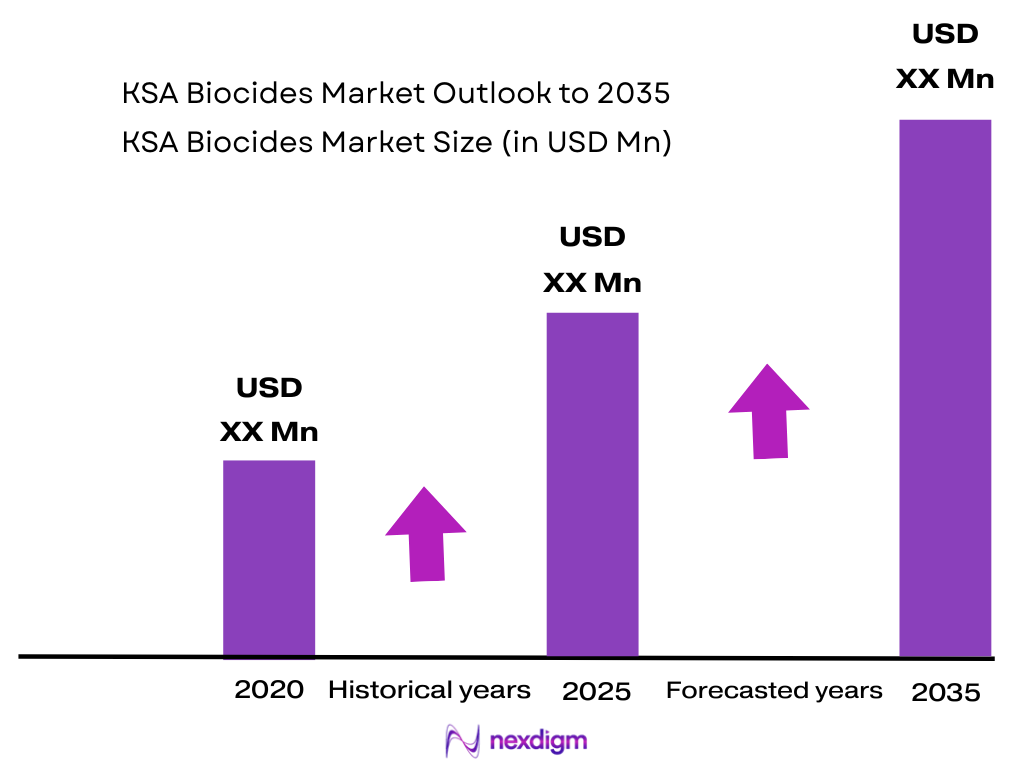
The KSA Biocides Market is supported by extensive desalination, wastewater treatment, oil and gas, petrochemical, power-generation, food-processing and industrial infrastructure. Saudi Arabia’s water sector has 16+ million m³/day of desalination production capacity and 43+ desalination plants, creating recurring requirements for microbial control, membrane protection and cooling-water treatment. The Kingdom also produced 3,277.5 million barrels of crude oil and 407.8 million barrels of gas oil/diesel, supporting additional biocide demand across upstream, refining and process-water applications.
Riyadh, Jeddah, Dammam, Jubail, Yanbu and Ras Al-Khair form the principal demand centers for KSA Biocides Market activity because they combine municipal infrastructure with industrial water treatment, desalination, oil and gas, refining, petrochemicals, mining and manufacturing. Riyadh represents the largest administrative and urban demand center, Jeddah combines population, desalination and commercial activity, while Dammam, Jubail and Ras Al-Khair concentrate Eastern Province energy, petrochemical and industrial operations. Yanbu is particularly important because of its refining, petrochemical and water infrastructure.
Market Segmentation
By Product Type
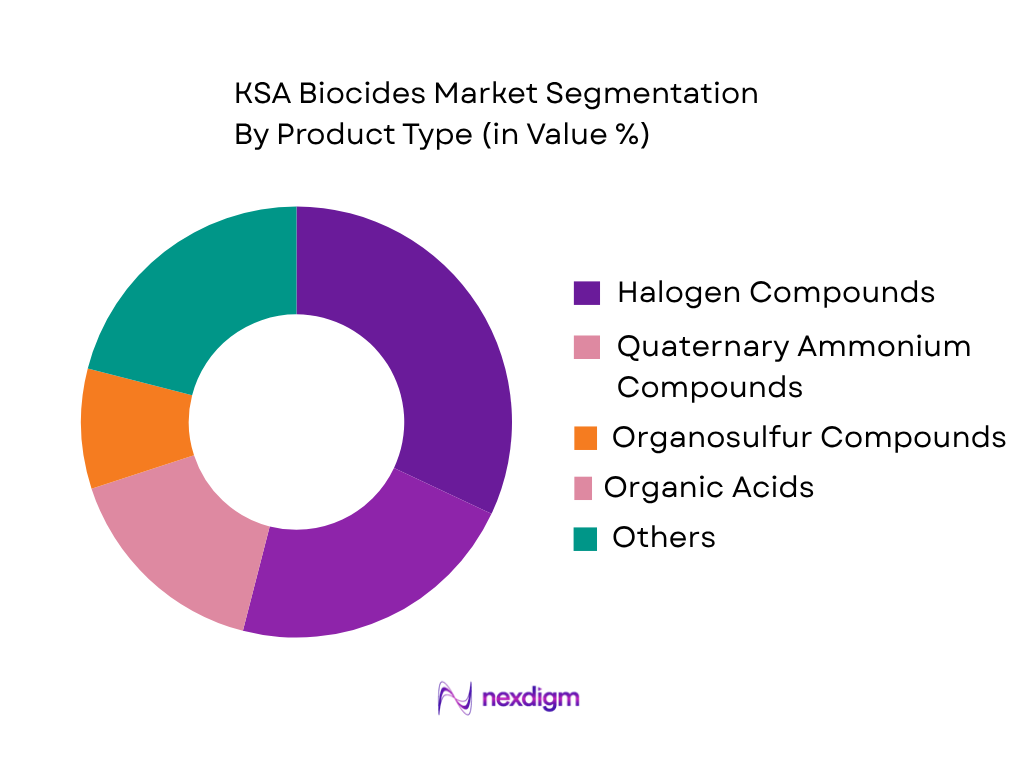
The KSA Biocides Market is segmented into halogen compounds, quaternary ammonium compounds, organosulfur compounds, metallic compounds, organic acids, phenolic biocides and other specialty biocides. Halogen compounds are positioned as the leading product category because chlorine- and bromine-based chemistries provide broad-spectrum microbial control and are particularly relevant to large-scale water treatment, desalination, cooling systems and industrial sanitation. Saudi Arabia’s desalination infrastructure provides an unusually large addressable treatment environment, with 16+ million m³/day of desalination production capacity and more than 43 desalination plants. The country’s oil and gas infrastructure further supports demand for both oxidizing and non-oxidizing microbial-control chemistry. Quaternary ammonium compounds remain relevant to industrial cleaning, institutional disinfection and material preservation, while organosulfur compounds are important for industrial water, oilfield and preservation applications. Metallic compounds and phenolic technologies address more specialized applications. The product mix is therefore shaped by Saudi Arabia’s high salinity, water scarcity, industrial cooling requirements and extensive hydrocarbon infrastructure. The broader biocides industry also identifies halogen compounds as a leading product category because of their broad activity against bacteria, fungi and algae.
By Application
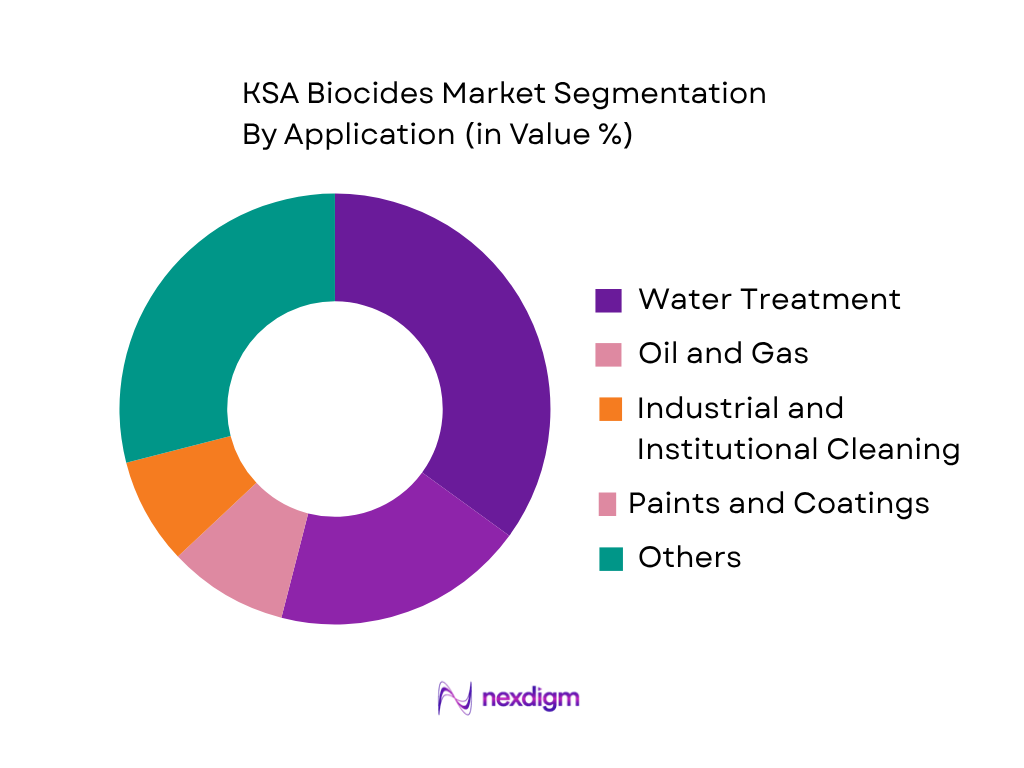
The KSA Biocides Market is segmented by application into water treatment, oil and gas, paints and coatings, industrial and institutional cleaning, food and beverage processing, HVAC and cooling systems, marine applications, personal care, pulp and paper, textiles and other industrial applications. Water treatment is positioned as the leading application because Saudi Arabia’s water-security strategy depends heavily on desalination, reverse osmosis, wastewater treatment and water reuse. Saudi Arabia has 16+ million m³/day of desalination production capacity, while Shuqaiq 3 alone has 450,000 m³/day of production capacity. Biocides are required to control bacteria, algae and biofilm in cooling water, membrane pretreatment, process water and wastewater systems. Oil and gas is the second major application because Saudi Arabia produced 3,277.5 million barrels of crude oil and 407.8 million barrels of gas oil/diesel, creating extensive produced-water, injection-water, refinery and pipeline environments. Industrial cooling, petrochemicals, paints and coatings, food processing and institutional hygiene diversify demand. This application structure is consistent with Saudi water-treatment segmentation, where biocides and disinfectants are specifically identified alongside desalination, cooling-water and industrial applications.
Competitive Landscape
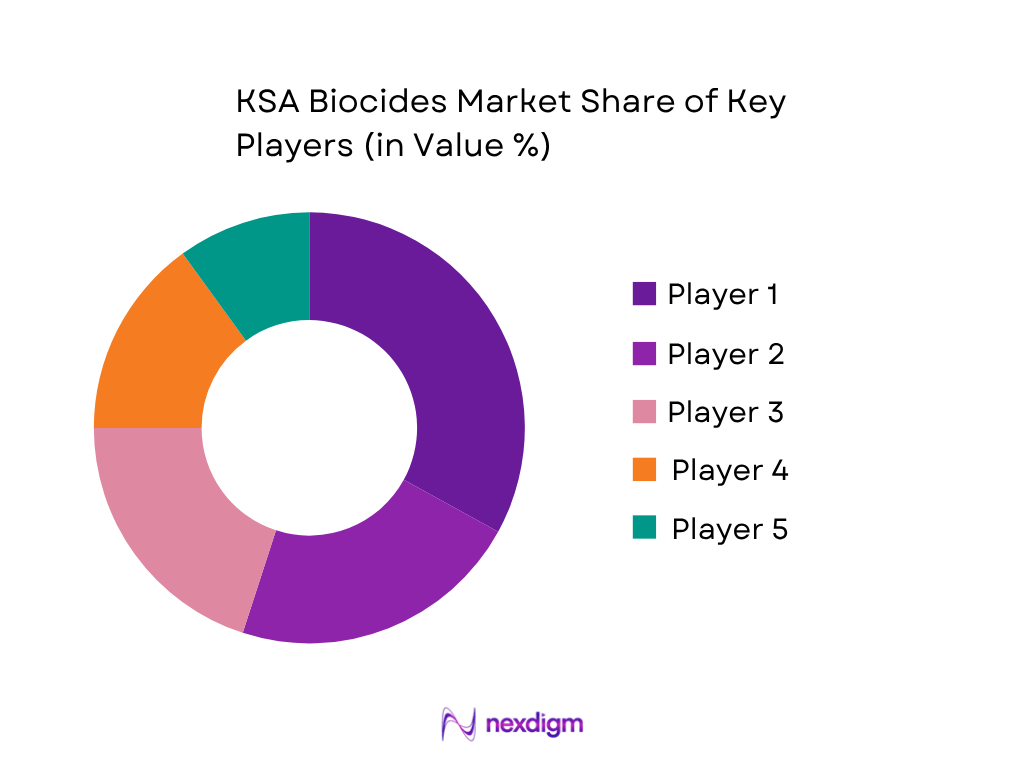
The KSA Biocides Market includes multinational specialty-chemical manufacturers, water-treatment specialists and regional chemical suppliers. Competition is particularly concentrated around desalination chemicals, cooling-water biocides, oilfield microbial control, industrial preservation and institutional disinfection. The market includes international companies such as LANXESS, Ecolab, BASF, Arxada and Nouryon, alongside Saudi and regional water-treatment suppliers. The local competitive environment is differentiated by desalination expertise, active-ingredient breadth, technical service, local inventory, regulatory capabilities and ability to support large industrial customers. Saudi Arabia-specific water-treatment sources also identify local companies such as Saudi Water Treatment Company, Al-Jazira Water Treatment Chemicals, AES Arabia and Raha Water Treatment Corporation.
| Major Player | Establishment Year | Headquarters | Active Ingredient Portfolio | Desalination Capability | Oil & Gas Capability | Local/Regional Service | Technical Support | Regulatory Capability |
| LANXESS | 1863 | Cologne, Germany | ~ | ~ | ~ | ~ | ~ | ~ |
| Ecolab | 1923 | St. Paul, USA | ~ | ~ | ~ | ~ | ~ | ~ |
| BASF | 1865 | Ludwigshafen, Germany | ~ | ~ | ~ | ~ | ~ | ~ |
| Arxada | 2021 | Basel, Switzerland | ~ | ~ | ~ | ~ | ~ | ~ |
| Nouryon | 2018 | Amsterdam, Netherlands | ~ | ~ | ~ | ~ | ~ | ~ |
KSA Biocides Market Analysis
Market Growth Drivers
Desalination Capacity Expansion and Water-Reuse Infrastructure
The KSA Biocides Market is structurally supported by Saudi Arabia’s exceptionally large desalination and water-distribution infrastructure, where microbial control is required across seawater reverse-osmosis systems, pretreatment, cooling circuits, storage and wastewater facilities. The National Transformation Program reported 16+ million m³/day of desalination production capacity, 9.8+ million m³/day of water-distribution capacity, 19+ million m³/day of transmission capacity and 27+ million m³ of water-storage capacity. The Kingdom had 43+ desalination plants, while water-service infrastructure reached 25,938,115 beneficiaries and wastewater services reached 21,106,295 beneficiaries. The water-distribution network extended beyond 135,000 km, creating a substantial infrastructure base requiring microbial management. The World Bank reported Saudi Arabia’s GDP at USD 1,239.8 billion in 2024, GDP per capita at USD 35,121.7, and annual GDP growth at 2.0, indicating a large economic base supporting continued infrastructure operation and industrial activity. These conditions create recurring requirements for oxidizing and non-oxidizing biocides, membrane-biofouling control, cooling-water treatment and microbial management in wastewater systems. The combination of high desalination dependence, extensive water networks and large treated-water infrastructure makes water treatment one of the most important structural demand drivers for KSA Biocides Market development.
Oil and Gas Production, Refining and Petrochemical Expansion
Oil and gas activity provides a major industrial demand base for the KSA Biocides Market because microbial-control chemicals are used in produced-water treatment, injection-water systems, pipelines, storage facilities, refineries and petrochemical processes. Saudi Arabia’s official Oil and Gas Statistics recorded 3,277.5 million barrels of crude-oil production in 2024, while crude-oil exports reached 2,214 million barrels. Domestic production of gas oil/diesel reached 407.8 million barrels, compared with 398.8 million barrels in the preceding observation, while gasoline production reached 238.1 million barrels. Domestic gas-oil/diesel consumption reached 224.1 million barrels, demonstrating the scale of downstream petroleum operations. The World Bank recorded Saudi Arabia’s GDP at USD 1,239.8 billion and GDP per capita at USD 35,121.7 in 2024, reflecting the economic scale supporting energy and industrial infrastructure. Such operating environments require microbial control because bacteria, algae and biofilm can contribute to microbiologically influenced corrosion, reservoir souring, pipeline fouling and deterioration of process-water quality. Biocide demand is therefore linked not only to crude production but also to refining, water injection, storage and petrochemical processing. Suppliers capable of delivering high-performance formulations compatible with hydrocarbons, high salinity, elevated temperatures and complex process-water chemistry are positioned to address this specialized demand.
Market Challenges
Arid Climate, High Water Demand and Extreme Operating Conditions
The KSA Biocides Market faces technical challenges arising from Saudi Arabia’s arid environment, high water-treatment intensity, elevated temperatures and extensive reliance on desalination. The National Transformation Program reported 16+ million m³/day of desalination production capacity, 9.8+ million m³/day of water-distribution capacity and 19+ million m³/day of transmission capacity. The Kingdom’s water network exceeded 135,000 km, while water-storage capacity exceeded 27 million m³. Wastewater services covered 21,106,295 beneficiaries, demonstrating the scale of treatment infrastructure operating across demanding environmental conditions. These conditions require biocides to maintain efficacy under high salinity, elevated temperatures and continuous circulation. In desalination facilities, poorly controlled microbial growth can contribute to membrane biofouling, increased cleaning requirements and deterioration of pretreatment performance. Cooling-water systems face similar challenges because high ambient temperatures can increase biological activity and place greater stress on heat-transfer infrastructure. At the same time, excessive chemical dosing can create residual-management and environmental problems. The World Bank recorded Saudi Arabia’s GDP at USD 1,239.8 billion and GDP per capita at USD 35,121.7 in 2024, indicating the substantial economic infrastructure operating within this demanding environment. Consequently, suppliers must provide formulations with strong thermal and salinity tolerance while maintaining equipment compatibility and controlled residual levels.
Regulatory Requirements, Active-Ingredient Restrictions and Environmental Management
Regulatory compliance creates an important challenge for the KSA Biocides Market because microbial-control products must satisfy product-safety, chemical-management, labeling and application requirements while demonstrating appropriate efficacy. The Saudi Product Safety Law issued in 2024 strengthened the Kingdom’s product-safety framework, increasing the importance of conformity and safety documentation for products placed on the Saudi market. Environmental requirements become particularly relevant for water-treatment biocides because Saudi Arabia operates 43+ desalination plants, with more than 16 million m³/day of desalination production capacity and 21,106,295 wastewater-service beneficiaries. Chemical selection therefore has to consider aquatic toxicity, biodegradability, residual concentrations and compatibility with desalination membranes and downstream wastewater processes. Active-ingredient restrictions can also limit formulation flexibility when specific chemistries face safety or environmental concerns. The World Bank recorded 1.7 consumer-price inflation in 2024 and USD 1,239.8 billion of GDP, demonstrating a large and relatively stable economic environment in which regulatory compliance is integrated into industrial procurement rather than treated as an isolated requirement. Suppliers entering the KSA market consequently need robust technical dossiers, safety data, product classification, application documentation and local regulatory expertise. Companies that can combine efficacy with environmental performance and complete registration support are better positioned to address increasingly sophisticated procurement requirements.
Market Opportunities
Advanced Desalination Biocides and Reverse-Osmosis Biofouling Control
The KSA Biocides Market offers substantial opportunities in advanced desalination and reverse-osmosis applications because Saudi Arabia operates one of the world’s largest desalination infrastructures. The National Transformation Program reported 16+ million m³/day of desalination production capacity and 43+ desalination plants, including 30 public-sector plants and 13 private-sector plants. Water-distribution capacity exceeded 9.8 million m³/day, transmission capacity exceeded 19 million m³/day, and water-storage capacity exceeded 27 million m³. The scale of this infrastructure creates continuing requirements for pretreatment, microbial control and membrane-biofouling management. Biocides designed for seawater reverse osmosis can address bacterial growth, slime formation and biofilm accumulation while maintaining compatibility with membranes and downstream processes. The opportunity is increasingly centered on specialized treatment rather than commodity disinfectants, including low-residual formulations, controlled-release chemistry, automated dosing and biofilm-specific programs. The National Transformation Program also reported 55,000 m³/day of purification-plant capacity and 526,992 m³/day of wastewater lift-station capacity, expanding the addressable treatment environment beyond desalination alone. The World Bank recorded Saudi GDP at USD 1,239.8 billion in 2024, providing a substantial economic base for continued water infrastructure operation. These existing infrastructure conditions support future adoption of higher-performance microbial-control technologies without relying on speculative future statistics.
Wastewater Reuse, Sustainable Low-Residual Chemistry and Biofilm-Specific Technologies
Wastewater reuse and more sustainable microbial-control technologies represent an important opportunity because Saudi Arabia has developed a large wastewater-service infrastructure alongside its desalination system. The National Transformation Program reported 21,106,295 beneficiaries of wastewater services, 748,647 meters of wastewater-network length and 526,992 m³/day of lift-station capacity. The broader water system includes 25,938,115 water-service beneficiaries, 135,000+ km of water-distribution infrastructure and 27+ million m³ of storage capacity. These existing assets create opportunities for biocides designed specifically for treated-wastewater reuse, industrial process water, cooling systems and membrane protection. Low-residual formulations can help operators manage microbial contamination while limiting unnecessary chemical discharge, while biofilm-specific treatments can target microorganisms responsible for fouling and reduced hydraulic or equipment performance. Automated dosing and online monitoring can further improve treatment precision by adjusting chemical application to operating conditions. Saudi Arabia’s economic scale also supports industrial adoption: the World Bank recorded GDP of USD 1,239.8 billion, GDP per capita of USD 35,121.7 and 2.0 annual GDP growth in 2024. The opportunity therefore extends beyond conventional disinfection toward integrated microbial-management programs combining formulation, dosing, monitoring and technical support. Existing wastewater and water infrastructure provides the immediate application base for these technologies.
Future Outlook
The KSA Biocides Market is expected to benefit from continued investment in desalination, wastewater treatment, industrial diversification, oil and gas, petrochemicals and manufacturing.Water treatment should remain the principal demand center because Saudi Arabia’s water-security infrastructure requires continuous microbial management across desalination and reuse systems. The Kingdom’s industrial base also supports increasing requirements for cooling-water biocides, oilfield microbial control, material preservation and institutional disinfection. The market is expected to move toward application-specific formulations, biofilm-control technologies, automated dosing, lower-residual chemistries and integrated microbial-monitoring systems.
Major Player
- LANXESS
- Ecolab
- BASF
- Arxada
- Nouryon
- Dow
- Clariant
- Solenis
- Kemira
- Evonik Industries
- Veolia
- Buckman
- Italmatch Chemicals
- Troy Corporation
- Thor Group
Key Target Audience
- Biocides and specialty-chemical manufacturers
- Desalination and municipal water-treatment operators
- Oil and gas producers, refineries and petrochemical companies
- Industrial water-treatment and chemical-service providers
- Paints, coatings and construction-chemical manufacturers
- Investments and venture capitalist firms
- Government and regulatory bodies (Saudi Water Authority, Ministry of Environment, Water and Agriculture, Saudi Food and Drug Authority, Saudi Standards, Metrology and Quality Organization, Ministry of Industry and Mineral Resources)
- Mining, power-generation, food-processing, healthcare, hospitality and marine operators
Research Methodology
Step 1: Identification of Key Variables
The initial phase involves constructing a KSA Biocides Market ecosystem covering active-ingredient manufacturers, formulators, distributors, desalination operators, water-treatment companies, oilfield-service providers and industrial users. Variables include product chemistry, active ingredient, formulation, application, dosage, end-use industry, regulatory classification, import dependency, local formulation and technical-service requirements.
Step 2: Market Analysis and Construction
The market is constructed through bottom-up assessment of biocidal active ingredients and formulated products consumed across water treatment, oil and gas, petrochemicals, coatings, industrial cleaning, HVAC, food processing and marine applications. Demand indicators are cross-checked against desalination capacity, wastewater infrastructure, industrial production and hydrocarbon activity.
Step 3: Hypothesis Validation and Expert Consultation
Market hypotheses are validated through consultations with biocide manufacturers, specialty-chemical distributors, desalination operators, industrial water-treatment companies, oilfield-service providers and major end users. Discussions assess active-ingredient preferences, treatment frequency, dosing requirements, procurement criteria, regulatory barriers and substitution patterns.
Step 4: Research Synthesis and Final Output
The final stage integrates primary interviews, Saudi government statistics, regulatory documents, company disclosures, trade information and infrastructure indicators. Market calculations are triangulated across product type, application and end-use industry to minimize double counting. Competitive positioning evaluates product breadth, technical expertise, local distribution, regulatory capability and application coverage.

- Executive Summary
- Research Methodology (Market Definition and Scope, Biocide Product Classification, Active Ingredient Mapping, Formulation-Level Market Sizing, Consumption and Revenue Assessment, Top-Down Market Sizing, Bottom-Up Market Sizing, Demand-Side Assessment, Supply-Side Assessment, Import and Distribution Analysis, End-Use Industry Mapping, Primary Industry Interviews, Regulatory Document Review, Data Triangulation, Forecasting Framework, Scenario Analysis, Market Assumptions, Limitations)

- Definition and Scope
- KSA Biocides Industry Structure
- Biocidal Active Ingredient Ecosystem
- Formulation and Application Ecosystem
- Evolution of Microbial-Control Technologies in KSA
- KSA Biocides Value Chain Analysis
- Regulatory and Institutional Landscape

- Market Growth Drivers (Desalination Capacity Expansion, Water Reuse Infrastructure, Oil and Gas Production, Refining and Petrochemical Expansion, Industrial Water Treatment, Manufacturing Diversification, Construction and Infrastructure Development, Food-Safety Requirements)
- Market Challenges (Arid Climate and High Water Demand, Extreme Operating Temperatures, Regulatory Registration Requirements, Active Ingredient Restrictions, Imported Specialty Chemical Dependency, Environmental and Aquatic Toxicity, Biocide Resistance, Hazardous Chemical Handling)
- Market Opportunities (Advanced Desalination Biocides, Reverse-Osmosis Biofouling Control, Cooling-Tower Treatment, Wastewater-Reuse Biocides, Oilfield Microbial-Control Solutions, Sustainable Low-Residual Chemistry, Biofilm-Specific Technologies, Marine Biofouling Control, Local Formulation and Blending)
- Market Trends (Shift Toward Advanced Water-Treatment Chemistry, Reverse-Osmosis Expansion, Water-Reuse Adoption, Biofilm-Specific Treatment, Low-Residual Formulations, Sustainable Biocides, Automated Chemical Dosing, Digital Water Monitoring, Application-Specific Formulations)
- Regulatory Authority Mapping (Saudi Standards, Metrology and Quality Organization, Saudi Food and Drug Authority, Ministry of Environment, Water and Agriculture, Saudi Water Authority, Saudi Water Partnership Company, Ministry of Industry and Mineral Resources)
- SWOT Analysis
- Porter’s Five Forces Analysis
- PESTLE Analysis

- By Market Value (2020-2025)
- By Biocidal Active Ingredient Consumption Volume (2020-2025)
- By Formulated Biocide Consumption Volume (2020-2025)
- By Application Consumption (2020-2025)
- By End-Use Industry Consumption (2020-2025)
- By Domestic Production, Imports and Re-Exports (2020-2025)

- By Product Type (In Value %)
Halogen Compounds
Quaternary Ammonium Compounds
Metallic Compounds
Organosulfur Compounds
Organic Acids
Phenolic Biocides
Nitrogen-Based Biocides
Glutaraldehyde
Isothiazolinones
Other Specialty Biocides - By Active Ingredient (In Value %)
Chlorine-Based Biocides
Bromine-Based Biocides
Chlorine Dioxide
Glutaraldehyde
Isothiazolinones
Quaternary Ammonium Compounds
Bronopol
DBNPA
Copper-Based Compounds
Organic Acids - By Application (In Value %)
Water Treatment
Oil and Gas
Plastics and Polymers
Paints and Coatings
Industrial and Institutional Cleaning
HVAC and Cooling Systems
Food and Beverage Processing
Personal Care and Cosmetics
Marine Applications
Pulp and Paper
Textiles
Wood Preservation - By End-Use Industry (In Value %)
Water and Wastewater Treatment
Oil and Gas
Petrochemicals and Chemicals
Power Generation
Construction and Infrastructure
Food and Beverage
Healthcare and Hospitality
Manufacturing
Marine and Offshore
Agriculture and Aquaculture - By Formulation Type (In Value %)
Liquid Biocides
Powder and Granular Biocides
Concentrated Formulations
Ready-to-Use Disinfectants
Water-Soluble Formulations
Emulsion and Dispersion Formulations
Controlled-Release Formulations - By Function (In Value %)
Disinfection
Preservation
Biofilm Control
Algae Control
Bacterial Control
Fungal Control
Slime Control
Microbiologically Influenced Corrosion Control
Biofouling Prevention
Membrane Protection

- Market Share of Major Players (By Value, Volume, Product Type, Active Ingredient, Application, End-Use Industry, Distribution Channel, Geographic Region)
- Cross Comparison Parameters (Active Ingredient Portfolio Breadth, Desalination and Water-Treatment Capability, Oilfield Biocide Expertise, Petrochemical Application Coverage, Regulatory Registration Expertise, Local Distribution and Technical-Service Network, Sustainable and Low-Residual Product Capability, Automated Dosing and Microbial-Monitoring Capability)
- SWOT Analysis of Major Players
- Detailed Profiles of Major Companies
LANXESS
Ecolab
BASF
Arxada
Nouryon
Dow
Clariant
Solenis
Kemira
Evonik Industries
Veolia
Buckman
Italmatch Chemicals
Troy Corporation
Thor Group

- Industrial Water Treatment Demand Assessment
- Desalination Customer Analysis
- Oil and Gas Customer Analysis
- Petrochemical Customer Analysis
- Construction and Infrastructure Customer Analysis
- Food and Beverage Customer Analysis

- By Market Value (2026-2035)
- By Biocidal Active Ingredient Consumption Volume (2026-2035)
- By Formulated Biocide Consumption Volume (2026-2035)
- By Application Consumption (2026-2035)
- By End-Use Industry Consumption (2026-2035)
- By Domestic Production, Imports and Re-Exports (2026-2035)


 Request a Sample
 Ask for Customization
 Get a Quote
 Enquire Now