

 Download PDF
Market Overview
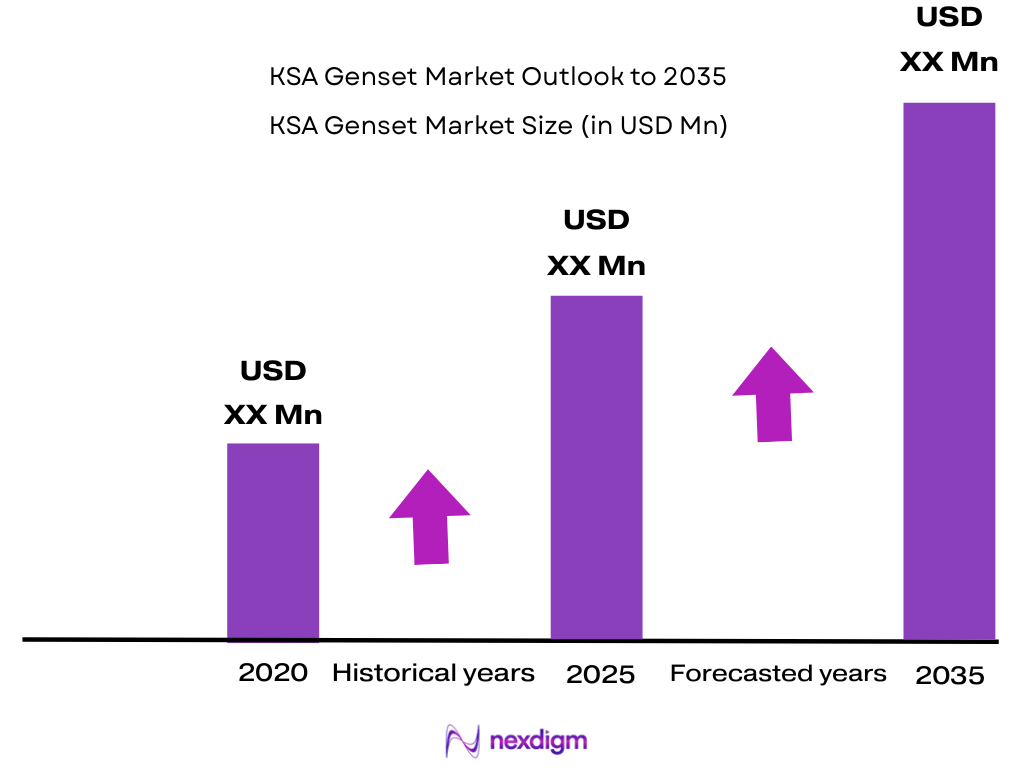
The KSA Genset Market is valued at approximately ~ million, supported by the Kingdom’s population increasing from 33.7 million people to 35.3 million people, adding approximately 1.6 million residents to the domestic infrastructure base. Construction, logistics, oil and gas operations, industrial facilities, tourism projects and temporary power applications generate requirements for mobile and stationary gensets, particularly where continuous electricity, emergency backup or off-grid power is needed.Riyadh, Jeddah, Dammam-Al Khobar and major project corridors along the Red Sea dominate genset deployment because they combine infrastructure development, logistics hubs, airports, industrial activity and large commercial facilities. Saudi airport passenger traffic expanded from the preceding operational base to more than 128 million passengers, while national population increased from 33.7 million to 35.3 million, strengthening electricity-intensive urban infrastructure and backup-power requirements around major metropolitan and transport nodes.
Market Segmentation
By Fuel Type
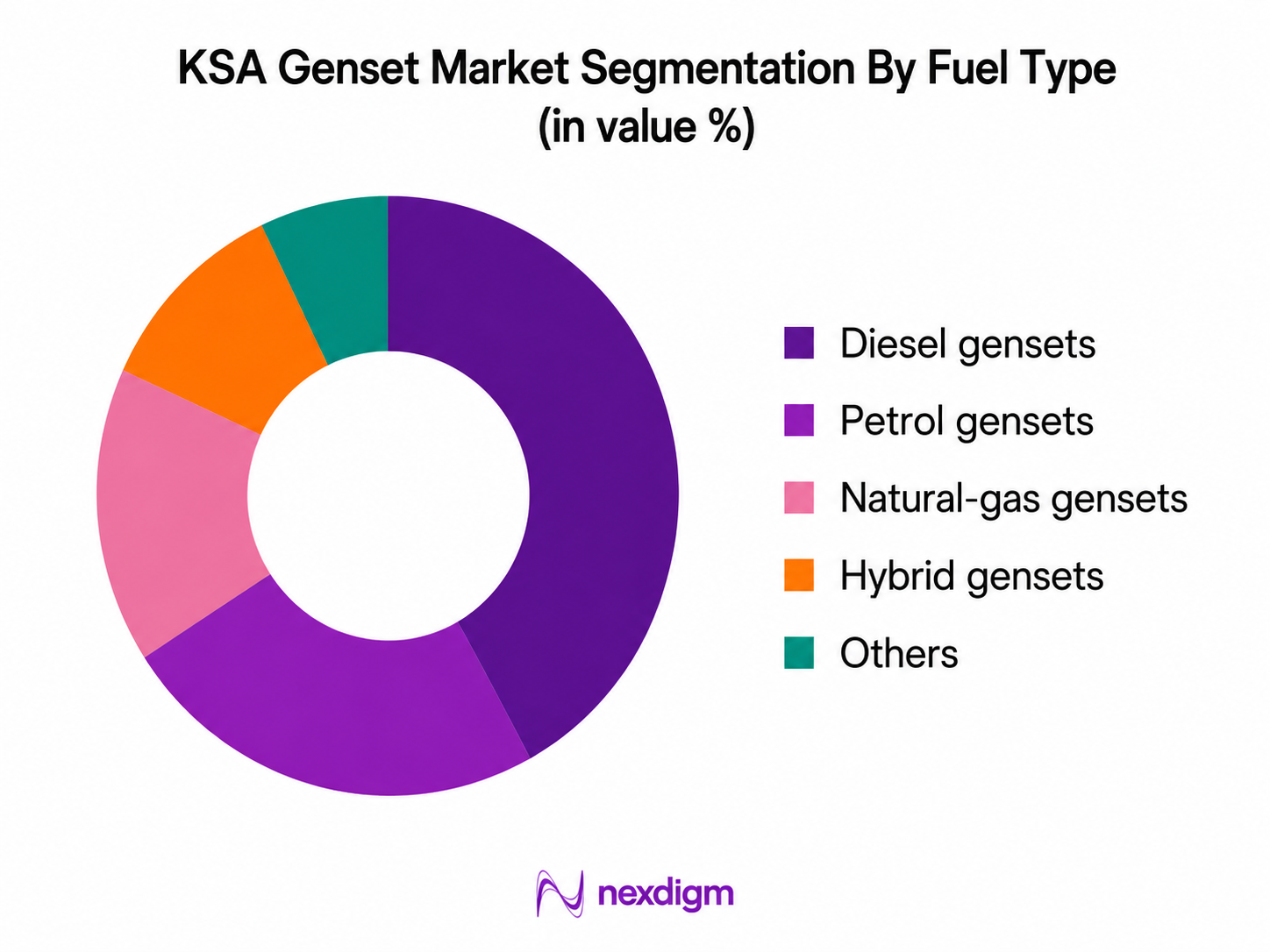
The KSA Genset Market is segmented by fuel type into diesel gensets, petrol gensets, natural-gas gensets and hybrid gensets. Recently, diesel gensets hold the dominant market position because Saudi construction, logistics, industrial and oilfield applications require high torque, long runtime, durability under heavy loads and widespread fuel availability. Diesel units are particularly suitable for construction camps, infrastructure works, industrial facilities, telecom installations and remote operations where equipment may run for extended periods. Saudi climatic conditions further favour rugged industrial gensets designed for high ambient temperatures, dust and demanding duty cycles. Caterpillar’s Saudi dealer Zahid Tractor, for example, supplied 69 generator sets representing 32 MW for construction-related power at the Red Sea development, demonstrating the scale at which diesel-based temporary power can be deployed. Natural-gas and hybrid systems are gaining relevance as users pursue lower-emission solutions, but diesel’s operational flexibility and established service ecosystem continue to support its leadership.
By Power Rating
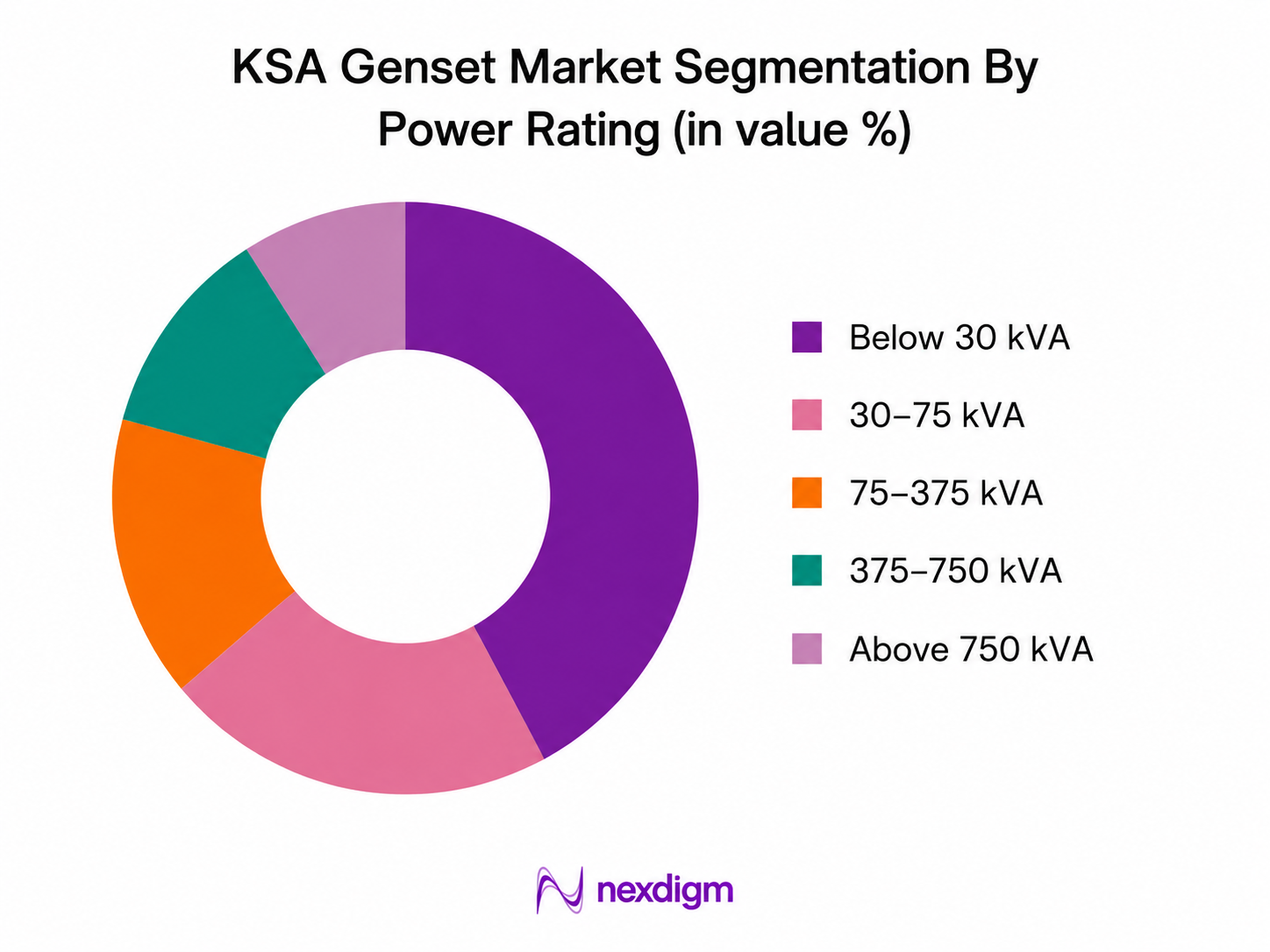
The KSA Genset Market is segmented into below 30 kVA, 30–75 kVA, 75–375 kVA, 375–750 kVA and above 750 kVA systems. The 75–375 kVA category holds the dominant market position because this range balances mobility, load capability and operating flexibility for construction sites, commercial facilities, workshops, logistics centres, temporary offices and medium-sized industrial loads. Units in this range can supply multiple construction tools, HVAC equipment, pumps, lighting systems and building-services loads while remaining simpler to transport and deploy than multi-megawatt generator installations. Saudi Arabia’s continuing construction and economic diversification programmes make this middle-power range particularly relevant. GASTAT’s revised national accounts highlight substantial expansion in construction activity, while its construction statistics cover machinery rentals, energy costs and specialised construction operations across all 13 administrative regions. Higher-capacity units remain critical to airports, hospitals, industrial plants and large infrastructure projects, whereas lower-capacity sets are used primarily for workshops, residential backup and small commercial applications.
Competitive Landscape
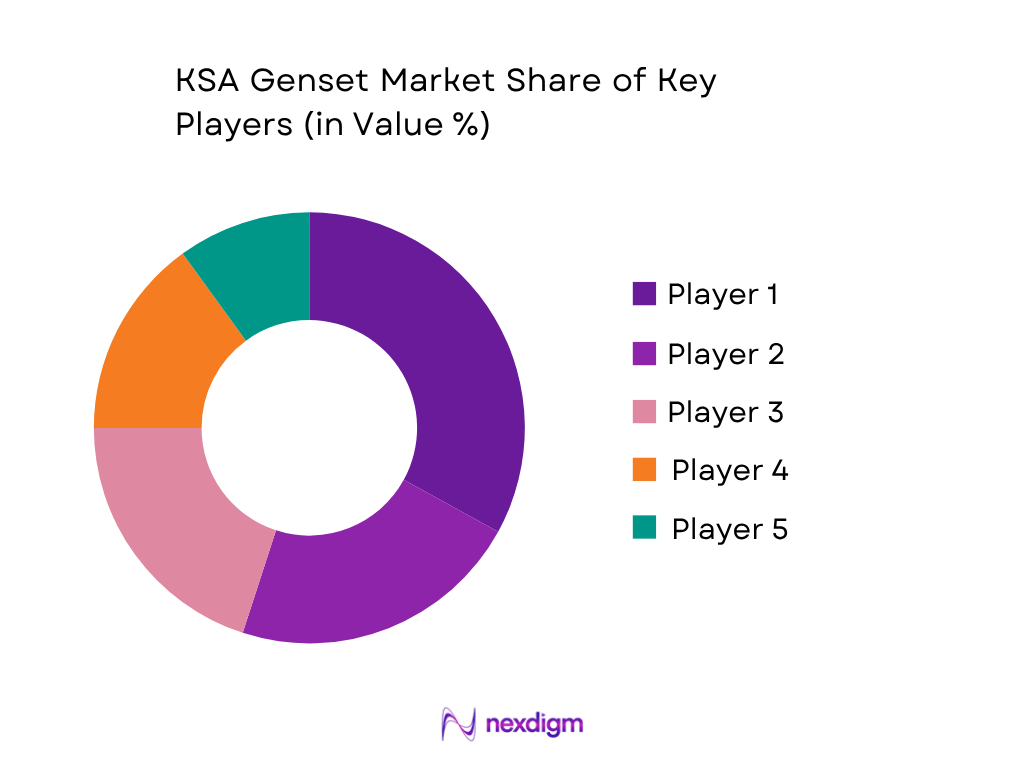
The KSA Genset Market has a strong mix of multinational power-equipment manufacturers, established Saudi distributors and regional generator assemblers. Caterpillar operates through Zahid Tractor, while FG Wilson equipment is represented through TAMGO. Atlas Copco maintains direct Saudi operations for mobile power equipment, and Cummins provides integrated generation solutions across the Kingdom. Competition revolves around power range, high-temperature capability, fuel efficiency, engine durability, service network coverage, spare-part availability, remote monitoring and suitability for prime versus standby operation.
| Major Player | Establishment Year | Headquarters | Generator Power Range | Primary Applications | Fuel Capability | Mobile Genset Capability | Saudi Service Presence | Key Market Strength |
| Caterpillar | 1925 | Texas, USA | ~ | ~ | ~ | ~ | ~ | ~ |
| Cummins | 1919 | Indiana, USA | ~ | ~ | ~ | ~ | ~ | ~ |
| FG Wilson | 1966 | Northern Ireland, UK | ~ | ~ | ~ | ~ | ~ | ~ |
| Atlas Copco | 1873 | Stockholm, Sweden | ~ | ~ | ~ | ~ | ~ | ~ |
| Alkhorayef / Gulf Power | 1957 | Riyadh, Saudi Arabia | ~ | ~ | ~ | ~ | ~ | ~ |
KSA Genset Market Analysis
Growth Drivers
Construction, Infrastructure and Temporary Power Requirements
The KSA Genset Market is being supported by Saudi Arabia’s unusually large construction and capital-investment pipeline, where mobile generator sets are required to power tools, lighting, temporary offices, pumps, welding equipment, site accommodation and auxiliary systems before permanent grid connections are commissioned. General Authority for Statistics data places Saudi nominal GDP at SAR 4,703 billion in 2024, with construction accounting for a substantial part of national economic activity. Gross fixed capital formation exceeded SAR 1,490 billion when the national accounts components are translated from the published expenditure structure, illustrating the scale of assets being created across transport, tourism, housing, industrial and urban-development programmes. GASTAT also identifies construction as one of the Kingdom’s major non-oil activities. The wider macroeconomic platform remains supportive: World Bank data places Saudi Arabia’s GDP at approximately USD 1.24 trillion in 2024 and around USD 1.3 trillion in 2025, while the population reached approximately 36.97 million people in 2025. These indicators support expansion of housing, commercial infrastructure, roads, industrial developments and public facilities requiring temporary and standby electricity. For automotive and mobile genset suppliers, construction activity is particularly important because many worksites require equipment that can be moved rapidly between operating zones rather than permanently installed generation. Trailer-mounted and vehicle-transportable gensets can support road construction, civil works, tunnelling, utility installation, remote accommodation, maintenance operations and event infrastructure. Unlike fixed industrial generators, automotive gensets are selected partly around towability, compact footprints, rugged frames, integrated fuel tanks, environmental protection and ease of deployment. Saudi Arabia’s climatic conditions further increase equipment requirements because high ambient temperatures, airborne dust and prolonged summer operation place additional stress on engines, cooling systems and alternators. Suppliers therefore have opportunities to differentiate through high-temperature cooling packages, heavy-duty air filtration, larger radiators, dust-resistant enclosures and automatic shutdown systems. Saudi Electricity Company data also demonstrates the underlying expansion of national electrical demand: first-half 2024 peak grid load reached 72.9 GW, while consumption reached 146 TWh, and more than 165,000 new subscribers were connected during the period. Rising permanent electricity connections do not eliminate temporary genset demand; they indicate how rapidly new buildings, facilities and economic activity are being added. During the construction phase, many of those assets require independent power before grid energisation. Genset manufacturers serving contractors can therefore compete through rental partnerships, fleet financing, telematics, rapid service response, spare-parts availability and machines capable of repeated relocation between projects. The principal supporting sources are GASTAT, World Bank and Saudi Electricity Company.
Industrial, Manufacturing and Logistics Capacity Expansion
Saudi Arabia’s industrial diversification is another major growth driver for the KSA Genset Market because factories, warehouses, logistics facilities, workshops, mining-support operations and industrial construction sites require both temporary and emergency generation. The Ministry of Industry and Mineral Resources reported that Saudi Arabia had more than 12,000 factories across 40 industrial cities at the end of 2024. This industrial footprint creates demand for mobile gensets not only during factory construction but also during equipment commissioning, scheduled electrical maintenance, temporary capacity requirements and emergency interruptions. The relevance of these facilities is reinforced by national accounts data. Saudi Arabia recorded nominal GDP of SAR 4,703 billion in 2024, with manufacturing and construction both forming major elements of economic output. GASTAT’s revised accounts place non-oil activities at the centre of recent economic expansion, providing a broad demand base for distributed industrial power equipment. The Ministry of Industry’s factory count is particularly relevant to mobile generator suppliers because industrial operators frequently require temporary power outside the normal electrical architecture. Generator sets may supply maintenance shutdowns, plant expansions, outdoor fabrication, mobile workshops, warehouses, refrigeration systems, temporary cranes and construction contractors operating within industrial zones. Mining and quarrying applications create additional requirements for rugged portable equipment where permanent electrical infrastructure can be distant from the actual operating location. Saudi Electricity Company’s network expansion demonstrates the scale of national energy demand accompanying industrialisation. In 2025, electricity demand reached 77.1 GW, total electricity consumption reached 275.1 TWh, approximately 183,000 new customers were connected and the distribution network expanded to around 840,000 circuit kilometres. These numbers indicate that Saudi industrial and commercial activity is consuming increasingly large quantities of electricity even as grid infrastructure expands. Automotive gensets occupy a complementary role where continuous mobility, temporary deployment or backup redundancy is required. The expansion of logistics is also relevant because Saudi Arabia’s Vision 2030 industrial strategy explicitly positions the Kingdom as an industrial and logistics hub, creating requirements for power at distribution centres, yards, remote loading locations and infrastructure-development sites. For suppliers, this shifts competition beyond basic engine displacement or rated output. Industrial customers increasingly evaluate load acceptance, runtime, fuel autonomy, ambient-temperature derating, automatic voltage regulation, remote monitoring, sound attenuation and service response. Equipment capable of synchronising multiple smaller generators can also offer greater operational flexibility than a single oversized unit. The macroeconomic backdrop supports these investments: World Bank data records Saudi GDP at approximately USD 1.3 trillion in 2025, with a population approaching 37 million people, while the IMF reported that the economy entered 2026 with substantial momentum following expansion in 2025. The principal supporting sources are the Ministry of Industry and Mineral Resources, GASTAT, Saudi Electricity Company, World Bank and IMF.
Market Challenges
High Grid Coverage and Expanding Utility Generation Capacity
One of the most important structural challenges for the KSA Genset Market is the increasing reach and capacity of Saudi Arabia’s central electricity system. World Bank data shows that electricity access in Saudi Arabia reached essentially 100 people out of every 100 residents in 2024, meaning the addressable market for generators is not driven by widespread absence of grid electricity. Instead, suppliers must compete for narrower use cases such as construction power, critical backup, mobile operations, events, remote industrial work and redundancy. Saudi Electricity Company is simultaneously adding generating and network capacity. During 2024, SEC added or restored approximately 1,850 MW of generation capacity, strengthening the supply available through the conventional utility system. By 2025, system demand had reached 77.1 GW, consumption reached 275.1 TWh, the customer base stood around 11.5 million connections, and the distribution network extended to approximately 840,000 circuit kilometres. These infrastructure figures represent a challenge for genset vendors because improved transmission and distribution coverage reduces the need for businesses to depend on self-generation during normal operations. Grid expansion also reaches new industrial areas, residential developments and commercial facilities that historically might have relied more heavily on temporary equipment. The result is increasing segmentation of genset demand: basic electricity access is no longer sufficient justification for purchase, so equipment must deliver measurable resilience, mobility or operational flexibility. Saudi macroeconomic development reinforces this challenge. GASTAT places national nominal GDP at SAR 4,703 billion in 2024, demonstrating the economic resources available for continued utility investment and modernisation. At the same time, World Bank data places GDP around USD 1.3 trillion in 2025, supporting investment in increasingly sophisticated infrastructure rather than dependence on distributed combustion generators. For genset manufacturers, this requires a change in product positioning. Suppliers can no longer rely primarily on unreliable-grid narratives and must instead target defined mission-critical applications. Hospitals, telecommunications facilities, data centres, oil and gas sites, construction contractors and logistics companies generally require redundancy even where utility quality is high, but these customers also demand more advanced controls and service guarantees. Rental models become important because customers requiring power only during construction or maintenance may prefer temporary access rather than equipment ownership. High grid availability therefore shifts purchasing from broad necessity toward specialised resilience. It also intensifies competition with battery energy-storage systems, grid-connected UPS equipment and hybrid solar-storage solutions, particularly for shorter-duration loads. Automotive genset suppliers need to defend their role through rapid refuelling, long-duration operation, high power density, mobility and compatibility with harsh environmental conditions. The principal supporting sources are the World Bank, Saudi Electricity Company and GASTAT.
Emissions, Fuel Consumption and Environmental Compliance Pressure
Environmental and fuel-efficiency requirements represent a growing challenge for combustion-based automotive gensets in Saudi Arabia, particularly as government policy increasingly prioritises efficient electricity production, cleaner fuels and reduced emissions intensity. World Bank environmental data records Saudi Arabia’s carbon dioxide emissions excluding land-use change at approximately 18.5 tonnes per person in 2024. This high emissions intensity increases policy and corporate pressure to manage combustion-based power equipment more carefully, particularly at industrial sites, urban construction zones and high-profile infrastructure projects. Saudi Electricity Company is itself moving its generation portfolio toward more efficient configurations and fuel conversion, which raises the performance benchmark against which temporary generator solutions are assessed. SEC’s 2025 programme included additional generation projects and continued conversion of liquid-fuel generation toward gas-based operation, indicating an energy system increasingly focused on fuel efficiency and lower-emission generation technologies. Gensets operating on diesel or petrol therefore face increasing scrutiny around exhaust emissions, fuel burn, noise, spill prevention and idle operation. This affects equipment design because customers may require electronic engine management, automatic start-stop capability, load-sensitive operation, larger high-efficiency alternators and particulate or exhaust-control systems where technically applicable. Fuel consumption is particularly important for mobile equipment because fuel must frequently be transported to remote or temporary sites. The cost and logistical burden of repeated refuelling can make an oversized genset uneconomical even where the equipment itself is technically capable of serving the load. The challenge is amplified by the Kingdom’s large scale of electrical demand. Saudi Electricity Company reported electricity consumption of 275.1 TWh in 2025 and peak demand of 77.1 GW, illustrating the scale of the national power system against which distributed generation competes. The national economy also provides strong incentives for businesses to improve operating efficiency. World Bank data places Saudi output near USD 1.3 trillion in 2025, while GASTAT reports nominal GDP of SAR 4,703 billion in 2024. Large industrial and construction customers increasingly assess total operating reliability rather than equipment acquisition alone. This means automotive genset suppliers face pressure to document fuel consumption at multiple loads, ambient-temperature derating, runtime, service intervals and emissions characteristics. Competition from battery storage and hybrid power further strengthens this requirement. A battery can handle brief low-load periods without running a combustion engine, while a genset can be activated for sustained demand. This architecture reduces unnecessary engine hours but also means traditional generators must increasingly integrate with external controllers and energy-management systems. Manufacturers that continue to offer mechanically simple, non-connected machines may therefore become concentrated in lower-value applications. Conversely, compliant low-emission engines, advanced automatic controls and hybrid compatibility can preserve gensets’ role in remote and critical power. The principal supporting sources are the World Bank, Saudi Electricity Company and GASTAT.
Market Opportunities
Hybrid Mobile Gensets and Digitally Managed Temporary Power Systems
Hybridisation represents a significant future-growth opportunity for the KSA Genset Market because it allows mobile generators to remain relevant while Saudi businesses place greater emphasis on efficiency, digital monitoring and lower combustion-engine runtime. The opportunity is supported by current energy and infrastructure conditions rather than speculative future statistics. Saudi Electricity Company recorded electricity demand of 77.1 GW and consumption of 275.1 TWh in 2025, while approximately 183,000 new customers were added and the distribution network expanded to around 840,000 circuit kilometres. This growing power system is serving increasingly sophisticated industrial, construction and digital applications where temporary power reliability is important but continuous operation of a large combustion generator may be inefficient. Hybrid solutions combining gensets with battery storage, automatic controls and remote monitoring can address this requirement by allowing the battery system to serve low-load periods and short peaks while the genset operates closer to efficient loading conditions. Saudi Arabia’s current industrial footprint provides a broad application base. The Ministry of Industry and Mineral Resources reported over 12,000 factories and 40 industrial cities at the end of 2024, creating numerous maintenance, construction, expansion and remote-power use cases. GASTAT also recorded SAR 4,703 billion of nominal national output in 2024, with substantial activity in construction and manufacturing. These current indicators demonstrate sufficient industrial scale for sophisticated temporary-power solutions without relying on future market projections. Hybrid systems can be particularly valuable on construction sites where power demand fluctuates substantially during the day. Large generators are commonly selected for peak loads but may spend many operating hours below their optimal load. Battery integration allows engine shutdown during very low-demand periods while maintaining power for lighting, security, communications and small tools. The same architecture can support telecommunications sites, temporary accommodation, mining support, maintenance shutdowns and remote workshops. Digital controls create an additional layer of opportunity. Saudi Arabia’s Ministry of Communications and Information Technology reported that the national ICT market exceeded SAR 180 billion in 2024, while the technology workforce had expanded beyond 381,000 jobs by its 2025 update. This digitalisation supports greater acceptance of connected equipment, telematics and remote asset management. For genset fleets, IoT-based controllers can report fuel level, operating hours, output, coolant temperature, battery condition and fault codes to a central rental or fleet-management platform. Suppliers can consequently move from one-time equipment sales toward uptime-based service contracts. Rental companies can dispatch maintenance before breakdowns, reduce unnecessary site inspections and redeploy underutilised equipment. Manufacturers able to package generators, batteries, switchgear and cloud monitoring as one system can therefore capture higher-value temporary power applications. The principal supporting sources are Saudi Electricity Company, Ministry of Industry and Mineral Resources, GASTAT and Ministry of Communications and Information Technology.
Data Centres, Digital Infrastructure and Critical-Load Backup Power
Saudi Arabia’s expanding digital infrastructure creates a strong future opportunity for high-reliability automotive and mobile genset suppliers serving data centres, telecommunications infrastructure, network expansion and temporary critical loads. The Ministry of Communications and Information Technology reported that Saudi Arabia’s ICT market surpassed SAR 180 billion in 2024. In its 2025 update, the ministry stated that the broader digital economy had reached approximately SAR 495 billion, while the technology workforce exceeded 381,000 jobs. These current indicators demonstrate that the Kingdom already operates a large technology ecosystem requiring highly reliable electricity. Even where primary utility supply is robust, data centres and communications assets require backup architectures because loss of power can interrupt cloud workloads, financial transactions, government applications, telecommunications and enterprise systems. Automotive gensets can participate particularly in temporary capacity, construction commissioning, emergency mobile backup and maintenance support around these facilities. The opportunity is complemented by the underlying growth of the electricity system. Saudi Electricity Company added or restored approximately 1,850 MW of generation capacity during 2024. In 2025, peak electricity demand reached 77.1 GW, annual consumption reached 275.1 TWh, and the national customer base approached 11.5 million electricity connections. These are important current indicators because digital facilities are being developed within a rapidly expanding electrical economy rather than in isolation. Reliability requirements also create higher technical barriers than ordinary construction use. Data-centre and telecom customers need rapid start capability, stable frequency, low voltage distortion, synchronisation, load-bank testing, redundant control systems and structured preventive maintenance. For temporary backup, mobile gensets must connect rapidly to pre-engineered switchgear and operate alongside UPS and battery systems. This encourages suppliers to offer complete critical-power packages rather than basic engine-alternator units. Saudi macroeconomic indicators further support this opportunity. GASTAT places national nominal GDP at SAR 4,703 billion in 2024, while the World Bank records an economy of approximately USD 1.3 trillion in 2025 and a population near 36.97 million people. The scale of economic activity supports continued digitisation across government, finance, healthcare, retail, logistics and industrial operations. Data-centre-related demand is particularly attractive to genset companies because reliability is more important than initial equipment simplicity. Suppliers can compete through redundant configurations, automatic transfer systems, remote monitoring, extended service contracts, load testing and fast-response maintenance. Temporary mobile generators can additionally provide contingency capacity when permanently installed backup units undergo maintenance or when new facilities are being commissioned. Connected controllers can enable remote operating data, fuel tracking and predictive maintenance, aligning with Saudi Arabia’s broader digitalisation environment. For manufacturers with strong engineering and after-sales capabilities, digital and critical infrastructure therefore represents a pathway toward higher-specification, service-intensive genset demand rather than purely commoditised equipment sales. The principal supporting sources are the Ministry of Communications and Information Technology, Saudi Electricity Company, GASTAT and World Bank.
Future Outlook
The KSA Genset Market is expected to expand at approximately ~ CAGR during 2026–2035, supported by infrastructure construction, industrial diversification, logistics investment, tourism development and continuing requirements for resilient backup and temporary power. Construction and project-based demand will remain particularly important as generators support civil engineering, site offices, temporary accommodation, pumps, cranes, lighting systems and machinery before permanent grid connections become operational. Equipment-rental companies are therefore expected to remain major channels for mobile gensets. At the same time, the product mix is expected to change. Conventional diesel units will increasingly incorporate electronic engine controls, telematics, automatic load management, remote monitoring and more efficient alternators. Hybrid generator-battery systems are also expected to become more relevant where customers seek lower idling time and fuel consumption. Saudi electricity infrastructure is continuing to expand under formal regulatory and grid-development frameworks. This reduces the role of generators as permanent substitutes for grid electricity in many developed areas, but strengthens their use as emergency, mobile and project-based power systems where reliability and immediate deployment remain critical.
Major Players
- Caterpillar
- Cummins
- FG Wilson
- Atlas Copco
- Alkhorayef Commercial / Gulf Power
- Saudi Diesel Equipment Company
- HIMOINSA
- Generac Power Systems
- Rehlko
- Pramac
- Rolls-Royce Power Systems / mtu
- Volvo Penta
- Mitsubishi Heavy Industries
- Yanmar
- Jubaili Bros
Key Target Audience
- Genset manufacturers and assemblers
- Construction and infrastructure contractors
- Generator rental and temporary-power companies
- Oil, gas, mining and petrochemical operators
- Logistics, warehousing and transportation infrastructure operators
- Real estate, hospitality and commercial-facility developers
- Investments and venture capitalist firms
- Government and regulatory bodies (Saudi Electricity Regulatory Authority, Saudi Standards, Metrology and Quality Organization, Ministry of Energy, Ministry of Municipalities and Housing)
Research Methodology
Step 1: Identification of Key Variables
The initial phase involves developing an ecosystem map encompassing genset OEMs, engine manufacturers, alternator suppliers, Saudi distributors, rental companies, EPC contractors, construction companies and industrial end users. Key variables include installed kVA, fuel type, prime-versus-standby usage, operating hours, project duration, replacement cycle, ambient-temperature rating, fuel consumption and service-network availability.
Step 2: Market Analysis and Construction
Historical demand is constructed through top-down and bottom-up assessments covering construction, oil and gas, industrial manufacturing, telecom, hospitality, infrastructure, commercial buildings and emergency backup applications. Generator demand is analysed by power rating, fuel technology and end-user application. Supply-side assessment evaluates manufacturer shipments, dealer networks, local assembly, rental fleets and imported generator systems.
Step 3: Hypothesis Validation and Expert Consultation
Market hypotheses are validated through CATIs and discussions with genset distributors, rental operators, EPC contractors, facility managers, industrial buyers and power-system integrators. Interviews evaluate load profiles, preferred generator capacities, purchasing versus rental behaviour, service requirements, fuel selection, high-temperature derating, preventive maintenance practices and customer preference for global versus locally supported brands.
Step 4: Research Synthesis and Final Output
The final stage triangulates demand-side installation estimates against supplier capacities, distributor product ranges and project-level deployments. Evidence such as Caterpillar-Zahid’s 69-unit, 32-MW Red Sea project deployment and FG Wilson’s Saudi generator range provides reference points for validating capacity requirements. The resulting model is reconciled with official construction, population, electricity, tourism and infrastruture indicators before final forecasts are developed.

- Executive Summary
- Research Methodology (Market Definition and Scope, Generator Set Classification, kVA-to-kW Conversion Framework, Top-Down Market Sizing, Bottom-Up Installed Base Analysis, Import and Local Assembly Assessment, End-User Demand Mapping, Genset Replacement Cycle Analysis, Rental Fleet Assessment, Primary Interviews with Dealers and EPC Contractors, OEM Validation, Data Triangulation, Forecasting Framework, Limitations and Assumptions)

- Definition and Scope
- Market Evolution and Industry Genesis
- Development of Saudi Standby and Prime Power Ecosystem
- Role of Gensets in Saudi Power Resilience
- Generator Set Value Chain Analysis

- Growth Drivers (Megaproject Construction Demand, Data Center Critical Power Expansion, Oil & Gas Infrastructure, Telecom Network Expansion, Tourism Infrastructure Development, Remote-Site Electrification)
- Market Challenges (Diesel Dependency, Fuel Consumption, Emissions Compliance, High Ambient Temperatures, Dust Exposure, Maintenance Complexity, Noise Restrictions, Battery Storage Substitution)
- Market Opportunities (Hybrid Power Systems, Biodiesel-Compatible Gensets, Remote Monitoring, Data Center Gensets, Rental Fleets, Local Assembly, Service Contracts)
- Market Trends (Digital Controllers, IoT Monitoring, Automatic Transfer Switches, Synchronization Systems, Hybridization, Low-Emission Engines, Modular Power Plants)
- Government Regulations and Standards (SASO Requirements, Machinery Safety, Environmental Compliance, Import Conformity, Noise Requirements, Electrical Protection, Fuel Standards, Civil Defence Requirements)
- SWOT Analysis
- Porter’s Five Forces Analysis
- PESTLE Analysis

- By Market Value (2020-2025)
- By Unit Sales Volume (2020-2025)
- By Installed Genset Capacity (2020-2025)

- By Power Rating (In Value %)
Below 30 kVA
30–75 kVA
76–150 kVA
151–375 kVA
376–750 kVA - By Application Mode (In Value %)
Standby Power Gensets
Prime Power Gensets
Continuous Power Gensets
Peak-Shaving Gensets
Emergency Power Gensets - By End-User Industry (In Value %)
Construction and Megaprojects
Oil and Gas
Data Centers
Telecommunications
Healthcare and Hospitals
Hotels, Resorts and Tourism - By Region (In Value %)
Riyadh and Central Region
Jeddah, Makkah and Western Region
Dammam, Khobar and Eastern Province
NEOM and Northwestern Project Corridor
Southern Region
Northern Industrial and Mining Corridor

- Market Share of Major Players (By Revenue, Unit Shipments, Installed Capacity, Power Rating, End-User Sector)
- Cross Comparison Parameters (Generator Power Range, Prime/Standby Rating Portfolio, Engine and Alternator Integration, High-Ambient Cooling Capability, Remote Monitoring Capability, Fuel Flexibility, Saudi Dealer & Service Network, Rental and Megaproject Capability)
- SWOT Analysis of Major Players
- Detailed Profiles of Major Companies
Cummins Arabia
Caterpillar / Zahid Tractor
FG Wilson
Atlas Copco
Saudi Diesel Equipment Company
Kohler Energy / Rehlko
AKSA Power Generation
Generac Power Systems
Mitsubishi Heavy Industries
Rolls-Royce Power Systems / mtu
HIMOINSA
Pramac
Aggreko
Yanmar
Baudouin

- Construction and Megaproject Demand Analysis
- Oil and Gas Demand Analysis
- Data Center Demand Analysis
- Telecom Demand Analysis
- Healthcare Demand Analysis
- Hospitality and Tourism Demand Analysis

- By Future Market Value (2026-2035)
- By Future Unit Demand (2026-2035)
- By Future Installed Capacity (2026-2035)


 Request a Sample
 Ask for Customization
 Get a Quote
 Enquire Now