

 Download PDF
Market Overview
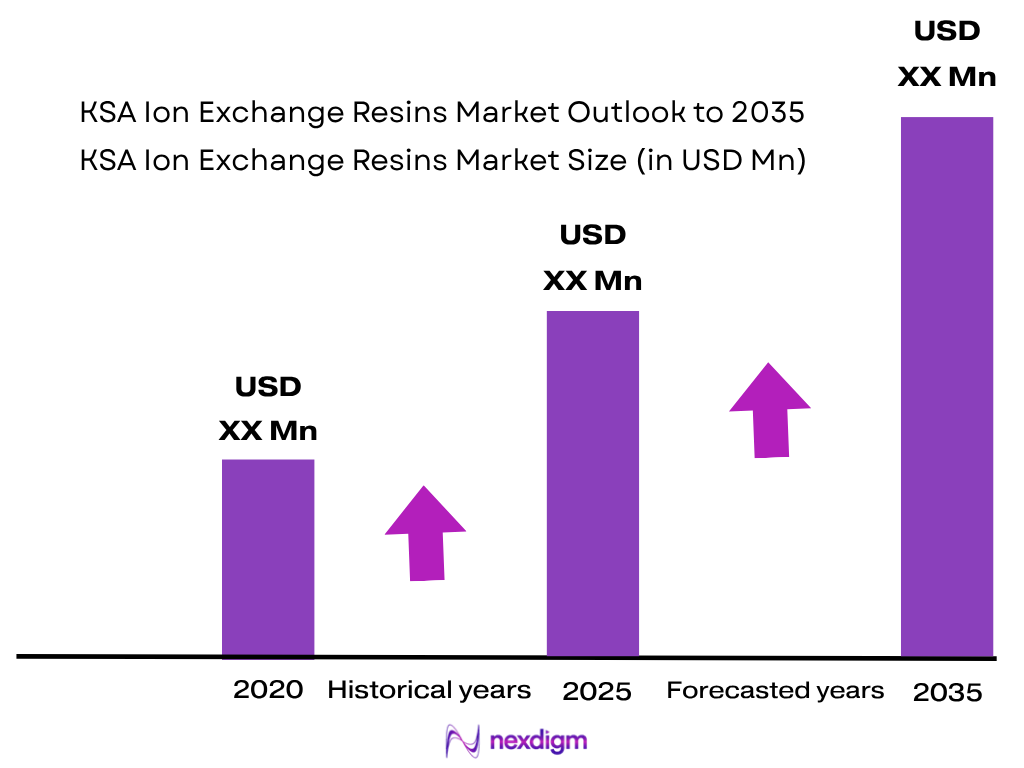
The KSA Ion Exchange Resins Market is valued at USD 35.7 million, supported by demand from desalination post-treatment, industrial demineralization, boiler-feedwater purification, condensate polishing, water softening and process-water treatment. Saudi Arabia’s water infrastructure provides a large recurring resin-consumption base: recent major desalination additions include 600,000 m³/day at Jubail 3A and 570,000 m³/day at Jubail 3B. Oil refining, petrochemicals, power generation and mining further sustain replacement and specialty-resin requirements.
Eastern Province, Riyadh and the Western industrial corridor represent the principal consumption centers for the KSA Ion Exchange Resins Market. Jubail 3A alone provides 600,000 m³/day of desalination capacity, while the wider Eastern supply system includes plants exceeding 500,000 m³/day individually. Medina’s major wastewater-treatment project provides another 375,000 m³/day of capacity. Jubail, Dammam, Ras Al-Khair, Riyadh, Yanbu and Jeddah dominate because of concentrated refining, petrochemicals, mining, utilities, manufacturing and water-treatment infrastructure.
Market Segmentation
By Resin Type
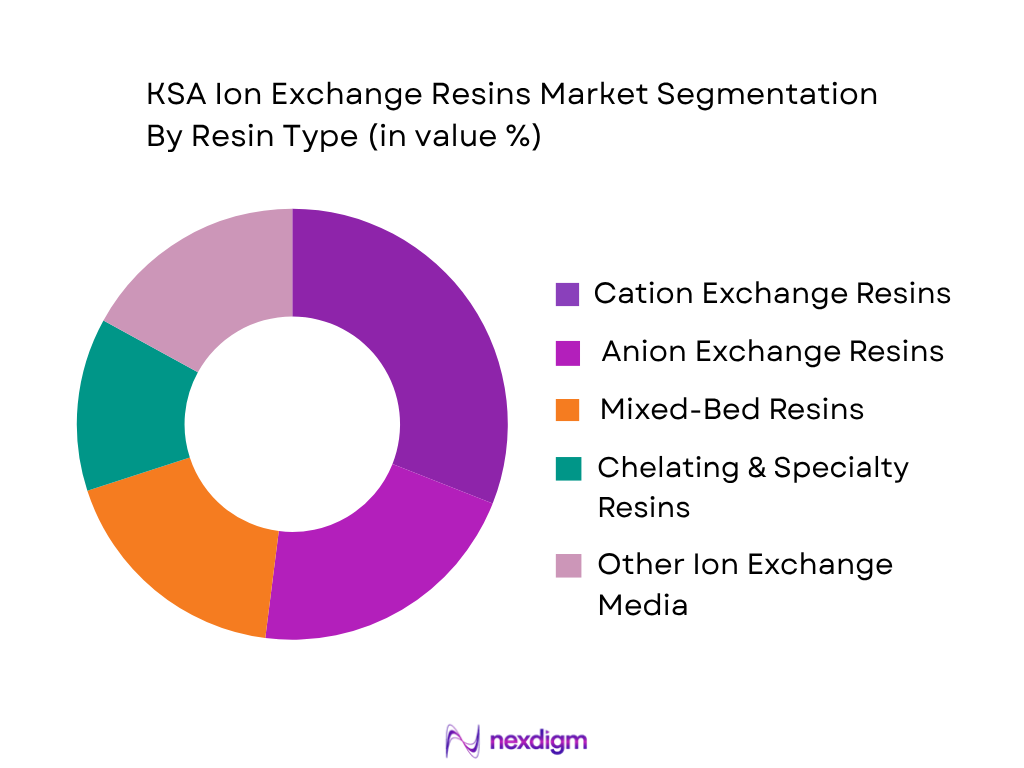
The KSA Ion Exchange Resins Market is segmented by resin type into cation exchange resins, anion exchange resins, mixed-bed resins, chelating and specialty resins, and other ion exchange media. Cation exchange resins hold the dominant position, supported by extensive deployment in water softening and demineralization across desalination-linked utilities, refineries, petrochemical plants, power facilities and general industrial water systems. Strong-acid cation resins remove calcium, magnesium and other dissolved cations and are routinely incorporated upstream of anion-exchange or mixed-bed polishing units. Their broad application range, established regeneration procedures and substantial installed equipment base create recurring replacement demand. Grand View Research identifies cationic resin as the largest revenue-generating product category in Saudi Arabia. Anion and mixed-bed resins remain essential in applications requiring deeper demineralization, while specialty and chelating products address selective metal recovery, purification and complex industrial separation requirements.
By End-User Industry
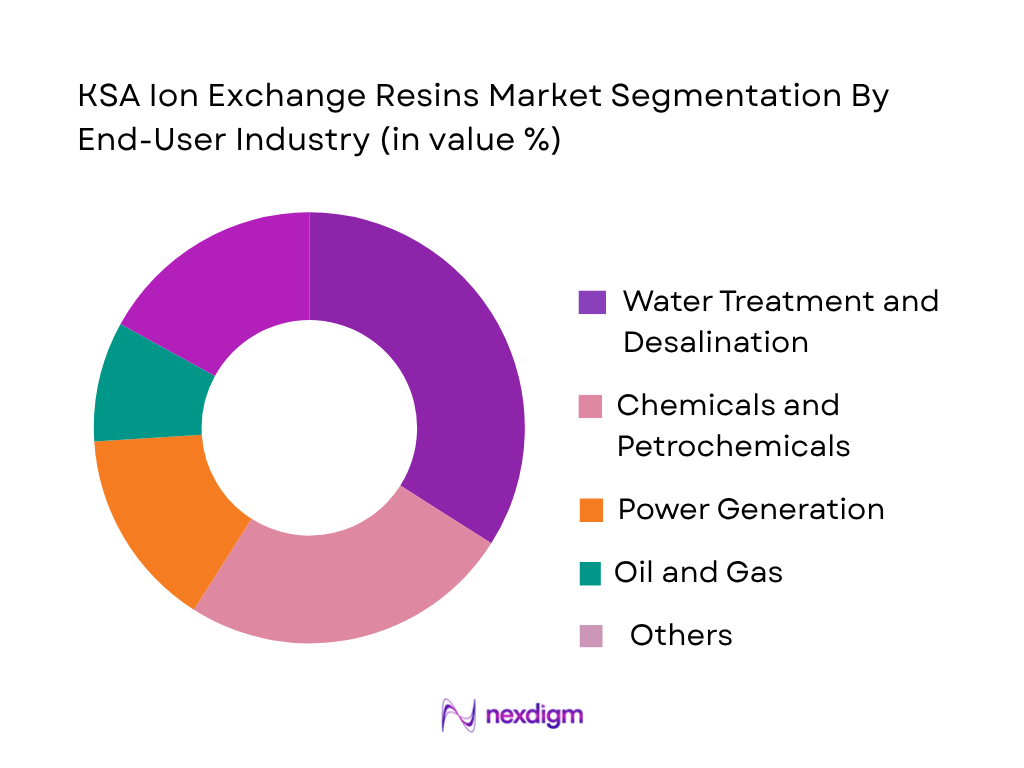
The KSA Ion Exchange Resins Market is segmented by end-user industry into water treatment and desalination, chemicals and petrochemicals, power generation, oil and gas, mining and mineral processing, food and beverage, pharmaceuticals, and other industrial applications. Water treatment and desalination represent the dominant end-user segment because water security is a strategic requirement in the Kingdom and large-scale desalination, municipal treatment and industrial purification assets operate continuously. Ion exchange systems are used for softening, demineralization, condensate polishing, process-water preparation and final polishing after membrane treatment. Saudi Arabia’s large desalination pipeline and growing wastewater-reuse infrastructure create both new installation and replacement demand. Chemicals, petrochemicals and power facilities are also significant users because high-pressure boilers and sensitive process equipment require tightly controlled feedwater chemistry. Mining development adds opportunities for selective and chelating resins used in purification and metal-separation processes.
Competitive Landscape
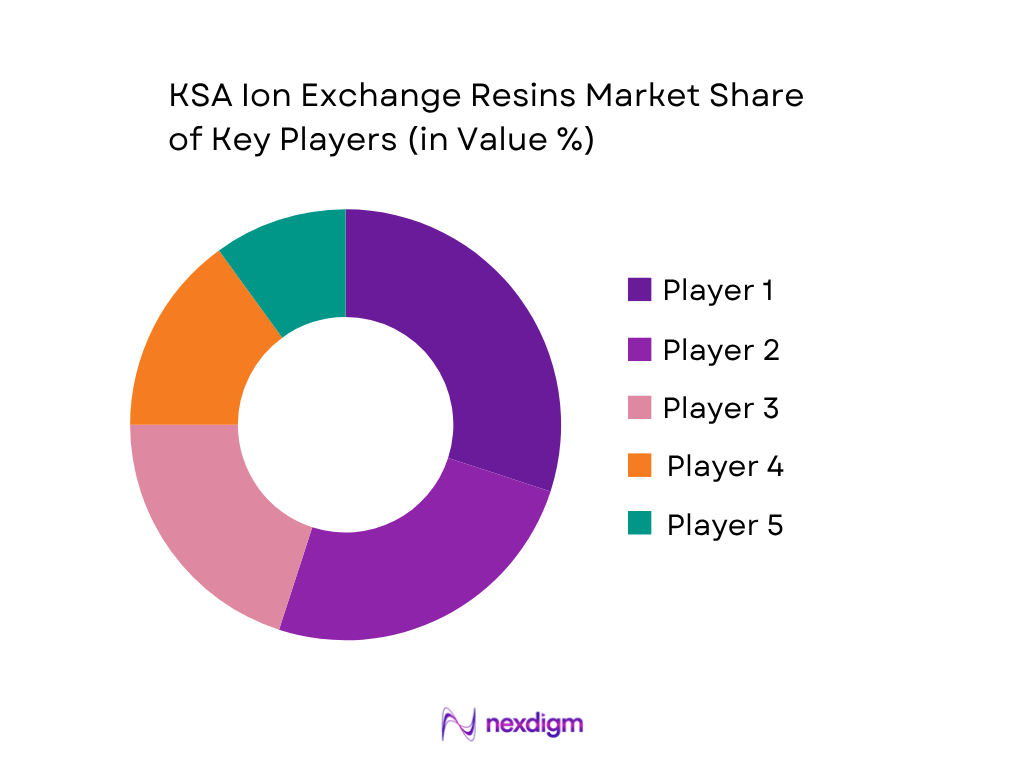
The KSA Ion Exchange Resins Market features established global specialty-chemical manufacturers and Asian resin suppliers competing through exchange capacity, resin durability, application expertise, technical support, inventory availability and total cost of ownership. Premium suppliers are particularly influential in condensate polishing, high-purity water, petrochemicals and critical industrial applications, while cost-competitive Asian producers have strong relevance in conventional softening and demineralization. Qualification history, local distributor support, resin service life and reliable replacement availability are major procurement considerations.
| Major Player | Establishment Year | Headquarters | Principal Resin Brand | Resin Portfolio | High-Purity Water Capability | Key KSA Applications | Specialty Resin Capability | Competitive Positioning |
| DuPont de Nemours, Inc. | 1802* | Wilmington, USA | ~ | ~ | ~ | ~ | ~ | ~ |
| LANXESS AG | 2004 | Cologne, Germany | ~ | ~ | ~ | ~ | ~ | ~ |
| Mitsubishi Chemical Group Corporation | 1933* | Tokyo, Japan | ~ | ~ | ~ | ~ | ~ | ~ |
| Ecolab Inc. / Purolite | 1923* | Saint Paul, USA | ~ | ~ | ~ | ~ | ~ | ~ |
| Thermax Limited | 1966 | Pune, India | ~ | ~ | ~ | ~ |
KSA Ion Exchange Resins Market Analysis
Growth Drivers
Expansion of Desalination, Wastewater Treatment and Water-Reuse Infrastructure
Saudi Arabia’s large desalination and wastewater-treatment system is a fundamental demand driver for ion exchange resins used in water softening, demineralization, condensate polishing and final-water purification. Saudi Water Partnership Company records show Jubail 3A has 600,000 m³/day of desalination capacity and Jubail 3B has 570,000 m³/day, while Rabigh 3 operates at 600,000 m³/day and Shuqaiq 3 at 450,000 m³/day. Wastewater infrastructure is similarly substantial: SWPC’s water-sector planning data records 6.85 million m³/day of wastewater generation in 2024, while wastewater-network coverage reached 64 out of every 100 units of generated wastewater. Medina 3 entered commercial operation with 375,000 m³/day of treatment capacity, and Buraydah 2 added another 150,000 m³/day. These operating assets require continuous control of dissolved ions, hardness and process-water chemistry, supporting recurring resin regeneration and replacement. The macroeconomic platform is also substantial: World Bank data place Saudi Arabia’s 2024 GDP at USD 1,239.8 billion and population at 35,300,280, reinforcing municipal and industrial water requirements. Sources: Saudi Water Partnership Company, Ministry of Environment, Water and Agriculture, World Bank.
Expansion of Industrial, Petrochemical, Power and Process-Water Demand
Saudi Arabia’s industrialization is widening the installed base of boilers, cooling systems, demineralization plants and high-purity process-water systems that consume ion exchange resins. Ministry of Industry and Mineral Resources data recorded 11,672 factories operating or under construction at the end of January 2024, while 152 new industrial licences were issued during that month alone. These included 27 food-products licences, 18 rubber and plastics licences and 14 chemical and chemical-product licences, all relevant to purified-water, boiler-feedwater and process-treatment requirements. The power sector adds another major demand platform: General Authority for Statistics data show 92.5 GW of licensed electricity-generation capacity in 2024, 402,628 GWh of electricity sent to the network and approximately 340,430 GWh consumed. Saudi crude-oil production also stood at 8.91 million barrels per day in December 2024, according to official statistics, supporting a large refining and hydrocarbon-processing ecosystem where demineralization and condensate polishing are operationally important. The IMF records Saudi nominal non-oil GDP at SAR 3,511 billion in 2024, demonstrating the scale of economic activity increasingly supporting industrial rather than solely oil-linked resin demand. Sources: Ministry of Industry and Mineral Resources, General Authority for Statistics, IMF.
Market Challenges
High Import Dependence and Concentrated Overseas Supply Base
Saudi Arabia’s ion exchange resin supply chain remains highly dependent on foreign manufacturing, exposing distributors and industrial users to international logistics, qualification lead times and inventory-management requirements. World Bank WITS data sourced from UN Comtrade show Saudi Arabia imported exactly 3,016,770 kilograms of polymer-based ion exchangers under HS 391400 in 2024, whereas exports amounted to only 18,474 kilograms. China supplied 1,590,090 kilograms, India supplied 537,065 kilograms, France supplied 469,607 kilograms, Italy supplied 296,916 kilograms and Germany supplied 58,359 kilograms. This sourcing profile demonstrates that the Kingdom’s requirements for standard and specialty ion exchange media are predominantly fulfilled through international supply chains. For end users such as refineries, power plants, desalination facilities and chemical complexes, resin replacement can require specific approved grades, making substitution during supply disruptions more complicated than procurement of undifferentiated treatment chemicals. The issue is material within a large economy: World Bank data show Saudi Arabia generated USD 1,239.8 billion in GDP in 2024, while IMF data place nominal non-oil GDP at SAR 3,511 billion, indicating substantial industrial activity relying on imported technical inputs. Sources: World Bank WITS, UN Comtrade, World Bank, IMF.
Demanding Water Conditions and Growing Treatment-System Complexity
The KSA Ion Exchange Resins Market faces an operational challenge from the scale and complexity of water treatment required across desalination, wastewater, power and industrial systems. Saudi Water Partnership Company planning information records approximately 6.85 million m³/day of wastewater generation in 2024, yet only 64 out of every 100 units were covered by wastewater collection networks. Large individual treatment assets also impose demanding purification requirements: Medina 3 has 375,000 m³/day of capacity, West Dammam 350,000 m³/day, North Taif 270,000 m³/day, Buraydah 2 150,000 m³/day and Tabuk 2 90,000 m³/day. Such high-volume treatment systems increasingly combine membranes, pretreatment, biological treatment and polishing technologies, requiring resin suppliers to demonstrate compatibility with variable feedwater chemistry, suspended solids, organics and upstream treatment configurations. Failure to manage iron, organic fouling or oxidant exposure can reduce ion-exchange performance and complicate regeneration. The broader utilities burden is also significant: General Authority for Statistics recorded 402,628 GWh of electricity supplied to the network and 92.5 GW of licensed generating capacity in 2024, creating substantial boiler and utility-water treatment requirements. World Bank GDP stood at USD 1,239.8 billion. Sources: Saudi Water Partnership Company, General Authority for Statistics, World Bank.
Market Opportunities
Localization of Resin Supply, Inventory and Technical-Service Capabilities
Saudi Arabia’s import-heavy resin supply structure creates a significant opportunity for local stocking, resin finishing, technical laboratories, application support and eventually greater domestic value addition. World Bank WITS and UN Comtrade data show the Kingdom imported 3,016,770 kilograms of polymer-based ion exchangers in 2024 while exporting only 18,474 kilograms, illustrating the wide physical gap between inbound and outbound resin flows. Imports were sourced from multiple manufacturing hubs, including 1,590,090 kilograms from China, 537,065 kilograms from India and 469,607 kilograms from France. Local inventory hubs in the Eastern Province and other industrial centers could therefore improve availability for refineries, petrochemical plants, power stations, desalination facilities and water-treatment EPC contractors that require approved replacement grades. The industrial customer base already provides a strong platform: the Ministry of Industry and Mineral Resources recorded 11,672 factories operating or under construction at the end of January 2024 and issued 152 industrial licences during that month. Saudi Arabia’s 2024 nominal non-oil GDP reached SAR 3,511 billion, according to the IMF, indicating a sizable diversified economic base supporting localization of industrial inputs. These current conditions create room for Saudi-based resin testing, regeneration optimization, emergency inventories and application engineering. Sources: World Bank WITS, UN Comtrade, Ministry of Industry and Mineral Resources, IMF.
Advanced Resins for Wastewater Reuse, High-Purity Water and Industrial Polishing
Saudi Arabia’s expanding treatment infrastructure creates an opportunity for higher-performance mixed-bed, selective, chelating and polishing resins rather than only conventional softening products. Saudi Water Partnership Company data record 6.85 million m³/day of wastewater generation in 2024, providing a large physical stream that requires collection, treatment and increasingly effective reuse. Medina 3 commenced commercial operations with 375,000 m³/day of treatment capacity, while Buraydah 2 provides 150,000 m³/day and Tabuk 2 provides 90,000 m³/day. In parallel, major desalination facilities such as Jubail 3A at 600,000 m³/day, Jubail 3B at 570,000 m³/day and Rabigh 3 at 600,000 m³/day create substantial treated-water flows where ion exchange can serve in polishing, demineralization and specialty purification applications. Advanced resins can also address industrial reuse streams requiring selective removal of metals, hardness or residual ionic contaminants after membrane treatment. The opportunity is supported by Saudi Arabia’s broader economic scale: World Bank data record 35,300,280 residents and GDP of USD 1,239.8 billion in 2024, while the electricity system operated 92.5 GW of licensed generation capacity. These existing assets provide a substantial installed base for higher-specification resin applications. Sources: Saudi Water Partnership Company, World Bank, General Authority for Statistics.
Future Outlook
The KSA Ion Exchange Resins Market is forecast to expand at a CAGR of approximately ~XX% during the forecast period, supported by continued investment in desalination, industrial water treatment, wastewater reuse, petrochemicals, mining and high-purity process-water infrastructure. The competitive focus is expected to shift gradually from commodity softening grades toward higher-capacity, uniform-particle-size, low-leachable, selective and longer-life ion exchange resins.
Saudi Arabia’s water-sector investment pipeline provides a substantial foundation for future resin consumption. The Saudi Water Partnership Company has mapped major desalination projects including 600,000 m³/day at Ras Al-Khair 2, 400,000 m³/day at Ras Al-Khair 3, 400,000 m³/day at Tabuk and 300,000 m³/day at Jazan. These projects increase requirements for pretreatment, polishing and industrial-grade water-treatment materials and create recurring replacement opportunities throughout plant operating lives. Industrial expansion will provide a second layer of demand. Saudi Arabia’s National Industrial Strategy targets development of more than 36,000 factories, with chemicals, food processing, pharmaceuticals, advanced manufacturing and mining among targeted sectors. Such industrial development increases demand for demineralized process water, boiler-feed treatment, cooling-water conditioning and wastewater recycling. Ion exchange resins can therefore benefit both from greenfield treatment systems and replacement demand associated with the expanding installed equipment base.
Major Players
- DuPont de Nemours, Inc. – AmberLite™
- Ecolab Inc. / Purolite – Purolite™
- LANXESS AG – Lewatit™
- Mitsubishi Chemical Group Corporation – DIAION™
- Samyang Corporation – TRILITE™
- Thermax Limited – Tulsion™
- Ion Exchange (India) Limited – INDION™
- Sunresin New Materials Co., Ltd.
- ResinTech, Inc.
- Jacobi Carbons Group / Jacobi Resins
- Jiangsu Suqing Water Treatment Engineering Group
- Anhui Sanxing Resin Technology Co., Ltd.
- Aldex Chemical Company Limited
- Zhejiang Zhengguang Industrial Co., Ltd.
- Hebi Higer Chemical Co., Ltd.
Key Target Audience
- Ion Exchange Resin Manufacturers and Specialty Separation Media Producers
- Desalination, Industrial Water Treatment EPC Companies and System Integrators
- Oil & Gas, Refining, Petrochemical and Chemical Manufacturers
- Power Generation, Mining, Food & Beverage and Pharmaceutical Companies
- Ion Exchange Resin Importers, Authorized Distributors and Industrial Chemical Suppliers
- Water Utilities, Desalination Operators and Industrial Wastewater-Reuse Companies
- Investments and Venture Capitalist Firms
- Government and Regulatory Bodies
Research Methodology
Step 1: Identification of Key Variables
The initial phase involves mapping the complete KSA Ion Exchange Resins Market ecosystem, including global resin manufacturers, Saudi importers, authorized distributors, water-treatment EPC contractors, desalination operators and industrial customers. Secondary research identifies critical variables including resin consumption, installed bed capacity, resin type, application, replacement cycle, import dependence, pricing, regeneration requirements and end-user demand across major industrial clusters.
Step 2: Market Analysis and Construction
Historical market demand is reconstructed using top-down and bottom-up approaches. The top-down framework evaluates desalination capacity, industrial water infrastructure, petrochemical activity, power generation, mining development and relevant import flows. The bottom-up framework assesses typical resin loading per treatment system, replacement frequency, installed resin beds, application-specific consumption and supplier/distributor sales to establish a detailed demand structure.
Step 3: Hypothesis Validation and Expert Consultation
Market hypotheses are validated through computer-assisted telephone interviews and structured discussions with resin suppliers, distributors, EPC companies, plant operators, procurement executives and industrial water-treatment professionals. These consultations assess resin selection criteria, annual purchasing volumes, regeneration practices, service life, qualification requirements, pricing differences, supplier performance and substitution between ion exchange, reverse osmosis and electrodeionization technologies.
Step 4: Research Synthesis and Final Output
Primary findings are triangulated against company documentation, water-sector project pipelines, industrial-development indicators, trade information and application-level consumption models. Top-down and bottom-up calculations are reconciled to validate market size and segmentation. Forecast assumptions incorporate desalination additions, petrochemical and mining investment, industrial localization, water reuse, replacement cycles and the expected shift toward high-performance and specialty resin grades.

- Executive Summary
- Research Methodology (Market Definition and Scope, Ion Exchange Resin Classification, Market Boundary Assessment, Abbreviations, Market Sizing Methodology, Top-Down Market Estimation, Bottom-Up Market Validation, Demand-Side Assessment, Supply-Side Assessment, Import-Based Market Reconstruction, Distributor Sales Assessment, Installed Resin Bed Assessment)

- Definition and Scope
- Evolution of KSA Ion Exchange Resins Industry
- Ion Exchange Resin Industry Genesis and Market Development
- Domestic Availability versus Imported Resin Supply Landscape
- Ion Exchange Resin Importer–Distributor–EPC–End User Ecosystem
- Desalination and Industrial Water Treatment Infrastructure Landscape

- Market Growth Drivers (Expansion of Desalination and Water Treatment Infrastructure, Increasing Industrial Wastewater Reuse, Expansion of Oil & Gas and Petrochemical Processing Capacity, Rising Boiler Feedwater and Condensate Polishing Requirements, Growth of Mining and Mineral Processing Projects)
- Market Challenges (High Dependence on Imported Resins, Foreign Exchange and Freight Exposure, Resin Price Volatility, Competition from Reverse Osmosis and Electrodeionization, Resin Fouling from Organic Matter, Iron, Oil and Suspended Contaminants)
- Market Opportunities (Desalinated Water Polishing Resins, Industrial Wastewater Recycling, High-Capacity Uniform Particle Size Resins, Low-Leachable High-Purity Resins, Petrochemical Condensate Polishing Resins, Mining and Metal-Recovery Chelating Resin)
- Market Trends (Shift from Commodity to High-Performance Resins, Adoption of Uniform Particle Size Resins, RO–Ion Exchange Hybridization, Growth of Mixed Bed Polishing, Increasing Demand for Low-Leachable Resins, Longer Resin Life Optimization, Reduced Chemical Regeneration Consumption)
- SWOT Analysis of Major Players
- Porter’s Five Forces Analysis
- PESTLE Analysis

- By Market Value (2020-2025)
- By Consumption Volume (2020-2025)
- By Average Selling Price (2020-2025)
- By Import Value (2020-2025)
- By Import Volume (2020-2025)
- By Installed Resin Bed Volume (2020-2025)
- By Fresh Resin Consumption versus Replacement Resin Demand (2020-2025)

- By Resin Type
Strong Acid Cation Resins
Weak Acid Cation Resins
Strong Base Anion Resins – Type I
Strong Base Anion Resins – Type II
Weak Base Anion Resins
Mixed Bed Resins
Chelating Resins
Selective Ion Exchange Resins
Adsorbent and Specialty Separation Resins
Ultrapure Water Grade Resins
Food and Pharmaceutical Grade Resins
Condensate Polishing Resins - By Polymer Matrix
Styrene-Divinylbenzene Resins
Acrylic Resins
Polystyrenic Resins
Macroporous Resins
Gel-Type Resins
Specialty Polymeric Matrices - By Ionic Form
Hydrogen Form
Sodium Form
Hydroxide Form
Chloride Form
Free-Base Form
Mixed Ionic Form
Application-Specific Ionic Forms - By Application
Water Softening
Demineralization and Deionization
Condensate Polishing
Ultrapure Water Production
Boiler Feedwater Treatment
Process Water Purification
Desalinated Water Post-Treatment
Drinking and Municipal Water Treatment
Wastewater Treatment and Water Reuse
Heavy Metal Removal
Boron and Selective Contaminant Removal
Food and Beverage Purification
Pharmaceutical Purification and Separation
Chemical Processing and Catalysis
Metal Recovery and Hydrometallurgy - By End-User Industry
Desalination and Municipal Water Utilities
Oil & Gas
Refining and Petrochemicals
Power Generation
Chemicals and Fertilizers
Mining and Mineral Processing
Metals and Steel
Food and Beverage
Pharmaceuticals and Healthcare
Industrial Cities and Utilities
Commercial and Institutional Water Treatment - By Geography
Eastern Province
Jubail Industrial City
Dammam–Khobar–Dhahran Industrial Corridor
Ras Al-Khair Mining and Industrial Cluster
Riyadh and Central Region
Riyadh Industrial Cluster
Western Region
Jeddah Industrial Corridor
Yanbu Industrial City
Rabigh Refining and Petrochemical Cluster
Northern Mining Corridor
Southern Region and Jazan Industrial Cluster

- Market Share Analysis of Major Players
- Cross Comparison Parameters (Product Portfolio Breadth, Ion Exchange Capacity and Resin Performance Range, KSA Distributor and Inventory Coverage, Oil & Gas and Petrochemical Application Capability, Desalination and Industrial Water Treatment Coverage, High-Purity and Specialty Resin Capability, Price Positioning and Total Cost of Ownership, Regeneration Efficiency and Expected Resin Service Life)
- Competitive Benchmarking Analysis (Product Innovation Capability, Pricing Strategy, KSA Market Presence, Supply Chain Efficiency, Customer Base Strength, Product Grade Coverage, Application-Specific Resin Capability, Distribution and Technical Service Strength)
- SWOT Analysis of Major Players
- Pricing Analysis
- Detailed Profile of Major Companies
DuPont de Nemours, Inc. – AmberLite™
Ecolab Inc. / Purolite – Purolite™
LANXESS AG – Lewatit™
Mitsubishi Chemical Group Corporation – DIAION™
Samyang Corporation – TRILITE™
Thermax Limited – Tulsion™
Ion Exchange (India) Limited – INDION™
Sunresin New Materials Co., Ltd.
ResinTech, Inc.
Jacobi Carbons Group / Jacobi Resins
Jiangsu Suqing Water Treatment Engineering Group
Anhui Sanxing Resin Technology Co., Ltd.
Aldex Chemical Company Limited
Zhejiang Zhengguang Industrial Co., Ltd.
Hebi Higer Chemical Co., Ltd.

- Procurement Behavior Analysis
- Buyer Preference Assessment
- Import Dependency and Sourcing Analysis
- Pricing Sensitivity Analysis
- KSA Ion Exchange Resins Supply-Demand Analysis
- Domestic Resin Availability and Distribution Assessment
- Import Dependency Analysis
- Domestic Consumption Assessment

- By Market Value (2026-2035)
- By Consumption Volume (2026-2035)
- By Average Selling Price (2026-2035)
- By Import Value (2026-2035)
- By Import Volume (2026-2035)
- By Installed Resin Bed Volume (2026-2035)
- By Fresh Resin Consumption versus Replacement Resin Demand (2026-2035)


 Request a Sample
 Ask for Customization
 Get a Quote
 Enquire Now