

 Download PDF
Market Overview
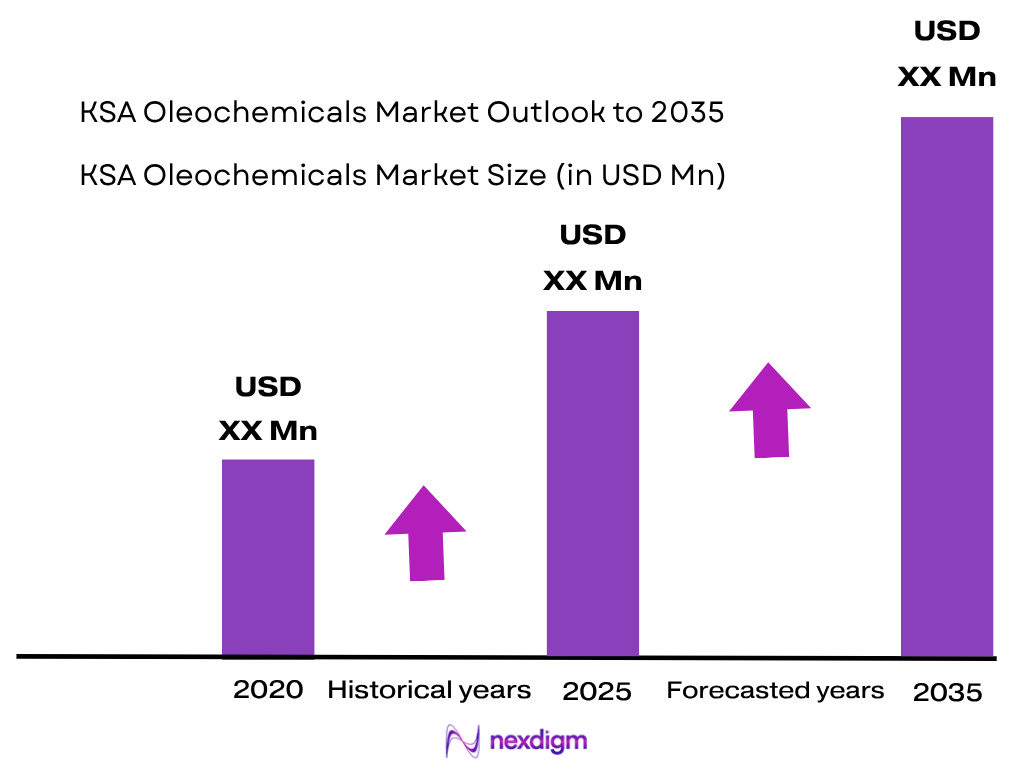
The KSA Oleochemicals Market is valued at approximately ~USD XXX million, with the final market-size figure to be validated against licensed industry databases. Underlying trade indicators confirm a sizeable import-led demand base: refined and synthetic glycerol imports moved from USD 13.0 million and 11.68 million kg in the preceding trade period to USD 12.8 million subsequently, while crude glycerol imports changed from 7.13 million kg to 2.35 million kg. The market is concentrated around Jubail-Dammam, Riyadh and Jeddah, while Malaysia and Indonesia dominate external supply. The Eastern industrial corridor benefits from petrochemical, lubricant, polymer and oilfield-chemical manufacturing; Riyadh concentrates consumer-goods, pharmaceutical and formulation demand; and Jeddah serves as a major western import-distribution hub. Malaysia and Indonesia dominate upstream sourcing because of integrated palm and palm-kernel oleochemical industries. Saudi crude palm-oil imports increased from 553.5 million kg to 601.7 million kg, highlighting this Asian feedstock linkage.
Market Segmentation
By Product Type
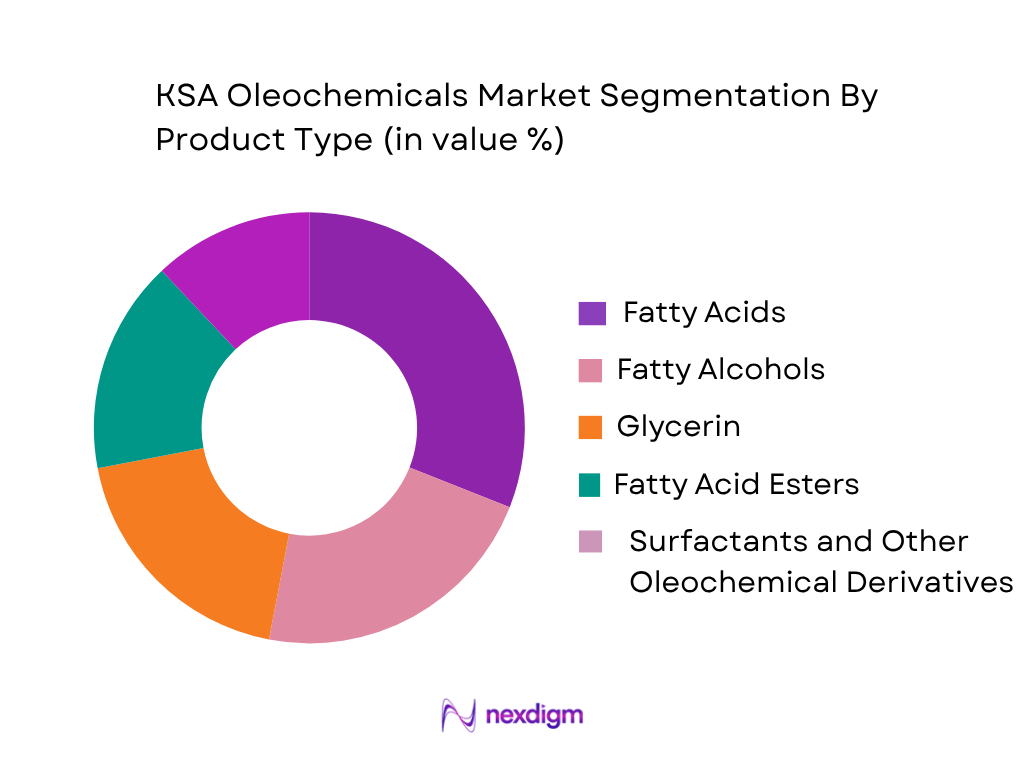
The KSA Oleochemicals Market is segmented by product type into fatty acids, fatty alcohols, glycerine, fatty acid esters and surfactants/other derivatives. Fatty acids hold the dominant position in this segmentation because of their broad applicability across detergents, soaps, plastics, rubber, lubricants, coatings and industrial formulations. Stearic and oleic acids are particularly important for polymer processing, rubber compounding, metallic soaps, release agents and lubricant formulations, while lauric derivatives support cleaning and surfactant applications. The dominance of fatty acids is also reinforced by Saudi Arabia’s substantial reliance on imported industrial monocarboxylic fatty acids. Trade data records imports of industrial fatty-acid categories exceeding 13 million kg in one recent period, demonstrating the depth of downstream demand. Large industrial clusters in the Eastern Province further strengthen consumption through plastics, chemicals and oilfield-related manufacturing.
By Application Industry
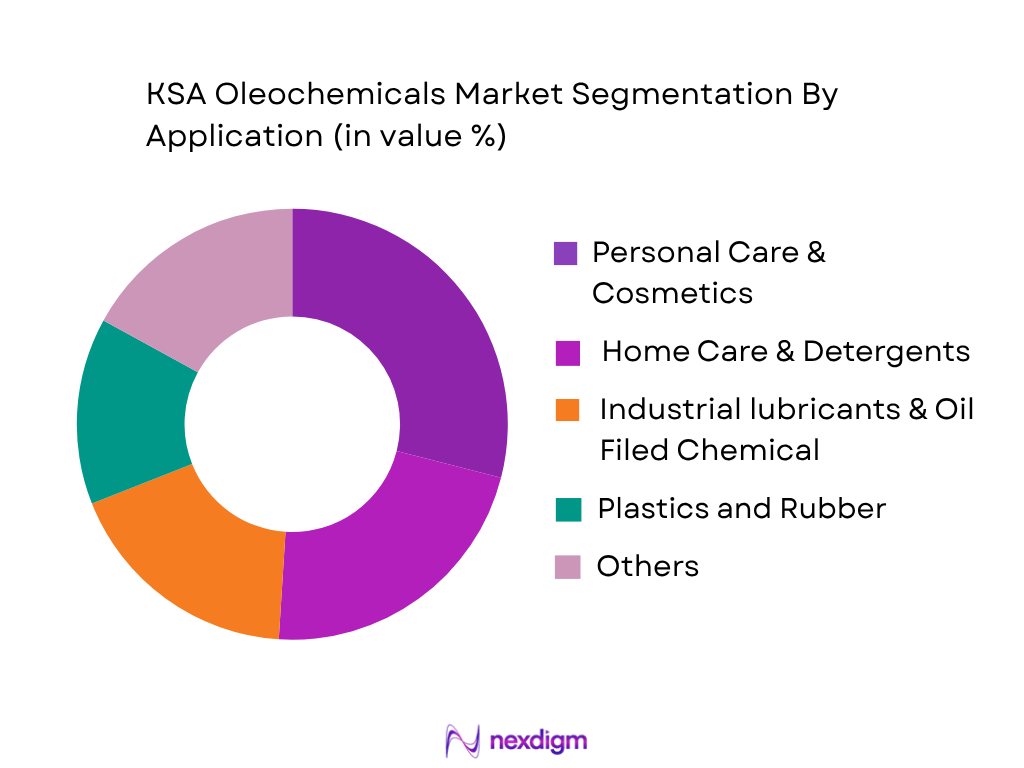
The KSA Oleochemicals Market is segmented by application into home care and detergents, personal care and cosmetics, industrial lubricants and oilfield chemicals, plastics and rubber, food and pharmaceuticals, and other industrial applications. Home care and detergents constitute the dominant segment because oleochemical-derived fatty acids, fatty alcohols, glycerine and surfactant intermediates are integral to laundry detergents, dishwashing liquids, soaps, institutional cleaners and surface-care products. Saudi Arabia has a large domestic consumer-products market supplemented by hospitality, healthcare and institutional-cleaning demand. Local manufacturers also require reliable bulk supplies with consistent purity, chain-length distribution and formulation performance. Fatty alcohol derivatives are particularly relevant to surfactant systems, while glycerine acts as a humectant and formulation ingredient. The strong import orientation of these products creates an established distribution ecosystem involving global producers, Saudi chemical distributors, bulk stockists and specialty formulators.
Competitive Landscape
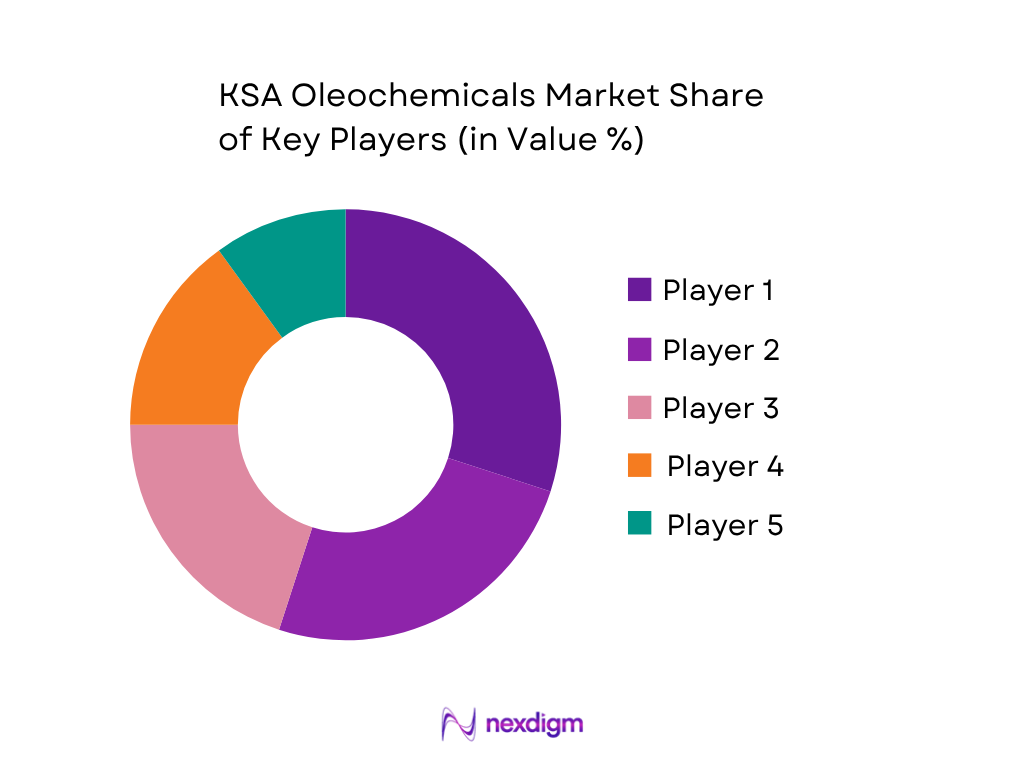
The KSA Oleochemicals Market is characterized by a combination of large integrated Asian oleochemical manufacturers, global specialty-chemical suppliers and Saudi/GCC distributors. The upstream competitive advantage rests largely with Southeast Asian companies possessing direct access to palm and palm-kernel feedstocks, while European and American suppliers are stronger in specialized esters, high-purity derivatives and application-specific formulations. Saudi competition therefore centers on landed cost, product availability, certification, local inventory, technical support and distributor relationships rather than only manufacturing capacity.
| Major Player | Establishment | Headquarters | Core Oleochemical Portfolio | Feedstock Integration | Manufacturing Footprint | Primary End Uses | Sustainability Position | KSA Market Relevance |
| Wilmar International | 1991 | Singapore | ~ | ~ | ~ | ~ | ~ | ~ |
| KLK OLEO | 1991 oleochemical entry | Malaysia | ~ | ~ | ~ | ~ | ~ | ~ |
| IOI Oleochemical | 1980 | Malaysia | ~ | ~ | ~ | ~ | ~ | ~ |
| Emery Oleochemicals | 1840 | Cincinnati, USA | ~ | ~ | ~ | ~ | ~ | ~ |
| Musim Mas Group | 1932 | Singapore | ~ | ~ | ~ | ~ | ~ | ~ |
KSA Oleochemicals Market Analysis
Growth Drivers
Expansion of Saudi Downstream Manufacturing and Industrial Chemical Consumption
The KSA oleochemicals market is being structurally supported by the expansion of Saudi Arabia’s downstream manufacturing base, particularly across detergents, personal care, plastics, rubber, food processing, pharmaceuticals, lubricants, coatings and oilfield chemicals, where fatty acids, fatty alcohols, glycerine, esters and oleochemical-derived surfactants are used as functional intermediates. Saudi Arabia’s economy generated USD 1,254,140,800,000 in GDP in 2024 according to the World Bank, while the country’s population reached 35,300,280 people, providing both a large industrial economy and a substantial domestic consumption base for home-care, personal-care, food and pharmaceutical products. The industrial indicators are equally relevant to oleochemical demand. The General Authority for Statistics reported that the Saudi manufacturing index reached 116.3 in December 2024, while the index for manufacture of chemicals and chemical products stood at 113.0, compared with 107.8 in December 2023. The food-manufacturing index reached 122.4, basic-metals manufacturing stood at 123.3, and beverage manufacturing reached 139.3. These sectors directly or indirectly consume oleochemical derivatives: food processors use refined glycerine and mono- and diglycerides; chemical formulators consume fatty alcohols, acids and surfactant intermediates; polymer manufacturers use stearic acid and metallic stearates; and industrial processors consume lubricant esters and fatty-acid derivatives. Saudi Arabia’s chemical manufacturing infrastructure is also expanding at the establishment level.
Large Import-Based Consumption of Glycerine and Industrial Fatty Acids Supporting Established Oleochemical Demand
Saudi Arabia already exhibits substantial physical trade flows for core oleochemical products, demonstrating that the country has an established downstream consumption base rather than only prospective demand. World Bank WITS trade data show that Saudi Arabia imported 2,345,750 kg of crude glycerol and glycerol waters in 2024. This supply came from a diversified but externally dependent sourcing network including 560,010 kg from the UAE, 533,770 kg from Brazil, 525,569 kg from Spain, 480,493 kg from Indonesia, 120,000 kg from Malaysia and 75,000 kg from China. Refined and synthetic glycerol flows were considerably larger. Saudi Arabia imported 8,655,280 kg from Indonesia and 6,463,610 kg from Malaysia, alongside 426,255 kg from Brazil, 120,085 kg from China and 10,860 kg from the United States under the refined/synthetic glycerol category reported by Saudi Arabia. Glycerine has cross-industry use in personal care, pharmaceuticals, oral care, food processing, detergents, industrial formulations and chemical synthesis, so these volumes indicate a deep base of customers requiring varying purity and specification levels. Industrial fatty-acid trade provides an additional demand signal. Exporter-reported World Bank WITS data show India supplied 6,425,740 kg of industrial monocarboxylic fatty acids and acid oils to Saudi Arabia in 2024, while the United States supplied 2,822,730 kg, Malaysia supplied 3,374,920 kg, Egypt supplied 1,248,990 kg, and Turkey supplied 634,053 kg.
Market Challenges
High Dependence on Imported Oleochemical Feedstocks and Finished Intermediates
A principal structural challenge for the KSA oleochemicals market is its dependence on overseas production centers for critical natural oleochemical products, particularly glycerine and palm-derived intermediates. World Bank WITS data show Saudi Arabia imported 2,345,750 kg of crude glycerol and glycerol waters in 2024 from a geographically dispersed supply base. Indonesia supplied 480,493 kg, Spain 525,569 kg, Brazil 533,770 kg, Denmark 45,305 kg, the UAE 560,010 kg, China 75,000 kg, and Malaysia 120,000 kg. Dependence becomes even more concentrated in higher-volume refined glycerine. Saudi-reported data show imports of 8,655,280 kg from Indonesia and 6,463,610 kg from Malaysia, meaning two Southeast Asian suppliers accounted for more than 15 million kg of the specifically reported country volumes in this product category. This is market-specific because Indonesia and Malaysia are integrated palm and palm-kernel processing centers, whereas Saudi Arabia does not possess a comparable domestic plantation-based feedstock system. Industrial fatty acids show a similarly international sourcing model: exporter-reported data record 6,425,740 kg from India, 3,374,920 kg from Malaysia, 2,822,730 kg from the United States, 1,248,990 kg from Egypt, and 634,053 kg from Turkey entering Saudi Arabia. The challenge is therefore not merely obtaining chemical products; Saudi buyers must manage multiple origins, marine transportation, customs clearance, inventory buffers, specifications and supplier qualification.
Limited Domestic Primary Oleochemical Integration Relative to the Scale of Saudi Chemical Manufacturing
Saudi Arabia has a large and increasingly sophisticated chemical sector, but its strength is concentrated in hydrocarbons, petrochemicals, polymers and downstream conversion rather than in plantation-linked natural oleochemical production. This creates a structural mismatch between the Kingdom’s industrial customer base and its local availability of primary fatty acids, fatty alcohols and glycerine feedstocks. The Ministry of Industry and Mineral Resources reported 11,672 factories operating or under construction at the end of January 2024, with 152 new industrial licenses issued during that month alone. Within these approvals, 14 licenses were for chemicals and chemical products and 18 licenses were for rubber and plastic products. These activities are relevant to oleochemicals because rubber and plastics producers consume stearic acid, metallic stearates and fatty-derived processing aids, while chemical manufacturers use fatty acids, alcohols, esters, glycerine and surfactant intermediates. GASTAT data reinforce the scale of this downstream base: the manufacture-of-chemicals-and-chemical-products index stood at 113.0 in December 2024, the food-manufacturing index at 122.4, basic metals at 123.3, and beverages at 139.3. Yet Saudi physical trade demonstrates continued reliance on foreign oleochemical conversion capacity. The Kingdom imported 2,345,750 kg of crude glycerol, while refined glycerine inflows included 8,655,280 kg from Indonesia and 6,463,610 kg from Malaysia. Industrial fatty-acid supply likewise included 6,425,740 kg from India, 3,374,920 kg from Malaysia, 2,822,730 kg from the United States, and 1,248,990 kg from Egypt based on exporter reporting.
Market Opportunities
Localization of Glycerine Refining, Fatty-Acid Processing and Specialty Oleochemical Conversion
Saudi Arabia’s current import structure creates a tangible future opportunity to localize selected stages of the oleochemical value chain without requiring a fully integrated palm plantation model. The opportunity is supported by current physical volumes rather than future forecasts. Saudi Arabia imported 2,345,750 kg of crude glycerol and glycerol waters in 2024, sourced from the UAE, Brazil, Spain, Indonesia, Malaysia, China, Denmark and the United States. In addition, refined and synthetic glycerol imports included 8,655,280 kg from Indonesia and 6,463,610 kg from Malaysia, indicating substantial existing consumption of processed glycerine. This gap between crude and refined-material flows provides a strategic basis for assessing local purification, concentration, distillation and high-purity glycerine capabilities. Industrial fatty acids offer another localization pathway. Exporter records show 6,425,740 kg from India, 3,374,920 kg from Malaysia, 2,822,730 kg from the United States, 1,248,990 kg from Egypt and 634,053 kg from Turkey supplied into Saudi Arabia during 2024. These volumes can support feasibility assessments for local fractionation, formulation, esterification and application-specific processing, particularly if local manufacturing can serve detergent, polymer, rubber, lubricant and personal-care buyers with shorter replenishment cycles.
Development of KSA as a GCC Oleochemical Distribution, Processing and Re-Export Hub
Saudi Arabia has an opportunity to strengthen its position as a regional oleochemical distribution and value-added processing hub because current trade data already demonstrate two-way flows between the Kingdom, GCC markets and international suppliers. World Bank WITS data show Saudi Arabia exported 4,120,290 kg of industrial monocarboxylic fatty acids and acid oils in 2024. The UAE received 2,348,970 kg, Jordan received 285,990 kg, Kuwait received 77,599 kg, Oman received 10,000 kg, and Bahrain received 500 kg, while other shipments went to India, Vietnam, China, France and Pakistan. Refined and synthetic glycerol exports also reached 21,300 kg, including 14,925 kg to Bahrain, 2,100 kg to Qatar, 4,025 kg to India and 250 kg to Algeria. These flows demonstrate that Saudi Arabia already participates in regional chemical redistribution and is not solely an import-consuming market. This creates a foundation for larger stock-and-sell operations, local packaging, blending, formulation and application-specific distribution. The opportunity becomes stronger when Saudi Arabia’s domestic industrial scale is considered. World Bank data place the country’s 2024 GDP at USD 1,254,140,800,000, while the population reached 35,300,280, supporting a large anchor market from which regional distribution can be built. GASTAT’s industrial data show a December manufacturing index of 116.3, a chemicals-and-chemical-products index of 113.0, a food-products index of 122.4, and a basic-metals index of 123.3.
Future Outlook
The KSA Oleochemicals Market is expected to expand at a forecast CAGR of approximately ~X.X% during the forecast period, supported by deeper downstream manufacturing, specialty-chemical localization, consumer-product production and demand for renewable chemical ingredients. Growth will increasingly shift from straightforward commodity imports toward locally stocked, formulated and potentially manufactured higher-value derivatives. Demand for fatty alcohols and surfactant intermediates is likely to benefit from expanding detergent, household-cleaning and personal-care manufacturing. Pharmaceutical and food-processing activities should support higher-purity glycerine and specialty ester consumption, while industrial diversification will create demand for lubricity additives, polymer-processing aids, fatty amines and bio-based specialty chemicals.
Major Players
- Wilmar International Limited
- KLK OLEO
- IOI Oleochemical
- Emery Oleochemicals
- Musim Mas Group
- Oleon
- BASF SE
- Evonik Industries AG
- Croda International Plc
- Kao Corporation / Kao Chemicals
- REDA Chemicals
- Kanoo Manuchar
- Brenntag Saudi Arabia
- Azelis Arabia
- United Industrial Chemicals – UIC
Key Target Audience
- Oleochemical Manufacturers and Integrated Palm-Based Chemical Producers
- Saudi Chemical Importers, Distributors and Bulk Chemical Stockists
- Home Care, Detergent and Personal Care Product Manufacturers
- Pharmaceutical, Food Ingredient and Specialty Formulation Companies
- Plastics, Rubber, Lubricant and Oilfield Chemical Manufacturers
- Industrial Investors and Chemical Manufacturing Groups
- Investments and Venture Capitalist Firms
- Government and Regulatory Bodies (Ministry of Industry and Mineral Resources, Saudi Authority for Industrial Cities and Technology Zones – MODON, Royal Commission for Jubail and Yanbu, Saudi Food and Drug Authority – SFDA, Saudi Standards, Metrology and Quality Organization – SASO, Zakat, Tax and Customs Authority – ZATCA)
Research Methodology
Step 1: Identification of Key Variables
The initial phase involves developing an ecosystem map for the KSA Oleochemicals Market covering feedstock suppliers, international manufacturers, Saudi importers, distributors and major downstream industries. Extensive secondary research is conducted through customs statistics, industry associations, company publications and government resources. Critical variables include product volumes, feedstock routes, import dependency, pricing, application demand and product grades.
Step 2: Market Analysis and Construction
Historical market data is assessed using a combination of top-down and bottom-up approaches. Import flows for glycerine, fatty-acid categories and renewable feedstocks are reconciled against domestic consumption patterns, distributor activity and downstream industrial requirements. Product-level average selling prices are then used to develop the overall market-value framework and segment-level revenue pools.
Step 3: Hypothesis Validation and Expert Consultation
Market hypotheses are validated through structured primary interviews and CATIs with oleochemical suppliers, chemical distributors, procurement managers, formulators and downstream industrial users. Discussions examine purchasing frequency, annual consumption, supplier preferences, product specifications, pricing mechanisms, import lead times and certification requirements. Findings are used to refine supply-demand assumptions and competitive positioning.
Step 4: Research Synthesis and Final Output
The final phase triangulates supplier-side findings with importer statistics, application-level consumption and company-level market intelligence. Top-down estimates are cross-checked against product-level bottom-up demand calculations to minimize double counting and HS-code overlap. The resulting framework produces market size, segmentation, competitive benchmarking, forecast scenarios and strategic recommendations for the KSA Oleochemicals Market.

- Executive Summary
- Research Methodology (Market Definition and Scope, Product Taxonomy and Market Boundary, HS-Code and Trade Data Mapping, Top-Down Market Sizing, Bottom-Up Market Sizing, Demand-Side Assessment, Supply-Side Assessment, Primary Industry Interviews, Data Triangulation, Pricing Methodology, Forecasting Framework, Scenario Framework, Research Limitations)

- Definition and Scope
- Oleochemical Industry Genesis and Market Evolution
- KSA Oleochemical Industry Structure
- Basic Oleochemicals versus Specialty Oleochemical Derivatives
- Natural Oleochemical versus Petrochemical-Derived Chemical Substitution
- KSA Oleochemical Value Chain
- Feedstock-to-Derivative Conversion Chain
- Industry Ecosystem: Producer–Exporter–Importer–Distributor–Formulator–End User
- Key Industrial and Consumption Clusters
- Role of Jubail, Dammam, Riyadh and Jeddah in the Oleochemical Supply Chain
- Position of KSA within GCC and Middle East Oleochemical Trade

- Growth Drivers (Expansion of Home and Personal Care Manufacturing, Detergent Production Growth, Pharmaceutical Localization, Food Processing Expansion, Plastics and Rubber Conversion, Lubricant Demand, Oilfield Chemical Consumption, Sustainable Ingredient Adoption, Specialty Chemical Localization)
- Market Challenges (Palm and Palm Kernel Import Dependency, Oleochemical Import Concentration, Feedstock Price Volatility, Freight Exposure, Limited Primary Oleochemical Capacity, Heated Storage Requirements, Long Supplier Qualification Cycles, Petrochemical Substitution)
- Market Opportunities (Fatty Acid Processing, Glycerine Refining, Specialty Ester Manufacturing, Fatty Amine Production, Bio-Based Surfactants, Local Stocking, High-Purity Grades, Import Substitution, GCC Export Supply)
- Market Trends
- Government Regulations
- SWOT Analysis
- Porter’s Five Forces Analysis
- PESTLE Analysis
- Stakeholder Ecosystem
- Competition Ecosystem

- By Market Value (2020-2025)
- By Consumption Volume (2020-2025)
- By Average Selling Price (2020-2025)
- By Domestic Supply (2020-2025)
- By Import Value (2020-2025)

- By Product Type (In Value %)
Fatty Acids
Fatty Alcohols
Glycerine
Fatty Acid Methyl Esters
Glycerol Esters
Specialty Esters - By Feedstock (In Value %)
Palm Oil
Palm Kernel Oil
Coconut Oil
Soybean Oil
Rapeseed/Canola Oil
Sunflower Oil
Animal Fats/Tallow
Mixed and Other Renewable Lipid Feedstocks - By Functional Application (In Value %)
Surfactants
Emulsifiers
Humectants
Emollients
Lubricity Agents
Plastic Lubricants & Release Agents
Stabilizers & Processing Aids - By Sales Channel (In Value %)
Direct Manufacturer-to-End User
Authorized Chemical Distributors
Independent Importers & Traders
Stockists and Bulk Chemical Warehouses
Regional/GCC Trading Houses
B2B Chemical Procurement Platforms - By Region (In Value %)
Eastern Region – Jubail/Dammam/Khobar
Central Region – Riyadh
Western Region – Jeddah/Makkah/Madinah
Southern Region
Northern Region

- Cross Comparison Parameters (Product & Grade Portfolio Breadth, C8–C18 Chain-Length Coverage, Feedstock Integration Level, KSA Distribution & Stocking Reach, Saudi Landed-Cost Competitiveness, Supply Reliability & Delivery Lead Time, RSPO/Halal/Food/Pharma Certification Coverage, Technical Support & End-User Industry Coverage)
- Competitive Benchmarking Analysis (Fatty Acid & Fatty Alcohol Supply Capability, Specialty Oleochemical Innovation, Pricing Strategy, Import & Supply Chain Efficiency, Local Inventory Availability, Customer Base Strength, Application Development Capability, Sustainability Positioning)
- SWOT Analysis of Major Players
- Pricing Analysis (Fatty Acids, Fatty Alcohols, Glycerine, Glycerol Esters, Specialty Esters, Grade-Wise Pricing, Origin-Wise Pricing, Bulk vs Packaged Pricing, Direct Import vs Distributor Pricing)
- Major Competitors
Wilmar International Limited
KLK OLEO
Emery Oleochemicals
IOI Oleochemical
Musim Mas Group
Oleon
BASF SE
Evonik Industries AG
Croda International Plc
Cargill, Incorporated
Kao Corporation / Kao Chemicals
Godrej Industries Limited
Ecogreen Oleochemicals
VVF Limited
Corbion N.V.

- End-User Industry Demand Assessment
- Application-Based Consumption Analysis
- Procurement Behavior Analysis
- Buyer Preference Assessment
- Import Dependency and Sourcing Analysis
- Pricing Sensitivity Analysis

- By Market Value (2026-2035)
- By Consumption Volume (2026-2035)
- By Average Selling Price (2026-2035)
- By Domestic Supply (2026-2035)
- By Import Value (2026-2035)


 Request a Sample
 Ask for Customization
 Get a Quote
 Enquire Now