

 Download PDF
Market Overview
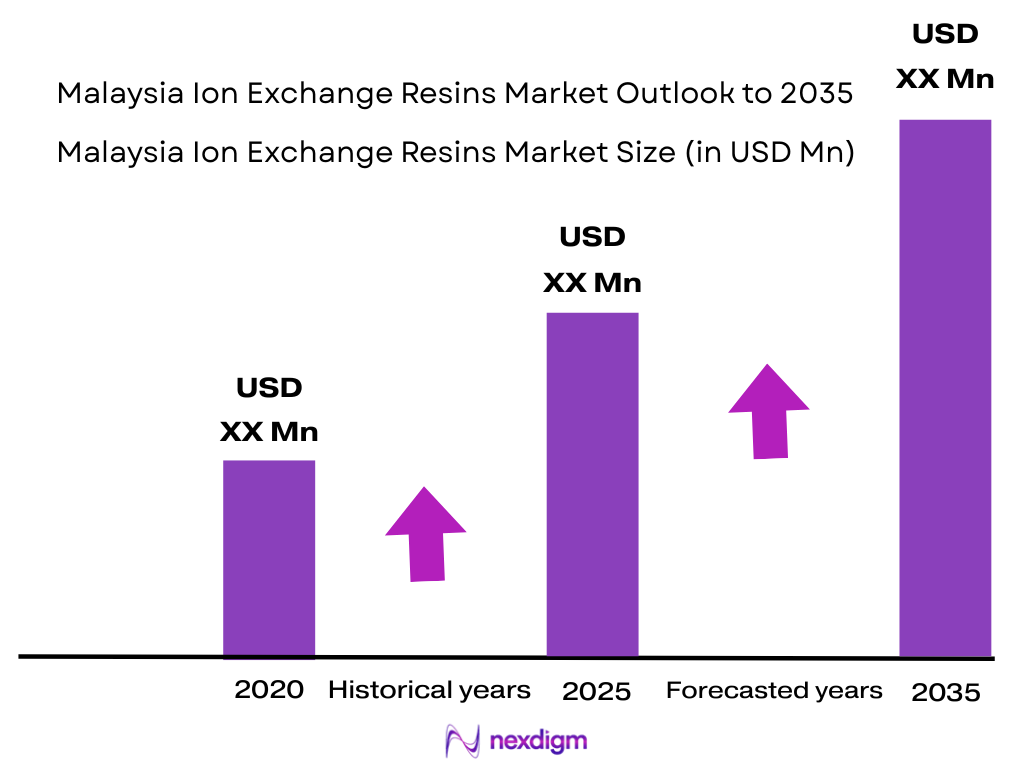
The Malaysia Ion Exchange Resins Market is valued at approximately ~USD XX million, supported by the country’s large industrial water-treatment base and expanding high-purity manufacturing ecosystem. Malaysia’s manufacturing sector generated RM1.9 trillion in sales in the latest completed annual period, while semiconductor exports in the preceding period stood at approximately RM575 billion. Demand is primarily generated by semiconductor ultrapure-water systems, industrial demineralization, boiler-feed treatment, wastewater recycling, and recurring resin replacement.
Dominant Industrial Locations: Penang, Kedah, Selangor and Johor represent the principal demand centres for the Malaysia Ion Exchange Resins Market because they combine semiconductor fabrication, electronics manufacturing, chemicals, utilities and rapidly expanding digital infrastructure. Malaysia recorded RM378.5 billion of approved investments, with Selangor attracting RM101.1 billion, Johor RM48.5 billion, Kedah RM45.8 billion and Penang RM32.0 billion. Penang–Kedah benefits from semiconductor concentration, whereas Johor’s expanding data-centre ecosystem increases requirements for sophisticated water-treatment infrastructure.
Market Segmentation
By Resin Type
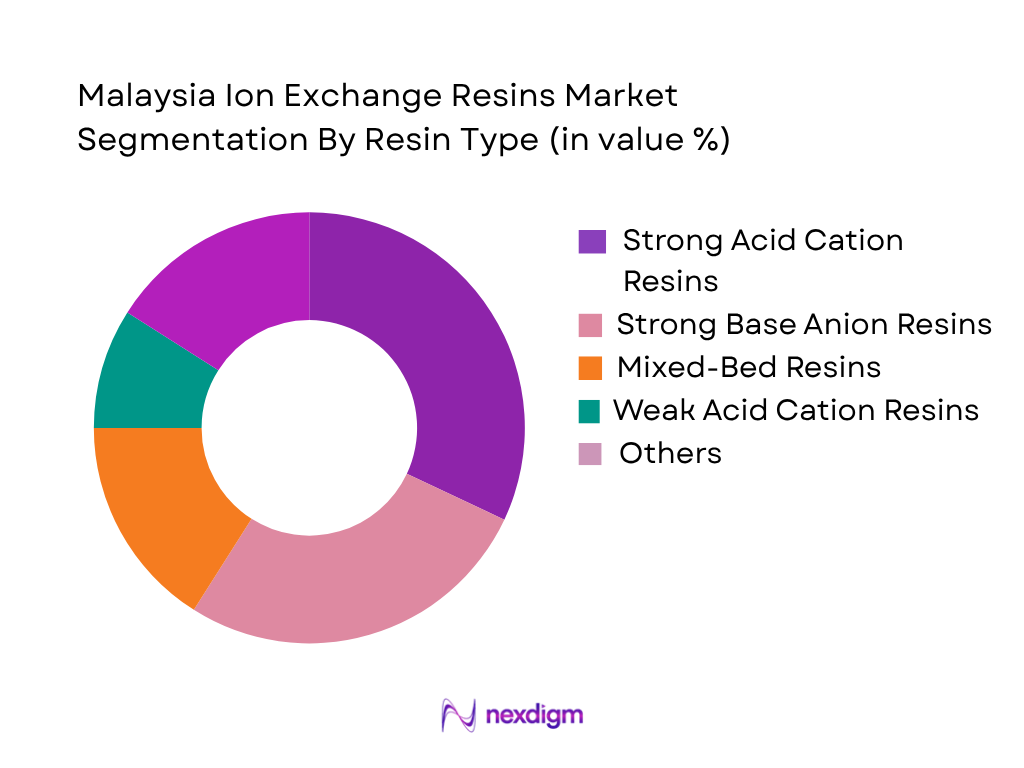
The Malaysia Ion Exchange Resins Market is segmented by resin type into strong acid cation resins, weak acid cation resins, strong base anion resins, weak base anion resins, mixed-bed resins, and chelating and specialty resins. Strong acid cation resins represent the dominant sub-segment, supported by their broad deployment in water softening, demineralization, boiler-feedwater conditioning and industrial process-water treatment. Their ability to exchange positively charged ions across a wide pH range makes them suitable for Malaysia’s diverse manufacturing facilities. Strong acid cation resins are also commonly paired with strong base anion resins in two-bed demineralization systems and are incorporated into mixed-bed polishing systems. The substantial installed base of industrial water-treatment plants creates recurring replacement demand, while semiconductor, power, chemical, palm oil and food-processing facilities require consistent ionic contaminant removal. Global suppliers such as DuPont and LANXESS offer SAC products for industrial and ultrapure-water applications, reinforcing availability across sophisticated treatment configurations.
By End-Use Industry
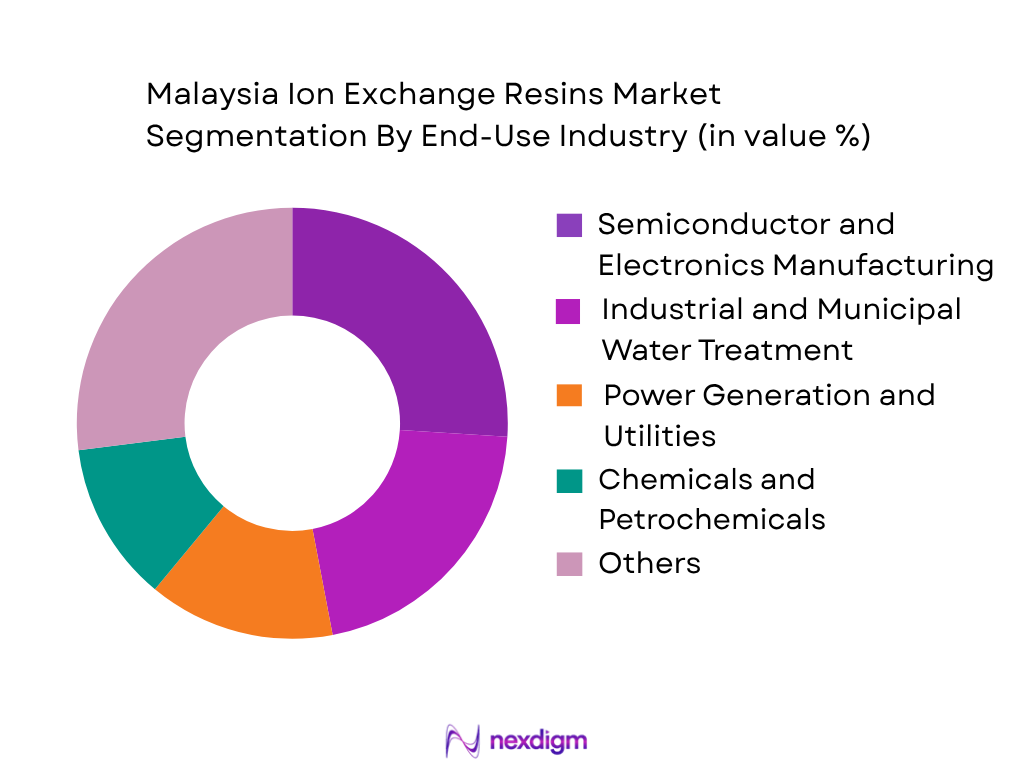
The Malaysia Ion Exchange Resins Market is segmented by end-use industry into semiconductor and electronics manufacturing, industrial and municipal water treatment, power generation, palm oil and oleochemicals, chemicals and petrochemicals, pharmaceuticals, food and beverage, and other industrial applications. Semiconductor and electronics manufacturing represents the dominant high-value demand segment because fabrication and advanced packaging facilities require ultrapure water with exceptionally low ionic, silica, boron and organic contamination. Malaysia has an established semiconductor ecosystem centred particularly around Penang and Kulim, with major investments including Intel’s advanced packaging activities and Infineon’s fabrication expansion. High-purity resin systems are deployed alongside reverse osmosis and electrodeionization for working mixed beds and final polishing. Suppliers increasingly offer specially cleaned, uniform-particle resins designed for semiconductor applications, where low TOC release, rapid rinsing, high resistivity and consistent bead characteristics are essential. This makes electronics manufacturing particularly important for premium resin revenues rather than merely bulk resin consumption.
Competitive Landscape
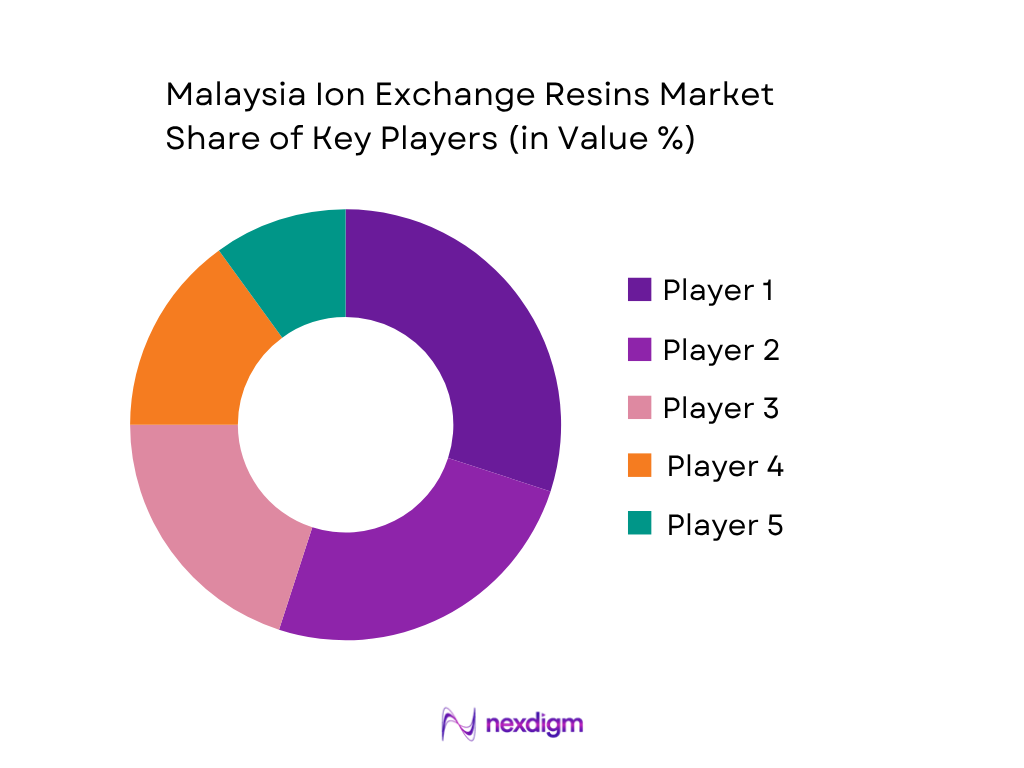
The Malaysia Ion Exchange Resins Market comprises global specialty-chemical manufacturers, dedicated resin producers and Asian suppliers competing through product performance, application-specific grades, regional inventories and technical support. DuPont, Ecolab/Purolite, LANXESS, Mitsubishi Chemical Group and Samyang are particularly relevant because their portfolios extend from standard cation and anion resins to mixed-bed, specialty and ultrapure-water products. Competition is increasingly influenced by resin purity, exchange capacity, uniform particle technology, lifecycle economics and the ability to support semiconductor and high-purity industrial customers. LANXESS, for example, markets semiconductor-focused ultrapure-water resins capable of high resistivity and very low organic leaching.
| Major Player | Establishment Year | Headquarters | Key Resin Brand | Core Resin Portfolio | Ultrapure-Water Capability | Specialty/Chelating Capability | Key Malaysian End Uses | Asia-Pacific Supply Position |
| DuPont de Nemours, Inc. | 1802* | Wilmington, United States | ~ | ~ | ~ | ~ | ~ | ~ |
| Ecolab / Purolite | 1981* | King of Prussia, United States | ~ | ~ | ~ | ~ | ~ | ~ |
| LANXESS AG | 2004 | Cologne, Germany | ~ | ~ | ~ | ~ | ~ | ~ |
| Mitsubishi Chemical Group | 1933* | Tokyo, Japan | ~ | ~ | ~ | ~ | ~ | ~ |
| Samyang Corporation | 1924 | Seoul, South Korea | ~ | ~ | ~ | ~ |
Malaysia Ion Exchange Resins Market Analysis
Growth Drivers
Expansion of Semiconductor and Electrical & Electronics Manufacturing
Malaysia’s expanding semiconductor and electrical and electronics manufacturing ecosystem is a direct demand driver for ion exchange resins because wafer fabrication, assembly, advanced packaging and precision electronics production require demineralized and ultrapure water systems incorporating cation, anion and mixed-bed polishing resins. The Malaysian Investment Development Authority reported RM47.0 billion of approved E&E investments across the first nine months of 2024, while a single Siliconware Precision Malaysia project involved RM6.0 billion for integrated-circuit assembly, wafer bumping and wafer sorting. Infineon’s Kulim expansion involved an additional RM30.1 billion for a 200-millimetre silicon-carbide fabrication plant, reinforcing Kedah as a high-purity manufacturing cluster. Malaysia also hosts 6 of the world’s 12 largest semiconductor companies, creating a substantial installed base for sophisticated water-treatment systems. This industrial momentum operates within a sizeable macroeconomic base: World Bank data place Malaysia’s 2024 nominal GDP at US$422.23 billion and GDP per capita at US$11,874.4. As semiconductor facilities require repeated ionic contaminant removal throughout process-water treatment, new fabs, packaging plants and supporting equipment facilities increase demand for strong acid cation, strong base anion, mixed-bed and semiconductor-grade low-leachable resins.
Large Industrial Manufacturing Base Supporting Process-Water Treatment
Malaysia’s broad manufacturing base provides recurring demand for ion exchange resins across chemical processing, power and utilities, food manufacturing, palm oil and oleochemicals, pharmaceuticals, metal processing and other water-intensive industries. Department of Statistics Malaysia recorded RM1.9 trillion in manufacturing-sector sales during 2024, demonstrating the scale of industrial operations requiring boiler-feed treatment, water softening, demineralization, process-water purification and wastewater polishing. MIDA recorded RM120.5 billion of approved manufacturing investments during 2024, while the first nine months alone included 800 manufacturing projects expected to create 58,017 jobs. Chemicals and chemical products accounted for RM7.0 billion of approved investment during that nine-month period, strengthening a particularly relevant customer base because chemical plants commonly employ ion exchange for process-water purification, condensate polishing and ionic contaminant removal. Malaysia’s wider economy recorded US$422.23 billion in nominal GDP during 2024 according to the World Bank, while the IMF recorded a population of 34.1 million, supporting expanding industrial and utility requirements. This combination of a large installed manufacturing base and continuing factory investment creates both greenfield resin demand and recurring replacement requirements as existing cation, anion and mixed-bed resin systems reach operational replacement cycles.
Market Challenges
Heavy Dependence on Imported Ion Exchange Resin Supply
Malaysia’s ion exchange resin market faces material supply-chain exposure because the country imports substantially more polymer-based ion exchangers than it exports, making local users dependent on overseas manufacturers, regional stocking hubs and distributors. World Bank WITS trade data for HS 391400, covering ion exchangers based on polymers, recorded Malaysian imports of 4,851,370 kilograms during 2024, compared with exports of only 347,678 kilograms. China supplied 1,813,470 kilograms, while the United Arab Emirates accounted for 1,384,990 kilograms, the United States supplied 509,753 kilograms, Singapore supplied 399,099 kilograms, India supplied 206,643 kilograms, Japan supplied 108,105 kilograms, France supplied 138,976 kilograms, and South Korea supplied 63,382 kilograms. These flows show that resin availability is linked to multiple international manufacturing and logistics networks rather than a large domestic production base. The exposure becomes more significant for semiconductor-grade, mixed-bed, chelating and other high-purity products where substitution cannot always occur immediately. Malaysia’s broader economy recorded US$422.23 billion in nominal GDP during 2024 according to the World Bank, while MIDA approved 6,700 investment projects during the same period. Expanding industrial activity therefore increases the operational importance of reliable resin inventories, qualified alternative suppliers and shorter replenishment lead times.
Increasing Technical Qualification Requirements in High-Purity Applications
The movement of Malaysia’s industrial base toward semiconductor fabrication, advanced packaging and other precision manufacturing raises technical barriers for ion exchange resin suppliers because high-purity applications demand tighter control of ionic leachables, organic contamination, resin consistency, rinse performance and mixed-bed polishing efficiency than conventional water-softening applications. MIDA reported that Malaysia hosts 6 of the world’s 12 largest semiconductor companies, illustrating the depth of the customer base operating within demanding global manufacturing standards. Infineon’s additional RM30.1 billion Kulim investment is supporting a 200-millimetre silicon-carbide power fabrication facility, while Siliconware Precision Malaysia committed RM6.0 billion to integrated-circuit assembly, wafer bumping and wafer sorting activities. Penang also secured RM31.38 billion in investments during the first half of 2024, generating more than 6,600 job opportunities, with high-value manufacturing and the E&E ecosystem among the region’s principal strengths. These projects increase potential resin consumption but simultaneously make product approval more demanding because resin performance can affect ultrapure-water integrity and manufacturing reliability. Against Malaysia’s US$422.23 billion 2024 economy reported by the World Bank, increasingly sophisticated manufacturing shifts competition away from simple product availability toward validated resin quality, batch consistency, technical support and application-specific qualification.
Market Opportunities
Expansion of Data Centre Water-Treatment Infrastructure
Malaysia’s accelerating data-centre build-out creates a significant future opportunity for ion exchange resin suppliers serving water softening, demineralization, cooling-water treatment, make-up water purification and integrated RO–EDI–mixed-bed systems. At the end of 2024, Malaysia had 54 operational data centres with combined live IT capacity of 504.8 megawatts; the Klang Valley contained 37 facilities, Johor contained 12, Penang contained 3 and Sarawak contained 2. Johor already had 9 completed data-centre projects with 1,280 megawatts of combined capacity during 2024, alongside 6 projects under development with almost 1,490 megawatts of estimated capacity. AirTrunk opened its 150-megawatt JHB1 hyperscale facility on a 10.3-hectare site in Johor, while TM and Nxera initiated a 64-megawatt AI-ready campus capable of scaling to 200 megawatts. These current operating and construction statistics establish a substantial physical infrastructure base that will require dependable utility-water management. Malaysia’s 2024 nominal GDP stood at US$422.23 billion, according to the World Bank, providing a strong macroeconomic platform for digital-infrastructure investment. The opportunity for resin suppliers lies particularly in high-capacity softening, polishing and hybrid water-treatment applications supporting increasingly dense computing infrastructure.
Higher-Value Resin Demand from New Industrial Investment and Water-Intensive Manufacturing
Malaysia’s current industrial investment pipeline creates an opportunity for ion exchange resin suppliers to move beyond standard commodity water-softening products toward high-capacity, mixed-bed, chelating, ultrapure-water and application-specific resins. MIDA recorded RM378.5 billion in approved investments across 6,700 projects during 2024, with the manufacturing sector contributing RM120.5 billion. Selangor attracted RM101.1 billion, Johor RM48.5 billion, Kedah RM45.8 billion and Penang RM32.0 billion, positioning several of Malaysia’s most industrialized states as concentrated locations for new process-water and wastewater-treatment requirements. Manufacturing investment during the first nine months included 800 projects, while the chemical and chemical-products industry alone secured RM7.0 billion of approvals. These facilities expand the addressable installed base for demineralization, boiler-feed treatment, condensate polishing, ionic contaminant removal and wastewater-recovery systems. The World Bank recorded Malaysia’s 2024 GDP at US$422.23 billion and GDP per capita at US$11,874.4, indicating an economy increasingly oriented toward higher-value industrial output. For ion exchange suppliers, current investment activity creates future potential through local inventory development, EPC partnerships, technical service, resin replacement programs and specialized grades designed for electronics, chemical, pharmaceutical and high-purity industrial water applications.
Future Outlook
The Malaysia Ion Exchange Resins Market is forecast to expand at a ~X.X% CAGR during the forecast period, supported by further semiconductor investment, industrial water reuse, pharmaceutical manufacturing, data-centre infrastructure and recurring resin replacement. Premium growth is expected to shift toward low-leachable mixed beds, uniform-particle resins, specialty chelating materials and ultrapure-water grades. Malaysia’s increasing emphasis on high-value manufacturing should progressively raise the technical specifications required from resin suppliers. Semiconductor manufacturing will remain one of the strongest structural opportunities. Malaysia already hosts significant packaging, testing and wafer-related manufacturing, and announced expansions continue to strengthen Penang and Kedah as high-purity-water demand centres. MIDA has highlighted Intel’s US$7 billion advanced-packaging investment and Infineon’s RM25 billion fabrication expansion, indicating continued development of sophisticated production infrastructure requiring stringent water-quality controls.
Johor is expected to create an additional demand channel through data-centre construction and related utility infrastructure. The state had nine completed data-centre projects with combined capacity of 1,280 MW and another six projects approaching 1,490 MW during the referenced development phase. Water availability, cooling requirements and water-reuse considerations are therefore becoming important elements of new infrastructure planning. Ion exchange is likely to participate principally within pretreatment, softening, demineralization, polishing and integrated RO–EDI treatment configurations rather than operate as a standalone technology.
Major Players
- LANXESS AG – Lewatit™
- DuPont de Nemours, Inc. – AmberLite™
- Ecolab Inc. / Purolite – Purolite™
- Mitsubishi Chemical Group Corporation – DIAION™
- Samyang Corporation – TRILITE™
- Thermax Limited – Tulsion™
- Ion Exchange (India) Limited – INDION™
- Sunresin New Materials Co., Ltd.
- ResinTech, Inc.
- Jacobi Carbons Group / Jacobi Resins
- Graver Technologies LLC
- Jiangsu Suqing Water Treatment Engineering Group
- Zhejiang Zhengguang Industrial Co., Ltd.
- Aldex Chemical Company Limited
- Veolia Water Technologies
Key Target Audience
- Ion Exchange Resin Manufacturers
- Industrial Water Treatment EPC and System Integration Companies
- Semiconductor and Electrical & Electronics Manufacturers
- Power, Petrochemical, Palm Oil, Pharmaceutical and Process Industry Operators
- Ion Exchange Resin Importers, Distributors and Industrial Chemical Suppliers
- Water Treatment and Resin Regeneration Service Providers
- Investments and Venture Capitalist Firms
- Government and Regulatory Bodies (Malaysian Investment Development Authority [MIDA], Ministry of Investment, Trade and Industry [MITI], Department of Environment Malaysia [DOE], National Water Services Commission [SPAN])
Research Methodology
Step 1: Identification of Key Variables
The initial stage involves constructing an ecosystem map for the Malaysia Ion Exchange Resins Market covering manufacturers, importers, distributors, EPC contractors, regeneration companies and industrial end users. Secondary research is used to identify critical variables including resin type, exchange capacity, application, imported supply, installed resin-bed volume, replacement cycles, average selling prices and end-user water-treatment requirements.
Step 2: Market Analysis and Construction
Historical market construction combines top-down and bottom-up approaches. The top-down assessment evaluates Malaysia’s manufacturing activity, semiconductor ecosystem, industrial water-treatment investment and relevant trade flows, while the bottom-up approach assesses resin consumption across treatment systems, application types and end-user facilities. Resin replacement frequency, bed loading, product grade and pricing are incorporated to derive market-value and volume structures.
Step 3: Hypothesis Validation and Expert Consultation
Preliminary market hypotheses are validated through computer-assisted telephone interviews and direct discussions with ion exchange resin manufacturers, distributors, water-treatment EPC providers, system integrators, application engineers and procurement personnel. These discussions are designed to validate resin consumption patterns, purchasing cycles, pricing structures, supplier preferences, imported versus locally stocked supply, technical qualification practices and application-specific demand.
Step 4: Research Synthesis and Final Output
The final stage triangulates secondary information, trade indicators and primary interviews to reconcile supply-side and demand-side estimates. Company product portfolios, distributor networks, end-user demand and replacement patterns are cross-checked against the bottom-up model. The resulting framework is then used to develop segment shares, competitive positioning, market forecasts and scenario-based assessments for the Malaysia Ion Exchange Resins Market.

- Executive Summary
- Research Methodology (Market Definition and Scope, Ion Exchange Resin Classification, Market Boundary Assessment, Abbreviations, Market Sizing Methodology, Top-Down Market Estimation, Bottom-Up Market Validation, Demand-Side Assessment, Supply-Side Assessment, Domestic Supply Assessment, Import-Based Market Reconstruction, Distributor Sales Assessment, Installed Resin Bed Assessment, Resin Replacement Cycle Analysis, End-User Consumption Assessment, Industrial Water Treatment Project Mapping, Primary Interviews with Resin Manufacturers, Importers, Distributors, Water Treatment EPC Companies and Industrial End Users)

- Definition and Scope
- Evolution of Malaysia Ion Exchange Resins Industry
- Ion Exchange Resin Industry Genesis and Market Development
- Malaysia Ion Exchange Resins Industry Ecosystem Analysis
- Malaysia Ion Exchange Resins Value Chain Analysis
- High-Purity and Ultrapure Water Treatment Ecosystem
- Semiconductor and Electronics Water Treatment Ecosystem
- Industrial Water Reuse and Wastewater Treatment Ecosystem

- Market Growth Drivers (Expansion of Semiconductor and Advanced Electronics Manufacturing, Increasing Ultrapure Water Requirements, Growth of Data Centre Infrastructure, Rising Industrial Water Treatment Investment, Increasing Industrial Water Reuse, Expansion of Pharmaceutical and Biopharmaceutical Manufacturing, Growth of Palm Oil and Oleochemical Processing, Increasing Demand for High-Purity Process Water)
- Market Challenges (Dependence on Imported Specialty Resins, Volatility in Styrene-Divinylbenzene and Acrylic Feedstock Prices, Resin Price Volatility, Competition from Reverse Osmosis and Electrodeionization, Resin Fouling from Organic and Metal Contaminants, Regeneration Chemical Cost, Disposal of Spent Regenerants and Resins, Technical Skill Requirements)
- Market Opportunities (Ultrapure Water Resins for Semiconductor Manufacturing, Semiconductor Grade Mixed Bed Resins, Data Centre Water Treatment Applications, Industrial Wastewater Recycling, Heavy Metal and Selective Chelating Resins, High-Purity Pharmaceutical Resins, Palm Oil and Oleochemical Purification Resins, Condensate Polishing Resins, Resin Replacement Services)
- Market Trends (Shift from Commodity to High-Performance Resins, Adoption of Uniform Particle Size Resins, RO–Ion Exchange–EDI Hybridization, Growth of Mixed Bed Polishing, Increasing Demand for Low-Leachable and Low-TOC Resins, Semiconductor Grade Resin Qualification, Longer Resin Life Optimization, Reduced Chemical Regeneration Consumption)
- Ion Exchange Performance Benchmarking
- Regeneration Economics Analysis
- SWOT Analysis of Major Players
- Porter’s Five Forces Analysis
- PESTLE Analysis

- By Market Value (2020-2025)
- By Consumption Volume (2020-2025)
- By Average Selling Price (2020-2025)
- By Domestic Supply Value (2020-2025)
- By Import Value (2020-2025)
- By Import Volume (2020-2025)
- By Installed Resin Bed Volume (2020-2025)
- By Fresh Resin Consumption versus Replacement Resin Demand (2020-2025)

- By Resin Type
Strong Acid Cation Resins
Weak Acid Cation Resins
Strong Base Anion Resins – Type I
Strong Base Anion Resins – Type II
Weak Base Anion Resins
Mixed Bed Resins
Chelating Resins
Selective Ion Exchange Resins
Adsorbent and Specialty Separation Resins
Ultrapure Water Grade Resins
Food and Pharmaceutical Grade Resins
Condensate Polishing Resins - By Application
Water Softening
Demineralization and Deionization
Mixed Bed Polishing
Condensate Polishing
Ultrapure Water Production
Boiler Feedwater Treatment
Process Water Purification
Municipal and Drinking Water Treatment
Industrial Wastewater Treatment
Industrial Water Reuse
Heavy Metal Removal
Nitrate Removal
Boron and Selective Contaminant Removal
Silica and Trace Ionic Contaminant Removal
Food and Beverage Purification
Palm Oil and Oleochemical Purification
Pharmaceutical Purification and Separation
Biopharmaceutical Process Water Treatment
Chemical Processing and Catalysis
Metal Recovery and Hydrometallurgy - By End-Use Industry
Semiconductor and Electrical & Electronics Manufacturing
Municipal and Industrial Water Treatment
Power Generation and Utilities
Palm Oil and Oleochemical Industry
Petrochemical and Chemical Processing
Oil and Gas Industry
Food and Beverage Processing
Pharmaceutical and Biopharmaceutical Manufacturing
Data Centres
Metal Finishing and Electroplating
Rubber and Latex Processing
Pulp and Paper Industry
Mining and Metal Recovery
Other Industrial Applications - By Supply Source
China
South Korea
Japan
India
United States
Germany
Other European Markets
Other Asia-Pacific Markets
Domestic and Locally Stocked Supply - By Sales Channel
Direct Manufacturer Sales
Authorized Distributor Sales
Water Treatment EPC Procurement
System Integrator Procurement
Industrial Chemical Distributor Sales
Replacement and Aftermarket Sales - By Geography
Selangor and Kuala Lumpur Industrial Cluster
Penang
Kedah
Johor
Perak
Melaka
Negeri Sembilan
Pahang and East Coast Industrial Cluster
Sarawak
Sabah
Other Industrial and Manufacturing Clusters

- Market Share Analysis of Major Players
- Cross Comparison Parameters (Product Portfolio Breadth, Ion Exchange Capacity and Resin Performance Range, Ultrapure Water and Semiconductor Grade Capability, Malaysia Distributor and Inventory Coverage, Industrial–Electronics and Pharmaceutical Application Coverage, Resin Qualification and Technical Support Capability, Price Positioning and Total Cost of Ownership, Regeneration Efficiency and Expected Resin Service Life)
- Competitive Benchmarking Analysis (Product Innovation Capability, Pricing Strategy, Malaysia Market Presence, Supply Chain Efficiency, Customer Base Strength, Product Grade Coverage, Application-Specific Resin Capability, Distribution and Technical Service Strength)
- SWOT Analysis of Major Players
- Pricing Analysis
- Major Companies
DuPont de Nemours, Inc. – AmberLite™ / AmberTec™
Ecolab Inc. / Purolite – Purolite™
LANXESS AG – Lewatit™
Mitsubishi Chemical Group Corporation – DIAION™
Samyang Corporation – TRILITE™
Thermax Limited – Tulsion™
Ion Exchange (India) Limited – INDION™
Sunresin New Materials Co., Ltd.
ResinTech, Inc.
Jacobi Carbons Group / Jacobi Resins
Graver Technologies LLC
Jiangsu Suqing Water Treatment Engineering Group
Zhejiang Zhengguang Industrial Co., Ltd.
Aldex Chemical Company Limited
Veolia Water Technologies

- End-User Industry Demand Assessment
- Application-Based Consumption Analysis
- Procurement Behavior Analysis
- Buyer Preference Assessment
- Domestic versus Imported Resin Sourcing Analysis
- Pricing Sensitivity Analysis
- Malaysia Ion Exchange Resins Supply-Demand Analysis
- Domestic Resin Availability and Distribution Assessment
- Import Dependency Analysis
- Domestic Consumption Assessment

- By Market Value (2026-2035)
- By Consumption Volume (2026-2035)
- By Average Selling Price (2026-2035)
- By Domestic Supply Value (2026-2035)
- By Import Value (2026-2035)
- By Import Volume (2026-2035)
- By Installed Resin Bed Volume (2026-2035)
- By Fresh Resin Consumption versus Replacement Resin Demand (2026-2035)


 Request a Sample
 Ask for Customization
 Get a Quote
 Enquire Now