

 Download PDF
Market Overview
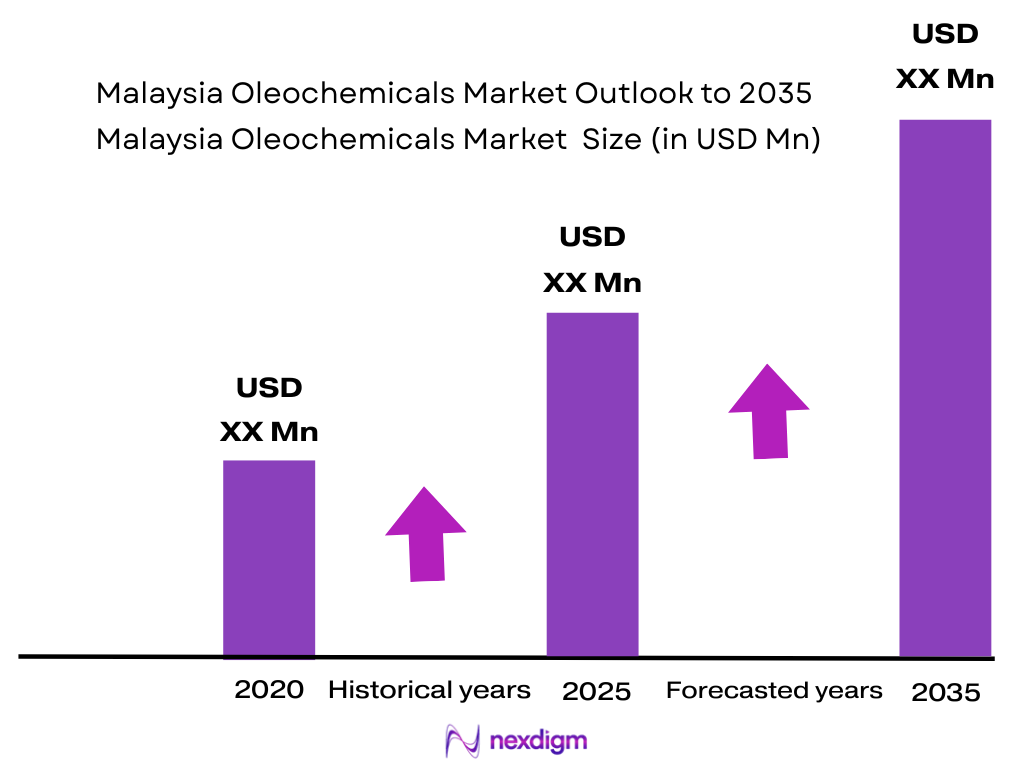
The Malaysia oleochemicals market is estimated at USD 1.42 billion in 2024, derived from the published 2025 revenue of USD 1.5196 billion and the reported 6.8% CAGR. The market is supported by Malaysia’s integrated palm-based feedstock ecosystem and established downstream processing infrastructure. MPOB recorded 19.34 million tonnes of crude palm oil production, 2.99 million tonnes of palm-based oleochemical exports, and RM17.41 billion in palm-based oleochemical export revenue in 2024, compared with 18.55 million tonnes, 2.86 million tonnes, and RM16.00 billion, respectively, in 2023.
Malaysia’s oleochemical industry is concentrated principally in Peninsular Malaysia, where palm-oil processing, refining, ports and chemical manufacturing are closely integrated. MPOB recorded 19 oleochemical plants with 2.681 million tonnes per year of capacity in Peninsular Malaysia. Major industrial locations include Port Klang and Selangor, Prai and Penang, Johor and the Klang Valley, where proximity to palm oil mills, refineries, kernel crushers and export terminals supports manufacturing efficiency. Malaysia had 453 palm oil mills, 53 refineries and 43 kernel crushers, creating an extensive feedstock-to-oleochemical infrastructure.
Market Segmentation
By Product Type
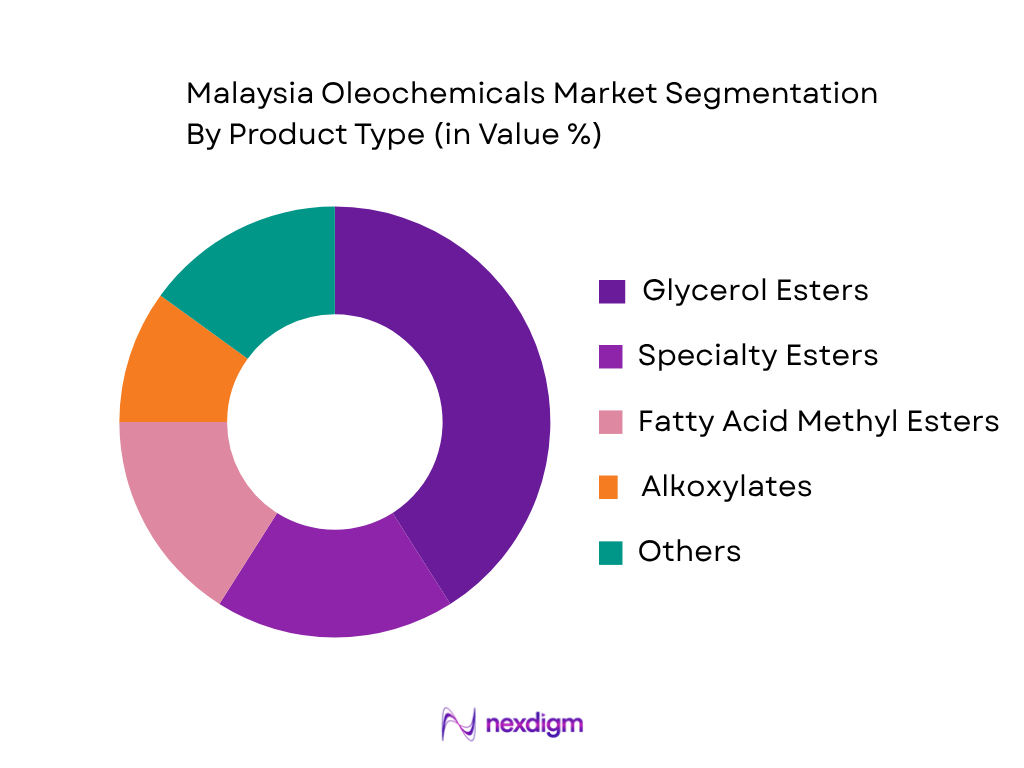
The Malaysia oleochemicals market is segmented by product type into glycerol esters, specialty esters, alkoxylates, fatty amines, fatty acid methyl esters and other oleochemical products. Glycerol esters are the leading category, accounting for 40.96% of Malaysia’s oleochemicals market revenue in 2025, according to Grand View Research. The segment benefits from applications across personal care, food processing, pharmaceuticals, detergents and industrial formulations. Malaysia’s extensive palm-based feedstock ecosystem provides the raw materials required to manufacture glycerol and related derivatives at industrial scale. Fatty acid methyl ester is identified as the fastest-growing product category, supported by demand for renewable chemical intermediates and applications linked to surfactants, specialty chemicals and bio-based products. Malaysia’s export platform reinforces the importance of derivative manufacturing: MPOB recorded 2,993,592 tonnes of palm-based oleochemical exports in 2024, compared with 2,864,004 tonnes in 2023. The product mix is increasingly shifting toward higher-value derivatives as producers seek to extract greater value from the country’s palm resources.
By Application
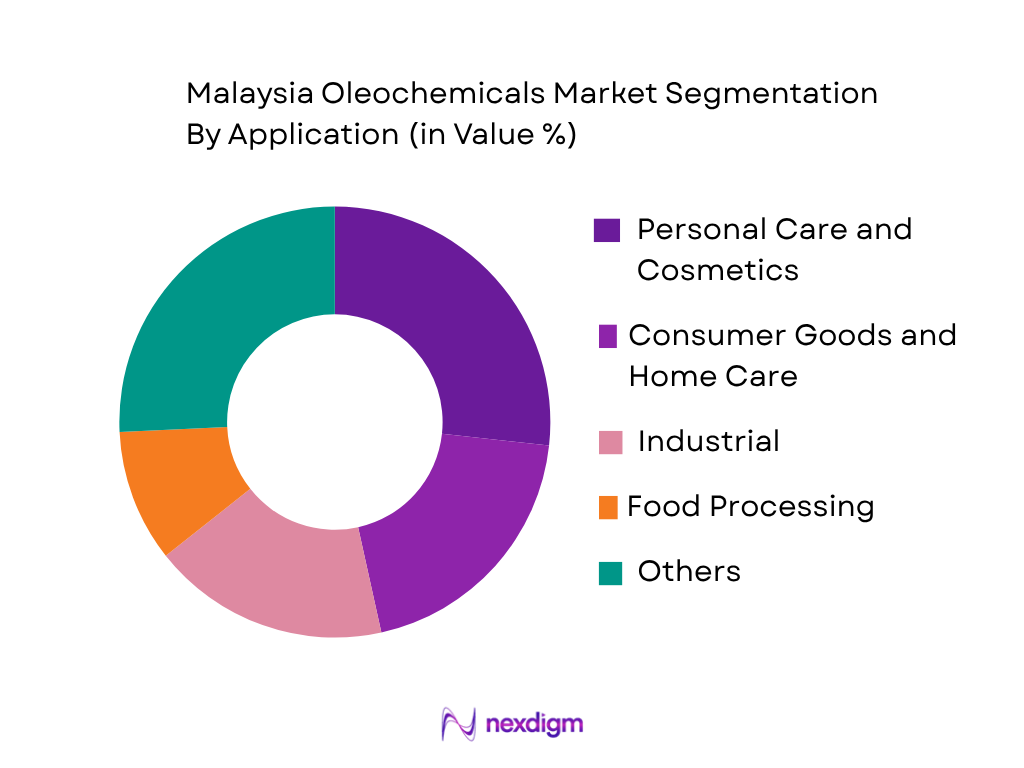
The Malaysia oleochemicals market is segmented by application into personal care and cosmetics, consumer goods and home care, food processing, textiles, paints and inks, industrial applications, healthcare and pharmaceuticals, polymer and plastic additives, and other applications. Personal care and cosmetics represent a major downstream demand center because fatty acids, fatty alcohols, esters, glycerol and surfactant intermediates are widely used in skin care, hair care, cleansing and formulation systems. Malaysia’s integrated palm-based chemical ecosystem allows producers to serve multinational and regional formulators with renewable ingredients. The downstream opportunity is reinforced by the scale of regional consumer industries. Malaysia exported 2.99 million tonnes of palm-based oleochemicals in 2024, while palm oil exports reached 16.90 million tonnes. The country also exported 1.15 million tonnes of palm kernel oil, demonstrating the breadth of its lipid feedstock and derivative trade. The combination of domestic processing, export infrastructure and downstream formulation demand supports continued development of personal care, home care, pharmaceutical and industrial oleochemical applications.
Competitive Landscape
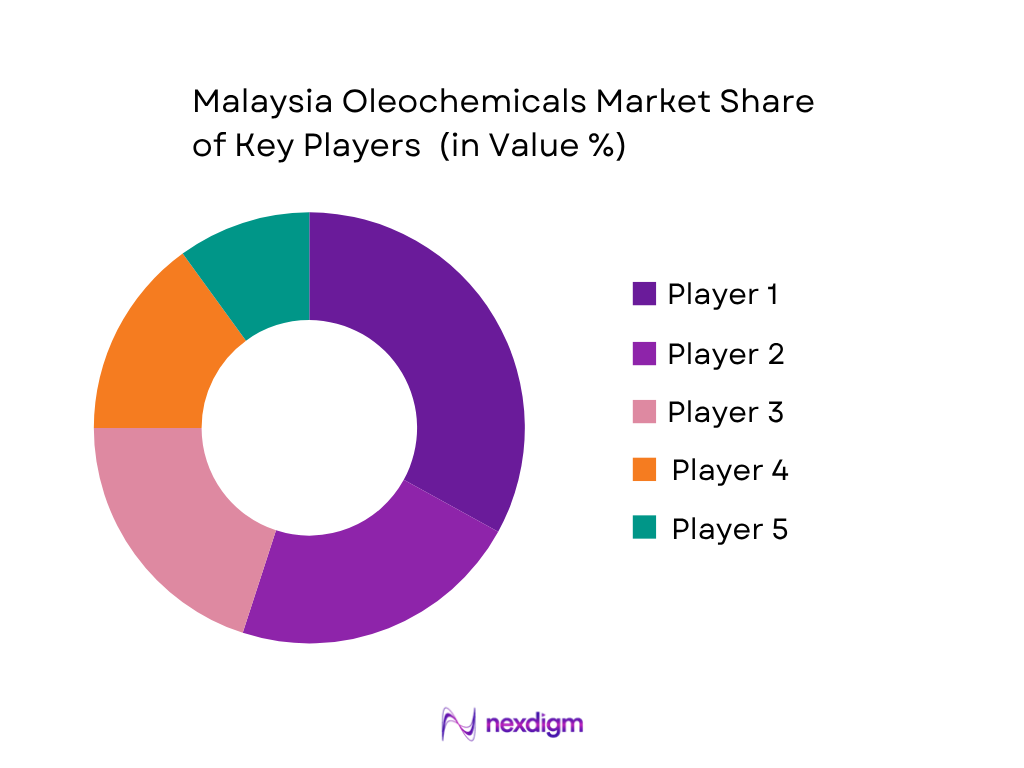
The Malaysia oleochemicals market is characterized by large integrated palm-based producers, specialist oleochemical manufacturers and multinational chemical companies. Competition is driven by palm-feedstock integration, manufacturing scale, product breadth, specialty derivative capabilities, sustainability certification, export logistics and downstream customer relationships. Malaysia’s structural advantage is the proximity between plantations, mills, refineries, kernel crushers and oleochemical plants. MPOB recorded 19 oleochemical plants and 2.681 million tonnes of annual oleochemical capacity, while palm-based oleochemical exports reached 2,993,592 tonnes in 2024. This combination gives Malaysian producers a strong foundation for serving Asian, European and North American customers.
| Major Player | Establishment | Headquarters | Core Oleochemical Products | Feedstock Integration | Manufacturing Strength | Sustainability Focus | Key Applications | Export Reach |
| KLK OLEO | 1991* | Malaysia | ~ | ~ | ~ | ~ | ~ | ~ |
| IOI Oleochemical Industries | 1980s* | Malaysia | ~ | ~ | ~ | ~ | ~ | ~ |
| Emery Oleochemicals | 2008 | Malaysia / USA | ~ | ~ | ~ | ~ | ~ | ~ |
| Wilmar International | 1991 | Singapore | ~ | ~ | ~ | ~ | ~ | ~ |
| Musim Mas | 1988 | Indonesia | ~ | ~ | ~ | ~ | ~ | ~ |
Malaysia Oleochemicals Market Analysis
Growth Drivers
Abundant Palm Oil and Palm Kernel Feedstock
Malaysia’s abundant palm-based feedstock ecosystem is a fundamental growth driver for the oleochemicals industry because fatty acids, fatty alcohols, glycerine, methyl esters and specialty derivatives are produced from palm oil and palm-kernel oil streams. The Malaysian Palm Oil Board recorded 19,338,266 tonnes of crude palm oil production in 2024, compared with 18,551,950 tonnes in 2023, providing a large domestic raw-material base for downstream conversion. Palm-kernel oil exports reached 1,151,105 tonnes in 2024, while palm-based oleochemical exports reached 2,993,592 tonnes, demonstrating the scale of lipid-based processing and international demand. Malaysia also recorded 5,612,852 hectares of oil-palm planted area in 2024, supporting long-term feedstock availability across Peninsular Malaysia, Sabah and Sarawak. Peninsular Malaysia alone produced 10,891,417 tonnes of CPO, while Sabah and Sarawak produced 4,274,440 tonnes and 4,172,409 tonnes, respectively. The feedstock ecosystem is further strengthened by 453 palm-oil mills, 53 refineries and 43 kernel crushers, creating multiple conversion points before raw materials reach oleochemical plants. This integrated agricultural and industrial structure enables Malaysian manufacturers to secure palm-derived inputs close to processing facilities and supports continuous production of basic and specialty oleochemicals.
Integrated Plantation-to-Oleochemical Supply Chains
Malaysia’s integrated plantation-to-oleochemical supply chain gives domestic producers an important structural advantage by connecting oil-palm cultivation, fresh-fruit-bunch collection, milling, refining, kernel crushing and oleochemical conversion within a mature industrial ecosystem. MPOB recorded 5,612,852 hectares of planted oil palm and 19,338,266 tonnes of CPO production in 2024. Malaysian fresh-fruit-bunch productivity reached 16.70 tonnes per hectare, compared with 15.79 tonnes per hectare in 2023, supporting greater availability of oil-bearing feedstock for downstream processing. The country had 453 palm-oil mills, 53 refineries and 43 kernel crushers, while registered oleochemical capacity in Peninsular Malaysia reached 2.681 million tonnes per year across 19 plants. This infrastructure allows manufacturers to convert palm-derived raw materials into fatty acids, fatty alcohols, glycerine, methyl esters and specialty derivatives without relying entirely on imported intermediates. The supply chain also supports export-oriented production: Malaysia shipped 2,993,592 tonnes of palm-based oleochemicals in 2024, compared with 2,864,004 tonnes in 2023. The country’s broader trade infrastructure reinforces this advantage, with total national trade reaching RM2.9 trillion, exports reaching RM1.5 trillion, and imports reaching RM1.4 trillion in 2024.
Market Challenges
Palm Oil Price Volatility
Palm oil feedstock volatility remains a major challenge for Malaysian oleochemical manufacturers because the availability and economic attractiveness of palm-derived inputs directly influence downstream production planning, inventory requirements and product-mix decisions. The challenge is evident from changes in Malaysia’s physical palm-oil supply and trade flows. CPO production increased from 18,551,950 tonnes in 2023 to 19,338,266 tonnes in 2024, while palm-oil exports increased from 15,135,026 tonnes to 16,902,595 tonnes. Palm-kernel oil exports also increased from 981,799 tonnes to 1,151,105 tonnes during the same period. Such movements demonstrate the scale of material moving between domestic processing and international markets and the potential for oleochemical producers to face changing feedstock availability as refiners, biodiesel producers, food manufacturers and exporters compete for the same palm-derived resources
Competition from Indonesian Producers
Competition from Indonesian oleochemical producers represents a significant challenge because Malaysia and Indonesia operate within the same palm-based raw-material ecosystem and compete for international customers across fatty acids, fatty alcohols, glycerine, methyl esters, surfactants and specialty derivatives. Malaysia exported 2,993,592 tonnes of palm-based oleochemicals in 2024, generating RM17,409.76 million in export revenue, demonstrating the scale of Malaysia’s international position. However, Indonesia possesses an even larger palm-oil production base and an extensive domestic processing industry, allowing Indonesian manufacturers to compete aggressively for Asian, European and other international buyers. Malaysia’s own trade data illustrate the importance of maintaining competitiveness: the country exported 16,902,595 tonnes of palm oil and 1,151,105 tonnes of palm-kernel oil in 2024, creating a highly export-oriented feedstock ecosystem that exposes oleochemical producers to international competition. Malaysia also exported 255,669 tonnes of biodiesel in 2024, demonstrating that palm-derived raw materials are increasingly utilized by multiple downstream industries.
Market Opportunities
Specialty Oleochemicals
The expansion of specialty oleochemicals provides Malaysian manufacturers with an opportunity to capture greater downstream value from the country’s extensive palm-based feedstock ecosystem. Malaysia produced 19,338,266 tonnes of CPO and exported 2,993,592 tonnes of palm-based oleochemicals in 2024, demonstrating that the country already possesses both feedstock availability and large-scale conversion capabilities. The next opportunity is to convert a greater proportion of these raw materials into differentiated products such as specialty fatty acids, cosmetic esters, pharmaceutical-grade glycerine, high-purity fatty alcohols, specialty surfactants, biolubricant esters and functional additives. Malaysia’s downstream industrial base provides multiple customer industries for these products. Manufacturing sales reached RM1.9 trillion in 2024, while the petroleum, chemical, rubber and plastic products segment recorded increased industrial activity, according to DOSM. Malaysia’s cosmetics, personal care, household products, pharmaceutical and industrial formulation sectors can therefore provide domestic demand alongside export markets.
Pharmaceutical-Grade Glycerine
Pharmaceutical-grade glycerine represents a particularly attractive opportunity because Malaysian producers can leverage the country’s large palm-based oleochemical industry to supply a higher-purity derivative into pharmaceutical, healthcare, personal care and specialty formulation applications. Malaysia exported 2,993,592 tonnes of palm-based oleochemicals in 2024, while the country’s palm-processing system generated substantial quantities of glycerine as a downstream co-product. The scale of the broader feedstock base is demonstrated by 19,338,266 tonnes of CPO production, 1,151,105 tonnes of palm-kernel-oil exports, and 2.681 million tonnes per year of registered oleochemical capacity in Peninsular Malaysia. Pharmaceutical-grade glycerine requires tighter purity, traceability, contamination control and quality-assurance systems than commodity technical glycerine, creating an opportunity for producers capable of meeting stringent customer specifications.
Future Outlook
The Malaysia oleochemicals market is expected to maintain steady expansion as international manufacturers increase their use of renewable and biodegradable chemical ingredients. Malaysia’s palm-based feedstock advantage provides a structural foundation for fatty acids, fatty alcohols, glycerine, methyl esters and specialty derivatives. Future competitiveness will increasingly depend on downstream value addition, sustainability credentials and specialty product development rather than commodity volume alone. Specialty esters, bio-based surfactants, pharmaceutical-grade glycerine, biolubricants and circular palm derivatives represent important areas for expansion. The latest Malaysia-specific market assessment reports USD 1.6472 billion in 2026 revenue, increasing to USD 2.6175 billion by 2033, at a 6.8% CAGR during 2026–2033. Extending the same CAGR through 2035 produces a derived market value of approximately USD 2.98 billion. This 2035 value is a calculation rather than a directly published forecast.
Major Players
- KLK OLEO
- IOI Oleochemical Industries
- Wilmar International Limited
- Emery Oleochemicals
- Musim Mas
- Edenor Oleochemicals (M) Sdn Bhd
- Fatty Chemical (Malaysia) Sdn Bhd
- FPG Oleochemicals Sdn Bhd
- Southern Acids Industries Sdn Bhd
- Natural Oleochemicals Sdn Bhd
- Vance Bioenergy
- Palm-Oleo Sdn Bhd
- Oleon NV
- BASF SE
- Kao Corporation
Key Target Audience
- Oleochemical manufacturers and integrated palm-based chemical producers
- Palm oil plantation groups, palm oil mills, refineries and kernel crushers
- Personal care, cosmetics, home care and detergent manufacturers
- Pharmaceutical, food ingredient and specialty formulation manufacturers
- Lubricant, plastics, rubber, coatings and industrial chemical manufacturers
- Investments and venture capitalist firms (Bioeconomy Funds, Renewable Chemicals Funds, Sustainable Materials Investment Firms)
- Government and regulatory bodies (Malaysian Palm Oil Board, Ministry of Plantation and Commodities, Malaysian Investment Development Authority, Department of Environment Malaysia)
- Chemical distributors, specialty ingredient distributors, exporters and industrial procurement organizations
Research Methodology
Step 1: Identification of Key Variables
The initial phase involves constructing a Malaysia-specific oleochemical ecosystem covering oil-palm plantations, fresh fruit bunch suppliers, palm oil mills, refineries, kernel crushers, oleochemical plants, specialty derivative producers, distributors and downstream users. MPOB statistics are used to identify 5.61 million hectares of planted oil-palm area, 19.34 million tonnes of CPO production, and 2.99 million tonnes of palm-based oleochemical exports in 2024.
Step 2: Market Analysis and Construction
Market construction combines company-level production capabilities with official Malaysian trade statistics and downstream demand indicators. The model evaluates fatty acids, fatty alcohols, glycerine, methyl esters, specialty esters and other derivatives while reconciling production, domestic consumption and exports. Capacity analysis incorporates the 19 registered oleochemical plants and 2.681 million tonnes of annual capacity reported for Peninsular Malaysia.
Step 3: Hypothesis Validation and Expert Consultation
Market hypotheses are validated through discussions with oleochemical manufacturers, palm processors, chemical distributors, personal care formulators, detergent manufacturers and industrial buyers. Interviews focus on feedstock procurement, product specifications, plant utilization, export demand, MSPO and RSPO requirements, customer qualification and substitution of petrochemical ingredients with renewable alternatives.
Step 4: Research Synthesis and Final Output
The final stage integrates primary interviews with MPOB statistics, trade data, company disclosures and downstream industry indicators through data triangulation. Supply-side findings are reconciled with demand across personal care, home care, pharmaceuticals, food, lubricants, plastics and industrial applications. Competitive benchmarking evaluates production scale, palm integration, specialty capability, sustainability credentials and export reach.

- Executive Summary
- Research Methodology (Market Definition and Product Taxonomy, Malaysia Market Boundary, Historical Data Reconstruction, Top-Down Market Sizing, Bottom-Up Company-Level Assessment, Feedstock-to-Product Mapping, Production Capacity Mapping, Domestic Consumption Analysis, Import-Export Reconciliation, End-Use Demand Assessment, Primary Industry Interviews, Secondary Data Validation, Data Triangulation, Forecasting Framework, Sensitivity Analysis, Research Limitations)

- Definition and Scope
- Evolution of Malaysia’s Oleochemical Industry
- Oleochemical Industry Development Milestones
- Malaysia Oleochemical Industry Ecosystem
- Oleochemical Value Chain

- Growth Drivers (Abundant Palm Oil and Palm Kernel Feedstock, Integrated Plantation-to-Oleochemical Supply Chains, Malaysia’s Global Oleochemical Manufacturing Position, Expanding Personal Care and Home Care Manufacturing, Bio-Based Chemical Substitution, Strong Export Orientation, Specialty Oleochemical Development, ASEAN Market Integration)
- Market Challenges (Palm Oil Price Volatility, Climate-Related Plantation Risk, Sustainability Certification Requirements, Competition from Indonesian Producers, Energy and Utilities Intensity, Feedstock Competition with Biodiesel, European Regulatory Requirements, Commodity Margin Pressure)
- Market Opportunities (Specialty Oleochemicals, Pharmaceutical-Grade Glycerine, Bio-Based Lubricants, Cosmetic Esters, Sustainable Surfactants, Circular Palm Feedstocks, Used Cooking Oil Valorization, Higher-Value Palm Derivatives, Downstream Specialty Manufacturing, ASEAN Export Expansion)
- Market Trends (Palm-Based Oleochemical Integration, Specialty Product Premiumization, Sustainable Palm Feedstock, RSPO and MSPO Traceability, Circular Oleochemistry, Bio-Based Surfactants, Pharmaceutical-Grade Ingredients, Green Lubricants, Palm-Derivative Diversification, Downstream Integration)
- Government Policies and Regulatory Framework (Malaysian Palm Oil Board Requirements, Malaysian Palm Oil Certification Scheme, Malaysian Sustainable Palm Oil Standards, National Agrofood Policy, National Energy Transition Roadmap, Industrial Development Policies, Environmental Quality A
- SWOT Analysis
- Porter’s Five Forces Analysis
- PESTLE Analysis

- By Market Value (2020-2025)
- By Production Volume (2020-2025)
- By Domestic Consumption Volume (2020-2025)
- By Export Volume (2020-2025)
- By Import Volume (2020-2025)
- By Average Realization (2020-2025)
- By Production Capacity (2020-2025)
- By Capacity Utilization (2020-2025)
- By Domestic Production Contribution (2020-2025)
- By Export Revenue Contribution (2020-2025)

- By Product Type (in value %)
Fatty Acids
Fatty Alcohols
Glycerine and Glycerol Derivatives
Methyl Esters
Fatty Acid Esters - By Feedstock Typ (in value %)
Crude Palm Oil
Palm Kernel Oil
Palm Kernel Fatty Acids
Palm Fatty Acid Distillate
Coconut Oil
Soybean Oil
Animal Fats
Used Cooking Oil and Recovered Oils
Other Renewable Lipid Feedstocks - By Application (in value %)
Personal Care and Cosmetics
Home Care and Detergents
Pharmaceuticals
Food and Beverage
Lubricants and Industrial Fluids
Plastics and Polymers - By Grade (in value %)
Industrial Grade
Technical Grade
Cosmetic Grade
Food Grade
Pharmaceutical Grade
High-Purity Specialty Grade
Sustainable and Certified Grade - By Production Process (in value %)
Fat Splitting and Hydrolysis
Fatty Acid Distillation
Fractionation
Hydrogenation
Esterification
Transesterification
Glycerine Refining
Ethoxylation
Sulfonation
Amide Formation - By Distribution Channel (in value %)
Direct Industrial Sales
Specialty Chemical Distributors
Chemical Trading Companies
Regional Distributors
Contract Manufacturing and Toll Processing
Export-Oriented Sales
Integrated Plantation-to-Customer Sales

- Market Share of Major Players (By Revenue, Production Capacity, Product Type, Feedstock, Application, Domestic Sales, Export Sales)
- Cross Comparison Parameters (Production Capacity, Fatty Acid Portfolio Breadth, Fatty Alcohol Capacity, Glycerine Refining Capability, Palm Feedstock Integration, Specialty Derivative Portfolio, Sustainable Certification Coverage, Export Market Reach)
Competitive Positioning Matrix (Manufacturing Scale, Feedstock Integration, Product Specialization, Specialty Chemistry Capability, Sustainability Positioning, Geographic Reach) - Pricing and Realization Analysis (By Product Type, Grade, Application, Contract Type, Domestic Sales, Export Sales)
- SWOT Analysis of Major Players
- Detailed Profiles of Major Companies
KLK OLEO
IOI Oleochemical Industries
Emery Oleochemicals
Wilmar International Limited
Musim Mas
Kao Corporation
Oleon
BASF
Croda International
Evyap
Edenor Oleochemicals (M) Sdn Bhd
Fatty Chemical (Malaysia) Sdn Bhd
FPG Oleochemicals Sdn Bhd
Southern Acids Industries Sdn Bhd
Natural Oleochemicals Sdn Bhd

- Personal Care and Cosmetics Demand Analysis
- Home Care and Detergents Demand Analysis
- Pharmaceutical Demand Analysis
- Lubricants and Industrial Fluids Demand Analysis
- Plastics and Polymer Demand Analysis
- Rubber and Elastomer Demand Analysis
- Paints, Coatings and Inks Demand Analysis

- By Market Value (2026-2035)
- By Production Volume (2026-2035)
- By Domestic Consumption Volume (2026-2035)
- By Export Volume (2026-2035)
- By Import Volume (2026-2035)
- By Average Realization (2026-2035)
- By Production Capacity (2026-2035)
- By Capacity Utilization (2026-2035)
- By Domestic Production Contribution (2026-2035)
- By Export Revenue Contribution (2026-2035)


 Request a Sample
 Ask for Customization
 Get a Quote
 Enquire Now