

 Download PDF
Market Overview
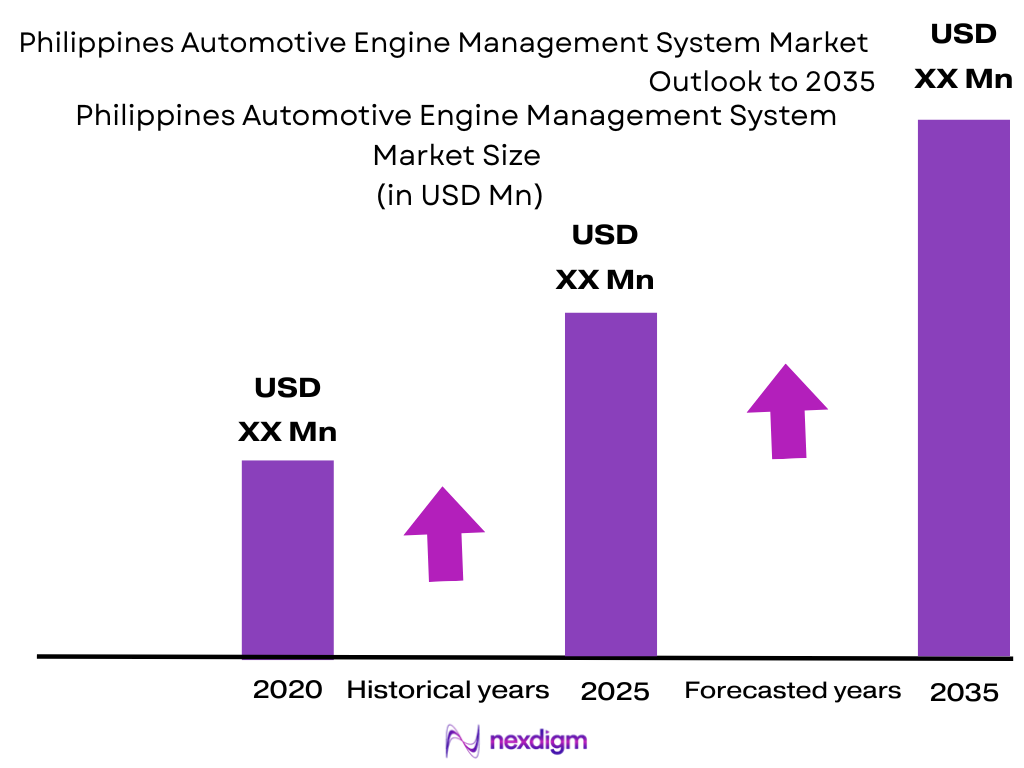
The Philippines Automotive Engine Management System Market is valued at approximately ~ million, supported by a substantial combustion-engine vehicle base and continued vehicle replacement. Registered cars increased from 1,356,102 units to 1,369,997 units, while utility vehicles increased from 2,515,587 to 2,545,449 units across the latest two annual observations. This installed base sustains recurring requirements for ECUs, fuel injectors, oxygen sensors, ignition electronics, electronic throttles and diagnostic systems. NCR, CALABARZON and Central Luzon represent the most important Philippine demand clusters because they combine vehicle ownership, logistics activity, repair networks and automotive-industrial capacity. NCR has 14,001,751 residents, while CALABARZON has 16,933,234 residents. CALABARZON is the country’s predominant industrial region, while Central Luzon combines manufacturing, construction and motor-vehicle repair activity. These characteristics support concentrated demand for OEM engine electronics, replacement sensors, diesel-injection servicing and ECU diagnostics.
Market Segmentation
By Vehicle Type
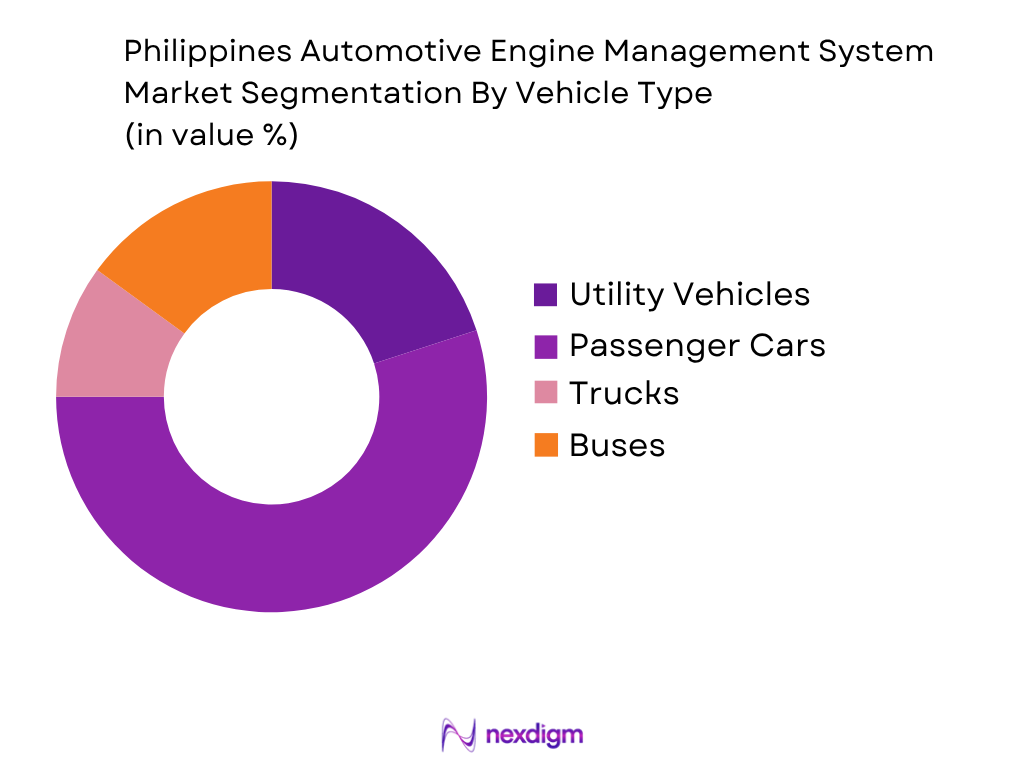
The Philippines Automotive Engine Management System Market is segmented into passenger cars, utility vehicles and SUVs, trucks and light commercial vehicles, and buses/public utility vehicles. Utility vehicles and SUVs form the dominant addressable segment, reflecting the country’s preference for MPVs, crossovers, pickups and utility-oriented platforms capable of handling passenger, family and commercial applications. PSA recorded 2,545,449 registered utility vehicles compared with 1,369,997 cars and 434,165 trucks in the latest complete annual dataset. Utility vehicles also encompass many diesel and increasingly turbocharged gasoline platforms requiring common-rail control, fuel-pressure sensing, electronic throttle control, exhaust sensors and sophisticated ECUs. Their extensive operation in urban and provincial environments increases accumulated mileage, strengthening replacement demand for injectors, MAP/MAF sensors, oxygen sensors and engine-position sensors. For EMS suppliers, this makes the Philippine market more utility-vehicle-oriented than markets dominated primarily by conventional sedans.
By Component Type
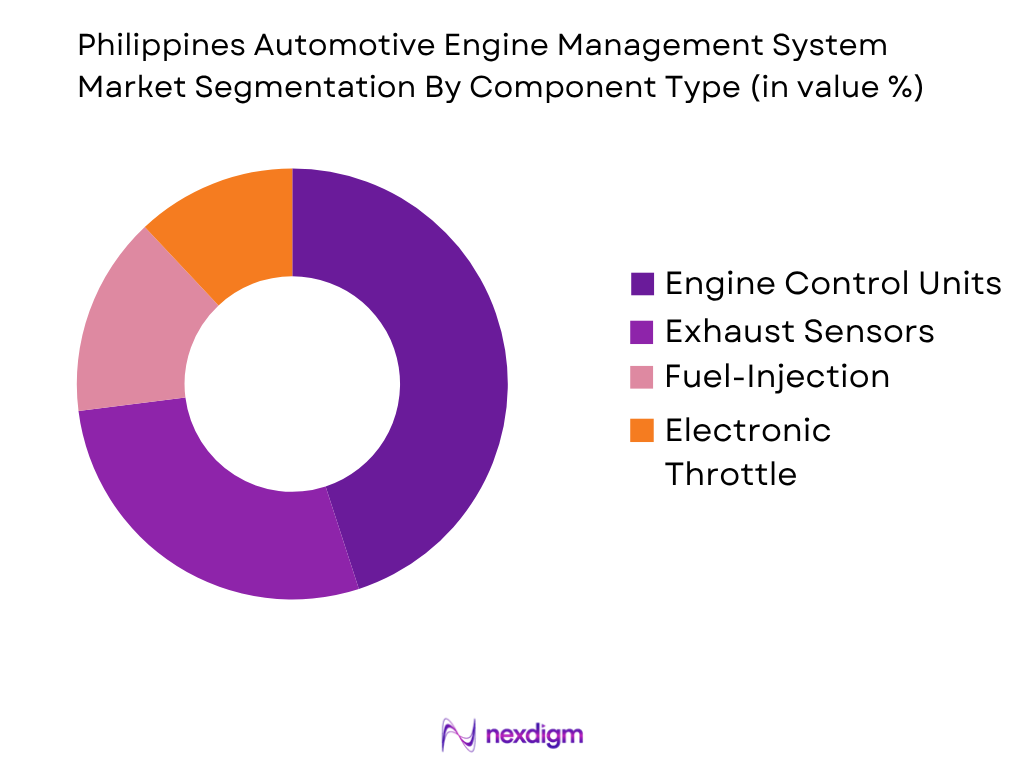
The Philippines Automotive Engine Management System Market is segmented into engine control units, engine and exhaust sensors, fuel-injection systems, ignition-management components, and electronic throttle and engine actuators. Engine control units and associated sensor electronics constitute the central technology segment, because virtually every Euro 4-compliant gasoline or diesel vehicle relies on closed-loop electronic control of air intake, fueling, ignition or injection timing and emissions. The ECU continuously interprets signals from crankshaft, camshaft, lambda, pressure, airflow and temperature sensors before commanding injectors, ignition coils, throttle actuators and emission-control equipment. The Philippines’ Euro 4 requirements for new vehicles reinforce this electronic dependency. Ageing vehicles create an additional aftermarket layer: sensors often become replacement items before the core ECU, while injector, ignition and throttle faults generate recurring workshop activity. Increasing hybridization further shifts value toward integrated controllers and software, as combustion control must interact with electric propulsion, battery management and start-stop functions.
Competitive Landscape
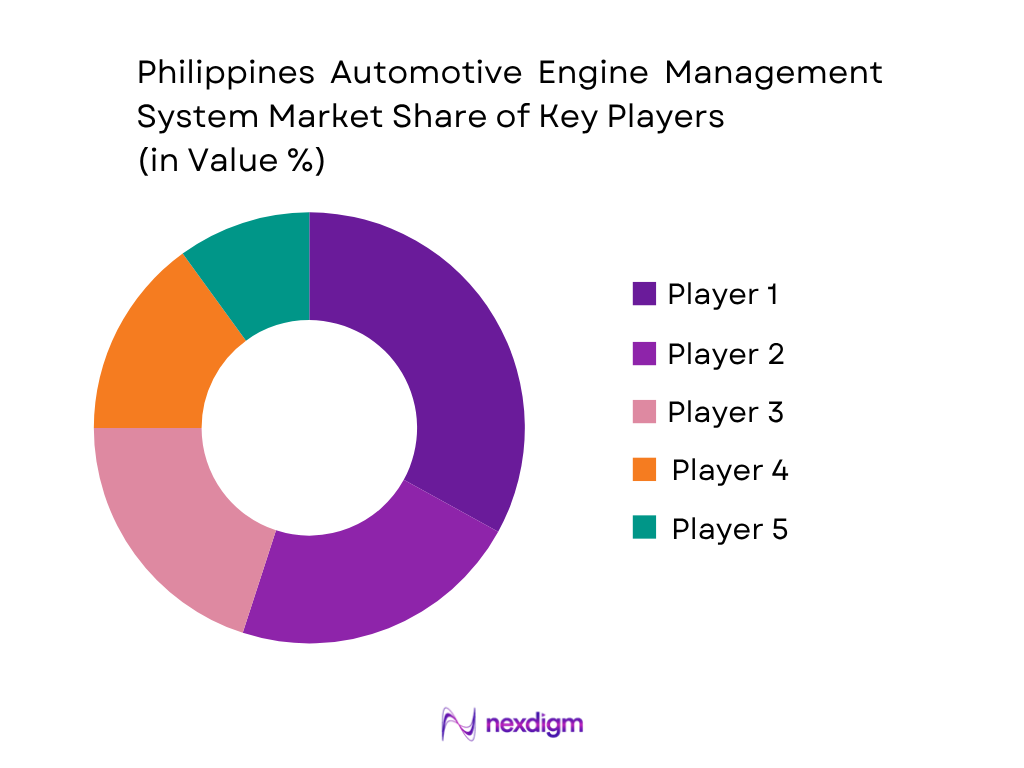
The Philippines Automotive Engine Management System Market is primarily supplied by global Tier-1 automotive technology companies with strong exposure to Japanese, Korean, European and American vehicle platforms. Bosch and DENSO have long-established capabilities spanning engine electronics, sensors, ignition, fuel delivery and aftermarket servicing. BorgWarner contributes combustion, turbocharging and hybrid technologies, while PHINIA combines Delphi fuel systems, electrical products and aftermarket capabilities. AUMOVIO, separated from Continental’s automotive business in 2025, brings sensors, vehicle electronics, controllers and software capabilities.
| Major Player | Establishment Year | Headquarters | ECU / Controller Capability | Sensor Portfolio | Fuel / Ignition Capability | Diesel EMS Capability | Hybrid / Electrified Capability | Aftermarket & Diagnostics |
| Robert Bosch GmbH | 1886 | Stuttgart, Germany | ~ | ~ | ~ | ~ | ~ | ~ |
| DENSO Corporation | 1949 | Kariya, Japan | ~ | ~ | ~ | ~ | ~ | ~ |
| BorgWarner Inc. | 1928 | Auburn Hills, USA | ~ | ~ | ~ | ~ | ~ | ~ |
| PHINIA Inc. / Delphi | 2023 | Auburn Hills, USA | ~ | ~ | ~ | ~ | ~ | ~ |
| AUMOVIO | 2025 | Frankfurt, Germany | ~ | ~ | ~ | ~ | ~ | ~ |
Philippines Automotive Engine Management System Market Analysis
Growth Drivers
Large Gasoline and Diesel Vehicle Base Supporting Continuous EMS Demand
The Philippines Automotive Engine Management System Market is supported by a large and still predominantly combustion-powered vehicle fleet, sustaining demand for engine control modules, fuel injectors, ignition coils, oxygen sensors, crankshaft and camshaft sensors, throttle-control systems, rail-pressure sensors and associated diagnostic electronics. Philippine Statistics Authority data based on Land Transportation Office records show that registered vehicles increased from 14.27 million units in 2023 to 14.56 million units in 2024. Within the 2024 fleet, 11.45 million vehicles used gasoline and approximately 3.08 million used diesel, creating an extensive installed base dependent on electronic fuel, ignition and emission management. Hybrid registrations also increased from 6,155 units in 2023 to 17,590 units in 2024, indicating that electrification is not immediately eliminating engine management demand because hybrids retain combustion engines while adding supervisory electronic controls. The relevance of this installed base extends beyond OEM production. Millions of vehicles progressively enter replacement cycles for lambda sensors, electronic throttles, injectors, ignition modules, fuel-pressure sensors and ECUs, which supports independent workshops and component distributors. Gasoline engines increasingly rely on sequential injection, electronic throttles, variable valve timing and knock control, while diesel pickups, vans, trucks and buses use common-rail injection, high-pressure fuel management, turbo control and exhaust-management electronics. The Philippines’ macroeconomic scale supports continued motorization and maintenance activity. World Bank data place nominal GDP at approximately USD 461.62 billion in 2024 and USD 487.09 billion in 2025, while the Philippine Statistics Authority counted 112,729,484 people as of July 2024 and the World Bank reported 116,786,962 people in 2025. This large population combined with nationwide dependence on road transport creates demand not only in Metro Manila but also across CALABARZON, Central Luzon, Cebu, Davao and other regional transport centers. The market is therefore supported by two layers of demand: fitment of electronically managed engines in newer vehicles and recurring servicing of an extensive gasoline and diesel installed base. Unlike markets where battery-electric penetration has already removed substantial combustion content, the Philippines still has millions of engines requiring electronically controlled air, fuel, ignition and exhaust functions, making vehicle-parc expansion and ageing a durable EMS growth driver.
Emission Compliance and Increasing Electronic Content in Modern Powertrains
Vehicle-emission regulation is raising the technical content required from automotive engine management systems in the Philippines. DENR requires new vehicles to comply with Euro 4 emission standards, while the country’s corresponding fuel specifications were introduced to reduce sulfur and other harmful exhaust constituents. Modern Euro 4-compatible engines depend extensively on closed-loop electronic control rather than purely mechanical fuel delivery. Gasoline applications require ECUs to coordinate injection timing, ignition timing, oxygen-sensor feedback, electronic throttle operation and catalyst efficiency; diesel applications require common-rail pressure control, electronic injectors, turbocharger management and, depending on vehicle architecture, EGR and exhaust-aftertreatment monitoring. This regulatory foundation is increasingly important because the Philippines had 14.56 million registered vehicles in 2024, including 11.45 million gasoline vehicles and 3.08 million diesel vehicles, according to PSA data sourced from the LTO. Hybridization is simultaneously adding another level of electronic complexity. Registered hybrids increased to 17,590 units in 2024, from 6,155 units in 2023. A hybrid vehicle typically retains the conventional engine ECU, injectors, ignition management, lambda sensing and catalyst monitoring while introducing engine-motor coordination, automated restart logic, torque arbitration and communication with battery and hybrid-control modules. Consequently, even when the number of combustion engines does not expand proportionately with total vehicle registrations, electronic content per applicable vehicle can increase. The underlying economy provides a substantial base for the replacement of older mechanical or early-generation powertrains with newer electronically controlled vehicles. World Bank data show Philippine GDP at approximately USD 461.62 billion in 2024, while GDP reached USD 487.09 billion in 2025 and the population reached 116,786,962. The Philippine Statistics Authority also reported that wholesale and retail trade and the repair of motor vehicles and motorcycles remained among the major contributors to economic activity entering 2026, demonstrating the continuing relevance of the automotive service ecosystem. For EMS suppliers, the regulatory effect extends well beyond sales of complete ECUs. It supports replacement oxygen sensors, MAP and MAF sensors, fuel-rail sensors, ignition coils, diesel injectors, electronic throttle bodies, EGR electronics and diagnostic equipment necessary to keep vehicles within prescribed emission performance. As enforcement and vehicle inspection become increasingly digitized, component accuracy and calibration become more important, favoring suppliers that can provide OEM-equivalent electronics and technical support rather than basic mechanical replacement parts.
Market Challenges
Accelerating Electric-Vehicle Adoption Reducing Long-Term ICE Component Content
Battery-electric vehicle adoption represents the most important structural challenge for the Philippines Automotive Engine Management System Market because a full-electric powertrain eliminates most conventional EMS components. The Department of Energy reported 24,286 EV registrations during 2024, while 29,715 EVs were registered between January and July 2025, already exceeding the preceding full-year figure. Battery-electric vehicles do not require conventional engine control modules, gasoline or diesel injectors, spark-ignition systems, oxygen sensors, crankshaft sensors, camshaft sensors, exhaust-temperature sensors or combustion-air management. As electrification progresses, each ICE vehicle displaced by a battery-electric model directly reduces the potential OEM demand for these product categories. The policy environment reinforces this threat. Republic Act No. 11697, the Electric Vehicle Industry Development Act, established the national framework for broader EV adoption and mandated development of the Comprehensive Roadmap for the Electric Vehicle Industry. CREVI covers charging infrastructure, manufacturing, research and development and human-resource development, demonstrating that electrification is being developed as an industrial ecosystem rather than solely as a consumer-vehicle programme. The physical support network is also expanding. The Department of Energy reported 250 accredited EV charging-station providers as of February 2026 and 280 providers as of April 2026, indicating an increasingly developed supporting infrastructure for electrified mobility. From an EMS perspective, this creates a portfolio-transition problem. The Philippines still had 11.45 million gasoline vehicles and 3.08 million diesel vehicles in 2024, so conventional EMS demand remains substantial in the present installed fleet, but suppliers cannot assume that each replacement vehicle will reproduce equivalent combustion-electronics content. World Bank data place Philippine GDP at USD 487.09 billion in 2025 and population at 116,786,962, giving the national vehicle market sufficient economic and demographic scale for EV adoption to materially alter component demand as infrastructure expands. The challenge will be strongest for firms concentrated in ignition coils, gasoline injectors, diesel injection equipment and exhaust sensors without parallel exposure to hybrids or electrified controls. Suppliers with hybrid supervisory controllers, thermal electronics, powertrain software or broader automotive electronics portfolios will have greater ability to absorb this shift. The Philippine EMS market therefore faces a long transition rather than immediate contraction: the existing ICE fleet protects replacement demand, but continued EV registrations progressively reduce the combustion-electronics content of newly added vehicles.
Vehicle Diversity, Ageing Fleet and Diagnostic Complexity
The Philippines’ highly diverse vehicle population creates a substantial technical and aftermarket challenge for engine-management suppliers, distributors and workshops. The 14.56 million registered vehicles in 2024 encompass motorcycles, passenger cars, SUVs, vans, pickups, jeepneys, buses and commercial trucks using multiple generations of gasoline and diesel engine technology. The fuel mix alone included 11.45 million gasoline vehicles, 3.08 million diesel vehicles, 17,590 hybrids and 6,697 electric vehicles in PSA’s vehicle-stock classification. The practical implication for the EMS market is significant: component suppliers cannot serve the installed base with a limited range of standardized ECUs or sensors. A replacement crankshaft sensor, injector, electronic throttle or engine controller must match individual engine families, communication standards and calibration requirements. Newer vehicles increasingly require ECU coding, immobilizer synchronization, injector coding, electronic-throttle relearning and CAN-based diagnostics, while older vehicles can use earlier electronic architectures with limited diagnostic standardization. The country’s continued dependence on imported motor vehicles, used engines and replacement components adds another layer of complexity because the same model name can appear with different engine calibrations depending on origin, model year and specification. LTO’s Administrative Order VDM-2024-045 updated rules governing manufacturers, assemblers, importers, rebuilders, dealers and other entities authorized to import vehicles and components, illustrating the regulatory significance of the vehicle and component import ecosystem. Technical competency must therefore extend beyond mechanical repair. Workshops increasingly require bidirectional scan tools, oscilloscope diagnostics, ECU software access, sensor waveform interpretation and knowledge of hybrid high-voltage/engine interactions. The macroeconomic backdrop magnifies the scale of this servicing challenge. The Philippines had 112,729,484 people in the official July 2024 census, with population increasing to 116,786,962 in 2025 according to the World Bank, while nominal GDP advanced from approximately USD 461.62 billion to USD 487.09 billion across those observations. Automotive servicing consequently takes place across a geographically dispersed network ranging from large authorized dealer facilities to small independent workshops in provincial cities. For premium EMS suppliers, this fragmentation increases training, distribution, inventory and technical-support requirements. For independent workshops, rapidly changing hybrid, direct-injection and common-rail systems create a capability gap that can result in misdiagnosis or unnecessary component replacement. The challenge is thus not merely access to skilled labor; it is keeping diagnostic skills, software and equipment synchronized with an increasingly heterogeneous vehicle population.
Market Opportunities
Hybrid Powertrain Controls, Advanced Sensors and ECU Software
Hybridization represents one of the clearest forward opportunities for the Philippines Automotive Engine Management System Market because hybrid vehicles preserve most combustion-engine electronics while adding higher-value control layers. Philippine Statistics Authority data show that registered hybrid vehicles increased from 6,155 units in 2023 to 17,590 units in 2024. This current installed-base expansion provides evidence for future market potential without requiring speculative future vehicle numbers. Unlike battery-electric vehicles, hybrids continue to use an internal combustion engine and therefore retain an engine ECU, fuel injectors, ignition coils for gasoline applications, crankshaft and camshaft sensing, oxygen sensors, electronic throttle control and catalyst management. They additionally require supervisory software to coordinate engine starts and stops, torque transfer between the combustion engine and electric motor, battery state conditions, thermal requirements and regenerative-braking interactions. That makes hybrid EMS significantly more software-intensive than a conventional standalone gasoline powertrain. The policy framework also creates a pathway for broader electrified-powertrain adoption. EVIDA mandates a national EV-development framework, while CREVI specifically incorporates manufacturing, research and development and human-resource development alongside vehicle and charging infrastructure. This ecosystem creates future opportunities for suppliers positioned between traditional ICE hardware and full electrification, particularly integrated powertrain controllers, smart pressure and temperature sensors, wideband lambda sensors, electronic throttle modules, ECU software, calibration tools and diagnostic platforms. The Philippines’ economic and demographic base supports the relevance of this transition: World Bank data record USD 461.62 billion of GDP in 2024, increasing to USD 487.09 billion in 2025, while the population reached 116,786,962 in 2025. The large existing combustion fleet of 11.45 million gasoline vehicles and 3.08 million diesel vehicles also means hybridization can occur through gradual replacement rather than an abrupt technology discontinuity. For EMS suppliers, this favors a portfolio strategy spanning conventional controllers, hybrid-compatible ECUs and advanced software rather than concentrating solely on mechanical fuel-system components. Independent workshops present an additional opportunity because hybrid vehicles require increasingly sophisticated scan tools, software updates and technician training. Suppliers able to combine replacement components with diagnostic platforms, calibration data and technical education can build stronger aftermarket relationships while vehicle technology becomes more complex.
Public Utility and Commercial Fleet Modernization Creating Advanced EMS Demand
Modernization of public-utility and commercial fleets provides another significant future growth avenue for the Philippines Automotive Engine Management System Market. The country continues to operate large numbers of jeepneys, UV Express units, buses, vans, pickups and trucks, many of which are transitioning from older mechanically controlled or early-generation engines toward modern electronically managed diesel, gasoline, hybrid or electric platforms. In CALABARZON alone, government reporting showed 21,820 public utility vehicle units operating across 533 routes had undergone consolidation as of April 30, 2024, including 20,754 jeepneys across 443 routes. Consolidation is an important precursor to modernization because organized transport entities are better positioned to procure standardized fleets and manage centralized maintenance. For EMS suppliers, modern combustion and hybrid replacements create demand for common-rail injection controllers, electronic injectors, fuel-rail pressure sensors, turbocharger actuators, EGR management, electronic throttles and engine diagnostic systems. The existing diesel base remains particularly relevant. PSA/LTO data identified approximately 3.08 million diesel-powered registered vehicles in 2024, demonstrating that diesel engine electronics will remain materially important to commercial mobility during the transition period. Fleet operators also have stronger incentives than individual motorists to adopt predictive diagnostics because an unexpected injector, ECU or sensor failure can remove a revenue-producing vehicle from service. This opens opportunities for telematics-linked engine monitoring, remote diagnostic alerts, fault-code analytics, fuel-system condition monitoring and scheduled replacement of critical sensors. The Philippines’ national economy provides an expanding transport and logistics foundation. World Bank figures put GDP at approximately USD 461.62 billion in 2024 and USD 487.09 billion in 2025, while PSA identified wholesale and retail trade and the repair of motor vehicles and motorcycles among major contributors to economic activity entering 2026. The opportunity extends beyond supplying new components. Older commercial vehicles create demand for ECU repair, injector rebuilding, crankshaft and camshaft sensors, throttle modules and engine harness diagnostics, while newer fleet vehicles require software-enabled service and electronic calibration. Electrification will progressively modify this opportunity, but current vehicle evidence indicates a substantial transition period in which combustion and hybrid systems remain central. Suppliers able to support fleet operators with parts availability, diagnostics, technician training and preventive maintenance can therefore convert modernization from a one-time OEM fitment opportunity into recurring aftermarket demand.
Future Outlook
The Philippines Automotive Engine Management System Market is forecast to expand at approximately ~ CAGR during 2026–2035, using the requested placeholder framework. Growth will be supported by continued motorization, a large installed ICE vehicle base, utility-vehicle demand, common-rail diesel servicing, hybrid adoption and increasing electronic content per combustion vehicle. The strongest conventional opportunity will remain in replacement engine sensors, injectors, ignition systems, ECU diagnostics and commercial-vehicle electronics. More than 2.5 million utility vehicles and over 434,000 trucks in the latest official vehicle dataset create a significant serviceable population for powertrain component suppliers. Hybrid powertrains should become increasingly relevant because they preserve much of the traditional EMS stack while adding engine-motor coordination. Fuel injection, ignition, lambda sensing, throttle management and catalyst control remain necessary, but they interact with supervisory controllers and electrified powertrain software.
Major Players
- Robert Bosch GmbH
- DENSO Corporation
- AUMOVIO
- BorgWarner Inc.
- PHINIA Inc. / Delphi
- Valeo
- Astemo Ltd.
- Marelli
- FORVIA HELLA
- Mitsubishi Electric Automotive
- AISIN Corporation
- Schaeffler Group
- Hyundai Mobis
- Niterra Co., Ltd.
- Standard Motor Products / Intermotor
Key Target Audience
- Automotive OEMs and Vehicle Assemblers
- Authorized Automotive Distributors and Dealership Groups
- Engine ECU, Sensor and Fuel-System Manufacturers
- Automotive Parts Importers and Distribution Networks
- Public Utility, Logistics and Commercial Fleet Operators
- Automotive Semiconductor and Embedded Software Companies
- Investments and Venture Capitalist Firms
- Government and Regulatory Bodies (Land Transportation Office, Department of Transportation, Department of Energy, Department of Environment and Natural Resources, Department of Trade and Industry)
Research Methodology
Step 1: Identification of Key Variables
The initial phase develops an ecosystem map for the Philippines Automotive Engine Management System Market covering vehicle manufacturers, importers, Tier-1 suppliers, parts distributors, authorized dealers, independent workshops, fleets and regulatory bodies. Variables include vehicle parc, vehicle type, fuel architecture, engine technology, ECU content, sensor content, emissions requirements and replacement cycles. Special consideration is given to utility vehicles, commercial diesel applications, public transportation, ageing vehicles, regional demand concentration and emerging hybrid and EV adoption.
Step 2: Market Analysis and Construction
The top-down assessment starts with officially registered cars, utility vehicles, trucks and buses, after which applicable combustion and hybrid platforms are mapped against engine-management content. PSA reported 1,369,997 cars, 2,545,449 utility vehicles and 434,165 trucks in its latest annual table. The bottom-up model analyzes ECU, injector, sensor, ignition, electronic-throttle and aftertreatment demand separately. OEM fitment and replacement demand are then reconciled to prevent double counting.
Step 3: Hypothesis Validation and Expert Consultation
Market hypotheses are validated through computer-assisted telephone interviews with vehicle distributors, component suppliers, diesel-injection specialists, ECU repair providers, independent workshops and fleet maintenance operators. The consultations evaluate engine-sensor replacement frequency, ECU failure and repair behavior, common-rail injector servicing, availability of genuine and aftermarket components, hybrid diagnostics and model-specific programming requirements. Findings are triangulated against official vehicle and regulatory data.
Step 4: Research Synthesis and Final Output
The final phase integrates vehicle-parc analysis, component-level modelling and industry consultations. Top-down and bottom-up results are reconciled by vehicle category, component, powertrain architecture and channel. Forecast scenarios incorporate motorization, Euro 4 compliance, utility-vehicle demand, hybrid adoption, public-transport modernization, ageing vehicles and battery-electric substitution. DOE’s growing EV-registration base is specifically incorporated as a long-term erosion factor for conventional combustion EMS.

- Executive Summary
- Research Methodology (Market Definitions and Assumptions, Abbreviations, EMS Market Boundary, Top-Down Vehicle-Parc Analysis, Bottom-Up Component Build-Up, Vehicle Registration Mapping, Powertrain Mapping, Engine ECU Content-per-Vehicle, Sensor Content Assessment, OEM Fitment Analysis, Replacement-Cycle Assessment, Demand-Side Interviews, Supply-Side Interviews, Parts Import Mapping, Data Triangulation, Electrification Scenario Analysis, Forecasting Framework, Limitations and Future Conclusions)

- Definition and Scope
- Market Evolution and Industry Genesis
- Transition from Carburetion to Electronic Fuel Injection
- Development of Gasoline Engine Management Systems
- Evolution of Common-Rail Diesel Engine Management

- Growth Drivers (Expanding Vehicle Fleet, Gasoline and Diesel Electronic Content, Public Utility Vehicle Modernization, Hybrid Adoption, Emission-Control Requirements, Automotive Electronics Penetration)
- Market Challenges (Imported EMS Dependence, Counterfeit and Low-Quality Replacement Parts, Diagnostic Capability Gaps, Vehicle Platform Fragmentation, Ageing Vehicle Parc, EV Substitution)
- Market Opportunities (Hybrid Controllers, GDI Electronics, Common-Rail Diesel Components, Smart Sensors, ECU Remanufacturing, Predictive Diagnostics, Public Utility Fleet Modernization)
- Market Trends (Turbocharged Engines, Direct Injection, Hybridization, Software Diagnostics, ECU Reprogramming, Connected Fleet Maintenance, Smart Sensor Integration)
- SWOT Analysis
- Porter’s Five Forces Analysis
- PESTLE Analysis

- By Market Value (2020-2025)
- By Engine Management System Unit Volume (2020-2025)
- By Engine ECU/ECM Unit Volume (2020-2025)

- By Component Type (In Value %)
Engine Control Unit / Engine Control Module
Powertrain Control Module
Electronic Fuel Injectors
High-Pressure Fuel Pumps
Oxygen / Lambda Sensors - By Vehicle Type (In Value %)
Passenger Cars
SUVs and Crossovers
Multi-Purpose Vehicles
Pickup Trucks
Light Commercial Vehicles - By Powertrain Type (In Value %)
Conventional Gasoline
Conventional Diesel
Mild Hybrid
Full Hybrid
Plug-in Hybrid - By Sales Channel (In Value %)
OEM and Vehicle Assembly Plants
Authorized Vehicle Dealerships
Tier-1 Direct Supply
Authorized Automotive Parts Distributors - By Geography (In Value %)
National Capital Region
CALABARZON
Central Luzon
Central Visayas
Western Visayas

- Market Share of Major Players by Value
- Cross Comparison Parameters (Engine ECU and Powertrain Controller Portfolio Breadth, Gasoline-Diesel-Hybrid EMS Capability, Engine Sensor Portfolio Depth, Fuel-Injection and Ignition System Capability, Euro 4 and Exhaust-Aftertreatment Technology Capability, Philippines OEM-Distributor-Workshop Reach, ECU Software-Diagnostics-Calibration Capability, Electrification and Next-Generation Powertrain Readiness)
- SWOT Analysis of Major Players
- Detailed Profiles of Major Companies
Robert Bosch GmbH
DENSO Corporation
AUMOVIO
BorgWarner Inc.
PHINIA Inc. / Delphi
Valeo
Astemo Ltd.
Marelli
FORVIA HELLA
Mitsubishi Electric Automotive
AISIN Corporation
Schaeffler Group
Hyundai Mobis
Niterra Co., Ltd.
Standard Motor Products / Intermotor

- Private Passenger Vehicle EMS Demand
- SUV and MPV EMS Demand
- Pickup Truck EMS Demand
- Jeepney and Public Utility Vehicle Demand
- Taxi and Transport-Network Vehicle Demand
- Light Commercial Fleet Demand

- By Market Value (2026-2035)
- By Engine Management System Unit Volume (2026-2035)
- By Engine ECU/ECM Unit Volume (2026-2035)


 Request a Sample
 Ask for Customization
 Get a Quote
 Enquire Now