

 Download PDF
Market Overview
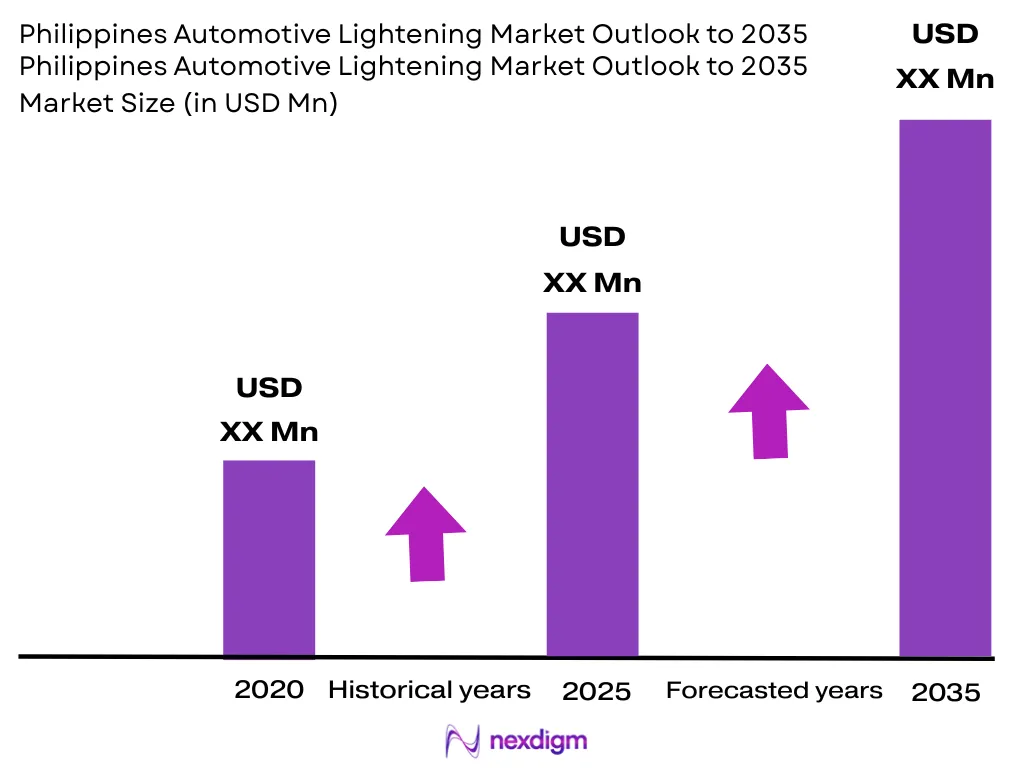
The Philippines Automotive Lighting Market increased by approximately 17% in 2024 to reach approximately USD ~ million, rising for the third consecutive year following a period of decline between 2021 and 2023, with the market value increasing at an average annual rate of approximately 3.3% between 2012 and 2024. The market is primarily driven by rising vehicle ownership, the continued shift from halogen to LED lighting systems, and tightening Land Transportation Office (LTO) safety and roadworthiness regulations. The broader Philippines LED lighting market, which includes automotive as well as commercial and residential applications, was valued at approximately USD ~ million in 2025 and is projected to grow at a CAGR of approximately 10.1% to reach approximately USD ~ million by 2034, reflecting the accelerating shift toward energy-efficient lighting technology across all end-use segments. Within the automotive segment specifically, demand for LED lighting continues to outpace halogen and xenon technologies as OEMs increasingly adopt LED daytime running lights and headlights as standard fitment across new passenger car and light commercial vehicle models.
Market Segmentation
By Product Type
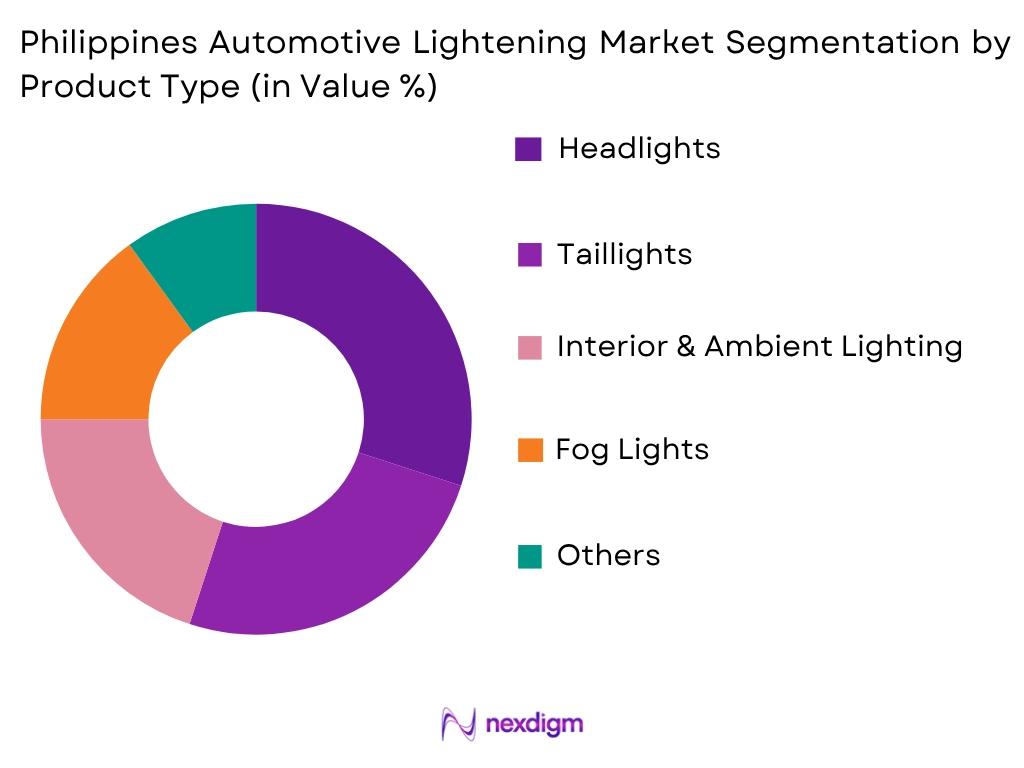
Among these, Headlights continue to dominate the Philippines Automotive Lighting Market by revenue, with Koito Philippines and Stanley Electric Philippines supplying OEM-fit headlight assemblies to major vehicle manufacturers operating in the country and maintaining manufacturing and support facilities across CALABARZON supporting their position as preferred lighting partners for passenger car and light commercial vehicle assembly. Koito Philippines continues to differentiate through its integrated LED and adaptive lighting technology transferred from its Japanese parent, positioning itself as the preferred partner for OEMs requiring globally certified, safety-compliant lighting assemblies. Toyota Autoparts Philippines has carved out significant market share through its captive supply arrangements, which serve Toyota’s regional manufacturing and export operations. Taillights and Interior & Ambient Lighting are gaining increasing importance as aftermarket demand for customisation grows, contributing to a notable share of aftermarket revenue growth, supporting the shift toward higher-value, customisable lighting products.
By Region
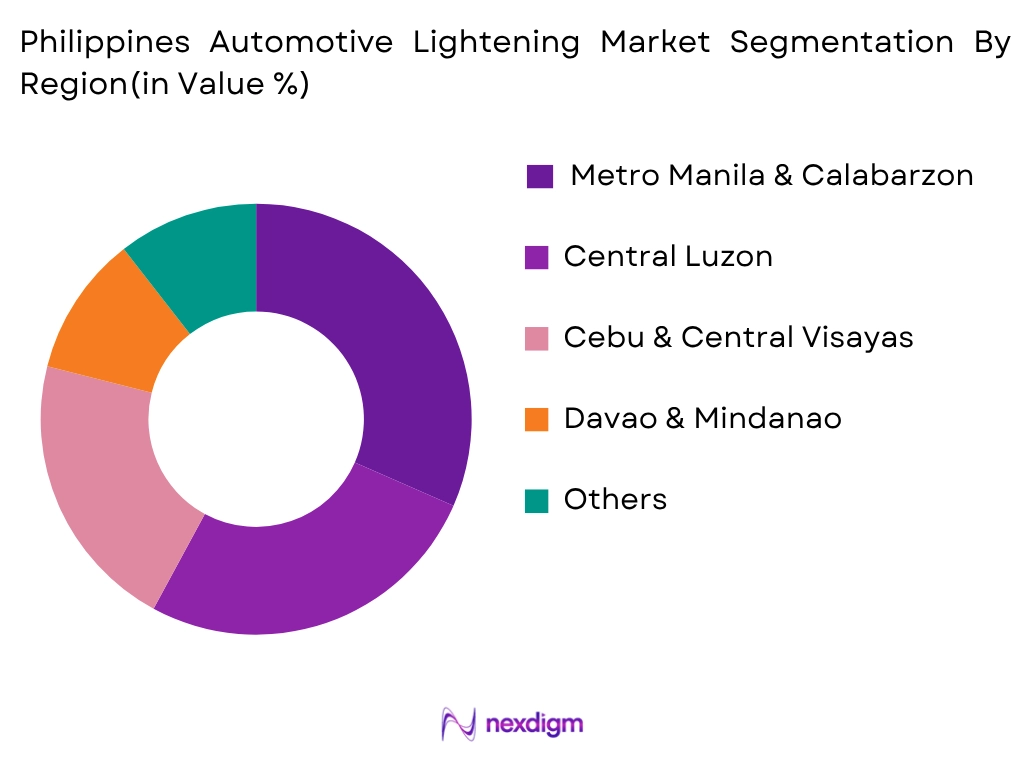
Metro Manila and CALABARZON remain the largest regional market within the Philippines Automotive Lighting Market by sales value and installed vehicle base, given the concentration of vehicle assembly plants, dealerships, and aftermarket workshops across the National Capital Region and neighbouring provinces, though rising traffic congestion and vehicle age continue to sustain steady replacement-driven demand in the region. Cebu and Central Visayas are witnessing above-average growth as rising vehicle ownership and a growing aftermarket customisation culture expand demand across the Visayas region, supported by growing e-commerce-based distribution of aftermarket lighting products. Distributors including Osram Philippines and Hella Philippines continue expanding regional dealer networks to capture demand, while independent workshops and online marketplaces increasingly unlock previously underserved lighting replacement demand across Davao and the broader Mindanao region.
Competitive Landscape
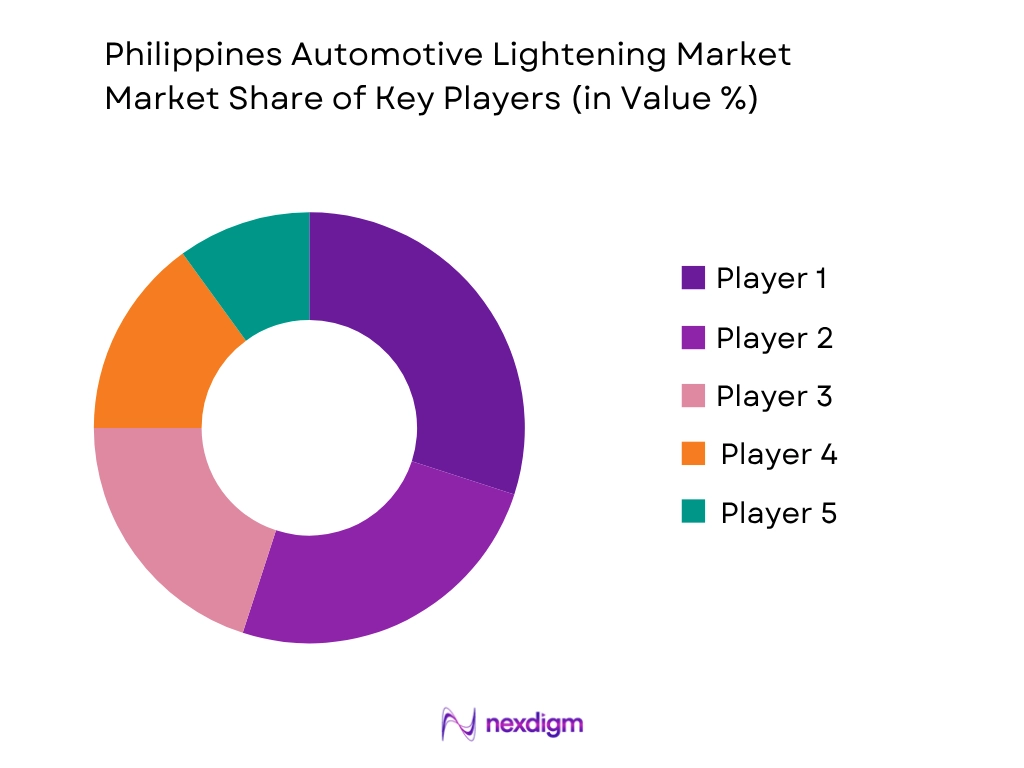
The Philippines Automotive Lighting Market is moderately fragmented and highly competitive, with Koito Philippines, Stanley Electric Philippines, Toyota Autoparts Philippines, Ichikoh Philippines, and Phoenix Petroleum’s automotive distribution arm together handling a substantial share of OEM and aftermarket lighting value nationwide. Competition is primarily based on OEM partnership depth, national distribution coverage, product certification compliance, pricing, and brand reliability. Koito Philippines maintains its position as a leading OEM lighting supplier in installed base and channel penetration across the country, serving as the preferred lighting partner for major passenger vehicle assemblers with its LED and adaptive lighting technology. Stanley Electric Philippines continues to compete on headlight and taillight assembly depth, while Ichikoh Philippines targets mirror-integrated and side lighting segments. Toyota Autoparts Philippines leverages its captive OEM supply relationship to compete on large-scale assembly-line lighting integration, while distribution-focused players including Osram Philippines, Hella Philippines, and Valeo Philippines continue to expand their aftermarket and workshop distribution footprints to reduce consumers’ reliance on unbranded imports. Yazaki-Torres Manufacturing and Automotive Industries Corporation compete for wiring-harness-integrated lighting component volume, while Mitsubishi Electric Philippines, SL Corporation Philippines, and Depo Auto Parts Philippines continue to leverage their component manufacturing and distribution platforms to serve both OEM and aftermarket lighting needs across the vehicle parc.
| Company | Establishment Year | Headquarters | OEM Partnerships | LED/Adaptive Lightening Portfolio
|
Manufacturing Presence in Philippines | Major End-Use Industries | Key Strategic Focus | Certifications & Compliance |
| Koito Philippines Corporation | 1996 | ~ | ~ | ~ | ~ | ~ | ~ | ~ |
| Stanley Electric Philippines Inc. | 1997 | ~ | ~ | ~ | ~ | ~ | ~ | ~ |
| Toyota Autoparts Philippines Inc. | 1992 | ~ | ~ | ~ | ~ | ~ | ~ | ~ |
| Ichikoh Philippines Manufacturing Inc. | 1995 | ~ | ~ | ~ | ~ | ~ | ~ | ~ |
| Phoenix Petroleum / PH Automotive Distributors (Aftermarket Lighting Div.) | 2002 | ~ | ~ | ~ | ~ | ~ | ~ | ~ |
Philippines Automotive Lightening Market Analysis
Growth Drivers
Rising Vehicle Ownership and Shift to LED Lighting Systems
The Philippines Automotive Lighting Market continues to be shaped decisively by rising vehicle ownership and new vehicle sales growth, which has driven a 17% increase in market value to approximately USD 298 million in 2024, marking the third consecutive year of growth following a period of decline. The continued shift from halogen to LED lighting systems, combined with tightening Land Transportation Office roadworthiness and safety regulations, has further expanded the market’s addressable base of both OEM and aftermarket lighting demand. According to industry estimates, the broader Philippines LED lighting market is projected to grow at a CAGR of approximately 10.1% through 2034, propelled in part by growing local automotive parts manufacturing under the Comprehensive Automotive Resurgence Strategy (CARS) programme that is encouraging OEMs to localise higher-value lighting assembly.
Aftermarket Customisation and Urbanisation-Led Demand
The growth of the automotive aftermarket and vehicle customisation segment that enables consumers to upgrade ageing halogen lighting systems to LED and adaptive alternatives continues to be a critical driver of market expansion, as vehicle owners increasingly seek both safety and aesthetic upgrades beyond factory-fitted equipment. Rising urbanisation across Metro Manila, Cebu, and Davao continues to expand the vehicle parc requiring regular lighting replacement and upgrades, positioning the Philippines as a growing aftermarket lighting hub within Southeast Asia. Distributors are scaling regional dealer and e-commerce presence to capture this demand, while independent workshops leverage growing online marketplace access to unlock previously underserved replacement and customisation demand, illustrating the scale of investment being deployed to address the market’s fragmented distribution and counterfeit-product challenges.
Market Challenges
Import Dependency and Price Sensitivity
The Philippines Automotive Lighting Market faces significant challenges from heavy reliance on imported lighting components and raw materials, which creates substantial exposure to currency fluctuation and global supply chain disruption for both OEM suppliers and aftermarket distributors. Price sensitivity among aftermarket and budget vehicle segments continues to constrain premium LED and adaptive lighting adoption in the country’s high-volume entry-level vehicle segment, requiring providers to maintain tiered product portfolios spanning halogen, LED, and premium adaptive offerings to serve the full range of consumer budgets. The prevalence of counterfeit and substandard lighting products in the aftermarket continues to add competitive and safety-related unpredictability, periodically undermining consumer trust and requiring certified brands to invest in authentication and consumer education initiatives.
Limited Local Manufacturing and Fragmented Distribution
Limited domestic LED chip and semiconductor manufacturing capacity, while critical to long-term cost competitiveness, continues to increase reliance on imported components for both OEM and aftermarket lighting products, given the need to source advanced LED and adaptive lighting technology from established regional and global suppliers. A fragmented distribution network across the country’s island provinces constrains delivery speed and reliability outside major urban centres, where smaller regional distributors and informal aftermarket suppliers often supplement national brands’ coverage gaps. Rising component and logistics costs continue to pressure margins across the industry, particularly for import-dependent lighting products serving geographically dispersed island markets.
Market Opportunities
Adaptive Lighting Growth and EV-Specific Systems
The continued expansion of adaptive and smart LED lighting adoption presents substantial opportunities for lighting suppliers willing to invest in higher-value, technology-differentiated product lines beyond traditional halogen and basic LED offerings, as OEM adoption of daytime running lights as standard fitment accelerates across new passenger vehicle launches. Growth of electric and hybrid vehicle-specific lighting systems is expanding the addressable market for suppliers capable of offering lighting solutions optimised for lower power draw and integration with advanced driver assistance systems. Companies developing sequential and ambient interior lighting products are well positioned to capture growing demand as younger vehicle owners increasingly prioritise customisation and in-cabin aesthetic upgrades across the country’s expanding aftermarket segment.
E-Commerce Distribution and CARS Programme Localisation
The growing adoption of e-commerce and marketplace-based aftermarket lighting distribution presents a significant opportunity for suppliers seeking to reduce distribution costs while reaching previously underserved consumers across the Visayas and Mindanao regions. Potential expansion of local assembly under the CARS programme’s incentive framework is expected to encourage OEMs and Tier 1 suppliers such as Koito Philippines and Stanley Electric Philippines to further localise higher-value lighting component production. Expansion of motorcycle and tricycle fleet electrification presents a significant opportunity for lighting suppliers such as Yazaki-Torres Manufacturing and Automotive Industries Corporation that combine component manufacturing and distribution capabilities, positioning them to capture growing demand from the country’s large two-wheeler and tricycle vehicle parc.
Future Outlook
The Philippines Automotive Lighting Market is expected to witness steady expansion over the forecast period, supported by continued growth in vehicle ownership, the ongoing shift from halogen to LED and adaptive lighting technologies, and expanding aftermarket customisation demand across the country’s major urban centres. Continued investment in local assembly capacity under the CARS programme, alongside growing e-commerce-based aftermarket distribution, is expected to further strengthen the market’s competitive landscape. Growing regulatory emphasis on vehicle safety and roadworthiness under Land Transportation Office standards, alongside rising consumer preference for energy-efficient lighting, will continue to reshape investment decisions and competitive dynamics across the industry through 2035.
Major Players
- Koito Philippines Corporation
- Stanley Electric Philippines Inc.
- Toyota Autoparts Philippines Inc.
- Ichikoh Philippines Manufacturing Inc.
- Phoenix Petroleum / PH Automotive Distributors (Aftermarket Lighting Div.)
- Osram Philippines (Distribution)
- Hella Philippines Inc. (Distribution)
- Valeo Philippines (Distribution)
- Mitsubishi Electric Philippines Corporation
- Yazaki-Torres Manufacturing Inc.
- PHINMA Automotive Component Solutions
- Automotive Industries Corporation (AICOR)
- Federal-Mogul Philippines
- SL Corporation Philippines
- Depo Auto Parts Philippines
Key Target Audience
- Automotive OEMs and Vehicle Assemblers
- Automotive Lighting Component Manufacturers and Suppliers
- Aftermarket Distributors and Retail Chains
- Tier 1 and Tier 2 Automotive Component Suppliers
- Investment and Venture Capitalist Firms
- Government and Regulatory Bodies (Land Transportation Office, Department of Trade and Industry, Board of Investments)
- Automotive Workshop and Service Centre Operators
- E-Commerce and Online Aftermarket Parts Platforms
Research Methodology
Step 1: Identification of Key Variables
The research process begins with identifying the complete ecosystem of the Philippines Automotive Lighting Market, including OEM lighting suppliers, aftermarket distributors, technology providers, and regulatory authorities. Extensive secondary research is conducted using company annual reports, government publications, regulatory agency disclosures, industry journals, and proprietary databases to determine the variables influencing market demand, pricing, sales volume, and technological developments.
Step 2: Market Analysis and Construction
Historical market information is collected and analysed to estimate market size, sales volume, product-wise demand, and pricing trends. A combination of top-down and bottom-up approaches is used to estimate market revenues and validate segment-level performance. Consumption patterns across OEM assemblers, aftermarket distributors, and independent workshops are evaluated to establish an accurate representation of the industry.
Step 3: Hypothesis Validation and Expert Consultation
The preliminary findings are validated through Computer-Assisted Telephone Interviews (CATIs) and structured discussions with OEM lighting suppliers, aftermarket distributors, workshop operators, regulatory experts, and senior executives operating within the Philippines automotive lighting industry. These interviews help verify market assumptions, competitive developments, technology adoption trends, pricing dynamics, and future investment opportunities while refining the overall market estimates.
Step 4: Research Synthesis and Final Output
The final stage integrates insights obtained from primary interviews with quantitative information collected through secondary sources. Data triangulation techniques are applied to reconcile differences between supply-side and demand-side estimates, ensuring robust market forecasting. The report is then reviewed through multiple quality assurance checkpoints to deliver a comprehensive analysis covering market size, segmentation, competitive landscape, future outlook, and strategic recommendations for industry stakeholders.

- Executive Summary
- Research Methodology (Market Definitions and Assumptions, Abbreviations, Market Sizing Approach, Top-Down Analysis, Bottom-Up Analysis, Demand-Side Assessment, Supply-Side Assessment, Primary Industry Interviews, Data Triangulation, Forecasting Framework, Limitations and Future Conclusions)

- Definition and Scope
- Market Evolution and Industry Genesis
- Timeline of Major Industry Developments
- Automotive Lighting Value Chain Analysis
- Raw Material and Component Supply Chain Analysis
- New-Vehicle and Replacement Ecosystem Analysis
- Import, Warehousing and Distribution Framework

- Growth Drivers (Rising Vehicle Ownership and New Vehicle Sales Growth, Shift from Halogen to LED Lighting Systems, Tightening Land Transportation Office Safety and Roadworthiness Regulations, Growth of the Automotive Aftermarket and Vehicle Customisation Segment, Expansion of Local Automotive Parts Manufacturing under the CARS Programme, Rising Urbanisation Across Metro Manila, Cebu, and Davao)
- Market Challenges (Heavy Reliance on Imported Lighting Components and Raw Materials, Price Sensitivity Among Aftermarket and Budget Vehicle Segments, Prevalence of Counterfeit and Substandard Lighting Products, Currency Fluctuation Impact on Import-Dependent Pricing, Limited Domestic LED Chip and Semiconductor Manufacturing Capacity, Fragmented Distribution Network Across Island Provinces)
- Market Opportunities (Expansion of Adaptive and Smart LED Lighting Adoption, Growth of Electric and Hybrid Vehicle-Specific Lighting Systems, Rising Demand for Customisation Among Younger Vehicle Owners, Growth of E-Commerce-Based Aftermarket Lighting Distribution, Potential for Local Assembly Under Expanded CARS Programme Incentives, Increasing Motorcycle and Tricycle Fleet Electrification)
- Market Trends (Rapid Shift Toward LED and Adaptive Lighting Technologies, Growth of Sequential and Ambient Ombre Lighting in Aftermarket Segment, Rising OEM Adoption of Daytime Running Lights as Standard Fitment, Consolidation Among Regional Lighting Distributors, Expansion of Online and Marketplace-Based Aftermarket Sales, Increasing Consumer Preference for Energy-Efficient Lighting)
- Government Regulations (Land Transportation Office (LTO) Vehicle Lighting and Roadworthiness Standards, Comprehensive Automotive Resurgence Strategy (CARS) Programme, Bureau of Philippine Standards Lighting Product Certification, Department of Trade and Industry Import Tariff Regulations, Philippine National Standards for Automotive Lighting Equipment, Motor Vehicle Inspection System (MVIS) Compliance Requirements)
- Import and Export Analysis (Trade Volume, Major Import Sources, Export Destinations, HS Code Analysis, Trade Balance)
- Infrastructure Availability Analysis (Domestic Lighting Assembly and Manufacturing Capacity, Skilled Automotive Component Workforce Availability, Distribution and Logistics Network Across Island Provinces, Aftermarket Retail and Installation Service Coverage, Component Import and Port Handling Capacity)
- Technology Landscape (LED and Matrix LED Lighting Systems, Adaptive Front Lighting Systems (AFS), Laser Headlight Technology, Ambient and Sequential Interior Lighting, Smart Lighting Integration with ADAS)
- Sustainability Assessment (Energy-Efficient LED Adoption Reducing Vehicle Power Draw, Recyclability of Lighting Housing and Component Materials, Reduced Hazardous Material Use in Modern Lighting Systems, Manufacturer Sustainability and Emissions Reduction Commitments, End-of-Life Lighting Component Recycling Programmes)
- PESTLE Analysis
- SWOT Analysis
- Porter’s Five Forces Analysis
- Stakeholder Ecosystem
- Competition Ecosystem

- By Market Value (2020-2025)
- By Unit Shipments (2020-2025)
- By Average Selling Price (2020-2025)

- By Product Type (In Value %)
Headlights
Taillights
Fog Lights
Interior & Ambient Lighting
Daytime Running Lights (DRL) - By Technology (In Value %)
Halogen Lighting
LED Lighting
Xenon/HID Lighting
Laser & Adaptive Lighting - By Vehicle Type (In Value %)
Passenger Cars
Light Commercial Vehicles
Heavy Commercial Vehicles
Two-Wheelers & Tricycles
By Sales Channel (In Value %)
OEM (Original Equipment Manufacturer)
Aftermarket - By Region (In Value %)
Metro Manila & CALABARZON
Central Luzon
Cebu & Central Visayas
Davao & Mindanao

- Market Share of Major Players (By Value, Sales Volume, Product Type, Vehicle Type, Region Served)
- Cross Comparison Parameters (Product Portfolio Breadth, Manufacturing Capacity, National and Regional Coverage, OEM Partnership Depth, Regulatory Compliance Reliability, Customer Base, Innovation & New Product Launch Frequency, Sustainability Initiatives)
- SWOT Analysis of Major Players
- Pricing Analysis by Product Type and Technology
- Manufacturing Capacity Analysis
- Network Footprint Analysis
- Distribution Network Analysis
- Innovation Benchmarking
- Detailed Profiles of Major Companies
Koito Philippines Corporation
Stanley Electric Philippines Inc.
Toyota Autoparts Philippines Inc.
Ichikoh Philippines Manufacturing Inc.
Phoenix Petroleum / PH Automotive Distributors (Aftermarket Lighting Div.)
Osram Philippines (Distribution)
Hella Philippines Inc. (Distribution)
Valeo Philippines (Distribution)
Mitsubishi Electric Philippines Corporation
Yazaki-Torres Manufacturing Inc.
PHINMA Automotive Component Solutions
Automotive Industries Corporation (AICOR)
Federal-Mogul Philippines
SL Corporation Philippines

- Consumption Pattern Analysis (Vehicle Parc Composition, Replacement Cycle Distribution, Vehicle Segment Penetration, Seasonal Purchase Cycles, OEM vs Aftermarket Purchase Activity)
- Purchasing Criteria (Product Price, Brand Reliability, Lighting Brightness and Beam Quality, Regulatory Compliance, Product Lifespan and Warranty, Ease of Installation)
- Procurement and Supplier Selection Analysis
- OEM-Fit vs Universal-Fit Aftermarket Product Adoption Assessment
- Dealer-Installed vs Independent Workshop Installation Demand
- Product Attribute Preference Analysis (Brightness and Visibility Performance, Energy Efficiency, Product Durability, Regulatory and Roadworthiness Compliance, Aesthetic and Customisation Appeal, After-Sales Support and Warranty Coverage)
- Consumer Reliability Expectations
- Pain Point Analysis
- Decision-Making Process

- By Market Value (2026-2035)
- By Unit Shipments (2026-2035)
- By Average Selling Price (2026-2035)


 Request a Sample
 Ask for Customization
 Get a Quote
 Enquire Now