

 Download PDF
Market Overview
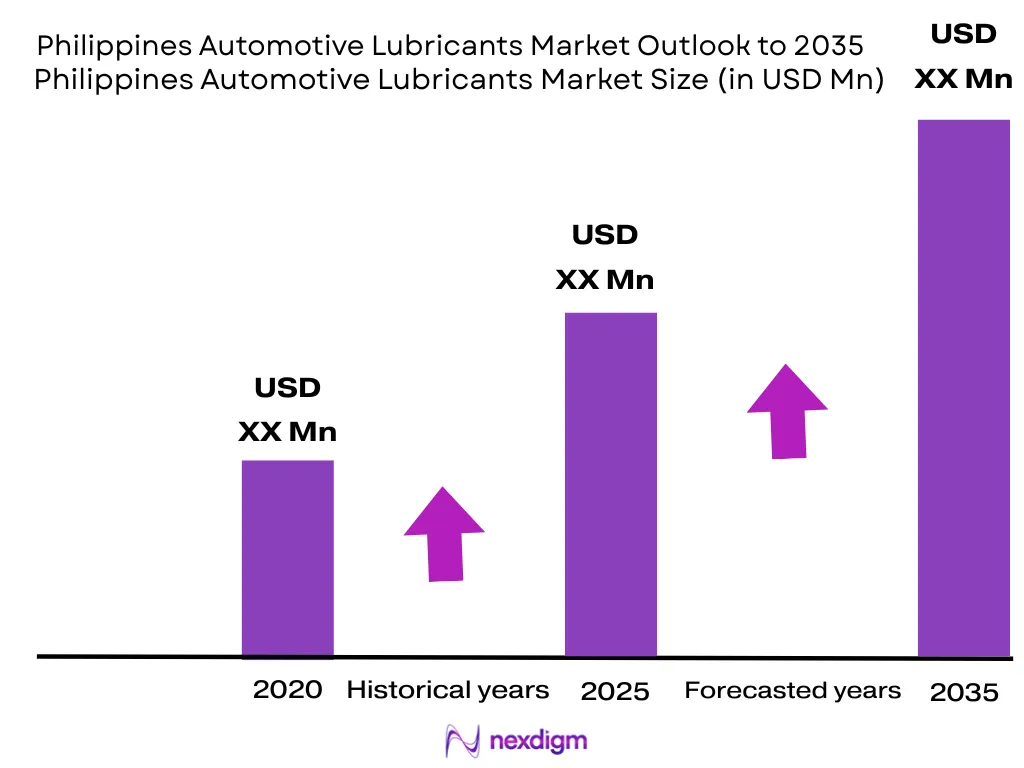
The Philippines Automotive Lubricants Market is valued at approximately ~ million, supported by vehicle sales rising from 429,807 units to 467,252 units and motorcycle wholesale sales increasing from 1,577,597 units to 1,682,482 units. The exceptionally large motorcycle base, expanding passenger and commercial vehicle population, intensive public-utility transport usage, delivery fleets and continued reliance on internal-combustion powertrains generate recurring requirements for motorcycle oils, passenger-car motor oils, diesel lubricants, transmission fluids and greases. Metro Manila, CALABARZON and Central Luzon form the principal automotive lubricant demand corridor because these areas combine dense vehicle populations, industrial activity, logistics facilities, dealership networks and independent workshops. Metro Manila supports high-utilisation taxis, ride-hailing vehicles and delivery motorcycles, while CALABARZON and Central Luzon contain major manufacturing and logistics centres. The importance of these regions is reinforced by the broader Philippine economy, where transportation, warehousing, vehicle repair and manufacturing remain important economic activities.
Market Segmentation
By Vehicle Type
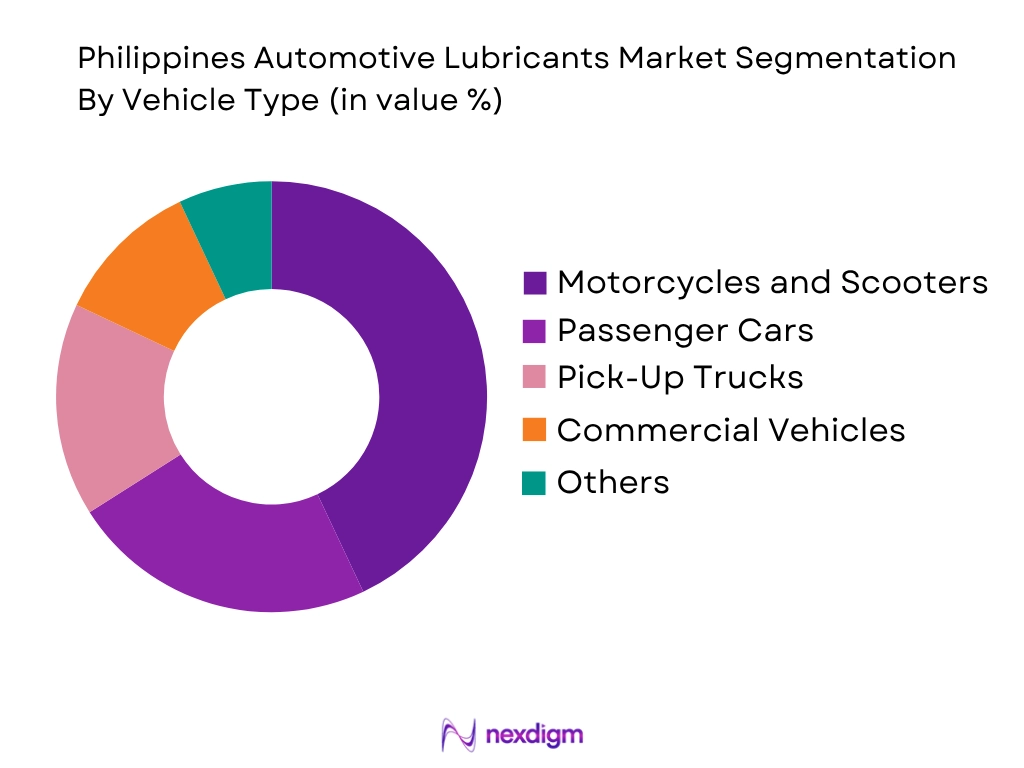
The Philippines Automotive Lubricants Market is segmented into motorcycles and scooters, passenger cars, SUVs and utility vehicles, light commercial vehicles, heavy commercial vehicles, jeepneys and buses. Motorcycles and scooters hold the dominant market position because two-wheelers represent the country’s largest recurring lubricant-consumption ecosystem. MDPPA members alone recorded 1,682,482 motorcycle wholesale sales, compared with 1,577,597 units in the preceding period. Motorcycles are widely used for commuting, courier services, food delivery, small-business transport and provincial mobility, resulting in frequent engine-oil replacement. The segment also supports multiple lubricant specifications, including JASO MA, MA2 and MB products, conventional 4-stroke oils and scooter-specific formulations. Small sump capacities reduce lubricant volume per individual service, but very large unit numbers, high annual utilisation and relatively frequent maintenance create considerable aggregate demand. The continued availability of 800-ml and one-litre motorcycle lubricant packs from major suppliers further reflects the importance of two-wheelers to the Philippine aftermarket.
By Product Type
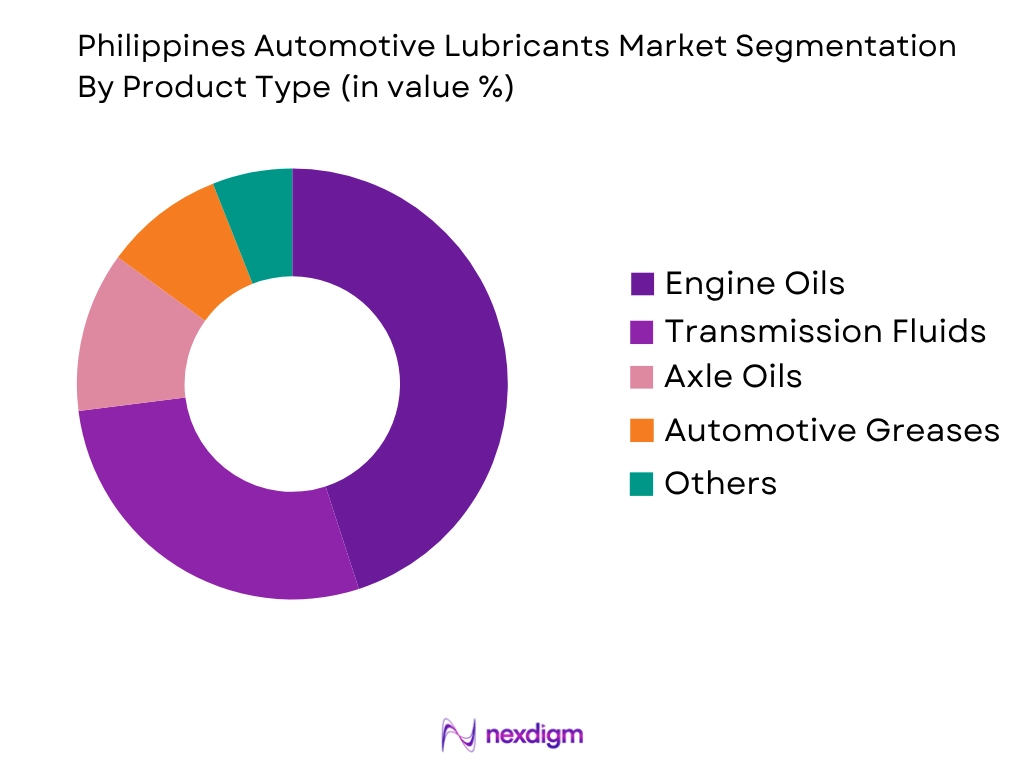
The Philippines Automotive Lubricants Market is segmented into engine oils, transmission fluids, gear and axle oils, greases, coolants, brake fluids and emerging hybrid/EV fluids. Engine oil remains the dominant lubricant category because the country’s installed vehicle base is still overwhelmingly dependent on combustion engines, ranging from motorcycles and passenger cars to jeepneys, delivery vans, buses and trucks. Vehicle sales reached 467,252 units, including 346,482 commercial vehicles, strengthening the service-fill base for gasoline and diesel lubricants. Engine-oil demand spans lightweight motorcycle formulations, passenger-car SAE 5W-30 and 10W-40 products, older-vehicle 20W-50 grades and heavy-duty SAE 15W-40 diesel oils. Philippine suppliers therefore maintain broad portfolios covering mineral, semi-synthetic and fully synthetic formulations. Transmission fluids form an increasingly significant secondary category as automatic transmissions and CVTs become more prevalent, while electrification is gradually creating demand for e-drive and thermal-management fluids.
Competitive Landscape
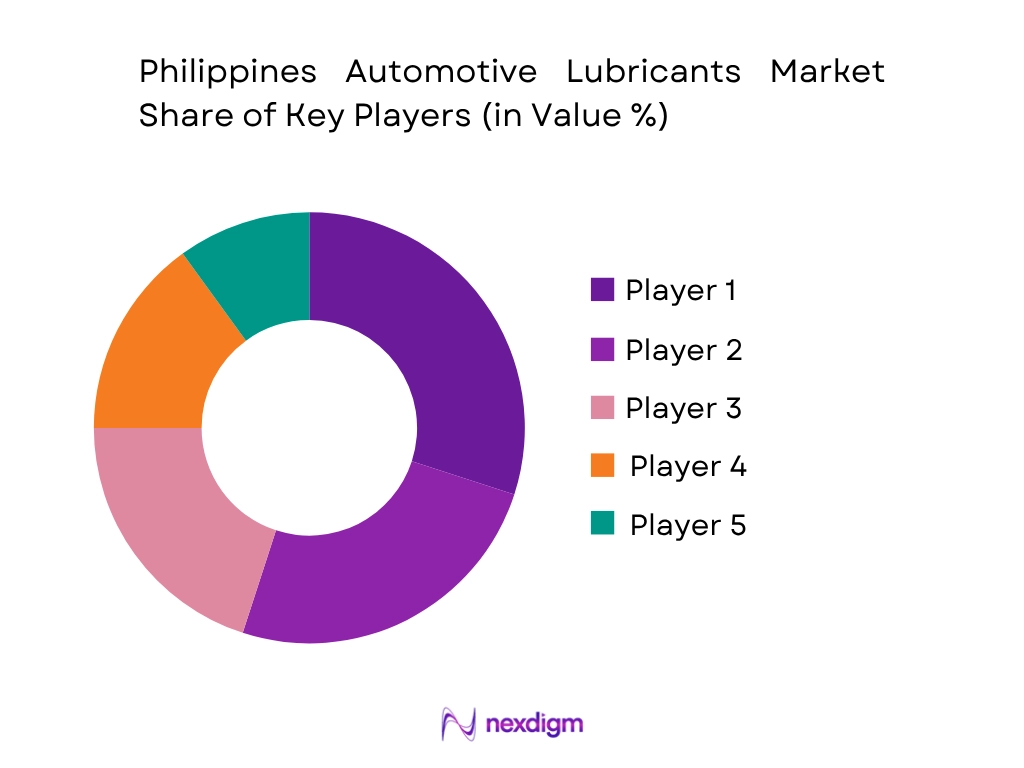
The Philippines Automotive Lubricants Market combines domestic petroleum companies, international oil majors, independent fuel retailers and specialist lubricant brands. Petron has a particularly integrated position because its automotive lubricants are formulated and manufactured locally at its Tondo Lube Oil Blending Plant. Shell and Caltex maintain extensive passenger-car, motorcycle and commercial-vehicle portfolios, while SEAOIL provides locally available gasoline, diesel, motorcycle and gear oils plus toll-blending services. Competition is becoming more manufacturing-oriented following Repsol’s partnership with Unioil Lubricants, whose Philippine facility had 25,000 tonnes of production capacity at the end of 2024.
| Major Player | Establishment Year | Headquarters | Passenger-Car Oils | Motorcycle Oils | Heavy-Duty Oils | Local Manufacturing / Blending | Synthetic Capability | Distribution Strength |
| Petron Corporation | 1933 | Mandaluyong, Philippines | ~ | ~ | ~ | ~ | ~ | ~ |
| Shell | 1907 | London, UK | ~ | ~ | ~ | ~ | ~ | ~ |
| Chevron / Caltex | 1879 | California, USA | ~ | ~ | ~ | ~ | ~ | ~ |
| SEAOIL Philippines | 1978 | Pasig, Philippines | ~ | ~ | ~ | ~ | ~ | ~ |
| Repsol / Unioil Lubricants | 1987 / Philippine JV | Madrid, Spain / Philippines | ~ | ~ | ~ | ~ | ~ | ~ |
Philippines Automotive Lubricants Market Analysis
Growth Drivers
Expanding Internal-Combustion Vehicle Base and Recurring Service-Fill Demand
The Philippines Automotive Lubricants Market is supported by a large and still expanding internal-combustion vehicle parc that creates recurring demand for passenger-car motor oil, motorcycle oil, heavy-duty diesel lubricants, transmission fluids, gear oils, greases and coolants. Philippine Statistics Authority data sourced from the Land Transportation Office shows that the number of registered motor vehicles increased from 14.27 million units in 2023 to 14.56 million units in 2024, adding roughly 290,000 registered vehicles to the national servicing base. More importantly for lubricant consumption, gasoline-powered vehicles reached 11.45 million units and diesel-powered vehicles reached approximately 3.08 million units in 2024. This means more than 14.5 million vehicles continued to rely primarily on combustion-engine or combustion-assisted powertrains, providing a very large installed base requiring periodic lubrication. The expansion is particularly important because lubricant demand is generated throughout the vehicle lifecycle rather than only when vehicles are sold. Motorcycles, cars, utility vehicles, jeepneys, vans and trucks require repeated engine-oil changes, while aging vehicles can additionally consume transmission fluid, differential oils, coolant, brake fluid and grease during maintenance. The structure of the Philippine economy strengthens this installed-base effect. The Philippine Statistics Authority recorded 3,309 formal transportation and storage establishments in 2024, with 244,593 workers employed across passenger transport, freight transport, storage, cargo handling, courier activities and related operations. These businesses maintain vehicle fleets whose annual utilisation is generally greater than that of household vehicles, increasing maintenance frequency and lubricant consumption. The broader macroeconomic environment also supports vehicle usage. World Bank data places Philippine GDP at approximately USD 487.09 billion in 2025, while the Philippine Statistics Authority’s official population count stood at 112,729,484 people in July 2024. This combination of a large population, growing economic output and extensive transportation activity supports continued mobility requirements across urban and provincial markets. The lubricant opportunity is particularly resilient because the installed vehicle base is diversified. Gasoline-powered motorcycles and passenger cars support SAE 5W-30, 10W-40, 20W-50 and JASO-compliant motorcycle oils, while diesel-powered commercial vehicles and public transportation sustain demand for heavy-duty grades including SAE 15W-40 and other diesel formulations. Automatic transmissions, CVTs and increasingly sophisticated vehicle drivetrains also broaden the fluid basket beyond basic engine oil. Consequently, vehicle parc expansion creates both volume demand and product-complexity demand. Newer vehicles require improved API specifications and more synthetic formulations, while older vehicles sustain high-mileage and conventional viscosity products. For lubricant manufacturers and distributors, the result is a market in which fleet expansion, vehicle aging and drivetrain diversification operate simultaneously, making nationwide product availability, workshop penetration and specification coverage central growth drivers. Principal supporting sources are the Philippine Statistics Authority, Land Transportation Office and World Bank.
Expanding Logistics, Delivery and Commercial Transport Ecosystem
The development of the Philippines’ logistics, transportation and commercial distribution system is a major growth driver for automotive lubricants because commercial vehicles accumulate higher operating hours and mileage than most privately used vehicles. The Philippine Statistics Authority’s 2024 Annual Survey of Philippine Business and Industry recorded 3,309 transportation and storage establishments, up from 3,066 establishments in the previous available structural benchmark, while employment in the sector reached 244,593 workers. The sector generated approximately PHP 782.97 billion in economic activity covered by the survey, demonstrating the scale of formal passenger transport, freight movement, warehousing, cargo handling, postal and courier operations operating across the country. These activities directly translate into demand for delivery vans, trucks, motorcycles, buses and logistics support vehicles that require frequent preventive maintenance. Philippine automotive lubricants therefore benefit not simply from increases in privately registered vehicles but from greater utilisation intensity among commercially operated vehicles. Trucks and light commercial vehicles typically require larger quantities of diesel engine oil per service event than passenger cars, while axle oils, differential lubricants, transmission fluids, chassis grease and engine coolants add additional consumption categories. Delivery motorcycles represent another important lubricant-intensive application because motorcycles used for food delivery, parcel distribution and e-commerce logistics can accumulate substantial daily mileage, increasing oil-change frequency relative to purely recreational motorcycles. The economy provides a broad foundation for this transport demand. Philippine GDP reached roughly USD 487.09 billion in 2025 according to the World Bank, and the International Monetary Fund continued to characterize domestic demand as resilient during its 2025 assessment of the economy. The automotive-service ecosystem also benefits from the scale of trade and vehicle-repair activity. Philippine Statistics Authority national accounts identify wholesale and retail trade together with repair of motor vehicles and motorcycles as one of the industries making a substantial contribution to economic activity. This directly matters for lubricant suppliers because repair shops, motorcycle mechanics, fleet workshops, dealerships and auto-supply outlets are among the most important lubricant-selection points in the Philippine aftermarket. Commercial transportation additionally creates a stronger case for premium heavy-duty lubricants than low-mileage private use. Fleet operators need to reduce engine wear, deposit formation, overheating and unplanned downtime, particularly where vehicles face congestion, high ambient temperatures, heavy loads and repeated start-stop operation. This creates demand for API CK-4 and other modern diesel specifications, oxidation-resistant engine oils, high-performance greases and longer-life coolants. Fleet servicing can also support bulk packs, drums and direct supply agreements rather than only consumer-sized bottles, giving lubricant suppliers opportunities to secure recurring institutional accounts. As e-commerce, warehousing and inter-island distribution networks develop, commercial vehicle uptime becomes increasingly important to logistics performance. Lubricant companies that combine products with technical recommendations, drain-interval management, oil-condition analysis and fleet servicing can therefore capture higher-value relationships. The combination of 14.56 million registered vehicles, 3,309 transport and storage establishments and more than 244,000 formal workers in the sector illustrates why commercial mobility is a fundamental, data-supported driver of the Philippines Automotive Lubricants Market.
Market Challenges
Accelerating Electric Vehicle Adoption Reducing Long-Term Engine-Oil Intensity
Accelerating electrification is creating a structural challenge for conventional automotive lubricants in the Philippines because battery-electric vehicles eliminate routine crankcase engine-oil changes, one of the largest recurring automotive lubricant applications. The Department of Energy reported 24,286 registered electric vehicles in 2024 and 29,715 registered EVs during January–July 2025 alone, meaning registrations during only seven months of 2025 had already exceeded the entire 2024 level. Although these numbers remain small compared with the country’s 14.56 million registered motor vehicles, their direction is strategically important for engine-oil suppliers because each battery-electric passenger car or commercial vehicle entering service has significantly lower conventional lubricant requirements than a comparable gasoline or diesel model. The Department of Energy is also strengthening the regulatory foundation for electrification under the Electric Vehicle Industry Development Act and Comprehensive Roadmap for the Electric Vehicle Industry. The roadmap covers EV charging infrastructure, domestic manufacturing, research and development and workforce development, providing a policy framework intended to accelerate the broader electric-mobility ecosystem. For lubricant companies, this means traditional product portfolios will eventually encounter a declining lubricant intensity per vehicle even if overall mobility activity continues increasing. An internal-combustion car may require repeated engine-oil replacement throughout its operating life, whereas an electric vehicle requires no combustion-engine oil and generally has fewer lubricated mechanical components. The remaining fluid requirements shift toward reduction gears, electric drive units, motor bearings, braking systems, air-conditioning compressors and thermal-management circuits. These fluids can be technologically sophisticated but often have substantially longer service intervals than engine oil, making direct volume replacement difficult. Hybrid vehicles create an intermediate challenge because they retain engines but can operate those engines less continuously, altering duty cycles and requiring low-viscosity, oxidation-resistant and corrosion-protective lubricants. Suppliers must therefore maintain legacy mineral and semi-synthetic products for millions of existing vehicles while simultaneously developing full-synthetic hybrid formulations and electric-drive fluids. This expands SKU complexity across distributors and workshops. The economic environment also increases the strategic importance of allocating capital carefully. World Bank data places the Philippine economy at about USD 487.09 billion in 2025, meaning manufacturers are serving a large and growing mobility market, but the mix of technologies within that market is becoming less predictable. Suppliers that remain concentrated on traditional gasoline and diesel engine oils risk gradual erosion of their addressable demand as EV penetration rises. Conversely, premature expansion into highly specialized EV fluid categories can create inventory inefficiencies before replacement demand reaches scale. The key competitive challenge is therefore managing a dual technology cycle: serving 11.45 million gasoline vehicles and approximately 3.08 million diesel vehicles while developing a commercially viable portfolio for an EV parc that is adding tens of thousands of units. Product development, mechanic training and application guidance must evolve accordingly. Lubricant suppliers will increasingly require expertise in dielectric characteristics, copper compatibility, thermal stability and e-motor protection rather than relying exclusively on traditional engine-oil specifications. Principal supporting sources are the Department of Energy, Philippine Statistics Authority, Land Transportation Office and World Bank.
Fragmented Vehicle Age, Specification and Aftermarket Service Requirements
The Philippines Automotive Lubricants Market faces substantial technical complexity because suppliers must service a large and heterogeneous installed vehicle base containing motorcycles, passenger cars, diesel utility vehicles, jeepneys, commercial fleets and increasingly electrified vehicles. The challenge begins with scale: official Philippine Statistics Authority data shows 14.56 million registered vehicles in 2024, including 11.45 million gasoline vehicles and approximately 3.08 million diesel units. These vehicles span very different generations of engine and drivetrain technology. Older vehicles can require comparatively high-viscosity mineral or semi-synthetic oils, while newer gasoline engines increasingly specify SAE 0W-20 or 5W-30 products, advanced API performance categories and longer drain intervals. Diesel trucks and public-utility vehicles require separate heavy-duty formulations, while motorcycles add JASO MA, MA2 and MB requirements. Automatic transmissions, CVTs and dual-clutch transmissions further increase the risk of incorrect fluid application. Consequently, distributors and workshops must carry a broad portfolio rather than a small number of universal products. This raises stock-management requirements and increases the possibility of mechanic or consumer selection errors. The challenge is magnified by the highly fragmented service ecosystem. The Philippine Statistics Authority records large economic activity in wholesale and retail trade and repair of motor vehicles and motorcycles, reflecting the importance of small workshops, motorcycle mechanics, parts retailers, fuel stations and independent service providers alongside formal dealerships. These channels vary significantly in technical equipment, lubricant-brand access and familiarity with current API, JASO and OEM requirements. A mechanic servicing an older jeepney may select oil primarily based on viscosity and experience, while a dealership servicing a new turbocharged passenger vehicle may require strict manufacturer approval. This fragmentation makes nationwide technical standardization more difficult for lubricant companies. It also creates an environment where brand authenticity and traceability become commercially important because products move through numerous regional distributors and retailers before reaching the end user. Macroeconomic diversity intensifies this issue. The Philippines had 112,729,484 residents in July 2024, spread across a large archipelagic geography, meaning manufacturers must support both major urban automotive centres and provincial markets where motorcycles and utility vehicles are essential mobility tools. Distribution is therefore geographically demanding: products must move through regional depots, inter-island logistics systems, wholesalers, auto-supply stores and motorcycle dealers before reaching workshops. The wider transport network contained 3,309 formal transportation and storage establishments and 244,593 workers in 2024, illustrating the scale but also complexity of domestic distribution. As newer technologies enter the vehicle parc, the range of required fluids expands further. Hybrid engine oils, CVT fluids, DCT fluids, long-life coolants and electric-drive fluids coexist with legacy 20W-50 motorcycle and passenger-car oils and SAE 15W-40 diesel products. Suppliers that cannot provide accurate application databases, mechanic education and dependable regional inventory risk losing sales or creating misapplication problems. For the Philippines Automotive Lubricants Market, technical complexity is therefore not merely a product-development issue; it affects inventory planning, workshop training, distribution economics and consumer confidence across a vehicle base exceeding 14 million units. Principal supporting sources are the Philippine Statistics Authority, Land Transportation Office and World Bank-linked demographic datasets.
Market Opportunities
Synthetic, Motorcycle-Specific and High-Performance Lubricant Upgrade Opportunity
The Philippines offers a substantial future growth opportunity for lubricant companies that move existing internal-combustion vehicle users toward more advanced synthetic and application-specific products rather than depending only on increases in total vehicle numbers. The opportunity is supported by the country’s 14.56 million registered vehicles in 2024, including 11.45 million gasoline-powered units, which form a broad addressable base for repeated lubricant replacement. Unlike electric vehicles, the overwhelming majority of the current parc continues to require engine lubrication, meaning suppliers can create growth through technology upgrades within the installed base. Passenger cars increasingly require lower-viscosity engine oils designed for tighter engine tolerances, turbocharging and improved deposit control, while motorcycles require dedicated JASO-compatible products that address wet-clutch performance or scooter transmission architecture. Diesel commercial vehicles add demand for high-performance soot control, oxidation stability and wear protection. This diversity creates room for premium synthetic formulations without requiring speculative future vehicle-volume assumptions. The opportunity is supported by the broader economy’s capacity to absorb improving automotive technology. World Bank data reports Philippine GDP at approximately USD 487.09 billion in 2025, while the country had more than 112.7 million people in the latest official 2024 census count. This large consumer base creates extensive aftermarket servicing activity across passenger mobility, motorcycle commuting and commercial transport. The transport ecosystem itself included 3,309 formal transportation and storage establishments employing 244,593 workers, providing a concentrated fleet segment that can adopt higher-specification lubricants where lifecycle reliability is more important than initial lubricant expenditure. For commercial fleets, synthetic and extended-performance oils can be positioned around engine cleanliness, thermal stability and preventive maintenance. For motorcycles, manufacturers can segment products according to manual transmission motorcycles, automatic scooters, high-mileage delivery motorcycles and premium recreational bikes rather than treating the sector as a single commodity category. The opportunity is similarly strong among aging vehicles. As engines accumulate mileage, suppliers can develop dedicated high-mileage formulations with detergent, seal-conditioning and wear-control characteristics tailored to older units that remain economically important to households and small businesses. Workshop education can support the transition because mechanics are influential lubricant selectors in the Philippine aftermarket. Suppliers that provide viscosity-selection tools, API/JASO training, branded workshop programmes and authenticity verification can build loyalty while improving specification compliance. Digital commerce creates another route for supplying niche viscosities and premium synthetics beyond major cities, although product traceability becomes critical. The opportunity is therefore not dependent on dramatic fleet forecasts. It is already grounded in an existing combustion-powered parc exceeding 14 million vehicles. Even modest migration within this installed base from conventional mineral formulations to semi-synthetic, full-synthetic, high-mileage, low-viscosity or motorcycle-specific oils can materially change the value mix of the market. Principal supporting sources are the Philippine Statistics Authority, Land Transportation Office and World Bank.
EV Fluids, Fleet Technical Services and Local Value-Added Lubrication Solutions
The transition of Philippine mobility toward electrification and more professionally managed commercial fleets creates an opportunity for lubricant suppliers to expand beyond traditional packaged engine oil into specialised fluids and technical services. The opportunity is supported by current rather than forecast vehicle data. The Department of Energy recorded 24,286 registered electric vehicles in 2024, followed by 29,715 additional or registered EV units recorded from January through July 2025, demonstrating that the electrified vehicle ecosystem has moved beyond a negligible pilot market. At the same time, conventional transport remains enormous, with 14.56 million total registered vehicles, 11.45 million gasoline units and approximately 3.08 million diesel vehicles recorded in 2024. This combination creates a multi-technology opportunity: lubricant companies can continue serving engine-oil demand while developing high-margin products required by hybrids and EVs. EV applications include reduction-gear fluids, e-axle lubricants, electric-motor bearing greases, compressor oils, brake fluids and battery thermal-management products. These fluids require different engineering properties from traditional crankcase oils, including electrical compatibility, copper protection, thermal stability and compatibility with specialised polymers and electronic components. The policy environment supports development of this new product category. The Department of Energy’s Comprehensive Roadmap for the Electric Vehicle Industry, created under Republic Act 11697, explicitly covers charging infrastructure, EV manufacturing, research and development and human-resource development. This creates an opening for lubricant manufacturers, additive suppliers and local blenders to establish technical capabilities alongside the developing EV ecosystem instead of waiting until engine-oil demand begins declining materially. Fleet technical services represent a second major opportunity. Philippine Statistics Authority data records 3,309 transportation and storage establishments and 244,593 employees in the formal sector in 2024. Logistics companies, bus operators, delivery fleets and commercial vehicle owners require vehicle availability and predictable maintenance, allowing lubricant suppliers to move from product selling toward service-based relationships. Oil-condition monitoring, wear-metal analysis, lubricant-consolidation programmes, drain-interval optimisation and bulk inventory management can help differentiate suppliers while creating recurring customer relationships. These services are particularly relevant to diesel trucks and heavily utilised commercial fleets where unscheduled engine or transmission failure can interrupt revenue-generating operations. Local formulation and packaging provide an additional opportunity because the Philippine archipelagic distribution system makes product availability and logistics important competitive factors. Manufacturers able to produce motorcycle-sized packages, fleet drums, specialized synthetic grades and region-specific SKU assortments can reduce dependence on fully imported finished products. The broader macroeconomic environment provides scale: World Bank data places Philippine output near USD 487.09 billion in 2025, while the population exceeded 112.7 million people in the official 2024 count. The future opportunity therefore lies in transforming lubricant companies from commodity engine-oil suppliers into mobility-fluid and fleet-reliability providers. Suppliers that combine conventional lubricants, hybrid oils, EV fluids, condition monitoring and regional technical support can participate across both the current combustion-engine base and the emerging electrified fleet. Principal supporting sources are the Department of Energy, Philippine Statistics Authority, Land Transportation Office and World Bank.
Future Outlook
The Philippines Automotive Lubricants Market is expected to expand at approximately ~ CAGR during 2026–2035, supported by continued motorisation, motorcycle usage, commercial logistics activity and gradual consumer migration toward higher-performance lubricants.The market is expected to shift progressively from mineral oils toward semi-synthetic and full-synthetic formulations as newer vehicles specify tighter viscosity ranges and higher API and JASO standards. Motorcycle lubricants will remain strategically important because two-wheelers serve both private mobility and commercial delivery applications. Electrification will gradually reduce conventional engine-oil intensity in selected vehicle classes but will simultaneously create opportunities in hybrid engine oils, e-drive lubricants, reduction-gear fluids, dielectric products and battery thermal-management fluids. The Philippine Department of Energy’s CREVI framework explicitly covers EV infrastructure, manufacturing, research and industry development. Local blending is also likely to become a competitive differentiator. Petron already manufactures lubricants locally, SEAOIL provides blending capabilities, and Repsol’s partnership with Unioil has added another Philippine production platform. This supports shorter supply chains, motorcycle-specific pack formats, private-label manufacturing and greater localisation of lubricant specifications.
Major Players
- Petron Corporation
- Pilipinas Shell – Shell Lubricants
- Chevron Philippines – Caltex Havoline and Delo
- SEAOIL Philippines
- Phoenix Petroleum Philippines
- Mobil Lubricants
- Motul Philippines
- ENEOS Philippines
- Valvoline
- Repsol Lubricants / Unioil Lubricants
- Idemitsu Lubricants
- PETRONAS Lubricants International
- LIQUI MOLY
- Gulf Oil
- FUCHS Lubricants
Key Target Audience
- Automotive lubricant manufacturers and lubricant blenders
- Motorcycle lubricant manufacturers and distributors
- Passenger-car, motorcycle and commercial-vehicle OEMs
- Automotive dealerships, independent workshops and motorcycle service centres
- Jeepney, bus, logistics, ride-hailing and commercial fleet operators
- Base-oil, lubricant additive and automotive-fluid component suppliers
- Investments and venture capitalist firms
- Government and regulatory bodies (Department of Energy, Land Transportation Office, Department of Environment and Natural Resources, Department of Trade and Industry)
Research Methodology
Step 1: Identification of Key Variables
The initial stage establishes a complete ecosystem map of the Philippines Automotive Lubricants Market covering vehicle owners, motorcycle riders, jeepney operators, logistics fleets, lubricant manufacturers, base-oil suppliers, distributors, fuel stations, workshops and dealers. Key variables include registered vehicle population, motorcycle parc, vehicle age, engine capacity, sump capacity, annual mileage, drain intervals, viscosity grades, API/JASO specifications and lubricant technology.
Step 2: Market Analysis and Construction
Historical demand is developed through bottom-up modelling of motorcycles, passenger cars, SUVs, utility vehicles, jeepneys, buses, trucks and other vehicle classes. Vehicle registrations and sales are combined with estimated maintenance cycles, lubricant consumption per service, transmission type and powertrain architecture. Supply-side assessment examines locally manufactured products, imported finished lubricants, blending infrastructure, distributor coverage and service-channel availability. Vehicle-sales and transport-sector data are triangulated against government and industry records.
Step 3: Hypothesis Validation and Expert Consultation
Market hypotheses are validated through CATIs and structured discussions with lubricant manufacturers, distributors, automotive workshops, motorcycle service centres, public-utility vehicle operators and commercial fleets. Interviews focus on viscosity preferences, mineral-to-synthetic migration, API and JASO standards, motorcycle oil-change patterns, transmission-fluid servicing, product authenticity concerns, brand switching and fleet purchasing behaviour.
Step 4: Research Synthesis and Final Output
Demand estimates are reconciled with supply-side evidence from lubricant manufacturers and blending facilities. Petron’s domestic production capability, SEAOIL’s toll-blending operations and Repsol-Unioil’s 25,000-tonne production platform provide reference points for local supply analysis. The resulting dataset is triangulated with vehicle sales, motorcycle sales, regional automotive activity and electrification policy to create a validated market and forecast framework.

- Executive Summary
- Research Methodology (Market Definitions and Assumptions, Abbreviations, Market Sizing Approach, Top-Down Analysis, Bottom-Up Analysis, LTO Vehicle Registration Assessment, Vehicle Type Mapping, Motorcycle Parc Assessment, Public Utility Vehicle Assessment, Passenger Car Demand Assessment, Commercial Vehicle Demand Assessment, Annual Mileage Assessment, Oil Drain Interval Mapping, Sump Capacity Analysis, Lubricant Consumption per Vehicle, Fuel-Type Assessment, Workshop Channel Assessment, Fuel Station Channel Assessment, Local Blending Assessment, Import and Distributor Assessment, Primary Industry Interviews, Distributor Interviews, Workshop Interviews, Fleet Operator Interviews, Data Triangulation, Forecasting Framework, Limitations and Future Conclusions)

- Definition and Scope
- Market Evolution and Industry Genesis
- Development of Automotive Lubricant Consumption Ecosystem
- Evolution of Motorcycle Lubricant Demand
- Evolution of Passenger Car Motor Oil Demand
- Development of Public Utility Vehicle Lubrication

- Growth Drivers (Large Motorcycle Parc, Expanding Vehicle Registrations, High Vehicle Utilisation, Public Transport Dependence, Logistics Expansion)
- Market Challenges (Counterfeit Lubricants, Fragmented Distribution, Older Vehicles, Specification Complexity, EV Substitution)
- Market Opportunities (Motorcycle Oils, Synthetic Conversion, Public Fleet Contracts, Local Blending, EV Fluids)
- Market Trends (Synthetic Adoption, Motorcycle Specialisation, Digital Retail, OEM Specifications, Circular Lubricants)
- Government Regulations (Product Quality, EV Transition, Hazardous Waste, Vehicle Modernisation, Fuel Economy)
- SWOT Analysis
- Porter’s Five Forces Analysis
- PESTLE Analysis

- By Market Value (2020-2025)
- By Lubricant Consumption Volume (2020-2025)
- By Passenger Car Lubricant Value (2020-2025)

- By Product Type (In Value %)
Passenger Car Motor Oil
Motorcycle Engine Oil
Heavy-Duty Diesel Engine Oil
Light-Duty Diesel Engine Oil
Automatic Transmission Fluid - By Vehicle Type (In Value %)
Passenger Cars
SUVs and AUVs
Pick-Up Trucks
Motorcycles
Scooters - By Lubricant Technology (In Value %)
Mineral Lubricants
Semi-Synthetic Lubricants
Full-Synthetic Lubricants
Synthetic Blend Motorcycle Oils
Low-Viscosity Synthetic Lubricants - By Region (In Value %)
National Capital Region
CALABARZON
Central Luzon
Central Visayas
Western Visayas

- Market Share of Major Players (By Value, Volume, Passenger Car Oils, Motorcycle Oils, Commercial Vehicle Oils, Distribution Channel)
- Cross Comparison Parameters (Motorcycle Oil Portfolio and JASO Coverage, Passenger Car SAE/API Portfolio Breadth, Heavy-Duty Diesel and PUV Lubricant Capability, Local Blending and Packaging Footprint, Fuel Station–Auto Supply–Workshop Distribution Reach, Synthetic and High-Mileage Product Depth, OEM–Fleet–Technical Service Capability, Product Authentication–E-Commerce–Used Oil Sustainability Capability)
- SWOT Analysis of Major Players
- Detailed Profiles of Major Companies
Petron Corporation
Pilipinas Shell – Shell Lubricants
Chevron Philippines – Caltex Havoline and Delo
SEAOIL Philippines
Phoenix Petroleum Philippines
Mobil Lubricants
Motul Philippines
ENEOS Philippines
Valvoline
Repsol Lubricants – Unioil Lubricants
Idemitsu Lubricants
PETRONAS Lubricants International
LIQUI MOLY
Gulf Oil
FUCHS / LUBCON Philippines

- Passenger Car Owner Analysis
- SUV and Pick-Up Owner Analysis
- Motorcycle Rider Analysis
- Scooter Rider Analysis
- Tricycle Operator Analysis
- Jeepney Operator Analysis

- By Market Value (2026-2035)
- By Lubricant Consumption Volume (2026-2035)
- By Passenger Car Lubricant Value (2026-2035)


 Request a Sample
 Ask for Customization
 Get a Quote
 Enquire Now