

 Download PDF
Market Overview
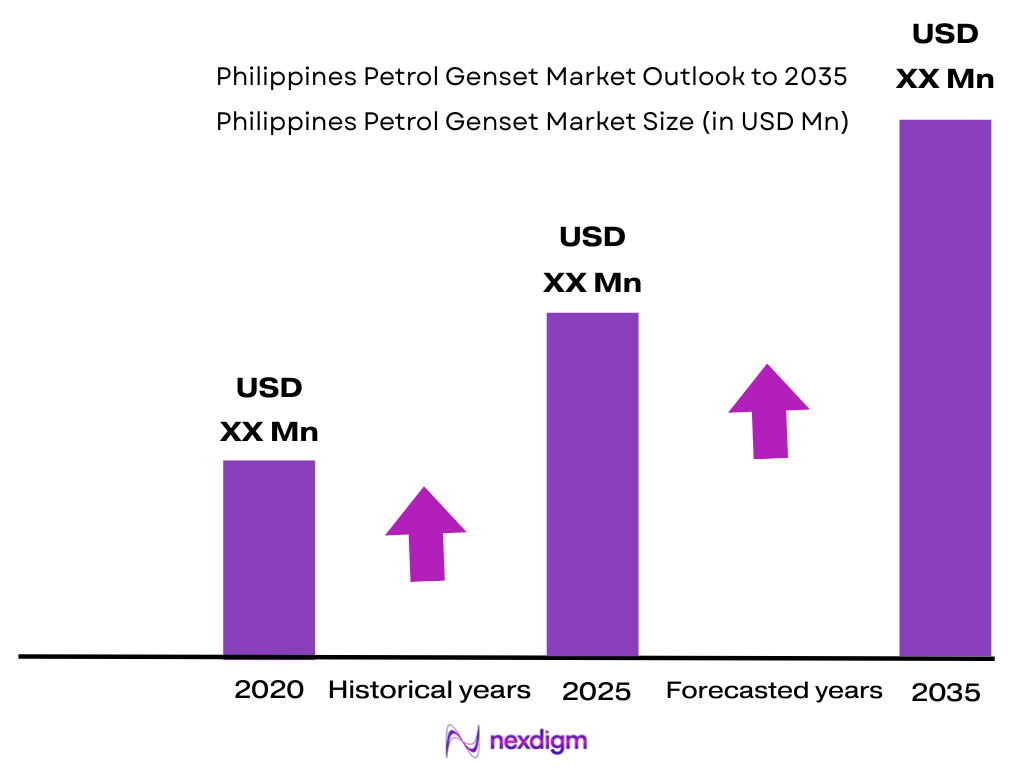
The Philippines Petrol Genset Market is valued at approximately ~ million, supported by expanding construction, household backup-power requirements, automotive workshops and mobile commercial applications. Approved constructions increased from 171,268 units to 180,341 units, while their aggregate value increased from PHP 515.30 billion to PHP 563.89 billion. Petrol gensets benefit from portability, rapid deployment and suitability for intermittent loads where permanent generating infrastructure is unnecessary. CALABARZON, the National Capital Region and Central Luzon represent major demand centres because they combine construction, workshops, commercial establishments, housing and logistics activity. Total construction floor area increased from 41.47 million square metres to 42.84 million square metres. CALABARZON subsequently recorded 41,471 constructions, while the combined construction value of CALABARZON, NCR and Central Luzon reached PHP 307.70 billion, supporting substantial temporary and backup-power requirements.
Market Segmentation
By Power Rating
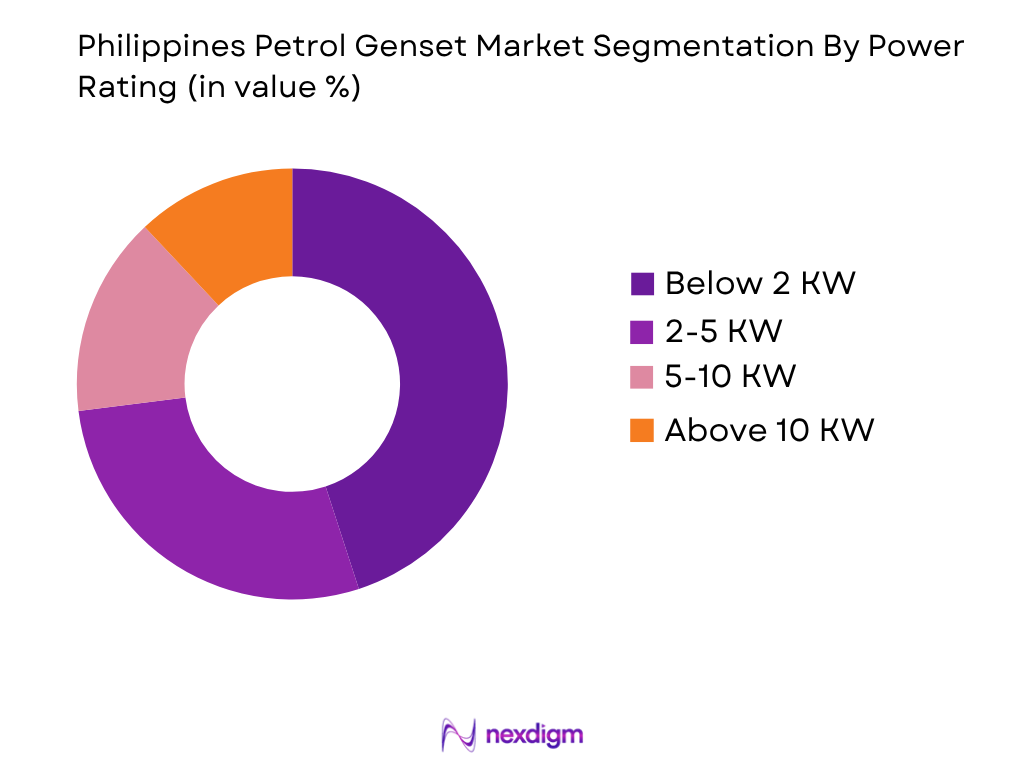
The Philippines Petrol Genset Market is segmented into below 2 kW, 2–5 kW, 5–10 kW and above 10 kW gasoline generator sets. The 2–5 kW category holds the dominant market position because it provides a practical balance between portability and usable power for households, automotive repair shops, roadside maintenance, construction crews and small businesses. Honda’s Philippine portfolio includes generator outputs ranging from approximately 900 VA through 2.6 kW and 5.5 kVA, demonstrating the importance of compact and medium-capacity models in actual local product portfolios. INGCO Philippines similarly offers gasoline generators at approximately 2.5 kW, 3.3 kW, 4.5 kW and higher capacities, indicating broad commercial availability around the mid-output range. Units in this category can power lighting, compressors, battery chargers, diagnostic equipment, drills, grinders and essential domestic appliances while remaining sufficiently compact for transportation between work sites. The segment also benefits from both conventional alternator and inverter-generator configurations.
By Application
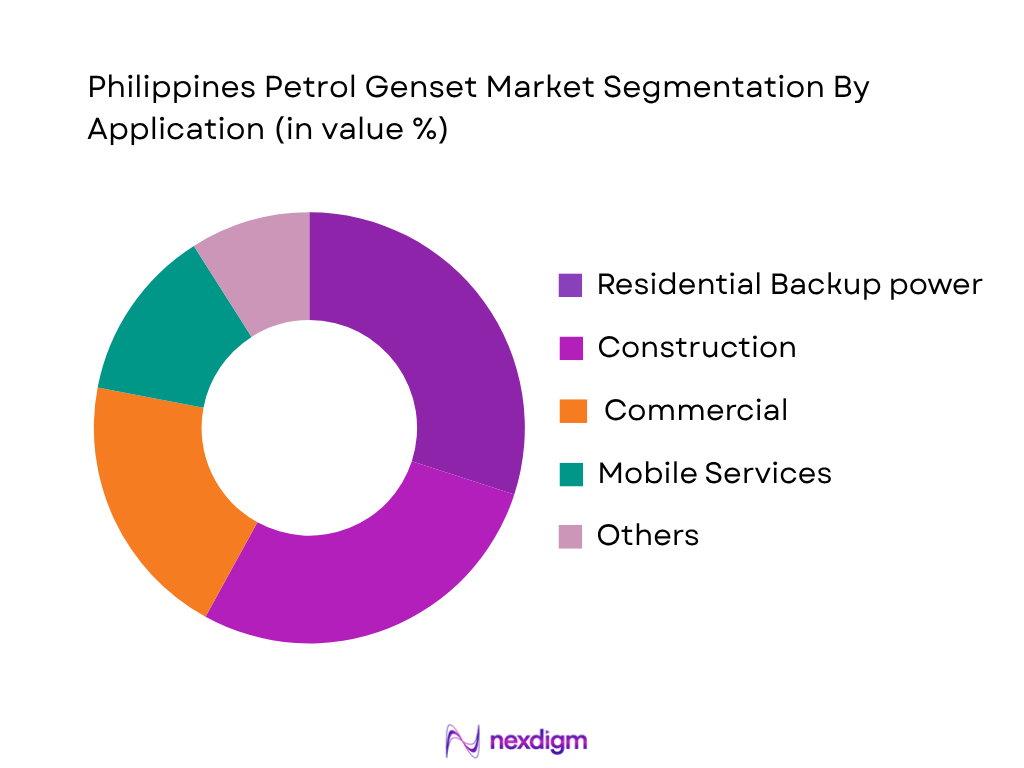
The Philippines Petrol Genset Market is segmented into residential backup, automotive workshops and service centres, construction and contractors, commercial establishments, outdoor/mobile applications and emergency services. Residential and small-commercial backup represents the dominant application segment because compact gasoline generators provide immediate power without permanent installation and can be stored until outages or emergencies occur. The underlying requirement remains meaningful despite improving electricity coverage: World Bank data places Philippine electricity access at 94.8% of the population, meaning full grid accessibility and reliability are not universal across the archipelago. Honda specifically positions its Philippine generator products for power failures, construction work, outdoor activities, disasters and other emergencies. Automotive workshops form an important adjacent user group because grinders, lighting, chargers, pressure equipment and selected diagnostic tools require electricity even where grid service is interrupted or unavailable. Contractors similarly value mobile sets that can be moved between small projects rather than maintaining fixed power infrastructure.
Competitive Landscape
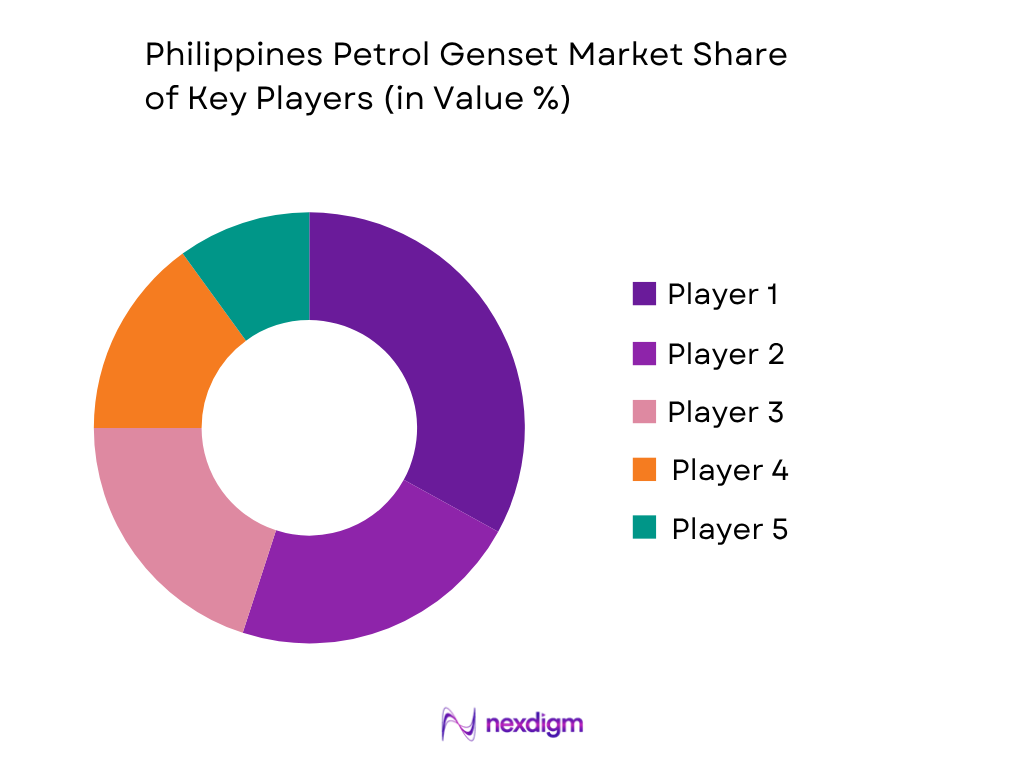
The Philippines Petrol Genset Market contains established Japanese power-equipment brands, international engine and generator manufacturers, and value-oriented tool brands. Honda has a particularly visible local offering, with conventional and inverter generators spanning approximately 900 VA to 6.5 kVA on its Philippine product platform. Yamaha Motor Philippines also markets generators as part of its power-products offering, while INGCO provides an extensive local gasoline-generator range extending from compact models to inverter sets exceeding 10 kW.
| Major Player | Established | Headquarters | Petrol Generator Portfolio | Typical Output Coverage | Inverter Technology | Starting System | Key Safety/Protection Features | Philippine Channel Position |
| Honda Motor Co. | 1948 | Tokyo, Japan | ~ | ~ | ~ | ~ | ~ | ~ |
| Yamaha Motor Co. | 1955 | Iwata, Japan | ~ | ~ | ~ | ~ | ~ | ~ |
| INGCO | 2000s | China | ~ | ~ | ~ | ~ | ~ | ~ |
| Briggs & Stratton | 1908 | Milwaukee, USA | ~ | ~ | ~ | ~ | ~ | ~ |
| Generac | 1959 | Wisconsin, USA | ~ | ~ | ~ | ~ | ~ | ~ |
Philippines Petrol Genset Market Analysis
Growth Drivers
Rising Grid Load and Requirement for Backup Power Continuity
The Philippines Petrol Genset Market is supported by rising electricity demand and the continuing requirement for rapidly deployable backup power across homes, small businesses, workshops, retail locations, construction sites and transport-related facilities. The Department of Energy reported that national system peak electricity demand reached 19,274 MW in 2024, compared with 17,331 MW in 2023, demonstrating the increasing load being placed on the country’s electricity infrastructure. Higher peak requirements increase the importance of backup generation during transmission failures, distribution interruptions, severe weather and local capacity constraints, particularly for businesses that cannot tolerate prolonged loss of lighting, communications, refrigeration, pumps or workshop equipment. Petrol gensets are particularly relevant for lower-output and mobile requirements because they can be started quickly, transported between locations and operated without permanent gas infrastructure. The demand environment is reinforced by the scale of the Philippine economy. World Bank data places Philippine gross domestic product at approximately USD 487.09 billion in 2025, while GNI per capita reached USD 4,470 in 2024, providing an expanding economic base for commercial establishments and households purchasing small backup-power equipment. The Department of Energy continues to identify reliability improvement as an infrastructure priority, including transmission and distribution upgrades in island grids such as Palawan, Masbate, Catanduanes, Marinduque and Mindoro. These initiatives improve long-term grid reliability but also demonstrate the operational challenges involved in supplying electricity consistently across an archipelagic system. Petrol generators therefore remain relevant as supplementary assets even where grid connections exist. Residential users commonly require power for lighting, refrigerators, telecommunications and water pumps, while workshops and small commercial establishments need electricity for compressors, tools, point-of-sale systems and digital communications. Portable units also provide temporary redundancy during typhoons and local network restoration. From a market perspective, the strongest demand lies below the large industrial genset category, where gasoline equipment competes through portability, uncomplicated starting systems and readily available retail fuel. As electricity consumption increases alongside economic activity, the value proposition of petrol gensets increasingly centres on continuity rather than primary generation. This supports recurring replacement demand for engines, alternators and older open-frame models as well as migration toward quieter inverter units. Supporting data are drawn from the Department of Energy and World Bank.
Expanding Construction and Temporary-Site Power Requirements
Construction activity creates a direct growth driver for the Philippines Petrol Genset Market because building sites frequently require temporary electricity before permanent utility connections are commissioned and need portable power at locations where extension cables or grid connections are impractical. The Philippine Statistics Authority recorded 180,341 approved constructions in 2024, increasing from 171,268 constructions in 2023. The total subsequently reached 181,832 constructions in 2025, showing that a large nationwide pipeline of residential, commercial, industrial and institutional projects continued to require tools, lighting, pumps and temporary electrical equipment. Construction floor area reached 42.84 million square metres in 2024, while the recorded value of authorised construction activity reached PHP 563.89 billion, according to PSA’s subsequent annual release. Petrol gensets are especially relevant to small and medium construction projects where electrical loads include drills, grinders, circular saws, mixers, compressors, temporary lighting and battery-charging systems. Unlike high-capacity diesel generator sets intended for major infrastructure sites, petrol-powered units can address smaller mobile workloads with comparatively simple deployment. Contractors can move units among residential projects, renovation sites and field operations rather than installing fixed generating equipment at each project. The opportunity is particularly relevant because Philippine construction activity is geographically dispersed rather than concentrated exclusively in Metro Manila. Residential projects, commercial buildings, tourism developments and municipal construction across Luzon, Visayas and Mindanao require temporary electrical access at different phases of development. The country’s macroeconomic scale also supports sustained capital formation. World Bank data places Philippine GDP at USD 487.09 billion in 2025, while the IMF reported Philippine economic output continuing to expand from its 2024 base despite moderation in 2025. For generator manufacturers, the construction segment favours rugged open-frame products, wheel kits, multiple AC outlets, voltage regulation, overload protection and engines capable of operating in hot and humid environments. Contractors increasingly require equipment that can simultaneously run sensitive electronics and conventional power tools, expanding the role of inverter technology in higher-specification portable generators. Rental companies also represent an important route to market because contractors with intermittent requirements can obtain gensets without maintaining a dedicated unit for every site. Beyond new buildings, repair and reconstruction following typhoons or flooding can create concentrated temporary-power requirements. Consequently, the large number of active building projects creates a repeatable demand base for portable petrol gensets, particularly in lower kVA categories where portability and rapid deployment outweigh the operating advantages of larger diesel equipment. Supporting statistics are from the Philippine Statistics Authority, World Bank and International Monetary Fund.
Market Challenges
Petroleum Dependence and Transition Toward Cleaner Backup Power Technologies
The Philippines Petrol Genset Market faces a structural challenge from its dependence on petroleum fuel at the same time that national energy policy is encouraging cleaner and more efficient technologies. Petrol gensets remain convenient for intermittent backup applications, but every operating hour requires gasoline that must move through the country’s import, storage, depot and retail-fuel infrastructure. The Department of Energy identifies the Philippines as an oil-import-dependent economy and maintains responsibility for ensuring sufficient petroleum supply, product quality and downstream market competition. This dependence exposes petrol-genset operators to supply disruptions caused by international crude-market conditions, shipping constraints, geopolitical events and natural disasters affecting domestic logistics. The challenge is significant in an archipelagic country where fuel must be transported across multiple island markets. At the same time, the electricity system is incorporating increasing renewable generation and energy-storage technologies, creating substitutes for small combustion generators in selected applications. The Department of Energy reported national peak electricity demand of 19,274 MW in 2024, but system planning increasingly combines conventional power, renewables, grid reinforcement and battery solutions rather than relying solely on distributed fossil-fuel generation. For consumers, portable battery power stations and solar-plus-storage systems compete most directly with small petrol gensets used for telecommunications, lighting and household electronics. These alternatives eliminate local exhaust emissions and can operate indoors where combustion generators cannot. Petrol gensets retain advantages for extended outages and high-energy tools, but manufacturers increasingly need to demonstrate better fuel efficiency, reduced noise and cleaner exhaust characteristics. The wider macroeconomic environment reinforces both sides of this transition. The World Bank reports Philippine GDP at about USD 487.09 billion in 2025, reflecting growing electricity requirements but also improving capacity among households and businesses to consider more advanced backup solutions. The policy direction is also toward more resilient and sustainable power infrastructure in off-grid areas. The Department of Energy’s Missionary Electrification Development Plan covers the expansion of electricity services in remote areas while explicitly incorporating renewable-energy and infrastructure improvements. For petrol genset suppliers, this means future competitiveness cannot rely solely on conventional carbureted open-frame generators. Products must increasingly incorporate electronic fuel management, inverter controls, eco-mode operation and engine designs that reduce fuel consumption at partial load. Dual-fuel capability may further mitigate reliance on gasoline where LPG is available. The challenge is therefore technological and strategic: petrol gensets continue to solve real backup-power problems, but their role is moving toward emergency, temporary and mobile usage rather than continuous electricity supply. Supporting sources are the Department of Energy and World Bank.
Fuel Handling, Maintenance and Safe-Operation Constraints
Operational complexity presents another challenge for the Philippines Petrol Genset Market because petrol generators require fuel storage, routine engine maintenance, ventilation and careful user handling. These requirements are more demanding than plug-and-play battery backup systems and can limit adoption among households and commercial users seeking low-maintenance emergency power. The Philippine downstream fuel system remains extensive, but fuel availability itself does not eliminate the challenges associated with safely storing gasoline at homes, workshops and temporary worksites. The Department of Energy’s downstream petroleum framework specifically regulates product quality, supply, storage, distribution and retail operations because the country’s economy remains heavily dependent on imported petroleum. Users operating petrol gensets during emergencies must therefore maintain fresh fuel, manage approved containers and avoid contamination or deterioration during extended storage. Generators that remain unused for long periods can suffer carburetor deposits, clogged fuel systems and difficult starting if gasoline is stored incorrectly. Maintenance requirements include engine-oil replacement, spark-plug inspection, air-filter servicing and periodic running to confirm readiness. These issues become particularly significant in the Philippine climate, where heat, humidity and storage conditions can accelerate deterioration of equipment components. Safe exhaust management is another fundamental constraint. Petrol engines produce carbon monoxide and must be operated outdoors with adequate separation from occupied buildings. Improper operation during typhoons and blackouts can create serious health risks when consumers position generators in garages, enclosed balconies or covered areas. Manufacturers therefore need clearer warning systems, automatic CO shutoff devices and user education rather than competing exclusively on wattage. The challenge is magnified by the country’s scale and geographic dispersion. The World Bank records Philippine GDP at approximately USD 487.09 billion in 2025, while national energy and infrastructure activities extend across thousands of islands and remote communities, creating differences in access to authorised service centres and spare parts. Construction demand further illustrates this operational burden. The Philippine Statistics Authority recorded 181,832 approved construction projects in 2025, following 180,341 projects in 2024. Gensets operating on dusty building sites require more frequent air-filter checks and preventive servicing than units stored for residential emergency use. Equipment downtime can interrupt tool operation and construction schedules, so buyers increasingly value robust alternators, automatic voltage regulation, low-oil shutdown and readily available replacement components. Service networks are therefore an important competitive differentiator. Suppliers without authorised technicians, spare-parts inventories and regional distribution can struggle outside major urban centres. Petrol genset companies must consequently address the entire ownership lifecycle—installation guidance, fuel handling, safety, maintenance and repair—to defend the technology against increasingly simple battery-based alternatives. Supporting data are from the Department of Energy, Philippine Statistics Authority and World Bank.
Market Opportunities
Inverter Generators, Digital Controls and Advanced Safety Systems
Technological improvement represents one of the strongest future growth opportunities in the Philippines Petrol Genset Market because users increasingly require quieter, more efficient and electronically stable portable power rather than conventional fixed-speed open-frame generators. The opportunity is supported by the scale of the country’s current electricity requirements. National system peak demand reached 19,274 MW in 2024, according to the Department of Energy, while the country’s economy reached approximately USD 487.09 billion in 2025, according to World Bank data. These figures indicate a large base of households, commercial establishments, construction activities and service businesses whose operations increasingly depend on digital equipment. Conventional generators designed primarily for motors and incandescent loads can struggle to differentiate when end users need to power laptops, routers, telecommunications devices, electronic controllers, modern refrigerators and battery chargers. Inverter gensets address this opportunity by electronically controlling output frequency and voltage while allowing the engine to reduce speed when electrical load declines. This architecture can lower fuel consumption, noise and vibration during partial-load operation and produce cleaner electricity for sensitive electronics. The market opportunity extends beyond inverter circuitry. Automatic low-oil shutdown, electronic overload protection, electric starting, remote starting and digital displays showing operating hours and remaining runtime can reduce the knowledge required to operate generators safely. Carbon-monoxide detection and automatic engine shutdown can become increasingly important product features for residential buyers. Parallel-operation capability also allows two smaller inverter units to be combined when additional output is required, giving contractors and recreational users greater flexibility than a single heavy generator. The opportunity is reinforced by continuing building activity. Philippine Statistics Authority data recorded 180,341 approved constructions in 2024 and 181,832 in 2025, creating a substantial addressable base for portable equipment used during construction, renovation and temporary electrical installation. Contractors can use high-output inverter gensets for tools and simultaneously operate electronics without maintaining separate power sources. Technology also creates room for hybridisation. Petrol generators can be paired with portable battery packs, automatically charging energy storage when battery levels fall and shutting down when sufficient charge is restored. Such systems reduce continuous engine operation while preserving the extended-runtime advantage of liquid fuel. Smartphone monitoring and Bluetooth-enabled operating data could further improve fleet management for rental companies and contractors managing multiple portable units. The opportunity therefore lies not simply in selling additional gensets but in moving the market toward higher-specification products with better power quality, safety, connectivity and fuel management. Suppliers that localise these features while maintaining serviceability in Philippine conditions can capture premium replacement demand as older conventional generators reach retirement. Supporting sources are the Department of Energy, Philippine Statistics Authority and World Bank.
Island, Remote-Site and Disaster-Resilience Applications
The Philippines’ island geography creates a distinctive growth opportunity for portable petrol gensets because many communities, tourism sites, construction projects and small businesses operate in areas where electricity reliability and equipment mobility remain operational concerns. The Department of Energy’s Missionary Electrification Development Plan 2024–2028 specifically identifies power-infrastructure requirements for off-grid and remote locations and includes transmission and distribution upgrades for island grids including Palawan, Masbate, Catanduanes, Marinduque and Mindoro. These investments aim to improve long-term electricity quality, but the existence of dedicated off-grid planning demonstrates why decentralised backup equipment remains relevant. Small petrol generators can support island resorts, sari-sari stores, telecom equipment, fisheries, repair workshops, emergency-response teams and contractors where deploying larger stationary generating systems is impractical. The opportunity is particularly strong in temporary and contingency applications rather than permanent baseload generation. A compact generator can be transported by pickup, van or small boat and deployed quickly after severe weather, whereas fixed electrical assets may require extensive repair before service is restored. Philippine power demand itself reached a national peak of 19,274 MW in 2024, placing increasing requirements on generation and network infrastructure as the economy expands. World Bank data places GNI per capita at USD 4,470 in 2024 and GDP at approximately USD 487.09 billion in 2025, illustrating the expanding economic base behind provincial businesses, tourism facilities and household appliance ownership that increasingly depend on uninterrupted electricity. Construction is another important pathway into remote-market demand. The Philippine Statistics Authority recorded 180,341 approved constructions in 2024, increasing to 181,832 in 2025. Projects located outside established urban centres commonly need portable electricity for early-stage site preparation, lighting, pumps and power tools before permanent service is available. Genset manufacturers can address this opportunity through compact wheel-mounted units, corrosion-resistant frames, large fuel tanks, easy-start systems and engines designed for humid environments. Dealer and service expansion outside Metro Manila, Cebu and Davao is equally important because generator availability without spare parts or technicians limits commercial adoption. Rental fleets can provide another route to provincial penetration, especially for construction contractors, event operators and disaster-response requirements. Dual-fuel petrol/LPG products can further improve resilience by allowing users to switch between fuel sources depending on local availability. The market opportunity therefore rests on geographic flexibility: petrol generators can provide power exactly where fixed infrastructure is weakest or temporarily unavailable. As grid reinforcement progresses, the technology’s role will increasingly concentrate on emergency resilience, construction, mobile commercial activity and remote-site redundancy rather than continuous household generation. Supporting data are from the Department of Energy, Philippine Statistics Authority and World Bank.
Future Outlook
The Philippines Petrol Genset Market is forecast to expand at approximately ~ CAGR during 2026–2035, supported by increasing power requirements across households, workshops, construction sites, mobile businesses and provincial commercial establishments. Demand will increasingly shift from basic open-frame generators toward inverter-based petrol gensets providing cleaner electrical output, improved fuel efficiency, reduced engine speed under partial load and lower operating noise. This development is particularly relevant for modern diagnostic equipment, computers, communication devices and electronic control equipment requiring stable electricity. The construction sector will remain an important demand generator. Approved constructions reached 180,341 units, including 116,427 residential projects and 39,238 non-residential projects. Temporary power is required for small tools, lighting, site offices, welding-support equipment and other activities before permanent electrical connections become operational. Regional expansion will also favour portable models. CALABARZON recorded 41,471 constructions, Central Luzon 22,824, and Central Visayas 19,585, creating dispersed equipment demand beyond Metro Manila. Manufacturers with strong provincial dealerships, spare-parts availability and mechanic support are therefore positioned more favourably than brands relying exclusively on major-city retail.
Major Players
- Honda Power Products
- Yamaha Motor Philippines
- INGCO Philippines
- Briggs & Stratton
- Generac
- Atlas Copco
- Powerhouse Tools
- TOTAL Tools
- Hyundai Power Products
- FIRMAN Power Equipment
- Westinghouse Outdoor Power Equipment
- Stanley Power Equipment
- Makita
- KIPOR
- Lutian Machinery
Key Target Audience
- Petrol genset manufacturers and assemblers
- Automotive workshop and service-equipment distributors
- Construction equipment and power-tool distributors
- Automotive dealerships and independent repair networks
- Residential and commercial backup-power solution providers
- Equipment rental and construction fleet operators
- Investments and venture capitalist firms
- Government and regulatory bodies (Department of Energy, Energy Regulatory Commission, Department of Environment and Natural Resources, Department of Trade and Industry, Bureau of Philippine Standards)
Research Methodology
Step 1: Identification of Key Variables
The initial research phase constructs the complete Philippines Petrol Genset Market ecosystem covering manufacturers, importers, tool distributors, automotive workshops, equipment-rental companies, construction contractors and residential users. Core variables include rated output, maximum output, petrol-engine displacement, fuel-tank capacity, runtime, alternator type, inverter penetration, voltage, starting system, noise output, mobility and safety features.
Step 2: Market Analysis and Construction
Historical demand is evaluated through top-down and bottom-up approaches using construction activity, electricity access, automotive-service activity, emergency-power demand and generator availability. Philippine construction statistics provide demand-side indicators, while manufacturer product ranges support supply-side validation. Honda’s locally marketed range extends from approximately 900 VA to 6.5 kVA, while INGCO offers gasoline and inverter units extending above 10 kW, providing benchmarks for locally available capacity bands.
Step 3: Hypothesis Validation and Expert Consultation
Market hypotheses are validated through structured interviews and CATIs with generator dealers, power-equipment distributors, automotive workshop operators, contractors, rental companies and repair technicians. Interviews examine preferred output ranges, conventional versus inverter demand, runtime requirements, brand-selection criteria, after-sales service expectations, spare-parts availability and typical emergency-power applications.
Step 4: Research Synthesis and Final Output
Supply-side findings are reconciled with Philippine macroeconomic and infrastructure indicators. Construction volumes, regional project concentration and electricity-access data are triangulated with generator specifications, channel availability and competitive positioning. This framework allows petrol genset demand to be distinguished from larger diesel generator installations and emerging battery-based portable power, resulting in a dedicated outlook for compact gasoline-driven generator systems.

- Executive Summary
- Research Methodology (Market Definition and Scope, Petrol/Gasoline Genset Classification, Primary and Standby Power Definitions, Top-Down Market Sizing, Bottom-Up Unit Shipment Assessment, Generator Dealer Interviews, Hardware Retailer Assessment, End-User Demand Validation, Import and Distribution Analysis, Product SKU Mapping, kW/kVA Conversion Framework, Data Triangulation, Forecasting Framework, Limitations and Assumptions)

- Definition and Scope
- Market Evolution and Industry Genesis
- Development of Portable Petrol Generator Ecosystem
- Evolution from Conventional Alternator Gensets to Inverter Gensets
- Philippines Power Reliability and Backup-Power Ecosystem

- Growth Drivers (Grid Interruption Exposure, Typhoon-Related Backup Demand, Residential Backup Adoption, MSME Electricity Continuity, Construction Activity, Portable Power Requirements)
- Market Challenges (Petrol Runtime, Fuel Storage, Carbon Monoxide Risk, Noise, Emission Compliance, Maintenance Frequency, Battery Power Competition)
- Market Opportunities (Inverter Technology, Low-Noise Design, Hybrid Backup, Smart Controls, Portable Power, Disaster Preparedness, Contractor Applications)
- Market Trends (Inverter Adoption, Pure Sine Wave Output, Electric Start, Portable Frames, Fuel Efficiency, Noise Reduction, Safety Protection)
- Government Regulations (DENR-EMB Air Compliance, Standby Genset Operating Requirements, Philippine Clean Air Act, Fuel Quality, Fire Safety, Electrical Installation)
- SWOT Analysis
- Porter’s Five Forces Analysis
- PESTLE Analysis

- By Market Value (2020-2025)
- By Unit Sales Volume (2020-2025)
- By Installed Petrol Genset Base (2020-2025)

- By Rated Power Output (In Value %)
Below 1 kW
1–3 kW
Above 3–5 kW
Above 5–7.5 kW
Above 7.5–10 kW - By Generator Type (In Value %)
Conventional Open-Frame Petrol Generators
Inverter Petrol Generators
Silent/Enclosed Petrol Generators
Portable Generator-Welder Units
Heavy-Duty Contractor Petrol Generators - By Application (In Value %)
Residential Emergency Backup
Small Businesses and Retail Stores
Construction and Contractor Sites
Work-from-Home and Home Office Backup
Outdoor Events and Mobile Operations - By Geography (In Value %)
Metro Manila
CALABARZON
Central Luzon
Northern and Southern Luzon
Central and Western Visayas

- Market Share of Major Players by Value
- Cross Comparison Parameters (Rated Output Range, Generator Architecture, Inverter Availability, Fuel Tank Capacity & Runtime, Starting System, Noise Level, Safety & Protection Features, Dealer & Service Network)
- SWOT Analysis of Major Players
- Detailed Profiles of Major Companies
Honda Power Products Philippines
Yamaha Motor Philippines – Power Products
Promate Generators / Powertech Asia Pacific
INGCO Philippines
TOTAL Tools
Powerhouse Tools & Equipment
Lotus Tools Philippines
Atlas Copco Philippines
JR Kawasaki
Greenfield Power Products
EF Power
Stanley Power Equipment
WADFOW Tools
Golden Horse / Goldpeak Tools
Hyundai Power Products Philippines

- Residential Household Demand Analysis
- Small Retail and MSME Backup-Power Demand
- Construction Contractor Demand Analysis
- Work-from-Home Backup-Power Requirements
- Agricultural and Farm Generator Demand

- By Future Market Value (2026-2035)
- By Future Unit Sales Volume (2026-2035)
- By Future Installed Petrol Genset Base (2026-2035)


 Request a Sample
 Ask for Customization
 Get a Quote
 Enquire Now