

 Download PDF
Market Overview
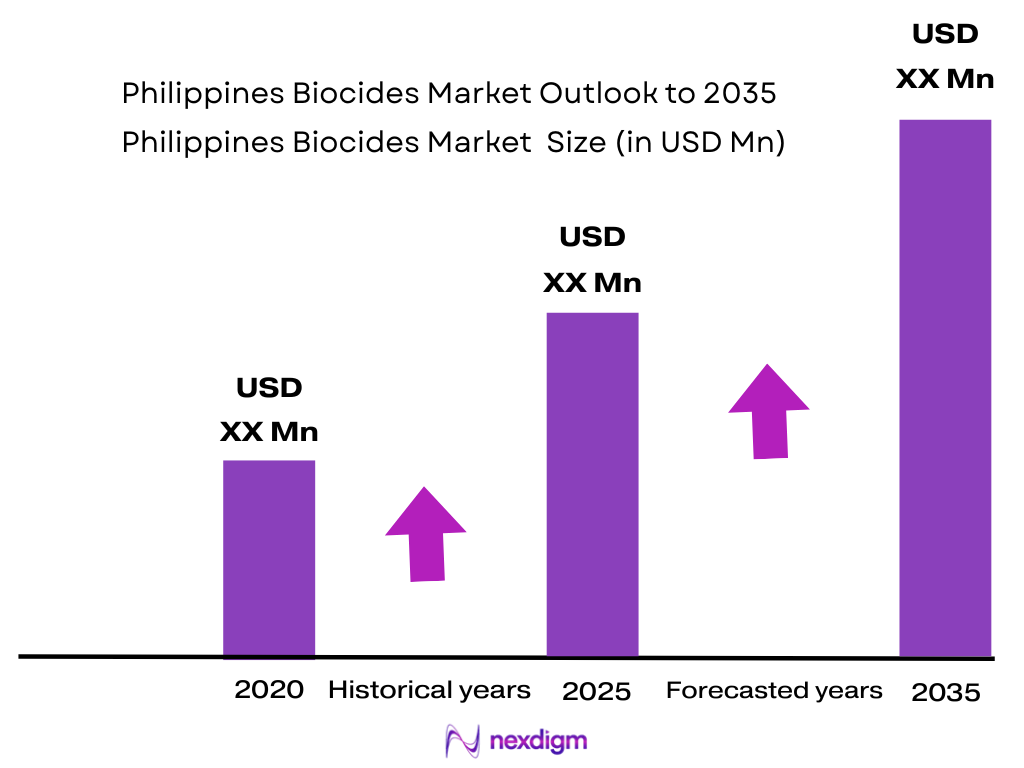
The Philippines Biocides Market is valued at ~USD 45 million, supported by expanding water and wastewater treatment, food processing, aquaculture, agriculture, paints and coatings, healthcare sanitation and industrial manufacturing. The Philippine economy generated USD 461.67 billion in GDP in the latest World Bank observation, compared with USD 437.06 billion in the preceding year, while national GDP growth reached 5.7% compared with 5.5%. Industrial, food, construction and services activity therefore provides a broad end-use base for microbial-control products.
The Philippines Biocides Market is concentrated around Metro Manila, Calabarzon, Central Luzon, Cebu and Davao, reflecting the location of manufacturing, food processing, healthcare, logistics, ports and water-treatment infrastructure. Central Visayas recorded 7.3% economic growth, Central Luzon 6.5%, Davao 6.3%, and Northern Mindanao 6.0%, compared with national growth of 5.7%. These regions combine industrial production, food and beverage processing, commercial activity and expanding urban infrastructure, generating recurring microbial-control requirements.
Market Segmentation
By Product Type
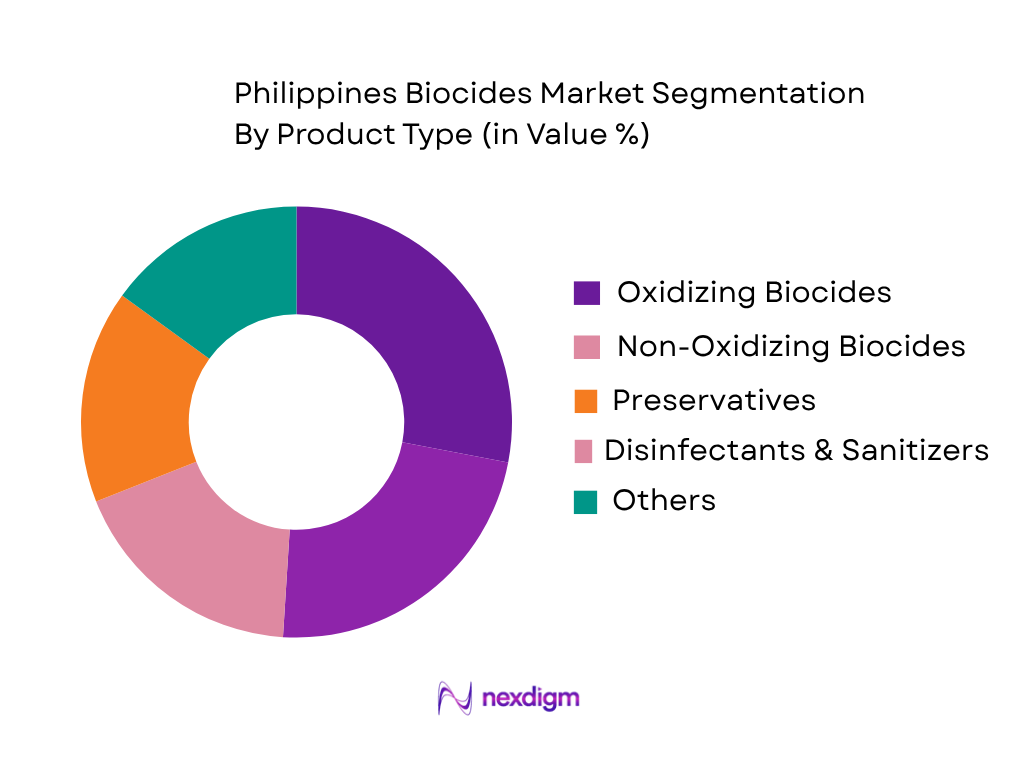
The Philippines Biocides Market is segmented into oxidizing biocides, non-oxidizing biocides, preservatives, disinfectants and sanitizers, antimicrobial additives and other microbial-control agents. Oxidizing biocides are expected to represent the leading product category because chlorine-based and related chemistries provide broad-spectrum microbial control across municipal water, wastewater, food processing, institutional sanitation, aquaculture and industrial applications. The Philippines has a large and geographically dispersed water-management requirement, while food and agricultural production creates additional sanitation and microbial-control demand. Aquaculture produced 2.22 million metric tons of output, compared with 2.38 million metric tons in the preceding year, and represented 54.9% of total fisheries production. (Philippine Statistics Authority) Non-oxidizing biocides remain important for industrial cooling, oil and gas, coatings and applications requiring targeted microbial control. Preservatives serve water-based paints, coatings, polymers and formulated products, while disinfectants and sanitizers address hospitals, food facilities, hospitality and institutional environments. The resulting product mix is therefore determined by the country’s combination of water treatment, agriculture, aquaculture, food manufacturing and industrial applications.
By Application
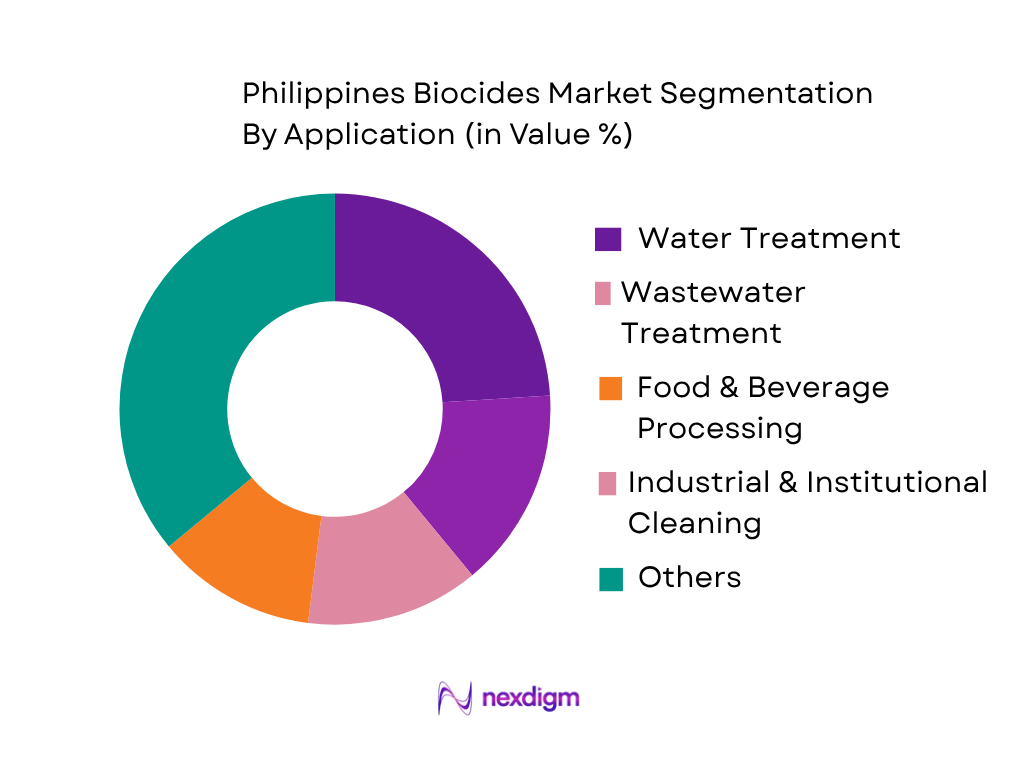
The Philippines Biocides Market is segmented by application into water treatment, wastewater treatment, industrial and institutional cleaning, food and beverage processing, paints and coatings, aquaculture, oil and gas, agriculture and animal facilities, personal care and cosmetics, pulp and paper, textiles and marine applications. Water treatment is modeled as the dominant application because microbial control is required across municipal systems, industrial water circuits, wastewater plants and commercial facilities. Aquaculture creates a particularly differentiated demand base: Philippine aquaculture generated 2.22 million metric tons in the latest annual statistics, with seaweed accounting for 65.5%, brackish-water fishponds 12.6%, freshwater fishponds 9.1%, and marine cages 7.0%. (Philippine Statistics Authority) Food processing is another important application because microbial control is required for process-water systems, equipment sanitation and cleaning operations. Industrial applications are supported by the country’s expanding economy, with national GDP growth reaching 5.7% and construction growth reaching 10.2%. (Philippine Statistics Authority) Consequently, demand extends from commodity disinfectants into specialized cooling-water, wastewater, preservation, aquaculture and biofilm-control products.
Competitive Landscape
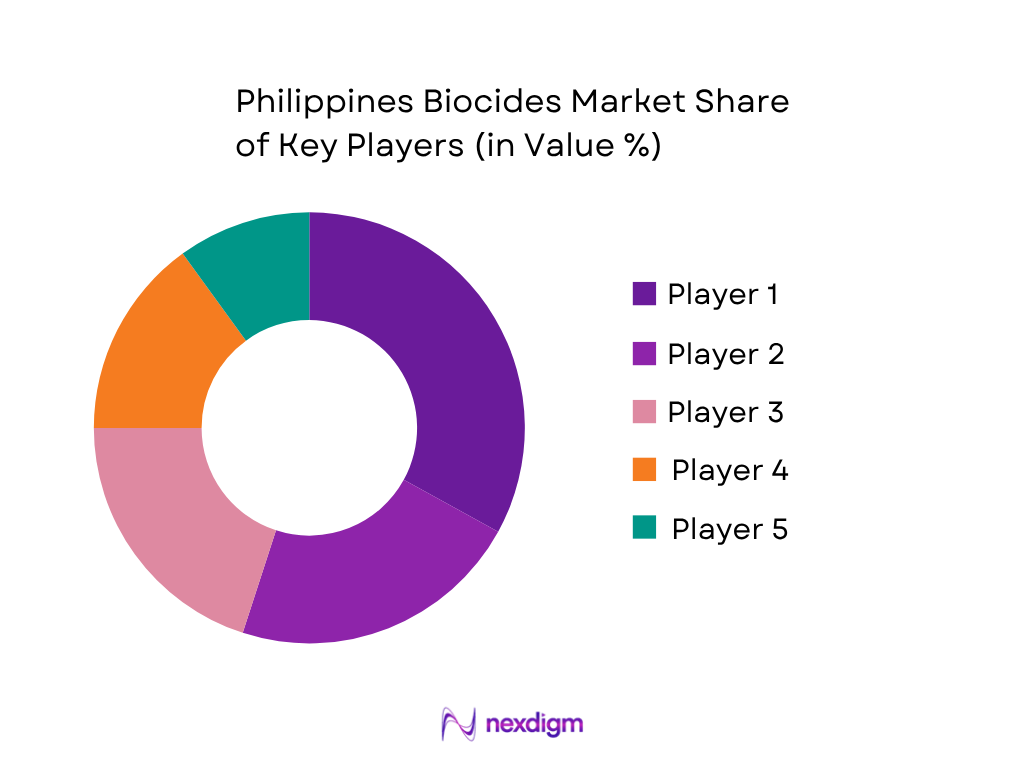
The Philippines Biocides Market is characterized by multinational specialty-chemical manufacturers, water-treatment companies, chemical distributors and regional formulators. Competition is concentrated around active-ingredient breadth, application expertise, regulatory registration, local distribution, technical service and supply reliability. The country’s expanding industrial base increases the addressable application pool: national GDP grew 5.7%, construction grew 10.2%, and Central Visayas grew 7.3%. (Philippine Statistics Authority) Aquaculture also provides a specialized microbial-control market, with 2.22 million metric tons of production.
| Company | Established | Headquarters | Active Ingredient Portfolio | Water Treatment Capability | Food & Institutional Hygiene | Industrial Biocides | Local/Regional Distribution | Regulatory Capability |
| LANXESS | 2004 | Cologne, Germany | ~ | ~ | ~ | ~ | ~ | ~ |
| Ecolab | 1923 | St. Paul, USA | ~ | ~ | ~ | ~ | ~ | ~ |
| BASF | 1865 | Ludwigshafen, Germany | ~ | ~ | ~ | ~ | ~ | ~ |
| Arxada | 2021 | Basel, Switzerland | ~ | ~ | ~ | ~ | ~ | ~ |
| Nouryon | 2018 | Amsterdam, Netherlands | ~ | ~ | ~ | ~ | ~ | ~ |
Philippines Biocides Market Analysis
Market Growth Drivers
Water and Wastewater Treatment Expansion
Expansion of water and wastewater infrastructure is a major demand driver for the Philippines Biocides Market because microbial control is required in water collection, treatment, distribution and industrial wastewater systems. The Philippine Statistics Authority recorded 1,259 formal-sector establishments engaged in water supply, sewerage, waste management and remediation activities, including 1,066 establishments in water collection, treatment and supply. The broader water-treatment ecosystem therefore provides recurring applications for oxidizing biocides, non-oxidizing biocides, algaecides and biofilm-control chemistries. Aquaculture adds another water-intensive demand base, with national aquaculture production reaching 2.22 million metric tons and fishery-product exports reaching 119.40 million kilograms. Agriculture also generated 19.09 million metric tons of palay and 8.14 million metric tons of corn, creating additional requirements for water hygiene and microbial management across agricultural and livestock systems. The Philippines’ GDP reached approximately USD 461.67 billion, indicating a substantial economic base supporting municipal infrastructure, manufacturing and commercial facilities. These indicators collectively strengthen demand for microbial-control products in potable-water systems, wastewater treatment, industrial process water, cooling systems, aquaculture ponds and food-processing facilities.
Industrial Water Demand and Food Processing Growth
Industrialization and food-processing activity create recurring microbial-control requirements across process water, cooling systems, production equipment and sanitation operations. Philippine GDP expanded by 5.7%, while construction activity increased by 10.2%, indicating continued expansion of physical production and built infrastructure that requires water-management systems. The country’s formal water, sewerage, waste-management and remediation sector contained 1,259 establishments, with 1,066 establishments specifically classified under water collection, treatment and supply. Food and agricultural production further broadens the application base: palay production reached 19.09 million metric tons, corn production reached 8.14 million metric tons, and aquaculture production reached 2.22 million metric tons. These production volumes support demand for disinfectants, preservatives, oxidizing biocides and non-oxidizing microbial-control products across food-processing plants, agricultural facilities, aquaculture operations and associated water systems. The Philippines also imported 106.41 million kilograms of products under HS 3808, a broad category covering insecticides, fungicides, herbicides, disinfectants and related preparations. This demonstrates the scale of chemical-product flows supporting agricultural, sanitation and microbial-control applications, although HS 3808 is broader than the biocides market itself.
Market Challenges
Imported Active Ingredient Dependency
Dependence on imported specialty chemicals represents a structural challenge for the Philippines Biocides Market because many advanced active ingredients and formulated microbial-control products enter through international supply chains. Philippines imports under HS 3808 reached 106.41 million kilograms in 2024, with an import value of USD 376.44 million. China supplied 50.06 million kilograms, Indonesia supplied 10.78 million kilograms, India supplied 7.97 million kilograms, Malaysia supplied 7.68 million kilograms, and South Korea supplied 7.83 million kilograms. These flows cover a broad product classification rather than biocides alone, but they demonstrate substantial reliance on overseas chemical supply. Retail disinfectant imports alone reached 6.65 million kilograms, valued at USD 21.79 million, with the United Kingdom, Malaysia, China, Spain and Thailand among the leading suppliers. For specialist biocides, this dependence can expose formulators and industrial users to shipping disruptions, customs delays, foreign manufacturing interruptions and active-ingredient availability constraints. Limited domestic specialty-chemical production also reduces the ability to rapidly substitute imported actives. Consequently, suppliers with regional inventory, multiple sourcing locations, local formulation capability and technical substitution expertise can be better positioned to maintain continuity for water treatment, food processing, aquaculture and industrial customers.
Regulatory Registration and Environmental Management Requirements
Regulatory compliance and environmental management create an important operational challenge for the Philippines Biocides Market because products can fall under different regulatory frameworks depending on their intended application. The formal water supply, sewerage, waste-management and remediation sector comprised 1,259 establishments, including 1,066 water collection, treatment and supply establishments, creating a large regulated operating environment in which chemical treatment must be compatible with water-quality requirements and discharge controls. Agricultural and animal-facility applications are additionally subject to pesticide and chemical-product requirements administered by government authorities. The Fertilizer and Pesticide Authority issued Memorandum Circular No. 2024-006, establishing provisional registration requirements covering pesticides, disinfectants and other agricultural chemicals used in animal facilities. Environmental considerations become particularly significant for aquaculture because national aquaculture production reached 2.22 million metric tons, meaning microbial-control products can interact directly with aquatic production environments. Retail disinfectant imports totaled 6.65 million kilograms, illustrating the substantial quantity of chemical products requiring appropriate regulatory oversight. Product manufacturers must therefore manage registration documentation, permitted applications, labeling, safe handling and environmental compatibility. These requirements can lengthen product-development cycles and increase compliance complexity, particularly for specialty formulations entering new Philippine applications.
Market Opportunities
Advanced Water-Treatment and Wastewater-Reuse Biocides
Advanced water-treatment applications provide an opportunity for the Philippines Biocides Market to move beyond conventional disinfection toward targeted biofilm, algae and membrane-fouling control. The formal water supply, sewerage, waste-management and remediation sector comprised 1,259 establishments, of which 1,066 were engaged in water collection, treatment and supply. This installed operating base creates applications for membrane-compatible biocides, cooling-water microbial control, wastewater-treatment chemistry and specialized biofilm-management products. Industrial and commercial demand is reinforced by economic activity, with Philippine GDP expanding by 5.7% and construction activity increasing by 10.2%. The country’s water-intensive agricultural and aquaculture systems provide additional opportunities: aquaculture production reached 2.22 million metric tons, while palay production reached 19.09 million metric tons and corn production reached 8.14 million metric tons. These activities require reliable water-quality management and create potential demand for microbial-control chemistry designed for specific operating environments. The opportunity is particularly relevant for low-residual formulations, membrane-compatible products, automated dosing systems and treatment programs designed around biofilm rather than only bulk microbial reduction. Such solutions can address increasingly differentiated requirements across municipal water, industrial process water, wastewater, aquaculture and food-processing applications while supporting more efficient chemical management.
Aquaculture Microbial Control and Specialized Formulation
Aquaculture represents a distinct opportunity for specialized biocide and microbial-control products because the Philippines produced 2.22 million metric tons of aquaculture output. Seaweed accounted for 65.5% of aquaculture production, brackish-water fishponds represented 12.6%, and freshwater fishponds represented 9.1%, creating multiple production environments with different microbial, biofouling and water-quality requirements. Fish and fishery-product exports reached 119.40 million kilograms, while imports amounted to 402.76 million kilograms, demonstrating the scale of the wider fisheries ecosystem. Specialized products can therefore target pond-water hygiene, hatchery sanitation, biofilm control, equipment disinfection and biofouling management rather than relying exclusively on broad-spectrum commodity chemistry. The opportunity also extends to food-processing sanitation because fisheries output eventually enters processing, storage and distribution systems where microbial control is critical. Imported chemical flows demonstrate an established supply base: Philippines imported 106.41 million kilograms under the broad HS 3808 classification, including disinfectants and related preparations. This creates room for local formulation, application-specific blends and technical-service models that adapt international active ingredients to Philippine aquaculture conditions. Suppliers able to combine regulatory compliance, aquatic-environment expertise, dosing guidance and local distribution can develop differentiated positions in this specialized demand segment.
Future Outlook
The Philippines Biocides Market is expected to benefit from the continued expansion of water treatment, food manufacturing, aquaculture, agriculture, healthcare and industrial production. Aquaculture alone generated 2.22 million metric tons of production, providing a significant specialized application base for microbial management. (Philippine Statistics Authority) The national economy expanded by 5.7%, while construction increased by 10.2%, supporting demand from industrial and built-environment applications. (Philippine Statistics Authority) Future demand is expected to move toward advanced wastewater biocides, aquaculture microbial-control products, low-residual formulations, biofilm-specific technologies, cooling-water treatment and locally formulated specialty products.
Major Players
- LANXESS
- Ecolab
- BASF
- Arxada
- Nouryon
- Dow
- Solenis
- Kemira
- Clariant
- Evonik Industries
- Veolia Water Technologies
- Buckman
- Italmatch Chemicals
- Troy Corporation
- Thor Group
Key Target Audience
- Biocides and specialty-chemical manufacturers
- Water-treatment and wastewater-treatment operators
- Food and beverage processing companies
- Aquaculture and fisheries operators
- Paints, coatings and construction-material manufacturers
- Investments and venture capitalist firms
- Government and regulatory bodies (Fertilizer and Pesticide Authority, Food and Drug Administration, Department of Environment and Natural Reources, Department of Agriculture, Department of Health)
- Oil and gas, healthcare, hospitality, agricultural and industrial manufacturing companies
Research Methodology
Step 1: Identification of Key Variables
The initial stage involves mapping the Philippines Biocides Market ecosystem across manufacturers, importers, formulators, distributors, water-treatment operators and industrial end users. Variables include active ingredient, formulation, application, microbial target, end-use industry, regulatory classification, import dependency and distribution structure. Aquaculture, food processing and industrial water treatment are separately identified because their microbial-control requirements differ.
Step 2: Market Analysis and Construction
The market model is constructed using product-level and application-level analysis across 6 major product categories and 12 principal application areas. Historical indicators covering water treatment, aquaculture, food manufacturing, industrial production and construction are used to establish the underlying demand environment. Import and company-level information is used to distinguish domestic formulation from imported finished products.
Step 3: Hypothesis Validation and Expert Consultation
Market hypotheses are validated through discussions with manufacturers, chemical distributors, water-treatment operators, food processors, aquaculture operators and industrial users. The consultation framework evaluates active-ingredient preferences, treatment frequency, microbial-control requirements, regulatory requirements, procurement criteria, supply reliability and substitution between oxidizing and non-oxidizing chemistries.
Step 4: Research Synthesis and Final Output
The final market model triangulates government statistics, regulatory information, company disclosures, trade data and industry-level indicators. The model is reconciled across product type, application and end-use industry to minimize double counting. Competitive benchmarking evaluates 8 parameters, including portfolio breadth, water-treatment capability, food-hygiene capability, industrial applications, regulatory expertise, technical support, distribution reach and sustainable-formulation capability.

- Executive Summary
- Research Methodology (Market Definition and Scope, Biocide Classification Framework, Active Ingredient Mapping, Market Sizing Methodology, Top-Down Assessment, Bottom-Up Assessment, Demand-Side Analysis, Supply-Side Analysis, Import-Export Assessment, End-Use Industry Mapping, Primary Industry Interviews, Regulatory Review, Data Triangulation, Forecasting Framework, Scenario Analysis, Assumptions, Limitations)

- Definition and Scope
- Philippines Biocides Industry Structure
- Biocidal Active Ingredient Ecosystem
- Biocide Formulation and Distribution Structure
- Evolution of Microbial-Control Applications
- Philippines Biocides Value Chain Analysis

- Market Growth Drivers (Water and Wastewater Treatment Expansion, Industrial Water Demand, Food Processing Growth, Aquaculture Production, Agricultural Activity, Manufacturing Expansion, Healthcare Hygiene Requirements, Paints and Coatings Consumption)
- Market Challenges (Imported Active Ingredient Dependency, Regulatory Registration Requirements, Environmental and Aquatic Toxicity, Biocide Resistance, Limited Specialty-Chemical Manufacturing, Hazardous Chemical Handling, Infrastructure Gaps, Product-Quality Variability)
- Market Opportunities (Advanced Water-Treatment Biocides, Wastewater-Reuse Applications, Aquaculture Microbial Control, Cooling-Tower Treatment, Food-Processing Sanitation, Oilfield Biocides, Low-Toxicity Formulations, Biofilm-Control Technologies, Local Formulation and Regional Distribution)
- Market Trends (Shift Toward Water-Efficient Treatment, Low-Residual Chemistry, Integrated Microbial Management, Biofilm-Specific Treatment, Sustainable Biocide Formulations, Automated Chemical Dosing, Advanced Disinfection Systems, Industrial Water Recycling, Specialty Formulation Localization)
- Regulatory and Chemical-Safety Landscape (Pesticide Registration, Disinfectant Registration, Agricultural Chemicals, Household/Urban Hazardous Substances, Product Licensing, Environmental Protection, Chemical Handling, Labeling)
- SWOT Analysis
- Porter’s Five Forces Analysis
- PESTLE Analysis

- By Market Value (2020-2025)
- By Biocidal Active Ingredient Consumption Volume (2020-2025)
- By Formulated Biocide Consumption Volume (2020-2025)
- By Application Consumption (2020-2025)
- By End-Use Industry Consumption (2020-2025)
- By Domestic Production and Imported Biocides (2020-2025)

- By Product Type (In Value %)
Oxidizing Biocides
Non-Oxidizing Biocides
Preservatives
Disinfectants and Sanitizers
Antimicrobial Additives
Biofilm-Control Agents
Algaecides
Fungicides
Other Specialty Biocides - By Active Ingredient (In Value %)
Chlorine-Based Biocides
Bromine-Based Biocides
Chlorine Dioxide
Glutaraldehyde
Isothiazolinones
Quaternary Ammonium Compounds
DBNPA
Bronopol
Copper-Based Biocides
Organic Acids
Other Active Ingredients - By Application (In Value %)
Water Treatment
Wastewater Treatment
Cooling-Water Treatment
Industrial and Institutional Cleaning
Paints and Coatings
Food and Beverage Processing
Personal Care and Cosmetics
Oil and Gas
Marine and Offshore
Metalworking Fluids
Wood Preservation
Agricultural and Animal-Housing Applications - By End-Use Industry (In Value %)
Water and Wastewater Utilities
Food and Beverage Manufacturing
Agriculture and Aquaculture
Oil and Gas and Petrochemicals
Paints and Coatings
Construction Materials
Pulp and Paper
Textiles
Marine and Shipbuilding
Personal Care and Household Products
Industrial Manufacturing - By Formulation Type (In Value %)
Liquid Biocides
Powder and Granular Biocides
Concentrated Formulations
Ready-to-Use Disinfectants
Water-Soluble Formulations
Controlled-Release Formulations - By Function (In Value %)
Bacterial Control
Fungal Control
Algae Control
Biofilm Control
Slime Control
Preservation
Disinfection
Membrane Protection
Microbiologically Influenced Corrosion Control

- Market Share of Major Players (By Value, Volume, Product Type, Active Ingredient, Application, End-Use Industry, Distribution Channel)
- Cross Comparison Parameters (Active Ingredient Portfolio Breadth, Water-Treatment Application Depth, Aquaculture Microbial-Control Capability, Food and Beverage Hygiene Expertise, Industrial Cooling-Water Capability, Regulatory Registration Capability, Local Distribution and Technical-Service Reach, Sustainable and Low-Residual Formulation Capability)
- SWOT Analysis Of Major Players
- Detailed Profiles of Major Companies
LANXESS
Ecolab
BASF
Arxada
Nouryon
Dow
Solenis
Kemira
Clariant
Evonik Industries
Veolia Water Technologies
Thor Group
Troy Corporation
Italmatch Chemicals
Buckman

- Industrial Water Treatment Demand Assessment
- Food and Beverage Customer Analysis
- Aquaculture Customer Analysis
- Agriculture and Animal-Housing Customer Analysis
- Oil and Gas Customer Analysis
- Paints and Coatings Customer Analysis
- Healthcare and Institutional Customer Analysis
- Marine Customer Analysis

- By Market Value (2026-2035)
- By Biocidal Active Ingredient Consumption Volume (2026-2035)
- By Formulated Biocide Consumption Volume (2026-2035)
- By Application Consumption (2026-2035)
- By End-Use Industry Consumption (2026-2035)
- By Domestic Production and Imported Biocides (2026-2035)


 Request a Sample
 Ask for Customization
 Get a Quote
 Enquire Now