

 Download PDF
Market Overview
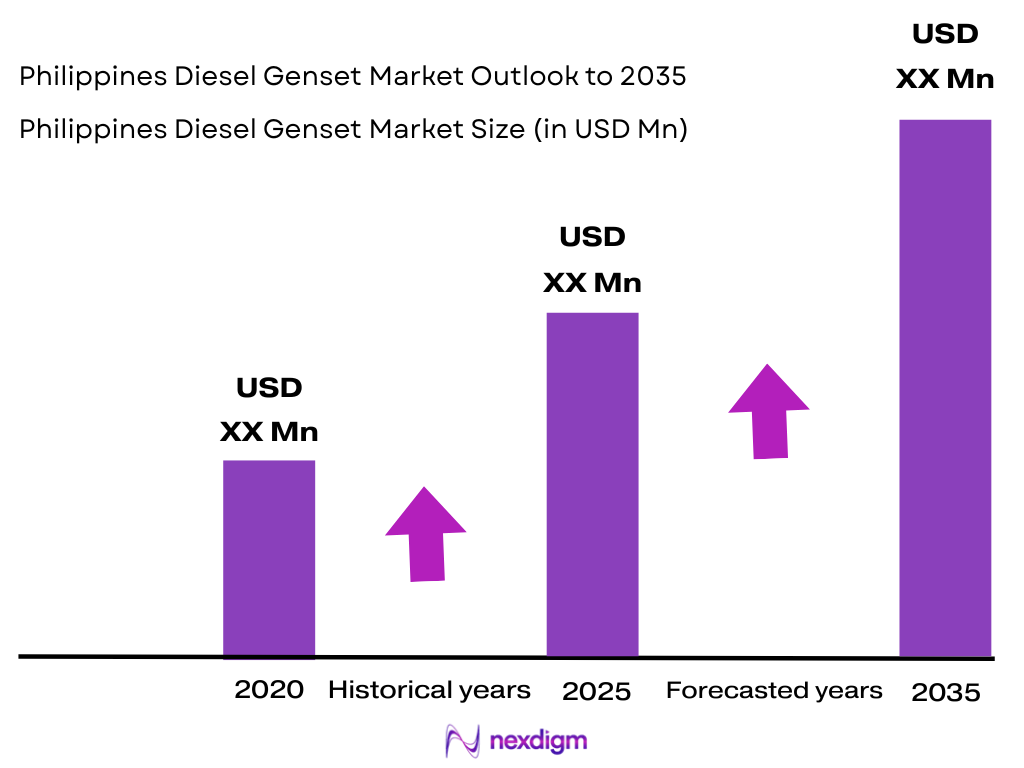
The Philippines Diesel Genset Market is valued at approximately USD ~ million, compared with USD ~ million in the preceding annual benchmark. Supporting demand strengthened as CAMPI-TMA vehicle sales increased from 429,807 units to 467,252 units, while registered motor vehicles expanded from 14.27 million to 14.56 million units. This enlarging vehicle ecosystem supports assembly plants, component factories, dealerships, workshops, logistics centers and fleet depots requiring standby power for production, HVAC, IT and safety systems. Laguna, Cavite, Batangas and Metro Manila dominate Philippines Diesel Genset Market demand because they combine manufacturing, industrial estates, dealerships, logistics operations and dense supplier networks. Philippine industry GVA increased from PHP 6.13 trillion to PHP 6.47 trillion, with Laguna, Cavite and Batangas remaining the country’s three largest provincial contributors to industrial GVA. This concentration supports higher genset penetration across assembly plants, electronics facilities, warehouses, component factories and service operations.
The Philippines Diesel Genset Market encompasses stationary and mobile diesel generator sets deployed specifically across vehicle manufacturing, component production, dealerships, service workshops, motorcycle facilities, commercial fleets, vehicle logistics centers, warehouses and pre-delivery inspection facilities. Demand is shaped by the interaction between an expanding ecosystem and power-continuity requirements across industrial and commercial facilities.
Market Segmentation
By Power Rating
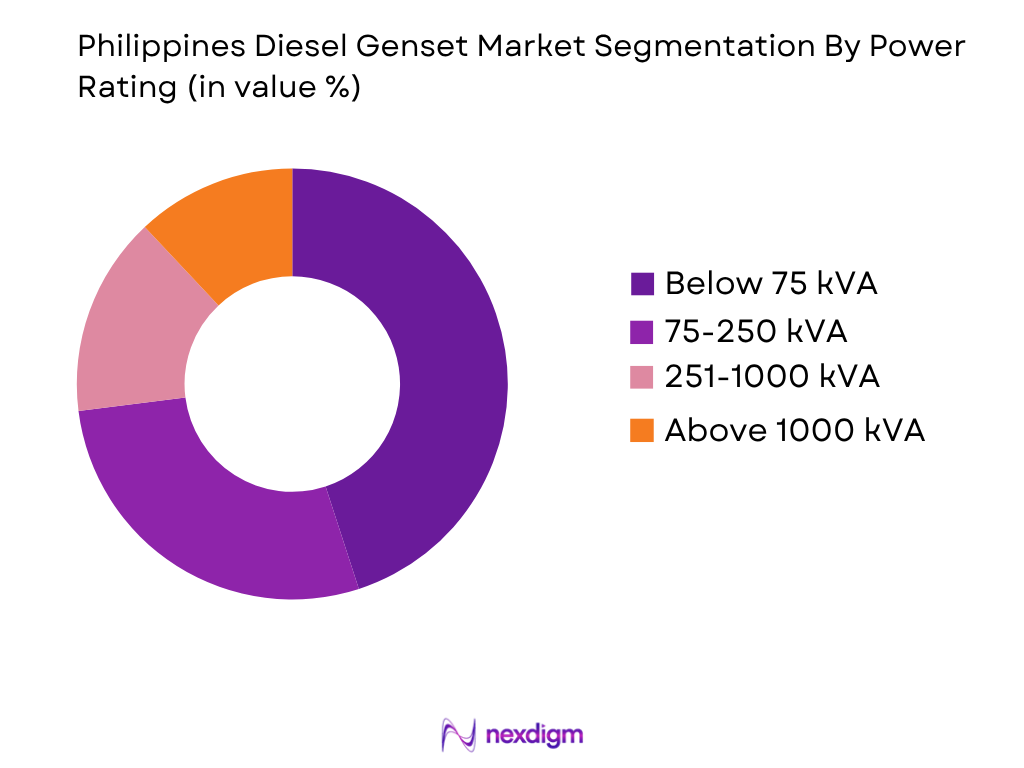
The Philippines Diesel Genset Market is segmented into below 75 kVA, 75–250 kVA, 251–500 kVA, 501–1,000 kVA and above 1,000 kVA. The 251–500 kVA segment holds the dominant analytical market share, reflecting the Philippines’ mix of component manufacturing plants, large dealerships, warehouses and medium-sized industrial facilities. This range provides sufficient backup capacity for compressors, production utilities, workshop equipment, HVAC, lighting and IT without requiring multi-megawatt infrastructure. Larger 501 kVA-plus systems remain important in assembly and electronics plants where production utilities and centralized safety systems require higher capacities. Cummins offers generator systems from 15 to 3,750 kVA, Caterpillar through Monark offers 8.8 to 4,000 kW, and Atlas Copco’s Philippine portfolio extends to 1,250 kVA, illustrating the broad equipment spectrum available for these applications.
By Facility Type
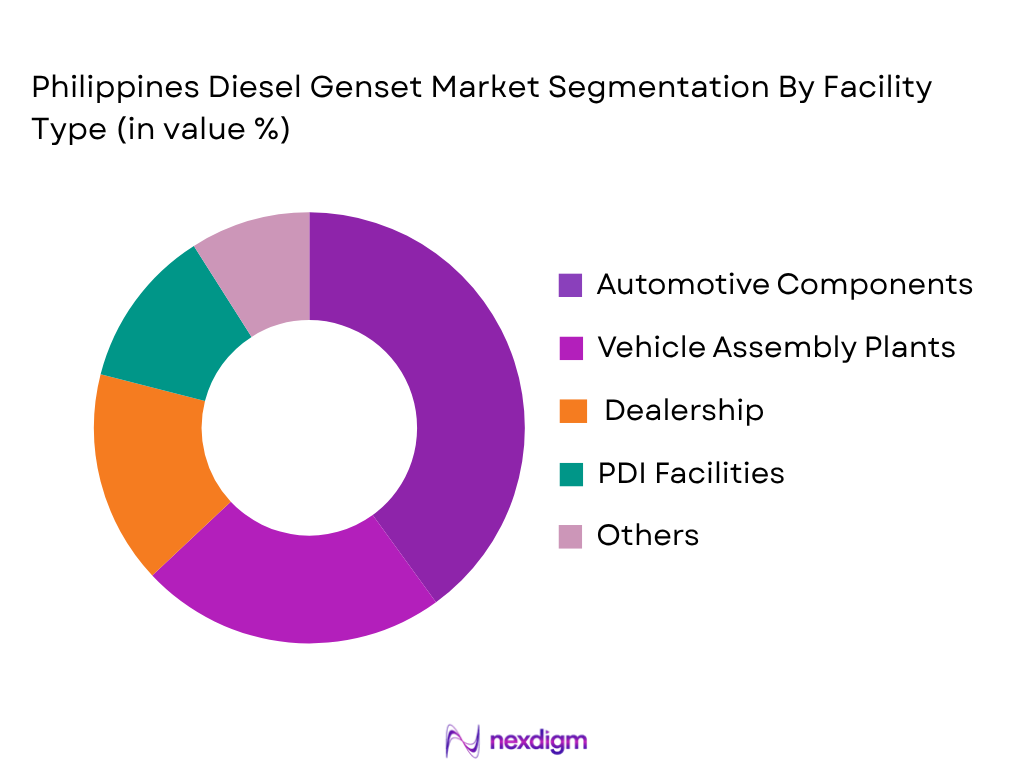
The Philippines Diesel Genset Market is segmented into vehicle assembly plants, component facilities, dealerships and workshops, logistics/PDI facilities, and fleet-maintenance depots. Component facilities hold the dominant analytical share because the domestic value chain extends into electrical components, wiring systems, plastics, rubber, machining, stamping and related manufacturing. BOI identifies manufacturing as a heterogeneous ecosystem containing both large global manufacturers and smaller local suppliers, while PEZA continues to approve expansions involving vehicle parts and components. Component plants are also heavily concentrated in Laguna, Cavite and Batangas, where industrial GVA is highest nationally. Vehicle assembly facilities require larger individual generator systems, but the broader number of supplier locations produces a more distributed installed base. Dealerships and workshops create additional demand for lower-capacity gensets serving service equipment, IT, ventilation and customer-facing operations.
Competitive Landscape
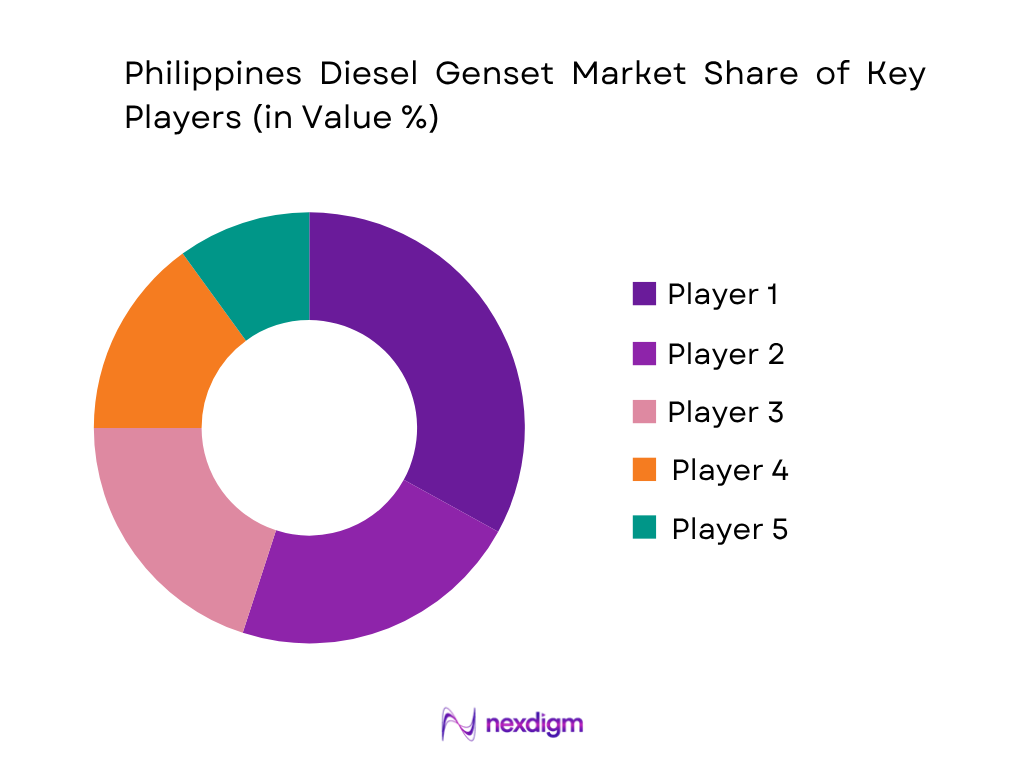
The Philippines Diesel Genset Market combines global generator manufacturers with Philippine distributors, industrial equipment dealers and specialist service organizations. Cummins has a sales-and-service operation located in Laguna International Industrial Park, Caterpillar is represented by Monark Equipment, Atlas Copco maintains a Philippine Power Technique operation in Laguna Technopark, Denyo operates through Kilton Motor Corporation, and Yanmar maintains a direct Philippine organization and dealer structure. Competition centers on generator range, standby reliability, spare-parts availability, service response, ATS integration, sound attenuation and capability to support customers inside CALABARZON.
| Major Player | Established | Headquarters | Power-Generation Position | Philippines Presence | Application Fit | Controls / Integration | Service & Parts Capability | Key Market Strength |
| Cummins Inc. | 1919 | Columbus, Indiana, USA | ~ | ~ | ~ | ~ | ~ | ~ |
| Caterpillar Inc. / Monark Equipment | 1925 | Irving, Texas, USA | ~ | ~ | ~ | ~ | ~ | ~ |
| Atlas Copco | 1873 | Stockholm, Sweden | ~ | ~ | ~ | ~ | ~ | ~ |
| Denyo Co., Ltd. | 1948 | Tokyo, Japan | ~ | ~ | ~ | ~ | ~ | ~ |
| Yanmar Holdings Co., Ltd. | 1912 | Osaka, Japan | ~ | ~ | ~ | ~ | ~ | ~ |
Philippines Diesel Genset Market Analysis
Growth Drivers
Expansion of Manufacturing and the CALABARZON Industrial Base
The Philippines Diesel Genset Market is being supported by the concentration of vehicle, component and related industrial activity in CALABARZON, particularly Laguna, Cavite and Batangas. The Philippine Statistics Authority reported that national Industry Gross Value Added reached PHP 6.47 trillion in 2024, increasing from PHP 6.13 trillion in 2023. Laguna alone accounted for industrial output equivalent to approximately PHP 641 billion when its reported contribution is applied to the national industry total, while Cavite and Batangas represented approximately PHP 382 billion and PHP 375 billion, respectively. These three provinces are important to genset suppliers because they accommodate vehicle manufacturing, electronics, wiring harnesses, machining, plastics, rubber products and logistics facilities. Power interruption at these facilities can affect assembly equipment, compressed-air systems, HVAC, paint operations, IT infrastructure, fire pumps and production controls, creating a structural requirement for standby diesel generation. The installed base is simultaneously expanding: the Philippine Statistics Authority reported 14.56 million registered motor vehicles in 2024, compared with 14.27 million in 2023, increasing downstream requirements for dealerships, service workshops, spare-parts warehouses and fleet-maintenance operations. Larger vehicle populations create additional infrastructure even where vehicles themselves do not directly consume genset capacity. This industrial expansion occurred within a supportive macroeconomic environment. World Bank data place Philippine nominal GDP at USD 461.62 billion in 2024 and GDP per capita at USD 3,984.8, while the International Monetary Fund recorded real GDP expansion of 5.7 units for every 100 units of output in 2024. For diesel-genset suppliers, the key demand implication is that industrialization is creating both concentrated high-capacity applications in CALABARZON and distributed medium-capacity opportunities among suppliers, dealerships and logistics facilities. Suppliers with inventories, technicians and emergency-response coverage around Laguna, Cavite and Batangas are particularly positioned to address factory standby systems, generator replacements, automatic transfer switches, synchronization panels and preventive-maintenance requirements.
EV Parts, Battery Manufacturing and Electrification of the Supply Chain
Electrification is widening the Philippines Diesel Genset Market from conventional vehicle and parts manufacturing into battery, electrical-component and power-electronics applications. The Philippine Economic Zone Authority reported PHP 56 billion in approved investments during 2024 from locator projects engaged in electric-vehicle parts and battery manufacturing, compared with only PHP 2.8 billion in the preceding benchmark. This is particularly relevant to diesel gensets because battery and EV-component facilities operate electricity-dependent production environments containing automated assembly machines, testing systems, air conditioning, ventilation, process-control equipment, IT infrastructure and safety systems. A power disruption affecting these systems can interrupt production or damage work-in-process, increasing the need for dependable emergency generation even as the sector becomes less dependent on petroleum for vehicle propulsion. The underlying ecosystem is also large enough to sustain supporting infrastructure. The Philippine Statistics Authority recorded 14.56 million registered motor vehicles in 2024, up from 14.27 million, which supports growing numbers of dealerships, parts distributors, warehouses, workshops and fleet facilities. Electrification increasingly adds high-voltage service bays, battery diagnostics, EV-specific tools and additional digital equipment to these sites, making reliable electricity more important rather than less important. Industrial activity provides a further demand foundation: Philippine Industry GVA reached PHP 6.47 trillion in 2024, with Laguna, Cavite and Batangas remaining the leading provincial industrial economies. This aligns EV investment with regions where genset distributors and industrial service providers can establish efficient coverage. Macroeconomic conditions were also supportive: World Bank data show Philippine GDP of USD 461.62 billion in 2024, while the IMF recorded economic growth of 5.7 units per 100 units of real output. The opportunity for diesel gensets consequently evolves rather than disappears under electrification. Diesel units increasingly serve as emergency layers supporting automated EV-component facilities, while batteries and UPS systems handle short-duration disturbances. Generator manufacturers capable of supplying digitally controlled standby systems, ATS equipment and synchronization solutions can therefore participate in an expanding electrical ecosystem despite the transition toward electric mobility.
Market Challenges
Expansion of Grid Capacity and Competition from Battery Energy Storage
One of the principal challenges for the Philippines Diesel Genset Market is the continuing expansion of national generating capacity and battery storage, which gradually reduces the justification for operating diesel gensets beyond genuine emergency conditions in major industrial zones. Department of Energy data show that grid-connected installed generating capacity reached 29,706 MW at the end of 2024, with dependable capacity of 26,087 MW. Luzon, where the majority of manufacturing facilities are located, accounted for 21,232 MW of installed capacity and 18,770 MW of dependable capacity. The system also contained 634 MW of energy-storage capacity, including 585 MW of battery energy storage, demonstrating that batteries have already entered the Philippine reliability architecture at meaningful scale. Installed capacity subsequently increased from 29,697 MW in October 2024 to 30,875 MW in April 2025, while dependable capacity increased from 25,876 MW to 27,050 MW over the same period. These additions strengthen industrial power availability and create competition for diesel gensets, particularly in short-duration backup applications. Facilities in well-served economic zones can increasingly evaluate batteries, UPS systems and improved utility infrastructure before adding or replacing conventional diesel equipment. The Department of Energy additionally reported total gross electricity generation of 126,941 GWh in 2024, compared with 118,004 GWh in 2023, illustrating the expansion of the electricity system supporting economic activity. For genset vendors, this changes the commercial proposition. Large vehicle factories and component plants may still require diesel units because battery systems can become impractical for prolonged high-load emergencies, but diesel generators must increasingly be positioned as long-duration resilience assets rather than routine power sources. Low annual utilization can itself create maintenance challenges involving starting batteries, fuel condition, coolant, injectors and insufficient engine loading. Macroeconomic conditions make customers more capable of evaluating alternatives: the World Bank recorded GDP of USD 461.62 billion in 2024, while the IMF reported 5.7 units of real economic growth for every 100 units of output. Vendors therefore need stronger capabilities in load-bank testing, automatic transfer, remote health monitoring and hybrid-system integration to defend diesel’s role within critical-power architecture.
Distributed Infrastructure and Increasing Service Complexity
The Philippines presents a challenging service environment for diesel-genset suppliers because demand extends from concentrated industrial factories in CALABARZON to dealerships, workshops, logistics facilities and fleet depots distributed across Luzon, Visayas and Mindanao. The Philippine Statistics Authority recorded 14.56 million registered vehicles in 2024, compared with 14.27 million in 2023, meaning the support ecosystem that genset vendors must serve is geographically broader than the manufacturing base alone. At the same time, grid conditions and generator requirements differ materially by region. Department of Energy data show 21,232 MW of installed grid-connected capacity in Luzon, compared with only 3,860 MW in the Visayas and 4,615 MW in Mindanao at the end of 2024. Dependable capacity stood at 18,770 MW, 3,296 MW and 4,020 MW, respectively. The Philippines also maintained 807 MW of off-grid installed generating capacity, of which only 626 MW was classified as dependable, reflecting the continued importance of dispersed and isolated electricity systems. For generator companies, this geography creates complexity in spare-parts stocking, field-service response, technician deployment and emergency rental availability. A supplier with strong operations around Laguna may serve large manufacturing customers efficiently but still struggle to provide equivalent response times to fleets or dealerships in Cebu, Davao or smaller provincial cities. Generator reliability therefore depends not only on engine quality but also on local access to filters, controllers, alternator components, starting batteries, ATS parts and trained technicians. Service complexity increases further as generator controls become digital and plants adopt synchronized multi-set installations or battery integration. The macroeconomic base remains substantial: World Bank data record Philippine GDP of USD 461.62 billion in 2024, GDP per capita of USD 3,984.8, and the IMF records real GDP growth of 5.7 units per 100 units. However, industrial activity is unevenly concentrated, with national Industry GVA of PHP 6.47 trillion led by Laguna, Cavite and Batangas. Suppliers consequently face a strategic trade-off between dense industrial service coverage and nationwide account coverage. Companies unable to maintain regional technicians, adequate inventories and remote diagnostic capabilities may lose customers to distributors that can provide faster lifecycle support.
Market Opportunities
Hybrid Diesel–Battery Systems, Digital Controls and Remote Monitoring
The increasing sophistication of the Philippine electricity system creates a forward growth opportunity for diesel-genset suppliers that can combine generators with battery storage and digital controls. Department of Energy data show that the Philippines already had 634 MW of grid-connected energy-storage capacity at the end of 2024, including 585 MW of battery systems, while total installed generation stood at 29,706 MW. The system produced 126,941 GWh of electricity in 2024, compared with 118,004 GWh in the preceding benchmark, showing rising electricity requirements alongside expanding infrastructure. These current conditions establish a technical foundation for hybrid critical-power architecture within facilities. Instead of configuring a diesel generator to handle every transient interruption and low-load condition, battery storage can provide immediate ride-through while a genset starts only when prolonged backup is required. This is particularly valuable for electronics, battery facilities, automated assembly plants and component manufacturers where sensitive equipment may not tolerate transfer interruptions. Remote monitoring represents an additional opportunity because standby generators can operate only occasionally but must remain immediately available. Connected controllers can continuously monitor starting-battery voltage, fuel levels, coolant temperature, engine alarms, exercise schedules, operating hours and automatic-transfer-switch status. The expanding base supports such lifecycle services: the Philippines had 14.56 million registered motor vehicles in 2024, while industrial GVA reached PHP 6.47 trillion. PEZA’s PHP 56 billion of approved EV-parts and battery investments further demonstrates a growing customer pool of electrically sophisticated facilities. World Bank data place national GDP at USD 461.62 billion in 2024, and the IMF recorded 5.7 units of real GDP growth per 100 units, supporting capital investment in industrial resilience. The future opportunity is therefore not simply to sell additional diesel engines. Vendors can increase the value of each account through ATS systems, paralleling switchgear, batteries, digital controllers, remote dashboards, preventive-maintenance agreements and load-bank testing. This approach allows diesel generators to remain relevant as long-duration emergency assets while battery technology handles shorter and more frequent electrical disturbances.
CALABARZON Replacement Demand and Expansion of Lifecycle Services
A significant future opportunity in the Philippines Diesel Genset Market lies in monetizing the existing industrial base through generator replacement, modernization and lifecycle services rather than depending exclusively on greenfield vehicle plants. Philippine Statistics Authority data show that national Industry GVA increased from PHP 6.13 trillion in 2023 to PHP 6.47 trillion in 2024, with Laguna, Cavite and Batangas remaining the three largest provincial contributors. This concentration means a substantial volume of manufacturing assets, warehouses, electrical rooms and backup-power equipment is located within a relatively compact industrial corridor. Existing gensets eventually require replacement or modernization because engines accumulate operating and exercise hours, controllers become obsolete, ATS systems age, alternators require servicing and original spare-parts support can weaken. The opportunity is reinforced by the customer base: registered vehicles reached 14.56 million in 2024, creating continuing demand for dealerships, repair centers, logistics hubs, fleet depots and parts warehouses that also maintain distributed backup systems. PEZA’s approval of PHP 56 billion in EV-parts and battery investments in 2024 adds a new generation of industrial customers that can subsequently require long-term generator servicing and replacement. The power environment also favors lifecycle services. The Department of Energy reported 29,706 MW of installed grid-connected capacity and 26,087 MW of dependable capacity, meaning industrial facilities may use generators relatively infrequently during normal operations. Low-runtime units nevertheless require rigorous maintenance because a failed starting battery, deteriorated diesel fuel, clogged radiator or faulty ATS can render the entire standby system ineffective during an outage. Generator vendors can therefore build recurring revenue around scheduled preventive maintenance, fuel-system inspection, coolant servicing, load-bank testing, engine overhaul, controller modernization, remote monitoring and temporary rental units during major repairs. The country’s macroeconomic fundamentals support this asset-maintenance model: World Bank data place Philippine GDP at USD 461.62 billion in 2024, while the IMF reports 5.7 units of growth per 100 units of output. The most attractive strategy is consequently to establish dense service coverage in Laguna, Cavite and Batangas, secure long-duration maintenance agreements with OEMs and Tier suppliers, and then use regional branches or remote diagnostics to extend the same model to Metro Manila, Central Luzon, Cebu and Mindanao.
Future Outlook
The Philippines Diesel Genset Market is expected to expand at approximately ~ CAGR during 2026–2035. Growth is likely to be supported by component investment, continued vehicle demand, generator replacement, expansion of industrial parks and increasing requirements for resilient manufacturing infrastructure. CALABARZON should remain the principal opportunity center. Philippine Statistics Authority data identify Laguna, Cavite and Batangas as the country’s three leading provincial contributors to industrial GVA, while generator suppliers such as Cummins and Atlas Copco maintain operations inside Laguna industrial estates. This combination of customer concentration and service accessibility makes the region particularly favorable for generator sales and aftermarket services. Electrification will broaden rather than eliminate critical-power requirements. PEZA’s substantial EV-parts and battery investment approvals demonstrate that manufacturing is moving toward more electrically intensive components. Battery and power-electronics facilities may require reliable HVAC, automation, testing systems and process controls that increase the importance of contingency electricity.
Major Players
- Cummins Inc. / Cummins Philippines
- Caterpillar Inc. / Monark Equipment
- FG Wilson
- Atlas Copco Philippines
- Denyo Co., Ltd. / Kilton Motor Corporation
- Yanmar Holdings Co., Ltd. / Yanmar Philippines
- Mitsubishi Heavy Industries Engine & Turbocharger
- Rolls-Royce Power Systems – mtu
- Rehlko
- HIMOINSA
- Doosan Bobcat
- Baudouin
- Perkins-Powered Generator Assemblers
- Multico Prime Power
- Powercity Corporation
Key Target Audience
- OEM and Vehicle Assembly Manufacturers
- Tier-1, Tier-2 and Tier-3 Component Manufacturers
- Dealership and Workshop Groups
- Vehicle Logistics, PDI and Spare Parts Distribution Operators
- Diesel Generator Manufacturers, Distributors and Rental Power Providers
- EPC, Electrical and Industrial Power-System Companies
- Investments and Venture Capitalist Firms
- Government and Regulatory Bodies (Department of Trade and Industry, Board of Investments, Philippine Economic Zone Authority, Department of Energy, Department of Environment and Natural Resources, Energy Regulatory Commission and Department of Transportation)
Research Methodology
Step 1: Identification of Key Variables
The initial phase constructs a complete ecosystem map for the Philippines Diesel Genset Market, covering generator OEMs, distributors, vehicle assemblers, component manufacturers, dealerships, fleet operators, rental companies and economic-zone developers. Critical variables include genset rating, facility type, installed capacity, grid exposure, replacement age, procurement channel and maintenance requirements. Secondary research uses official industrial, economic-zone and electricity information together with generator-manufacturer product data. The objective is to identify every variable influencing unit demand and installed kVA.
Step 2: Market Analysis and Construction
The top-down methodology evaluates the Philippine industrial diesel-genset ecosystem and then isolates demand attributable to manufacturing, parts production, workshops, fleets and logistics. The bottom-up approach maps facilities across Laguna, Cavite, Batangas, Metro Manila and other industrial centers. Typical generator configurations are assigned according to facility scale, critical load and backup requirements. New installations, replacement units, rental deployments and aftermarket revenues are treated separately to minimize double counting.
Step 3: Hypothesis Validation and Expert Consultation
Market assumptions are validated through computer-assisted telephone interviews with generator distributors, plant engineers, Tier suppliers, workshop operators, EPC contractors, fleet managers and power-service companies. Discussions assess generator ratings, operating modes, outage experience, replacement periods, maintenance frequency, purchasing criteria and vendor selection. Supplier-side information is cross-checked against end-user and contractor responses. This process validates market shares, installed-base assumptions, service requirements and differences between large manufacturing facilities and distributed service locations.
Step 4: Research Synthesis and Final Output
Primary findings are triangulated with PSA, BOI, PEZA, DOE and industry data to construct the final market model. The analysis produces market value, unit shipments, installed kVA and segmentation by generator rating, facility type and geography. Forecasting incorporates activity, industrial investment, economic-zone expansion, generator replacement, power-reliability conditions and BESS adoption. Multiple scenarios are used to assess how improved grid reliability or accelerated industrialization could change diesel-genset demand.

- Executive Summary
- Research Methodology (Market Definitions and Assumptions, Diesel Genset Market Boundary, Abbreviations, Top-Down Market Sizing, Bottom-Up Facility Mapping, Vehicle Assembly Plant Mapping, Supplier Mapping, Generator Import Assessment, Distributor Shipment Assessment, Installed-Base Estimation, Replacement-Cycle Analysis, Demand-Side Assessment, Supply-Side Assessment, Primary Industry Interviews, Generator Distributor Interviews, Facility Interviews, Rental Fleet Assessment, Pricing Benchmarking, Data Triangulation, Forecasting Framework, Scenario Analysis, Limitations and Future Conclusions)

- Definition and Scope
- Market Evolution and Industry Genesis
- Evolution of Manufacturing and Assembly
- Philippines Manufacturing Ecosystem
- Passenger Vehicle Assembly Ecosystem

- Growth Drivers (Manufacturing Expansion, Component Localization, Power Reliability Requirements, Industrial Zone Growth, Dealership Expansion, Fleet Growth, Generator Replacement)
- Market Challenges (Diesel Fuel Dependence, Emissions Compliance, Generator CAPEX, Maintenance Complexity, Skilled Technicians, BESS Competition, Import Dependence)
- Market Opportunities (Replacement Market, CALABARZON Expansion, EV Manufacturing, Hybrid Systems, Remote Monitoring, Rental Power, AMC, Local Assembly)
- Market Trends (IoT Monitoring, Digital Controls, Hybridization, Silent Gensets, Modular Paralleling, Predictive Maintenance, Automated Transfer)
- SWOT Analysis
- Porter’s Five Forces Analysis
- PESTLE Analysis

- By Market Value (2020-2025)
- By Unit Shipments (2020-2025)
- By Installed Diesel Genset Base (2020-2025)

- By Power Rating (In Value %)
Below 75 kVA
75–250 kVA
251–500 kVA
501–1,000 kVA
Above 1,000 kVA - By Facility Type (In Value %)
Passenger Vehicle Assembly Plants
Commercial Vehicle Assembly Plants
Motorcycle Manufacturing Plants
Tier-1 Component Plants - By Ecosystem (In Value %)
Passenger Vehicle Manufacturing
Commercial Vehicle Manufacturing
Motorcycle Manufacturing
Component Manufacturing
Electric Vehicle and Battery Operation - By Region (In Value %)
Metro Manila
CALABARZON
Central Luzon
Central Visayas
Davao Region

- Market Share of Major Players by Market Value
- Cross Comparison Parameters (Diesel Genset kVA Portfolio Coverage, Philippines Installed References, CALABARZON Dealer and Field-Service Coverage, Spare Parts Inventory and Engine-Overhaul Capability, Silent and Weather-Protected Package Capability, ATS–Synchronization–Remote Monitoring Integration, Generator Fuel-Efficiency and Load-Acceptance Performance, AMC and Emergency Response Capability)
- SWOT Analysis of Major Players
- Detailed Profiles of Major Companies
Cummins Inc. / Cummins Philippines
Caterpillar Inc. / Monark Equipment
FG Wilson
Atlas Copco Philippines
Denyo Co., Ltd.
Yanmar Holdings Co., Ltd.
Mitsubishi Heavy Industries Engine & Turbocharger
Rolls-Royce Power Systems – mtu
Rehlko
HIMOINSA
Doosan Bobcat
Baudouin
Perkins-Powered Generator Assemblers
Multico Prime Power
Powercity Corporation

- Installed Genset Fleet Assessment
- Average Genset Capacity by Facility
- Average Genset Count per Facility
- Generator Age Profile
- Annual Operating Hours

- By Market Value (2026-2035)
- By Unit Shipments (2026-2035)
- By Installed Genset Base (2026-2035)


 Request a Sample
 Ask for Customization
 Get a Quote
 Enquire Now