

 Download PDF
Market Overview
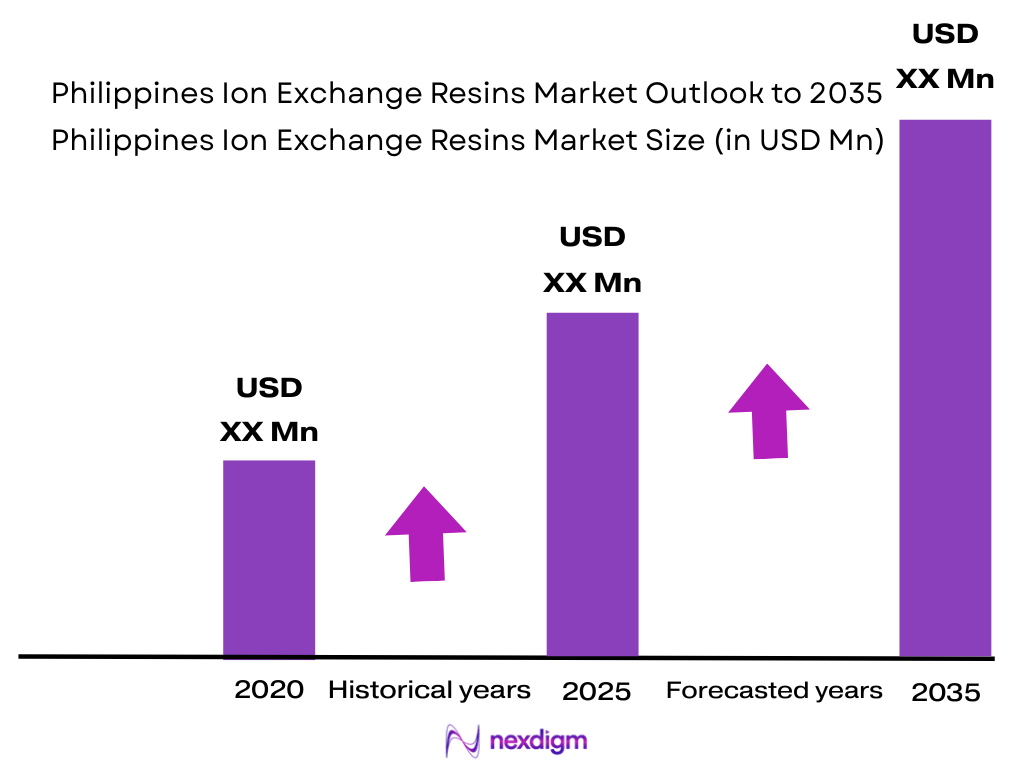
The Philippines Ion Exchange Resins Market is valued at approximately USD ~XX million, with the forecast period expected to register a CAGR of ~X.X%. For market-grounding purposes, World Bank WITS/UN Comtrade records show Philippine imports under HS 391400 at USD 6.72 million and 1.744 million kg, while published industry research reports import-market growth of 2.63% from the preceding period. Demand is supported by industrial water treatment, electronics, power, food processing, pharmaceuticals, and wastewater purification.
CALABARZON—particularly Laguna, Cavite and Batangas—along with Metro Manila and Central Luzon represents a critical demand belt because of concentrated electronics, semiconductor, manufacturing, utility and industrial-water infrastructure. The country’s electronics industry recorded USD 45.65 billion in exports in the preceding comparable period and USD 42.74 billion subsequently, illustrating the scale of a manufacturing ecosystem requiring high-purity process water. China, New Zealand, South Korea, Japan and India are meanwhile important resin supply origins.
Market Segmentation
By Resin Type
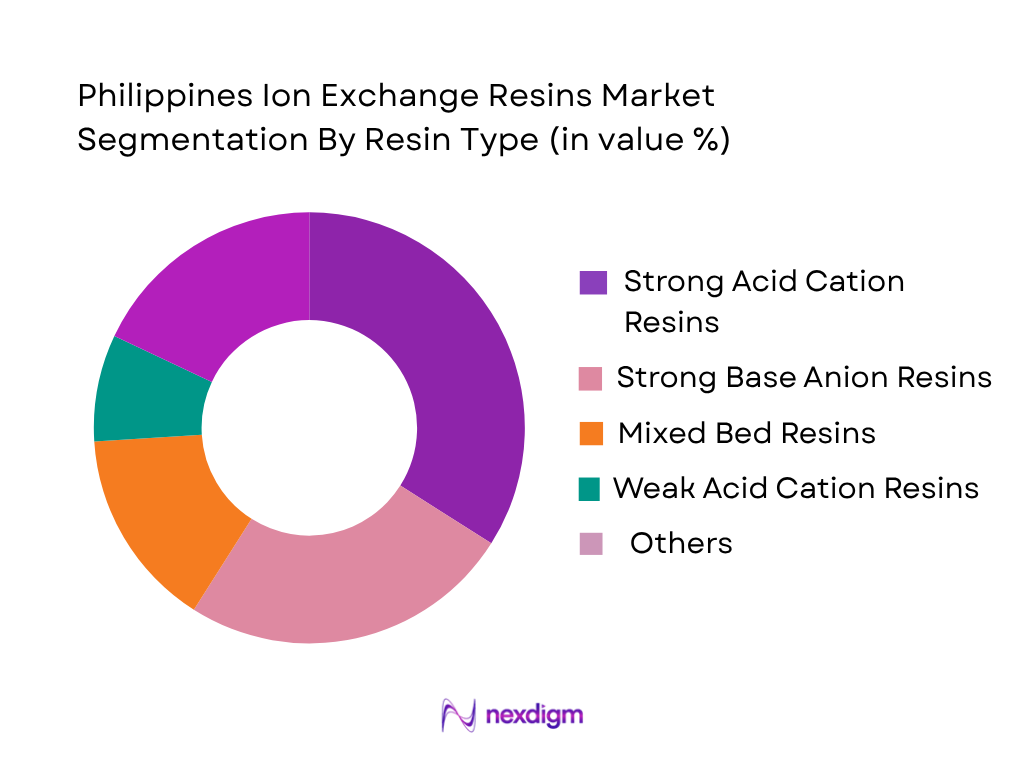
The Philippines Ion Exchange Resins Market is segmented by resin type into Strong Acid Cation Resins, Weak Acid Cation Resins, Strong Base Anion Resins, Weak Base Anion Resins, Mixed Bed Resins, Chelating Resins, and Specialty and Selective Resins. Strong Acid Cation Resins hold the dominant market share due to their extensive use in water softening, boiler feedwater treatment, demineralization, and industrial process-water systems. These resins are widely deployed across power plants, food and beverage facilities, electronics manufacturing plants, commercial establishments, and industrial water treatment installations. Their ability to remove calcium, magnesium, sodium, and other positively charged ions makes them a fundamental component of conventional ion exchange systems. Recurring resin replacement caused by fouling, oxidation, bead breakage, and declining exchange capacity further supports demand. Their relatively broad application base compared with specialized resin categories strengthens their leading position in the Philippines market.
By Application
The Philippines Ion Exchange Resins Market is segmented by application into Water Softening, Demineralization and Deionization, Ultrapure Water Production, Condensate Polishing, Wastewater Treatment and Water Reuse, Food and Beverage Purification, and Pharmaceutical, Chemical and Metal Separation Applications. Demineralization and Deionization hold the dominant market share due to their widespread application across industrial plants requiring low-conductivity process water and boiler feedwater. Manufacturing facilities use combinations of cation and anion exchange resins to remove dissolved ionic contaminants and produce purified water suitable for industrial operations. The segment is supported by power generation, electronics, food processing, pharmaceuticals, chemicals, and other manufacturing industries. Ion exchange systems are also frequently integrated with reverse osmosis systems to achieve higher water purity, increasing resin demand for final polishing. Replacement requirements from existing demineralization installations additionally create a recurring consumption base.

Competitive Landscape
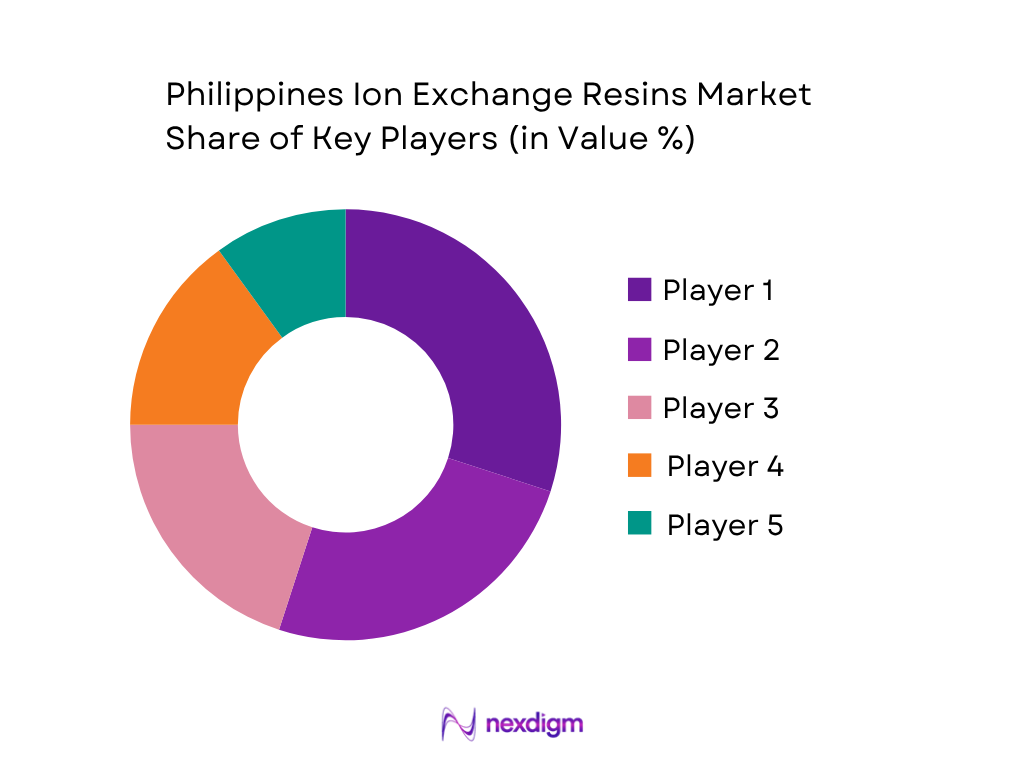
The Philippines Ion Exchange Resins Market is characterized by international resin manufacturers competing through imported products, local distributors, water-treatment OEMs and EPC partners. Competition differs significantly between commodity softening resins and premium products for ultrapure water, pharmaceuticals, condensate polishing and selective separation. Global suppliers with established resin technologies compete on exchange capacity, bead uniformity, chemical efficiency, resin lifetime, purity and application engineering, while Asian suppliers exert stronger pricing pressure in commodity applications. Global industry evidence also indicates continuing competition between established multinational producers and expanding Asian manufacturers.
| Company | Established | Headquarters | Major Resin Brand | Core Resin Portfolio | High-Purity/UPW Capability | Key Applications | Technology Positioning | Philippines/Asia Supply Position |
| DuPont | 1802 | Wilmington, USA | ~ | ~ | ~ | ~ | ~ | ~ |
| Purolite, an Ecolab Company | 1981 | Pennsylvania, USA | ~ | ~ | ~ | ~ | ~ | ~ |
| LANXESS | 2004 | Cologne, Germany | ~ | ~ | ~ | ~ | ~ | ~ |
| Mitsubishi Chemical Group | 1933* | Tokyo, Japan | ~ | ~ | ~ | ~ | ~ | ~ |
| Thermax | 1966 | Pune, India | ~ | ~ | ~ | ~ | ~ | ~ |
Philippines Ion Exchange Resins Market Analysis
Growth Drivers
Expansion of Electronics, Semiconductor and High-Purity Manufacturing
The Philippines Ion Exchange Resins Market is supported by the scale of the country’s electronics and semiconductor manufacturing ecosystem, where demineralized and ultrapure water are required for wafer-related processes, component cleaning, rinsing, plating and other contamination-sensitive operations. Philippine Statistics Authority data show that electronic products generated USD 39.09 billion in merchandise exports in 2024, while imports of electronic products reached USD 27.38 billion, demonstrating substantial two-way activity in electronics manufacturing and supply chains. PEZA approved 255 new and expansion projects during 2024, including 122 export-manufacturing projects, with these approved projects expected to generate more than 72,000 direct jobs. PEZA also reported 83 registered Taiwanese enterprises as of September 2024, supporting approximately 27,000 direct jobs, with many of these companies engaged in electronics, semiconductors and associated manufacturing. This industrial concentration directly supports consumption of strong acid cation, strong base anion, mixed-bed and high-purity polishing resins used in process-water systems. Larger electronics production footprints also increase the installed base of reverse-osmosis, demineralization and polishing systems requiring periodic resin replacement and performance maintenance.
Expansion of Industrial Water Treatment and Ecozone Infrastructure
Industrial expansion and investment in water-related infrastructure provide another structural demand driver for the Philippines Ion Exchange Resins Market. The Board of Investments recorded PHP 1.62 trillion in approved investments during 2024, including PHP 31.67 billion directed toward manufacturing and PHP 16.28 billion toward water supply, sewerage, waste management and remediation activities. These projects enlarge the potential installed base for water softening, boiler-water demineralization, process-water purification and wastewater treatment systems where ion exchange resins are regularly deployed. The Philippine Statistics Authority subsequently identified 1,259 formal establishments engaged in water supply, sewerage, waste management and remediation activities for the 2024 reference period, of which 1,066 establishments were specifically involved in water collection, treatment and supply. Industrial development is also geographically aligned with major resin-consuming areas: PEZA’s November 2024 approvals included projects in 4 locations in Batangas, 4 in Laguna, 4 in Cebu, 2 in Cavite, and facilities in Rizal, Pampanga and Negros Oriental. This continued buildup of manufacturing and utility infrastructure increases requirements for fresh resin loading, bed replacement and specialized industrial-water treatment.
Market Challenges
Heavy Dependence on Imported Ion Exchange Resin Supply
Import dependence remains a significant challenge for the Philippines Ion Exchange Resins Market because industrial users rely extensively on overseas resin manufacturing rather than a large domestic production base. World Bank WITS trade records show that the Philippines imported exactly 1,744,050 kilograms of polymer-based ion exchangers under HS 391400 in 2024. China alone supplied 1,357,340 kilograms, while other reported sources included 103,916 kilograms from India, 103,329 kilograms from South Korea, 51,158 kilograms from New Zealand and 24,402 kilograms from Japan. This sourcing structure exposes Philippine distributors, EPC contractors and industrial plants to international freight availability, customs processing, supplier production schedules and inventory-planning requirements. The exposure is especially relevant for semiconductor-grade mixed beds, specialty chelating resins and other application-specific products that cannot necessarily be substituted immediately when qualified material is unavailable. The broader Philippine merchandise system also handled USD 127.60 billion of imported goods during 2024, illustrating the scale of import-dependent industrial supply chains competing for logistics capacity. For ion exchange resin buyers, maintaining adequate local inventories and qualifying multiple overseas suppliers therefore becomes strategically important for minimizing treatment-system downtime.
Stringent Wastewater Compliance and Regeneration Management Requirements
Environmental compliance creates an operational challenge for the Philippines Ion Exchange Resins Market because resin-based treatment systems can require acids, alkalis or salt during regeneration and subsequently generate regenerant wastewater that must be managed within national discharge requirements. The issue is particularly material in CALABARZON, one of the Philippines’ most concentrated industrial and manufacturing regions. The Environmental Management Bureau reported 3,438 industries applying for Wastewater Discharge Permits through its Online Permitting and Monitoring System during 2024 in CALABARZON alone. Separate regional permitting records show 240 wastewater discharge permits issued, consisting of 96 new permits and 144 renewals, including 95 permits in Cavite, 105 in Batangas and 40 in Quezon. These figures demonstrate the scale of regulated wastewater-generating operations operating within major industrial territories where ion exchange equipment is commonly integrated into boiler-water, process-water, wastewater-reuse and polishing systems. Resin users must consequently manage not only ionic removal performance but also chemical storage, regeneration sequencing, rinse-water consumption and disposal of spent regenerant streams. For suppliers, this raises the technical-support requirement and increases the importance of resins capable of sustaining longer operating cycles and efficient regeneration under Philippine industrial conditions.
Market Opportunities
High-Purity Resin Opportunity from Continuing Ecozone Manufacturing Expansion
The Philippines Ion Exchange Resins Market has a strong opportunity to move toward higher-purity and application-specific resin grades as new electronics and advanced manufacturing facilities enter the economic-zone ecosystem. PEZA approved 255 projects during 2024, comprising 122 export-manufacturing projects, 65 IT-BPM projects, 27 ecozone-development projects, 18 facilities-development projects, 12 domestic-market projects, 9 logistics projects and 2 utility projects. The approved portfolio was associated with more than 72,000 planned direct jobs and more than USD 4.656 billion in projected exports. Momentum continued into 2025, when PEZA reported 150 newly approved and expansion projects through July, associated with 35,874 direct jobs and USD 2.003 billion in projected export activity. These current indicators provide a tangible pipeline of industrial activity that can require progressively more sophisticated water treatment. Electronics, semiconductor devices and other precision manufacturing facilities typically require deionization and final polishing after membrane treatment, creating room for mixed-bed, uniform-particle-size, low-leachable and high-purity cation and anion products. Resin suppliers able to support product qualification, technical troubleshooting and reliable local inventories are positioned to capture this developing premium application base.
Water Reuse, Wastewater Treatment and Specialty Resin Applications
Industrial wastewater management represents a major future-oriented opportunity for the Philippines Ion Exchange Resins Market because the country already has a substantial formal water-treatment ecosystem and a large regulated industrial discharge base. Philippine Statistics Authority data for the 2024 reference period identified 1,259 establishments engaged in water supply, sewerage, waste management and remediation activities, including 1,066 establishments dedicated to water collection, treatment and supply, 64 establishments in materials recovery and 24 establishments in waste treatment and disposal. At the investment level, the Board of Investments approved PHP 16.28 billion for water supply, sewerage, waste management and remediation activities during 2024. CALABARZON’s Environmental Management Bureau simultaneously recorded 3,438 industrial applications for wastewater discharge permits, highlighting the concentration of treatment obligations within a major manufacturing corridor. These current indicators create an addressable application environment for ion exchange beyond conventional softening, particularly in polishing treated wastewater, removing heavy metals, recovering selected ions and supporting industrial-water recycling. Chelating and selective resins can therefore gain relevance as manufacturers pursue higher water recovery, contaminant control and process-water reuse alongside membrane-based treatment systems
Future Outlook
The Philippines Ion Exchange Resins Market is projected to expand at a CAGR of approximately ~X.X% during the forecast period, supported by industrial water-treatment investment, electronics manufacturing, high-purity process-water requirements and stricter wastewater management. Growth is expected to shift progressively toward higher-value resins rather than being driven exclusively by commodity softening products.The electronics and semiconductor industry represents an important long-term opportunity. Electronics exports remain a major component of Philippine merchandise trade: Philippine Statistics Authority data recorded electronic-product exports of USD 39.09 billion, while SEIPI’s broader electronics-industry classification reported USD 42.74 billion. This manufacturing base supports requirements for ultrapure-water polishing, mixed-bed systems and low-leachable resins.
Another structural opportunity is industrial water reuse. Ion exchange systems can complement reverse osmosis and electrodeionization where extremely low ionic contamination is required. Premium resin suppliers are consequently expected to compete increasingly on operating capacity, bead integrity, regeneration efficiency, TOC release, pressure drop and resin lifetime rather than only initial purchase price.Import dependency will remain an important market characteristic. WITS data show that the Philippines imported 1.744 million kg of HS 391400 ion-exchange materials worth USD 6.72 million, with China supplying 1.357 million kg, followed by significant supplies from New Zealand, South Korea, Japan and India. This structure creates opportunities for distributors maintaining domestic inventories and providing technical support, rapid replacement and application engineering.
Major Players
- DuPont de Nemours, Inc. – AmberLite™ / AmberTec™
- Ecolab Inc. / Purolite – Purolite™
- LANXESS AG – Lewatit™
- Mitsubishi Chemical Group Corporation – DIAION™
- Samyang Corporation – TRILITE™
- Thermax Limited – Tulsion™
- Ion Exchange (India) Limited – INDION™
- Sunresin New Materials Co., Ltd. – SEPLITE™
- ResinTech, Inc.
- Jacobi Carbons Group / Jacobi Resins – Resinex™
- Jiangsu Suqing Water Treatment Engineering Group
- Anhui Sanxing Resin Technology Co., Ltd.
- Pure Resin Co., Ltd.
- Zhejiang Zhengguang Industrial Co., Ltd.
- Hebi Higer Chemical Co., Ltd.
Key Target Audience
- Ion Exchange Resin Manufacturers and Global Resin Suppliers
- Ion Exchange Resin Importers, Distributors and Authorized Dealers
- Industrial Water and Wastewater Treatment EPC Companies
- Semiconductor, Electronics, Power, Food & Beverage, Pharmaceutical and Mining End Users
- Water Treatment Equipment OEMs and System Integrators
- Investments and Venture Capitalist Firms
- Government and Regulatory Bodies (Department of Environment and Natural Resources [DENR], Environmental Management Bureau [EMB], Philippine Economic Zone Authority [PEZA], Department of Trade and Industry [DTI], Board of Investments [BOI])
- Industrial Park, Utility and Water Infrastructure Developers
Research Methodology
Step 1: Identification of Key Variables
The initial phase involves constructing an ecosystem map covering manufacturers, international suppliers, Philippine importers, distributors, EPC contractors, system integrators and major industrial consumers. Secondary research is used to identify critical variables including imported resin volumes, product types, exchange capacity, application demand, resin replacement cycles, pricing, end-user installations and water-treatment infrastructure.
Step 2: Market Analysis and Construction
Historical trade and industry data are analyzed to reconstruct the Philippines Ion Exchange Resins Market using both top-down and bottom-up approaches. Import flows under relevant customs classifications are assessed alongside distributor sales, installed resin-bed capacity, replacement frequency and consumption by power, electronics, food, pharmaceutical, chemical, mining and water-treatment users. WITS/UN Comtrade provides an important benchmark for the import-based reconstruction.
Step 3: Hypothesis Validation and Expert Consultation
Market hypotheses are validated through CATIs and structured discussions with resin manufacturers, authorized distributors, importers, industrial water-treatment specialists, EPC companies and procurement teams. Interviews focus on resin consumption, replacement intervals, average selling prices, competitive positioning, customer qualification, supplier switching, regeneration practices and the adoption of specialty and ultrapure-water grades.
Step 4: Research Synthesis and Final Output
Primary findings are reconciled with customs statistics, company information, industrial indicators and secondary databases. Bottom-up estimates based on resin consumption and installed beds are triangulated against top-down import and application-demand assessments. The resulting model is used to establish historical market development, segment structure, competitive positioning and long-term scenarios for the Philippines Ion Exchange Resins Market.

- Executive Summary
- Research Methodology (Market Definition and Scope, Ion Exchange Resin Classification, Market Boundary Assessment, Abbreviations, Market Sizing Methodology, Top-Down Market Estimation, Bottom-Up Market Validation, Demand-Side Assessment, Supply-Side Assessment, Import-Based Market Reconstruction, Distributor Sales Assessment, Installed Resin Bed Assessment, Resin Replacement Cycle Analysis, End-User Consumption Assessment, Industrial Water Treatment Project Mapping, Primary Interviews with Resin Manufacturers)

- Definition and Scope
- Evolution of Philippines Ion Exchange Resins Industry
- Ion Exchange Resin Industry Genesis and Market Development
- Philippines Ion Exchange Resins Industry Ecosystem Analysis
- Domestic Manufacturing versus Imported Resin Supply Landscape
- Ion Exchange Resin Importer–Distributor–EPC–End User Ecosystem
- Industrial Water Treatment Infrastructure Landscape

- Market Growth Drivers (Expansion of Electronics and Semiconductor Manufacturing, Increasing Ultrapure Water Requirements, Growth of PEZA Economic Zones and Industrial Parks, Rising Industrial Water Treatment Investment, Expansion of Power and Boiler Water Treatment Demand, Increasing Food and Beverage Processing Capacity)
- Market Challenges (High Dependence on Imported Resins, Foreign Exchange Exposure, Resin Price Volatility, Competition from Reverse Osmosis and Electrodeionization, Resin Fouling from Organic and Iron Contaminants, Regeneration Chemical Cost, Disposal of Spent Regenerants)
- Market Opportunities (Ultrapure Water Resins for Semiconductor Manufacturing, Electronics Grade Mixed Bed Resins, Industrial Wastewater Recycling, Heavy Metal Selective Resins, High-Purity Pharmaceutical Resins, Food and Sweetener Purification Resins, Condensate Polishing Resins)
- Market Trends (Shift from Commodity to High-Performance Resins, Adoption of Uniform Particle Size Resins, RO–Ion Exchange Hybridization, Growth of Mixed Bed Polishing, Increasing Demand for Low-Leachable Resins, High-Purity Resin Qualification, Longer Resin Life Optimization)
- Technology Landscape (Uniform Particle Size Technology, Gel Resin Technology, Macroporous Resin Technology, Mixed Bed Polishing Technology, Chelating Resin Technology, Low-TOC Resin Technology)
- SWOT Analysis of Major Players
- Porter’s Five Forces Analysis
- PESTLE Analysis

- By Market Value (2020-2025)
- By Consumption Volume (2020-2025)
- By Average Selling Price (2020-2025)
- By Import Value (2020-2025)
- By Import Volume (2020-2025)
- By Installed Resin Bed Volume (2020-2025)
- By Fresh Resin Consumption versus Replacement Resin Demand (2020-2025)

- By Resin Type
Strong Acid Cation Resins
Weak Acid Cation Resins
Strong Base Anion Resins – Type I
Strong Base Anion Resins – Type II
Weak Base Anion Resins
Mixed Bed Resins
Chelating Resins
Selective Ion Exchange Resins
Adsorbent and Specialty Separation Resins
Ultrapure Water Grade Resins
Food and Pharmaceutical Grade Resins
Condensate Polishing Resins - By Polymer Matrix
Styrene-Divinylbenzene Resins
Acrylic Resins
Polystyrenic Resins
Macroporous Resins
Gel-Type Resins
Specialty Polymeric Matrices - By Application
Water Softening
Demineralization and Deionization
Condensate Polishing
Ultrapure Water Production
Boiler Feedwater Treatment
Process Water Purification
Drinking and Municipal Water Treatment
Wastewater Treatment and Water Reuse
Heavy Metal Removal
Nitrate and Selective Contaminant Removal
Sugar and Sweetener Deashing
Food and Beverage Purification
Pharmaceutical Purification and Separation
Chemical Processing and Catalysis
Metal Recovery and Hydrometallurgy - By Supply Source
China
South Korea
Japan
India
Germany
United States
Other European Markets
Other Asia-Pacific Markets
Domestic and Locally Repacked Supply - By Geography
National Capital Region
CALABARZON Industrial Corridor
Cavite Manufacturing Cluster
Laguna Electronics and Industrial Cluster
Batangas Industrial and Petrochemical Corridor
Central Luzon
Clark–Pampanga Industrial Corridor
Bulacan Industrial Cluster
Central Visayas
Cebu Industrial and Manufacturing Cluster
Northern Mindanao
Cagayan de Oro–Misamis Oriental Industrial Corridor
Davao Region
Other Luzon, Visayas and Mindanao Industrial Clusters

- Market Share Analysis of Major Players (Market Share by Value, Market Share by Volume, Resin Type Share, Application Share, End-User Industry Share, Import Shipment Share, Distribution Channel Share, Specialty Resin Share)
- Cross Comparison Parameters (Product Portfolio Breadth, Ion Exchange Capacity and Resin Performance Range, Ultrapure Water and Semiconductor Grade Capability, Philippines Distributor and Inventory Coverage, Industrial Application Coverage, Resin Qualification and Technical Support Capability, Price Positioning and Total Cost of Ownership, Regeneration Efficiency and Expected Resin Service Life)
- Competitive Benchmarking Analysis (Product Innovation Capability, Pricing Strategy, Philippines Market Presence, Supply Chain Efficiency, Customer Base Strength, Product Grade Coverage, Application-Specific Resin Capability, Distribution and Technical Service Strength)
- SWOT Analysis of Major Players
- Pricing Analysis
- Major Companies
DuPont de Nemours, Inc. – AmberLite™
Ecolab Inc. / Purolite – Purolite™
LANXESS AG – Lewatit™
Mitsubishi Chemical Group Corporation – DIAION™
Samyang Corporation – TRILITE™
Thermax Limited – Tulsion™
Ion Exchange (India) Limited – INDION™
Sunresin New Materials Co., Ltd. – SEPLITE™
ResinTech, Inc.
Jacobi Carbons Group / Jacobi Resins – Resinex™
Jiangsu Suqing Water Treatment Engineering Group
Anhui Sanxing Resin Technology Co., Ltd.
Pure Resin Co., Ltd.
Zhejiang Zhengguang Industrial Co., Ltd.
Hebi Higer Chemical Co., Ltd.

- Procurement Behavior Analysis
- Buyer Preference Assessment
- Import Dependency and Sourcing Analysis
- Pricing Sensitivity Analysis
- Philippines Ion Exchange Resins Supply-Demand Analysis
- Domestic Resin Availability and Distribution Assessment
- Import Dependency Analysis
- Domestic Consumption Assessment

- By Market Value (2026-2035)
- By Consumption Volume (2026-2035)
- By Average Selling Price (2026-2035)
- By Import Value (2026-2035)
- By Import Volume (2026-2035)
- By Installed Resin Bed Volume (2026-2035)
- By Fresh Resin Consumption versus Replacement Resin Demand (2026-2035)


 Request a Sample
 Ask for Customization
 Get a Quote
 Enquire Now