

 Download PDF
Market Overview
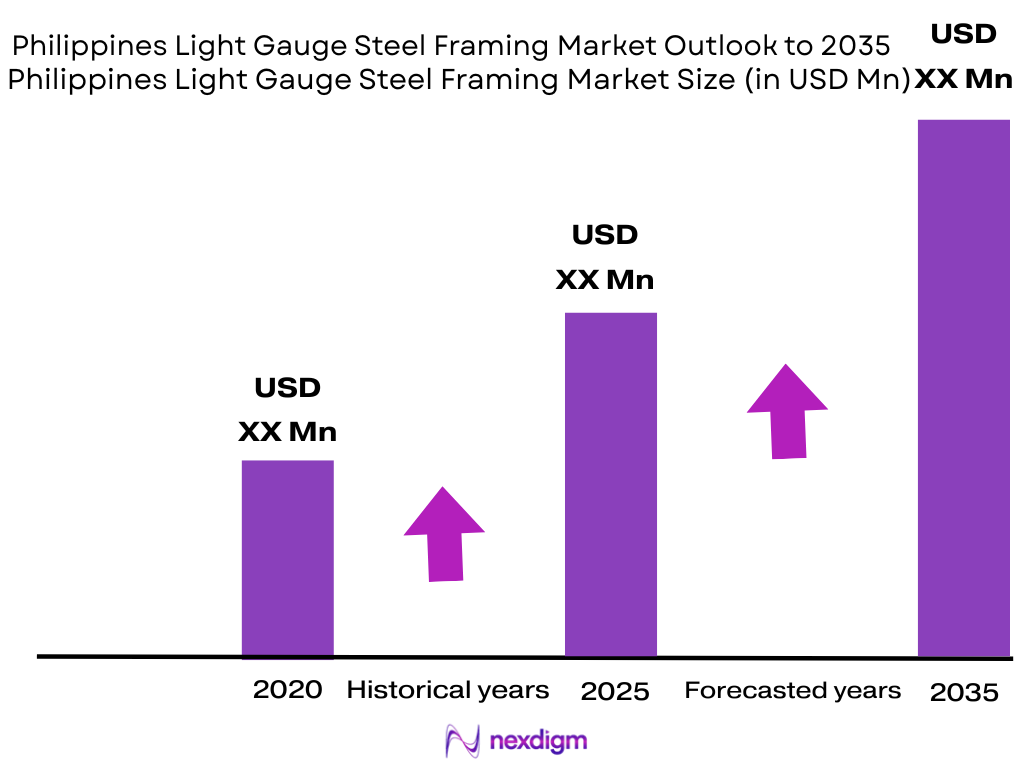
The Philippines Light Gauge Steel Framing Market is valued at approximately USD ~ million, compared with USD ~ million in the preceding period, based on the report’s historical market-sizing framework. Demand is supported by a construction pipeline that expanded from 171,268 approved constructions to 180,341, while associated floor area increased from 41.47 million square meters to 42.84 million square meters. Residential construction, prefabrication, housing development and demand for faster structural assembly underpin adoption. Metro Manila, CALABARZON, Central Luzon, Cebu and Davao represent important demand centers for light gauge steel framing because of concentrated residential development, commercial construction, industrial facilities and expanding urban housing requirements. Government-supported housing also reinforces geographic demand: SHFC had 10 ongoing 4PH projects covering 39,132 units, including developments in Manila and Davao. The concentration of developers, contractors, fabrication capabilities, logistics infrastructure and skilled engineering services further supports these construction hubs. The Philippines Light Gauge Steel Framing Market is forecast to expand at a ~% CAGR during 2026–2035, supported by prefabricated construction, housing requirements, greater acceptance of cold-formed steel systems, digital fabrication and demand for resilient building technologies.
Market Segmentation
By Application
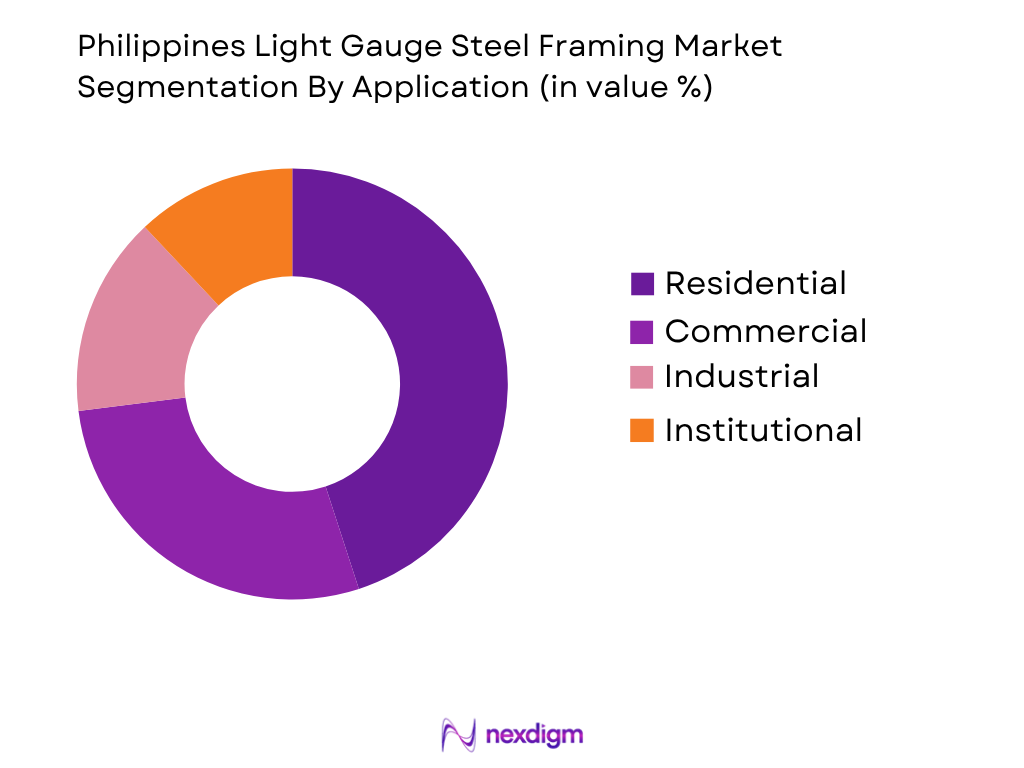
The Philippines Light Gauge Steel Framing Market is segmented by application into residential buildings, commercial buildings, industrial buildings, institutional buildings and other structures. Residential buildings hold the dominant market position under this segmentation. The leadership is linked to the scale of housing construction, subdivision development, low- and mid-rise projects, and the suitability of LGS framing for repetitive dwelling designs. Philippine construction records show residential buildings accounting for the largest number of approved constructions, while government housing initiatives create additional opportunities for standardized and prefabricated systems. LGS framing enables wall, floor and roof assemblies to be manufactured with controlled dimensions and assembled comparatively quickly on-site. The system is particularly relevant where developers require repeatability across multiple units, reduced dependence on wet construction processes and lighter structural assemblies. Expansion of horizontal housing under government programs also widens the addressable application base for cold-formed steel systems.
By Framing Component
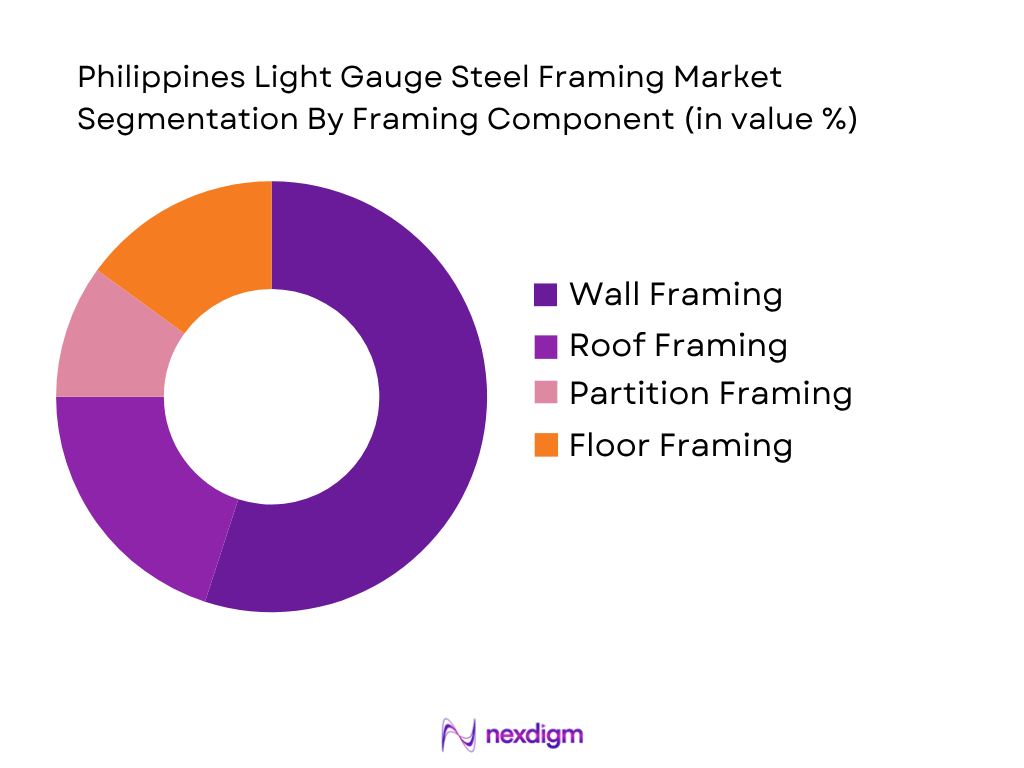
The Philippines Light Gauge Steel Framing Market is segmented by framing component into wall framing, roof framing, floor framing, ceiling and partition framing, and other structural components. Wall framing represents the dominant sub-segment because studs and tracks are required across a broad spectrum of residential, commercial and institutional construction. Light-gauge profiles are suitable for both structural framing and internal partition applications, increasing their addressable use compared with specialized components. Local manufacturers already supply studs, tracks, channels and related framing profiles, while integrated LGS providers use prefabricated wall panels for faster site installation. Wall systems also benefit from BIM-enabled detailing and automated roll forming, through which members can be pre-cut, punched and labelled before delivery. This improves dimensional control and supports repetitive residential construction. Increasing adoption of dry construction and prefabricated assemblies should consequently reinforce wall framing’s position within the component mix.
Competitive Landscape
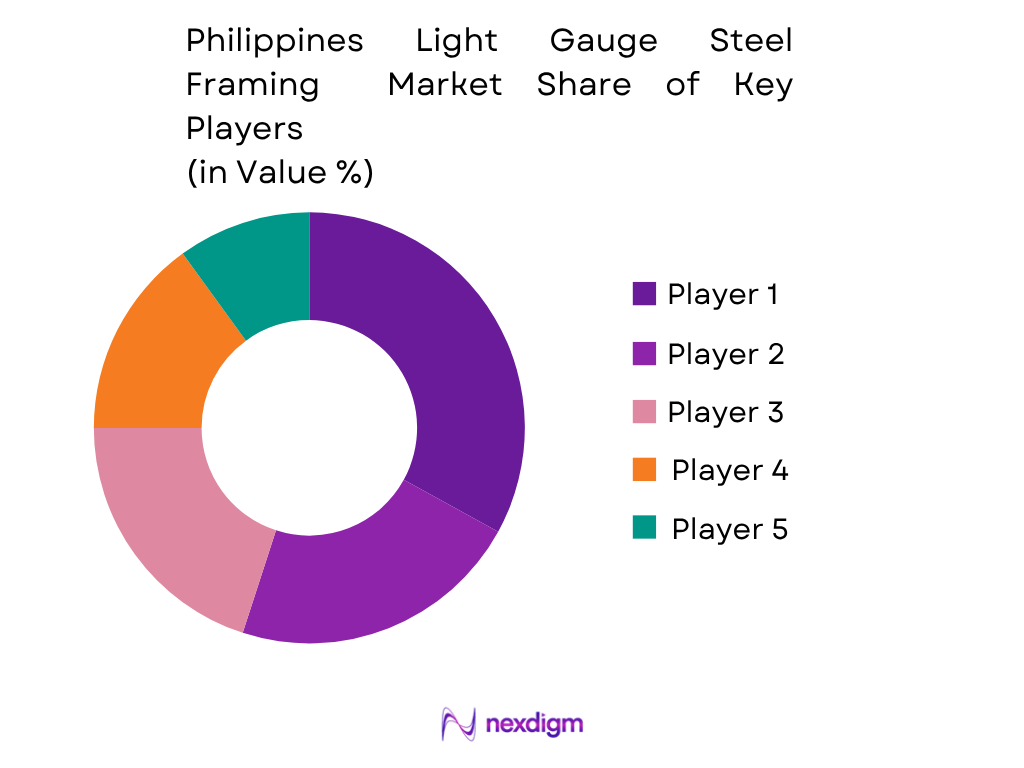
The Philippines Light Gauge Steel Framing Market combines domestic steel-profile manufacturers, integrated cold-formed-steel solution providers, construction companies and international technology suppliers. Competition increasingly extends beyond steel profiles to include engineering design, BIM integration, automated roll forming, prefabricated panels, installation capability and code compliance. Local suppliers such as Union Galvasteel Corporation and FRAMEGO 101 Corporation compete alongside technology-led participants using FRAMECAD systems.
| Major Player | Establishment | Headquarters | LGS Offering | Key Components | Fabrication Capability | Design/Engineering | Primary Applications | Key Differentiator |
| Union Galvasteel Corporation | Established player | Laguna, Philippines | ~ | ~ | ~ | ~ | ~ | ~ |
| FRAMEGO 101 Corporation | Recent-generation provider | Quezon City, Philippines | ~ | ~ | ~ | ~ | ~ | ~ |
| My Strong Home / Accutech | Engineering division created in 2018 | Taguig, Philippines | ~ | ~ | ~ | ~ | ~ | ~ |
| Evolution Homes | Philippine LGS specialist | Philippines | ~ | ~ | ~ | ~ | ~ | ~ |
| FRAMECAD | 35+ years of industry activity | Auckland, New Zealand | ~ | ~ | ~ | ~ | ~ | ~ |
Philippines Light Gauge Steel Framing Market Analysis
Growth Drivers
Expansion of Residential and Non-Residential Construction Activity
The Philippines Light Gauge Steel Framing Market is supported by a large and expanding construction pipeline that creates applications for cold-formed steel wall frames, roof trusses, floor joists, partitions, modular panels and lightweight building envelopes. Philippine Statistics Authority data show 180,341 constructions from approved building permits in 2024, followed by 181,832 constructions in 2025. The 2024 construction pipeline included residential, commercial, industrial and institutional buildings, all of which can adopt light-gauge steel framing where rapid installation and lower structural dead load are required. In the first four reported months of 2026 alone, approved constructions totalled 58,316, comprising 13,577 in January, 14,996 in February, 16,066 in March and 13,677 in April. This construction activity is occurring within an economy whose current-price GDP reached USD 461.67 billion in 2024 and USD 487.09 billion in 2025, according to the World Bank, while the IMF’s April 2026 database places current-price GDP at about USD 512.22 billion for 2026. The relevance to light-gauge steel framing is particularly strong in residential projects, warehouses, retail buildings, offices, accommodation facilities and institutional structures because these projects can benefit from factory-cut framing members, dry construction, reduced on-site material handling and faster enclosure. Northern Mindanao alone recorded 12,095 approved constructions, including 9,379 residential buildings and 2,119 non-residential buildings, with non-residential floor area reaching 1,506,354 square metres in 2024, illustrating the depth of construction activity outside Metro Manila. Housing programmes further widen the addressable pipeline: the Department of Human Settlements and Urban Development reported 56 Pambansang Pabahay projects under simultaneous development in 2024. Light-gauge steel framing can respond particularly well to such repetitive multi-unit construction because studs, tracks, joists and roof elements can be standardised before installation. The construction labour environment adds another reason for builders to consider more industrialised methods: PSA reported that construction employment increased by 745,000 workers year-on-year in May 2024, demonstrating the scale of labour absorption required by the building pipeline. Taken together, rising permit volumes, housing delivery requirements and continued economic expansion provide a tangible demand base for faster and more standardised framing systems.
Shift Toward Industrialised, Prefabricated and Disaster-Resilient Building Methods
The second major growth driver is the Philippine construction industry’s increasing requirement for building methods that can shorten site work, improve dimensional consistency and meet structural requirements in a country exposed to typhoons, earthquakes and high moisture conditions. Light-gauge steel framing is relevant because cold-formed steel members can be engineered off-site, cut to specified dimensions and assembled into repeatable wall, roof and floor systems, reducing dependence on wet trades during the structural framing stage. The strongest recent evidence of institutional adoption comes from the Technical Education and Skills Development Authority. In February 2025, TESDA received a two-storey cold steel frame structure from FrameGo 101 Corporation for use as a training laboratory, specifically enabling Carpentry NC II trainees to gain hands-on experience in assembling, installing and working with cold-steel framing systems. This is directly relevant to market development because it places cold-formed steel assembly within formal construction-skills training rather than limiting the technology to specialist contractors. Government procurement documents issued in 2025 also require building works to comply with the National Building Code of the Philippines, the latest National Structural Code of the Philippines and applicable standards of the American Institute of Steel Construction, American Iron and Steel Institute, American Welding Society and ASTM, providing a technical compliance environment within which engineered light steel systems can be specified. The macroeconomic and demographic base reinforces this opportunity. World Bank data record a Philippine population of 115.84 million people in 2024 and 116.79 million in 2025, while gross national income increased from approximately USD 518.01 billion to USD 566.82 billion across those years. At the construction level, PSA recorded 180,341 approved projects in 2024 and 181,832 in 2025, demonstrating that industrialised building technology has a large addressable project base rather than a narrow niche. Government infrastructure delivery also remains extensive: DPWH reported completion of 79 bridges and 399 kilometres of road sections as of May 2024, reflecting the broader scale of construction and engineering activity occurring around urban and regional development corridors. For light-gauge steel framing manufacturers, this environment favours prefabricated framing kits, computer-controlled roll-forming, panelised walls and roof-truss systems that can support residential, institutional and commercial buildings around new infrastructure corridors. The technology’s future adoption will therefore be tied not merely to urbanisation, but to the construction sector’s transition from site-intensive building toward digitally designed and factory-prepared structural components.
Market Challenges
Limited Availability of Light-Gauge Steel Framing-Specific Skills and Installation Expertise
A significant constraint for the Philippines Light Gauge Steel Framing Market is the need for workers who understand cold-formed steel layout, fastening, bracing, panel assembly, connection detailing and interface management with cladding, insulation and mechanical systems. The Philippines has a large construction workforce, but traditional construction capabilities do not automatically translate into competence in engineered light-gauge framing. PSA data illustrate the size and volatility of the sector’s labour requirement. Construction added 745,000 workers year-on-year in May 2024, yet the sector subsequently recorded employment declines of 692,000 workers in June 2025 compared with the previous year and 550,000 workers in December 2025 compared with December 2024. By June 2026, construction employment had again declined by 139,000 workers year-on-year even though overall Philippine employment reached 50.66 million people. These fluctuations matter for LGSF contractors because steel-framing installation is sequencing-sensitive: incorrect track alignment, screw spacing, stud orientation or lateral bracing can compromise wall straightness, load paths and downstream finishing. The fact that TESDA only formalised a dedicated cold-steel-frame training laboratory through a two-storey training structure in February 2025 indicates that specialised practical training is still being expanded. TESDA already maintains construction qualifications covering areas such as Carpentry, Reinforcing Steel Works, Shielded Metal Arc Welding and related building trades, but light-gauge framing requires a combination of carpentry-style layout and steel-specific assembly knowledge. Demand for competent installers will rise alongside the national building pipeline: the PSA counted 181,832 approved constructions in 2025, while the first four months of 2026 generated another 58,316 approvals. The workforce challenge therefore concerns quality and specialisation rather than a simple shortage of people. Contractors entering LGSF require trained supervisors, estimators, CAD/BIM detailers, roll-forming machine operators and installers who understand corrosion protection, fastener selection, opening reinforcement and connection design. Without this capability, developers may continue using familiar reinforced-concrete or masonry systems despite the potential construction-speed advantages of lightweight framing. Industry expansion will therefore depend on broader certification, manufacturer-led installer programmes and closer coordination with TESDA and contractors.
Engineering, Code-Compliance and Climate-Exposure Requirements
Light-gauge steel framing faces a second market challenge because the Philippines imposes demanding structural and environmental conditions on lightweight building systems. Projects must be designed for seismic loading, wind forces, connection behaviour and material durability rather than treating cold-formed steel as a direct replacement for ordinary timber or masonry framing. Government construction documents issued in 2025 explicitly reference the National Building Code, the latest National Structural Code of the Philippines, AISI requirements for steel systems, American Welding Society provisions and ASTM material standards. Compliance therefore requires engineers and manufacturers to document steel grade, section thickness, coating specification, member capacity, connection resistance, bracing and load paths. This becomes especially important as building activity spreads beyond large metropolitan areas. PSA recorded 180,341 approved constructions in 2024, while Northern Mindanao alone accounted for 12,095 projects, including 2,119 non-residential structures with more than 1.50 million square metres of floor area. LGSF suppliers must consequently design for different coastal, inland and high-rainfall exposure conditions rather than supplying a single undifferentiated framing specification nationally. Quality assurance becomes more important as the market scales because lighter-gauge members can be more sensitive to incorrect screw placement, local buckling, unbraced installation conditions and poor handling than heavier structural steel. The broader economic environment indicates that demand will not be confined to small projects: World Bank data place Philippine GDP at USD 461.67 billion in 2024 and USD 487.09 billion in 2025, while the IMF reports approximately USD 512.22 billion in current-price GDP for 2026. Large construction pipelines therefore create both opportunity and liability exposure. Manufacturers must provide engineering tables, connection schedules, shop drawings and site inspection protocols, while installers require accurate cutting and fastening equipment. Coastal applications additionally require disciplined protection of cut edges and appropriate metallic coatings. The market challenge is thus not simply “technical complexity”; it is the need to establish an integrated design-to-installation system that converts cold-formed steel coil into code-compliant structural assemblies. Suppliers unable to provide engineering documentation and installation support will face greater difficulty competing for institutional, commercial and multi-storey residential projects.
Market Opportunities
Prefabricated Light-Steel Systems for Housing and Multi-Unit Residential Delivery
The Philippine housing requirement creates one of the clearest future opportunities for light-gauge steel framing because repetitive housing programmes can benefit from standardised structural modules, factory-prepared wall panels and rapid assembly. The Department of Human Settlements and Urban Development reported 56 Pambansang Pabahay projects simultaneously under development in 2024 and had begun delivering the programme’s first units. One private-sector-supported 4PH development announced in 2024 comprised five residential towers containing 1,100 units on a 1.7-hectare site, illustrating the density and repetition involved in government-supported housing development. These characteristics are compatible with light-gauge steel because repeated wall types, openings, floor layouts and roof assemblies can be digitally detailed once and reproduced through roll-forming equipment. The broader private residential market provides an additional demand pool. PSA recorded 180,341 approved constructions in 2024 and 181,832 in 2025, while December 2024 alone included residential construction activity valued across a substantial national pipeline; the underlying permit counts, rather than monetary values, demonstrate continuous building formation. Regional markets are also significant: Northern Mindanao recorded 9,379 residential constructions and approximately 987,923 square metres of residential floor area during 2024. Meanwhile, World Bank data place the national population at 115.84 million in 2024 and 116.79 million in 2025, establishing a continuing requirement for additional housing stock. The opportunity for LGSF companies is to supply complete framing solutions rather than commodity studs alone. Potential offerings include pre-engineered wall panels, roof trusses, joists, bathroom and service modules, connection packages, erection drawings and installation supervision. Factory fabrication can also support projects in locations where skilled site labour is difficult to mobilise. TESDA’s adoption of a two-storey cold-steel framing training laboratory in 2025 further indicates that workforce capability for these construction methods is beginning to be institutionalised. Consequently, housing developers that standardise unit designs can become anchor customers for automated roll-forming companies. The strongest commercial opportunity lies in combining structural design, manufacturing, logistics and site erection into repeatable housing systems capable of serving public housing, subdivisions, dormitories, worker accommodation and low- to mid-rise residential buildings.
Industrial, Logistics and Commercial Prefabrication Supported by Investment Expansion
Industrial and logistics construction represents another major opportunity because light-gauge steel framing is well suited to internal partitions, offices within warehouses, mezzanine enclosures, service buildings, façade support, roof systems and secondary framing around factories and distribution facilities. The Philippine Board of Investments reported 115 projects approved through the government’s Green Lane mechanism as of August 2024, showing an active pipeline of strategically important investments requiring new physical facilities and supporting infrastructure. Construction-permit statistics support the existence of an extensive non-residential building base. PSA’s final national data show 180,341 approved constructions in 2024 and 181,832 in 2025, while the value of non-residential construction in 2024 was generated across commercial, industrial and institutional categories. Northern Mindanao provides a useful regional example: its 2,119 non-residential buildings represented approximately 1,506,354 square metres of floor area in 2024, exceeding the region’s residential floor area and demonstrating the physical scale of non-residential construction that can incorporate lightweight framing systems. The national economy also provides a supportive industrial backdrop. World Bank data show GDP increasing from USD 461.67 billion in 2024 to USD 487.09 billion in 2025, and the IMF’s April 2026 dataset places current-price output around USD 512.22 billion. Infrastructure development expands the geographic reach of such projects: DPWH had completed 79 bridges and 399 kilometres of road sections as of May 2024, improving links among urban centres, ports, industrial estates and regional markets. For LGSF suppliers, future growth can therefore come from integrating roll-formed steel into warehouse office pods, worker facilities, data-centre support buildings, retail structures, institutional buildings and factory expansions rather than relying solely on residential demand. Automated framing also aligns with investors that require predictable completion schedules because component fabrication can proceed concurrently with foundation and site works. Local suppliers that combine BIM detailing, roll-forming, panelisation and installation can move further up the construction value chain. The 2025 TESDA cold-steel-frame training initiative additionally provides a practical base for expanding installers capable of supporting this industrialised model.
Future Outlook
The Philippines Light Gauge Steel Framing Market is expected to expand through 2035 as construction shifts toward faster, more standardized and digitally enabled building systems. Housing requirements, urban expansion and increasing acceptance of prefabricated construction should create opportunities for structural LGS assemblies. Automated roll forming, BIM-based detailing and design-for-manufacturing-and-assembly will improve production consistency. Demand should also benefit from the need for lightweight and resilient construction suited to the Philippines’ seismic and typhoon exposure. Government-supported housing remains an important potential demand channel. The 4PH framework accommodates walk-up, mid-rise and high-rise housing formats, while its implementation model directly involves developers and contractors. Technology adoption should progressively shift competition from individual studs and tracks toward engineered framing packages, including structural calculations, digital shop drawings, pre-punched members, prefabricated panels, connectors and installation services. Automated platforms such as FRAMECAD already combine design software, engineering analysis and roll-forming equipment, illustrating the direction in which the Philippine LGS ecosystem can develop.
Major Players
- Union Galvasteel Corporation
- FRAMEGO 101 Corporation
- My Strong Home / Accutech Steel & Service Center
- Evolution Homes
- JEA-Maxx / On Solutions Inc.
- FRAMECAD
- BlueScope Steel
- LYSAGHT
- CapitalHomes Realty
- MetalYTE Construction and Development Corporation
- DN Steel Group
- Steeltech
- Metalink Manufacturing Corporation
- Jacinto Color Steel
- Philsteel Holdings Corporation
Key Target Audience
- Light Gauge Steel Framing Manufacturers
- Cold-Formed Steel and Galvanized Steel Suppliers
- Real Estate Developers and Housing Developers
- EPC Contractors and General Construction Companies
- Prefabricated and Modular Building Companies
- Investments and Venture Capitalist Firms
- Government and Regulatory Bodies (DHSUD, National Housing Authority, DPWH, DTI-Bureau of Philippine Standards, Social Housing Finance Corporation)
- Architecture, Engineering and Building-System Technology Providers
Research Methodology
Step 1: Identification of Key Variables
The initial phase involves constructing an ecosystem map covering galvanized-steel suppliers, roll-forming companies, LGS manufacturers, fabricators, developers, contractors and end users in the Philippines Light Gauge Steel Framing Market. Secondary research identifies variables such as steel consumption, construction activity, framing applications, building types, fabrication capacity, component specifications and geographic demand concentration.
Step 2: Market Analysis and Construction
Historical market development is assessed through supply-side and demand-side approaches. The demand model evaluates residential, commercial, industrial and institutional construction alongside potential LGS penetration, while the supply model examines domestic profile production, imported systems, fabrication capabilities, project pipelines and sales channels. PSA construction statistics provide an important external benchmark for underlying building activity.
Step 3: Hypothesis Validation and Expert Consultation
Initial market hypotheses are validated through CATIs and structured interviews with cold-formed-steel manufacturers, structural engineers, fabricators, contractors, developers, distributors and building-system specialists. Interviews test assumptions concerning material adoption, component demand, structural versus non-structural applications, project specifications, procurement criteria and competitive positioning.
Step 4: Research Synthesis and Final Output
The final phase triangulates company-level supply information, construction indicators, government housing activity and primary interviews. Bottom-up estimates based on framing consumption and project activity are reconciled against top-down construction indicators. Segment shares are then validated across application, component, building type and geography before preparation of the final Philippines Light Gauge Steel Framing Market forecast.

- Executive Summary
- Research Methodology (Market Definitions and Assumptions, Light Gauge Steel Framing Scope, Abbreviations, Top-Down Market Sizing, Bottom-Up Steel Consumption Assessment, Building Floor-Area Mapping, Project Pipeline Mapping, Structural versus Non-Structural Framing Assessment, Roll-Former Capacity Mapping, Contractor Interviews, Developer Interviews, Distributor Assessment, Demand-Side Analysis, Supply-Side Analysis, Data Triangulation, Forecasting Framework, Limitations and Future Conclusions)

- Definition and Scope
- Evolution of Cold-Formed Steel Construction
- Evolution from Conventional Reinforced Concrete and Timber Framing
- Light Gauge Steel Framing Industry Genesis
- Structural and Non-Structural LGS Ecosystem

- Growth Drivers (Residential Construction, Urban Housing Demand, Commercial Development, Prefabricated Construction, Faster Project Delivery, Reduced Site Labour, Termite Resistance, Disaster-Resilient Design)
- Market Challenges (Steel Price Volatility, Skilled Installer Availability, Design Familiarity, Corrosion Protection, Contractor Resistance, Equipment Investment, Specification Fragmentation, Concrete Preference)
- Market Opportunities (Affordable Housing, Modular Construction, Disaster Recovery, Mid-Rise LGS, Automated Fabrication, Remote Islands, Green Building, Industrialized Construction)
- Market Trends (Panelization, BIM Integration, DfMA, High-Tensile Steel, Automated Roll Forming, Digital Fabrication, Hybrid Construction, Prefabricated Housing)
- SWOT Analysis
- Porter’s Five Forces Analysis
- PESTLE Analysis

- By Market Value (2020-2025)
- By Framing Volume (2020-2025)
- By Galvanized Steel Consumption (2020-2025)

- By Framing Type (In Value %)
Structural Load-Bearing LGS Framing
Non-Load-Bearing Wall Framing
Drywall Partition Framing
Ceiling Framing
Roof and Truss Framing - By Component Type (In Value %)
C-Studs
U-Tracks
Floor Joists
Roof Rafters
Roof Trusses - By Application (In Value %)
Load-Bearing Walls
Internal Partition Walls
External Walls
Ceilings
Roof Structures - By Region (In Value %)
Metro Manila
CALABARZON
Central Luzon
Cordillera Administrative Region
Ilocos Region

- Market Share of Major Players by Value
- Cross Comparison Parameters (Structural LGS Profile Portfolio, Steel Thickness and Yield-Strength Range, Galvanized/Aluminum-Zinc Coating Specification, Roll-Forming and Automated Fabrication Capability, Structural Engineering and Design Support, Prefabricated Wall/Floor/Roof System Capability, Nationwide Distribution and Installation Footprint, Typhoon/Seismic Project Experience)
- SWOT Analysis of Major Players
- Detailed Profiles of Major Companies
- Union Galvasteel Corporation
FRAMEGO 101 Corporation
Evolution Homes
NEDSteel Construction and Development Corporation
My Strong Home
Scottsdale Construction Systems
FRAMECAD
Knauf Philippines
Saint-Gobain Philippines / Gyproc
Howick Ltd.
Puyat Steel Corporation
DN Steel Marketing Inc.
PHINMA Construction Materials Group / Union Galvasteel
Metalink Manufacturing Corporation
Light Steel Frame Philippines

- Residential Developers
- Affordable Housing Developers
- Commercial Real Estate Developers
- Industrial Developers
- Hotel Developers

- By Market Value (2026-2035)
- By Framing Volume (2026-2035)
- By Galvanized Steel Consumption (2026-2035)


 Request a Sample
 Ask for Customization
 Get a Quote
 Enquire Now