

 Download PDF
Market Overview
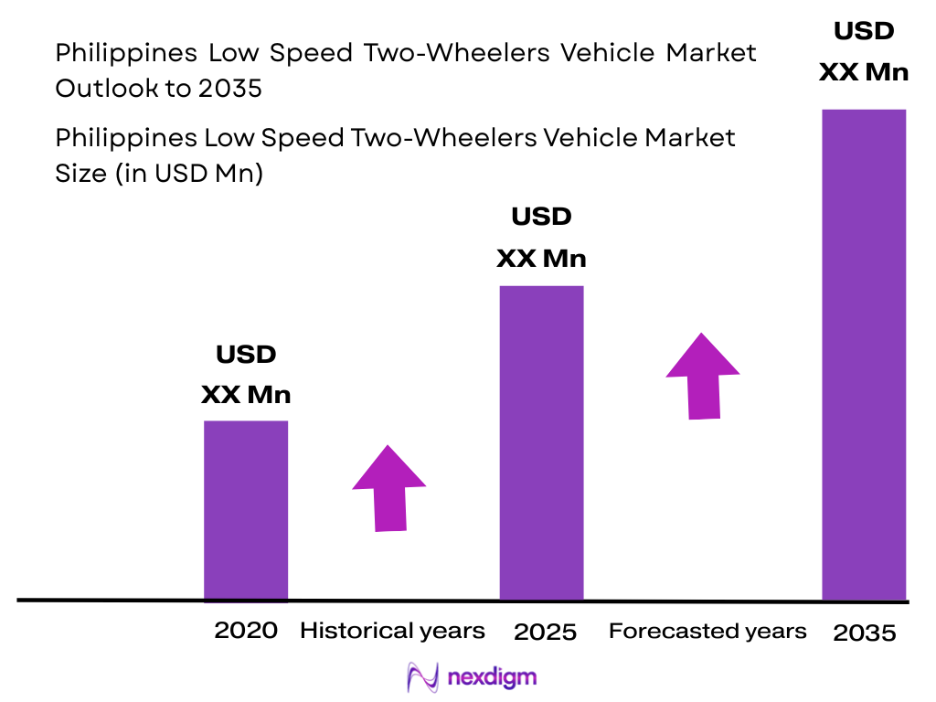
The Philippines low speed two-wheelers vehicle market is valued at USD 185 million in 2024, based on a five-year historical analysis, supported by increasing demand for affordable urban mobility solutions, rising fuel costs, and expanding electric mobility adoption. The market size is driven by growing usage of electric scooters, electric motorcycles, and electric tricycles among commuters, delivery operators, and small businesses. Government initiatives promoting electric vehicle adoption, along with increasing investments in charging and battery infrastructure, are accelerating market development.
The Philippines low speed two-wheelers vehicle market is concentrated in major urban centers including Metro Manila, Cebu, Davao, and other highly populated metropolitan areas due to dense traffic conditions, short-distance commuting patterns, and strong demand for economical transportation. Metro Manila dominates adoption because of congestion challenges, increasing last-mile delivery activities, and demand for compact mobility solutions. Cebu and Davao are emerging markets due to tourism activities, commercial transportation requirements, and growing acceptance of electric mobility solutions.
Market Segmentation
By Vehicle Type
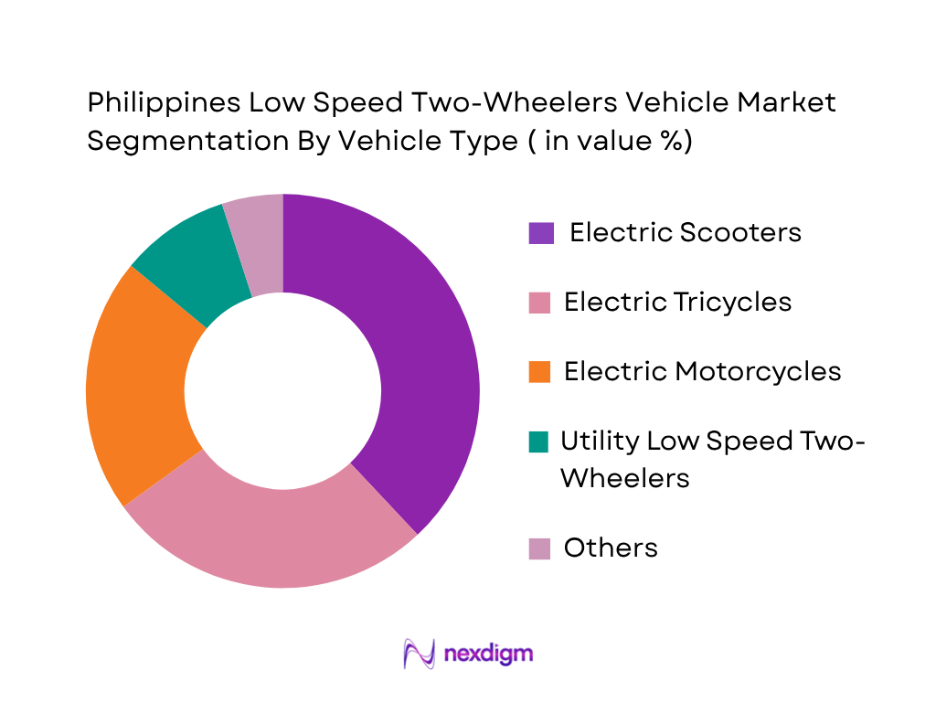
The Philippines low speed two-wheelers vehicle market is segmented by vehicle type into electric scooters, electric motorcycles, electric tricycles, low-speed mopeds, and utility-oriented low speed two-wheelers. Recently, electric scooters have maintained a dominant market position due to their affordability, ease of operation, suitability for urban commuting, and increasing adoption among individual consumers and delivery riders. Electric scooters require lower maintenance compared with conventional motorcycles and are preferred for short-distance travel within congested cities. Electric tricycles also represent a significant segment due to their application in public transport replacement programs and local government electrification initiatives. The growing popularity of app-based delivery services and increasing preference for low operating cost vehicles are further supporting demand for compact electric two-wheelers.
By Battery Technology
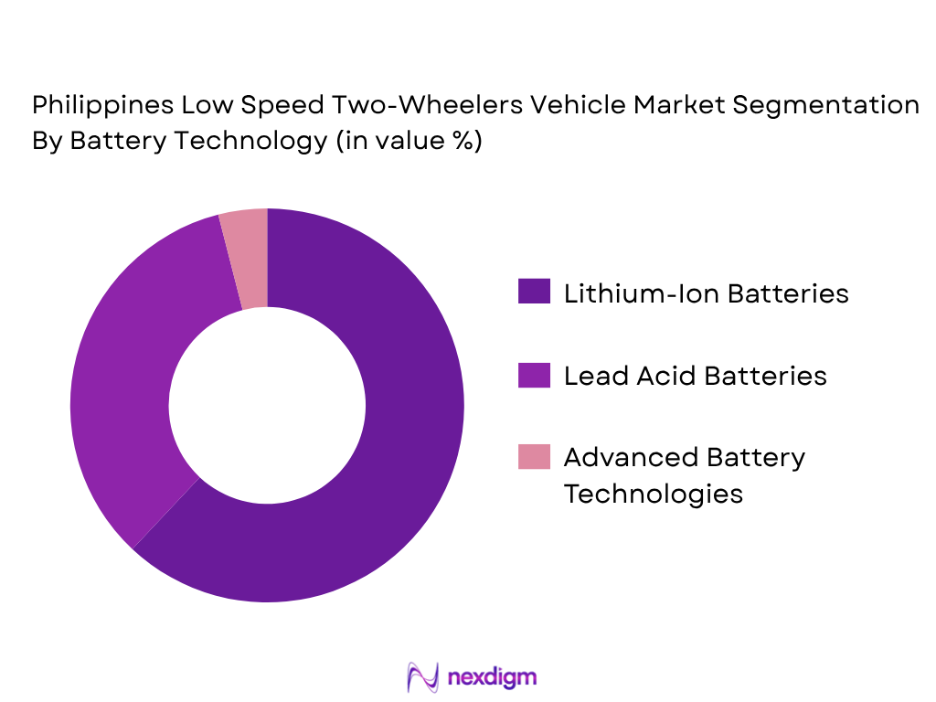
The Philippines low speed two-wheelers vehicle market is segmented by battery technology into lithium-ion batteries, lead-acid batteries, and advanced battery technologies. Lithium-ion battery-powered vehicles hold a dominant market position due to higher energy efficiency, longer lifecycle, faster charging capability, and improved vehicle performance compared with traditional lead-acid alternatives. The declining cost of lithium-ion batteries and increasing preference for reliable mobility solutions among fleet operators are accelerating adoption. Lead-acid batteries continue to maintain demand in entry-level vehicle categories because of their lower initial purchase cost and availability across local markets. However, commercial users and premium vehicle buyers are increasingly shifting toward lithium-ion technology due to lower lifetime operating expenses.
Competitive Landscape
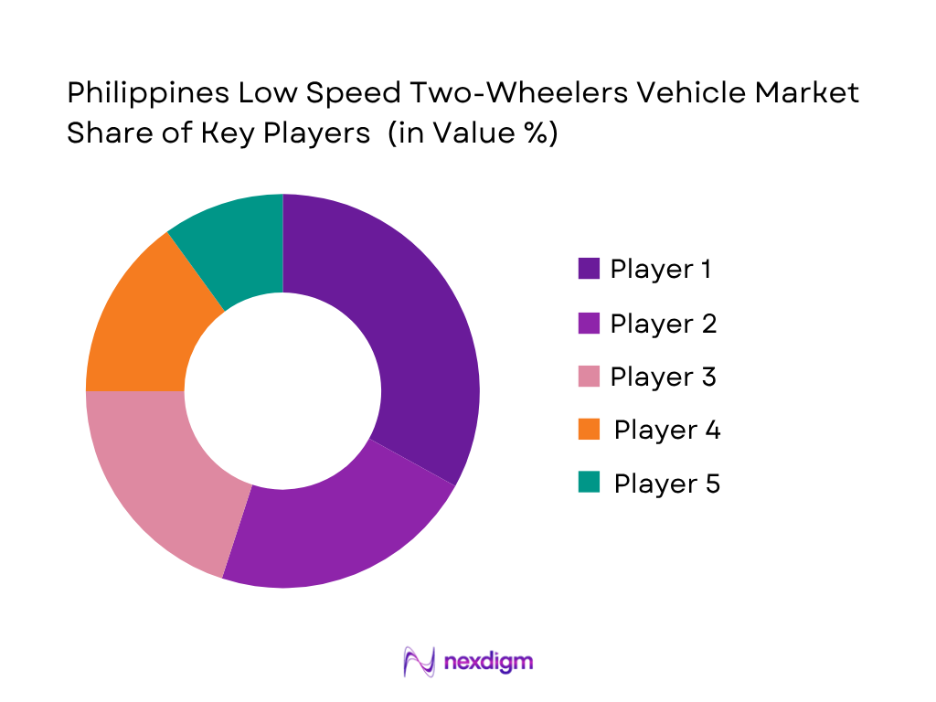
The Philippines low speed two-wheelers vehicle market is developing with competition from international electric mobility manufacturers, Chinese electric vehicle brands, and local two-wheeler companies. The market includes companies focusing on affordable electric scooters, battery-powered motorcycles, electric tricycles, and commercial mobility solutions. Competitive differentiation is based on battery technology, pricing strategy, dealership coverage, after-sales service capability, vehicle range, and fleet partnerships.
| Company | Establishment Year | Headquarters | Key Products in Philippines Low Speed Two-Wheeler Market | Battery Technology Focus | Distribution & Market Presence | Manufacturing / Assembly Capability | Key Competitive Strength |
| Yadea | 2001 | ~ | ~ | ~ | ~ | ~ | ~ |
| NIU Technologies | 2014 | ~ | ~ | ~ | ~ | ~ | ~ |
| Segway Inc. | 1999 | ~ | ~ | ~ | ~ | ~ | ~ |
| Gogoro | 2011 | ~ | ~ | ~ | ~ | ~ | ~ |
| Rusi Motorcycles | 2005 | ~ | ~ | ~ | ~ | ~ | ~ |
Philippines Low Speed Two-Wheelers Vehicle Market Analysis
Market Growth Drivers
Urban Traffic Congestion and Demand for Compact Urban Mobility
Urban traffic congestion is increasing the demand for low speed two-wheelers in the Philippines as consumers and businesses seek compact vehicles suitable for short-distance travel. Metro Manila remains among the most congested urban areas in Southeast Asia, with the World Bank highlighting transport inefficiencies as a major economic constraint due to high travel delays and limited road capacity. The Philippine Statistics Authority recorded a population of more than 115 million people, creating increasing pressure on urban transportation systems, especially in densely populated areas such as Metro Manila, Cebu, and Davao. The Department of Transportation has continued prioritizing sustainable and efficient mobility solutions through transport modernization programs, including electric vehicle adoption. Low speed electric scooters, electric motorcycles, and electric tricycles are gaining relevance because they require less road space, support short-distance commuting, and provide alternatives for congested urban routes. Increasing urbanization, with the World Bank reporting that more than 50 million Filipinos live in urban areas, is strengthening demand for affordable and efficient last-mile mobility solutions. The combination of congestion challenges, growing urban population concentration, and demand for flexible transportation options is supporting adoption of low speed two-wheelers across metropolitan regions.
Increasing Last-Mile Delivery Demand and Growth of E-Commerce Logistics
Expansion of e-commerce and delivery-based services is accelerating the adoption of low speed two-wheelers among logistics operators, small businesses, and delivery riders in the Philippines. The Department of Trade and Industry reported continued digital economy expansion, supported by increasing online transactions and digital consumer adoption. According to the Philippine Statistics Authority, the services sector contributed more than PHP 12 trillion to the national economy, highlighting the importance of logistics-intensive activities including retail, transportation, and digital commerce. Low speed electric two-wheelers are increasingly preferred for delivery applications because of their suitability for short-distance routes, lower operational requirements, and ability to navigate urban traffic conditions. The Bangko Sentral ng Pilipinas reported that digital payment transactions reached more than 11 billion transactions, reflecting the increasing integration of online commerce and digital services in daily consumer activity. As online retail, food delivery, and courier services expand, delivery operators require efficient vehicles capable of frequent urban movement. The growing ecosystem of e-commerce platforms, logistics providers, and small merchants is creating stronger demand for electric scooters, electric motorcycles, and utility-oriented low speed two-wheelers.
Market Challenges
Limited Charging Infrastructure and Battery Support Ecosystem
Limited charging infrastructure remains a key challenge restricting faster adoption of low speed electric two-wheelers in the Philippines. The Department of Energy has highlighted that electric vehicle adoption requires significant expansion of charging infrastructure and supporting energy systems across urban and provincial locations. The Philippines has a power generation capacity exceeding 29,000 megawatts, according to the Department of Energy, but charging accessibility remains concentrated in selected commercial and urban locations. Limited availability of public charging points creates concerns among consumers regarding vehicle usability, particularly for longer commuting routes and commercial fleet operations. Battery-dependent mobility also requires reliable replacement and servicing networks, especially as electric two-wheelers are increasingly used for intensive applications such as delivery operations. The Electric Vehicle Industry Development Act implemented through the government framework encourages charging infrastructure development; however, infrastructure deployment remains at an early stage compared with conventional fuel networks. The challenge is further influenced by geographic conditions, as the Philippines consists of more than 7,600 islands, making nationwide charging infrastructure expansion complex. Improving charging accessibility, battery service availability, and regional support networks will be critical for increasing consumer confidence in low speed two-wheeler adoption.
Imported Vehicle Dependency and Spare Parts Availability Issues
Dependence on imported electric vehicle components and finished vehicles creates supply chain challenges for the Philippines low speed two-wheelers market. The Philippine Statistics Authority reported that the country remains highly dependent on imported machinery, electrical equipment, and automotive-related components, with electronics and machinery among the largest import categories. Many low speed electric two-wheeler manufacturers source batteries, motors, controllers, and other critical components from international suppliers, particularly from China and other Asian manufacturing hubs. This dependence exposes manufacturers and distributors to logistics disruptions, foreign exchange fluctuations, and longer replacement part lead times. The Department of Trade and Industry has emphasized the importance of strengthening domestic manufacturing capabilities and local value chains to improve industrial resilience. Limited availability of specialized spare parts and trained service technicians can influence consumer confidence, particularly in provincial markets where dealership coverage is less developed. As electric two-wheelers require different maintenance capabilities compared with conventional motorcycles, expansion of local technical expertise and component availability will be necessary to support long-term market growth.
Market Opportunities
Expansion of Electric Tricycle Replacement Programs and Government Fleet Electrification
Government-led electrification programs create significant opportunities for low speed two-wheelers, particularly electric tricycles and utility-focused vehicles used in public and institutional transportation. The Philippine government introduced the Public Utility Vehicle Modernization Program to encourage replacement of older transport units with cleaner and more efficient alternatives. The Department of Transportation has been promoting modernization initiatives involving electric and alternative fuel vehicles to reduce dependence on conventional transportation systems. Local government units are increasingly exploring electric tricycles for public transportation, tourism zones, and municipal mobility applications because of their suitability for short-distance routes. The Department of Energy reported continued policy support for electric vehicle adoption through the Electric Vehicle Industry Development Act, which provides a framework for expanding electric mobility infrastructure and industry participation. The Philippines’ extensive local government network, consisting of more than 1,600 municipalities and cities, creates opportunities for decentralized adoption of electric mobility solutions. Government fleets, municipal transportation programs, and public mobility modernization initiatives provide growth avenues for manufacturers offering affordable electric tricycles and low speed commercial vehicles.
Delivery Fleet Electrification and Development of Battery Swapping Infrastructure
Electrification of delivery fleets and development of battery-support ecosystems represent major opportunities for low speed two-wheeler adoption in the Philippines. The rapid growth of digital commerce and logistics services has increased demand for efficient last-mile transportation solutions. The Bangko Sentral ng Pilipinas reported that digital payments exceeded 11 billion transactions, reflecting stronger digital economic activity and supporting growth in online commerce ecosystems. Delivery companies require vehicles capable of frequent daily usage, making electric scooters and low speed motorcycles attractive due to lower maintenance requirements and suitability for urban delivery routes. Battery swapping infrastructure can further improve operational efficiency by reducing charging downtime for commercial users. Companies and government agencies are increasingly evaluating alternative charging models to address electric mobility adoption barriers. The Philippines’ growing urban population, with the World Bank reporting more than 50 million urban residents, supports demand for fast and flexible delivery transportation. Expansion of fleet partnerships, battery exchange networks, and commercial electric mobility solutions can accelerate adoption among logistics operators, food delivery businesses, and small enterprises seeking efficient urban transportation options.
Future Outlook
Over the next decade, the Philippines low speed two-wheelers vehicle market is expected to demonstrate strong expansion driven by increasing urban mobility challenges, government support for electric transportation, rising fuel costs, and growing demand for cost-efficient delivery solutions. Advancements in battery technology, wider charging infrastructure deployment, and increasing participation from global EV manufacturers are expected to improve market accessibility and accelerate adoption across consumer and commercial applications.
Major Players
- Yadea
- NIU Technologies
- Segway
- Gogoro
- Vmoto Limited
- Zhejiang Luyuan Electric Vehicle Co., Ltd.
- TAILG
- AIMA Technology Group
- Sunra
- Horwin
- Ecooter
- Ola Electric
- Terra Motors
- Rusi Motorcycles
- EMotorad
Key Target Audience
- Electric two-wheeler manufacturers
- Battery manufacturers and energy storage companies
- Two-wheeler dealership networks and distributors
- Fleet operators and logistics companies
- Delivery service companies and mobility platforms
- Investments and venture capitalist firms
- Government and regulatory bodies (Land Transportation Office, Department of Transportation, Department of Energy, Board of Investments Philippines)
- Charging infrastructure providers and battery swapping companies
Research Methodology
Step 1: Identification of Key Variables
The initial phase involves developing a comprehensive ecosystem map of the Philippines low speed two-wheelers vehicle market covering OEMs, importers, distributors, battery suppliers, charging infrastructure providers, fleet operators, and regulatory institutions. Secondary research sources, industry databases, vehicle registration records, and proprietary information repositories are analyzed to identify key market variables influencing demand, supply, and competitive dynamics.
Step 2: Market Analysis and Construction
This stage focuses on collecting and evaluating historical market information related to vehicle sales, pricing trends, battery technology adoption, distribution structures, and consumer behavior patterns. The market model incorporates demand-side and supply-side assessments to estimate market value, unit sales, vehicle penetration, and category-level performance.
Step 3: Hypothesis Validation and Expert Consultation
Market assumptions are validated through discussions with industry stakeholders including electric vehicle manufacturers, dealers, battery suppliers, fleet operators, and mobility solution providers. Computer-assisted interviews and expert consultations are conducted to gather operational insights, validate market trends, and refine market forecasts.
Step 4: Research Synthesis and Final Output
The final stage involves integrating primary and secondary research findings to develop a detailed market assessment. Insights from manufacturers, distributors, government sources, and end users are analyzed to validate segmentation analysis, competitive positioning, future opportunities, and strategic recommendations.

- Executive Summary
- Research Methodology (Market Definition and Scope, Low Speed Two-Wheeler Vehicle Classification Framework, Electric and Non-Electric LSTW Categorization, Market Sizing Methodology, Top-Down Market Assessment, Bottom-Up Market Assessment, Demand-Side Analysis, Supply-Side Analysis, Primary Interviews with OEMs and Dealers, Consumer Survey Framework, Import and Local Assembly Assessment, Vehicle Registration Data Analysis, Pricing Benchmarking Methodology, Forecasting Model, Data Triangulation, Research Limitations)

- Definition and Scope
- Low Speed Two-Wheeler Vehicle Ecosystem Overview
- Market Evolution and Development Pathway
- Industry Value Chain Analysis

- Market Growth Drivers (Urban Traffic Congestion, Rising Fuel Prices, Increasing Last-Mile Delivery Demand, Growth of E-Commerce Logistics, Affordable Electric Mobility Adoption, Lower Operating Costs Compared with Conventional Motorcycles, Government Electrification Initiatives, Rising Environmental Awareness)
- Market Challenges (Limited Charging Infrastructure, Battery Replacement Concerns, Consumer Awareness Gap, Financing Availability Constraints, Imported Vehicle Dependency, Spare Parts Availability Issues, Limited Resale Value Perception, Regulatory Classification Uncertainty)
- Market Opportunities (Expansion of Electric Tricycle Replacement Programs, Battery Swapping Infrastructure Development, Delivery Fleet Electrification, Rural Mobility Solutions, Tourism Transportation Applications, Local Assembly Opportunities, Government Fleet Electrification)
- Market Trends (Growth of Lithium-Ion Powered Vehicles, Increasing Fleet Electrification, Rise of Affordable Chinese EV Brands, Expansion of Online Vehicle Sales, Battery-as-a-Service Models, Smart Connected Two-Wheelers, Lightweight Urban Mobility Solutions)
- Government Regulations and Policy Framework (Land Transportation Office Vehicle Registration Policies, Electric Vehicle Industry Development Act Framework, Department of Transportation Mobility Programs, Local Government Electrification Initiatives, Import Regulations, Safety Standards, Battery Disposal Regulations)
- Porter’s Five Forces Analysis
- PESTLE Analysis
- SWOT Analysis

- By Market Value (2020-2025)
- By Unit Sales Volume (2020-2025)
- By Vehicle Fleet Size (2020-2025)
- By Average Selling Price (2020-2025)
- By Battery Capacity Category (2020-2025)
- By Power Output Category (2020-2025)
- By Vehicle Usage Intensity (2020-2025)

- By Vehicle Type (In Value %)
Electric Scooters
Electric Motorcycles
Electric Tricycles
Low-Speed Mopeds
Electric Utility Two-Wheelers
Cargo-Oriented Low Speed Two-Wheelers
Passenger Mobility Low Speed Two-Wheelers - By Battery Technology (In Value %)
Lithium Iron Phosphate (LFP) Batteries
Lithium Nickel Manganese Cobalt (NMC) Batteries
Lead Acid Batteries
Advanced Battery Technologies - By End User (In Value %)
Individual Consumers
Delivery Riders
Small Businesses
Logistics Operators
Public Transport Operators
Tourism Operators
Government and Institutional Users - By Ownership Model (In Value %)
Individual Ownership
Fleet Ownership
Rental and Shared Mobility
Lease-Based Ownership
Subscription-Based Mobility - By Price Range (In Value %)
Entry-Level Low Speed Two-Wheelers
Mid-Range Low Speed Two-Wheelers
Premium Low Speed Two-Wheelers - By Region (In Value %)
National Capital Region (NCR)
Central Luzon
CALABARZON
Visayas Region
Mindanao Region
Urban Metropolitan Areas
Provincial and Rural Markets

- Market Share of Major Players (By Revenue, Unit Sales, Vehicle Category, Battery Technology, Distribution Channel, Regional Presence)
- Cross Comparison Parameters (Product Portfolio Coverage, Low Speed Vehicle Category Presence, Battery Technology Portfolio, Motor Power Range, Vehicle Range Capability, Dealer Network Strength, Local Assembly Capability, After-Sales Service Coverage)
- SWOT Analysis of Major Players
- Pricing Benchmarking (Vehicle Price, Battery Cost, Financing Options, Warranty Coverage)
- Detailed Profiles of Major Companies
Yadea
NIU Technologies
Segway Inc.
Vmoto Limited
Gogoro
Zhejiang Luyuan Electric Vehicle Co., Ltd.
TAILG
AIMA Technology Group
Sunra
Horwin
Ecooter
Ola Electric
Terra Motors
Rusi Motorcycles
EMotorad

- Consumer Demographic Assessment
- Mobility Behaviour Analysis
- Purchase Decision Analysis
- Commercial User Adoption Analysis
- Consumer Financing Analysis
- Consumer Pain Point Analysis

- By Market Value (2026-2035)
- By Unit Sales Volume (2026-2035)
- By Vehicle Fleet Size (2026-2035)
- By Average Selling Price (2026-2035)
- By Battery Capacity Category (2026-2035)
- By Power Output Category (2026-2035)
- By Vehicle Usage Intensity (2026-2035)


 Request a Sample
 Ask for Customization
 Get a Quote
 Enquire Now