

 Download PDF
Market Overview
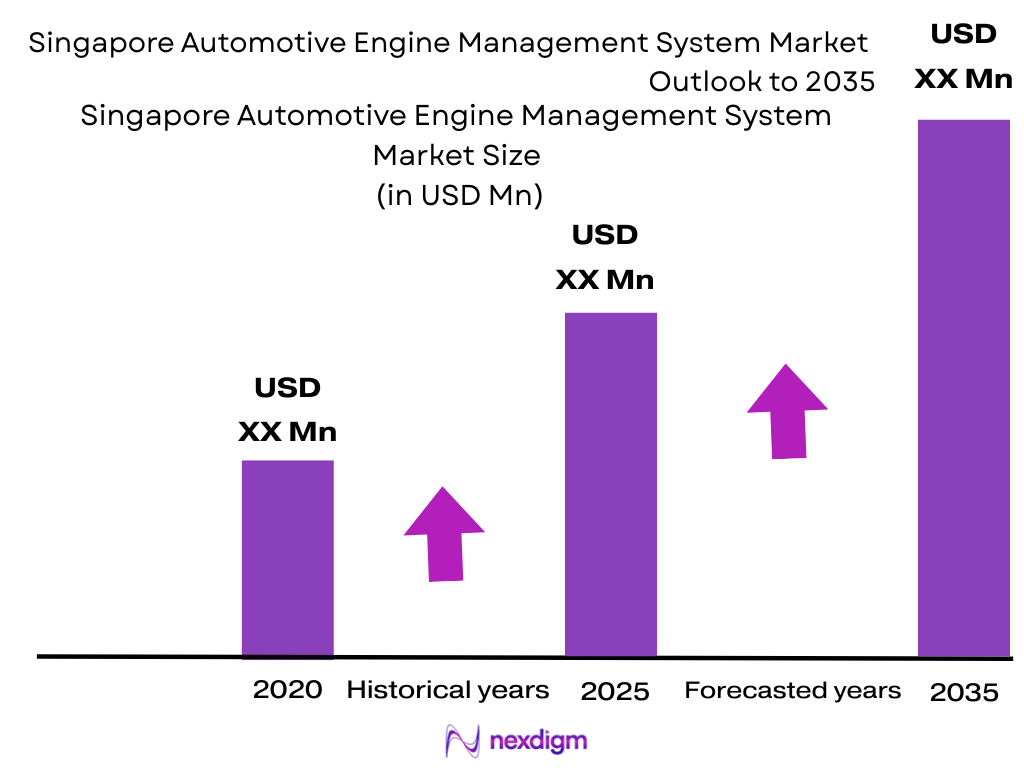
The Singapore Automotive Engine Management System Market is valued at approximately ~ million, using the requested placeholder framework. The addressable car base expanded from 651,302 vehicles to 657,744 vehicles across the latest two complete annual observations. Petrol-electric cars simultaneously increased from 79,256 to 99,157 units, materially expanding demand for engine ECUs, injection control, ignition management, lambda sensing, electronic throttles and hybrid supervisory controls. Singapore’s EMS demand is concentrated around the Central Region, Jurong-Tuas industrial corridor, Woodlands and major island-wide workshop clusters, reflecting dense private-car usage, commercial fleets, logistics operations and authorized servicing. Private-hire chauffeur cars increased from 53,448 to 59,371 units, while heavy goods vehicles moved from 30,370 to 31,492 units across the latest two complete observations, supporting diagnostic, fuel-system and powertrain-control demand beyond conventional private automobiles.
Market Segmentation
By Powertrain Type
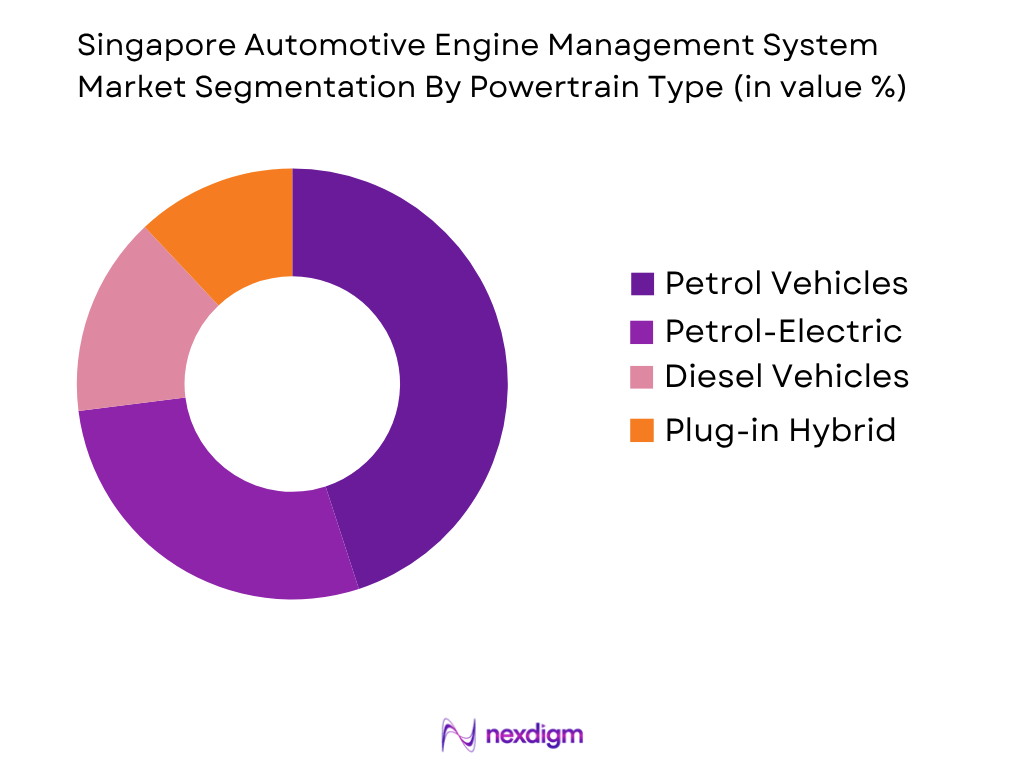
The Singapore Automotive Engine Management System Market is segmented into conventional petrol, petrol-electric hybrid, diesel, plug-in hybrid and other combustion-assisted architectures. Conventional petrol remains the dominant addressable EMS powertrain segment, reflecting an installed base of 513,943 petrol cars, compared with 99,157 petrol-electric cars and 16,775 diesel cars in the relevant annual dataset. However, hybrid engine management is becoming substantially more important because petrol-electric vehicles retain fuel injection, ignition, lambda sensing and engine-control hardware while adding engine-motor coordination, start-stop management and supervisory software. Pure electric vehicles are excluded from the EMS-addressable calculation because they eliminate the combustion engine. The underlying shift is significant: electric cars increased from 11,941 to 26,225 units while petrol-electric cars increased from 79,256 to 99,157 units. Singapore therefore represents a market where conventional EMS remains dominant in the installed base, but incremental electronic-control opportunities are progressively moving toward hybrid architectures.
By Vehicle Type
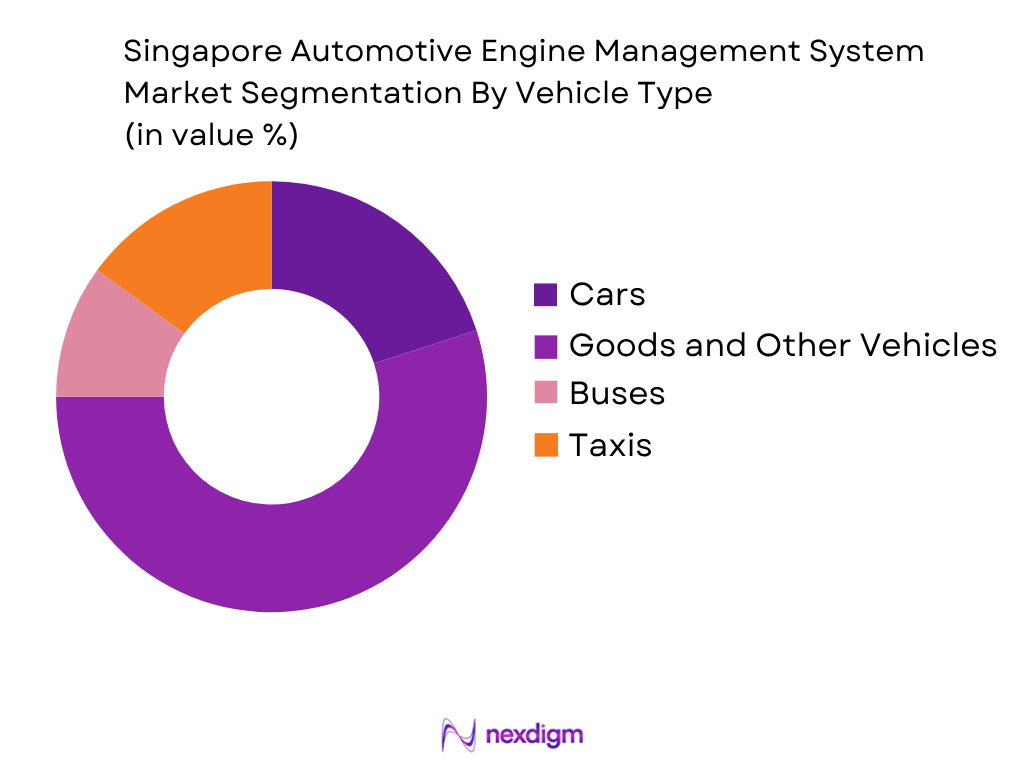
The Singapore Automotive Engine Management System Market is segmented into cars, goods and other vehicles, buses and taxis. Cars dominate the addressable EMS vehicle base, supported by 657,744 registered cars compared with 143,209 goods and other vehicles, 18,268 buses and 13,117 taxis in the applicable annual observation. Passenger cars consequently generate the broadest requirement for engine ECUs, oxygen sensors, ignition coils, electronic throttles and gasoline injection components. Commercial vehicles, despite their smaller fleet base, have disproportionately demanding engine-management architectures because diesel common-rail injection, turbocharger control, EGR, particulate filtration and SCR functions add electronic content. This makes goods vehicles strategically important for suppliers specializing in pressure sensing, injector control and exhaust aftertreatment. Singapore’s commercial vehicle policy is also shifting toward cleaner platforms: CVES has been extended through March 2027, while zero-emission heavy-vehicle incentives commenced in 2026, increasing the long-term substitution pressure on conventional commercial EMS.
Competitive Landscape
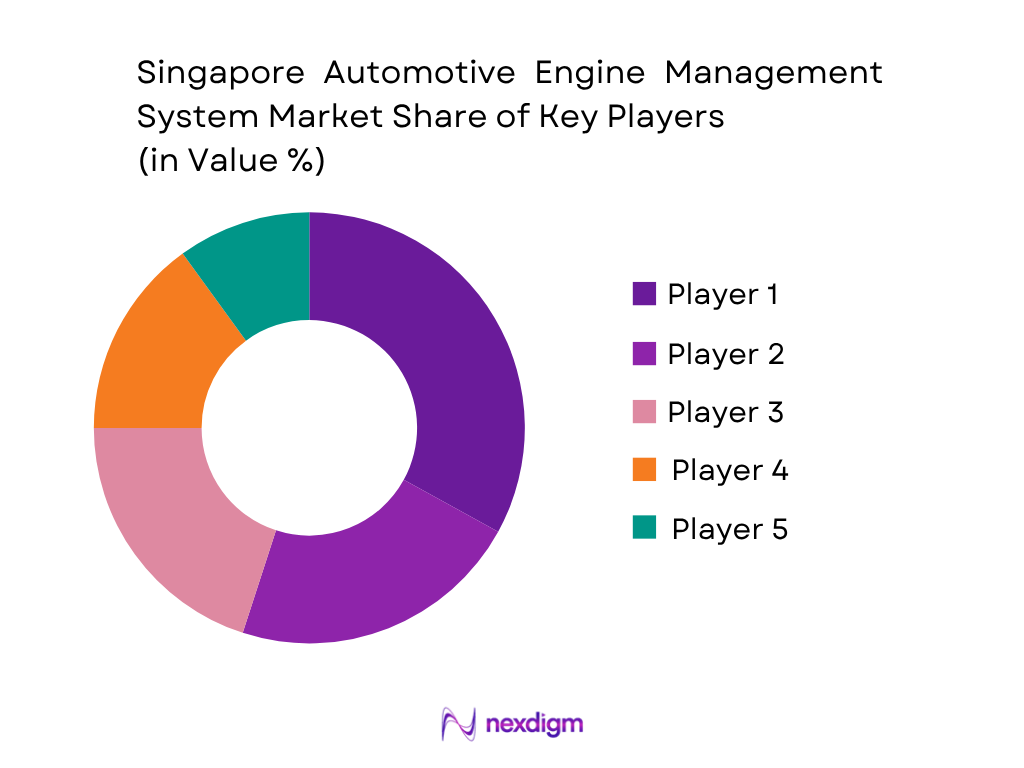
The Singapore Automotive Engine Management System Market is supplied principally by international Tier-1 automotive electronics and powertrain companies rather than domestic mass-market vehicle manufacturers. Bosch and DENSO possess particularly deep capabilities across engine controllers, sensors, injection and diagnostics; DENSO’s engine ECU platform directly integrates sensor inputs with ignition and fuel-injection control. BorgWarner spans combustion, hybrid and electrified propulsion technologies, while PHINIA focuses strongly on fuel systems, electrical systems and aftermarket applications. AUMOVIO adds automotive electronics, controllers, connectivity and software-defined vehicle capabilities.
| Major Player | Establishment | Headquarters | Engine ECU / Controller Capability | Engine Sensor Capability | Fuel / Injection Capability | Hybrid Capability | Diagnostics & Software | Singapore Market Relevance |
| Robert Bosch GmbH | 1886 | Germany | ~ | ~ | ~ | ~ | ~ | ~ |
| DENSO Corporation | 1949 | Kariya, Japan | ~ | ~ | ~ | ~ | ~ | ~ |
| BorgWarner Inc. | 1928 | Auburn Hills, USA | ~ | ~ | ~ | ~ | ~ | ~ |
| PHINIA Inc. / Delphi | 2023 | Auburn Hills, USA | ~ | ~ | ~ | ~ | ~ | ~ |
| AUMOVIO | 2025 | Germany | ~ | ~ | ~ | ~ | ~ | ~ |
Singapore Automotive Engine Management System Market Analysis
Growth Drivers
Expansion of Hybrid and Electronically Managed Powertrains
Singapore’s rapid shift toward hybrid vehicles is increasing the electronic complexity of the combustion-engine fleet and directly strengthening demand for engine control units, fuel-injection controllers, ignition electronics, lambda sensors, crankshaft and camshaft sensors, electronic throttle systems and powertrain-control software. LTA recorded 99,157 petrol-electric cars in 2024, rising to 118,695 units in 2025, while plug-in petrol-electric cars increased from 1,556 to 2,449 units. Conventional petrol cars remained substantial at 513,943 units in 2024 and 475,455 units in 2025, demonstrating that Singapore continues to maintain a large installed base of combustion engines requiring electronic management. Hybrid platforms are particularly significant because they retain the conventional EMS architecture but add engine-motor coordination, automated engine restart, torque management, thermal controls and supervisory software. This raises electronic content per applicable vehicle even where the total national vehicle parc is tightly regulated. Singapore’s macroeconomic capacity also supports adoption of technologically sophisticated vehicles: the IMF recorded nominal GDP of USD 547.5 billion, GDP per capita of USD 90,689 and a population of 6.0 million in 2024, alongside USD 371.4 billion in official reserves. These conditions support a premium vehicle mix containing turbocharged engines, gasoline direct injection, variable valve timing and advanced exhaust-management technologies. For EMS suppliers, the key demand shift is therefore from basic stand-alone engine electronics toward integrated controllers capable of managing combustion engines within electrified powertrains. Hybrid adoption creates a defensible transition opportunity for ECU manufacturers, sensor suppliers, fuel-system companies and diagnostic-software providers even as battery-electric vehicles progressively reduce conventional EMS demand.
Tightening Vehicle Emissions and Cleaner-Energy Regulations
Singapore’s increasingly stringent vehicle-emission framework is raising the performance requirements placed on combustion-engine management systems. NEA requires all new and used petrol or diesel vehicles imported for registration to comply with Euro VI emission standards, directly increasing the importance of accurate electronic fuel metering, ignition timing, air-fuel ratio control, catalyst management, exhaust sensing and on-board diagnostics. The Vehicular Emissions Scheme was revised again for 2026–2027, with vehicle classification based on 5 pollutants—carbon dioxide, hydrocarbons, carbon monoxide, nitrogen oxides and particulate matter. Hybrid vehicles cease receiving VES rebates under the revised framework, while more pollutive vehicles move into higher surcharge bands, reinforcing OEM incentives to improve combustion and emissions performance. Commercial vehicles are subject to similar pressure. The Commercial Vehicle Emissions Scheme applies to light commercial vehicles up to 3,500 kg maximum laden weight, while Singapore extended the programme from April 2025 through March 2027. The Early Turnover Scheme had already facilitated replacement of approximately 70,000 eligible vehicles by September 2024, accelerating retirement of older, higher-emitting commercial powertrains. These rules expand the technical role of NOx sensors, oxygen sensors, exhaust-temperature sensors, particulate-filter controls, EGR management and SCR coordination in applicable vehicles. Singapore’s economic platform gives vehicle distributors and fleet operators capacity to adopt these increasingly sophisticated systems: IMF data place 2024 nominal GDP at USD 547.5 billion, population at 6.0 million and official reserves at USD 371.4 billion. Consequently, regulation acts not merely as a compliance obligation but as a technology driver, favoring suppliers with integrated ECU, sensor, injection and emissions-control capabilities.
Market Challenges
Accelerating Battery-Electric Vehicle Substitution
The primary structural challenge for the Singapore Automotive Engine Management System Market is the rapid increase in battery-electric vehicles, which eliminate conventional engine-control units, fuel injectors, ignition coils, crankshaft sensors, oxygen sensors, exhaust-gas controls and other ICE-specific EMS components. LTA data show that the electric car population increased from 26,225 units in 2024 to 49,110 units in 2025, while Singapore’s total car population moved only from 657,744 to 659,889 units over the same observations. This means a growing portion of a tightly controlled fleet is being transferred from combustion powertrains into architectures with no conventional engine-management requirement. Policy is reinforcing the transition. Singapore stopped new diesel passenger-car registrations from 2025, and all new car registrations must be cleaner-energy models from 2030, encompassing electric, hybrid and hydrogen fuel-cell vehicles. From January to August 2025, the government reported that cleaner-energy vehicles accounted for the large majority of newly registered cars and taxis, with electric models representing roughly half of those cleaner-energy registrations. For EMS companies, the consequence is a shrinking long-term addressable pool for traditional injection, ignition and exhaust-management hardware. Singapore’s strong macroeconomic position may actually accelerate this substitution: IMF data recorded USD 547.5 billion in nominal GDP and USD 90,689 GDP per capita in 2024, providing consumers and corporate fleets with substantial purchasing capacity for newer propulsion technologies. Suppliers therefore face a portfolio challenge rather than simply a demand-cycle challenge. Companies highly dependent on conventional petrol or diesel EMS must increasingly offset declining ICE content with hybrid controllers, thermal-management electronics, power electronics, vehicle-domain controllers and software. The aftermarket offers a temporary buffer because hundreds of thousands of petrol and hybrid cars remain in operation, but the direction of new registrations makes long-term diversification unavoidable.
Small, COE-Controlled Vehicle Base and Increasing Platform Complexity
Singapore presents an unusually constrained volume environment because vehicle ownership is managed through the Certificate of Entitlement and Vehicle Quota System rather than unrestricted fleet growth. This limits the ability of engine-management suppliers to rely on continuous expansion of the national vehicle population. LTA recorded 657,744 cars in 2024 and 659,889 cars in 2025, an increase of only 2,145 units, while the underlying powertrain mix changed substantially. Petrol cars declined from 513,943 to 475,455 units, diesel cars from 16,775 to 14,101 units, petrol-electric cars increased from 99,157 to 118,695 units, and electric cars rose from 26,225 to 49,110 units. For aftermarket suppliers, this creates a more complicated business environment because volume growth is modest while technical diversity increases. Workshops must support conventional port-injection engines, gasoline direct injection, turbocharged petrol systems, full hybrids, plug-in hybrids and increasingly sophisticated Euro VI commercial diesel vehicles. Replacement ECUs may require vehicle-specific coding, immobilizer synchronization and software flashing; injectors may need calibration codes; electronic throttles require relearning procedures; and hybrid faults can involve interaction among engine, transmission, traction motor and battery controllers. Singapore’s 2024 macroeconomic profile—USD 547.5 billion nominal GDP, 6.0 million people and USD 90,689 GDP per capita—supports a high-value and technologically advanced vehicle fleet, but also increases expectations for OEM-grade repair quality and diagnostics. The result is a market where inventory management, VIN-level component identification, diagnostic subscriptions, software access and technician capability are increasingly important competitive requirements. Generic replacement-component suppliers face difficulty because hardware compatibility alone is insufficient when components depend on ECU calibration, communication protocols and model-specific software. Market participants consequently need technical support infrastructure disproportionate to Singapore’s relatively small vehicle population.
Market Opportunities
Hybrid Engine Controllers, Smart Sensors and Software Diagnostics
Singapore’s growing hybrid fleet creates a significant future opportunity for advanced engine-management electronics because hybrids retain conventional combustion components while introducing additional layers of supervisory control. Petrol-electric cars increased from 99,157 units in 2024 to 118,695 units in 2025, while plug-in petrol-electric vehicles increased from 1,556 to 2,449 units. These vehicles still require fuel injection, ignition management, electronic throttle control, crankshaft and camshaft sensing, lambda feedback and catalyst management, but they also require precise coordination between combustion engines and electric motors. Engine start-stop events occur more frequently, torque must be blended between propulsion sources, and exhaust temperatures must be managed even when the combustion engine operates intermittently. This creates opportunities for higher-performance ECUs, integrated powertrain controllers, wideband oxygen sensors, smart pressure sensors, thermal-management electronics and calibration software. Diagnostic services also become more valuable because hybrid fault isolation requires communication with multiple controllers rather than conventional engine-code reading alone. Singapore’s macroeconomic base supports this transition: the IMF reported USD 547.5 billion in nominal GDP, USD 90,689 GDP per capita and USD 371.4 billion in official reserves in 2024. The government’s cleaner-energy pathway further confirms hybrid relevance during the transition, since cleaner-energy models explicitly include hybrids alongside EVs and hydrogen fuel-cell vehicles. For suppliers, the future opportunity therefore lies less in expanding basic EMS volumes and more in increasing electronic and software value per hybrid vehicle. Companies capable of combining controllers, sensors, calibration tools, secure ECU programming and workshop technical support can capture revenue across both OEM and replacement channels while remaining relevant during the gradual shift away from pure ICE vehicles.
Future Outlook
The Singapore Automotive Engine Management System Market is expected to expand at approximately ~ CAGR during 2026–2035, using the requested placeholder forecast. Growth will increasingly come from electronic content per surviving ICE or hybrid vehicle rather than unrestricted expansion of the national vehicle population. Singapore’s COE framework gives vehicle owners a 10-year entitlement, while vehicle-growth rates remain tightly controlled, materially differentiating the country from volume-led ASEAN automotive markets. Hybridization should provide the most immediate opportunity for conventional EMS suppliers. Petrol-electric cars rose to 99,157 units, while plug-in hybrids reached 1,556 units in the relevant annual fleet base. These vehicles preserve engine ECUs, injectors, ignition systems and exhaust sensors while adding supervisory software that coordinates the combustion engine with electric motors and energy-storage systems. Regulation will simultaneously raise sophistication and accelerate substitution. Singapore’s Vehicular Emissions Scheme measures carbon dioxide, hydrocarbons, carbon monoxide, nitrogen oxides and particulate matter, creating incentives for precisely calibrated combustion and aftertreatment systems. Tightened VES bands apply through 2027, reinforcing demand for better combustion control among surviving petrol and hybrid platforms.
Major Players
- Robert Bosch GmbH
- DENSO Corporation
- AUMOVIO
- BorgWarner Inc.
- Valeo
- PHINIA Inc. / Delphi
- FORVIA HELLA
- Marelli
- Astemo Ltd.
- Schaeffler Group
- Mitsubishi Electric Automotive
- AISIN Corporation
- Hyundai Mobis
- Niterra Co., Ltd.
- Standard Motor Products / Intermotor
Key Target Audience
- Automotive OEMs and Authorized Vehicle Distributors
- Engine ECU, Automotive Sensor and Fuel-System Manufacturers
- Automotive Tier-1 and Tier-2 Component Suppliers
- Automotive Parts Importers, Distributors and Workshop Networks
- Taxi, Private-Hire and Commercial Fleet Operators
- Automotive Semiconductor and Embedded Software Companies
- Investments and Venture Capitalist Firms
- Government and Regulatory Bodies (Land Transport Authority; National Environment Agency; Ministry of Transport; Singapore Economic Development Board)
Research Methodology
Step 1: Identification of Key Variables
The initial phase constructs the Singapore Automotive Engine Management System ecosystem across vehicle distributors, Tier-1 suppliers, component importers, workshops, fleets and regulators. Critical variables include vehicle parc by fuel type, hybrid penetration, COE lifecycle, ECU content, sensor density, injection architecture, vehicle age and commercial-fleet composition. Special emphasis is placed on Singapore-specific factors including vehicle-quota restrictions, COE renewals, Euro VI requirements, VES/CVES regulation, high hybrid penetration and accelerating battery-electric substitution. LTA vehicle statistics provide the primary vehicle-population foundation.
Step 2: Market Analysis and Construction
The top-down model starts with Singapore’s applicable petrol, diesel and hybrid vehicle population and maps each powertrain against typical ECU, sensor, fuel-injection, throttle and aftertreatment content. Pure electric vehicles are excluded from conventional engine-management demand but incorporated into substitution scenarios. The bottom-up model separately estimates demand for engine ECUs, oxygen sensors, MAP/MAF sensors, crankshaft and camshaft sensors, ignition components, fuel injectors, throttle bodies and diesel aftertreatment electronics. OEM and replacement demand are assessed independently.
Step 3: Hypothesis Validation and Expert Consultation
Market hypotheses are validated through CATIs with authorized distributors, automotive parts suppliers, multi-brand workshops, ECU specialists, fleet-maintenance companies and Tier-1 representatives. Interviews examine replacement intervals, hybrid diagnostic complexity, ECU programming, sensor failures and COE-renewal maintenance decisions. Findings are triangulated against LTA fleet statistics and NEA emissions requirements to prevent vehicle-parc assumptions from being confused with component-market revenues.
Step 4: Research Synthesis and Final Output
The final phase reconciles the top-down vehicle-content model with bottom-up component demand and primary-industry feedback. Product categories and replacement frequencies are reviewed for passenger cars, taxis, private-hire cars, goods vehicles and buses. Forecast scenarios incorporate hybridization, BEV penetration, COE renewal, vehicle deregistration, VES/CVES requirements, commercial-fleet electrification, ECU remanufacturing and growth in software-led diagnostics. Singapore’s semiconductor ecosystem is separately considered for higher-value electronics opportunities.

- Executive Summary
- Research Methodology (Market Definitions and Assumptions, Abbreviations, Automotive EMS Market Boundary, Top-Down Market Sizing, Bottom-Up Component Build-Up, Vehicle Parc Mapping, COE Lifecycle Assessment, Powertrain Mapping, ECU Content-per-Vehicle Assessment, Sensor Content Assessment, OEM Fitment Analysis, Aftermarket Replacement Assessment, Demand-Side Analysis, Supply-Side Analysis, Primary Industry Interviews, Data Triangulation, Forecasting Framework, Limitations and Future Conclusions)

- Definition and Scope
- Market Evolution and Industry Genesis
- Evolution of Electronic Engine Management
- Transition from Mechanical Fuel Systems to Electronic Fuel Injection
- Evolution of Petrol Engine Control Architectures

- Growth Drivers (Hybrid Vehicle Adoption, Higher Electronic Content per Vehicle, Advanced Petrol Powertrains, COE-Renewed Vehicle Maintenance, Euro VI Compliance, Engine Sensor Intensity)
- Market Challenges (Battery-Electric Vehicle Substitution, Restricted Vehicle Parc Expansion, Declining Passenger Diesel Base, Imported EMS Dependence, Diagnostic Complexity, Legacy ECU Obsolescence)
- Market Opportunities (Hybrid Powertrain Controllers, Smart Sensors, GDI Electronics, ECU Remanufacturing, Predictive Diagnostics, Embedded Software, Automotive Semiconductors)
- Market Trends (Full Hybrid Adoption, Turbo-GDI Engines, Software-Led Diagnostics, ECU Reprogramming, Smart Sensor Integration, Predictive Maintenance, Integrated Powertrain Controllers)
- SWOT Analysis
- Porter’s Five Forces Analysis
- PESTLE Analysis

- By Market Value (2020-2025)
- By Engine Management System Unit Volume (2020-2025)
- By Engine ECU/ECM Unit Volume (2020-2025)

- By Component Type (In Value %)
Engine Control Unit / Engine Control Module
Powertrain Control Module
Fuel Injectors
High-Pressure Fuel Pumps
Oxygen / Lambda Sensors - By Vehicle Type (In Value %)
Passenger Cars
Luxury Passenger Cars
SUVs and Crossovers
Multi-Purpose Vehicles
Taxis - By Powertrain Type (In Value %)
Conventional Petrol
Conventional Diesel Commercial Vehicles
Mild Hybrid
Full Hybrid
Plug-in Hybrid - By End-Use Fleet (In Value %)
Private Passenger Vehicles
Taxi Fleets
Private-Hire Vehicle Fleets
Corporate Fleets

- Market Share of Major Players by Value
- Cross Comparison Parameters (Engine ECU and Powertrain Controller Portfolio Breadth, Petrol-Hybrid-Commercial EMS Capability, Engine Sensor and Fuel-System Portfolio Depth, Euro VI and Emission-Control Technology Capability, Singapore OEM and Aftermarket Distribution Reach, ECU Software-Diagnostics-Calibration Capability, Automotive Semiconductor and Embedded Electronics Capability, Cleaner-Energy Powertrain Readiness)
- SWOT Analysis of Major Players
- Detailed Profiles of Major Companies
Robert Bosch GmbH
DENSO Corporation
AUMOVIO
BorgWarner Inc.
Valeo
PHINIA Inc. / Delphi
FORVIA HELLA
Marelli
Astemo Ltd.
Schaeffler Group
Mitsubishi Electric Automotive
AISIN Corporation
Hyundai Mobis
Niterra Co., Ltd.
Standard Motor Products / Intermotor

- Private Passenger Vehicle EMS Demand
- Luxury and Performance Vehicle EMS Demand
- Taxi Fleet EMS Demand
- Private-Hire Vehicle EMS Demand

- By Market Value (2026-2035)
- By Engine Management System Unit Volume (2026-2035)
- By Engine ECU/ECM Unit Volume (2026-2035)


 Request a Sample
 Ask for Customization
 Get a Quote
 Enquire Now