

 Download PDF
Market Overview
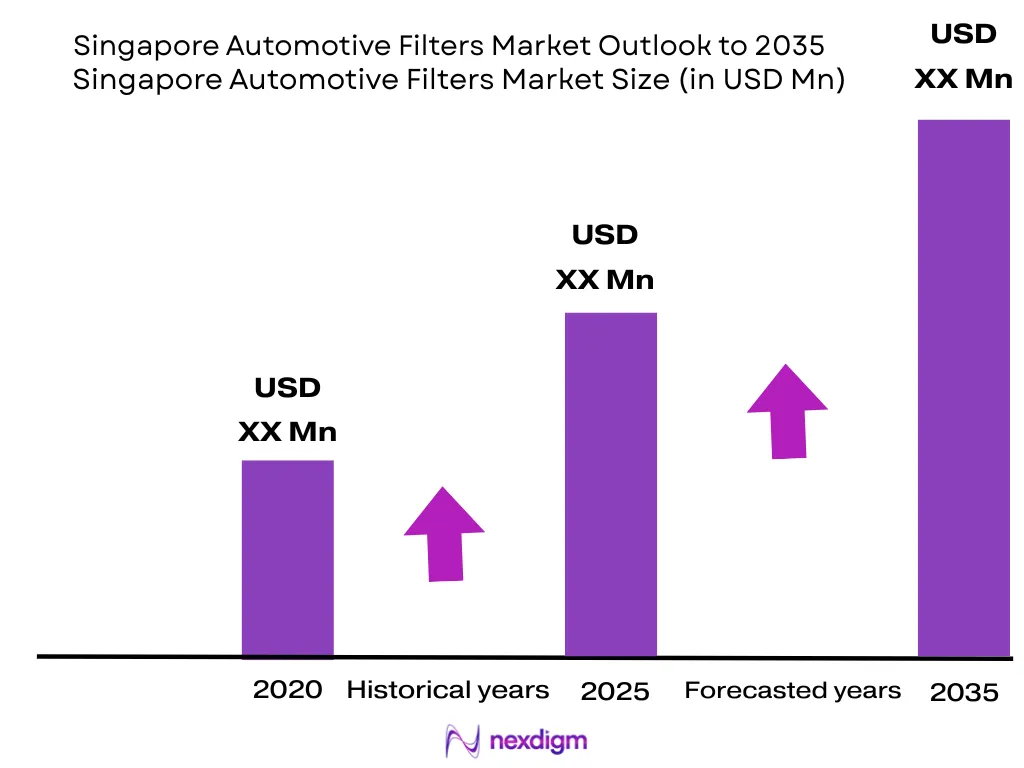
The Singapore Automotive Filters Market is valued at approximately ~ million, compared with ~ million in the preceding reporting period. Demand is supported by an overall motor-vehicle population exceeding 1.0 million units, including roughly 570,000 cars, 90,000 private-hire cars, 13,000 taxis, and 18,000 buses. COE-driven vehicle retention, high workshop expenditure, intensive fleet mileage, Euro VI systems, tropical humidity, and continuous air-conditioning usage sustain replacement-filter demand. The Central, East, and West regions dominate the Singapore Automotive Filters Market because they concentrate vehicle dealerships, workshops, taxi and private-hire operations, logistics facilities, bus depots, ports, and industrial activity. Ubi, Kaki Bukit, Sin Ming, Alexandra, and Leng Kee support passenger-vehicle servicing, while Jurong, Tuas, Pandan, Woodlands, and Changi generate commercial-vehicle, logistics, airport, construction, and material-handling filtration demand. These clusters also provide warehousing and rapid parts fulfilment across the city-state. Singapore’s automotive filters market covers products installed in private cars, company cars, taxis, private-hire vehicles, motorcycles, light goods vehicles, heavy goods vehicles, public buses, private coaches, construction equipment, and specialised municipal vehicles. The product scope includes engine-air filters, oil filters, fuel filters, cabin-air filters, transmission filters, hydraulic filters, crankcase ventilation filters, coolant filters, diesel particulate filters, gasoline particulate filters, selective catalytic reduction filters, diesel exhaust fluid filters, battery-cooling filters, and electric-drive filtration products.
Market Segmentation
By Filter Type
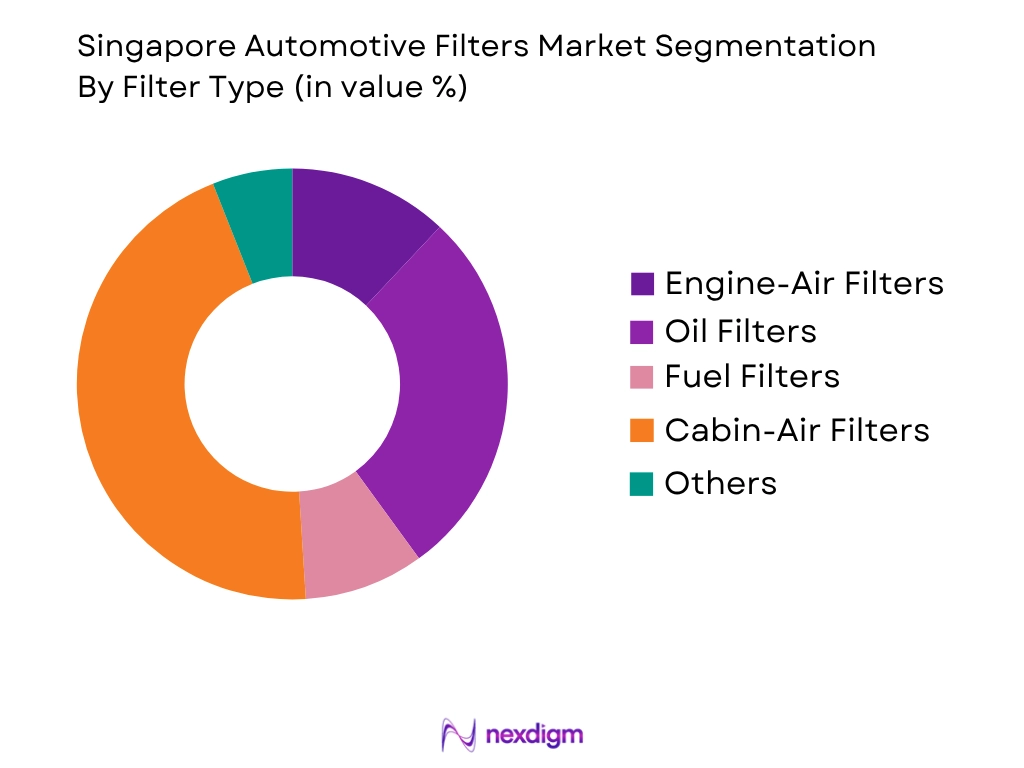
By filter type, the Singapore Automotive Filters Market is segmented into cabin-air filters, oil filters, engine-air filters, fuel filters, emission-control filters, transmission and hydraulic filters, and electric-vehicle or other filters. Cabin-air filters hold the dominant market share because they apply across petrol, diesel, hybrid, plug-in hybrid, and battery-electric vehicles. Singapore’s warm and humid climate supports extensive air-conditioning use throughout the year. High-mileage taxis, private-hire cars, buses, delivery vehicles, and household cars circulate air continuously through HVAC systems, accelerating filter loading. Urban traffic, construction activity, road dust, pollen, odours, and periodic regional haze strengthen demand for particulate, activated-carbon, antimicrobial, allergen-reduction, and multilayer cabin filters. Cabin filtration is also insulated from powertrain substitution: unlike oil, fuel, or engine-air filters, it remains necessary as the vehicle population electrifies. Premium vehicles and EVs further support higher-value products offering fine-particle capture, gas adsorption, low airflow resistance, and improved occupant comfort.
By Vehicle Type
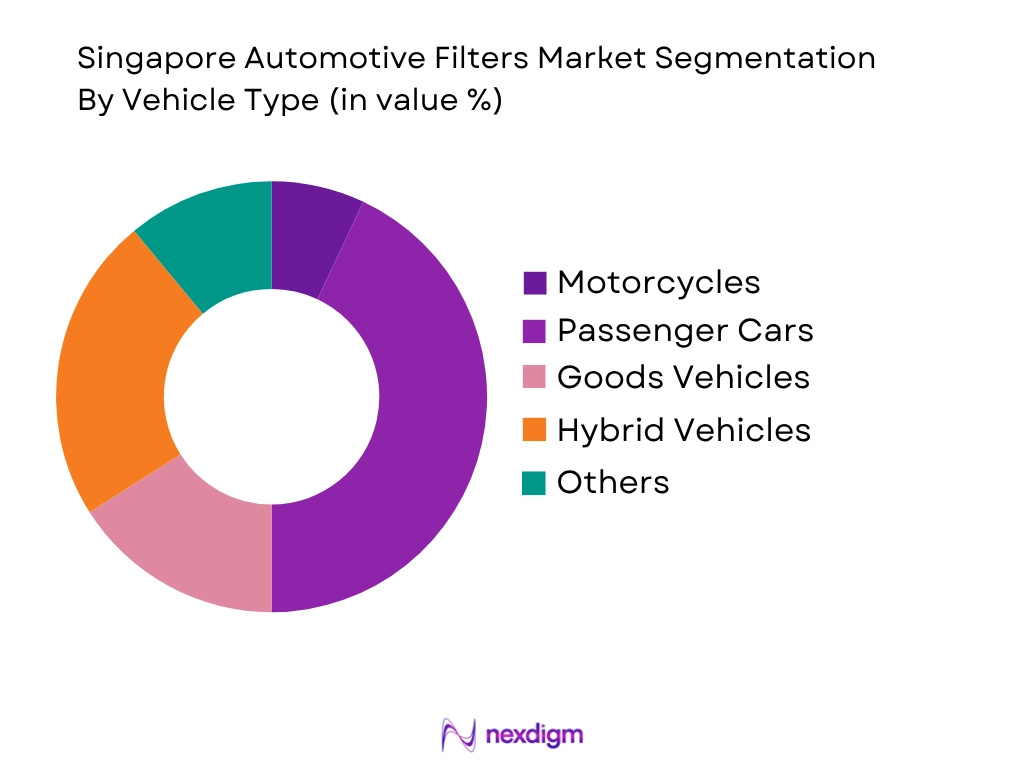
By vehicle type, the Singapore Automotive Filters Market is segmented into private passenger cars, taxis and private-hire cars, commercial vehicles, buses and coaches, motorcycles, hybrid vehicles, electric vehicles, and off-highway equipment. Private passenger cars hold the dominant value share because the car population exceeds 647,000 units when private cars, company cars, taxis, private-hire cars, and related categories are considered collectively. Passenger cars typically require cabin, oil, engine-air, fuel, transmission, and emission-system filtration. Their high asset values and COE-linked ownership costs encourage owners to maintain vehicle reliability and residual value. COE-renewed vehicles generate particularly broad filter demand because older engines and transmissions require closer maintenance. Taxis and private-hire cars form a smaller installed population but generate disproportionate replacement frequency through high annual mileage. Commercial vehicles and buses contribute premium diesel filtration, fuel-water separation, DPF, SCR, crankcase, air-dryer, and heavy-duty oil-filter demand. LTA statistics show that Singapore’s vehicle population remains large despite strict growth controls.
Competitive Landscape
The Singapore Automotive Filters Market includes global filtration specialists, Japanese and European automotive suppliers, heavy-duty filtration companies, regional distributors, genuine-parts networks, and private-label brands. MANN+HUMMEL, Bosch, DENSO, MAHLE, and Donaldson compete through original-equipment relationships, broad vehicle coverage, filter-media technology, Euro VI compatibility, digital catalogues, and established Southeast Asian supply networks. Competition is fragmented at workshop level. Authorised dealers promote genuine filters, while independent workshops compare original-equipment-supplier brands, premium aftermarket products, Japanese applications, European filters, and lower-priced alternatives. Availability and fitment accuracy are particularly important because Singapore has official imports, parallel imports, multiple engine variants, hybrids, EVs, and COE-renewed vehicles spanning numerous model years.
| Company | Established | Headquarters | Core Portfolio | Vehicle Coverage | Euro VI Capability | Media Technology | Fleet Capability | EV Readiness |
| MANN+HUMMEL | 1941 | Ludwigsburg, Germany | ~ | ~ | ~ | ~ | ~ | ~ |
| Robert Bosch | 1886 | Gerlingen, Germany | ~ | ~ | ~ | ~ | ~ | ~ |
| DENSO | 1949 | Kariya, Japan | ~ | ~ | ~ | ~ | ~ | ~ |
| MAHLE | 1920 | Stuttgart, Germany | ~ | ~ | ~ | ~ | ~ | ~ |
| Donaldson Company | 1915 | Bloomington, United States | ~ | ~ | ~ | ~ | ~ | ~ |

Singapore Automotive Filters Market Analysis
Growth Drivers
COE-Driven Vehicle Retention and Recurring Preventive Maintenance
Singapore’s Certificate of Entitlement framework supports automotive-filter replacement by encouraging owners to extract greater operational value from high-cost vehicles and, in many cases, renew them beyond the initial ten-year entitlement period. Older and COE-renewed cars require closer monitoring of engine-air, oil, fuel, transmission, cabin, crankcase, and emission-control filtration to preserve reliability and pass mandatory inspections. Singapore had 1,007,094 motor vehicles in 2024, including 569,956 cars, 90,383 private-hire cars, 13,117 taxis, and 18,698 buses. This tightly controlled but substantial installed population creates recurring maintenance demand even when annual fleet expansion remains limited. Petrol and hybrid cars retain engine-air and oil-filter requirements, while diesel goods vehicles and buses use fuel-water separators, particulate filters, crankcase systems, and selective catalytic reduction components. Singapore’s economy expanded by 4.0% in 2024, compared with 1.1% in 2023, supporting household income, business mobility, workshop expenditure, and fleet utilisation. The IMF projects a population of 6.121 million people and real GDP growth of 3.5% in 2026. These conditions favour premium filters with accurate fitment, longer service life, dependable bypass settings, high moisture resistance, and documented filtration performance, particularly for owners retaining vehicles beyond warranty periods.
High-Mileage Taxi, Private-Hire, Bus, and Logistics Operations
Singapore’s intensive urban transport system creates frequent filter replacement among taxis, private-hire cars, delivery vans, goods vehicles, and buses. The country operated 90,383 private-hire cars, 13,117 taxis, and 18,698 buses in 2024, alongside a large commercial-vehicle population serving ports, airports, industrial estates, construction sites, retailers, and last-mile delivery networks. These vehicles accumulate greater mileage and engine hours than typical household cars, exposing engine oil, intake systems, cabin HVAC units, transmissions, and diesel after-treatment systems to sustained stop-start operation. Private-hire and taxi vehicles create strong cabin-filter demand because air-conditioning runs continuously and occupants change frequently. Diesel goods vehicles and buses require precise fuel filtration, water separation, crankcase ventilation, diesel particulate filtration, and urea-system maintenance. Singapore was ranked first in the World Bank’s 2023 Logistics Performance Index, reflecting its high-volume trade and transhipment functions. The economy expanded by 4.0% in 2024, while the IMF projects 3.5% real GDP growth in 2026, supporting continued movement of goods, workers, tourists, and passengers. Suppliers can address this demand through fleet-specific replacement schedules, depot delivery, filter-service bundles, automatic replenishment, telematics-linked maintenance, and high-capacity media designed for frequent urban duty cycles.
Market Challenges
Rapid Electrification and Reduced Conventional Filter Content
Singapore’s accelerating transition toward battery-electric vehicles presents a structural challenge to suppliers concentrated in engine-air, engine-oil, fuel, crankcase, and tailpipe-filtration products. A battery-electric car eliminates these conventional components because it has no internal-combustion engine, fuel-injection system, lubricant circuit for engine operation, or exhaust after-treatment system. Electrification is being reinforced through registration incentives, charging infrastructure, fleet policies, and the requirement for all new car and taxi registrations to use cleaner-energy models from 2030. The existing population still provides replacement demand, but each electric vehicle entering service reduces the future number of traditional filters installed per vehicle. Suppliers must therefore manage declining conventional content while adding cabin-air filters, battery-cooling filters, high-voltage battery vent membranes, electric-drive lubrication filters, desiccants, and thermal-management fluid filtration. This transition increases engineering, catalogue, inventory, and technician-training requirements. Singapore’s economy expanded by 4.0% in 2024, while the IMF projects real GDP growth of 3.5%, consumer-price growth of 2.3%, and a population of 6.121 million in 2026. These indicators support mobility expenditure, but they do not offset the reduction in combustion-related filter content. Companies that remain dependent on oil, fuel, and engine-air products may therefore experience portfolio contraction despite stable vehicle utilisation.
Controlled Vehicle Population, Import Dependence, and Fitment Complexity
Singapore’s automotive-filter suppliers operate within a vehicle market constrained by the Vehicle Quota System and a generally zero-growth policy for cars and motorcycles. This limits expansion of the installed base and makes growth dependent on premiumisation, replacement frequency, fleet mileage, and filtration content rather than large increases in vehicle numbers. The market is also dependent on imported finished filters, specialised media, activated carbon, resins, valves, seals, and housings. International freight disruption or supplier concentration can therefore affect inventory availability. Fitment complexity is elevated because Singapore’s fleet contains authorised imports, parallel imports, Japanese domestic-market specifications, European vehicles, Chinese EVs, petrol-electric hybrids, commercial diesels, and COE-renewed models spanning numerous production years. The vehicle population reached 1,007,094 units in 2024, forcing distributors to maintain extensive long-tail catalogues despite limited unit demand for individual applications. Incorrect bypass pressure, gasket dimensions, media specification, or engine-code matching can cause oil leakage, fuel restriction, air bypass, or warranty claims. Singapore’s economy grew by 4.0% in 2024, while the IMF projects headline consumer-price growth of 2.3% in 2026. Rising operating, warehousing, and labour expenses increase pressure on distributor margins. Organised suppliers require registration-based fitment systems, digital cross-references, QR authentication, disciplined inventory planning, and same-day workshop fulfilment to manage these constraints.
Market Opportunities
Premium Cabin-Air Filtration for Humidity, Urban Pollution, and Fleet Usage
Cabin-air filtration is the strongest powertrain-neutral opportunity in Singapore because it remains required in petrol, diesel, hybrid, plug-in hybrid, and battery-electric vehicles. Warm, humid conditions encourage year-round air-conditioning, creating continuous airflow through cabin filters and accelerating the accumulation of road particles, pollen, odours, construction dust, traffic contaminants, and biological matter. The opportunity is especially attractive across 90,383 private-hire cars, 13,117 taxis, 18,698 buses, and nearly 570,000 cars recorded in 2024. High-mileage passenger-service vehicles carry changing occupants throughout the day, increasing the operational importance of clean HVAC systems and low airflow restriction. Standard particulate products can be upgraded to activated-carbon, antimicrobial, allergen-reduction, electrostatic, biofunctional, and multilayer filters. Regional haze episodes further strengthen awareness of fine-particle exposure, although automotive cabin filters cannot substitute for broader air-quality controls. Singapore’s economy expanded by 4.0% in 2024, while the IMF projects GDP per capita of approximately USD 107,760, real growth of 3.5%, and a population of 6.121 million in 2026. This high-income operating environment supports premium filter tiers, digital replacement reminders, cabin inspections during servicing, fleet subscriptions, and independently verified claims for particle capture, odour adsorption, humidity resistance, and airflow performance.
Euro VI After-Treatment Services and Connected Fleet Filtration
Singapore’s stringent vehicle-emission framework creates an opportunity for advanced filtration products, diagnostics, and condition-based fleet maintenance. Petrol vehicles imported for registration must comply with Euro VI requirements, while diesel vehicles have been subject to Euro VI standards since 2018. Modern commercial vehicles use high-pressure common-rail injection, diesel particulate filters, selective catalytic reduction, exhaust-gas recirculation, crankcase ventilation, onboard diagnostics, and diesel exhaust fluid systems. These technologies require efficient fuel filtration, water separation, lubricant cleanliness, particulate capture, and accurate differential-pressure monitoring. The Commercial Vehicle Emissions Scheme has been extended to 31 March 2027, with a SGD 15,000 incentive retained for Band A electric commercial vehicles and a SGD 20,000 surcharge applied to Band C vehicles. This policy will accelerate fleet renewal while sustaining specialist demand for Euro VI filter servicing among remaining diesel fleets. Connected air-restriction sensors, water-in-fuel detection, oil-condition analysis, and DPF-loading monitoring can reduce unnecessary maintenance and prevent costly downtime. Singapore’s logistics leadership and 4.0% economic growth in 2024 support continued operation of goods vehicles, buses, port equipment, and delivery fleets. The IMF projects 3.5% growth in 2026, providing a supportive base for DPF cleaning, core exchange, mobile diagnostics, automated filter replenishment, and recurring cost-per-kilometre maintenance contracts.
Future Outlook
The Singapore Automotive Filters Market is forecast to expand at approximately ~ CAGR during the forecast period. Market development will reflect two opposing forces: high maintenance expenditure on a controlled and relatively valuable vehicle population, and the gradual elimination of engine-related filters as cleaner-energy vehicles become dominant. COE-renewed vehicles, high-mileage private-hire fleets, Euro VI commercial vehicles, premium cabin filtration, and advanced emission-system servicing will sustain replacement demand. Electric mobility will reduce oil, fuel, engine-air, crankcase, and tailpipe-filter demand per new vehicle but create opportunities in cabin, battery-cooling, electric-drive, vent, and thermal-management filtration. Electric cars represented almost one-third of new car registrations during the first half of 2024, compared with around 18% in 2023. Singapore had approximately 18,000 electric cars at that point. For the full reporting period, EVs accounted for about one-third of new cars, while the electric-car population reached approximately 4 out of every 100 cars. All new car registrations must shift to cleaner-energy models from 2030, including electric, hybrid, or hydrogen fuel-cell cars. New diesel car registrations have ceased, further reducing the long-term addressable market for passenger diesel fuel filters, oil filters, and particulate-filter replacements.
Major Players
- MANN+HUMMEL
- Robert Bosch
- DENSO
- MAHLE
- Donaldson Company
- Parker Hannifin
- Atmus Filtration Technologies
- Hengst Filtration
- UFI Filters
- Sogefi Filtration
- Sakura Filter
- JS Asakashi
- Baldwin Filters
- K&N Engineering
- FRAM
Key Target Audience
- Automotive filter and filtration-module manufacturers
- Passenger, hybrid, electric and commercial-vehicle distributors
- Automotive-parts importers, distributors and regional wholesalers
- Authorised service centres and independent automotive workshops
- Taxi, private-hire, bus, logistics and delivery-fleet operators
- Filter-media, activated-carbon, housing, seal and sensor suppliers
- Investments and venture capitalist firms
- Government and regulatory bodies (Land Transport Authority, National Environment Agency, Ministry of Transport, Enterprise Singapore, Singapore Customs, and Public Transport Council)
Research Methodology
Step 1: Identification of Key Variables
The initial phase constructs an ecosystem map covering filter manufacturers, vehicle distributors, parts importers, workshops, taxi operators, private-hire fleets, bus operators, commercial fleets, regulators, and recyclers. Critical variables include vehicle population, COE age, propulsion type, annual mileage, filters per vehicle, replacement intervals, service channel, and product tier.
Step 2: Market Analysis and Construction
Historical vehicle populations, new registrations, deregistrations, COE renewals, fuel types, and fleet categories are compiled. Top-down analysis assesses filtration expenditure within the automotive aftermarket, while bottom-up analysis applies vehicle cohorts, filter content, replacement frequency, average selling value, and workshop installation activity.
Step 3: Supply-Side Assessment
Manufacturers and brands are assessed by portfolio breadth, regional warehousing, OEM relationships, Euro VI capability, hybrid and EV coverage, distribution reach, media technology, and digital-fitment accuracy. Product catalogues, importer listings, company disclosures, and workshop availability are used to reconstruct organised supply.
Step 4: Demand-Side Assessment
Private owners, COE-renewed vehicle users, taxis, private-hire cars, commercial fleets, bus operators, motorcycle riders, authorised dealers, and independent workshops are evaluated by mileage, maintenance frequency, channel preference, downtime sensitivity, price tier, and product-performance requirements.

- Executive Summary
- Research Methodology (Market Definitions and Assumptions, Automotive Filter Market Boundary, Abbreviations, Market Sizing Approach, Top-Down Analysis, Bottom-Up Analysis, Vehicle Parc–Based Demand Modelling, Vehicle Age Cohort Assessment, Filter Content per Vehicle, Replacement Interval Assessment, OEM Installation Analysis, Workshop Sell-Out Analysis, Fleet Maintenance Assessment, Import and Re-Export Assessment, Primary Industry Interviews, Data Triangulation, Forecasting Framework, Limitations and Future Conclusions)

- Definition and Scope
- Market Evolution and Industry Genesis
- Timeline of Major Industry Developments
- Automotive Filtration Technology Evolution
- Certificate of Entitlement and Vehicle Population Control Ecosystem

- Growth Drivers (COE Renewal and Vehicle Retention, High-Mileage Fleet Operation, Euro VI Filtration, Preventive Maintenance, Cabin Air Quality, Commercial Vehicle Servicing)
- Market Challenges (EV Transition, Zero Vehicle Growth Policy, Extended Service Intervals, Import Dependence, Fitment Complexity, Counterfeit Risk)
- Market Opportunities (Premium Cabin Filtration, COE-Renewed Vehicles, Connected Fleets, EV Thermal Management, Regional Distribution, Sustainable Filters)
- Market Trends (Digital Fitment, Hybrid Vehicle Growth, Premium Cabin Filtration, Connected Maintenance, Sustainable Media, Omnichannel Retail)
- Government Regulations (Euro VI Standards, Vehicle Inspection, In-Use Emissions, COE Policy, Product Safety, Waste Management)
- SWOT Analysis
- Porter’s Five Forces Analysis
- PESTLE Analysis

- By Market Value (2020-2025)
- By Filter Unit Sales (2020-2025)
- By Original Equipment Revenue (2020-2025)


- Market Share of Major Players (By Value, Unit Volume, Filter Type, Vehicle Application, Sales Channel)
- Cross Comparison Parameters (Engine Air–Oil–Fuel–Cabin–Transmission–Emission Filter Portfolio Breadth, Passenger–Hybrid–Taxi–Commercial–Bus–Motorcycle Vehicle Coverage, Euro VI–DPF–SCR–Common-Rail Filtration Capability, Filtration Efficiency–Pressure Drop–Dirt-Holding Capacity–Moisture Resistance Performance, Singapore Distributor–Workshop–Fleet–Bus Depot Network Reach, Synthetic–Nanofibre–Activated Carbon–Biofunctional Media Capability, VIN–Parallel Import–COE-Renewed Vehicle Fitment Accuracy, EV Battery Cooling–Connected Monitoring–ASEAN Distribution–Sustainable Product Readiness)
- SWOT Analysis of Major Players
- Detailed Profiles of Major Companies
MANN+HUMMEL
Robert Bosch
DENSO
MAHLE
Donaldson Company
Parker Hannifin
Atmus Filtration Technologies
Hengst Filtration
UFI Filters
Sogefi Filtration
Sakura Filter
JS Asakashi
Baldwin Filters
K&N Engineering
FRAM

- Individual Passenger Car Owner Analysis
- COE-Renewed Vehicle Owner Analysis
- Hybrid Vehicle Owner Analysis
- Battery Electric Vehicle Owner Analysis
- Taxi Fleet Analysis

- By Market Value (2026-2035)
- By Filter Unit Sales (2026-2035)
- By Original Equipment Revenue (2026-2035)


 Request a Sample
 Ask for Customization
 Get a Quote
 Enquire Now