

 Download PDF
Market Overview
The Singapore Automotive HUD Market was valued at USD 18.5 million in 2024, supported by increasing adoption of advanced driver assistance systems (ADAS), premium passenger vehicle penetration, and growing integration of digital cockpit technologies. The market size is driven by OEM-installed HUD systems, particularly windshield HUD and augmented reality HUD solutions, which are increasingly incorporated into luxury vehicles and electric vehicles. Singapore’s automotive HUD ecosystem is influenced by imported premium vehicle sales, technology-focused consumers, and rising demand for enhanced driver safety solutions. Market assessments for Singapore automotive HUD evaluate revenue and volume across HUD type, technology, vehicle type, dimension type, and sales channel segments.
Singapore City dominates automotive HUD adoption due to the concentration of premium vehicle ownership, high purchasing power, advanced transportation infrastructure, and strong acceptance of smart mobility technologies. The country recorded approximately 74,000 new vehicle registrations in 2024, creating demand primarily from premium passenger vehicles equipped with advanced cockpit systems. Singapore’s focus on intelligent transport systems, autonomous vehicle trials, and connected mobility solutions supports faster adoption of HUD technologies compared with developing Southeast Asian markets. The presence of regional automotive technology operations and imported luxury vehicle brands further strengthens HUD deployment.
Market Segmentation
By HUD Technology Type
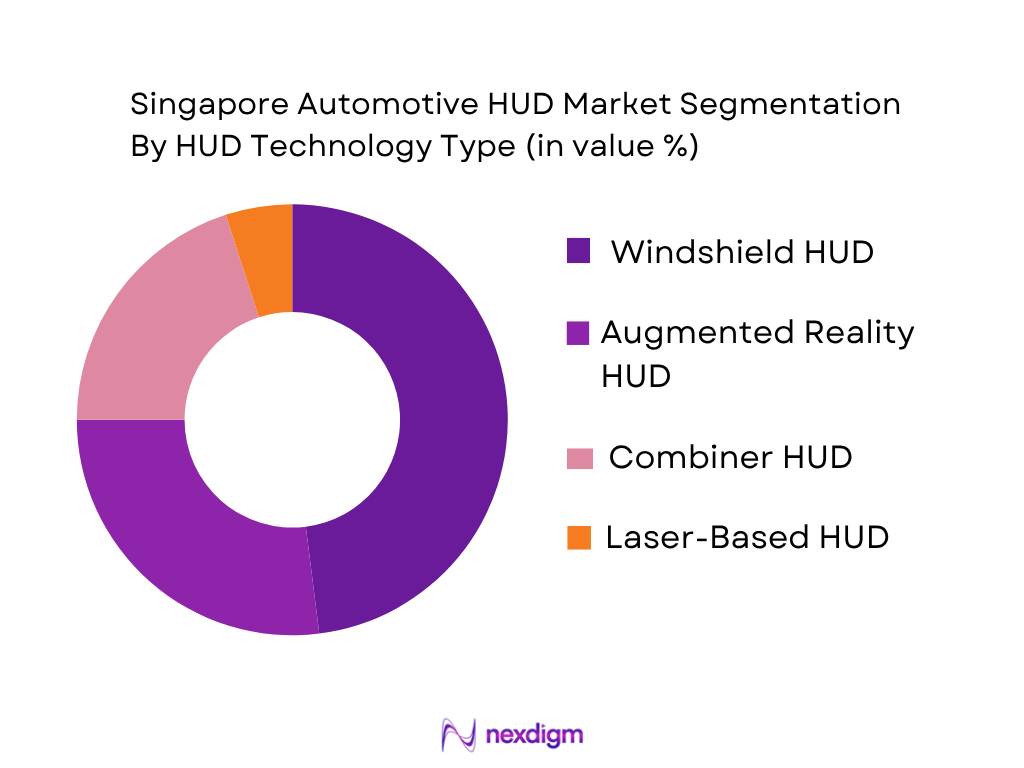
The Singapore Automotive HUD Market is segmented by HUD technology type into windshield HUD, combiner HUD, conventional HUD, augmented reality HUD, and laser-based HUD systems. Windshield HUD accounted for the largest market share of 48.0% in 2024 due to increasing adoption in premium passenger vehicles and electric vehicles. Windshield HUD systems provide a larger projection area, improved readability, and better integration with navigation and ADAS features. Augmented reality HUD represented 27.0% of the market in 2024, supported by increasing demand for navigation overlays and advanced driver assistance applications. Combiner HUD accounted for 20.0%, primarily used in mid-premium vehicles due to lower installation complexity and cost advantages. Laser-based HUD solutions contributed 5.0% due to limited commercial deployment.
By Vehicle Type
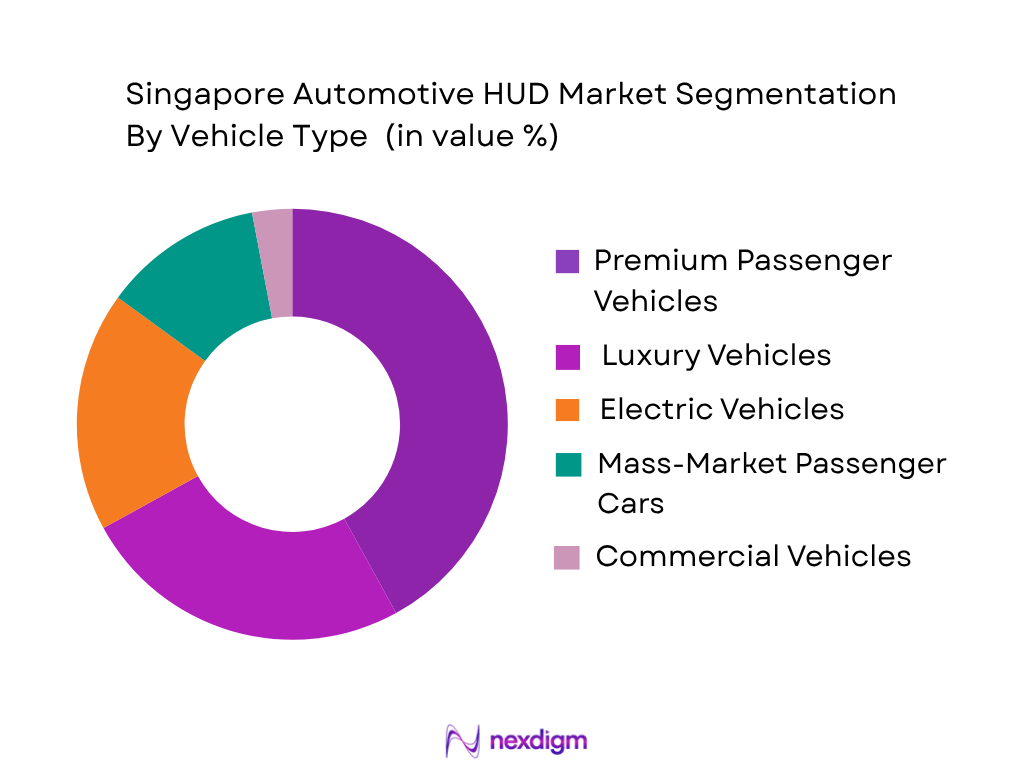
The Singapore Automotive HUD Market is segmented by vehicle type into premium passenger vehicles, luxury vehicles, electric vehicles, mass-market passenger cars, and commercial vehicles. Premium passenger vehicles dominated with a market share of 42.0% in 2024 due to higher integration of advanced cockpit features among brands such as BMW, Mercedes-Benz, Audi, and Lexus. Luxury vehicles represented 25.0%, driven by consumer preference for technologically advanced interiors and safety features. Electric vehicles accounted for 18.0%, supported by increasing EV adoption and manufacturers’ focus on digital cockpit experiences. Mass-market passenger vehicles contributed 12.0%, while commercial vehicles represented 3.0% due to slower HUD penetration.
Competitive Landscape
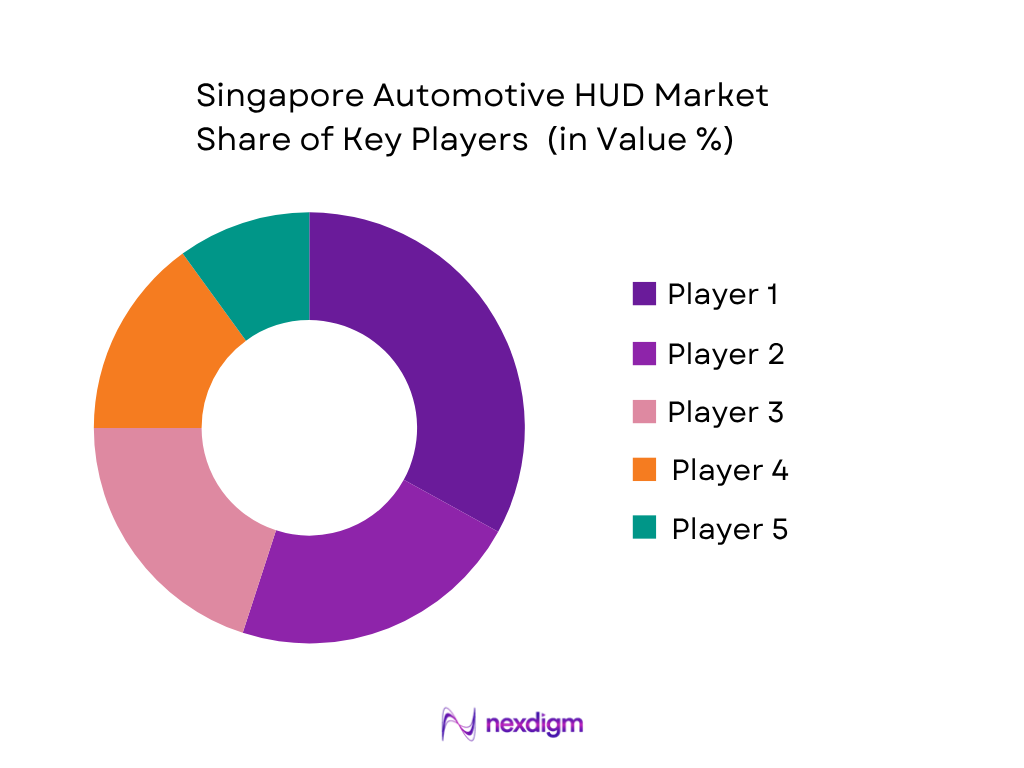
The Singapore Automotive HUD Market is moderately consolidated and dominated by global automotive electronics suppliers with strong OEM relationships. Major companies compete through AR-HUD technology development, optical system innovation, digital cockpit integration, and partnerships with vehicle manufacturers. Companies including Continental, Bosch, DENSO, Nippon Seiki, and Panasonic have established capabilities across HUD hardware, projection systems, display technologies, and automotive software integration.
| Continental AG | Establishment Year | Headquarters | HUD Technology | Main Components | OEM Integration | AR-HUD Capability | Vehicle Segments Served |
| Continental AG | 1871 | Germany | ~ | ~ | ~ | ~ | ~ |
| Robert Bosch GmbH | 1886 | Germany | ~ | ~ | ~ | ~ | ~ |
| DENSO Corporation | 1949 | Japan | ~ | ~ | ~ | ~ | ~ |
| Nippon Seiki Co., Ltd. | 1946 | Japan | ~ | ~ | ~ | ~ | ~ |
| Panasonic Automotive Systems | 2022 | Japan | ~ | ~ | ~ | ~ | ~ |
Singapore Automotive HUD Market Analysis
Market Growth Drivers
Increasing Premium Vehicle Penetration
Singapore’s premium vehicle ecosystem continues to support automotive HUD adoption due to strong demand for technologically advanced vehicles equipped with digital cockpit features. The country recorded 74,246 new motor vehicle registrations in 2024, according to the Land Transport Authority (LTA), with a significant contribution from passenger vehicles that increasingly incorporate advanced safety and infotainment technologies. Premium automotive brands operating in Singapore, including Mercedes-Benz, BMW, Audi, Lexus, and Volvo, commonly integrate HUD systems within higher-end vehicle variants to differentiate their models through enhanced visibility and driver assistance features. According to Singapore Department of Statistics data, the country recorded a resident population of 6.04 million in 2024, supported by one of the highest income environments globally, which enables higher adoption of advanced automotive technologies. The International Monetary Fund (IMF) reported Singapore’s GDP per capita at approximately USD 90,000 in 2024, reflecting strong purchasing capability for premium mobility solutions. The combination of a high-value vehicle market, technology-oriented consumers, and increasing preference for connected driving experiences strengthens demand for windshield HUD and augmented reality HUD solutions in Singapore.
Rising Adoption of Advanced Driver Assistance Systems
The increasing integration of advanced driver assistance systems (ADAS) in vehicles is accelerating demand for automotive HUD solutions in Singapore, as HUD technology provides a direct interface for displaying navigation guidance, collision warnings, lane assistance alerts, and driver information. The Land Transport Authority (LTA) reported that Singapore continues to expand intelligent transport initiatives through connected mobility infrastructure and autonomous vehicle development programs. Singapore recorded more than 1,000 autonomous vehicle trial permits and technology testing activities by 2024, demonstrating continued advancement in smart mobility applications. According to the Ministry of Transport Singapore, the country’s road network supports extensive deployment of digital transportation solutions, including real-time traffic management systems. The World Bank’s Logistics Performance Index highlights Singapore as a leading logistics hub, ranking among the top global markets for transport infrastructure efficiency, supporting greater adoption of connected vehicle technologies. Increasing deployment of ADAS features such as adaptive cruise control, automated emergency braking, and lane monitoring creates demand for HUD systems capable of presenting safety-critical information without requiring drivers to shift attention away from the road.
Market Challenges
High HUD System Cost
The high complexity of automotive HUD components creates adoption challenges, particularly for mid-range and entry-level vehicles. HUD systems require advanced optical modules, projection units, display technologies, sensors, and software integration, increasing engineering requirements for vehicle manufacturers. Singapore’s automotive market is highly dependent on imported vehicles, with the country recording 74,246 new vehicle registrations in 2024, according to LTA, meaning most advanced vehicle technologies are sourced from international manufacturers rather than developed locally. The Economic Development Board (EDB) reported that Singapore’s manufacturing sector remains focused on high-value electronics and precision industries rather than automotive mass production, limiting local economies of scale for HUD component manufacturing. The country’s small domestic vehicle production ecosystem increases reliance on imported automotive electronics supply chains. Additionally, according to the International Energy Agency (IEA), electric vehicles require increased electronic content compared with conventional vehicles, adding complexity to vehicle cockpit integration. These factors create challenges for widespread HUD adoption beyond premium vehicle segments, where manufacturers can better absorb advanced technology integration requirements.
Supply Chain Dependency on Imported Components
Singapore’s automotive HUD market faces supply chain challenges due to limited domestic automotive component manufacturing and dependence on global suppliers for displays, semiconductors, optical modules, and electronic control units. The Ministry of Trade and Industry Singapore reported that the country remains heavily integrated into global electronics supply chains, with electronics accounting for more than USD 90 billion in merchandise exports in 2024, demonstrating the importance of imported and globally connected technology components. According to the Singapore Economic Development Board, semiconductor manufacturing and electronics industries remain major pillars of the country’s advanced manufacturing ecosystem; however, dedicated automotive HUD component production remains limited. The Automotive Electronics Council and international automotive supply chains continue to rely on suppliers located across Japan, Germany, South Korea, China, and Taiwan for critical HUD technologies. The World Bank’s global trade indicators highlight Singapore’s position as a major trading hub, but this also exposes technology-dependent sectors to international supply disruptions. For automotive HUD suppliers and OEMs, dependency on imported optical components, display panels, and semiconductor technologies increases procurement complexity and creates challenges in maintaining consistent supply availability.
Market Opportunities
Growth of AR-HUD Deployment
Augmented reality HUD technology represents a significant opportunity for Singapore’s automotive HUD ecosystem due to increasing demand for intelligent vehicle interfaces and advanced navigation solutions. Singapore’s strong digital infrastructure provides favourable conditions for AR-enabled automotive technologies. The Infocomm Media Development Authority (IMDA) reported that Singapore achieved 99.9% nationwide household broadband coverage in 2024, supporting connected mobility applications requiring high-speed data exchange. The Land Transport Authority continues to develop smart transportation systems, including digital traffic management and connected mobility solutions, creating an environment where AR-HUD technologies can integrate navigation, traffic information, and safety alerts. Singapore recorded more than 1.3 million registered vehicles in 2024, according to LTA statistics, creating a substantial installed vehicle base for advanced cockpit technology adoption through new vehicle sales and future upgrades. AR-HUD systems can enhance driver experience by overlaying route guidance, lane information, and hazard warnings directly onto the windshield display area. Growing integration of vehicle connectivity, artificial intelligence, and real-time mobility information creates opportunities for automotive HUD manufacturers to introduce more advanced display solutions.
Integration with Vehicle-to-Everything Communication
Vehicle-to-Everything (V2X) communication development creates opportunities for automotive HUD adoption by enabling vehicles to display real-time infrastructure, traffic, and safety information directly through advanced cockpit systems. Singapore has been actively developing connected mobility infrastructure through the Land Transport Authority’s smart mobility initiatives. The LTA has deployed extensive intelligent transport systems, including electronic road pricing infrastructure, traffic monitoring networks, and connected transport management platforms. Singapore’s digital readiness supports V2X technology deployment, with the IMDA reporting nationwide 5G standalone network availability expansion across the country’s urban environment by 2024. The World Bank identifies Singapore as one of the world’s leading economies for infrastructure efficiency and digital connectivity, supporting advanced mobility applications. Automotive HUD systems integrated with V2X platforms can provide drivers with real-time information such as traffic congestion alerts, road condition updates, pedestrian warnings, and infrastructure notifications. The combination of smart city development, connected vehicle infrastructure, and advanced automotive electronics creates opportunities for HUD suppliers to expand beyond traditional display functions toward intelligent mobility information platforms.
Future Outlook
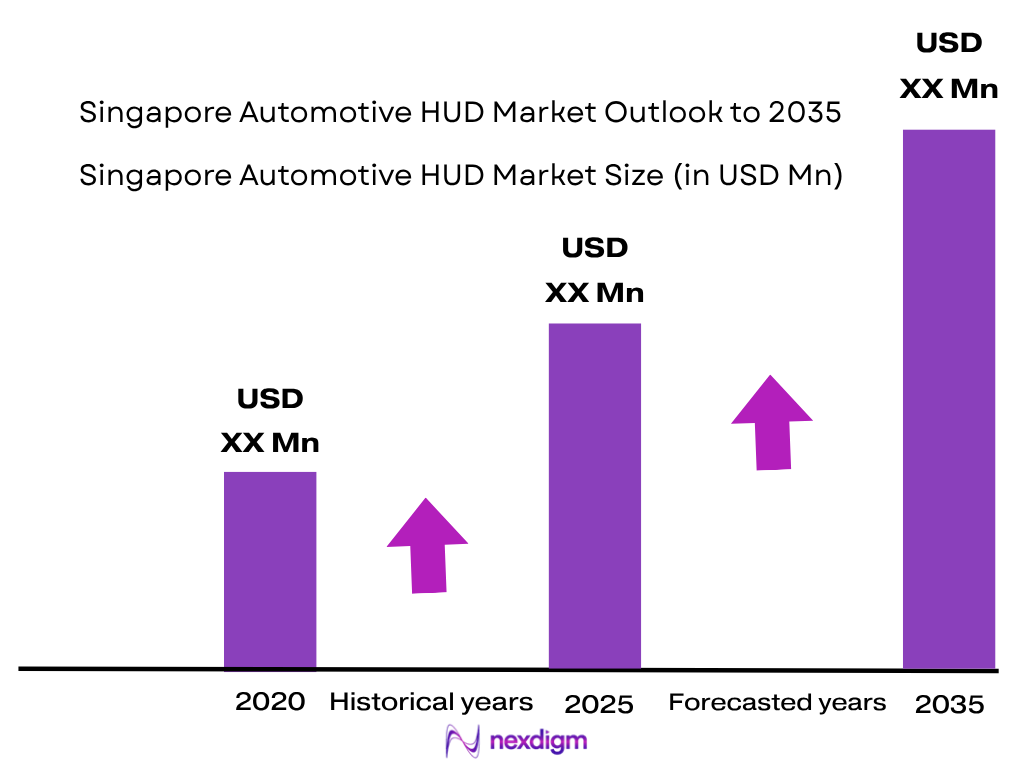
The Singapore Automotive HUD Market is expected to expand from USD 18.5 million in 2024 to USD 67.5 million by 2035, registering a CAGR of 14.8% during 2026–2035. Growth will be supported by increasing EV adoption, expansion of connected vehicle platforms, and rising integration of AR-based navigation systems. Automotive manufacturers are expected to shift from conventional HUD solutions toward advanced AR-HUD systems capable of integrating real-time navigation, driver monitoring information, and autonomous driving assistance features.
The next phase of market development will focus on improving field-of-view, reducing optical system size, increasing display brightness, and integrating artificial intelligence-based information prioritization. Singapore’s smart mobility ecosystem and premium vehicle market will continue supporting technology adoption.
Major Players
- Continental AG
- Robert Bosch GmbH
- DENSO Corporation
- Nippon Seiki Co., Ltd.
- Panasonic Automotive Systems
- Visteon Corporation
- Harman International
- LG Electronics Vehicle Component Solutions
- Samsung Electronics
- WayRay
- FICOSA International
- Luxoft
- MicroVision
- Yazaki Corporation
- Valeo
Key Target Audience
- Automotive OEMs (BMW Singapore, Mercedes-Benz Singapore, Audi Singapore, Toyota Motor Asia Pacific, BYD Singapore, Hyundai Motor Singapore)
- Tier-1 Automotive Suppliers (HUD system manufacturers, ADAS suppliers, digital cockpit solution providers, automotive electronics suppliers)
- Automotive Display and Semiconductor Companies (display panel manufacturers, optical component suppliers, semiconductor solution providers)
- Investments and Venture Capitalist Firms (automotive technology investment funds, mobility-focused venture capital firms, electric vehicle technology investors)
- Government and Regulatory Bodies (Land Transport Authority Singapore, Ministry of Transport Singapore, Enterprise Singapore, Economic Development Board Singapore)
- Electric Vehicle Ecosystem Companies (EV manufacturers, smart charging companies, connected mobility providers)
- Fleet Management Companies (commercial fleet operators, logistics companies, intelligent transportation solution providers)
- Automotive Software Companies (vehicle operating system providers, human-machine interface developers, autonomous driving software companies)
Research Methodology
Step 1: Identification of Key Variables
The initial stage involves developing a comprehensive ecosystem map of the Singapore Automotive HUD Market covering vehicle manufacturers, HUD technology providers, Tier-1 suppliers, semiconductor companies, display manufacturers, and mobility stakeholders. Secondary research is conducted using automotive databases, government transportation statistics, company annual reports, technology publications, and industry intelligence sources. The objective is to identify critical variables including HUD adoption rate, vehicle segment penetration, technology preference, pricing structure, and supplier landscape.
Step 2: Market Analysis and Construction
The market construction phase involves analyzing historical data related to vehicle registrations, premium vehicle sales, electric vehicle adoption, and automotive electronics integration. Market sizing is calculated using both supply-side and demand-side approaches, including HUD system pricing, OEM installation rates, component costs, and technology adoption levels. Global automotive HUD benchmarks are adjusted based on Singapore’s vehicle ecosystem, premium vehicle concentration, and smart mobility development. Global automotive HUD research indicates that automotive HUD revenue was approximately USD 1.1 billion in 2024, with growth supported by ADAS adoption and connected vehicle technologies.
Step 3: Hypothesis Validation and Expert Consultation
Market assumptions are validated through consultations with automotive industry professionals, technology suppliers, OEM representatives, and mobility ecosystem participants. Expert discussions focus on HUD adoption barriers, AR-HUD deployment trends, OEM procurement strategies, technology pricing, and future vehicle cockpit requirements. These primary insights are used to validate market estimates and refine segment-level analysis.
Step 4: Research Synthesis and Final Output
The final stage integrates primary interviews, secondary research, and analytical modelling to develop a complete assessment of the Singapore Automotive HUD Market. Data validation is conducted through triangulation of vehicle-level demand, supplier revenue analysis, technology penetration, and competitive intelligence. The final report provides market size, segmentation analysis, competitive benchmarking, growth drivers, challenges, and strategic recommendations.

- Executive Summary
- Research Methodology (Market Definition and Scope, Automotive HUD Classification Framework, Revenue and Volume Estimation Methodology, Top-Down Market Assessment, Bottom-Up Market Assessment, Vehicle Production-Based Demand Analysis, OEM Fitment Analysis, Tier-1 Supplier Assessment, Aftermarket Channel Evaluation, Primary Interviews with Automotive OEMs, Tier-1 Suppliers and Technology Providers, Secondary Research Framework, Data Validation and Triangulation, Forecasting Model, Market Assumptions, Research Limitations)

- Definition and Scope
- Automotive Head-Up Display (HUD) Technology Overview
- Evolution of HUD Systems in Singapore Automotive Industry
- Market Genesis and Technology Adoption Timeline
- Singapore Automotive Electronics Ecosystem Overview
- Singapore Passenger Vehicle and Commercial Vehicle Landscape

- Market Growth Drivers (Increasing Premium Vehicle Penetration, Rising Adoption of Advanced Driver Assistance Systems, Government Smart Mobility Initiatives, Expansion of Electric Vehicle Ecosystem, Growing Demand for Connected Vehicle Technologies, Increasing Consumer Preference for Advanced Cockpit Features)
- Market Challenges (High HUD System Cost, Limited Adoption in Entry-Level Vehicles, Complex Windshield Integration Requirements, Optical Calibration Challenges, Supply Chain Dependency on Imported Components, Limited Local Automotive Manufacturing Base)
- Market Opportunities (Growth of AR-HUD Deployment, Expansion of EV Cockpit Technologies, Autonomous Driving Development, Integration with Vehicle-to-Everything Communication, Smart City Infrastructure Connectivity, Premium Mobility Service Expansion)
- Market Trends (Augmented Reality Navigation Integration, AI-Based Driver Information Display, Digital Cockpit Convergence, Software-Defined Vehicle Integration, Larger Field-of-View HUD Development, Personalized Driver Interface Experience)
- Regulatory and Policy Landscape (Land Transport Authority Smart Mobility Regulations, Vehicle Safety Standards, Autonomous Vehicle Testing Framework, Advanced Driver Assistance System Guidelines, Data Connectivity Regulations, Automotive Electronics Compliance Standards)
- SWOT Analysis
- Porter’s Five Forces Analysis
- PESTLE Analysis

- By Market Value (2020-2025)
- By Installed HUD Units (2020-2025)
- By Average Selling Price (ASP) (2020-2025)
- By Vehicle Category Contribution (2020-2025)
- By Technology Type Contribution (2020-2025)

- By HUD Technology Type (In Value %)
Combiner Head-Up Display (CHUD)
Windshield Head-Up Display (W-HUD)
Augmented Reality Head-Up Display (AR-HUD)
Laser-Based Head-Up Display
MicroLED-Based Head-Up Display - By Display Technology (In Value %)
TFT-LCD HUD
DLP-Based HUD
LCoS-Based HUD
OLED-Based HUD
MicroLED Display HUD - By Vehicle Type (In Value %)
Passenger Cars
Premium Passenger Vehicles
Luxury Vehicles
Electric Passenger Vehicles
Commercial Vehicles
Fleet and Mobility Vehicles - By Vehicle Price Category (In Value %)
Mass Market Vehicles
Mid-Premium Vehicles
Premium Vehicles
Luxury Vehicles
Ultra-Luxury Vehicles - By Propulsion Type (In Value %)
Internal Combustion Engine (ICE) Vehicles
Hybrid Electric Vehicles (HEV)
Plug-in Hybrid Electric Vehicles (PHEV)
Battery Electric Vehicles (BEV)
Fuel Cell Electric Vehicles (FCEV) - By Sales Channel (In Value %)
OEM Factory-Fitted HUD Systems
Authorized Automotive Dealers
Automotive Technology Integrators
Aftermarket HUD Providers
Online Automotive Electronics Platforms

- Market Share Analysis of Major Players (By Revenue, Installed Units, Vehicle Integration, Technology Type, OEM Partnerships)
- Cross Comparison Parameters (Product Portfolio Coverage, HUD Technology Capability, AR-HUD Development Strength, OEM Integration Partnerships, Vehicle Segment Coverage, Display Technology Expertise, R&D Investment Capability, Optical System Innovation Capability)
- SWOT Analysis of Major Players
- Pricing Benchmark Analysis (By HUD Technology Type, Vehicle Segment, Display Technology, Feature Package)
- Detailed Profiles of Major Companies
Continental AG
DENSO Corporation
Panasonic Automotive Systems
Robert Bosch GmbH
Nippon Seiki Co., Ltd.
Yazaki Corporation
Visteon Corporation
Harman International
LG Electronics Vehicle Component Solutions
Samsung Electronics
WayRay
FICOSA International
Luxoft
MicroVision
Panasonic Holdings Corporation

- Vehicle Buyer Preference Analysis
- Demographic Vehicle Consumer Analysis
- Fleet and Commercial User Analysis
- Electric Vehicle User Analysis
- Purchase Decision-Making Analysis

- By Market Value (2026-2035)
- By Installed HUD Units (2026-2035)
- By Average Selling Price (ASP) (2026-2035)
- By Vehicle Category Contribution (2026-2035)
- By Technology Type Contribution (2026-2035)


 Request a Sample
 Ask for Customization
 Get a Quote
 Enquire Now