

 Download PDF
Market Overview
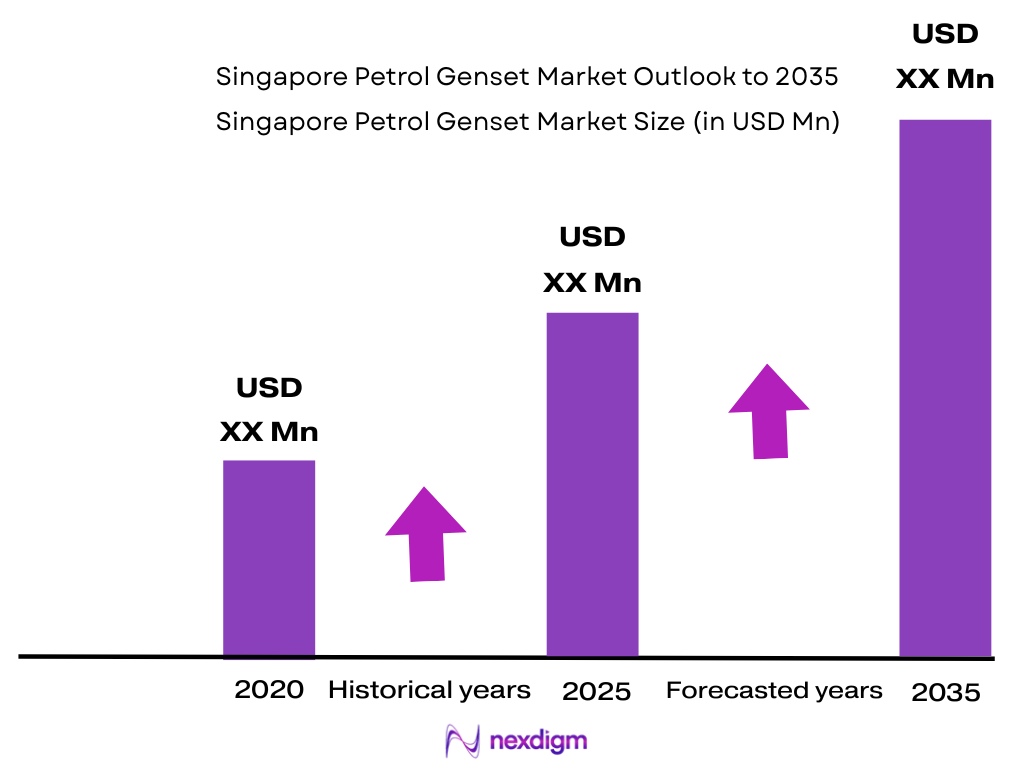
The Singapore Petrol Genset Market is valued at approximately ~ million, supported primarily by construction, temporary-power, events, maintenance and contingency applications. Electricity generation increased from 57,384 GWh to 59,616 GWh, while peak demand moved from 7,861 MW to 8,045 MW. Construction contracts simultaneously increased from S$33.8 billion to S$44.2 billion, sustaining requirements for compact generators at worksites where permanent electrical connections are unavailable or impractical. Jurong-Tuas, Changi, Ubi and Singapore’s central commercial and events districts represent important petrol-genset demand clusters because they concentrate industrial facilities, construction activity, equipment suppliers, logistics operations and temporary events. Infrastructure development around Tuas Port and Changi Terminal 5 strengthens temporary-power requirements, while international visitor arrivals increased from 13.6 million to 16.5 million, supporting events, hospitality and outdoor commercial activity. Singapore’s dense urban environment simultaneously favours compact, low-noise inverter generators over large conventional petrol sets.
Market Segmentation
By Generator Type
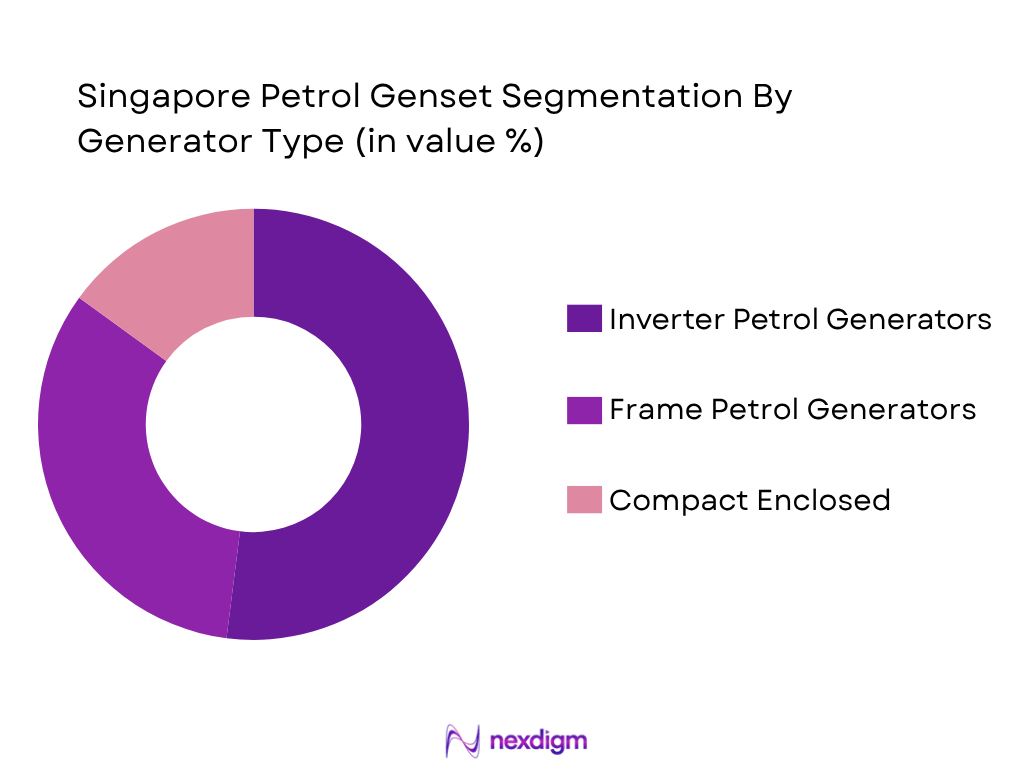
The Singapore Petrol Genset Market is segmented into conventional open-frame petrol generators, inverter petrol generators and compact enclosed portable generators. Inverter petrol generators hold the dominant position because Singapore’s principal petrol-genset applications favour portability, lower acoustic output and cleaner electrical output rather than high-capacity continuous generation. The national electricity network is exceptionally reliable, with customers experiencing only 0.006 sustained interruptions averaging 0.26 minutes in the latest reported period, limiting the role of petrol units as long-duration household backup systems. Instead, generators are commonly relevant to worksites, maintenance activities, mobile businesses and events. In these applications, inverter units provide variable engine speeds, compact dimensions and power suitable for sensitive electronics. Noise compliance is particularly important: NEA limits construction-site and industrial noise depending on time and surrounding receptors. Honda’s Singapore distributor specifically markets the EU22i inverter generator, illustrating the commercial importance of compact inverter technology in the local market.
By Power Rating
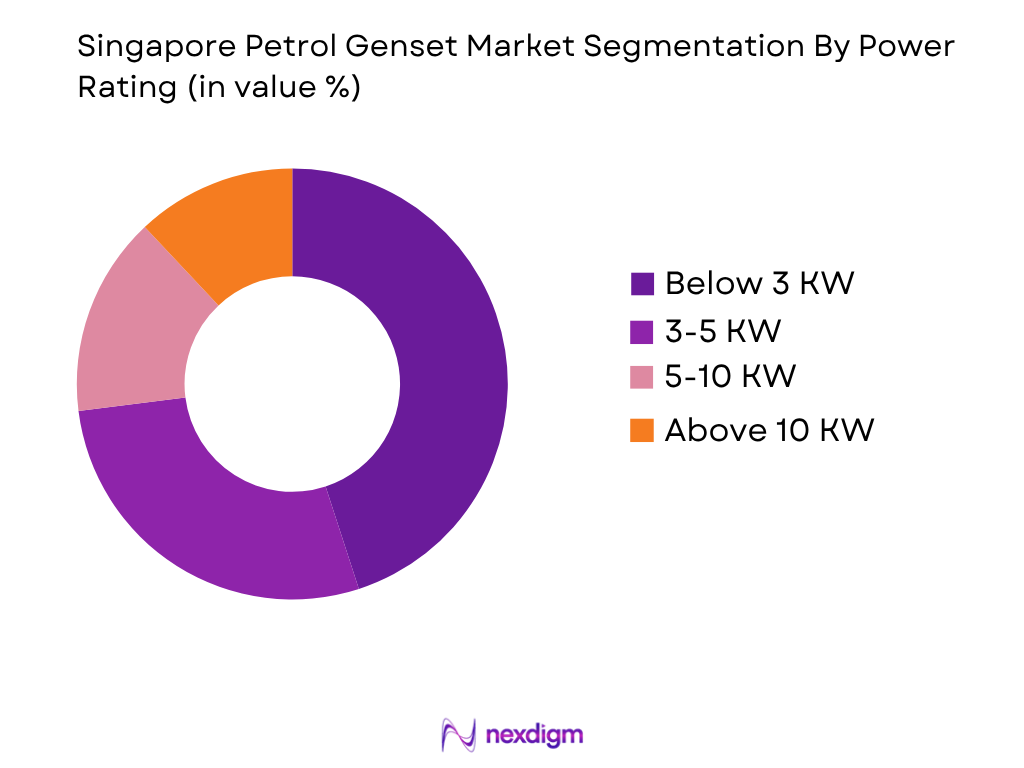
The Singapore Petrol Genset Market is segmented into below 3 kW, 3–5 kW, 5–10 kW and above 10 kW petrol generator sets. Below 3 kW generators dominate because petrol technology is most competitive in portable, intermittent-duty applications where equipment weight, mobility and rapid deployment matter more than extended runtime. Small inverter models can power tools, lighting, electronics, communications equipment and temporary workstations without requiring large fuel tanks or permanent installations. This operating profile is particularly suitable to Singapore because the conventional grid already provides highly dependable base electricity. The market therefore differs from countries where households routinely require high-capacity backup generators. Fuel-storage regulation further supports smaller sets: SCDF exempts only limited quantities of Class I petroleum from licensing in certain private and non-factory premises, with an exemption quantity of 20 litres. Larger-capacity petrol generators typically require greater fuel inventories, making them less convenient than compact units for many urban users.
Competitive Landscape
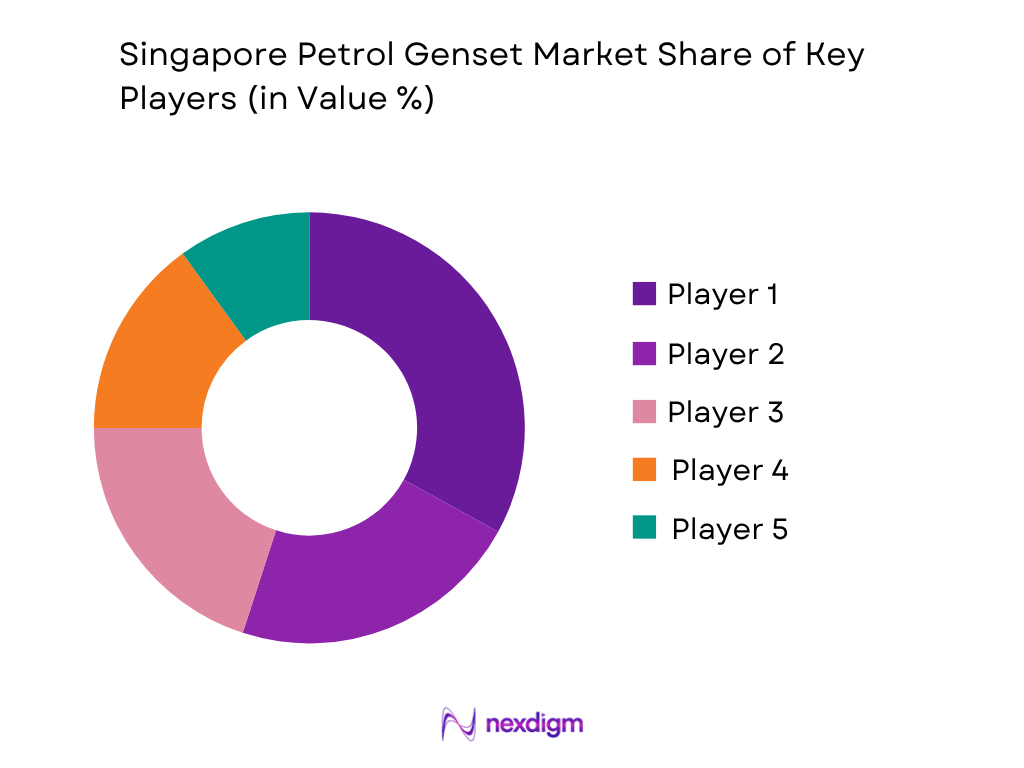
The Singapore Petrol Genset Market is fragmented across established Japanese power-equipment manufacturers, international portable-generator brands and locally represented equipment suppliers. Honda has a particularly visible local position through Kah Power Products, its official Singapore power-products distributor, which provides generators together with sales, service and spare-parts support. Briggs & Stratton also identifies an authorised Singapore dealer. Competition centres on inverter technology, acoustic performance, rated output, runtime, engine reliability, portability, service availability and compliance with Singapore’s operating environment.
| Major Player | Establishment Year | Headquarters | Petrol Generator Focus | Inverter Technology | Typical Power Positioning | Noise-Control Focus | Portable Product Strength | Singapore/Regional Support |
| Honda Motor Co., Ltd. | 1948 | Tokyo, Japan | ~ | ~ | ~ | ~ | ~ | ~ |
| Yamaha Motor Co., Ltd. | 1955 | Iwata, Japan | ~ | ~ | ~ | ~ | ~ | ~ |
| Briggs & Stratton | 1908 | Wisconsin, USA | ~ | ~ | ~ | ~ | ~ | ~ |
| Generac Power Systems | 1959 | Wisconsin, USA | ~ | ~ | ~ | ~ | ~ | ~ |
| PRAMAC | 1966 | Siena, Italy | ~ | ~ | ~ | ~ | ~ | ~ |
Singapore Petrol Genset Market Analysis
Growth Drivers
Construction and Infrastructure-Led Temporary Power Demand
Singapore’s continuing pipeline of construction and infrastructure activity supports demand for portable petrol gensets used where permanent electrical connections are unavailable, impractical or required only temporarily. The Building and Construction Authority recorded S$44.2 billion of construction demand in 2024, driven by public institutional developments, housing projects and private construction. Major infrastructure programmes include Changi Airport Terminal 5, MRT extensions, Tuas Port-related development, public housing projects and transport infrastructure. BCA subsequently indicated total construction output of approximately S$41.7 billion in 2025, with output expected at S$43 billion–S$46 billion in 2026. These figures provide a substantial operating base for contractors using portable electrical equipment, lighting systems, temporary site offices, pumps, power tools and auxiliary equipment requiring mobile power. Petrol gensets are particularly relevant at small and medium work areas where lower-capacity, transportable generating sets provide a simpler alternative to larger diesel installations. Singapore’s construction environment also creates demand during early-stage works before permanent electrical infrastructure becomes fully available. Contractors undertaking renovation, landscaping, road improvement and smaller civil works can deploy compact gensets for intermittent power requirements without installing fixed generation equipment. The broader economy provides substantial purchasing capacity for higher-specification portable equipment: World Bank data places Singapore’s GDP at USD 603.87 billion in 2025, while GDP per capita reached USD 98,814, supporting an advanced commercial equipment market where buyers can prioritise reliability, lower noise, inverter output and improved fuel efficiency rather than only basic generation capability. Singapore’s electrical consumption also reached 58 TWh in 2024, compared with 55 TWh in 2023, illustrating continued expansion in electricity-dependent economic activity. Commerce and services consumed about 23 TWh, industrial users another 23 TWh, households approximately 8 TWh, and transport approximately 3 TWh. Petrol gensets represent only a small supplementary part of this energy system, but construction sites and mobile activities generate specific off-grid or temporary-power requirements that the national grid cannot directly address at every operating location. Product demand consequently favours compact units with wheel kits, electric starting, automatic voltage regulation, protected sockets and inverter architecture suitable for electronic tools. BCA’s large infrastructure pipeline also creates secondary demand through subcontractors rather than only principal construction firms. Electrical contractors, maintenance companies, landscape contractors, road-service crews and equipment-rental operators can purchase portable generators for repeated deployment across multiple project sites. The underlying opportunity is therefore linked to the physical volume of construction work rather than weak grid infrastructure. Supporting data are from the Building and Construction Authority, Energy Market Authority and World Bank.
Growth in High-Value Commercial and Industrial Activities Requiring Contingency Power
Singapore’s advanced commercial and industrial economy creates a second growth driver for petrol gensets through contingency, maintenance, mobile-service and specialised temporary-power applications. The Energy Market Authority reported national electricity consumption of 58 TWh in 2024, with commerce and services consuming approximately 23 TWh and industrial facilities another 23 TWh. This large electricity-dependent base includes workshops, logistics premises, industrial service providers, temporary installations, small businesses and contractors that can require independent portable power for maintenance operations or contingency use. Singapore’s generation system had 12,445 MW of installed capacity in 2024 and recovered to 13,261 MW during the first half of 2025 as new units entered service. These figures demonstrate the substantial scale of the underlying power ecosystem against which portable gensets operate as distributed backup equipment rather than primary generators. Petrol gensets are particularly suited to smaller power loads because they can be transported relatively easily, started rapidly and deployed without permanent connection infrastructure. Vehicle workshops, field-service providers, roadside support operators, event contractors, temporary retail operations and maintenance teams can use them to power tools, compressors, lighting, diagnostic devices and other electrical equipment where utility sockets are unavailable. Singapore’s large external-investment and industrial base strengthens this specialised equipment market. The Department of Statistics recorded S$3.13 trillion of foreign direct investment stock at the end of 2024, showing the depth of corporate operations requiring high standards of business continuity, facility maintenance and equipment support. These conditions favour technically improved generators incorporating stable voltage output, lower acoustic emissions and electronic engine management. Petrol inverter gensets are particularly relevant where sensitive devices are operated, because conventional open-frame generator output can be less suited to electronic equipment than inverter-controlled supply. The use case is not necessarily extended emergency generation; many units are purchased for intermittent operations of several hours at maintenance sites, workshops, events or temporary work areas. This helps petrol models remain commercially relevant even in a country where larger standby applications are generally served by more permanent diesel, gas or integrated building systems. The high density of infrastructure also encourages equipment-rental models. Rental businesses can maintain fleets of compact gensets that are circulated among construction contractors, event organisers, maintenance providers and commercial customers, improving asset utilisation and widening customer access without requiring each end user to purchase a unit. As Singapore’s commercial activity continues to become more technologically intensive, electrical power quality becomes increasingly important. Products offering inverter output, overload protection, automatic shutdown, digital load displays and low-noise operation can therefore capture demand from professional rather than purely household users. Supporting figures are from the Energy Market Authority, Singapore Department of Statistics and World Bank.
Market Challenges
Exceptionally Reliable National Grid Limits Routine Residential Backup Demand
The strongest structural challenge for the Singapore Petrol Genset Market is the exceptional reliability of the national electricity grid. Unlike countries where prolonged blackouts create a large household-generator market, Singapore experiences extremely limited electricity interruption. The Energy Market Authority reported that each customer experienced only 0.006 sustained interruptions during 2024, with an average interruption duration of approximately 0.26 minutes for the year. EMA separately characterises average interruption time in Singapore as below 1 minute per customer annually. This performance materially reduces the economic case for ordinary households and small commercial premises to purchase petrol gensets solely for routine blackout protection. Singapore’s main power system also operated with 12,445 MW of installed generation capacity in 2024, rising to 13,261 MW in the first half of 2025, providing substantial centralized power capability. Electricity generation increased by 2,232 GWh between 2023 and 2024, while peak demand increased by 184 MW, yet reliability remained extremely high. These conditions differentiate Singapore from storm-prone, geographically dispersed or grid-constrained markets where portable generators are treated as essential household equipment. Petrol genset manufacturers therefore face a narrower addressable customer pool centred on construction sites, equipment rental, maintenance operations, events, mobile businesses and specialised contingency rather than mass residential backup. The challenge becomes more significant because alternative resilience technologies are also developing. Singapore already had 200 MW of energy-storage-system capacity in 2024, alongside 1,211 MWac of solar capacity, while the government continues to strengthen grid resilience and low-carbon power supply. These resources do not eliminate portable-generator applications, but they reduce the strategic dependence of permanent buildings on small fossil-fuel backup units. The market consequently requires suppliers to demonstrate applications that the utility system cannot economically fulfil, such as mobility, temporary deployment and isolated work areas. Residential customers considering emergency backup may also compare petrol gensets against portable battery power stations, which operate without engine exhaust, gasoline handling or combustion noise. Singapore’s compact geography further reduces the isolation advantage normally enjoyed by generators in rural markets because most residential and commercial development is connected to highly reliable infrastructure. This limits opportunities for large household inventories and places greater importance on professional-use segments. Suppliers may therefore need to focus distribution on hardware stores, construction equipment providers, rental companies and professional users rather than positioning petrol gensets primarily as essential household appliances. The wider macroeconomic scale—USD 603.87 billion of GDP in 2025 according to the World Bank—supports purchasing capability, but strong purchasing power does not automatically create backup-generator demand when utility reliability is already exceptionally high. For this market, the key challenge is not affordability but demonstrating a distinct operational need beyond what Singapore’s centralized electricity system already provides. Supporting data are from the Energy Market Authority and World Bank.
Noise, Fuel Handling and Operating-Environment Compliance
Petrol genset deployment in Singapore faces a demanding operating environment because combustion generators create noise, exhaust emissions and flammable-fuel handling requirements that are particularly sensitive in a dense urban setting. The National Environment Agency regulates construction and industrial noise, directly affecting gensets used near homes, schools, hospitals and other sensitive premises. For construction activities, NEA specifies limits including 90 dBA over a 5-minute period during defined daytime conditions and 75 dBA over a 12-hour daytime period in relevant circumstances. Construction sites located within 150 metres of noise-sensitive premises can also be required to install noise-monitoring systems. These requirements make acoustic performance a material procurement parameter for contractors using portable generators. Open-frame petrol gensets designed primarily for low acquisition cost may require acoustic barriers, careful siting or restricted operating hours, while enclosed inverter models can offer an operational advantage where surrounding development is dense. NEA has specifically identified quieter generators as a technology that can reduce construction noise and recommends proper silencers or mufflers on generating equipment. Industrial premises face their own limits: noise affecting residential premises may not exceed 70 dBA over a 5-minute period during specified daytime conditions and 65 dBA during certain evening hours. Petrol use also introduces fire and storage considerations. The Singapore Civil Defence Force regulates the import, transportation and storage of petroleum and flammable materials under the Fire Safety regulatory framework. Businesses storing fuel for generator operation therefore need appropriate management practices rather than treating petrol as an unrestricted consumable. Singapore’s Ministry of Manpower reiterated in 2024 that petrol and other flammable liquids can cause fires and explosions and require controls addressing safe containers, spills, vapour accumulation, grounding and appropriate waste disposal. These compliance requirements do not prohibit petrol gensets, but they increase the operational discipline required from professional users. The challenge is especially relevant at enclosed or space-constrained sites, where exhaust ventilation and separation from occupied areas become important. Petrol generators cannot be operated as casually indoors as battery-based power equipment because carbon monoxide and other combustion emissions create health hazards. Singapore’s dense built environment magnifies these disadvantages relative to more spacious markets. Contractors therefore assess generators based not only on output but also acoustic enclosure, exhaust orientation, fuel-tank security, automatic shutdown functions and ease of compliant placement. Petrol genset suppliers that rely on basic low-cost products can face difficulty competing where workplace and environmental standards are high. Market participants must instead provide engineering documentation, operating instructions, safety features and after-sales support that help users meet site requirements. This pushes the market toward professional-grade, quieter and better-controlled units while simultaneously creating a barrier for basic products. Supporting information is from the National Environment Agency, Singapore Civil Defence Force and Ministry of Manpower.
Market Opportunities
Quiet Inverter Petrol Gensets and Advanced Control Technology
Singapore creates an attractive product-development opportunity for compact inverter petrol gensets that solve the noise, fuel-efficiency and power-quality shortcomings of conventional open-frame generators. The opportunity is supported by a substantial professional temporary-power base. Construction demand reached S$44.2 billion in 2024, while BCA expects S$43 billion–S$46 billion of construction output in 2026. The market therefore includes a continuing stream of contractors, subcontractors and equipment-rental companies requiring temporary electricity while simultaneously operating under stringent noise-management rules. NEA requires construction sites within 150 metres of noise-sensitive premises to monitor construction noise in applicable situations and imposes limits including 90 dBA over 5 minutes and lower limits for certain periods and affected premises. These operating constraints create a practical business case for quieter generator technology rather than simply a consumer preference. Inverter generators can use variable engine speed according to electrical load instead of operating continuously at a fixed high engine speed. This architecture can reduce unnecessary fuel consumption and acoustic output during partial-load operation while producing more stable electricity for laptops, testing equipment, communications electronics and electronically controlled power tools. Additional market-specific features can include eco-throttle operation, automatic carbon-monoxide shutdown, electric start, remote start, digital load indicators, automatic low-oil shutdown and parallel operation allowing two compact units to supply a larger temporary load. These features are valuable in Singapore because commercial users frequently operate near occupied buildings rather than remote open land. Electrical consumption reached 58 TWh in 2024, with commercial/services and industrial activity each accounting for approximately 23 TWh, demonstrating the scale of electricity-dependent businesses that can require specialised temporary power during maintenance or field work. The opportunity is therefore less about replacing the grid and more about supplying clean, stable electricity exactly where fixed infrastructure is not available. Equipment-rental businesses represent an important route to adoption because high-specification inverter generators can be circulated across multiple short-duration projects. This model also allows contractors to access quieter or more sophisticated equipment without maintaining a large permanent generator fleet. Product differentiation can extend to telematics. Bluetooth or cellular modules can provide operating-hour counters, maintenance alerts, fuel-level monitoring, fault codes and geolocation for rental fleets. Such functionality would be particularly relevant where a rental provider owns numerous compact gensets deployed across separate construction projects. Singapore’s high-income operating environment, reflected in USD 98,814 GDP per capita in 2025 according to World Bank data, creates conditions where professional buyers can evaluate total lifecycle performance and compliance rather than selecting only the lowest-priced equipment. Thus, manufacturers offering low-noise inverter technology, digital controls and strong safety systems can address a clear gap between basic petrol gensets and more expensive fixed backup installations. Supporting data are from the Building and Construction Authority, National Environment Agency, Energy Market Authority and World Bank.
Rental, Mobile Service and Temporary Commercial Power Applications
The most practical future expansion opportunity for petrol gensets in Singapore lies in rental fleets and mobile commercial applications rather than widespread permanent residential backup. Singapore’s construction pipeline, dense commercial infrastructure and high level of maintenance activity produce numerous short-duration electricity requirements for which a compact generator is operationally suitable. Construction demand reached S$44.2 billion in 2024, while projects extending through 2025 and 2026 include Changi Airport Terminal 5, Marina Bay Sands expansion works, public housing, hospital developments, MRT infrastructure and major transport-related projects. BCA expects total construction output of S$43 billion–S$46 billion in 2026. These large projects generate layers of subcontracted work in electrical installation, surveying, landscaping, mechanical services, road works, temporary lighting and facility maintenance. Many such activities do not need permanent dedicated generating assets but require power for individual shifts or specific work packages. Equipment rental therefore enables contractors to obtain petrol gensets in appropriate capacity bands for several days or weeks and return them after completion. The same model extends beyond construction. Event companies require mobile electricity for outdoor exhibitions, temporary kiosks, sound systems and lighting. Automotive and equipment-service companies can use gensets for field repair, roadside equipment or mobile maintenance. Telecommunications and infrastructure maintenance crews can require short-duration emergency power at equipment locations. Marine and logistics support businesses can also use transportable generation for ancillary tasks where electrical infrastructure is temporarily disconnected. Singapore’s economy has significant scale to support these specialist service niches. The World Bank reports GDP of USD 603.87 billion in 2025, while the Department of Statistics recorded S$3.13 trillion of foreign direct investment stock at the end of 2024, indicating a deep corporate and industrial base requiring professional support services. Electricity consumption of 58 TWh in 2024 also highlights the degree to which commercial activity depends on uninterrupted access to powered equipment. Importantly, temporary-power providers can differentiate through more than the genset itself. Rental packages can combine generators with extension distribution boards, acoustic enclosures, fuel-management systems, cables, automatic transfer equipment and on-site technical support. Fleet owners can deploy digital operating-hour tracking to schedule oil changes, spark-plug service and preventive maintenance, improving uptime and reducing unexpected breakdowns. The highly reliable national grid, where average annual customer interruption was only 0.26 minutes in 2024, actually reinforces the case for this business model: end users may not need to own a generator permanently, but they still need temporary off-grid electricity for specific operational situations. Rental converts an otherwise limited ownership market into a recurring equipment-service opportunity. Suppliers can consequently partner with construction-equipment rental firms, maintenance contractors and specialised temporary-power companies rather than depending solely on conventional retail. Smaller petrol generators are particularly appropriate because they can be transported in service vehicles, deployed quickly and used for low-to-medium electrical loads without the logistical footprint of larger diesel sets. The result is a future growth avenue based on utilisation and service provision rather than mass ownership. Supporting figures are from the Building and Construction Authority, Energy Market Authority, Singapore Department of Statistics and World Bank.
Future Outlook
The Singapore Petrol Genset Market is forecast to expand at approximately ~ CAGR during 2026–2035, although growth will remain concentrated in portable and specialist applications rather than conventional whole-building standby power Singapore’s exceptionally reliable electricity system limits dependence on small petrol generators for routine residential backup. EMA reported average sustained interruption frequency of only 0.006 interruptions per customer, reinforcing the market’s orientation toward temporary and mobile applications rather than chronic grid-shortage mitigation Construction should remain an important demand source. BCA recorded S$44.2 billion in preliminary construction demand and subsequently projected a continuing pipeline involving Changi Terminal 5, MRT extensions, public housing, healthcare facilities and other major developments. Temporary electricity for tools, inspection equipment, mobile lighting and isolated work areas will therefore continue to provide opportunities for portable gensets.
Major Players
- Honda Motor Co., Ltd.
- Yamaha Motor Co., Ltd.
- Briggs & Stratton
- Generac Power Systems
- PRAMAC
- Champion Power Equipment
- Hyundai Power Products
- FIRMAN Power Equipment
- Westinghouse Outdoor Power Equipment
- Wacker Neuson
- Atlas Copco
- Cummins
- Rehlko
- Denyo
- Caterpillar
Key Target Audience
- Portable petrol generator manufacturers
- Power-equipment distributors and authorised dealers
- Construction contractors and infrastructure developers
- Equipment rental and temporary-power service providers
- Event production, hospitality and outdoor commercial operators
- Facilities-management and maintenance service providers
- Investments and venture capitalist firms
- Government and regulatory bodies (Energy Market Authority, National Environment Agency, Singapore Civil Defence Force, Building and Construction Authority)
Research Methodology
Step 1: Identification of Key Variables
The initial stage involves constructing the Singapore Petrol Genset Market ecosystem covering manufacturers, importers, authorised distributors, equipment-rental companies, contractors, maintenance firms and end users. Critical variables include rated and maximum output, engine displacement, runtime, tank capacity, inverter architecture, sound level, unit weight, starting system, fuel consumption and local service coverage. Desk research incorporates government data from the Energy Market Authority, Building and Construction Authority, National Environment Agency and Singapore Civil Defence Force. This identifies regulatory and demand-side variables influencing portable petrol-generator adoption.
Step 2: Market Analysis and Construction
Historical demand is constructed through bottom-up analysis of petrol generator sales across residential backup, construction, events, maintenance, recreation and commercial temporary-power applications. Generator demand is segmented by power rating, inverter versus conventional architecture and purchasing channel. The supply-side model evaluates locally represented generator brands, distributor networks, product portfolios and servicing capabilities. Demand is cross-referenced with construction activity, infrastructure projects, electricity reliability and temporary commercial activity to prevent overstating backup-power demand in Singapore’s highly reliable grid environment.
Step 3: Hypothesis Validation and Expert Consultation
Market hypotheses are validated through CATIs and structured interviews with generator dealers, contractors, equipment-rental companies, event operators, facilities managers and power-equipment service technicians. Consultation focuses on preferred wattage, typical operating hours, fuel-tank requirements, noise sensitivity, inverter penetration and service frequency. Particular attention is given to substitution between petrol generators and rechargeable battery systems. Interviews are also used to assess how fuel-storage constraints and noise requirements affect equipment selection across construction, commercial and temporary-event applications.
Step 4: Research Synthesis and Final Output
Top-down indicators are reconciled with bottom-up unit demand to establish the final market model. BCA construction activity, EMA grid-reliability data, SCDF petroleum-storage requirements and NEA noise regulations are integrated with supplier-product information. The forecast incorporates replacement cycles, construction activity, infrastructure development, inverter adoption, battery substitution and hybrid power solutions. Final outputs are validated for internal consistency across market value, unit shipments, product segmentation, power-rating segmentation and competitive positioning.

- Executive Summary
- Research Methodology (Market Definition and Scope, Petrol Genset Classification, Portable Generator Definition, Primary and Secondary Research Framework, Top-Down Market Sizing, Bottom-Up Unit Shipment Assessment, Import and Distributor Analysis, Dealer and Rental Channel Mapping, End-User Demand Assessment, Power Rating Mapping, Generator Runtime Analysis, Primary Interviews with Dealers and Rental Operators, Competitive Product Benchmarking, Data Triangulation, Forecasting Framework, Limitations and Future Conclusions)

- Definition and Scope
- Market Evolution and Industry Genesis
- Evolution of Portable Petrol Generator Technology
- Role of Petrol Gensets within Singapore’s Backup Power Ecosystem
- Petrol Genset Industry Value Chain

- Growth Drivers (Construction and Renovation Activity, Demand for Portable Temporary Power, Outdoor Event Activity, Mobile Contractor Equipment, SME Backup Requirements)
- Market Challenges (High Grid Reliability, Noise Restrictions, Petrol Storage Limitations, Carbon Emissions, Indoor Safety Restrictions, Battery Power Station Substitution)
- Market Opportunities (Inverter Generators, Low-Noise Designs, Compact Generator Platforms, Rental Fleets, Hybrid Power Solutions, Smart Generator Monitoring)
- Market Trends (Inverter Adoption, Variable-Speed Engines, Digital Control Panels, USB/DC Outputs, CO Detection, Compact Design, Generator-Battery Integration)
- Government Regulations (SS 535 Emergency Power Requirements, SCDF Fire Code, Petroleum and Flammable Material Controls, NEA Noise Regulations, Environmental Protection Requirements, Workplace Safety Requirements)
- SWOT Analysis
- Porter’s Five Forces Analysis
- PESTLE Analysis

- By Market Value (2020-2025)
- By Unit Sales Volume (2020-2025)
- By Installed and Operational Units (2020-2025)

- By Product Configuration (In Value %)
Inverter Petrol Generators
Conventional Open-Frame Petrol Generators
Silent/Enclosed Petrol Generators
Multi-Fuel Generators with Petrol Capability - By Power Rating (In Value %)
Below 2 kW
2–3 kW
3–5 kW
5–8 kW
Above 8 kW - By Generator Technology (In Value %)
Conventional Alternator Generators
Inverter Generators
Electronic Fuel-Management Generators
Automatic Voltage Regulation Generators
Variable-Speed/Eco-Throttle Generators - By Portability (In Value %)
Hand-Carry Generators
Wheeled Portable Generators
Contractor-Grade Portable Generators
Semi-Mobile Generators

- Market Positioning of Major Players (By Product Type, Power Output, End-User Segment, Distribution Channel)
- Cross Comparison Parameters (Rated Power Range, Peak Power Output, Inverter Generator Portfolio, Fuel Tank Capacity, Runtime per Tank, Noise Output, Product Weight and Portability, Local Dealer and After-Sales Coverage)
- SWOT Analysis of Major Players
- Detailed Profiles of Major Companies
Honda Power Products
Yamaha / Yamaha Power Products
Atlas Copco
Denyo
Pramac
Generac
Cummins
Kohler Energy / Rehlko
Champion Power Equipment
Hyundai Power Products
Kipor
Firman Power Equipment
Westinghouse Outdoor Power Equipment
DuroMax Power Equipment
A-iPower

- Residential Backup Power Analysis
- Construction Contractor Analysis
- Event and Exhibition Power Analysis
- SME Backup Power Analysis
- Equipment Rental Company Analysis

- By Market Value (2026-2035)
- By Unit Sales Volume (2026-2035)
- By Installed and Operational Units (2026-2035)


 Request a Sample
 Ask for Customization
 Get a Quote
 Enquire Now