

 Download PDF
Market Overview
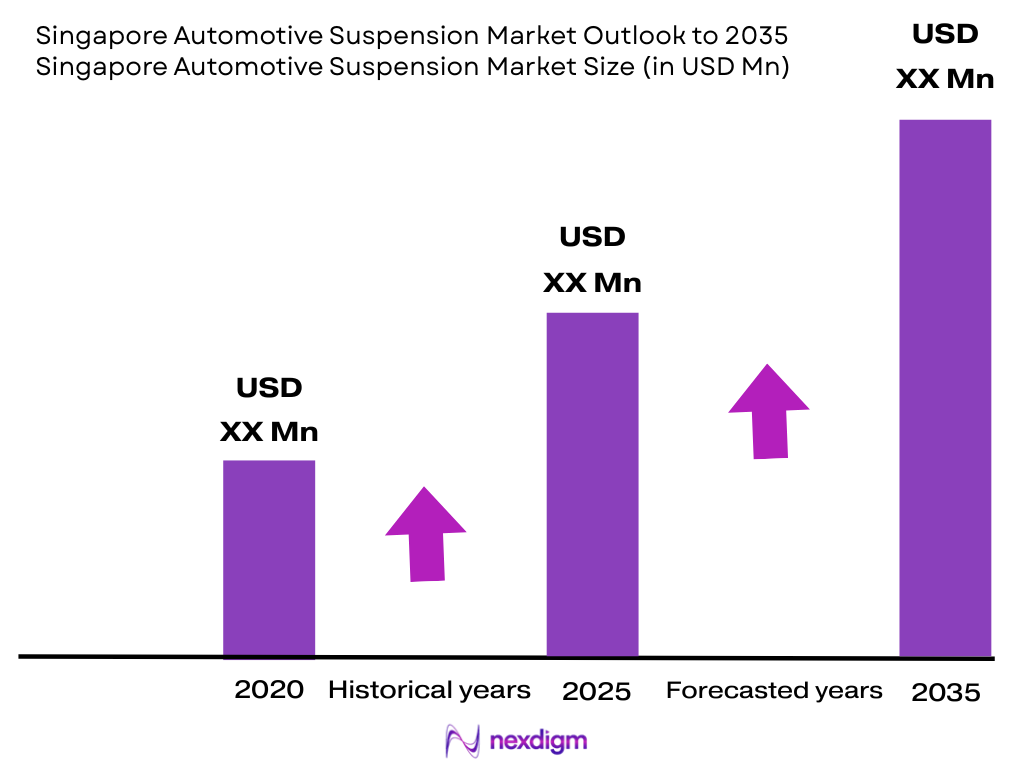
The Singapore Automotive Suspension Market is valued at approximately USD ~ million, compared with USD ~ million in the preceding annual benchmark. Singapore’s total car population increased from 653,768 cars to 660,339 cars, strengthening the installed base requiring shock absorbers, struts, bushings, control arms and springs. Demand is additionally supported by premium vehicle ownership, high vehicle values, COE-driven life extension, commercial fleets and increasingly sophisticated electric-vehicle suspension architectures. Ubi–Kaki Bukit, Sin Ming, Alexandra–Leng Kee, Jurong and Tuas dominate Singapore Automotive Suspension Market activity because the city-state concentrates dealerships, independent workshops, fleet facilities, parts distributors and specialised automotive services within established industrial clusters. Singapore’s car population moved from 653,768 units to 660,339 units, while approximately 18,000 electric cars were already operating during the latest transition benchmark. These clusters therefore serve both conventional replacement suspension and increasingly electronic EV and premium-vehicle systems.
Singapore represents a distinctive suspension market because vehicle quantity is constrained by the Vehicle Quota System, making vehicle value, vehicle age, technology content and maintenance intensity more important than unconstrained fleet expansion. LTA’s annual statistics show 660,339 cars at the end of 2024, rising to 662,441 in 2025. The market includes a substantial premium vehicle base: Mercedes-Benz alone accounted for more than 77,000 petrol, hybrid, plug-in and electric cars combined in 2024, while Porsche, BMW, Audi, Volvo and other premium brands add further demand for electronically controlled dampers, multi-link suspension and air-suspension repair.
Market Segmentation
By Vehicle Type
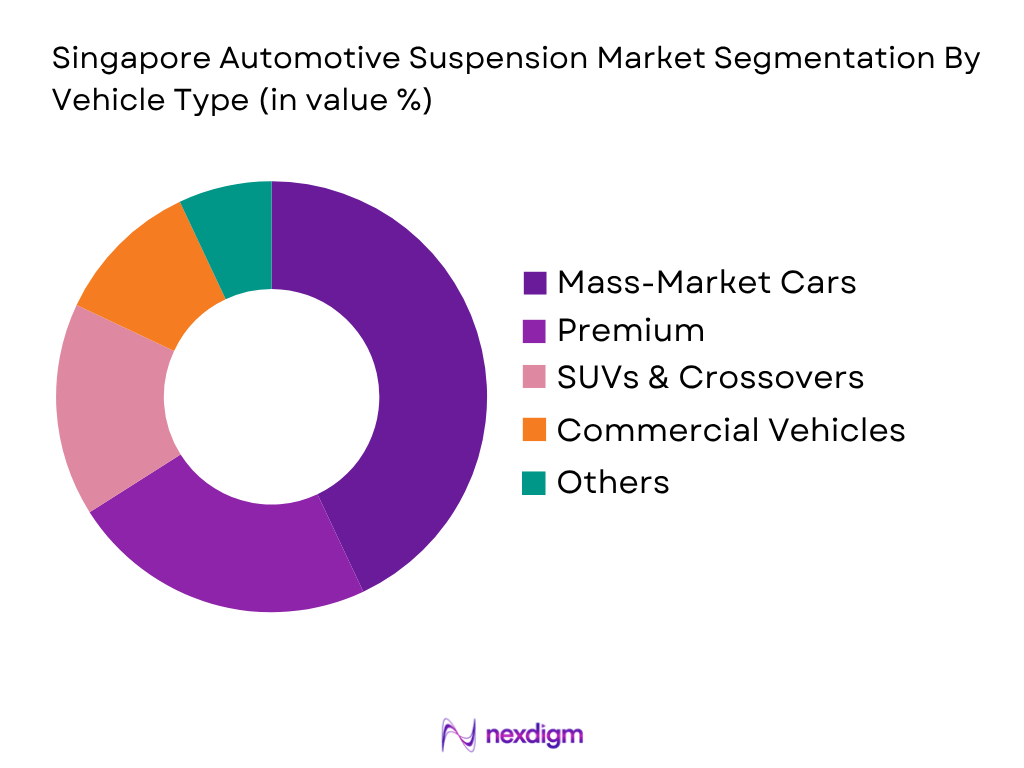
The Singapore Automotive Suspension Market is segmented into mass-market passenger cars, premium and luxury vehicles, SUVs and crossovers, taxis/private-hire vehicles, and commercial vehicles. Mass-market passenger cars hold the dominant market share because cars account for more than 660,000 units of Singapore’s installed vehicle base, generating recurring replacement demand across shocks, struts, coil springs, bushings and control arms. Toyota alone represented more than 141,000 petrol, hybrid, plug-in and electric cars in 2024, demonstrating the depth of mainstream Japanese vehicle fitment. Premium cars nevertheless generate disproportionately high value because Mercedes-Benz, Porsche, Audi, BMW and other European vehicles frequently use multi-link suspension, adaptive dampers and air suspension. Taxi and private-hire applications create a separate high-mileage demand pool, while commercial vehicles require heavier-duty dampers, springs and bushings designed around cargo loading and intensive utilisation.
By Suspension Technology
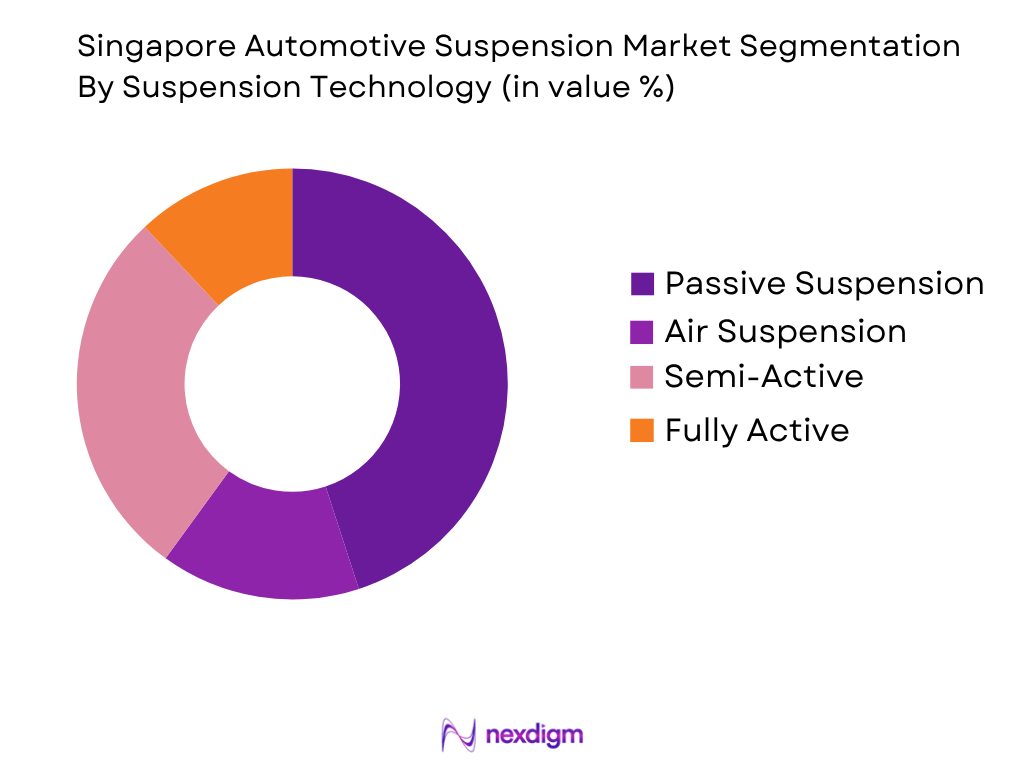
The Singapore Automotive Suspension Market is segmented into passive suspension, semi-active/electronic suspension, air suspension and fully active suspension. Passive suspension maintains the dominant share because conventional hydraulic dampers, struts and coil springs remain installed on most Japanese, Korean and mass-market European vehicles. However, Singapore has a comparatively valuable electronic-suspension segment because its vehicle fleet contains large numbers of premium German cars and an expanding EV population. Mercedes-Benz had 1,322 battery-electric cars in the 2024 fleet, Porsche had 672, Tesla had 5,163, and Volvo had 541, in addition to hybrid and plug-in platforms with increasingly sophisticated chassis technology. Adaptive damping and air suspension therefore represent important high-value replacement opportunities despite lower unit volumes.
Competitive Landscape
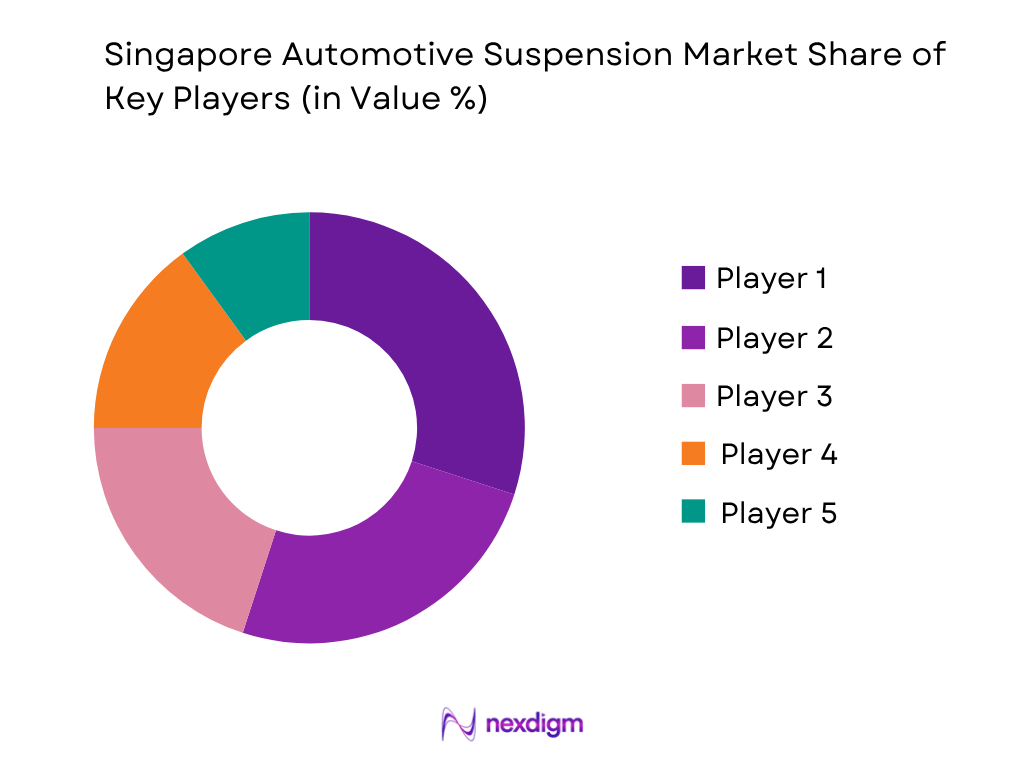
The Singapore Automotive Suspension Market is characterised by global Tier-1 chassis suppliers, Japanese shock-absorber manufacturers and European premium suspension brands. ZF has a direct regional footprint through ZF Asia Pacific Pte. Ltd. in Singapore, while its aftermarket portfolio includes shock absorbers, chassis parts and WABCO commercial-vehicle suspension technologies. KYB, Monroe, BILSTEIN and HL Mando address different vehicle and technology segments through distributor, OE and specialist channels. The competitive environment rewards broad fitment coverage, premium-vehicle compatibility, EV readiness, local inventory and technical diagnostic support rather than manufacturing scale within Singapore itself.
| Major Player | Establishment Year | Headquarters | Key Suspension Products | Vehicle Coverage | Electronic Suspension Capability | Singapore / Regional Presence | Aftermarket Strength | Market-Specific Position |
| ZF Friedrichshafen AG | 1915 | Friedrichshafen, Germany | ~ | ~ | ~ | ~ | ~ | ~ |
| KYB Corporation | 1919 | Tokyo, Japan | ~ | ~ | ~ | ~ | ~ | ~ |
| Tenneco / Monroe | 1999 current structure | Northville, USA | ~ | ~ | ~ | ~ | ~ | ~ |
| thyssenkrupp BILSTEIN | 1873 heritage | Ennepetal, Germany | ~ | ~ | ~ | ~ | ~ | ~ |
| HL Mando Corporation | 1962 heritage | Seongnam, South Korea | ~ | ~ | ~ | ~ | ~ | ~ |
Singapore Automotive Suspension Market Analysis
Growth Drivers
High-Value Vehicle Parc, Vehicle-Life Extension and Intensive Urban Usage
Singapore’s automotive suspension demand is supported less by unrestricted vehicle-population expansion and more by the economic value, utilisation intensity and maintenance requirements of the installed vehicle parc. Land Transport Authority data recorded 657,744 cars excluding taxis and tax-exempt vehicles at the end of 2024, compared with 651,302 cars in 2023, while the broader car population including relevant exempt categories reached approximately 660,339 units. Each vehicle creates recurring requirements for shock absorbers, struts, control arms, ball joints, stabiliser links, bushings and springs as mileage and vehicle age increase. Singapore’s Certificate of Entitlement framework is particularly relevant because vehicles retained through COE renewal can remain on the road beyond their first registration cycle, making suspension refurbishment economically relevant when owners choose life extension rather than deregistration. The country also had 143,209 goods and other vehicles in 2024, including 62,327 vans, 28,029 light-category lorries, 5,527 prime movers and other heavy-duty vehicles. These commercial applications experience repeated payload cycles and urban stop-start operation, accelerating wear on dampers, leaf springs, bushings and suspension joints. Taxi and private-hire vehicles add another intensive-use layer because passenger transport involves substantially greater annual utilisation than typical privately owned cars. Singapore’s high-income economic structure supports expenditure on preventive maintenance and OE-equivalent replacement components. World Bank data place national GDP at USD 547.39 billion in 2024 and GDP per capita at USD 90,674.1, indicating substantial purchasing capacity for maintenance of high-value vehicles. Economic activity then strengthened further, with World Bank data showing GDP reaching USD 603.87 billion in 2025 and GDP per capita increasing to USD 98,814.0. The IMF recorded real economic growth of 4.4% in 2024 and 5.0% in 2025, reflecting a robust domestic and externally oriented economy. For suspension suppliers, these conditions favour premium replacement rather than only economy products. Owners of Mercedes-Benz, BMW, Lexus, Toyota, Porsche and other high-value vehicles have stronger incentives to preserve ride quality and resale condition, while commercial operators need dependable suspension to minimise tyre wear and downtime. Complete strut assemblies, OE-equivalent dampers, premium bushings and digitally verified vehicle fitment therefore have a clear role in Singapore’s aftermarket structure.
Rapid Electrification and Increasing Suspension Technology Content
The transition toward electric vehicles is becoming a major structural growth driver for the Singapore Automotive Suspension Market because EVs alter vehicle weight distribution, suspension loading, NVH requirements and electronic chassis architecture. The Land Transport Authority reported approximately 18,000 electric cars operating in Singapore in August 2024, compared with a much smaller electric-car population entering 2023, while approximately 13,800 registered EV charging points were already available. LTA subsequently reported that the electric-car population represented 4 units out of every 100 cars at the end of 2024, while electric light-goods vehicles represented 4.7 units out of every 100 LGVs. By 2025, EVs represented roughly 6 vehicles in every 100 vehicles in the wider vehicle population according to LTA’s 2026 safety update, showing that electrification continued materially beyond the 2024 base. This matters directly for suspension suppliers because large traction batteries increase curb weight and alter axle loading. Springs must support greater static loads, dampers must control the additional mass during braking and cornering, and bushings must balance structural stiffness with ride isolation. Electric drivetrains also reduce engine and transmission noise, making suspension impact noise, damper friction and bushing vibration more noticeable inside the cabin. Premium electric cars increasingly integrate electronically adjustable dampers, multi-link rear suspension, variable ride modes and air suspension, increasing the value of suspension content per vehicle. Singapore’s domestic mobility technology ecosystem reinforces this shift. Hyundai Motor Group Innovation Center Singapore produced the IONIQ 5 locally and added locally manufactured IONIQ 6 production in 2024, using an advanced cell-based production environment incorporating artificial intelligence, robotics and digital-twin technology. Hyundai stated in December 2024 that the facility is being developed to manufacture multiple mobility types including EVs and purpose-built vehicles. This creates a local platform for chassis integration, suspension calibration, quality validation and smart-manufacturing applications even though Singapore is not a mass-scale conventional automobile production base. Macroeconomic conditions reinforce the technology transition: World Bank GDP reached USD 547.39 billion in 2024 and USD 603.87 billion in 2025, while IMF data show output growth of 5.0% in 2025 and a population of about 6.121 million people in 2026. Suspension suppliers can therefore position around EV-specific dampers, reinforced springs, lightweight control arms, electronic ride-control components and specialist diagnostics rather than relying exclusively on conventional passive replacement products.
Market Challenges
Controlled Vehicle Population and Limited Domestic Manufacturing Scale
A fundamental challenge for the Singapore Automotive Suspension Market is that the country intentionally constrains vehicle-population expansion through the Vehicle Quota System and Certificate of Entitlement framework. Unlike regional automotive markets where growing household motorisation can create continuous volume expansion, Singapore’s suspension suppliers operate within a tightly managed installed base. Land Transport Authority records show 651,302 cars in 2023 and 657,744 cars in 2024, excluding taxis and tax-exempt vehicles, meaning the addressable parc remains significant but structurally controlled. The goods and other vehicle population was 143,209 units in 2024, compared with 143,960 units in 2023, demonstrating that commercial vehicle numbers can even contract despite broader economic expansion. This limits the scale available to suppliers attempting to establish dedicated local manufacturing of conventional shocks, springs or suspension linkages. Singapore therefore depends heavily on imported suspension components sourced from Japan, Germany, South Korea, China, neighbouring ASEAN economies and other production centres. Import dependence is commercially manageable for established distributors but creates challenges around inventory depth, minimum order quantities, shipping lead times and parts obsolescence. The vehicle population is also unusually diverse by value and technology. A distributor serving Singapore may need basic struts for Japanese passenger cars, adaptive dampers for German premium cars, control arms for Korean hybrids, electronically integrated suspension components for Chinese EVs and heavy-duty parts for commercial vehicles. Yet the underlying national unit volume is far smaller than markets such as Thailand, Indonesia or Malaysia. This combination generates a difficult SKU-to-volume equation: distributors require broad coverage but individual applications may generate limited annual turnover. The macroeconomic structure reinforces this paradox. World Bank data show Singapore generated USD 547.39 billion of GDP in 2024 despite a population of only around 6 million people, with GDP per capita at USD 90,674.1. In 2025, output increased to USD 603.87 billion, demonstrating large economic value despite geographic and demographic limits. Suspension demand therefore tends to be high-value and technically sophisticated, but not necessarily high-volume. For manufacturers, this reduces the economic justification for greenfield mass-production plants dedicated solely to domestic consumption. The commercially stronger model involves regional warehousing, technical support, remanufacturing, specialist installation and distribution from Singapore into ASEAN. Suppliers that cannot spread inventory and support costs across a broader regional footprint may find the domestic market too fragmented to achieve attractive economies of scale.
Increasing Electronic Complexity and Workshop Capability Requirements
Suspension servicing in Singapore is becoming technically more demanding as premium vehicles, hybrids and EVs incorporate electronically controlled damping, air suspension, ride-height sensing and increasingly integrated vehicle-motion systems. LTA reported approximately 18,000 electric cars in operation during 2024, supported by around 13,800 registered charging points, and the EV population continued expanding through 2025. At the end of 2024, electric cars represented around 4 vehicles out of every 100 cars, while electric light-goods vehicles represented 4.7 out of every 100 LGVs. LTA’s March 2026 update subsequently stated that EVs represented approximately 6 out of every 100 vehicles in Singapore. This rising installed base increases the number of vehicles for which suspension repair cannot be treated as purely mechanical replacement. Electronic dampers may communicate with body-control modules; ride-height sensors can affect adaptive lighting, braking or chassis functions; and replacing an air spring without diagnosing compressor duty cycles can lead to repeated failures. Battery-electric vehicles introduce additional calibration requirements because their mass distribution differs from comparable internal-combustion vehicles. Installing a visually similar but incorrectly specified damper can change pitch control, wheel contact or ride behaviour. Singapore’s premium-car population adds further complexity because models equipped with multi-link systems can contain numerous arms, bushings and joints at each axle, while adaptive air-suspension vehicles incorporate compressors, reservoirs and valve blocks. Workshops therefore require diagnostic scanners, electronic service information, alignment equipment and technician knowledge alongside conventional mechanical skills. Commercial vehicles add another service requirement. Singapore recorded 143,209 goods and other vehicles in 2024, including tens of thousands of vans and lorries that depend on rapid repair turnaround to maintain fleet utilisation. The economic environment increases customer expectations: World Bank GDP per capita was USD 90,674.1 in 2024 and USD 98,814.0 in 2025, while IMF data recorded real output growth of 5.0% in 2025. Owners of high-value cars and fleet operators are consequently less tolerant of incorrect diagnosis, repeat workshop visits or degraded ride characteristics. Suspension companies increasingly need to provide installers with VIN-based fitment systems, torque specifications, calibration instructions and electronic diagnostic procedures. Independent workshops without this capability risk losing premium and EV suspension work to authorised dealer networks. The challenge is therefore shifting from simply stocking shocks and struts toward developing an integrated service proposition comprising component supply, electronic compatibility, technician training and after-installation validation.
Market Opportunities
EV-Specific Suspension, Smart Chassis Integration and Advanced Ride-Control Systems
Singapore’s accelerating transition toward cleaner-energy vehicles creates a substantial future opportunity for advanced suspension suppliers, and current operating data already provide a meaningful foundation for that opportunity without relying on future market estimates. LTA recorded approximately 18,000 electric cars in Singapore during 2024 and around 13,800 registered charging points, while electric cars represented roughly 4 units per 100 cars at the end of 2024. The EV presence expanded further through 2025, and LTA reported in 2026 that EVs represented about 6 vehicles per 100 vehicles in the national population. These existing vehicles establish an emerging replacement pipeline for dampers, springs, control arms, bushings and suspension electronics specifically calibrated for battery-electric architectures. EV battery packs alter axle loads, pitch behaviour and vertical wheel forces; this creates opportunities for stronger but carefully tuned springs, electronically adjustable dampers and lighter forged or cast aluminium links that partly offset battery mass. Reduced drivetrain noise makes suspension NVH particularly important, creating demand for low-friction dampers, refined top mounts and high-performance elastomer bushings. Singapore also offers an unusually strong technology-development environment relative to its vehicle volume. Hyundai Motor Group Innovation Center Singapore produced the IONIQ 5 locally and commenced local production of the IONIQ 6 in 2024, with the facility using robotics, artificial intelligence and digital-twin technologies. Hyundai stated in December 2024 that the centre is being developed for various mobility platforms, including electric vehicles and purpose-built vehicles. This allows suspension suppliers to pursue engineering, integration and validation activities rather than only finished-component sales. The country’s EV policy also provides long-term technology direction: LTA stopped accepting new diesel-car registrations from 2025 and requires new car registrations to use cleaner-energy powertrains from 2030. The immediate opportunity is therefore to build competencies before the replacement parc becomes significantly larger. Suppliers can establish EV-specific fitment catalogues, train workshops in electronically controlled damping, support ride-height calibration and supply lightweight chassis components suited to heavier electric platforms. Macroeconomic fundamentals support premium technology adoption: Singapore generated USD 547.39 billion of GDP in 2024, and the economy expanded to USD 603.87 billion in 2025, with IMF data showing 5.0% output growth in 2025. This combination of high purchasing power, advanced mobility policy and domestic smart-manufacturing capability positions Singapore as a valuable demonstration and engineering market for sophisticated suspension technology.
COE-Renewed Vehicle Maintenance, Fleet Suspension Packages and ASEAN Distribution
Singapore’s vehicle ownership model creates a distinctive opportunity for suspension manufacturers to monetise vehicle-life extension rather than depend exclusively on new registrations. The installed passenger-car base included 657,744 cars in 2024, compared with 651,302 in 2023, excluding taxis and tax-exempt cars. Vehicles approaching the end of their initial COE period can either be deregistered or retained through COE renewal, and owners choosing retention often need to address ageing dampers, control-arm bushings, ball joints, springs, mounts and other chassis wear points. This creates an opportunity for complete suspension refurbishment packages designed around vehicle age and remaining COE life. Instead of selling individual components after failure, suppliers can bundle four-corner dampers, top mounts, bushings and alignment-related parts into preventive packages for five-to-ten-year and COE-renewed vehicles. Commercial fleets provide another current opportunity. LTA recorded 143,209 goods and other vehicles in 2024, including 62,327 vans, 49,622 lorries across weight categories, 5,527 prime movers, 5,993 refrigerated vehicles and other specialised vehicles. These fleets depend heavily on predictable uptime and therefore benefit from scheduled shock, spring and bushing inspections. Fleet-specific suspension programmes can use vehicle mileage, axle loading and tyre-wear patterns to identify deterioration before component failure. Singapore’s broader economic and logistics position allows this domestic model to scale regionally. World Bank data show GDP of USD 547.39 billion in 2024 and USD 603.87 billion in 2025, while the IMF reported output growth of 5.0% in 2025, underscoring Singapore’s continuing role as a high-value trade and regional business hub. Rather than manufacturing all suspension components domestically, companies can use Singapore for ASEAN inventory consolidation, regional technical training, warranty management, diagnostic support and product management. This is particularly relevant for premium electronic suspension where individual ASEAN markets may not justify separate inventories of low-volume air springs, electronic dampers and ride-height sensors. Singapore can hold common regional stock and provide rapid fulfilment to nearby markets. Digital VIN identification adds another opportunity because Singapore’s diverse vehicle population requires accurate application matching. A regional platform linking chassis codes, suspension architecture and electronic compatibility could improve workshop ordering accuracy while supporting multiple ASEAN markets. The strongest commercial model therefore combines three demand streams: preventative refurbishment of older and COE-renewed private vehicles, structured maintenance contracts for commercial fleets, and Singapore-based regional distribution of high-value suspension components. This approach converts the country’s limited vehicle-volume growth from a constraint into an advantage by focusing on product quality, technical depth and regional scalability.
Future Outlook
The Singapore Automotive Suspension Market is expected to expand at approximately ~ CAGR during 2026–2035. Growth is expected to be value-led rather than purely volume-led because Singapore maintains strict controls over vehicle population. The principal changes will come from electrification, premium suspension technology, ageing and COE-renewed vehicles, fleet utilisation and rising electronic content per vehicle. Electrification will materially alter the suspension mix. LTA reported approximately 18,000 electric cars during the first half of 2024, while battery EVs were already accounting for nearly one-third of new car registrations. The policy framework requires cleaner-energy new-car registrations from 2030, reinforcing a sustained shift toward hybrid and battery-electric platforms.
Vehicle technology is becoming more diversified as new Chinese EV manufacturers join established European, Japanese and Korean brands. LTA’s 2025 vehicle statistics show Tesla’s electric-car population rising from 5,163 to 8,635, while newer brands such as XPeng and Zeekr expanded to 1,276 and 863 vehicles, respectively. These platforms increase future replacement requirements for EV-specific dampers, suspension links, bushings and electronically controlled chassis components. The economic environment remains supportive of premium automotive maintenance. IMF data indicate Singapore’s economy expanded by 4.4% in 2024, after 1.8% in 2023, and subsequently by 5.0% in 2025. Strong domestic demand and a high-income economic structure support maintenance of technologically sophisticated and high-value vehicles rather than premature substitution with lower-cost alternatives. Singapore’s role as an Asia-Pacific corporate and logistics centre also creates an opportunity beyond domestic consumption. ZF Asia Pacific’s Singapore presence illustrates how the country can function as a regional headquarters, training and aftermarket distribution node for suspension technologies serving wider ASEAN markets.
Major Players
- ZF Friedrichshafen AG / ZF Asia Pacific Pte. Ltd.
- KYB Corporation
- Tenneco / Monroe Ride Solutions
- thyssenkrupp BILSTEIN
- HL Mando Corporation
- BWI Group
- Astemo Ltd. / SHOWA–TOKICO
- Sogefi Group
- BENTELER International
- Magna International
- Gabriel / MAT Holdings
- KW automotive
- Eibach
- Öhlins Racing
- Hendrickson
Key Target Audience
- Automotive Suspension and Chassis Component Manufacturers
- Automotive Vehicle Importers and Authorised Distributors
- Premium and Luxury Vehicle Dealer Groups
- Automotive Parts Importers and Distributors
- Taxi, Private-Hire and Commercial Fleet Operators
- Automotive Workshop and Service Network Operators
- Investments and Venture Capitalist Firms
- Government and Regulatory Bodies (Land Transport Authority, Ministry of Transport, National Environment Agency, Enterprise Singapore and Economic Development Board)
Research Methodology
Step 1: Identification of Key Variables
The initial phase involves developing an ecosystem map covering Singapore’s vehicle distributors, suspension manufacturers, regional offices, importers, dealers, workshops, taxi fleets, private-hire operators and commercial fleets. Key variables include vehicle population, vehicle age, COE renewal, propulsion technology, suspension architecture, replacement cycle and premium-vehicle penetration.
LTA annual vehicle statistics form the principal vehicle-population base, supplemented by government policy, supplier information and macroeconomic indicators. Passenger cars, EVs, premium vehicles and commercial applications are modelled separately because their suspension content and replacement economics differ materially.
Step 2: Market Analysis and Construction
The top-down analysis assesses automotive component and maintenance activity before isolating shocks, struts, springs, links, bushings and electronic suspension. The bottom-up model maps these components against approximately 660,000 cars and relevant commercial and fleet applications.
Vehicle age and COE cycles are incorporated into replacement modelling because Singapore’s ownership structure can encourage either vehicle deregistration or significant maintenance expenditure before and after COE renewal. EV suspension is separately assessed using LTA’s growing battery-electric vehicle population.
Step 3: Hypothesis Validation and Expert Consultation
Market hypotheses are validated through computer-assisted telephone interviews with suspension distributors, authorised workshops, independent garages, premium-car specialists, fleet maintenance operators and regional supplier representatives.
These consultations validate replacement intervals, product-origin preferences, OE versus aftermarket behaviour, EV suspension compatibility, premium air-suspension repair demand and the relationship between remaining COE life and major suspension expenditure.
Step 4: Research Synthesis and Final Output
Primary findings are triangulated with LTA vehicle statistics, Singapore government policies, supplier disclosures and IMF macroeconomic data. The final market model estimates demand by vehicle type, suspension technology, component, propulsion type, vehicle age and service channel.
Future scenarios incorporate controlled vehicle population, cleaner-energy transition, COE renewal behaviour, EV adoption, fleet utilisation, premium vehicle technology and regional distribution opportunities.

- Executive Summary
- Research Methodology (Market Definitions and Assumptions, Automotive Suspension Market Boundary, Abbreviations, Top-Down Market Sizing, Bottom-Up LTA Vehicle Population Mapping, Vehicle Age Cohort Assessment, Suspension Content per Vehicle, Replacement-Cycle Modelling, COE Renewal and Vehicle Life Assessment, EV Suspension Assessment, Taxi and Private-Hire Fleet Assessment, Goods Vehicle and Bus Assessment, OE Service Channel Assessment, Independent Workshop Assessment, Importer and Distributor Interviews, Demand-Side Assessment, Supply-Side Assessment, Primary Industry Interviews, Data Triangulation, Forecasting Framework, Scenario Analysis, Limitations and Future Conclusions)

- Definition and Scope
- Market Evolution and Industry Genesis
- Evolution of Singapore Vehicle Population
- Evolution of Automotive Suspension Technology
- Vehicle Quota System and Suspension Demand Context

- Growth Drivers (High Vehicle Value, Vehicle Life Extension, COE Renewal, EV Adoption, Taxi and Private-Hire Usage, Premium Vehicle Content, Replacement Demand, Commercial Fleets)
- Market Challenges (Vehicle Population Cap, COE Dynamics, Import Dependency, Electronic Complexity, High SKU Diversity, Limited Domestic Manufacturing, Technician Capability, Parts Cost)
- Market Opportunities (EV Suspension, COE-Renewed Vehicles, Premium Air Suspension, Electronic Damping, Fleet Maintenance, Regional Distribution, Diagnostics, Smart Mobility)
- Market Trends (Electrification, Adaptive Damping, Air Suspension, Predictive Maintenance, Digital Diagnostics, Lightweighting, Fleet Formalisation, Smart Chassis)
- SWOT Analysis
- Porter’s Five Forces Analysis
- PESTLE Analysis

- By Market Value (2020-2025)
- By Suspension Component Units (2020-2025)
- By Shock Absorber and Strut Units (2020-2025)

- By Suspension Technology (In Value %)
Passive Suspension Systems
Semi-Active Suspension Systems
Fully Active Suspension Systems
Air Suspension Systems
Adaptive Air Suspension Systems - By Component Type (In Value %)
Shock Absorbers
Struts
Complete Strut Assemblies
Coil Springs
Leaf Springs - By Vehicle Type (In Value %)
Mass-Market Passenger Cars
Premium Passenger Cars
Luxury Vehicles
SUVs and Crossovers
Sports and Performance Cars - By Vehicle Origin (In Value %)
Japanese Vehicles
German Vehicles
Korean Vehicles
Chinese Vehicles
British Vehicles

- Market Share of Major Players by Market Value
- Cross Comparison Parameters (Singapore Vehicle-Make and COE-Age SKU Coverage, Passenger–Premium–Taxi–Commercial Vehicle Suspension Portfolio, Passive–Electronic–Air Suspension Technology Breadth, Singapore Distributor–Dealer–Workshop Reach, EV and High-Battery-Mass Suspension Capability, OE-Equivalent Quality and Electronic Compatibility, Local Inventory–Lead-Time–Regional Warehousing Capability, Asia-Pacific Technical Support–Diagnostics–Training Capability)
- SWOT Analysis of Major Players
- Detailed Profiles of Major Companies
ZF Friedrichshafen AG / ZF Asia Pacific Pte. Ltd.
KYB Corporation
Tenneco / Monroe Ride Solutions
thyssenkrupp BILSTEIN
HL Mando Corporation
BWI Group
Astemo Ltd. / SHOWA–TOKICO
Sogefi Group
BENTELER International
Magna International
Gabriel / MAT Holdings
KW automotive
Eibach
Öhlins Racing
Hendrickson

- Ride Comfort Preference
- Remaining COE Influence
- Vehicle Resale Value Consideration
- Premium Ride Expectations
- EV Ride and NVH Requirements

- By Market Value (2026-2035)
- By Suspension Component Units (2026-2035)
- By Shock Absorber and Strut Units (2026-2035)


 Request a Sample
 Ask for Customization
 Get a Quote
 Enquire Now