

 Download PDF
Market Overview
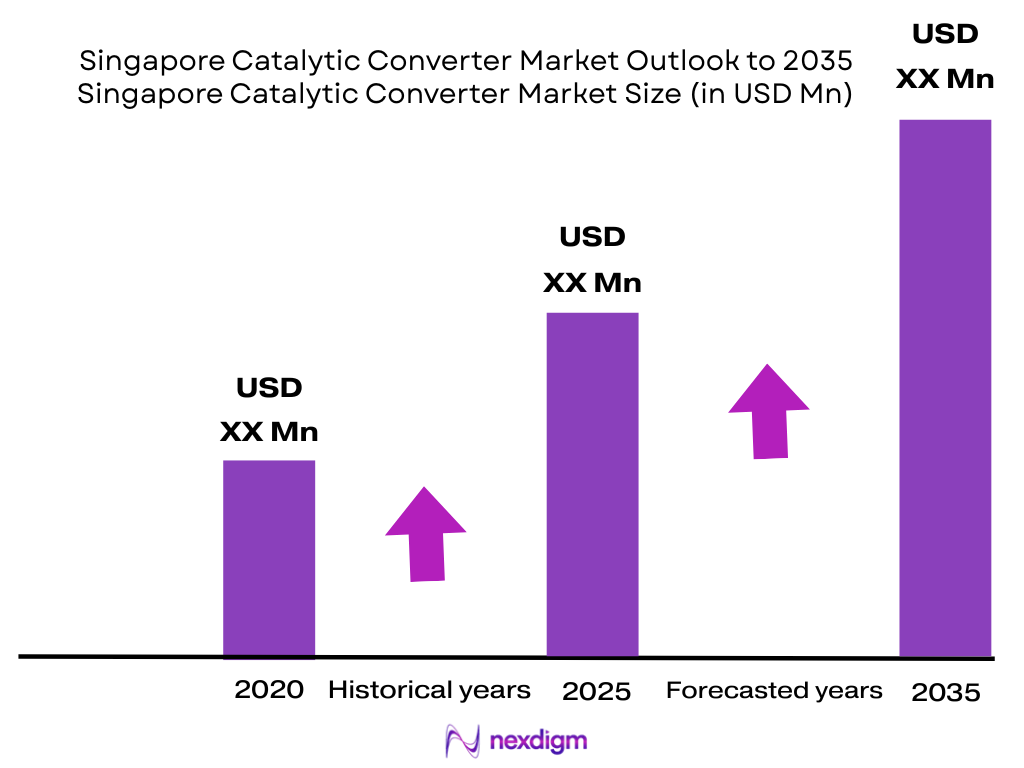
The Singapore Catalytic Converter Market is valued at USD ~ million, supported by a regulated vehicle parc that increased from 996,732 to 1,007,094 motor vehicles, while the car population rose from 651,302 to 657,744 units. Petrol cars declined from 540,605 to 513,943, but petrol-electric cars expanded from 79,256 to 99,157, maintaining substantial three-way catalyst demand while shifting technical requirements toward hybrid-compatible, low-light-off aftertreatment systems. Singapore’s Central Region, Jurong-Tuas western industrial corridor, Changi and eastern logistics corridor, and major island-wide fleet hubs concentrate catalytic-converter demand because the country operates as a single integrated urban market rather than separate city markets. Private-hire cars increased from 81,754 to 90,383, motorcycles from 143,992 to 147,883, and heavy goods vehicles from 30,370 to 31,492, supporting catalyst servicing across workshops, fleet depots, logistics facilities and authorized dealer networks.
Market Segmentation
By Powertrain Type
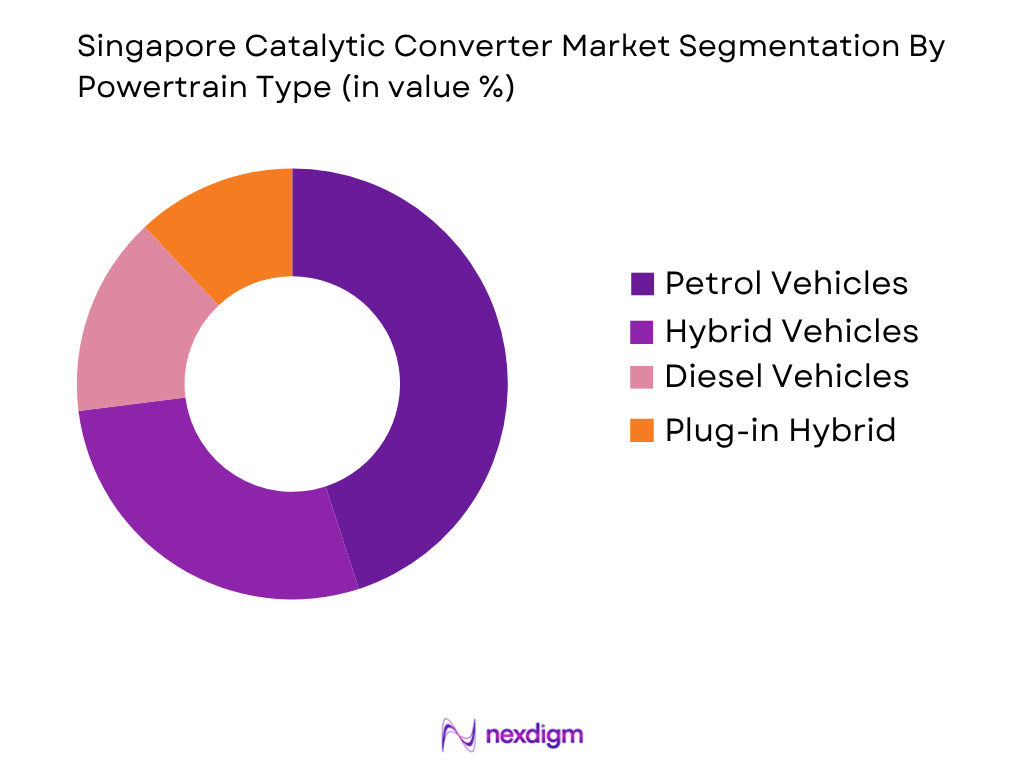
The Singapore Catalytic Converter Market is segmented into conventional petrol vehicles, petrol-electric hybrids, plug-in hybrids, diesel vehicles and other combustion powertrains. Conventional petrol vehicles remain dominant by value, because Singapore still had 513,943 petrol cars compared with 99,157 petrol-electric cars, 1,556 plug-in petrol-electric cars and 26,225 electric cars in the relevant base period. Petrol vehicles rely principally on three-way catalysts containing palladium and rhodium, while hybrid vehicles retain the same fundamental aftertreatment requirement but introduce additional thermal-management challenges. Hybrids are consequently the strategically fastest-changing catalyst segment: their population expanded sharply while conventional petrol vehicles contracted. Repeated engine shutdown and restart can reduce exhaust temperature, favouring close-coupled converters, low-thermal-mass substrates, improved oxygen-storage materials and rapidly activating wash coats. Singapore’s strict Euro VI emissions framework further encourages vehicle-specific high-efficiency catalyst systems rather than low-content universal replacements.
By Vehicle Type
The Singapore Catalytic Converter Market is segmented into private cars, private-hire cars, taxis, motorcycles and scooters, goods vehicles, and buses. Private passenger cars dominate by value, supported by 524,418 private cars, in addition to company and private-hire fleets. Passenger cars generally carry higher catalyst content than motorcycles and represent a broad mix of petrol, hybrid and premium imported platforms. Private-hire vehicles are particularly significant to replacement demand because their population increased from 81,754 to 90,383, while chauffeur-driven private-hire cars alone rose from 53,448 to 59,371. High utilization increases engine operating hours and thermal cycling, potentially accelerating oxygen-sensor and catalyst ageing. Goods vehicles remain strategically important despite smaller numbers because diesel applications can require oxidation catalysts integrated with particulate filters and SCR systems. Singapore’s inspection regime further strengthens replacement demand from ageing cars, taxis and commercial fleets because exhaust and emissions condition forms part of roadworthiness compliance.

Competitive Landscape
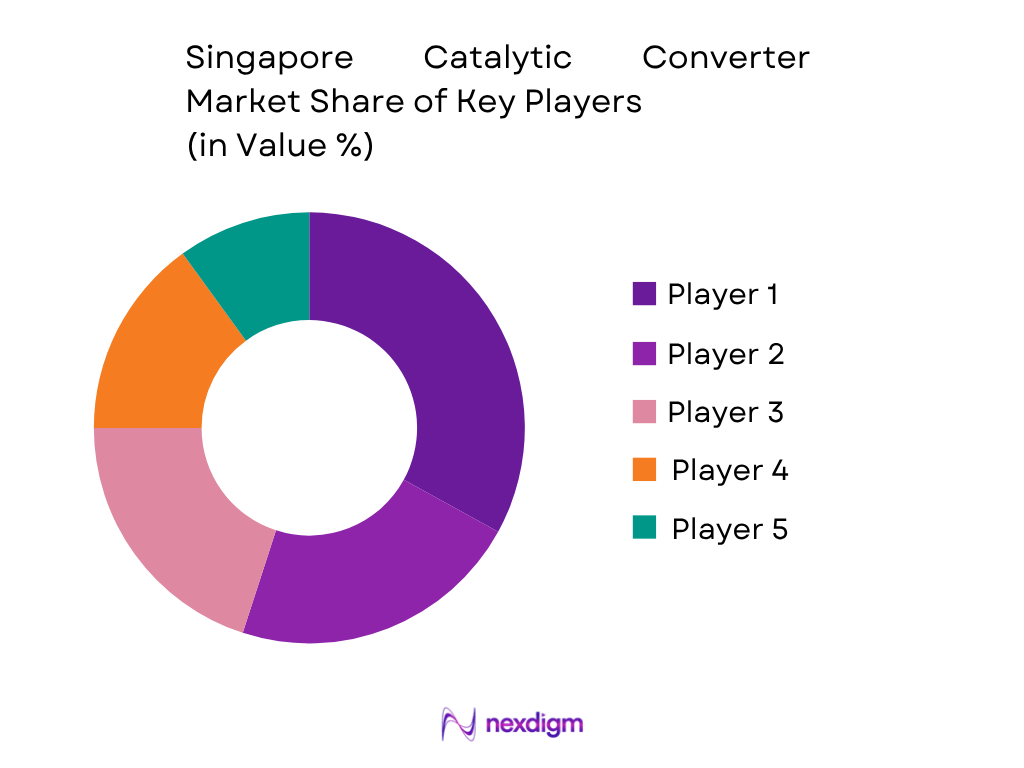
The Singapore Catalytic Converter Market is largely supplied through global emissions-control manufacturers, catalyst-chemistry specialists, substrate companies and imported aftermarket networks rather than substantial domestic catalyst manufacturing. Competition therefore centres on Euro VI compatibility, Japanese and European vehicle coverage, petrol-hybrid capability, PGM formulation, direct-fit accuracy, OBD compatibility and ASEAN inventory availability. BASF ECMS combines mobile-emissions catalyst technology with precious-metal management, while Umicore operates automotive catalyst and spent-catalyst recycling businesses. Purem and FORVIA provide complete exhaust-emission systems for major vehicle manufacturers.
| Player | Establishment | Headquarters | Core Offering | Petrol/Hybrid Capability | Commercial Aftertreatment | PGM Capability | Substrate/Exhaust Engineering | OEM Position | Recycling Capability |
| Tenneco / Walker | 1940 | Northville, USA | ~ | ~ | ~ | ~ | ~ | ~ | ~ |
| FORVIA Clean Mobility | 2022 | Nanterre, France | ~ | ~ | ~ | ~ | ~ | ~ | ~ |
| Purem by Eberspächer | 1865 group roots | Esslingen, Germany | ~ | ~ | ~ | ~ | ~ | ~ | ~ |
| BASF ECMS | 1865 group roots | Ludwigshafen, Germany | ~ | ~ | ~ | ~ | ~ | ~ | ~ |
| Umicore | 1805 roots | Brussels, Belgium | ~ | ~ | ~ | ~ | ~ | ~ | ~ |
Singapore Catalytic Converter Market Analysis
Growth Drivers
Stringent Euro VI Emission Compliance and Periodic Vehicle Inspection
Singapore’s stringent vehicle-emission regime is a direct structural driver for catalytic converters because combustion vehicles must maintain effective exhaust aftertreatment not only when entering the market but throughout their usable lives. The National Environment Agency requires all new and used imported petrol and diesel vehicles registered in Singapore to comply with Euro VI emission standards, creating stringent requirements around carbon monoxide, hydrocarbons, nitrogen oxides and particulate emissions. Singapore reinforced this framework in December 2024 when NEA extended the Commercial Vehicle Emissions Scheme and Early Turnover Scheme; eligible replacement commercial vehicles under the latter must comply with Euro 6 or equivalent standards. For catalytic-converter suppliers, these regulations make catalyst efficiency, PGM loading, oxygen-storage capability, light-off temperature and substrate durability commercially important rather than optional product attributes. Three-way catalysts fitted to petrol and petrol-hybrid cars must maintain simultaneous oxidation of carbon monoxide and hydrocarbons and reduction of nitrogen oxides, while diesel commercial vehicles require oxidation catalysts integrated with DPF and SCR systems. Singapore’s inspection framework creates another layer of recurring demand. Cars aged more than three but not more than ten years undergo inspection every 2 years, while cars more than ten years old are inspected annually; goods vehicles move to particularly intensive inspection schedules as they age. Exhaust-system condition is included in the technical inspection process, connecting catalyst integrity with continued legal vehicle operation. This is significant in a mature vehicle market because catalytic converters can deteriorate through thermal ageing, oil contamination, coolant contamination, ignition misfires, substrate cracking and inefficient engine calibration. Singapore’s macroeconomic environment reinforces consumers’ and fleets’ ability to maintain technically compliant vehicles. The IMF reported that real GDP expanded 4.4 in 2024, compared with 1.8 in the preceding year, supported by private consumption and an upswing in technology-related activity; economic output subsequently expanded another 5.0 in 2025. The IMF’s 2026 country profile also lists a population of 6.121 million, demonstrating the scale of economic activity concentrated within a compact, highly motorized city-state. These conditions favour technically validated direct-fit converters and OEM-equivalent systems rather than low-performance universal components that risk OBD faults or inspection failures. The market is especially relevant for COE-renewed vehicles because owners choosing to operate a car beyond its initial ten-year entitlement period face increasing maintenance exposure as catalysts, oxygen sensors and exhaust assemblies age. Hybrid vehicles add another layer: although fuel consumption falls, the petrol engine remains and therefore still requires a compliant three-way catalyst. Frequent engine stop-start operation can allow exhaust temperature to decline, which increases the value of close-coupled substrates, low-thermal-mass monoliths and highly active washcoats. Singapore’s combination of Euro VI market-entry requirements, recurring inspections, high regulatory enforcement and a financially capable vehicle-owning population therefore sustains demand for high-efficiency catalytic converters even as the conventional petrol fleet gradually contracts.
Rapid Petrol-Hybrid Adoption Preserving Catalyst Demand During Powertrain Transition
The rapid expansion of petrol-electric hybrid vehicles is another important driver because hybrids retain an internal-combustion engine and therefore preserve catalytic-converter demand even as Singapore progressively reduces reliance on conventional petrol cars. Land Transport Authority statistics show that the petrol-electric car population increased from 99,157 vehicles in 2024 to 118,695 vehicles in 2025, while conventional petrol cars fell from 513,943 to 475,455 units over the same annual comparison. The significance for catalyst suppliers is greater than the raw vehicle count suggests. A full hybrid switches repeatedly between electric propulsion and petrol-engine operation, allowing the catalytic converter to cool whenever the engine remains off. When combustion restarts, the system must rapidly recover effective conversion temperature to control carbon monoxide, hydrocarbons and nitrogen oxides. Consequently, hybridization can raise demand for technologically advanced aftertreatment even as it reduces engine operating time. Close-coupled converter placement, reduced substrate thermal mass, ceria-zirconia oxygen-storage materials, optimized palladium-rhodium distribution and fast-response lambda-sensor calibration become increasingly important. Hybrid taxis and private-hire cars amplify this effect because they operate at higher annual mileage than normal household vehicles and experience continuous stop-start duty cycles in dense urban traffic. Singapore’s broader vehicle population reinforces this potential aftermarket base: LTA’s annual statistics show a car fleet well above 650,000 units, while the island also supports substantial private-hire, goods-vehicle and bus operations. The underlying economy provides a strong foundation for adoption of comparatively sophisticated hybrid vehicles. The IMF recorded 4.4 economic growth in 2024, followed by 5.0 growth in 2025, while the 2026 IMF country profile lists Singapore’s population at 6.121 million. Singapore’s policy architecture reinforces this bridge technology. The government requires all new car and taxi registrations to be cleaner-energy models from 2030, with the definition explicitly including electric, hybrid and hydrogen-fuel-cell vehicles. New diesel car registrations stopped from 2025, making petrol hybrids one of the principal combustion-containing technologies able to remain within the longer-term cleaner-energy framework. For the Catalytic Converter Market, this creates a differentiated growth path: overall ICE vehicle numbers may decline, but the remaining combustion vehicles increasingly consist of hybrids carrying relatively sophisticated three-way catalyst systems. Replacement demand also remains attractive because hybrid catalyst deterioration can arise from repeated thermal cycling, engine oil consumption, aging oxygen sensors or engine-control faults, particularly after extended COE renewal. The transition therefore favours application-specific systems over generic converters. Suppliers with catalogues covering Toyota, Lexus, Honda, Hyundai, Kia and European hybrid platforms can address a growing portion of Singapore’s combustion-equipped car parc. Workshop capability must evolve as well because catalyst fault diagnosis on a hybrid requires understanding not only conventional engine parameters but also how engine-off periods influence temperature and sensor readings. Over time, hybrid vehicles should function as the central bridge between Singapore’s conventional petrol heritage and its eventual battery-electric fleet, preserving meaningful catalytic-converter demand while shifting the market toward higher-performance, low-light-off technology.
Market Challenges
Accelerating Battery-Electric Vehicle Adoption Eliminating Converter Fitment
Battery-electric vehicle adoption is the most significant structural challenge for the Singapore Catalytic Converter Market because a BEV does not contain an exhaust manifold, catalytic converter, oxygen sensors or downstream emission-control system. Singapore’s transition accelerated markedly through 2024–2026. In the first half of 2024, LTA reported that electric cars represented almost one in three new car registrations, compared with around 18 in every 100 during the preceding annual period, while approximately 18,000 electric cars were already operating on the road at that point. The installed electric-car population then increased substantially: LTA annual statistics record 26,225 electric cars in 2024 and 49,110 in 2025, meaning the number of converter-free passenger cars almost doubled within one annual interval. The transition strengthened further in January 2026, when EVs reached a record 55 out of every 100 new car registrations, according to the Ministry of Transport. Every battery-electric car replacing a petrol vehicle removes more than just one original-equipment converter. It also eliminates future replacement-converter revenue, lambda-sensor diagnostics, exhaust repairs and end-of-life catalyst recovery associated with that vehicle. This lifetime substitution effect means electrification has a disproportionate impact on companies dependent on passenger-car catalyst turnover. Infrastructure expansion makes this transition increasingly durable. Singapore had more than 29,000 charging points island-wide in early 2026, rising to 30,500 charging points by March 2026; the national programme remains aimed at 60,000 charging points, comprising 40,000 in public carparks and 20,000 on private premises. By December 2025, every HDB town was EV-ready and more than 90 in every 100 HDB carparks had charging facilities, reducing one of the practical constraints on electric-car ownership. Singapore’s cleaner-energy policy also progressively narrows the addressable conventional catalyst market. New diesel car and taxi registrations ceased from 2025, while all new cars and taxis must be cleaner-energy models from 2030. The macroeconomic environment provides consumers and fleet operators with the capacity to adopt these technologies: the IMF reports 4.4 economic growth in 2024 and 5.0 in 2025, indicating strong economic conditions during the acceleration of EV adoption. For catalytic-converter suppliers, the challenge is therefore not a cyclical slowdown but permanent technology substitution. Passenger-car new-fitment demand will progressively concentrate in hybrids rather than conventional petrol models. Aftermarket demand remains protected for a period by the installed petrol fleet and COE-renewed vehicles, but each deregistered ICE car potentially exits permanently if replaced by a BEV. Commercial vehicles offer somewhat more resilience because heavy-duty electrification typically involves different duty cycles and infrastructure requirements, but zero-emission programmes are also expanding into these segments. Suppliers consequently need to reduce dependence on conventional petrol new-fitment applications and focus on hybrid aftertreatment, aging-vehicle replacement, commercial diesel systems and PGM recovery from the shrinking combustion vehicle parc.
COE-Driven Vehicle Turnover and Import Dependence Constraining Aftermarket Replacement Economics
Singapore’s Certificate of Entitlement vehicle-ownership structure creates a market-specific challenge because catalyst replacement decisions compete directly with vehicle deregistration economics. Unlike markets where combustion vehicles remain on the road primarily until mechanical failure, Singapore’s ownership framework creates a distinct decision point when a vehicle approaches the end of its initial COE period. Owners must decide whether to renew the COE and retain an aging vehicle or deregister it and acquire another vehicle. This can suppress catalytic-converter replacement where a failure occurs close to the vehicle’s planned deregistration date, even when the vehicle is mechanically repairable. The challenge becomes increasingly relevant as Singapore transitions toward cleaner-energy vehicles because deregistered petrol cars are progressively replaced by hybrids or BEVs, shrinking the future addressable replacement pool. LTA figures illustrate this changing fleet composition: conventional petrol cars declined from 513,943 units in 2024 to 475,455 units in 2025, while petrol-electric cars increased to 118,695 and electric cars reached 49,110. Consequently, aftermarket companies must manage inventories for a declining conventional petrol base while simultaneously expanding application coverage for newer hybrid models. Singapore also lacks large-scale domestic production of catalytic converters, coated substrates and automotive PGM formulations, making its catalyst ecosystem heavily dependent on imported vehicles and imported components. That creates SKU and supply-chain complexity because the vehicle parc includes Japanese, German, Korean, Chinese and other imported platforms with different converter dimensions, exhaust manifolds, OBD calibrations and sensor positions. A universal converter may physically fit an exhaust pipe but fail to replicate OEM light-off characteristics, backpressure or catalyst efficiency, creating P0420/P0430-related problems or inspection concerns. The regulatory standard further limits product simplification. All imported new and used petrol and diesel vehicles must comply with Euro VI, while the VES framework continues through 2026–2027 with revised emissions bands, ensuring that technically sophisticated aftertreatment remains central to compliant combustion vehicles. Inspection frequency increases as vehicles age, further magnifying the need for validated replacement components among owners who do renew their COE. The result is a bifurcated market: one aging owner may purchase a high-quality direct-fit converter to keep a renewed vehicle compliant for several more years, while another may deregister the same model instead of repairing it. This makes demand forecasting more difficult than in conventional aftermarket environments. Singapore’s macroeconomic resilience adds another dimension. IMF data show 4.4 economic growth in 2024 and 5.0 in 2025, so declining conventional catalyst demand cannot simply be attributed to weaker purchasing power; it reflects policy and technology choices within a strong economy. Distributors therefore need precise vehicle-age, COE-renewal and powertrain forecasting when planning inventories. Maintaining too many legacy petrol SKUs risks obsolescence, but inadequate stocks create long lead times for vehicles that remain operational. Competitive suppliers will increasingly require accurate VIN-based catalogues, regional warehousing and access to ASEAN/Japan/Europe supply chains rather than broad inventories of undifferentiated universal products.
Market Opportunities
Advanced Hybrid Three-Way Catalysts and High-Mileage Fleet Applications
Singapore’s strongest catalytic-converter opportunity lies in the portion of electrification that retains an internal-combustion engine—particularly petrol-electric hybrids used as private cars, taxis and private-hire vehicles. Current fleet evidence already demonstrates the scale of this transition. LTA data show petrol-electric cars increasing from 99,157 units in 2024 to 118,695 units in 2025, while conventional petrol cars declined to 475,455. This creates a growing installed base requiring three-way catalysts despite the broader shift toward cleaner-energy mobility. The technical requirements of hybrid aftertreatment make the opportunity particularly attractive for advanced suppliers. In conventional petrol vehicles, continuous engine operation typically maintains catalyst temperature once warm. A hybrid engine can stop for repeated periods while the electric motor propels the vehicle, after which the petrol engine restarts under changing loads. The catalyst must rapidly regain efficient conversion temperature, creating demand for close-coupled configurations, low-thermal-mass substrates, highly dispersed palladium and rhodium, and washcoats with strong oxygen-storage capability. High-mileage commercial mobility adds further value. Singapore’s urban transport ecosystem includes taxis and a substantial private-hire fleet, where repeated acceleration, deceleration and stop-start operation generate far more thermal cycles than ordinary private-car usage. These operating characteristics can accelerate aging of oxygen sensors, substrate coatings and related exhaust components, producing replacement demand earlier in vehicle life. Hybrid taxis and private-hire cars are therefore attractive not because they use more fuel, but because they combine continued catalyst necessity with high utilization. Singapore’s regulatory structure reinforces this opportunity. All imported petrol vehicles must satisfy Euro VI, while cleaner-energy vehicle rules allow hybrids to remain part of new registrations beyond 2030. The market does not therefore face an immediate binary transition from petrol to BEV; hybrids can operate as an extended bridge technology. Singapore’s strong macroeconomic conditions also support high-quality replacement rather than purely low-cost repairs. The IMF recorded 4.4 growth in 2024, 5.0 in 2025, and projects continued economic activity in 2026, while its country profile lists a population of 6.121 million. For suppliers, the most defensible strategy is to develop vehicle-specific hybrid catalyst portfolios covering Toyota, Lexus, Honda, Hyundai, Kia and European petrol-electric platforms rather than relying on conventional petrol products. Workshops also need hybrid-aware diagnostics that consider catalyst temperature history, engine-off intervals, upstream and downstream oxygen-sensor behaviour and battery-assisted driving. Fleet operators present an additional channel opportunity because standardized vehicle models allow bulk sourcing and predictable maintenance planning. As Singapore’s petrol-car population contracts, hybrid applications can therefore preserve catalyst revenue while shifting value toward more sophisticated designs and higher technical service content.
COE-Renewed Vehicle Replacement, Commercial Aftertreatment and PGM Recovery
A second major opportunity lies in combining the residual aftermarket for COE-renewed vehicles and commercial fleets with systematic recovery of platinum-group metals from converters leaving the vehicle parc. Singapore’s ownership model produces a clear segmentation between vehicles that are deregistered and those whose operating lives are extended through COE renewal. Vehicles retained beyond ten years face annual inspection, making exhaust integrity and emissions performance increasingly relevant to continued ownership. This can support direct-fit catalyst replacement where the owner has already committed capital to extending the vehicle’s life and therefore has an incentive to maintain it properly. Commercial fleets create an additional source of durable demand. Goods vehicles and buses operate at higher annual mileage than normal private cars, and diesel applications use aftertreatment architectures that can include a diesel oxidation catalyst, particulate filter and selective catalytic reduction system rather than a single three-way catalyst. Singapore reinforced commercial-vehicle emissions controls in December 2024 by extending the Commercial Vehicle Emissions Scheme and Early Turnover Scheme; replacement vehicles qualifying under ETS must meet Euro 6 or equivalent standards. This creates opportunities for suppliers specializing in validated DOC components and integrated commercial exhaust aftertreatment. At the opposite end of the vehicle lifecycle, Singapore’s rapid transition toward electric vehicles is creating a growing stream of catalysts removed from deregistered combustion vehicles. These spent units contain recoverable platinum, palladium and rhodium embedded in ceramic or metallic substrates. Instead of treating them as ordinary scrap, workshops, dismantlers and vehicle exporters can classify converter cores by vehicle application and route them through professional assay and PGM-refining channels. This opportunity is particularly strategic because electrification progressively reduces new catalyst fitment while increasing the relative importance of secondary material recovery from the historical ICE parc. The vehicle transition is already substantial: electric cars reached 49,110 units in 2025, while the national charging network exceeded 29,000 points in early 2026 and reached 30,500 by March 2026. Each ICE vehicle deregistered in favour of a BEV can potentially yield one or multiple converter units for recovery, converting technological substitution into a recycling feedstock opportunity. Singapore’s logistical and industrial capabilities are well suited to this model because high-value automotive scrap can be consolidated efficiently and routed to established regional or global refiners even if final PGM refining is not conducted domestically. A closed-loop replacement model could further improve economics: workshops install a compliant direct-fit converter and retain the spent core, aggregating units until sufficient material exists for professional recycling. This improves traceability, reduces informal leakage and gives distributors an additional source of value. Macroeconomic conditions support investment in sophisticated circular supply chains; IMF data show economic output expanding 4.4 in 2024 and 5.0 in 2025, indicating that the catalyst market is operating within a high-value, technologically advanced economy rather than a cost-only repair environment. The combination of COE-renewed vehicle servicing, Euro 6 commercial aftertreatment and structured PGM recovery therefore provides one of the most defensible opportunity areas as Singapore’s market shifts away from conventional petrol new fitment.
Future Outlook
The Singapore Catalytic Converter Market is forecast to expand at ~ CAGR during 2026–2035 under the placeholder framework. The market should progressively shift away from conventional petrol new-fitment demand toward petrol-hybrid catalysts, COE-renewed vehicle replacement, private-hire fleet servicing and commercial-vehicle aftertreatment. The first major structural change is rapid hybridization. Petrol-electric cars increased from 79,256 to 99,157 and then 118,695 units across the latest three annual LTA observations. Conventional petrol cars moved in the opposite direction, falling from 540,605 to 513,943 and then 475,455 units. This means catalyst demand will increasingly favour hybrid systems engineered for frequent combustion-engine restart and lower exhaust-temperature operation. A second opportunity arises from Singapore’s vehicle-age and inspection framework. The COE system can extend vehicle operation beyond the original ownership period when owners renew entitlement rather than deregistering their vehicles. Older cars retained through COE renewal become relevant to the catalytic-converter aftermarket because catalyst efficiency, oxygen sensors, manifolds and exhaust systems accumulate additional operating years.
Commercial vehicles provide another comparatively resilient aftertreatment segment. Singapore had 143,209 goods and other vehicles and 18,268 buses in the relevant base period. Diesel goods vehicles alone numbered 125,549. Their systems can incorporate diesel oxidation catalysts alongside DPF and SCR technologies, creating greater emissions-control content than a standalone petrol converter. Regulation continues to support technically compliant catalysts. NEA requires all new and used imported petrol and diesel vehicles to meet Euro VI emission standards, placing stringent limits on pollutant emissions and making validated emissions-control technology central to vehicle homologation. The Commercial Vehicle Emissions Scheme and Early Turnover Scheme also push older commercial vehicles toward cleaner replacements; qualifying replacement vehicles under the adjusted ETS must meet Euro 6 or equivalent standards.
Major Players
- Tenneco / Walker Emissions Control
- FORVIA Clean Mobility
- Purem by Eberspächer
- BOSAL
- MagnaFlow
- BASF Environmental Catalyst and Metal Solutions
- Umicore
- Johnson Matthey
- Corning Incorporated
- DENSO Corporation
- Cataler Corporation
- NGK Insulators
- IBIDEN
- Futaba Industrial
- Sango Co., Ltd.
Key Target Audience
- Catalytic Converter and Exhaust-System Manufacturers
- Automotive OEM Distributors and Vehicle Importers
- Automotive Parts Importers and Aftermarket Distributors
- Taxi, Private-Hire and Commercial Fleet Operators
- Authorized Service Centres and Multi-Brand Automotive Workshops
- Platinum-Group-Metal Refiners and Automotive Recyclers
- Investments and Venture Capitalist Firms
- Government and Regulatory Bodies (Land Transport Authority, National Environment Agency, Ministry of Transport, Enterprise Singapore)
Research Methodology
Step 1: Identification of Key Variables
The initial phase constructs an ecosystem map covering vehicle importers, OEM distributors, catalyst suppliers, exhaust manufacturers, parts distributors, workshops, fleet operators and recyclers. Core variables include vehicle population by fuel, petrol-hybrid penetration, vehicle age, COE renewal, Euro VI compliance, converter count per vehicle, substrate type and PGM composition.
LTA vehicle statistics and NEA emissions regulations establish the demand foundation, while supplier disclosures are used to map catalyst technology and competitive capability.
Step 2: Market Analysis and Construction
The top-down model begins with Singapore’s combustion and hybrid vehicle parc, segregating private cars, private-hire cars, taxis, goods vehicles, buses and motorcycles. Converter content is assigned based on powertrain, emission standard and vehicle application.
The bottom-up model assesses OEM dealer replacement, independent workshop activity, direct-fit product portfolios, fleet maintenance and commercial aftertreatment demand. COE-renewed vehicles receive separate treatment because their extended operating life alters replacement economics.
Step 3: Hypothesis Validation and Expert Consultation
Market hypotheses are validated through CATIs with automotive importers, parts distributors, service centres, exhaust specialists, taxi/private-hire fleet operators, commercial vehicle workshops and recycling companies.
Discussions focus on catalyst replacement frequency, P0420/P0430 diagnostics, hybrid catalyst ageing, Euro VI compatibility, application availability and the point at which owners choose replacement versus vehicle deregistration.
Step 4: Research Synthesis and Final Output
The final phase triangulates LTA vehicle statistics, NEA emissions requirements, supplier technology mapping and primary interviews. Demand is segmented by converter type, vehicle type, powertrain, emissions standard, fitment type, substrate, PGM composition, vehicle age and distribution channel.
Forecast scenarios incorporate petrol-car contraction, hybrid adoption, EV penetration, COE renewal behaviour, fleet electrification, commercial-vehicle replacement, PGM availability and catalyst recycling.

- Executive Summary
- Research Methodology (Market Definitions and Assumptions, Abbreviations, Catalytic Converter Market Boundary, Vehicle-Parc Mapping, Fuel-Type Mapping, Converter-per-Vehicle Assessment, COE Age-Cohort Analysis, OEM Fitment Assessment, Replacement Cycle Analysis, Periodic Inspection Mapping, PGM Loading Assessment, Import Supply Mapping, Market Sizing Approach, Top-Down Analysis, Bottom-Up Analysis, Demand-Side Assessment, Supply-Side Assessment, OEM/Distributor/Workshop Interviews, Recycler Assessment, Data Triangulation, Forecasting Framework, Scenario Analysis, Limitations and Future Conclusions)

- Definition and Scope
- Evolution of Automotive Catalytic Emission Control in Singapore
- Development of Euro-Compliant Vehicle Aftertreatment
- Evolution of Three-Way Catalyst Technology
- Catalytic Converter Role in Petrol, Petrol-Hybrid and Diesel Powertrains

- Growth Drivers (Euro VI Compliance, Large Petrol Vehicle Parc, Rapid Petrol-Hybrid Adoption, Periodic Vehicle Inspection, COE-Renewed Vehicle Aftermarket, Taxi and Private-Hire Utilization, Commercial Vehicle Maintenance, High-Value OEM Replacement)
- Market Challenges (EV Adoption, Diesel Car Registration Ban, PGM Import Dependence, Small Domestic Manufacturing Base, High Vehicle Turnover from COE/PARF Economics, Application-Specific Converter Complexity, Imported Parts Dependence, Illegal Exhaust Modification)
- Market Opportunities (Hybrid Three-Way Catalysts, COE-Renewed Vehicle Replacement, Fleet Catalyst Maintenance, Euro VI Direct-Fit Converters, PGM Recycling, Commercial Vehicle Aftertreatment, VIN-Based Application Matching, Regional Distribution)
- Market Trends (Petrol-to-Hybrid Shift, Close-Coupled Catalysts, PGM Thrifting, High-Cell-Density Substrates, OBD Diagnostics, Direct-Fit Replacement, Converter Traceability, Recycled-PGM Utilization)
- SWOT Analysis
- Porter’s Five Forces Analysis
- PESTLE Analysis

- By Market Value (2020-2025)
- By Catalytic Converter Unit Volume (2020-2025)
- By OEM-Fitted Converter Volume (2020-2025)

- By Converter Type (In Value %)
Three-Way Catalytic Converters
Close-Coupled Catalytic Converters
Manifold-Integrated Catalytic Converters
Underfloor Catalytic Converters
Diesel Oxidation Catalysts - By Vehicle Type (In Value %)
Private Passenger Cars
Taxis
Private-Hire Cars
Motorcycles and Scooters
Light Goods Vehicles - By Powertrain Type (In Value %)
Conventional Petrol Vehicles
Petrol-Electric Hybrid Vehicles
Plug-in Petrol-Hybrid Vehicles
Diesel Vehicles
Diesel-Electric Vehicles - By Vehicle Origin (In Value %)
Japanese Vehicles
German Vehicles
Korean Vehicles
Swedish and Other European Vehicles
Chinese Vehicles

- Market Share of Major Players by Value
- Cross Comparison Parameters (Singapore Euro VI Vehicle Application Coverage, Petrol-Petrol-Hybrid-Commercial Vehicle Converter Portfolio Breadth, Platinum-Palladium-Rhodium Catalyst Formulation Capability, Ceramic/Metallic Substrate and Wash coat Engineering Capability, LTA/NEA-OBD and Vehicle-Specific Compliance Capability, Singapore/ASEAN Distribution and Inventory Footprint, OEM-Workshop-Taxi-Commercial Fleet Channel Reach, PGM Recycling and Closed-Loop Material Capability)
- SWOT Analysis of Major Players
- Detailed Profiles of Major Companies
Tenneco / Walker Emissions Control
FORVIA Clean Mobility
Purem by Eberspächer
BOSAL
MagnaFlow
BASF Environmental Catalyst and Metal Solutions
Umicore
Johnson Matthey
Corning Incorporated
DENSO Corporation
Cataler Corporation
NGK Insulators
IBIDEN
Futaba Industrial
Sango Co., Ltd.

- OEM Distributor Procurement
- Authorized Dealer Demand
- Independent Automotive Workshop Demand
- Exhaust Specialist Demand
- Taxi Fleet Procurement

- By Market Value
- By Catalytic Converter Unit Volume
- By OEM-Fitted Converter Volume


 Request a Sample
 Ask for Customization
 Get a Quote
 Enquire Now