

 Download PDF
Market Overview
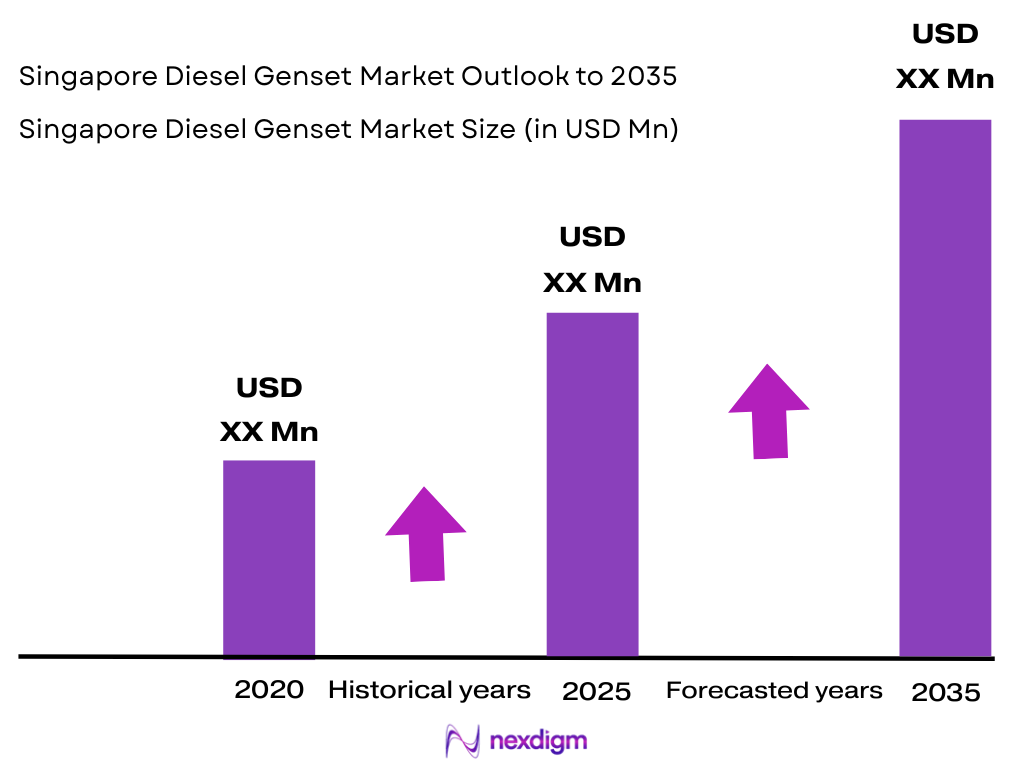
The Singapore Diesel Genset Market is valued at approximately USD ~ million, compared with USD ~ million in the preceding annual benchmark. Singapore’s car population increased from 651,302 to 657,744 vehicles, while its total motor-vehicle population reached 1,007,094 units. Demand is supported by manufacturing, electronics production, workshops, fleet depots and logistics facilities requiring standby electricity for automated equipment, HVAC, IT, security and life-safety systems. Jurong, Tuas, Ubi, Kaki Bukit and Sin Ming dominate Singapore Diesel Genset Market activity because they combine advanced manufacturing, servicing and industrial infrastructure. Jurong hosts Hyundai’s 86,900-square-metre smart manufacturing facility with capacity for 30,000 EVs annually, while Singapore’s latest vehicle base exceeds 1 million units. Tuas supports industrial and logistics activities, whereas Ubi, Kaki Bukit and Sin Ming contain dense workshop and vehicle-service ecosystems requiring distributed standby-power systems. Singapore differs from large vehicle-producing countries because diesel-genset demand is not driven primarily by numerous mass-production assembly plants. Instead, the market combines one highly automated smart vehicle-manufacturing ecosystem with semiconductor and electronics plants, precision-engineering companies, dealerships, workshops, logistics centers and commercial fleet facilities. Hyundai Motor Group Innovation Center Singapore is highly automated, using around 200 robots, with robotics performing a substantial share of production, inspection and material-handling activities.
Market Segmentation
By Power Rating
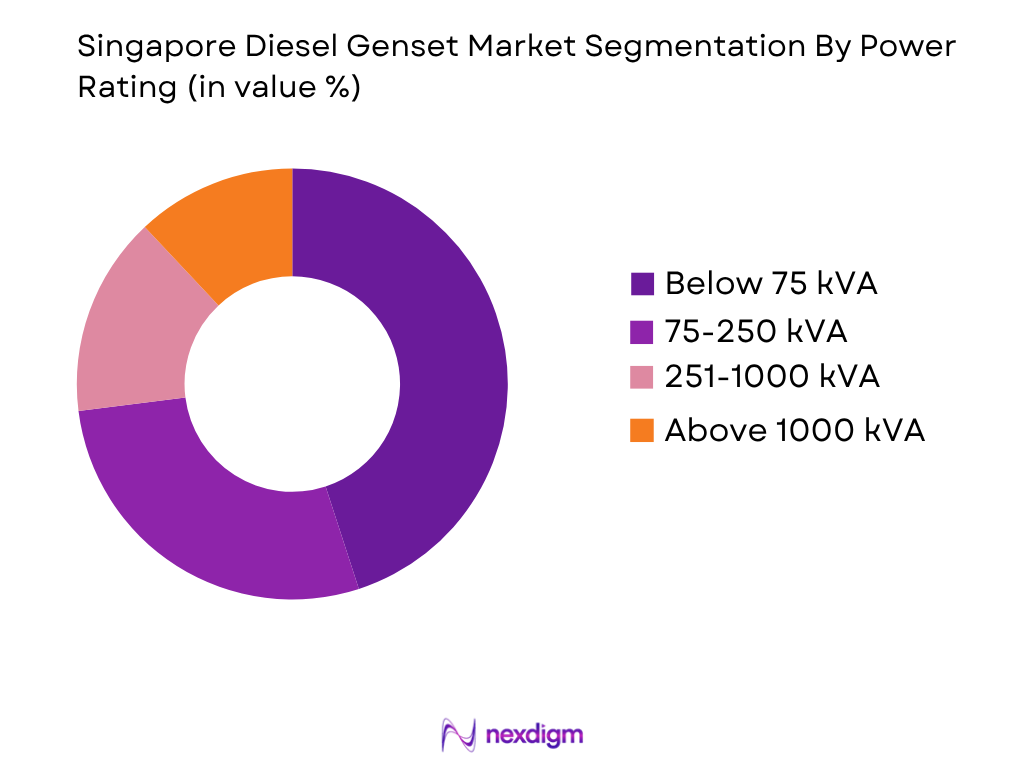
The Singapore Diesel Genset Market is segmented into below 75 kVA, 75–250 kVA, 251–500 kVA, 501–1,000 kVA and above 1,000 kVA. The 75–250 kVA category holds the dominant analytical market share because Singapore has a broad base of workshops, dealer service centers, fleet depots, PDI facilities and warehouses whose critical electrical loads are considerably smaller than full-scale vehicle factories. This rating range can support compressors, vehicle lifts, diagnostic equipment, lighting, IT infrastructure, ventilation and selected HVAC loads while fitting Singapore’s space-constrained industrial properties. Larger generator systems remain relevant for Hyundai’s advanced manufacturing facility and electronics or semiconductor operations, where critical HVAC, automation and process systems can require higher backup capacity. Singapore’s extreme grid reliability means systems are typically selected for emergency reliability and compact integration rather than extensive annual operating hours.
By Facility Type
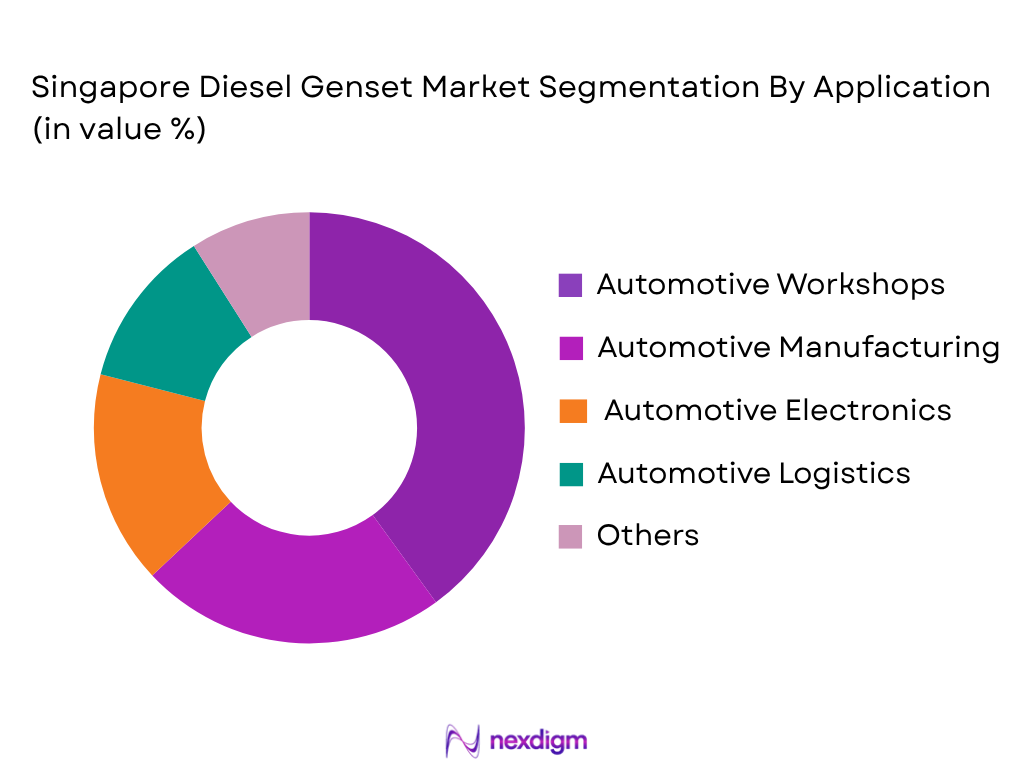
The Singapore Diesel Genset Market is segmented into dealerships and workshops, manufacturing and precision-engineering facilities, electronics and semiconductor plants, fleet-maintenance depots, and logistics/PDI facilities. Dealerships and workshops dominate the analytical market share because Singapore’s controlled but substantial vehicle population creates an extensive recurring servicing requirement despite limited domestic vehicle assembly. LTA records more than 1 million motor vehicles, including 569,956 cars and 167,057 goods and other vehicles in the latest benchmark relevant to the base market. Manufacturing and electronics sites represent fewer facilities but typically require larger generator ratings and greater redundancy. Semiconductor-related demand is strategically important because Singapore continues to attract fabrication and electronics investments serving, IoT and power-electronics applications.
Competitive Landscape
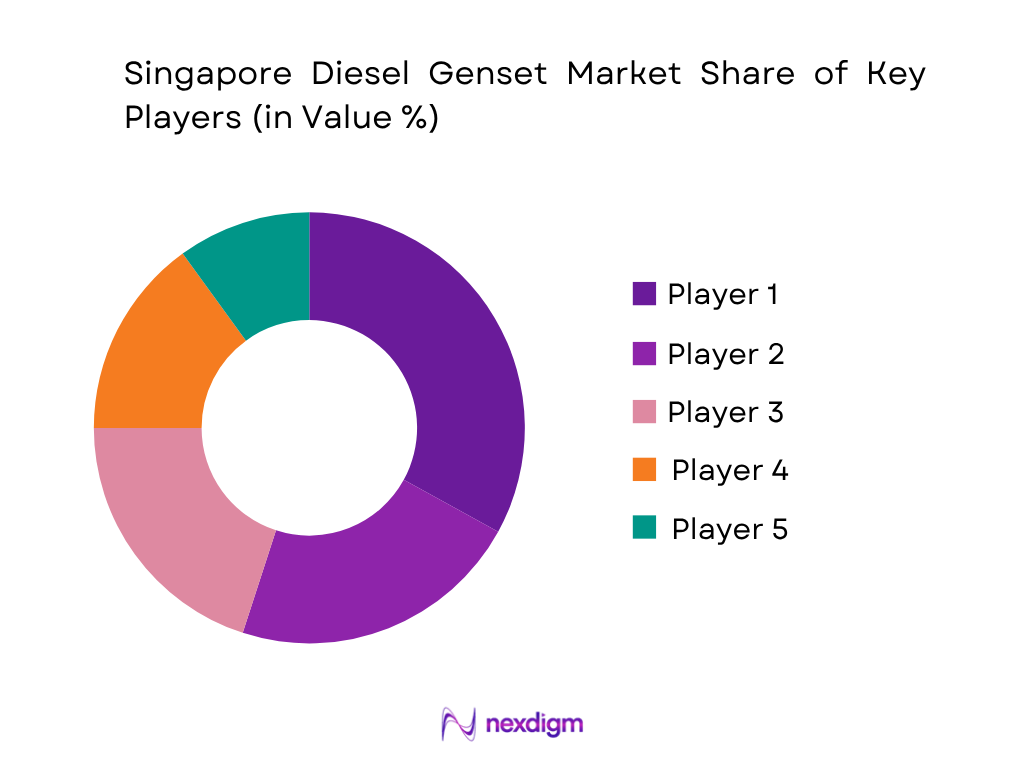
The Singapore Diesel Genset Market is served by a concentrated group of established international power-generation suppliers with local or regional sales, engineering and service capability. Cummins, Caterpillar through Tractors Singapore, Rolls-Royce Power Systems–mtu, Atlas Copco and Denyo compete across stationary, mobile and mission-critical applications. Because the grid is highly reliable, competition centers on equipment readiness, acoustic engineering, compact installation, service response, automatic-transfer integration, remote monitoring and lifecycle maintenance rather than fuel-driven prime-power economics.
| Major Player | Establishment Year | Headquarters | Singapore Presence | Diesel Genset Position | Application Fit | Acoustic / Compact Capability | Controls & Integration | Local Service Position |
| Cummins Inc. | 1919 | Columbus, Indiana, USA | ~ | ~ | ~ | ~ | ~ | ~ |
| Caterpillar Inc. / Tractors Singapore | 1925 | Irving, Texas, USA | ~ | ~ | ~ | ~ | ~ | ~ |
| Rolls-Royce Solutions Asia – mtu | 1974 Singapore presence | Singapore | ~ | ~ | ~ | ~ | ~ | ~ |
| Atlas Copco | 1873 | Stockholm, Sweden | ~ | ~ | ~ | ~ | ~ | ~ |
| Denyo Co., Ltd. / Denyo United Machinery | 1948 | Tokyo, Japan | ~ | ~ | ~ | ~ | ~ | ~ |
Singapore Diesel Genset Market Analysis
Growth Drivers
Advanced Manufacturing and Electronics Industrialization
Singapore’s move toward highly automated and electronics manufacturing is strengthening the need for reliable emergency diesel-generation systems even though the country does not operate a conventional large-volume manufacturing base. Hyundai Motor Group Innovation Center Singapore represents the clearest example: the Jurong facility covers 86,900 square metres, has capability to manufacture 30,000 electric vehicles annually, and in 2026 was operating more than 200 robots, including autonomous mobile robots and automated guided vehicles. Such automation increases the number of electrically dependent processes whose interruption can disrupt assembly, material movement, inspection, digital-twin applications, factory IT and environmental-control equipment. Related semiconductor manufacturing provides a second critical demand base. Singapore’s semiconductor industry employs more than 35,000 people, produces roughly 1 chip out of every 10 chips manufactured globally, and accounts for about 1 semiconductor-equipment unit out of every 5 units produced worldwide. A new national semiconductor R&D fabrication facility announced in 2025 carries investment of S$500 million, while UMC’s advanced fabrication facility became operational in 2025 and is expected to create around 700 jobs, supplementing more than 1,800 existing UMC positions. These facilities are relevant to gensets because power semiconductors, specialty chips, sensors and electronics require tightly controlled manufacturing environments with substantial HVAC, cleanroom, chilled-water, process-control and IT loads. Singapore’s macroeconomic performance provides additional support: the World Bank recorded nominal GDP of USD 547.39 billion in 2024 and GDP per capita of USD 90,674.1, while the IMF reported real GDP growth of 4.4 units for every 100 units of output in 2024, compared with 1.8 units previously. For diesel-genset suppliers, these indicators point toward a relatively small but technically demanding market where growth is generated by high-value manufacturing facilities rather than large numbers of basic generator installations. Critical-power specifications increasingly require fast automatic transfer, redundant controls, remote diagnostics, compact generator rooms and coordination with UPS and battery systems. The opportunity therefore extends beyond vehicle assembly into the semiconductor, robotics, precision-engineering and electronics ecosystem supporting next-generation mobility.
Expansion of Electrified Mobility, Vehicle Support Infrastructure and Power-Dependent Operations
Singapore’s rapid development of electric-mobility infrastructure is creating a larger and more technologically sophisticated support ecosystem in which diesel gensets can serve as emergency and contingency assets. The Land Transport Authority reported approximately 13,800 registered EV charging points across Singapore in August 2024, with charging infrastructure already installed in around 1,000 HDB carparks. More than 1,200 chargers had received co-funding under the EV Common Charger Grant at that point. Policy support has continued: from 2026, Singapore’s Electric Heavy Vehicle Charger Grant provides support for the first 500 qualifying heavy-vehicle chargers, with each charger required to have a minimum power rating of 50 kW, while the accompanying Heavy Vehicle Zero Emissions Scheme provides incentives for qualifying heavy goods vehicles and buses. These developments increase the electrical complexity of fleet depots, workshops, logistics facilities and charging sites. Diesel gensets are not expected to power normal charging operations; rather, their opportunity lies in maintaining critical workshop, fleet-management, security, communications, fire-protection and essential charging-support functions when electrical infrastructure is under maintenance or unavailable. Singapore’s electricity demand itself illustrates the scale of the environment: the Energy Market Authority reported 59,616 GWh of electricity generation in 2024, with national peak electricity demand reaching 8,045 MW. Total generation capacity stood at 12,445 MW, including 10,115 MW of combined-cycle, cogeneration and trigeneration capacity, 1,211 MWac of solar PV and 200 MW of energy-storage systems. In the first half of 2025, total generation capacity increased to 13,261 MW, demonstrating continued infrastructure expansion. Macroeconomic conditions remain supportive of technology-intensive capital investment, with the World Bank recording Singapore GDP of USD 547.39 billion in 2024 and the IMF reporting 4.4 units of real growth per 100 units of output. For the diesel-genset market, growing electrification creates a counterintuitive driver: more electric vehicles do not directly increase diesel-generator operation, but they expand electrically dependent workshops, fleet depots, diagnostic centers and charging infrastructure where contingency power becomes more important. Suppliers able to provide compact standby systems, automatic transfer equipment, low-noise enclosures and integration with battery storage can address this increasingly electrified support network without positioning diesel as the primary energy source.
Market Challenges
Exceptional Grid Reliability Restricts Diesel Genset Operating Requirement
The most fundamental restraint on Singapore Diesel Genset Market demand is the extraordinary reliability of the national electricity network. The Energy Market Authority reported that each electricity customer experienced only 0.006 sustained interruptions during 2024, with the average interruption lasting just 0.26 minutes, or approximately 16 seconds. Total electricity generation reached 59,616 GWh, while peak system demand was 8,045 MW, demonstrating that Singapore supports a large, highly concentrated economy while maintaining very short interruption durations. Generation capacity stood at 12,445 MW in 2024 and subsequently increased to 13,261 MW in the first half of 2025 as new generation assets came online. For facilities, this reliability materially limits prime-power and high-runtime generator requirements. Workshops, vehicle logistics facilities, Hyundai’s automated manufacturing center and electronics plants generally purchase diesel sets for contingency, emergency or maintenance conditions rather than routine daily generation. This changes both the economics and technical profile of the market. Customers place greater emphasis on immediate start reliability, automatic transfer, battery condition, fuel integrity and preventive testing because a generator may remain idle for long periods but must perform without delay during an abnormal event. Low utilization can itself create maintenance challenges, including degraded starting batteries, fuel aging and engine problems associated with insufficient loading. The country’s broader macroeconomic position also raises the technical standard expected by buyers. World Bank data record GDP of USD 547.39 billion in 2024 and GDP per capita of USD 90,674.1, while the IMF recorded 4.4 units of real GDP growth per 100 units of output. This high-income industrial environment allows customers to consider alternative resilience technologies such as dual utility feeds, UPS systems, automated demand management and battery storage instead of relying solely on diesel generation. Singapore already had 200 MW of energy-storage capacity in 2024, and EMA approved 14.5 MW of BESS capacity from multiple applicants for participation in demand-response or interruptible-load arrangements in 2025. Consequently, genset manufacturers cannot rely on outage frequency as a demand argument. Their commercial proposition must focus on the potentially high operational consequence of the rare interruption, providing engineered standby reliability for critical factory processes, safety systems and operations rather than selling diesel equipment as a routinely utilized electricity source.
Strict Noise, Emission and Space Constraints Increase Installation Complexity
Singapore’s dense urban-industrial environment creates unusually demanding installation conditions for diesel gensets. National Environment Agency industrial-noise rules require factory noise affecting residential premises to remain within 70 dBA over a 5-minute period between 7 a.m. and 7 p.m., falling to 65 dBA between 7 p.m. and 11 p.m., with tighter requirements applicable during later periods and depending on receiving premises. These limits are particularly relevant to workshops and dealerships located close to commercial or residential areas in clusters such as Ubi, Kaki Bukit and Sin Ming. Generator projects may therefore require high-performance acoustic canopies, exhaust silencers, intake and discharge attenuators, vibration isolators and carefully designed ventilation systems. Emission compliance creates an additional barrier. NEA explicitly classifies power generators among off-road diesel engines and requires qualifying imported units to comply with prescribed standards such as EU Stage II, US Tier II or Japan Tier I, while used off-road diesel engines require individual emission test reports before approval. These requirements reduce the attractiveness of low-specification or poorly documented imported equipment. The physical space available for generator rooms, fuel tanks, ventilation ducts and exhaust systems is another constraint because Singapore’s industrial land is intensively utilized. Facilities increasingly need compact designs that combine acoustic treatment with adequate cooling airflow without consuming valuable workshop or production space. Meanwhile, competition from cleaner distributed-energy technologies is strengthening. Singapore had 1.5 GWp of installed solar capacity in 2024, while battery energy storage accounted for 200 MW of power-system capacity. Registered demand-response resources reached 162 MW by June 2025, highlighting increasing sophistication in electricity demand management. Macroeconomic strength permits industrial users to adopt these alternatives: World Bank data put GDP at USD 547.39 billion in 2024, and the IMF recorded 4.4 units of economic growth per 100 units of output. For diesel genset suppliers, this means basic product availability is insufficient. Customers increasingly require environmental compliance documentation, acoustic engineering, footprint optimization, fire-safe fuel arrangements and integration with batteries or existing building-management systems. The additional engineering burden can lengthen procurement and reduce opportunities for commodity generator vendors, while benefiting technically capable suppliers with local design and service expertise.
Market Opportunities
Generator–BESS Hybridization, IoT Monitoring and Smart Critical-Power Systems
Singapore’s energy-system modernization creates a substantial opportunity for diesel-genset suppliers that reposition themselves as integrated resilience providers rather than standalone generator vendors. Battery energy storage already represented 200 MW of Singapore’s generation-capacity mix in 2024. In 2025, EMA granted in-principle approval to BESS projects totaling 14.5 MW for participation in demand-response and interruptible-load programs, while registered demand-response resources reached 162 MW by June 2025. These developments establish a regulatory and technical environment in which facilities can combine battery storage with diesel standby generation. In a workshop, semiconductor facility or automated manufacturing environment, BESS can cover instantaneous voltage disturbances and short interruptions, while a diesel genset starts and assumes longer-duration emergency loads. Such architecture can reduce unnecessary engine starts, improve low-load operation and maintain long-duration resilience. IoT-based generator controls further increase the value proposition. Singapore’s Hyundai manufacturing facility was operating more than 200 robots in 2026, illustrating the level of digital dependence within advanced manufacturing. A modern critical-power platform can monitor generator starting batteries, coolant temperature, fuel levels, engine fault codes, ATS position and run hours and send alarms to facility teams before an emergency occurs. This is particularly valuable in Singapore because extremely low outage frequency means generators may remain unused for long intervals. Macroeconomic indicators support investment in these sophisticated systems: World Bank figures place GDP at USD 547.39 billion in 2024 and GDP per capita at USD 90,674.1, while the IMF recorded 4.4 units of growth per 100 units of output. The opportunity is also reinforced by the scale of advanced electronics manufacturing. Singapore’s semiconductor industry employs more than 35,000 people, and a S$500 million national semiconductor R&D fabrication facility was announced in 2025. Chip and power-electronics plants operate critical HVAC, cleanroom and digital manufacturing systems where integrated resilience architecture is particularly valuable. Genset suppliers can therefore expand their addressable revenue per customer through batteries, automatic transfer systems, synchronization controls, SCADA connectivity, remote maintenance platforms and lifecycle service agreements. The future opportunity lies less in increasing diesel running hours and more in embedding diesel generators as a dependable long-duration component within digitally controlled, multi-technology backup-power systems.
Replacement, Ultra-Silent Systems and Lifecycle Services across Workshops and Advanced Manufacturing
Singapore’s mature and industrial ecosystem creates a future growth opportunity centered on replacement and lifecycle optimization rather than large-scale greenfield diesel deployment. The country’s operations increasingly combine traditional workshops and fleet depots with advanced manufacturing, semiconductor facilities and electric-mobility infrastructure. LTA recorded approximately 13,800 registered EV charging points in August 2024, and the heavy-vehicle electrification program introduced in 2026 supports the first 500 qualifying heavy-vehicle chargers with a minimum 50 kW charger specification. This broadening EV ecosystem means workshops and fleet depots must maintain diagnostic equipment, vehicle lifts, ventilation, IT platforms, high-voltage safety systems and charging-support equipment, creating a continued requirement for contingency power during building electrical failures or planned maintenance. The opportunity is particularly attractive for replacement products engineered specifically for Singapore’s operating constraints. Customers replacing older diesel gensets can move toward ultra-silent canopies, smaller footprints, digital controllers, automatic transfer switches and battery-assisted configurations that address current regulatory and technical requirements more effectively than legacy sets. NEA’s industrial noise limits of 70 dBA during the daytime residential-receptor period and 65 dBA during the evening period make acoustic performance a meaningful procurement differentiator. Suppliers can also generate recurring service revenue because low-runtime standby equipment requires disciplined maintenance. Fuel quality, starting batteries, coolant, radiator condition, automatic transfer switches and remote alarms must be periodically tested even where the electricity grid experiences only 0.006 interruptions per customer and 0.26 minutes of average interruption duration annually. Advanced manufacturing creates another replacement/service opportunity. HMGICS operates an 86,900-square-metre automated facility, while Singapore’s semiconductor industry employs more than 35,000 people and continues to receive new fabrication investment. Macroeconomic strength provides customers with capacity to pay for reliability-focused upgrades: the World Bank recorded GDP of USD 547.39 billion in 2024, and the IMF reported real output growth of 4.4 units per 100 units. For genset companies, the strongest growth strategy is therefore likely to combine installed-base replacement with annual maintenance contracts, remote condition monitoring, load-bank testing, acoustic retrofits, ATS modernization, compact packaging and temporary rental backup during generator replacement. This service-heavy model is better aligned with Singapore’s dense geography, strict environmental standards and exceptionally reliable grid than a strategy focused on maximizing standalone diesel-generator unit volumes.
Future Outlook
The Singapore Diesel Genset Market is expected to expand at approximately ~ CAGR during 2026–2035, with growth increasingly concentrated in replacement, advanced manufacturing and hybrid critical-power systems rather than large increases in conventional diesel-generator installations. Manufacturing will remain specialized and technology-intensive. Hyundai’s Singapore facility combines AI, robotics, IoT and digital-twin technologies within an 86,900-square-metre plant capable of producing 30,000 EVs annually, creating a model for compact, automation-heavy manufacturing where continuity of controls, HVAC and digital infrastructure is operationally important.
Electronics should provide another demand pocket. Singapore continues to develop semiconductor capacity serving communications, IoT, and AI applications, while EDB reports that the country accounts for roughly one in ten chips produced globally and hosts a substantial semiconductor equipment industry. Diesel gensets will nevertheless face stronger competition from battery energy storage. EMA has explicitly incorporated BESS into demand-response participation and is developing a grid architecture with growing distributed energy resources, including energy storage and EV charging.
The resulting market should shift toward generators functioning as the long-duration layer of a hybrid resilience system. Batteries can provide instantaneous support, while diesel generators remain available for extended contingencies, scheduled electrical maintenance and emergency conditions.
Major Players
- Cummins Inc. / Cummins Singapore
- Caterpillar Inc. / Tractors Singapore Limited
- Rolls-Royce Power Systems – mtu / Rolls-Royce Solutions Asia
- Atlas Copco Singapore
- FG Wilson
- Denyo Co., Ltd. / Denyo United Machinery
- Yanmar Holdings Co., Ltd. / Yanmar Asia Singapore
- Mitsubishi Heavy Industries Engine & Turbocharger
- Rehlko
- HIMOINSA
- Baudouin
- Doosan Bobcat
- Perkins-Powered Generator Assemblers
- Aggreko
- Prime Diesel Spares / FG Wilson Singapore Channel
Key Target Audience
- Manufacturers and Mobility Technology Companies
- Semiconductor and Electronics Manufacturers
- Dealership and Workshop Groups
- Commercial Fleet and Fleet-Maintenance Operators
- Diesel Generator Manufacturers, Distributors and Rental Power Providers
- EPC, Electrical and Critical-Power Infrastructure Companies
- Investments and Venture Capitalist Firms
- Government and Regulatory Bodies (Land Transport Authority, Energy Market Authority, National Environment Agency, Enterprise Singapore, Economic Development Board and Singapore Civil Defence Force)
Research Methodology
Step 1: Identification of Key Variables
The first phase develops an ecosystem map of the Singapore Diesel Genset Market covering generator manufacturers, distributors, manufacturing facilities, electronics plants, workshops, fleet operators, logistics facilities and rental-power companies. Critical variables include installed kVA, facility type, operating mode, acoustic specification, generator age, replacement cycle, grid reliability and service requirements. Secondary research incorporates government vehicle statistics, manufacturing information, electricity-system data, supplier product portfolios and company operating footprints. This establishes the variables used in both the top-down and bottom-up calculations.
Step 2: Market Analysis and Construction
The top-down assessment begins with Singapore’s industrial diesel-generator ecosystem and isolates demand attributable to manufacturing, electronics, workshops, fleets and vehicle logistics. The bottom-up analysis maps key facilities and assigns generator configurations based on facility scale, critical load and operating requirements. The model separately evaluates new installations, replacements, mobile equipment and service revenue to minimize double counting. Grid reliability is incorporated because it materially affects generator utilization and the balance between emergency standby and prime-power demand.
Step 3: Hypothesis Validation and Expert Consultation
Market hypotheses are validated through computer-assisted telephone interviews with generator distributors, facility engineers, workshop operators, fleet managers, electrical contractors and rental-power providers. Interviews assess installed capacities, preferred generator ratings, acoustic requirements, replacement cycles, maintenance schedules and customer purchasing criteria. Supplier responses are cross-checked against end-user and contractor perspectives. Particular attention is given to service response, space constraints, low-run-hour maintenance, ATS configuration and the increasing consideration of BESS alongside diesel generation.
Step 4: Research Synthesis and Final Output
Primary findings are reconciled with official LTA, EMA and EDB statistics to develop the final market structure. Demand is segmented by power rating, facility type, operating mode and procurement category. Forecasting incorporates advanced-manufacturing activity, semiconductor investment, generator replacement, fleet-support infrastructure and technology substitution. Scenario analysis evaluates stronger BESS adoption, continued exceptional grid reliability and accelerated replacement of older diesel-generator assets.

- Executive Summary
- Research Methodology (Market Definitions and Assumptions, Diesel Genset Market Boundary, Abbreviations, Top-Down Market Sizing, Bottom-Up Facility Mapping, Generator Shipment Assessment, Import Supply Analysis, Installed-Base Estimation, Facility Census, Replacement-Cycle Assessment, Demand-Side Research, Supply-Side Research, Generator OEM Interviews, Distributor and Service Provider Interviews, End-User Interviews, Rental Fleet Assessment, Price Benchmarking, Data Triangulation, Forecasting Framework, Scenario Analysis, Limitations and Future Conclusions)

- Definition and Scope
- Market Evolution and Industry Genesis
- Evolution of Manufacturing and Mobility Activities
- Singapore Manufacturing Ecosystem
- Electric Vehicle Manufacturing Ecosystem

- Growth Drivers (Advanced Manufacturing, Electronics Expansion, Critical Process Reliability, Workshop Modernization, Fleet Infrastructure, Replacement Demand, Temporary Power Requirements)
- Market Challenges (High Grid Reliability, Diesel Emissions, Industrial Noise Limits, Land Constraints, Fuel Storage, Low Generator Runtime, BESS Competition)
- Market Opportunities (Replacement Market, Electronics, Silent Gensets, Hybrid Systems, Remote Monitoring, Rental Power, Controls Retrofit, Lifecycle Services)
- Market Trends (IoT Monitoring, Hybridization, Sound Attenuation, Modular Paralleling, Smart Controls, Predictive Maintenance, Reduced Runtime)
- SWOT Analysis
- Porter’s Five Forces Analysis
- PESTLE Analysis

- By Market Value (2020-2025)
- By Unit Shipments (2020-2025)
- By Installed Diesel Genset Base (2020-2025)

- By Power Rating (In Value %)
Below 75 kVA
75–250 kVA
251–500 kVA
501–1,000 kVA
Above 1,000 kVA - By Facility Type (In Value %)
Vehicle Manufacturing and Assembly Facilities
Semiconductor and Electronics Facilities
Component and Precision Engineering Plants
Authorized Dealership and Service Centers
Independent Workshops - By Application (In Value %)
Vehicle Assembly and Manufacturing Lines
Robotics and Automated Material Handling
Semiconductor Production
Precision Machining Operations
Paint and Body Repair Facilities - By Industrial and Cluster (In Value %)
Jurong Innovation District
Jurong and Tuas Industrial Corridor
Tuas Advanced Manufacturing Cluster
Woodlands Industrial Area
Ubi Cluster

- Market Share of Major Players by Market Value
- Cross Comparison Parameters (Diesel Genset kVA Portfolio Coverage, Singapore Advanced-Manufacturing Installed References, Low-Noise and Acoustic-Enclosure Capability, Local Sales–Service–Spare Parts Presence, Compact-Footprint and Space-Constrained Installation Capability, ATS–Synchronization–Remote Monitoring Integration, Generator–BESS Hybridization Capability, AMC and Emergency Response Capability)
- SWOT Analysis of Major Players
- Detailed Profiles of Major Companies
Cummins Inc. / Cummins Singapore
Caterpillar Inc. / Tractors Singapore Limited
Rolls-Royce Power Systems – mtu / Rolls-Royce Solutions Asia
Atlas Copco Singapore
FG Wilson
Denyo Co., Ltd. / Denyo United Machinery
Yanmar Holdings Co., Ltd. / Yanmar Asia Singapore
Mitsubishi Heavy Industries Engine & Turbocharger
Rehlko
HIMOINSA
Baudouin
Doosan Bobcat
Perkins-Powered Generator Assemblers
Aggreko
Prime Diesel Spares / FG Wilson Singapore Channel

- Installed Generator Fleet Assessment
- Average Genset Capacity by Facility
- Average Number of Gensets per Facility
- Generator Age Profile
- Annual Emergency Operating Hours

- By Market Value (2026-2035)
- By Unit Shipments (2026-2035)
- By Installed Genset Base (2026-2035)


 Request a Sample
 Ask for Customization
 Get a Quote
 Enquire Now