

 Download PDF
Market Overview
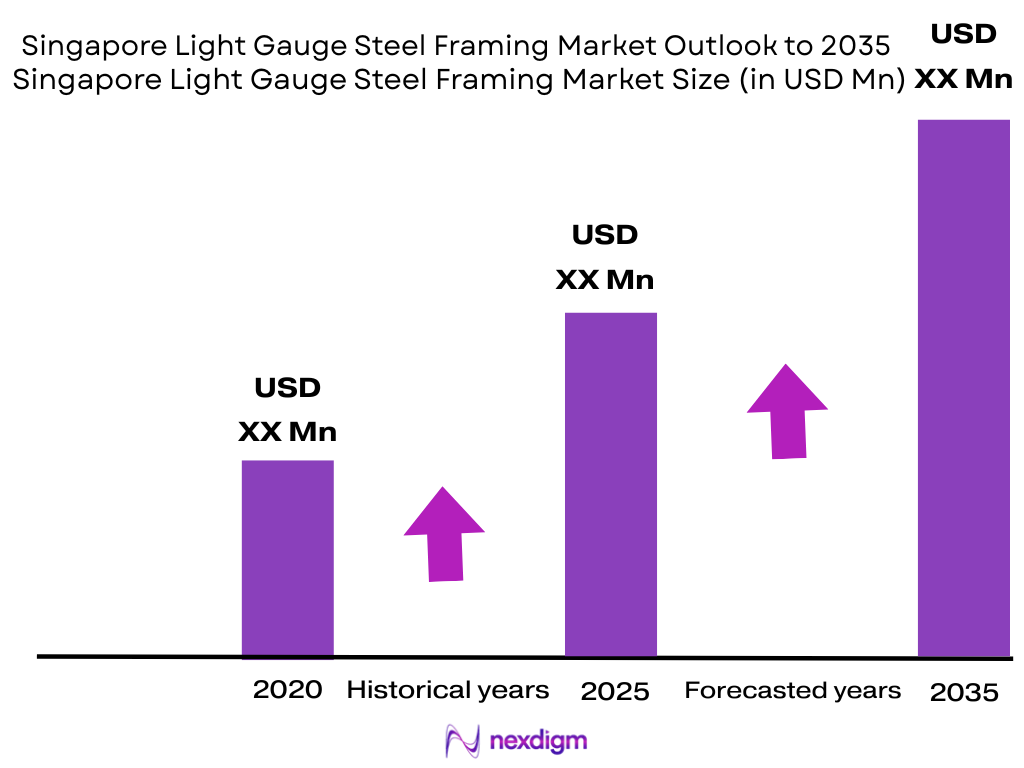
The Singapore Light Gauge Steel Framing Market is valued at approximately USD ~ million, retained as a placeholder because no government dataset separately reports LGSF revenue. Underlying construction activity provides a strong demand base: Building and Construction Authority construction demand increased from S$33.8 billion to S$44.2 billion, while nominal construction output advanced from S$34.8 billion to S$38.4 billion, supporting demand for prefabricated wall, partition, roof and modular framing systems. Jurong–Tuas, Tengah, Woodlands, Changi and central Singapore are important LGSF demand clusters because they combine industrial redevelopment, public housing, institutional projects, logistics facilities and commercial construction. HDB’s housing pipeline moved from 22,780 BTO flats launched to about 19,600 flats in the subsequent programme, while JTC released a Kallang Way industrial site capable of approximately 114,239 sqm of gross floor area, reinforcing demand for fast, lightweight and factory-prefabricated framing solutions.
Market Segmentation
By Application
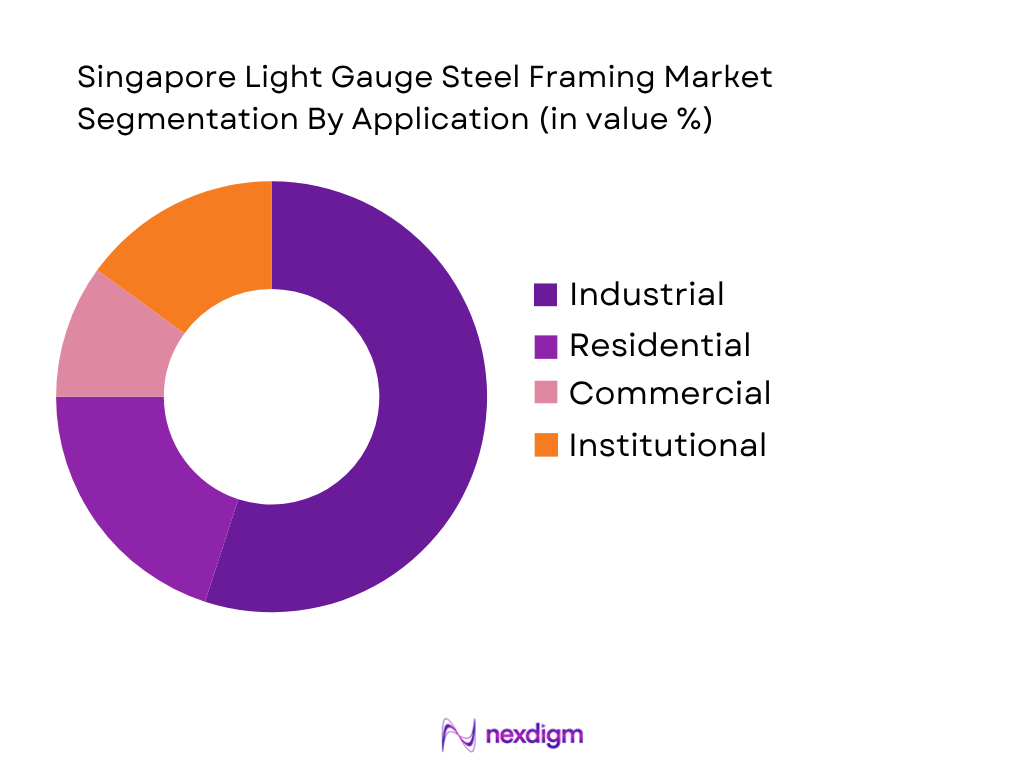
The Singapore Light Gauge Steel Framing Market is segmented by application into residential buildings, commercial buildings, industrial facilities, institutional buildings and modular or temporary structures. Residential buildings hold the dominant modelled share because Singapore maintains a sustained pipeline of HDB housing, private residential development, upgrading and refurbishment activity. Light gauge steel is particularly suitable for internal partitions, façade-support framing, rooftop structures, service enclosures and selected prefabricated building systems where reduced dead load and faster installation are valued. HDB launched 22,780 BTO flats in one annual cycle, followed by a programme of approximately 19,600 flats, demonstrating the continuing scale of the residential construction pipeline. BCA also identifies public housing as an important contributor to construction demand. LGSF additionally aligns with Singapore’s Design for Manufacturing and Assembly strategy because framing members can be digitally detailed, roll-formed and prefabricated away from congested construction sites, reducing wet trades and on-site labour requirements.
By Framing Component
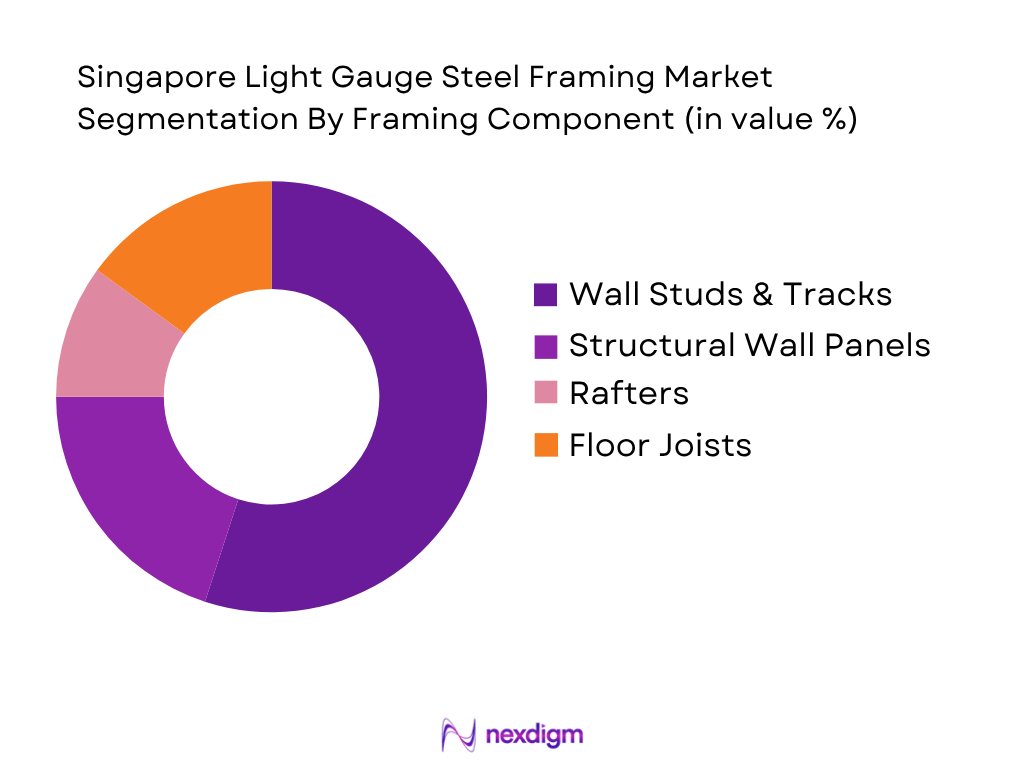
The Singapore Light Gauge Steel Framing Market is segmented into wall studs and tracks, floor joists, roof trusses and rafters, structural wall panels and modular framing assemblies. Wall studs and tracks hold the dominant modelled market share because they have broad applicability across residential, commercial, healthcare, hospitality, industrial and institutional construction. Unlike complete load-bearing light steel buildings, metal stud partitions can be integrated efficiently into Singapore’s predominantly reinforced-concrete building stock, making them applicable to both new construction and refurbishment. They also integrate naturally with gypsum board, insulation, acoustic systems and fire-rated drylining assemblies. Demand is strengthened by Singapore’s continued redevelopment of commercial premises, institutional projects, hotels and residential buildings. Factory-cut framing can further reduce material wastage and installation errors. BCA’s broader DfMA programme explicitly promotes prefabrication and labour-efficient construction, while PPVC technologies can deliver substantial manpower and construction-time savings, reinforcing the strategic case for compatible dry-framing systems.
Competitive Landscape
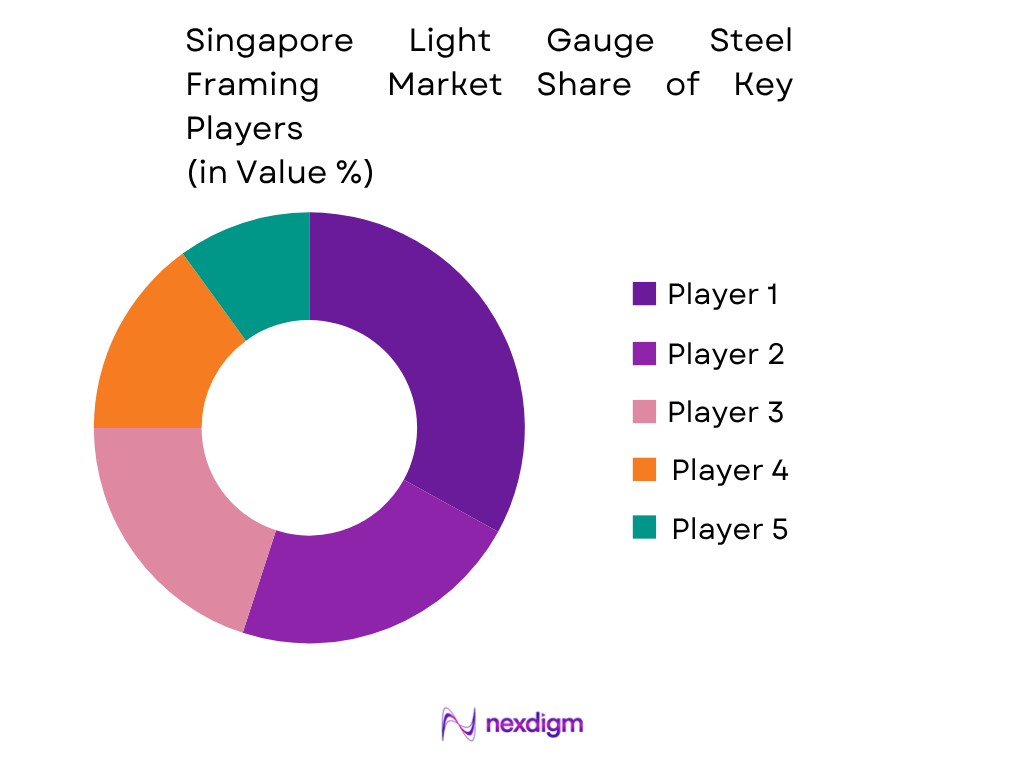
The Singapore Light Gauge Steel Framing Market combines global steel producers, drylining-system manufacturers and specialist cold-formed-steel technology suppliers. Competition is increasingly influenced by galvanised-steel quality, section design, fire and acoustic system compatibility, automated roll-forming, engineering software and the ability to participate in DfMA-based projects. FRAMECAD provides integrated cold-formed steel design and manufacturing technology, while BlueScope markets building-steel solutions including LYSAGHT and TRUECORE. Knauf and Saint-Gobain participate through integrated drylining and metal-framing ecosystems, and Tata Steel has developed dedicated light gauge steel construction solutions.
| Player | Establishment | Headquarters | LGSF Positioning | Primary Framing Offering | Digital / Prefab Capability | Coating / Durability Focus | Building Applications | Singapore / APAC Relevance |
| FRAMECAD | 1987 | Auckland, New Zealand | ~ | ~ | ~ | ~ | ~ | ~ |
| BlueScope / LYSAGHT | 2002 | Melbourne, Australia | ~ | ~ | ~ | ~ | ~ | ~ |
| Knauf Group | 1932 | Iphofen, Germany | ~ | ~ | ~ | ~ | ~ | ~ |
| Saint-Gobain / Gyproc | 1665 | Courbevoie, France | ~ | ~ | ~ | ~ | ~ | ~ |
| Tata Steel | 1907 | Mumbai, India | ~ | ~ | ~ | ~ | ~ | ~ |
Singapore Light Gauge Steel Framing Market Analysis
Growth Drivers
Urban Housing Construction and Land-Constrained Development
Singapore’s dense urban development model is a major structural driver for light gauge steel framing because developers need building systems that reduce on-site work, shorten structural and partition installation cycles, and maximise usable space on highly constrained construction sites. The Housing & Development Board launched 21,225 new flats in 2024, comprising 19,637 Build-To-Order units and 1,588 Sale of Balance Flats, providing a substantial pipeline of residential construction activity. Housing activity remained elevated in 2025, when HDB had launched 29,975 new flats by the October sales exercise, including 19,723 BTO flats and 10,252 SBF units. In 2026, HDB launched another 9,012 flats in February and 6,952 flats across 7 projects in June, demonstrating continued demand for efficient residential construction systems. These volumes are relevant to light gauge steel framing because cold-formed steel studs, tracks, joists, roof members, wall framing and prefabricated light-steel assemblies are suited to repetitive residential layouts where dimensional accuracy and rapid installation are important. Singapore’s macroeconomic capacity further supports sustained development: the IMF records nominal GDP of USD 547.5 billion, population of 6.0 million people, and GDP per capita of USD 90,689 for 2024. High economic output within a geographically compact city creates persistent pressure to deliver residential, commercial and institutional buildings efficiently rather than expand outward. Lightweight framing can reduce structural dead load relative to heavier wall systems, facilitate factory cutting and preassembly, and simplify movement of components within congested projects. Singapore’s increasingly industrialised construction model also favours systems that can be coordinated digitally before arriving on site. For LGS manufacturers and fabricators, this creates opportunities across internal partitions, façade support structures, roof framing, lightweight extensions and modular building assemblies. HDB’s continuing residential pipeline therefore supports demand not simply through construction volume but through the requirement for highly repeatable, space-efficient and assembly-oriented building systems.
Government-Led Shift Toward Prefabrication and Industrialised Construction
Singapore’s systematic transition toward Design for Manufacturing and Assembly creates a particularly strong structural driver for light gauge steel framing because LGS is inherently suited to computer-controlled fabrication, standardised component production and rapid dry assembly. The Building and Construction Authority reported in March 2025 that adoption of Integrated Digital Delivery and DfMA had advanced materially across Singapore’s Built Environment sector. More importantly for steel-framing suppliers, BCA’s Buildability and Constructability framework specifically promotes prefabricated, modular and standardised building components for projects with gross floor area of 5,000 square metres and above. This framework is closely aligned with the fundamental advantages of cold-formed light steel: studs, tracks, joists and panels can be detailed digitally, manufactured to pre-set lengths, punched for service penetrations and assembled into wall or floor panels before delivery. Singapore’s regulatory digitalisation is reinforcing this direction. By May 2025, 47 public and private projects had joined the voluntary CORENET X implementation phase, while larger projects were moving toward coordinated Building Information Model submissions. This reduces design conflicts and makes dimensional coordination between steel framing, mechanical systems, façades and architectural finishes more practical. BCA also maintains a formal PPVC ecosystem in which volumetric modules are manufactured at accredited facilities and transported for assembly. Current BCA guidance states that PPVC projects can save approximately 1 to 2 months compared with conventional construction, with some projects achieving 4 months or more of schedule savings. Although PPVC in Singapore has historically included substantial concrete-based construction, the underlying policy direction benefits lightweight steel systems because steel-frame modules, wall cassettes and hybrid assemblies can be manufactured using the same off-site logic. The macroeconomic environment supports investment in such productivity technology: IMF figures place Singapore’s 2024 output at USD 547.5 billion with GDP per capita of USD 90,689, giving the construction ecosystem financial capacity to invest in automated roll-forming, BIM-based detailing and factory assembly. For LGS suppliers, demand therefore increasingly depends on compatibility with Singapore’s industrialised building process rather than simply competing as a substitute structural material.
Market Challenges
Technical Compliance, Engineering Integration and High-Rise Application Complexity
Light gauge steel framing suppliers entering Singapore face demanding technical requirements because the city’s building stock combines high-rise development, humid tropical exposure, stringent fire-safety expectations and sophisticated regulatory coordination. Singapore’s Building Control Regulations explicitly recognise structural design involving materials including light gauge steel, meaning LGS applications fall within an established engineering and compliance framework rather than being treated as informal lightweight construction. For suppliers, this creates requirements around structural calculations, connection design, wind loading, corrosion protection, fire resistance, acoustic performance and compatibility with surrounding structural systems. BCA’s current Buildability and Constructability framework applies mandatory productivity-related scoring requirements to building projects with gross floor area of 5,000 square metres or more, increasing the need for framing solutions to demonstrate not only structural compliance but also constructability and efficient installation. CORENET X creates another technical layer because consultants must increasingly coordinate digital building models before construction. By May 2025, 47 projects had participated in the CORENET X voluntary submission phase, demonstrating the movement toward model-based regulatory coordination. Light gauge steel suppliers that historically supplied generic studs or channels therefore need stronger digital engineering capabilities, including BIM-ready component libraries, connection details, penetration planning and tolerance management. Singapore’s scale magnifies these requirements. IMF data show an economy of USD 547.5 billion, population of 6.0 million and GDP per capita of USD 90,689 in 2024, while high land intensity results in vertically complex projects where engineering failures have substantial consequences. The competitive benchmark is also demanding because LGS is not the only industrialised construction system. Advanced precast concrete, PPVC and prefabricated MEP assemblies are already well established under BCA’s DfMA framework. Advanced Precast Concrete System guidance, for example, formalises simplified mechanical connections, modularisation and automated manufacturing, setting a high productivity benchmark against which steel systems must compete. LGS suppliers therefore require credible engineering documentation, certified coating systems, robust connection technology and integration with fire-rated and acoustic wall assemblies. The challenge is less about whether light gauge steel can technically be used in Singapore and more about whether suppliers can deliver complete, digitally coordinated and code-compliant framing systems suited to demanding multi-storey projects.
Skilled Workforce Constraints and Dependence on Construction Labour Transformation
Singapore’s construction labour structure presents a second significant challenge for light gauge steel framing because LGS reduces wet trades but shifts the skills requirement toward accurate assembly, connection detailing, digital fabrication, setting-out and quality control. Ministry of Manpower data for the first half of 2024 show total employment increased by 16,000 workers, consisting of 4,900 resident and 11,200 non-resident workers. In the second quarter alone, non-resident employment increased by 12,000, with growth driven significantly by Work Permit holders in construction and manufacturing. This shows that Singapore’s built-environment sector still relies substantially on imported labour even while national policy encourages more productive construction technologies. The challenge for LGS contractors is that simply replacing conventional masonry or concrete-related tasks with steel framing does not remove manpower requirements; it changes the capabilities required. Installers need to understand lightweight structural behaviour, screw and fastener requirements, wall alignment, bracing, service openings, corrosion protection and interfaces with gypsum boards, insulation, MEP systems and façades. Factory-side workers must operate roll-forming machinery, interpret digital fabrication files and conduct component-level quality checks. Singapore’s workforce transformation policy increasingly emphasises precisely these higher-value capabilities. BCA’s Built Environment Skills Framework is designed around new construction roles and evolving technical competencies, while CORENET X and Integrated Digital Delivery are raising expectations for digital coordination throughout the project lifecycle. By May 2025, 47 projects had already participated in CORENET X’s early adoption phase. The broader economy creates further competition for skilled labour: IMF figures show Singapore generated USD 547.5 billion of nominal GDP from a population of only 6.0 million people in 2024, with output per person of USD 90,689. Construction employers therefore compete with advanced manufacturing, engineering, logistics and other sectors for technically capable personnel. LGS companies that lack dedicated design engineers, BIM modellers, framing supervisors and trained installation crews may struggle to convert the theoretical labour efficiencies of lightweight framing into consistent project performance. The market challenge consequently extends from manpower availability to capability depth: suppliers must combine automated fabrication with formal training, installation procedures and digital quality assurance if LGS is to outperform Singapore’s mature precast and PPVC alternatives.
Market Opportunities
Automated Off-Site LGS Manufacturing and DfMA Integration
The strongest opportunity for the Singapore Light Gauge Steel Framing Market lies in positioning LGS as a digitally manufactured DfMA solution rather than merely as an alternative framing material. Government policy is actively creating infrastructure for this transition. In March 2025, Singapore announced a S$100 million Built Environment Technology and Capability programme to support longer-term technology and capability development across Built Environment firms. In April 2025, BCA also expanded the Land Intensification Allowance framework to cover a broader range of multi-storey DfMA facilities, explicitly including the production of structural steel, Prefabricated MEP systems, mass engineered timber and other industrialised construction products. From planning applications made from January 2026, new qualifying multi-storey DfMA facilities can participate under the expanded framework, with a minimum gross plot ratio of 1.03 for relevant facilities and 1.6 for Integrated Construction and Prefabrication Hubs. These policies are directly relevant to light gauge steel because automated cold-roll-forming lines can convert digital models into numbered studs, tracks, joists and panel components with pre-punched service openings and precisely located connection points. This makes LGS highly compatible with BIM, Integrated Digital Delivery and automated production. By May 2025, 47 public and private projects had already participated in CORENET X’s voluntary phase, strengthening the case for manufacturers to integrate framing design with common digital building models. Singapore’s active housing programme creates a substantial application base: HDB launched 21,225 new flats in 2024 and 29,975 new flats in 2025, while another 15,964 flats were launched across the February and June exercises of 2026. Rather than relying exclusively on complete light-steel buildings, manufacturers can target hybrid opportunities such as lightweight internal wall panels, façade framing, roof systems, service enclosures and steel subassemblies integrated into concrete or PPVC structures. The IMF’s 2024 figures of USD 547.5 billion in GDP and USD 90,689 output per person show the economic capacity to support capital-intensive manufacturing automation. For LGS companies, the opportunity therefore lies in establishing digitally connected fabrication operations capable of producing project-specific framing kits at industrial scale while reducing site cutting, material handling and rework.
Hybrid Modular Construction and International Prefabrication Partnerships
Singapore’s increasingly sophisticated prefabrication ecosystem creates a second major opportunity for light gauge steel framing through hybrid modular construction and partnerships with regional steel-frame manufacturers. BCA’s current PPVC framework supports modules manufactured in accredited fabrication facilities, including facilities located outside Singapore, which creates an institutional pathway for international suppliers to participate in Singapore projects when they meet required quality and accreditation standards. This is especially relevant to LGS because lightweight steel modules can be fabricated regionally, transported efficiently and combined with locally coordinated architectural, façade and MEP systems. Singapore’s construction pipeline provides sufficient project continuity to support such specialised supply chains. HDB launched 21,225 flats in 2024 and 29,975 flats during 2025; HDB also completed about 19,600 flats in 2025. During 2026, the February and June sales exercises added 9,012 and 6,952 flats, respectively. Beyond housing, BCA reported preliminary construction demand of S$50.5 billion for 2025, driven substantially by institutional and housing projects. This construction-contract figure is not an estimate of the LGS market; it demonstrates the breadth of projects from which lightweight framing suppliers can identify suitable applications. Singapore’s macroeconomic foundation remains substantial, with IMF data placing 2024 nominal GDP at USD 547.5 billion, population at 6.0 million and GDP per capita at USD 90,689. The technical opportunity is strongest where LGS complements rather than attempts to replace established heavy structural systems. Steel-framed bathroom pods, lightweight room modules, rooftop additions, façade back-framing, internal wall cassettes and prefabricated service enclosures can be integrated with reinforced-concrete cores and precast floor systems. BCA’s PPVC guidance states that off-site volumetric construction has achieved typical schedule savings of approximately 1 to 2 months, with some projects recording 4 months or more, illustrating the operational value placed on prefabrication. International LGS suppliers with experience in automated framing, corrosion-resistant coatings, fire-rated wall assemblies and modular engineering can therefore partner with Singapore developers, main contractors and DfMA manufacturers rather than enter solely as commodity steel vendors. The result is a future growth pathway based on cross-border fabrication, accredited manufacturing and hybrid construction systems suited to Singapore’s dense, high-value and tightly scheduled building environment.
Future Outlook
The Singapore Light Gauge Steel Framing Market is projected to expand at approximately ~XX% CAGR during 2026–2035, retained as a placeholder for the final forecast model. Growth will be supported by Singapore’s strong construction pipeline, labour-productivity requirements, DfMA adoption, industrial redevelopment and increasing use of prefabricated building systems. BCA expects construction activity to remain substantial, with construction demand projected at S$47–53 billion in 2026 and average demand of S$39–46 billion annually from 2027 to 2030. Major projects include Changi Terminal 5, public housing, hospitals, educational facilities and infrastructure-linked development. Light gauge steel framing should benefit where projects seek reduced structural weight, dry installation, dimensional accuracy and off-site fabrication. Its strongest opportunities are likely to remain in partitions, façades, rooftop additions, modular buildings and hybrid structures rather than wholesale replacement of reinforced concrete in high-rise Singapore construction. Digitalisation will become increasingly important. CORENET X becomes mandatory for progressively broader project categories, encouraging coordinated digital design and regulatory submissions. LGSF manufacturing can integrate effectively with BIM-driven detailing and automated roll-forming, improving design-to-factory continuity.
Major Players
- FRAMECAD
- BlueScope Steel / LYSAGHT
- Knauf Group
- Saint-Gobain / Gyproc
- Tata Steel
- Hadley Group
- Metsec
- The Steel Network
- ClarkDietrich Building Systems
- voestalpine
- ArcelorMittal Construction
- Nippon Steel
- JFE Steel Corporation
- Howick Ltd.
- Scottsdale Construction Systems
Key Target Audience
- Light Gauge Steel Framing Manufacturers
- Cold-Formed Steel and Galvanised Steel Suppliers
- Prefabricated and Modular Building Manufacturers
- Real Estate Developers and Main Construction Contractors
- Architectural, Engineering and Building-System Companies
- Investments and Venture Capitalist Firms
- Building Material Importers, Distributors and Fabricators
- Government and Regulatory Bodies (Building and Construction Authority, Housing & Development Board, JTC Corporation, Urban Redevelopment Authority, Singapore Civil Defence Force)
Research Methodology
Step 1: Identification of Key Variables
The initial phase constructs an ecosystem map covering steel producers, coil suppliers, roll-formers, LGSF manufacturers, drywall-system companies, modular contractors, developers and public-sector construction agencies. Key variables include construction demand, building type, steel consumption, framing intensity, section thickness, galvanisation level, prefabrication adoption, floor area and project pipeline. Secondary analysis is anchored to BCA, HDB and JTC information, complemented by manufacturer documentation covering cold-formed steel systems, production equipment, drylining and modular construction technologies.
Step 2: Market Analysis and Construction
Historical construction demand is segmented into residential, commercial, industrial and institutional building activity. The top-down approach estimates addressable floor area and identifies applications where LGSF can substitute masonry, timber or heavier structural systems. The bottom-up approach calculates framing demand using wall area, stud spacing, section weight, steel consumption per square metre, project type and component utilisation. Manufacturer and distributor information is then used to triangulate implied market value and volume.
Step 3: Hypothesis Validation and Expert Consultation
Market hypotheses are validated through CATIs with contractors, architects, structural engineers, modular-construction specialists, steel distributors and framing-system suppliers. Discussions focus on specifications, coating requirements, fire resistance, acoustic performance, corrosion protection, prefabrication, labour productivity and procurement practices. Expert interviews also test assumptions regarding residential versus commercial utilisation, imported versus locally fabricated systems, steel coil sourcing and adoption barriers for structural light gauge steel in high-rise developments.
Step 4: Research Synthesis and Final Output
The final phase reconciles top-down construction indicators with bottom-up steel-framing consumption estimates. Data triangulation compares contract awards, project pipelines, BTO supply, industrial development, supplier capabilities and application-specific framing intensity. Forecast scenarios incorporate DfMA adoption, construction output, manpower constraints, modularisation, digital manufacturing, sustainability requirements and competition from reinforced concrete, aluminium, timber and conventional structural steel to develop the Singapore Light Gauge Steel Framing Market outlook.

- Executive Summary
- Research Methodology (Market Definition and Scope, Light Gauge Steel Framing Boundary, Cold-Formed Steel Classification, Primary and Secondary Research, Top-Down Market Sizing, Bottom-Up Steel Consumption Assessment, Building Pipeline Mapping, Project-Level Frame Consumption, Manufacturer and Fabricator Interviews, Contractor Interviews, Architect and Structural Engineer Interviews, Import Analysis, Product Benchmarking, Price Validation, Data Triangulation, Forecast Framework, Limitations and Future Conclusions)

- Definition and Scope
- Industry Evolution and Development
- Evolution from Conventional Masonry and Reinforced Concrete Partitioning to Lightweight Framing
- Evolution of Cold-Formed Steel Construction
- Singapore Light Gauge Steel Framing Ecosystem

- Growth Drivers (DfMA Adoption, Construction Productivity, Labour Constraints, PPVC, Industrial Construction, Redevelopment, Prefabrication, Sustainability)
- Market Challenges (Imported Steel Dependency, Material Price Volatility, Fire Certification, Corrosion Protection, Contractor Familiarity, Design Complexity, Competing Materials, Logistics)
- Market Opportunities (Panelised Construction, Modular Buildings, Industrial Buildings, Lightweight Extensions, Digital Fabrication, High-Strength Steel, Circular Construction, Regional Export)
- Market Trends (Digital Fabrication, Automated Roll Forming, BIM Integration, Pre-Assembled Panels, Low-Carbon Steel, Higher Strength Grades, Multi-Material Construction, Circularity)
- SWOT Analysis
- Porter’s Five Forces Analysis
- PESTLE Analysis

- By Market Value (2020-2025)
- By Steel Framing Volume (2020-2025)
- By Installed Framing Area (2020-2025)

- By Framing System Type (In Value %)
Wall Framing Systems
Floor Joist Systems
Roof Framing Systems
Light Steel Roof Trusses
Ceiling Framing Systems - By Building Type (In Value %)
Public Residential Buildings
Private Residential Buildings
Condominiums
Landed Residential Properties
Commercial Offices - By Construction Method (In Value %)
Factory-Prefabricated Panelised Construction
Volumetric Modular Construction
PPVC-Integrated Light Steel Framing
Hybrid Steel-Concrete Construction
Hybrid Light Gauge and Structural Steel Construction - By Construction Cluster (In Value %)
Central Singapore
Eastern Singapore
Western Singapore
Northern Singapore

- Market Share of Major Players by Value
- Cross Comparison Parameters (Product Portfolio Breadth, Load-Bearing versus Non-Load-Bearing Capability, Profile Gauge and Thickness Range, Galvanized Coating and Corrosion Protection Specification, Fire and Acoustic Tested System Portfolio, DfMA/BIM/Roll-Forming Integration, Local Fabrication-Warehousing and Lead-Time Capability, Project References across Residential-Commercial-Industrial and Modular Construction)
- SWOT Analysis of Major Players
- Detailed Profiles of Major Companies
Lightrus Singapore
NS BlueScope Lysaght Singapore
Saint-Gobain Singapore / Gyproc GypFrame
Knauf Singapore
FRAMECAD
Howick Ltd.
Scottsdale Construction Systems
William Hare Group
PEB Steel
LCP Building Products Pte. Ltd.
Steelmech Pte. Ltd.
Chuan Eu International Pte. Ltd.
Hanwa Singapore Pte. Ltd.
Nippon Steel / NS BlueScope Coated Products
POSCO International Singapore Pte. Ltd.

- Public Housing Developers
- Private Residential Developers
- Commercial Property Developers
- Industrial Developers
- Logistics Facility Developers

- By Market Value (2026-2035)
- By Steel Framing Volume (2026-2035)
- By Installed Framing Area (2026-2035)


 Request a Sample
 Ask for Customization
 Get a Quote
 Enquire Now