

 Download PDF
Market Overview
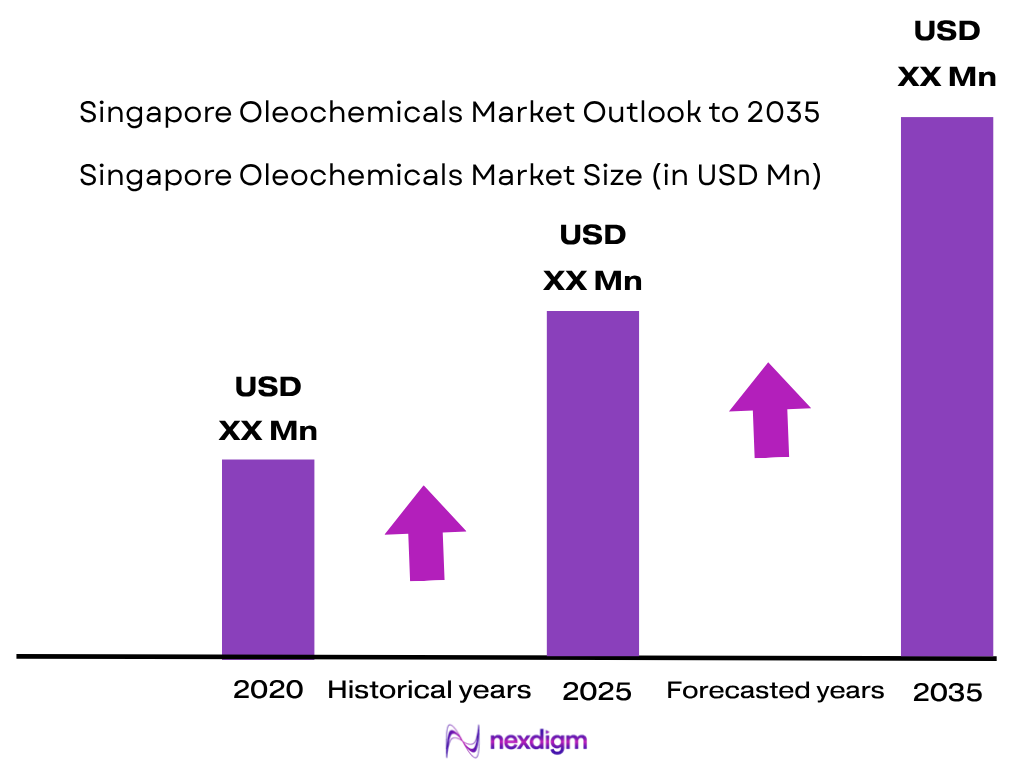
Market Size and Demand Dynamics: The Singapore Oleochemicals Market is valued at approximately ~USD XXX million, based on the requested base-period framework. Grand View Research maintains a Singapore-specific historical revenue series and reports a subsequent market value of USD 669.1 million, confirming the country’s material oleochemicals base. Supporting industry indicators show Singapore chemical-cluster value added moving from S$20.285 billion to S$17.512 billion, while total manufacturing output increased from S$410.9 billion to S$429.6 billion.
Dominant Geographic and Supply Hubs: Jurong Island and Tuas dominate Singapore’s chemicals production, storage, logistics and regional distribution ecosystem, while Malaysia and Indonesia dominate the upstream palm and palm-kernel feedstock corridor. Jurong Island hosts more than 100 global energy and chemical companies and has attracted over S$50 billion in investments. Malaysia’s crude palm oil production increased from 18,551,950 tonnes to 19,338,266 tonnes, while palm-based oleochemical exports increased from 2,864,004 tonnes to 2,993,592 tonnes, reinforcing Singapore’s regional sourcing advantage.
Market Segmentation
By Product Type
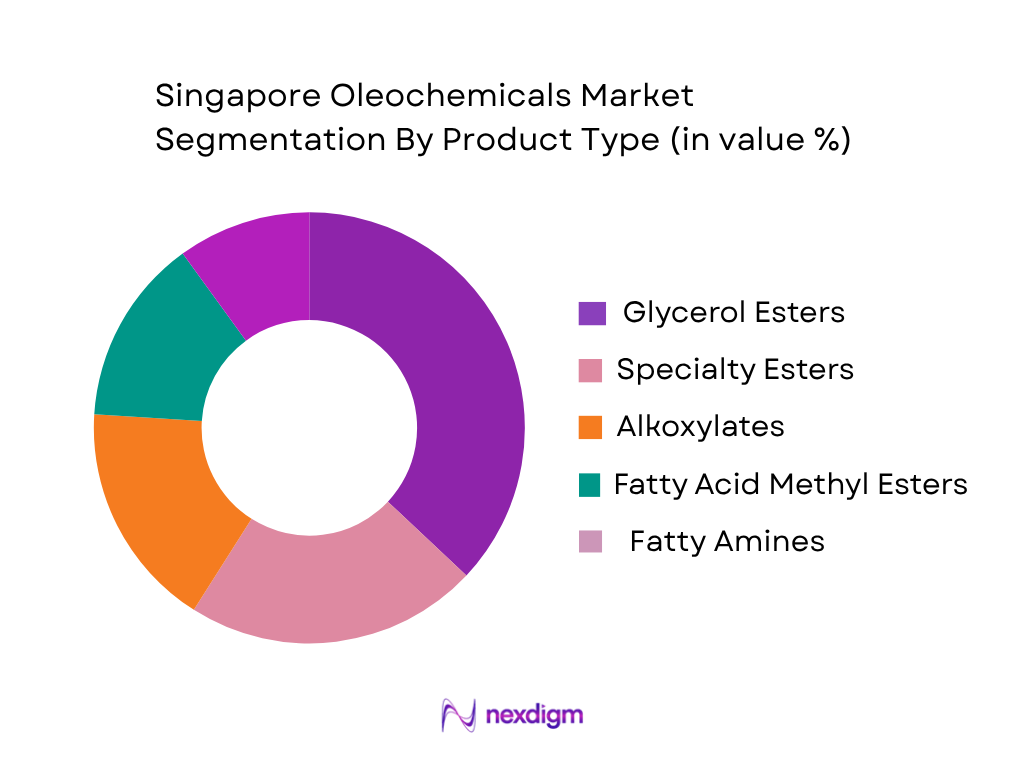
The Singapore Oleochemicals Market is segmented by product type into glycerol esters, specialty esters, alkoxylates, fatty acid methyl esters and fatty amines. Glycerol esters dominate the product segmentation, supported by their broad functional application across food processing, cosmetics, personal care, pharmaceutical formulations and industrial applications. Singapore’s role as a specialty-chemical and ingredients hub strengthens demand for higher-purity glycerol derivatives rather than restricting the market to commodity fatty acids. The concentration of multinational formulation businesses, chemical distributors and regional procurement operations also supports imports and redistribution of differentiated glycerol esters. Grand View Research identifies glycerol esters as Singapore’s largest revenue-generating oleochemical product category in its published market series, while fatty acid methyl esters are positioned among the faster-growing categories. Singapore’s transition toward specialty and sustainable chemicals should reinforce value-added esterification, purification and formulation activities.
By Application
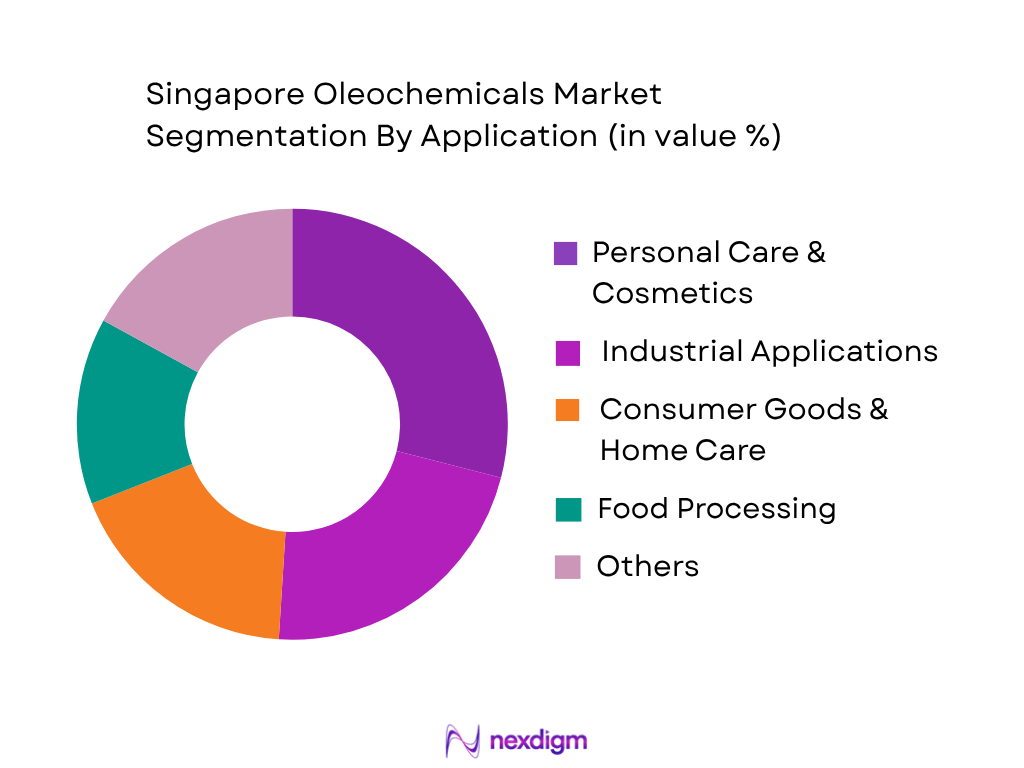
The Singapore Oleochemicals Market is segmented by application into personal care and cosmetics, industrial applications, consumer goods and home care, food processing, paints and inks, polymers and textiles. Personal care and cosmetics represent the dominant application segment, supported by Singapore’s position as a regional formulation, distribution and innovation centre for consumer ingredients. Oleochemical derivatives such as glycerol esters, emollient esters, fatty alcohol derivatives and surfactants provide moisturization, emulsification, cleansing, texture modification and formulation stability. Demand is additionally supported by multinational companies using Singapore as an Asia-Pacific commercial and technical base. Specialty ingredients command greater importance than bulk commodity molecules because product purity, sensory properties, certification, consistency and application-specific performance strongly influence purchasing decisions. Singapore’s policy emphasis on hygiene, health, biotechnology, bio-based materials and specialty chemicals further supports advanced oleochemical applications in personal-care formulations.
Competitive Landscape
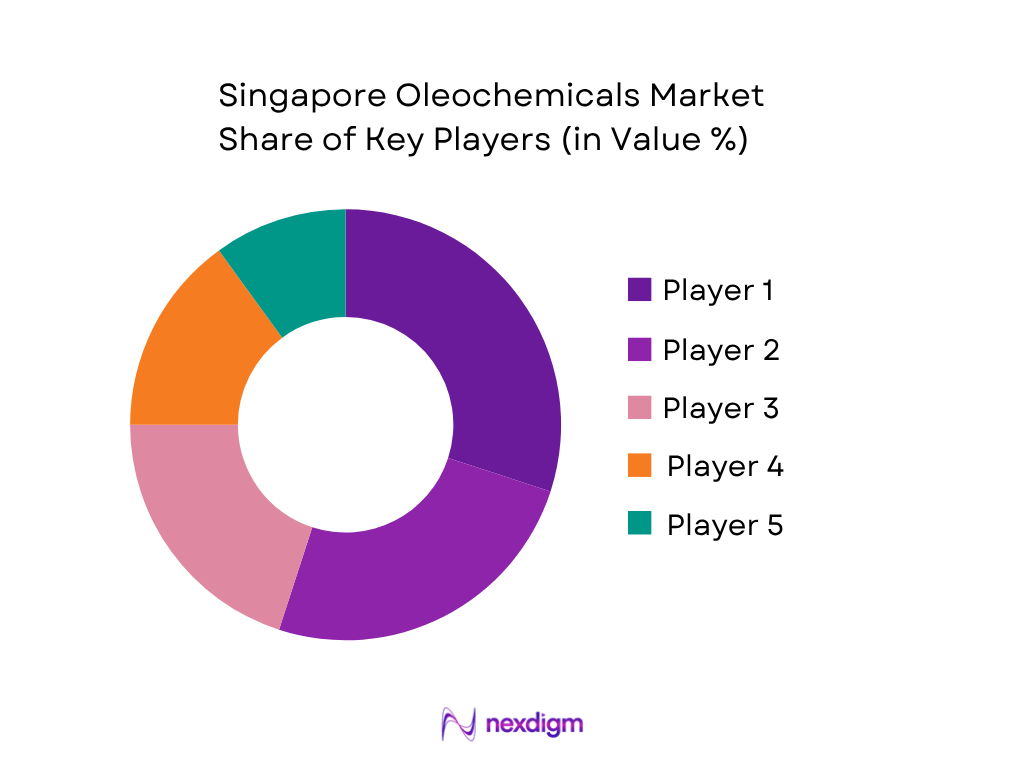
The Singapore Oleochemicals Market is influenced by a concentrated group of integrated Asian palm-based manufacturers and global specialty-chemical companies. Wilmar and Musim Mas benefit from Singapore headquarters and extensive upstream integration, while KLK OLEO and IOI Oleochemical leverage substantial Malaysian palm-based manufacturing capabilities. Emery Oleochemicals competes through natural-based specialty products. Competition increasingly extends beyond price and scale to traceability, specialty derivatives, regional inventory, technical support, carbon performance and certified sustainable feedstocks.
| Company | Establishment | Headquarters | Core Oleochemicals | Feedstock Integration | Southeast Asia Manufacturing | Specialty Capability | Sustainability Position | Key End-Use Exposure |
| Wilmar International | 1991 | Singapore | ~ | ~ | ~ | ~ | ~ | ~ |
| Musim Mas Group | 1932 | Singapore | ~ | ~ | ~ | ~ | ~ | ~ |
| KLK OLEO | 1991* | Petaling Jaya, Malaysia | ~ | ~ | ~ | ~ | ~ | ~ |
| IOI Oleochemical Industries | 1980 | Malaysia | ~ | ~ | ~ | ~ | ~ | ~ |
| Emery Oleochemicals | 1840 | Cincinnati, United States | ~ | ~ | ~ | ~ | ~ | ~ |
Singapore Oleochemicals Market Analysis
Growth Drivers
Integrated Chemicals and Trade Infrastructure Supporting Oleochemical Flows
Singapore’s oleochemicals industry benefits from a highly developed chemicals, logistics and re-export ecosystem that supports the movement of fatty acids, fatty alcohols, glycerine, esters and downstream derivatives across Asia. Singapore recorded S$1,285.9 billion in total merchandise trade, including S$674.5 billion in exports and S$611.4 billion in imports. Chemicals and chemical products alone accounted for S$69.5 billion of non-oil merchandise exports and S$42.8 billion of imports, demonstrating the scale of the chemical trading platform available to oleochemical suppliers. Re-exports reached S$387.9 billion, which is particularly relevant because Singapore functions as a regional redistribution centre for chemicals sourced from ASEAN manufacturing locations. Jurong Island strengthens this advantage through a 3,000-hectare integrated energy and chemicals complex housing more than 100 companies. Singapore’s economy also generated US$547.39 billion of GDP, while GDP per capita reached US$90,674.1, according to the World Bank, providing a strong industrial and commercial base for value-added chemicals distribution, formulation, warehousing and regional procurement.
Strong Regional Feedstock Connectivity with Malaysia and Indonesia
Singapore’s oleochemical sector is supported by immediate access to the world’s most important palm and palm-kernel processing corridor, particularly neighbouring Malaysia and Indonesia. Malaysia produced 19,338,266 tonnes of crude palm oil compared with 18,551,950 tonnes in the preceding period, while palm kernel oil exports reached 1,151,104 tonnes. More importantly for Singapore’s oleochemical ecosystem, Malaysian exports of palm-based oleochemicals increased from 2,864,004 tonnes to 2,993,592 tonnes, providing a substantial regional supply pool for Singapore-based trading, distribution, formulation and downstream chemical activities. Malaysia also exported 16,902,595 tonnes of palm oil, strengthening availability of renewable C16-C18 feedstock streams used in fatty acids, soaps, esters and derivatives. Singapore complements this nearby supply base with substantial international trade infrastructure: merchandise imports reached S$611.4 billion, while non-oil chemicals and chemical products imports were S$42.8 billion. The World Bank reports Singapore GDP at US$547.39 billion and GDP per capita at US$90,674.1, supporting sophisticated downstream consumption and regional headquarters operations tied to specialty and bio-based chemical value chains.
Market Challenges
Dependence on External Renewable Feedstocks and Regional Production Bases
Singapore lacks a domestic plantation base for palm oil, palm kernel oil, coconut oil and castor oil, creating structural dependence on external feedstocks and intermediate oleochemical production. This dependence is material because Malaysia produced 19,338,266 tonnes of crude palm oil and exported 1,151,104 tonnes of palm kernel oil, while palm-based oleochemical exports reached 2,993,592 tonnes. Singapore itself recorded only around S$0.3 billion of non-oil merchandise exports classified under animal and vegetable oils, fats and waxes, compared with S$3.1 billion of imports in the same broad commodity grouping, highlighting its import-oriented position in lipid feedstocks. For oleochemical manufacturers and formulators, this means supply continuity is tied to cross-border shipping, regional refinery operations, kernel crushing capacity and inventory management rather than domestic agricultural production. The challenge is amplified by Singapore’s small physical footprint of approximately 735 square kilometres and highly industrialized economic structure. World Bank data place national GDP at US$547.39 billion and GDP per capita at US$90,674.1, reinforcing why Singapore is structurally better positioned for specialty processing and trade than large-scale feedstock cultivation.
Increasing Regulatory and Decarbonisation Requirements for Chemical Operations
Singapore oleochemical manufacturers, processors, storage operators and distributors face progressively tighter environmental and chemical-management requirements that raise the operational importance of emissions control, product classification, traceability and regulatory documentation. Singapore raised its carbon tax from S$5 per tonne of CO2-equivalent to S$25 per tonne and increased it to S$45 per tonne for the subsequent tax period. Around 70 units out of every 100 units of national emissions fall within the carbon-tax coverage framework, making energy-intensive chemical operations particularly exposed to decarbonisation requirements. Separately, the National Environment Agency made chemical reporting compulsory for Hazardous Substances Licence and Permit holders from 1 January 2026, requiring affected companies to screen imported and locally manufactured chemicals. Regulatory controls were also expanded to 2 additional groups of chemicals and 9 mercury-added product categories, with licensing, storage and transport requirements applying from August 2025. This compliance environment matters for oleochemical derivatives, specialty surfactants, additives and formulated intermediates handled alongside controlled chemicals. Singapore’s chemicals cluster nevertheless produced a 4.3-point increase in output during the relevant reporting period, demonstrating the sector’s continued strategic importance despite tighter operating requirements.
Market Opportunities
Expansion into High-Value Specialty and Bio-Based Oleochemical Derivatives
Singapore has an opportunity to shift further from bulk commodity handling toward specialty esters, bio-based intermediates, high-purity glycerine, personal-care ingredients, pharmaceutical excipients and advanced renewable materials. The opportunity is supported by tangible industrial investment. A new Arkema facility on Jurong Island represents an investment of €400 million and integrates production of Rilsan polyamide 11 with Oleris oleochemicals derived from castor beans; the project increased the company’s global polyamide-11 capacity by 50 units for every 100 units of previous capacity and provides a direct example of renewable oleochemical feedstocks being converted into higher-value materials in Singapore. Jurong Island spans approximately 3,000 hectares and accommodates more than 100 companies, allowing specialty producers to access integrated utilities, logistics and downstream customers. Singapore also secured S$13.5 billion in fixed-asset investment commitments across manufacturing and services, with S$11.1 billion originating from manufacturing activities. The World Bank reports GDP of US$547.39 billion and GDP per capita of US$90,674.1, supporting demand for high-value industrial technologies and sophisticated regional headquarters functions that can accelerate commercialization of specialty oleochemical applications.
Development of Singapore as a Regional Sustainable-Chemicals and Innovation Hub
The Singapore Oleochemicals Market has a significant opportunity to use the country’s innovation infrastructure and Jurong Island ecosystem to develop low-carbon surfactants, specialty esters, renewable lubricants, functional ingredients and circular-feedstock chemistry for Asian customers. Singapore has committed S$37 billion under its RIE2030 research and commercialization plan, providing a substantial innovation platform relevant to advanced materials, biotechnology and sustainable chemical processing. Since 2024, more than 70 AI Centres of Excellence have been established across industries, strengthening digital manufacturing, process optimization and predictive maintenance capabilities that chemical operators can deploy. Jurong Island has additionally allocated close to 300 hectares for next-generation energy infrastructure, including hydrogen, ammonia, sustainable aviation fuel and advanced battery systems. New specialty chemical investments announced around the island are expected to support more than 1,000 jobs, expanding technical capabilities in high-value manufacturing. Singapore’s broader economic base remains supportive, with World Bank GDP of US$547.39 billion, GDP per capita of US$90,674.1, and chemical-product exports of S$69.5 billion. These conditions provide oleochemical companies with a credible platform for regional product development, application laboratories, sustainable manufacturing and ASEAN distribution.
Future Outlook
The Singapore Oleochemicals Market is expected to expand at approximately ~X.X% CAGR over the forecast period. Growth will increasingly depend on specialty derivatives, sustainable ingredients and high-purity formulations rather than commodity oleochemical manufacturing alone. Singapore’s regional connectivity, integrated Jurong Island infrastructure and proximity to Malaysian and Indonesian feedstocks should support its position as a distribution, trading and specialty-processing centre.
The transition toward bio-based surfactants, specialty esters, high-purity glycerine, personal-care ingredients and renewable industrial chemicals should create higher-value opportunities. Singapore’s policy direction also supports specialty chemicals and sustainable materials. EDB notes that specialty chemicals are growing in importance within Singapore’s energy and chemicals ecosystem, while Jurong Island is being repositioned toward sustainable materials, circular feedstocks and low-carbon manufacturing.
Major Players
- Wilmar International Limited
- Musim Mas Group
- KLK OLEO
- IOI Oleochemical Industries Berhad
- Emery Oleochemicals
- Mewah International / MewahOleo
- Ecogreen Oleochemicals
- Oleon NV
- BASF SE
- Evonik Industries AG
- Croda International Plc
- Kao Corporation
- Arkema S.A.
- Vantage Specialty Chemicals
- Cargill Incorporated
Key Target Audience
- Oleochemicals Manufacturers and Integrated Palm-Based Chemical Producers
- Specialty Chemical and Bio-Based Ingredient Manufacturers
- FMCG, Personal Care, Home Care and Cosmetics Manufacturers
- Chemical Importers, Distributors, Traders and Regional Procurement Organizations
- Food, Pharmaceutical and Industrial Formulation Companies
- Tank Terminal, Bulk Chemical Storage, Port and Chemical Logistics Operators
- Investments and Venture Capitalist Firms
- Government and Regulatory Bodies (Singapore Economic Development Board, JTC Corporation, National Environment Agency, Singapore Customs, Ministry of Trade and Industry)
Research Methodology
Step 1: Identification of Key Variables
The initial phase involves constructing a detailed ecosystem map for the Singapore Oleochemicals Market covering feedstock suppliers, integrated producers, importers, distributors, traders, storage operators and downstream industries. Secondary research is used to identify critical variables including product pricing, consumption, imports, re-exports, regional production capacity, feedstock availability, end-use demand and specialty-product penetration.
Step 2: Market Analysis and Construction
Historical market data is assessed through both top-down and bottom-up approaches. The top-down model examines Singapore’s chemicals industry, oleochemical trade flows, application demand and regional supply patterns. The bottom-up model analyses company sales, product volumes, distributor throughput, customer procurement, average selling prices and addressable consumption across personal care, detergents, food, pharmaceuticals and industrial applications.
Step 3: Hypothesis Validation and Expert Consultation
Initial market hypotheses are validated through computer-assisted telephone interviews and structured discussions with oleochemical manufacturers, regional distributors, procurement managers, traders, specialty-chemical formulators and industry experts. Interviews are designed to validate product mix, price points, supplier positioning, import dependency, purchasing patterns, feedstock preference and competitive dynamics that are not fully visible through secondary databases.
Step 4: Research Synthesis and Final Output
The final phase triangulates secondary research, company-level information, trade statistics and primary interviews. Supply-side results are reconciled with downstream consumption and import-export patterns to eliminate double counting arising from Singapore’s substantial trading and re-export activity. Forecast assumptions are subsequently tested against specialty-chemical adoption, feedstock economics, sustainability requirements and expected shifts in regional manufacturing.

- Executive Summary
- Research Methodology (Market Definition and Scope, Oleochemicals Industry Classification, Market Boundary Assessment, Abbreviations, Market Sizing Methodology, Top-Down Market Estimation, Bottom-Up Market Validation, Demand-Side Analysis, Supply-Side Analysis, Producer and Processing Capacity Assessment, Import-Export and Re-export Data Analysis, Feedstock Availability Assessment, Singapore Domestic Consumption Assessment, Primary Interviews with Oleochemicals Manufacturers, Traders, Distributors and Downstream Industry Stakeholders, Secondary Research Framework, Data Triangulation, Market Forecasting Model, Assumptions and Limitations)

- Definition and Scope
- Evolution of Singapore Oleochemicals Industry
- Singapore Oleochemicals Industry Ecosystem Analysis
- Singapore Oleochemicals Value Chain Analysis
- Singapore Oleochemicals Supply Chain Analysis
- Singapore Oleochemicals Manufacturing and Processing Landscape

- Market Growth Drivers (Bio-Based Chemical Adoption, Expansion of Specialty Chemicals Manufacturing, Growth of Personal Care and Home Care Ingredient Demand, Rising Demand for High-Purity Oleochemicals, Singapore’s Position as an ASEAN Chemical Trading and Re-export Hub, Jurong Island Chemical Ecosystem Integration, Proximity to Malaysian and Indonesian Palm-Based Oleochemical Production, Increasing Demand for Sustainable Ingredients, Regional Supply Chain Diversification)
- Market Challenges (Dependence on Imported Palm and Lauric Feedstocks, Volatility in Palm Oil and Palm Kernel Oil Prices, Competition from Malaysian and Indonesian Oleochemical Producers, High Manufacturing and Utility Costs, Limited Industrial Land Availability, Commodity Oleochemical Margin Pressure, Carbon Cost Exposure, Sustainability Certification and Traceability Requirements)
- Market Opportunities (Expansion of Specialty Oleochemicals, High-Purity Glycerine Development, Specialty Fatty Acid Ester Growth, Bio-Based Surfactant Development, Bio-Lubricant Applications, Cosmetic Ingredient Manufacturing, Castor-Based Specialty Oleochemicals, Sustainable Palm-Based Products, Circular Feedstock Utilization, ASEAN Re-export Expansion, Low-Carbon Oleochemical Processing)
- Market Trends (Commodity-to-Specialty Olechemical Shift, RSPO-Certified Feedstock Adoption, High-Purity Ingredient Demand, Growth of Bio-Based Surfactants, Specialty Ester Premiumization, Feedstock Traceability, Product Carbon Footprint Measurement, Circular Lipid Feedstock Adoption, Regional Inventory and Distribution Hub Development)
- Singapore Oleochemicals SWOT Analysis
- Singapore Oleochemicals Porter’s Five Forces Analysis
- Singapore Oleochemicals PESTLE Analysis
- Stakeholder Ecosystem Analysis
- Competition Ecosystem Analysis

- By Market Value (2020-2025)
- By Production and Processing Volume (2020-2025)
- By Consumption Volume (2020-2025)
- By Average Selling Price (2020-2025)
- By Import Value and Volume (2020-2025)
- By Export and Re-export Value and Volume (2020-2025)

- By Product Type (In Value %)
Fatty Acids
Fatty Alcohols
Glycerine
Methyl Esters
Specialty Esters
Amides
Surfactants and Surfactant Intermediates
Fatty Amines
Glycerides and Emulsifier Derivatives
Other Oleochemical Derivatives - By Feedstock Source (In Value %)
Palm Oil-Based Oleochemicals
Palm Kernel Oil-Based Olechemicals
Coconut Oil-Based Oleochemicals
Castor Oil-Based Oleochemicals
Soybean and Other Vegetable Oil-Based Oleochemicals
Animal Fat-Based Oleochemicals
Circular and Waste-Lipid-Based Oleochemicals - By Application (In Value %)
Personal Care and Cosmetics
Home Care and Detergents
Food Processing and Ingredients
Pharmaceuticals and Healthcare
Industrial Lubricants and Metalworking Fluids
Plastics and Polymers
Paints, Coatings, Adhesives and Inks
Textile and Leather Chemicals
Industrial and Institutional Cleaning
Biofuels and Renewable Fuels - By Distribution Channel (In Value %)
Direct Industrial Sales
Long-Term Contract Sales
Chemical Distributors
Specialty Chemical Suppliers
Chemical Trading Houses
Online B2B Chemical Platforms
Export and Re-export Trading Companies - By Supply Origin (In Value %)
Malaysia
Indonesia
China
India
Japan and South Korea
Europe
Other Asia-Pacific Markets

- Market Share Analysis of Major Players
- Cross Comparison Parameters (Product Portfolio Breadth, Feedstock and Upstream Integration, Southeast Asia Oleochemical Production Capacity, Singapore Commercial/Trading/Logistics Presence, Specialty and High-Purity Grade Capability, RSPO/ISCC and Feedstock Traceability Coverage, End-Use Industry Coverage, Regional Distribution and Export Reach)
- Competitive Benchmarking Analysis (Product Innovation Capability, Pricing Strategy, Feedstock Cost Position, Supply Chain Efficiency, Customer Base Strength, Manufacturing Scale, Specialty Derivative Capability, Regional Distribution Strength)
- Production Capacity Benchmarking (Fatty Acid Capacity, Fatty Alcohol Capacity, Glycerine Refining Capacity, Methyl Ester Capacity, Specialty Derivative Capacity, Regional Manufacturing Footprint)
- Technology and Innovation Benchmarking (Fat Splitting Technology, Fractionation Capability, Hydrogenation Technology, Esterification Capability, High-Purity Refining, Bio-Based Chemistry, Application Development, Product Customization)
- Sustainability Benchmarking
- SWOT Analysis of Major Players
- Pricing Analysis
- Major Companies
Major Singapore, ASEAN and Global Oleochemicals Companies
Wilmar International Limited
Musim Mas Group
KLK OLEO
IOI Oleochemical Industries Berhad
Emery Oleochemicals
Mewah International / MewahOleo
Ecogreen Oleochemicals
Oleon NV
BASF SE
Evonik Industries AG
Croda International Plc
Kao Corporation
Arkema S.A.
Vantage Specialty Chemicals
Cargill Incorporated

- End-User Industry Demand Assessment
- Application-Based Consumption Analysis
- Procurement Behavior Analysis
- Buyer Preference Assessment
- Import Dependency and Sourcing Analysis
- Pricing Sensitivity Analysis
- Singapore Oleochemicals Supply-Demand Analysis
- Domestic Production and Processing Assessment
- Import Dependency Analysis
- Domestic Consumption Assessment

- By Market Value (2026-2035)
- By Production and Processing Volume (2026-2035)
- By Consumption Volume (2026-2035)
- By Average Selling Price (2026-2035)
- By Import Value and Volume (2026-2035)
- By Export and Re-export Value and Volume (2026-2035)


 Request a Sample
 Ask for Customization
 Get a Quote
 Enquire Now