

 Download PDF
Market Overview
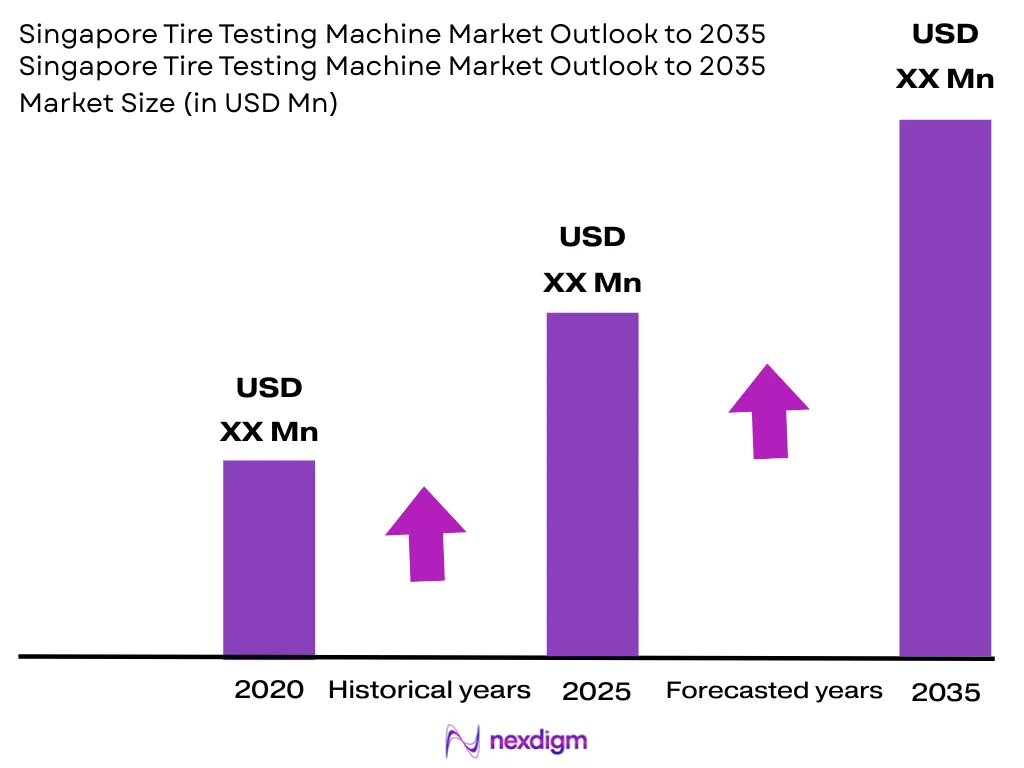
The Singapore Tire Testing Machine Market was valued at USD ~ Million in 2024 and is anticipated to expand at a CAGR of ~% during 2026-2035. The market is primarily driven by rising EV adoption driving tyre performance testing demand, Singapore’s position as an ASEAN testing and certification hub, and rapid capacity expansion across independent testing labs and OEM validation centres. According to industry estimates, the Singapore Tire Testing Machine Market was valued at approximately USD ~ million in 2025 and is projected to grow at a CAGR of approximately 9.3%, reaching approximately USD ~ million by 2032, while the broader Singapore-hub testing and certification equipment market is projected to grow from approximately USD 120 million in 2025 to USD 190 million by 2030 at a CAGR of approximately 9.6%. Automated and AI-based testing line deployments climbed to cover approximately 35% of large Singapore testing establishments in 2025 as operators increasingly adopted servo-hydraulic testing rigs, AI-based defect detection, and cloud-connected laboratory execution systems, generating a step-change in demand for testing hardware, software, and integration services across OEM and independent laboratory segments.
Market Segmentation
By Component
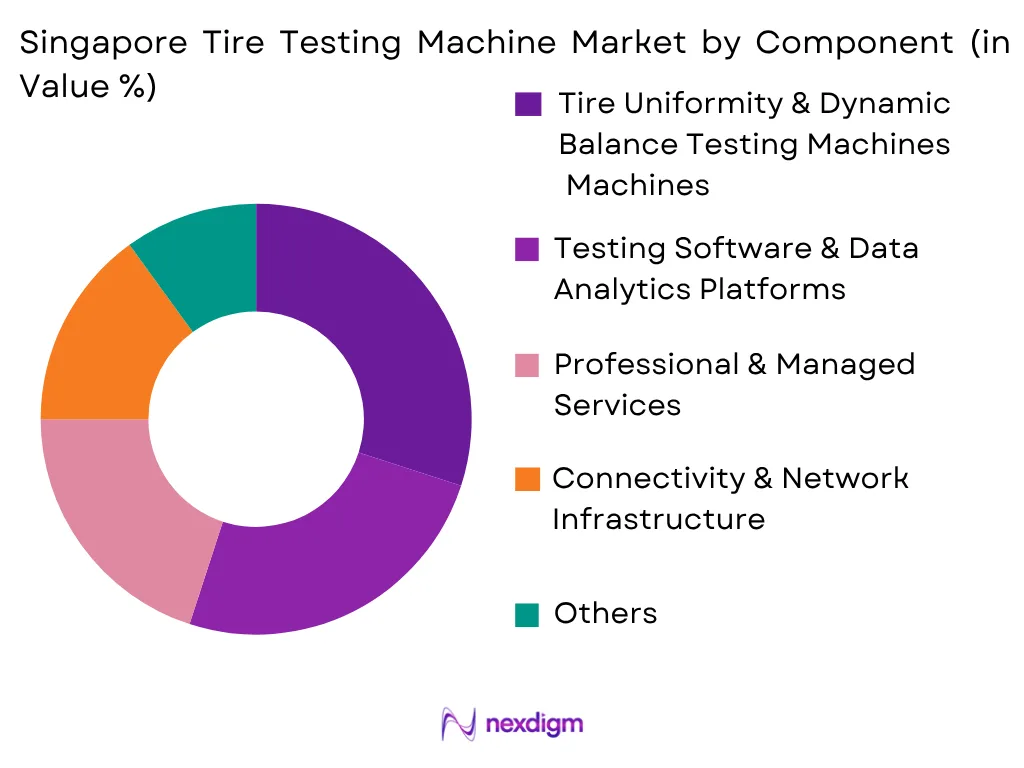
Among these, Tire Uniformity & Dynamic Balance Testing Machines continue to dominate the Singapore Tire Testing Machine Market, with MTS Systems and Link Engineering shipping precision testing rigs, force-measurement sensors, and robotic handling systems to dozens of testing customers nationwide and operating support facilities across Jurong, Tuas, and Woodlands supporting their position as preferred testing partners for OEM validation centres and independent certification labs. MTS Systems continues to differentiate through its integrated testing-software stack and end-to-end automated data-acquisition portfolio, positioning itself as the preferred partner for large enterprise laboratories requiring end-to-end hardware-software integration. Kobelco (Kobe Steel, Ltd.) has carved out significant market share through its high-speed uniformity and dynamic-balance testing offerings, which serve OEM and aftermarket tyre validation operators. Testing Software & Data Analytics Platforms are gaining increasing importance as technology majors including TÜV SÜD and SGS expand digital twin and Industry 4.0 platform adoption, contributing to approximately 33% growth in laboratory software spend between 2019 and 2025, supporting the shift toward AI-integrated testing models.
By Region
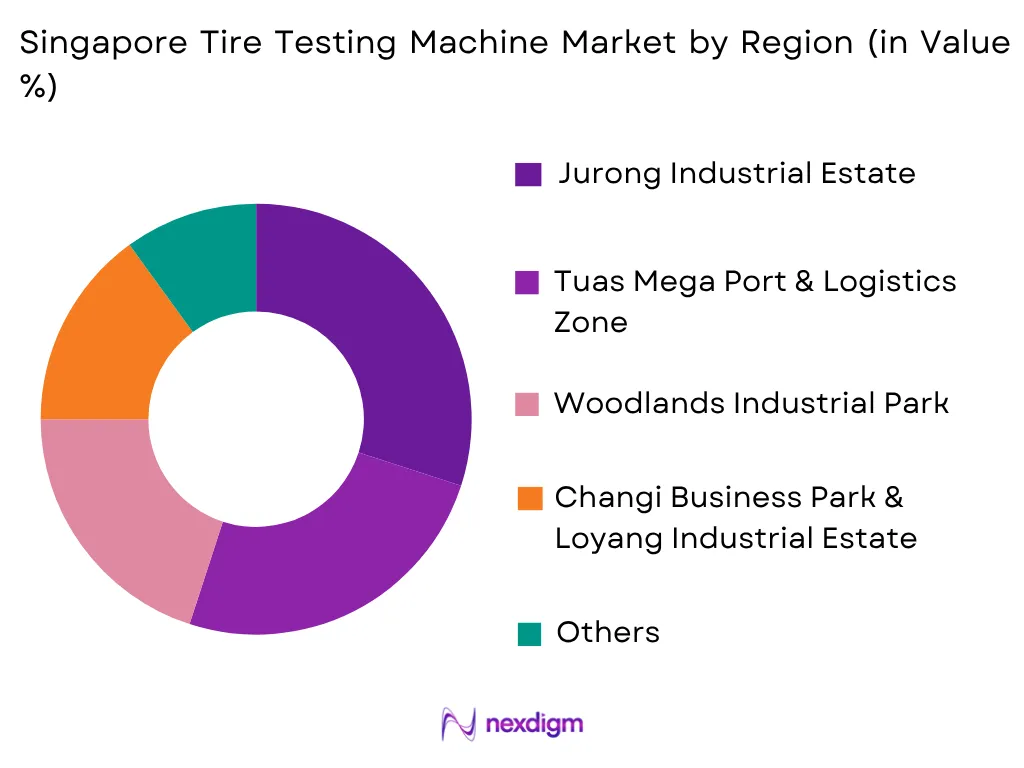
Jurong Industrial Estate remains the largest regional market within the Singapore Tire Testing Machine Market by installed base and revenue, given its concentration of heavy industry and testing laboratory infrastructure, though rising real estate costs and limited land availability continue to accelerate retrofit and vertical-facility investment in the region. Tuas Mega Port & Logistics Zone is witnessing the fastest growth as new OEM validation and certification facilities expand alongside the port’s logistics infrastructure, with MTS Systems’ 2025 partnership with a major regional tyre manufacturer embedding digital twin commissioning inside new testing facilities to cut laboratory ramp-up times. Global integrators including Link Engineering continue scaling testing-equipment production capacity to capture ASEAN-driven demand, while systems integrators and equipment distributors leverage Enterprise Singapore programme hubs to unlock previously underserved mid-market laboratory segments across Woodlands and the Changi/Loyang corridor.
Competitive Landscape
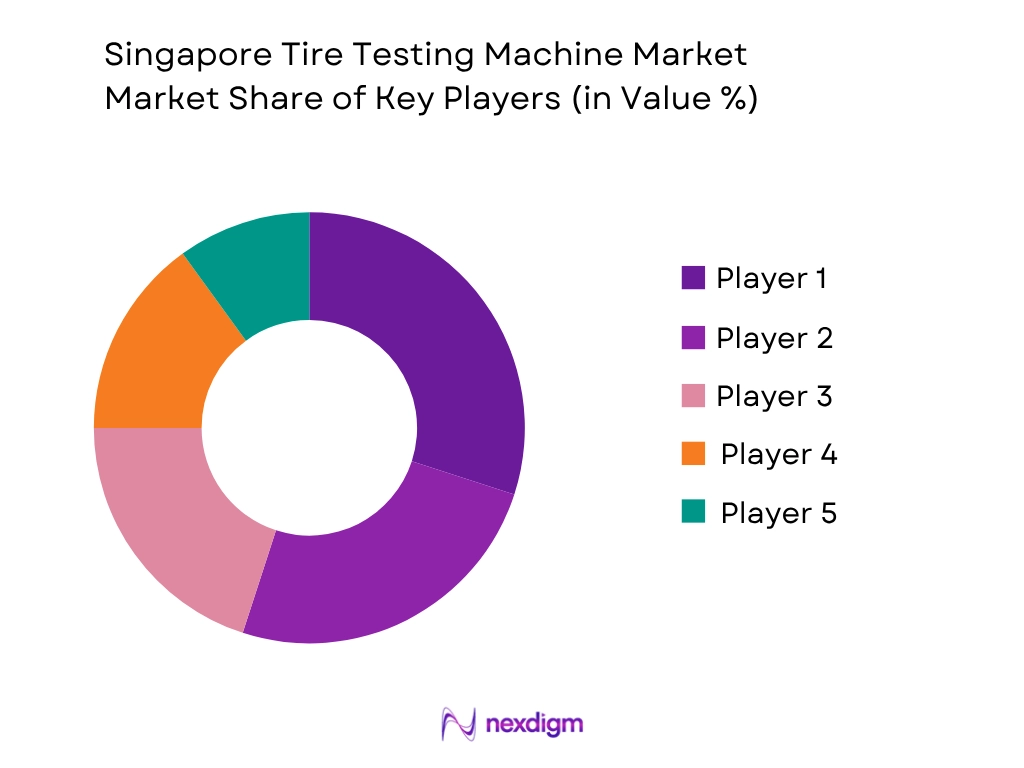
The Singapore Tire Testing Machine Market is moderately fragmented and highly competitive, with MTS Systems, Link Engineering, Kobelco, Illinois Tool Works, and ZwickRoell together handling a substantial share of installed testing value nationwide. Competition is primarily based on national and regional service coverage, platform interoperability, cybersecurity assurance, integration capability, and total cost of ownership. MTS Systems maintains its position as a leading testing equipment supplier in installed base and channel penetration across Singapore, serving as the preferred testing partner for OEM validation centres and independent certification labs with its integrated testing-software suite. Link Engineering continues to compete on uniformity-testing depth and dynamic-balance offerings, while Illinois Tool Works targets certification-lab verticals with its Instron and Micro-Poise analytics and process control offerings. Kobelco leverages its deep engineering and systems integration heritage to compete on large-scale OEM and aftermarket testing projects, while technology and certification majors including TÜV SÜD, SGS, and Applus+ continue to expand their Industry 4.0 consulting and precision testing footprints to reduce operators’ reliance on point solutions. ZwickRoell and Shimadzu compete for discrete testing automation volume in Jurong and Tuas, while Bureau Veritas, Intertek, and DEKRA continue to leverage their process control and testing platforms to serve both laboratory connectivity and analytics needs across the certification base.
| Company | Establishment Year | Headquarters | Primary Product/Service Portfolio | Testing Technology Focus
|
Network Presence | Major End-Use Industries | Key Strategic Focus | Certifications & Compliance |
| MTS Systems Corporation (Asia Pacific) | 1966 | ~ | ~ | ~ | ~ | ~ | ~ | ~ |
| Link Engineering Company (Asia Pacific) | 1980 | ~ | ~ | ~ | ~ | ~ | ~ | ~ |
| Kobelco (Kobe Steel, Ltd.) Machinery | 1905 | ~ | ~ | ~ | ~ | ~ | ~ | ~ |
| Illinois Tool Works Inc. (Instron / Micro-Poise) | 1912 | ~ | ~ | ~ | ~ | ~ | ~ | ~ |
| ZwickRoell Asia Pacific Pte Ltd | 1938 | ~ | ~ | ~ | ~ | ~ | ~ | ~ |
Singapore Tire Testing Machine Market Analysis
Growth Drivers
EV Adoption and ASEAN Testing Hub-Driven Market Expansion
The Singapore Tire Testing Machine Market continues to be shaped decisively by continued expansion of rising EV adoption and associated tyre performance validation requirements, which have driven new testing equipment investment and capacity expansion exceeding SGD 180 million in committed capital deployment since 2020 across OEM validation, certification, and independent laboratory sectors. Singapore’s role as an ASEAN testing and certification hub and regional homologation priorities, combined with continued growth of generative AI-based predictive maintenance and defect inspection platforms, have further expanded the market’s addressable base of both large enterprise and mid-market laboratories. According to industry estimates, the Singapore Tire Testing Machine Market is projected to grow at a CAGR of approximately 9.3% from its 2025 base of approximately USD 45 million, propelled in part by rising regional homologation demand that is pushing laboratories to prioritise automation investment to maintain testing throughput.
Automated Testing-as-a-Service and Private 5G Infrastructure Investment
The rollout of testing-as-a-service financing models and private 5G infrastructure that enable real-time laboratory visibility across the country’s testing base continues to be a critical driver of market expansion, as operators increasingly deploy connected testing rigs and edge computing capacity beyond pilot programmes into full production environments. Government advanced manufacturing programmes, including the Enterprise Singapore Manufacturing 2030 initiative with dedicated Industry 4.0 demonstration centres, continue to expand workforce training, technology demonstration, and small-laboratory technology adoption support, positioning Singapore as a leading hub for advanced tyre testing technology development in ASEAN. Global equipment vendors are scaling testing-machine production capacity regionally to capture homologation-driven demand, while systems integrators leverage these government programmes to unlock previously underserved small and mid-sized laboratory segments, illustrating the scale of investment being deployed to address the industry’s persistent testing talent and legacy-infrastructure gaps.
Market Challenges
High Capital Costs and Cybersecurity Vulnerabilities
The Singapore Tire Testing Machine Market faces significant challenges from the high upfront capital expenditure required for precision testing equipment, which creates substantial adoption cost complexity for laboratories seeking to modernise legacy testing lines without extended downtime. Rising cybersecurity vulnerabilities across connected laboratory networks continue to constrain adoption confidence in the country’s highest-value testing facilities, requiring providers to invest in industrial cybersecurity frameworks and network segmentation to maintain operational resilience. Persistent shortages of skilled tyre-testing engineering talent add further operational unpredictability, periodically delaying implementation timelines and requiring providers to maintain flexible deployment models and remote support capacity to minimise project disruption.
Legacy System Integration and Limited Land Availability Constraints
Integration complexity with legacy laboratory management systems, while critical to preserving existing capital investment, continues to increase deployment costs and implementation timelines for both equipment providers and laboratories, given the need to manage data interoperability, protocol translation, and phased migration across multi-vendor operational technology environments. Fragmented component supply chains and continued import dependency for high-precision testing hardware constrain delivery speed and reliability, where smaller regional integrators and informal supplier networks often supplement national vendors’ capacity gaps. Rising component and logistics costs, together with Singapore’s limited land availability for large-scale testing facilities, continue to pressure project economics across the industry, particularly for hardware-intensive deployments operating across dispersed multi-site laboratory footprints.
Market Opportunities
Expansion of Robotics-as-a-Service and AI-Driven Predictive Maintenance
The continued expansion of testing-as-a-service and flexible equipment financing models presents substantial opportunities for equipment providers willing to invest in modular, subscription-based deployment capacity beyond traditional capital-purchase models, as mid-market laboratory penetration accelerates across Woodlands and the Changi/Loyang corridor. Growth in AI-driven predictive maintenance and defect inspection platforms is expanding the addressable market for technology providers capable of offering integrated analytics and computer-vision-based quality control alongside traditional testing hardware. Companies developing digital twin and edge computing platforms are well positioned to capture growing demand as laboratories increasingly prioritise testing visibility and real-time decision-making across the country’s complex multi-site laboratory networks.
Private 5G Adoption, Cobot Growth, and Small Laboratory Automation
The growing adoption of private 5G networks and edge computing infrastructure presents a significant opportunity for technology providers seeking to reduce latency and connectivity costs while addressing rising cybersecurity and reliability expectations from enterprise laboratory clients. Growth of human-robot collaboration through cobots, led by providers such as Bureau Veritas and Intertek, is expanding the addressable market beyond traditional fixed automation models, particularly across small and mid-sized laboratories in Jurong and Tuas. Expansion of automation-as-a-service offerings for small and mid-sized laboratories, which comprise the substantial majority of Singapore testing establishments, presents a significant opportunity for providers such as Applus+ and DEKRA that combine hardware, software, and managed services capabilities, positioning them to capture growing demand from underserved laboratories scaling their automation adoption.
Future Outlook
The Singapore Tire Testing Machine Market is expected to witness robust expansion over the forecast period, supported by continued growth in EV-driven testing equipment investment, ASEAN homologation-led capacity expansion, and the ongoing rollout of automated testing rigs and private 5G infrastructure across the country’s laboratory base. Continued investment in AI-driven predictive maintenance, digital twin platforms, and testing-as-a-service offerings is expected to further strengthen the market’s competitive landscape. Growing government emphasis on advanced manufacturing and testing capacity under the Enterprise Singapore Manufacturing 2030 initiative, alongside sustained cybersecurity and workforce development investment, will continue to reshape investment decisions and competitive dynamics across the industry through 2035.
Major Players
- MTS Systems Corporation (Asia Pacific)
- Link Engineering Company (Asia Pacific)
- Kobelco (Kobe Steel, Ltd.) Machinery
- Illinois Tool Works Inc. (Instron / Micro-Poise)
- ZwickRoell Asia Pacific Pte Ltd
- Shimadzu Asia Pacific Pte Ltd
- Yasui Seiki Co., Ltd.
- A&D Company, Limited
- Beijing WEW Testing Machine Co., Ltd.
- TÜV SÜD Asia Pacific Pte Ltd
- SGS Testing & Control Services Singapore Pte Ltd
- Applus+ Singapore Pte Ltd
- Bureau Veritas Singapore Pte Ltd
- Intertek Testing Services Singapore Pte Ltd
- DEKRA Testing and Certification Singapore Pte Ltd
Key Target Audience
- Manufacturing Enterprises and Industrial Plant Operators
- Industrial Automation Hardware and Software Providers
- Systems Integrators and Managed Service Providers
- Original Equipment Manufacturers and Component Suppliers
- Investment and Venture Capitalist Firms
- Government and Regulatory Bodies (Enterprise Singapore, Land Transport Authority, Singapore Accreditation Council)
- Robotics, AI, and Industrial IoT Technology Providers
- Automotive, Electronics, and Advanced Manufacturing Facility Operators
Research Methodology
Step 1: Identification of Key Variables
The research process begins with identifying the complete ecosystem of the Singapore Tire Testing Machine Market, including testing equipment manufacturers, software and platform providers, systems integrators, and regulatory authorities. Extensive secondary research is conducted using company annual reports, government publications, regulatory agency disclosures, industry journals, and proprietary databases to determine the variables influencing market demand, pricing, installed base, and technological developments.
Step 2: Market Analysis and Construction
Historical market information is collected and analysed to estimate market size, installed base, application-wise demand, and pricing trends. A combination of top-down and bottom-up approaches is used to estimate market revenues and validate segment-level performance. Consumption patterns across large enterprise manufacturers, mid-market producers, and systems integrators are evaluated to establish an accurate representation of the industry.
Step 3: Hypothesis Validation and Expert Consultation
The preliminary findings are validated through Computer-Assisted Telephone Interviews (CATIs) and structured discussions with equipment providers, laboratory operations executives, systems integrators, regulatory experts, and senior executives operating within the Singapore tire testing machine industry. These interviews help verify market assumptions, competitive developments, technology adoption trends, pricing dynamics, and future investment opportunities while refining the overall market estimates.
Step 4: Research Synthesis and Final Output
The final stage integrates insights obtained from primary interviews with quantitative information collected through secondary sources. Data triangulation techniques are applied to reconcile differences between supply-side and demand-side estimates, ensuring robust market forecasting. The report is then reviewed through multiple quality assurance checkpoints to deliver a comprehensive analysis covering market size, segmentation, competitive landscape, future outlook, and strategic recommendations for industry stakeholders.

- Executive Summary
- Research Methodology (Market Definitions and Assumptions, Abbreviations, Market Sizing Approach, Top-Down Analysis, Bottom-Up Analysis, Demand-Side Assessment, Supply-Side Assessment, Primary Industry Interviews, Secondary Research Validation, Data Triangulation, Forecasting Framework, Limitations and Future Conclusions)

- Definition and Scope
- Market Evolution and Industry Genesis
- Timeline of Major Industry Developments
- Tire Testing Machine Industry Value Chain Analysis
- Supply Chain Analysis

- Growth Drivers (Rising EV Adoption Driving Tyre Performance Testing Demand, Singapore’s Position as an ASEAN Testing and Certification Hub, Growing Regional Homologation and Type-Approval Requirements, Expansion of Enterprise Singapore’s Manufacturing 2030 Initiatives, Growth of AI-Based Defect Detection and Automated Testing Lines, Expansion of High-Performance and Motorsport Tyre R&D)
- Market Challenges (High Upfront Capital Expenditure for Precision Testing Equipment, Limited Domestic Land Availability for Large-Scale Testing Facilities, Integration Complexity with Legacy Laboratory Management Systems, Persistent Shortage of Specialised Tyre-Testing Engineering Talent, Fragmented Component Supply Chain and Import Dependency, Data Interoperability Across Multi-Vendor Testing Platforms)
- Market Opportunities (Expansion of Testing-as-a-Service and Flexible Equipment Financing Models, Growth of AI-Driven Predictive Maintenance and Defect Inspection, Adoption of Digital Twin Technology Across Tyre Validation Operations, Edge Computing Integration for Real-Time Testing Analytics, Small and Mid-Sized Laboratory Automation Adoption, Expansion of Private 5G Networks Within Testing Campuses)
- Market Trends (Rise of Generative AI Copilots for Laboratory Floor Operations, Growth of Human-Robot Collaboration Through Cobots, Consolidation Among Tyre Testing Equipment Vendors, Increasing Use of Cloud-Based Laboratory Execution Systems, Expansion of Sustainability-Linked Testing Facility Retrofits, Growth of Interoperable Open-Platform Testing Ecosystems)
- Government Regulations (Enterprise Singapore Manufacturing 2030 Initiative, Singapore Accreditation Council (SAC-SINGLAS) Laboratory Standards, Land Transport Authority (LTA) Vehicle Type-Approval Requirements, National Environment Agency (NEA) Tyre Disposal Regulations, ASEAN Vehicle Standards Harmonisation Framework, Singapore Personal Data Protection Act (PDPA) Compliance Guidelines)
- Import and Export Analysis (Trade Volume, Major Import Sources, Export Destinations, HS Code Analysis, Trade Balance)
- Infrastructure Availability Analysis (Industrial Automation Equipment Manufacturing Capacity, Skilled Automation Workforce Availability, Data Centre and Edge Computing Infrastructure, Private 5G and Industrial Network Coverage, Electronics and Component Supply Capacity)
- Technology Landscape (AI-Based Predictive Maintenance and Quality Control, Digital Twin and Simulation Platforms, Manufacturing Execution Systems and SCADA, Industrial Robotics and Cobot Technology, Private 5G and Edge Computing Integration)
- Sustainability Assessment (Energy-Efficient Automation and Motor Systems, Predictive Maintenance for Reduced Material Waste, Circular Manufacturing and Resource Optimisation, Carbon Footprint Reduction Through Process Automation, Sustainable Factory Design and Green Building Certification)
- PESTLE Analysis
- SWOT Analysis
- Porter’s Five Forces Analysis
- Stakeholder Ecosystem
- Competition Ecosystem

- By Market Value (2020-2025)
- By Installed Base of Testing Machines (2020-2025)
- By Average Machine Price (2020-2025)

- By Component (In Value %)
Tire Uniformity & Dynamic Balance Testing Machines
Testing Software & Data Analytics Platforms
Professional & Managed Services
Connectivity & Network Infrastructure - By Technology (In Value %)
Servo-Hydraulic Testing Technology
Artificial Intelligence & Machine Learning
Automated Robotic Handling & Cobots
Digital Twin & Tyre Simulation - By Deployment Mode (In Value %)
On-Premise Deployment
Cloud-Based Deployment
Hybrid Deployment - By End-Use Industry (In Value %)
Tire Manufacturers (OEM Production Lines)
Automotive OEMs (Quality Validation)
Independent Testing & Certification Labs
Motorsport & Aerospace Tyre R&D
Retreading & Aftermarket Tyre Service Centres - By Region (In Value %)
Jurong Industrial Estate (Heavy Industry & Manufacturing Hub)
Tuas Mega Port & Logistics Zone
Woodlands Industrial Park (North Region)
Changi Business Park & Loyang Industrial Estate (East Region)

- Market Share of Major Players (By Value, Installed Base, Component Type, Technology, Region Served)
- Cross Comparison Parameters (Product Portfolio Breadth, Manufacturing and R&D Capacity, National and Regional Coverage, Platform Integration and API Capability, Cybersecurity and Compliance Reliability, Customer Base, Innovation & New Product Launch Frequency, Sustainability Initiatives)
- SWOT Analysis of Major Players
- Pricing Analysis by Component and Deployment Mode
- Manufacturing & R&D Capacity Analysis
- Network Footprint Analysis
- Distribution Network Analysis
- Innovation Benchmarking
- Detailed Profiles of Major Companies
MTS Systems Corporation (Asia Pacific)
Link Engineering Company (Asia Pacific)
Kobelco (Kobe Steel, Ltd.) Machinery
Illinois Tool Works Inc. (Instron / Micro-Poise)
ZwickRoell Asia Pacific Pte Ltd
Shimadzu Asia Pacific Pte Ltd
Yasui Seiki Co., Ltd.
A&D Company, Limited
Beijing WEW Testing Machine Co., Ltd.
TÜV SÜD Asia Pacific Pte Ltd
SGS Testing & Control Services Singapore Pte Ltd
Applus+ Singapore Pte Ltd
Bureau Veritas Singapore Pte Ltd
Intertek Testing Services Singapore Pte Ltd
DEKRA Testing and Certification Singapore Pte Ltd

- Consumption Pattern Analysis (Installed Automation Base, Deployment Size Distribution, Industry Vertical Penetration, Seasonal Capital Expenditure Cycles, Large Enterprise vs Mid-Market Adoption Activity)
- Purchasing Criteria (Return on Investment Timeline, Total Cost of Ownership, Interoperability with Existing Systems, Cybersecurity Assurance, System Reliability and Uptime, Vendor Support and Service Coverage)
- Procurement and Supplier Selection Analysis
- Platform-Native vs Best-of-Breed Vendor Adoption Assessment
- In-House Integration vs Outsourced Systems Integrator Demand
- Product Attribute Preference Analysis (Implementation Turnaround Time, Real-Time Analytics Capability, Cybersecurity Reliability, Legacy System Compatibility, API and Platform Integration Capability, After-Sales Support and Service Response)
- Consumer Reliability Expectations
- Pain Point Analysis
- Decision-Making Process

- By Market Value (2026-2035)
- By Installed Base of Testing Machines (2026-2035)
- By Average Machine Price (2026-2035)


 Request a Sample
 Ask for Customization
 Get a Quote
 Enquire Now