

 Download PDF
Market Overview
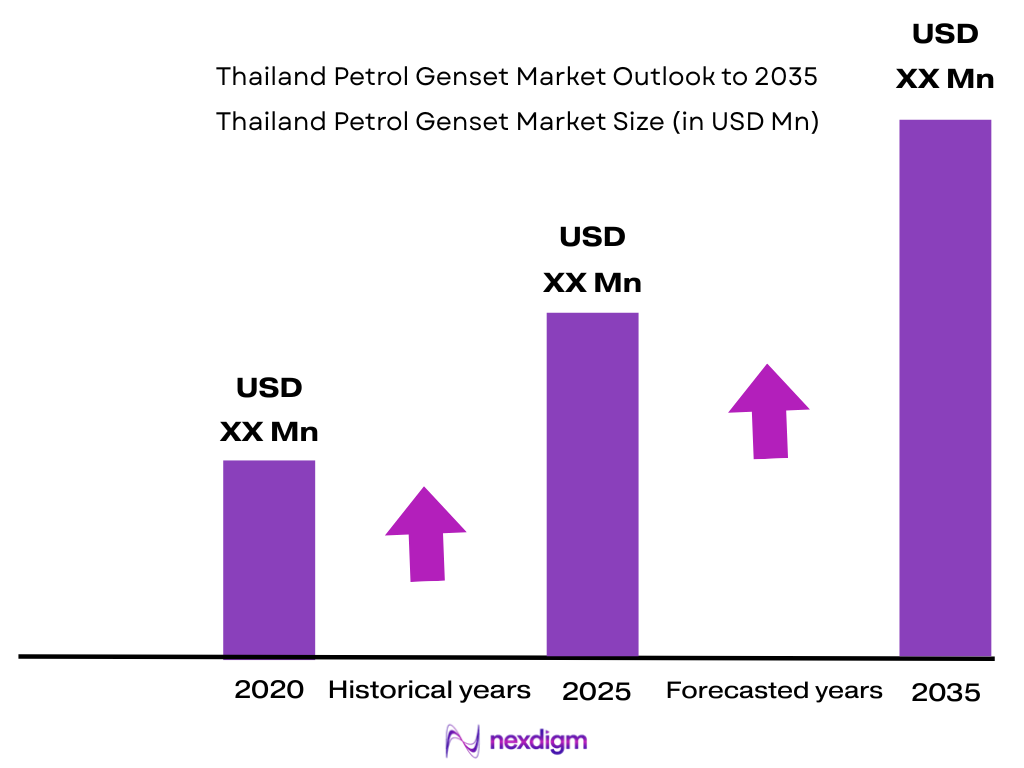
The Thailand Petrol Genset Market is valued at approximately ~ million, supported by rising electricity requirements, construction activity, industrial operations and demand for portable backup power. EGAT’s net system peak electricity demand increased from 34,130.5 MW to 36,477.8 MW, adding more than 2,300 MW of peak load. Petrol generators remain relevant for households, workshops, construction sites, outdoor businesses and temporary applications because compact units can provide immediately deployable electricity where grid connections are unavailable or interrupted. Bangkok, Chonburi, Rayong and Chachoengsao are important demand centres because they combine dense commercial activity, construction sites, workshops, logistics facilities and industrial estates. Thailand’s industrial infrastructure expanded around 68 industrial estates across 16 provinces, while the Eastern Economic Corridor concentrates automotive, electronics, petrochemical and advanced manufacturing operations. Electricity peak demand moved from 34,130.5 MW to 36,477.8 MW, reinforcing the requirement for contingency and temporary power equipment around high-load commercial and industrial clusters.
Market Segmentation
By Power Rating
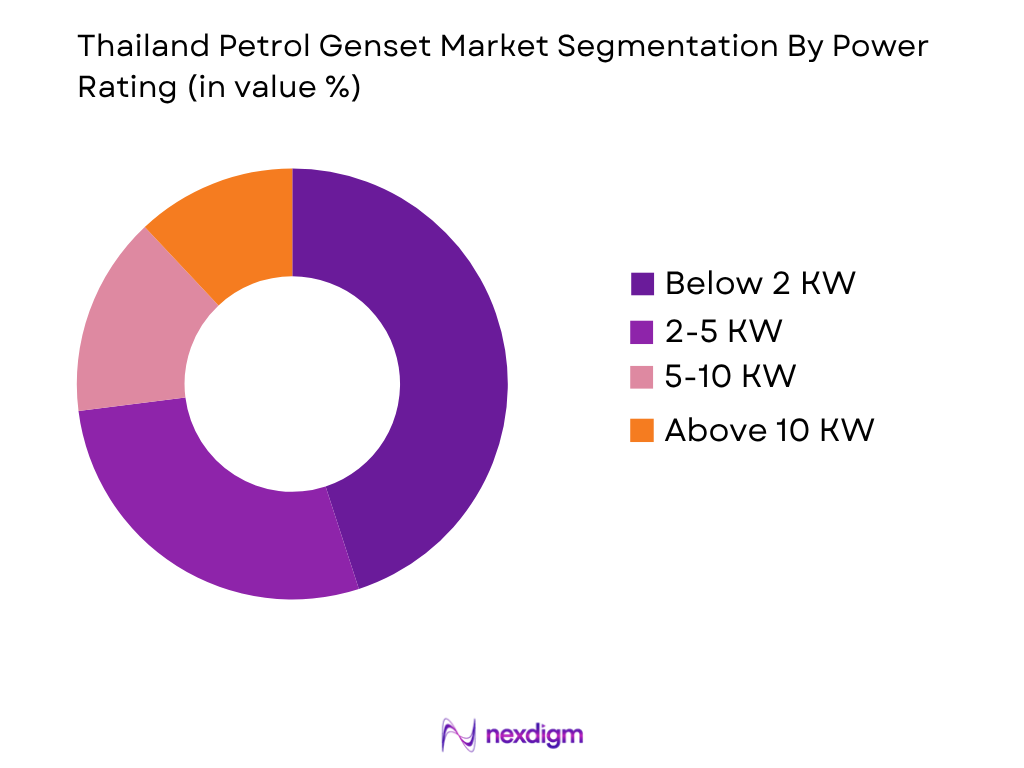
The Thailand Petrol Genset Market is segmented into below 2 kW, 2–5 kW, 5–10 kW and above 10 kW petrol generator sets. The 2–5 kW category holds the dominant market position because this output range provides a practical balance between portability, fuel consumption and the ability to operate common electrical equipment. These systems can support refrigerators, lighting, pumps, power tools, small air-conditioning equipment and workshop machinery without requiring the size and fuel infrastructure associated with larger commercial gensets. Construction contractors, roadside businesses, mobile workshops and households can also transport these products relatively easily. Thailand’s industrial and construction base strengthens demand because the country maintains extensive manufacturing and infrastructure activity, including dozens of industrial estates and major development zones in the Eastern Economic Corridor. Inverter models within this output band are increasingly attractive where users require stable electricity for electronics, telecom devices and control equipment. Yamaha describes generator applications including construction work, household emergency use and outdoor events, while Honda positions portable generators for backup, recreation and industrial applications.
By Application
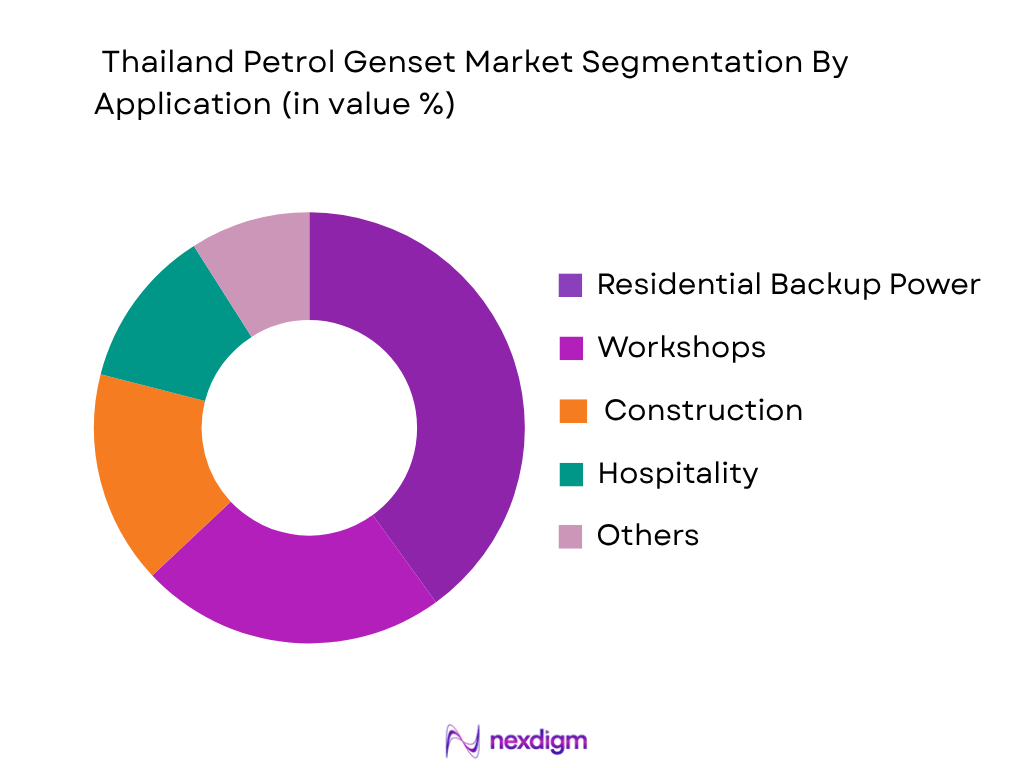
The Thailand Petrol Genset Market is segmented into residential backup, construction and contracting, workshops and small enterprises, commercial and hospitality applications, recreation and events, and agriculture or remote-site usage. Residential and small-business backup applications represent the leading segment because petrol gensets are comparatively easy to deploy and can provide immediate temporary power without permanent infrastructure. Rising electricity load reinforces the importance of backup capability; EGAT recorded system peak demand of 36,477.8 MW, compared with 34,130.5 MW previously. Thailand also has extensive tourism, retail, food-service and small-enterprise activity where even short electricity interruptions can disrupt refrigeration, lighting, point-of-sale equipment and communications. Petrol gensets additionally suit construction contractors and mobile work crews because equipment can be moved between projects rather than installed permanently. The Provincial Electricity Authority serves 74 provinces, demonstrating how geographically broad electricity demand is outside Bangkok, Nonthaburi and Samut Prakan. Remote farms, provincial workshops and temporary infrastructure sites therefore remain relevant portable-power customers even as national grid reliability improves.
Competitive Landscape
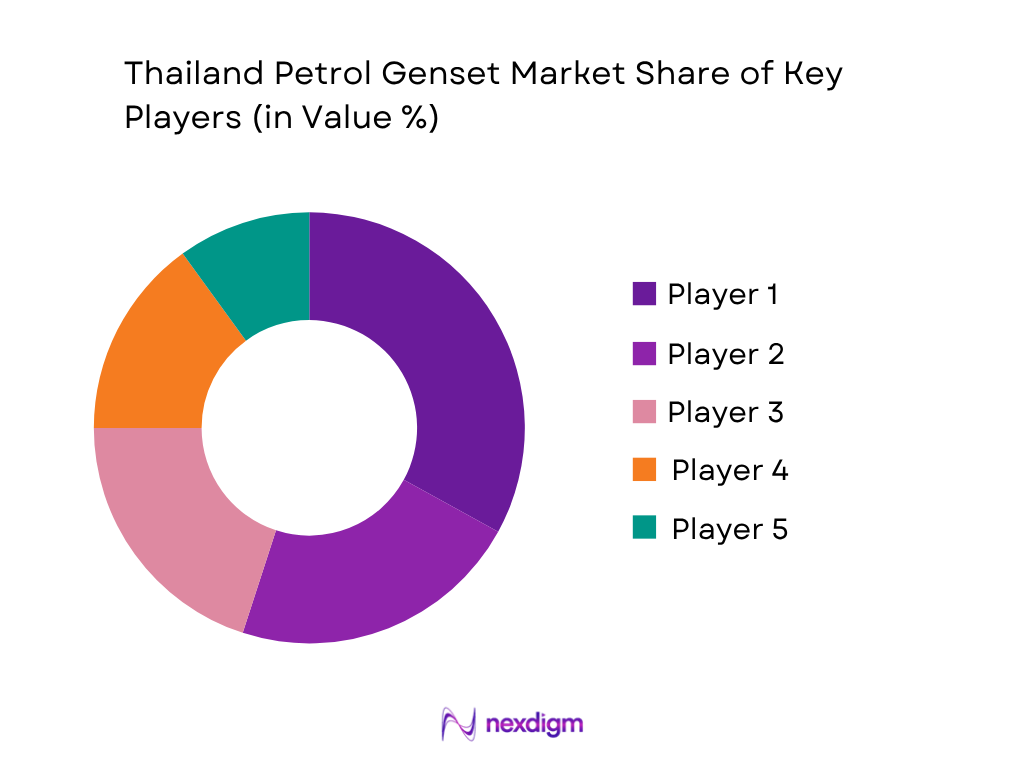
The Thailand Petrol Genset Market combines Japanese power-equipment manufacturers, international generator specialists and imported value-oriented brands distributed through machinery dealers, hardware retailers and specialist power-equipment channels. Honda has an especially established local power-products ecosystem: Thai Honda states that its Thai power-products operations date to 1964 and that more than 2 million Thai-made engines have been produced since 1987. Yamaha also operates an established Asian generator business, while Generac products are distributed locally through specialist power-system suppliers.
| Major Player | Establishment Year | Headquarters | Petrol Generator Range | Inverter Technology | Typical Output Coverage | Primary Applications | Portable Capability | Distribution Approach |
| Honda Motor Co. | 1948 | Tokyo, Japan | ~ | ~ | ~ | ~ | ~ | ~ |
| Yamaha Motor Co. | 1955 | Iwata, Japan | ~ | ~ | ~ | ~ | ~ | ~ |
| Generac Holdings | 1959 | Wisconsin, USA | ~ | ~ | ~ | ~ | ~ | ~ |
| PRAMAC | 1966 | Siena, Italy | ~ | ~ | ~ | ~ | ~ | ~ |
| Sawafuji Electric / ELEMAX | 1908 | Gunma, Japan | ~ | ~ | ~ | ~ | ~ | ~ |
Thailand Petrol Genset Market Analysis
Growth Drivers
Rising Peak Electricity Load and Business Continuity Requirements
Thailand’s Petrol Genset Market is supported by rising electricity demand and the growing requirement for temporary or emergency power across workshops, service facilities, construction sites, small businesses, tourism properties and mobile operations. Electricity Generating Authority of Thailand data shows that the national system recorded a net peak demand of 36,477.8 MW in 2024, compared with 34,130.5 MW in 2023, adding more than 2,300 MW of peak load within one year. This increase places additional operational importance on power continuity, particularly for businesses running electrical tools, pumps, compressors, diagnostic equipment, refrigeration and communications equipment. EGAT continued system development under Thailand’s Power Development Plan to strengthen electricity security, but portable petrol generators remain relevant where temporary power access, mobility or immediate backup capability is required. The underlying macroeconomic base reinforces this requirement. According to the World Bank, Thailand generated approximately USD 577.01 billion in GDP in 2025, while the IMF places the country’s population at approximately 71.56 million people. Thailand therefore combines a large consumer economy with substantial manufacturing, services, tourism and commercial infrastructure. Automotive petrol gensets are particularly suited to applications requiring relatively low-to-medium electrical output with high mobility. Small repair workshops can deploy petrol units for emergency tool operation; roadside maintenance teams can power lighting, welding support equipment and electric tools; construction contractors can operate equipment before permanent electrical connections are available; and mobile vendors or event operators can use compact generators away from fixed utility connections.
Expansion of Construction, Industrial Projects and Mobile Power Applications
Thailand’s continuing infrastructure and industrial investment creates a significant demand base for petrol gensets because construction sites and project commissioning activities frequently require portable electricity before permanent grid connections are installed. The National Economic and Social Development Council reported that Thailand’s construction sector returned to expansion during 2024 and strengthened further during 2025, with public construction providing a major component of the recovery. More importantly for portable generator demand, the Thailand Board of Investment documented 3,137 investment applications valued at THB 1.14 trillion in 2024, followed by 3,370 applications worth THB 1.876 trillion in 2025. The scale of these projects increases requirements for temporary lighting, handheld electric tools, water pumps, site offices, security systems, telecommunicationsequipment and equipment commissioning. Automotive and machinery investment itself is directly relevant. Thailand Board of Investment material records approximately THB 138.56 billion of foreign direct investment applications in automotive and machinery activities during 2024. Electronics and electrical appliances accounted for approximately THB 229.38 billion, while digital investments represented approximately THB 220.32 billion in the same investment dataset. These projects are concentrated particularly in industrial locations such as the Eastern Economic Corridor and manufacturing provinces where factories, warehouses, logistics facilities and supplier sites undergo continual development. Petrol gensets can serve contractors operating outside completed utility infrastructure and provide mobile emergency supply during installation, maintenance and plant shutdown activities.
Market Challenges
Strong Grid Coverage and Improving Electricity-System Reliability
One of the principal challenges for Thailand’s Petrol Genset Market is the high availability of utility electricity across most populated and economically active areas. Portable generators become most valuable when grid electricity is unavailable, unreliable or impractical to access. Thailand, however, has invested heavily in transmission, distribution, substations, smart-grid systems and rural electrification, reducing the need for household or commercial users to rely routinely on small petrol generators. The Provincial Electricity Authority manages distribution across 74 provinces, excluding Bangkok, Nonthaburi and Samut Prakan, and historically developed its network to cover approximately 510,000 square kilometres. Its distribution footprint covers virtually the entire geographical area outside Metropolitan Electricity Authority territory. The system has continued to become more sophisticated. PEA’s 2024 sustainability reporting focuses directly on power-system stability, industrial-estate outage management and network modernization. The Metropolitan Electricity Authority likewise reported improved distribution-system reliability in its 2024 operating assessment for Bangkok, Nonthaburi and Samut Prakan. This is significant for petrol genset demand because improvements in grid reliability reduce the number of hours for which households, garages, retail shops and small businesses need emergency generators.
Competition from Solar, Battery Storage and Alternative Portable Power Systems
Thailand’s Petrol Genset Market increasingly faces substitution pressure from solar photovoltaic systems, battery energy storage and rechargeable portable power equipment. The fundamental advantage of a petrol genset is that it can continuously produce electricity as long as fuel is available, but battery systems offer quiet operation, zero point-of-use exhaust emissions and immediate power delivery. Thailand’s electricity transition is creating stronger domestic supply chains around these alternatives, which could reduce petrol-generator usage in applications requiring only moderate energy over short durations. Thailand already had 55,831.76 MW of contractual generating capacity at the end of 2024, according to the Energy Regulatory Commission, while cumulative installed solar PV capacity reached approximately 9,942 MWp, including around 3,310 MWp of rooftop solar according to data published through Thailand’s participation in the IEA Photovoltaic Power Systems Programme. This installed rooftop base increases the number of businesses and properties with access to self-generated electricity during daylight hours and creates a natural platform for the subsequent integration of stationary batteries.
Market Opportunities
Inverter Gensets, Intelligent Controls and High-Efficiency Portable Power
Technological upgrading represents one of the strongest future opportunities in Thailand’s Petrol Genset Market because the use case is shifting from basic mechanical generators toward portable systems capable of powering modern electronic loads. Thailand is attracting substantial investment in digital, electrical and electronics activities, increasing the installed base of sensitive equipment requiring stable voltage and frequency. Thailand Board of Investment data recorded 150 digital-sector investment projects worth THB 243.3 billion in 2024, while electronics and electrical-appliance investments included 407 projects worth THB 231.7 billion. These investments reinforce a broader economy increasingly dependent on electronic controls, communications equipment, computers, diagnostic devices, sensors and digitally controlled machinery. Conventional generators can produce voltage and frequency fluctuations as engine speed changes with load. Inverter petrol generators address this issue by generating electricity electronically and converting it into a more stable output waveform. This makes them better suited to laptops, electronic diagnostic equipment, telecommunications devices, sensitive power tools and control systems. Thailand’s automotive manufacturing and service ecosystem is especially relevant because workshops increasingly use electronic vehicle scanners, battery-management tools and computerised diagnostic platforms alongside traditional mechanical equipment.
Rural, Disaster-Response and Distributed Temporary Power Applications
Thailand offers a continuing opportunity for petrol gensets in provincial, agricultural, disaster-response and temporary-power applications where portability matters more than permanent generating capacity. The Provincial Electricity Authority covers 74 provinces and approximately 510,000 square kilometres outside the Metropolitan Electricity Authority’s service area, demonstrating the enormous geographical scale over which electricity infrastructure must be maintained. Even with extensive grid coverage, distribution lines in rural, mountainous, agricultural, island and flood-prone areas can be exposed to local disruptions or may not reach temporary work locations where electricity is required. Petrol generators are particularly suitable for short-duration power needs in these environments because compact units can be transported in pickup trucks and service vehicles without dedicated installation infrastructure. Agricultural users can employ them for small pumps, lighting, electrical tools and temporary processing equipment. Road-maintenance crews can operate drills, lighting and electronic equipment. Telecom and utility maintenance teams can use small gensets during field repairs. Disaster-response agencies can deploy them to evacuation centres, command posts or local service facilities before normal electricity distribution is restored. The Provincial Electricity Authority’s 2024 sustainability reporting specifically includes industrial-estate outage planning and power-system restoration management, demonstrating that continuity planning remains an active operating requirement even in a mature electricity network. Thailand’s national peak electricity demand also reached 36,477.8 MW during 2024, reinforcing the importance of resilient distribution as electricity dependence rises. When storms, floods, equipment faults or construction work interrupt local lines, end users increasingly lose access not only to lighting but also communications, refrigeration, charging, security systems and digitally controlled equipment.
Future Outlook
The Thailand Petrol Genset Market is expected to expand at approximately ~ CAGR during 2026–2035, supported by construction, commercial activity, industrial decentralisation and growing expectations for resilient temporary electricity. Petrol generators will remain particularly relevant at the lower end of the power spectrum, where portability and rapid deployment matter more than continuous-duty operating economics. Small contractors, workshops, households, events and outdoor businesses will continue to require mobile units that can power tools, lighting, appliances and electronic equipment without permanent installations. The product mix is likely to move increasingly toward inverter generators, electric-start systems, automatic voltage regulation, quieter enclosures and electronic monitoring. Yamaha notes that inverter generators provide cleaner-quality electricity suitable for precision equipment, while Honda already integrates Bluetooth connectivity and carbon-monoxide monitoring technologies into selected portable generator platforms internationally. Thailand’s electricity infrastructure will simultaneously become more sophisticated. EGAT recorded net peak demand of 36,477.8 MW, while PEA continues to monitor SAIFI and SAIDI reliability indicators across its 74-province service territory. The result is not necessarily declining genset demand; rather, petrol generators are likely to shift further toward temporary, emergency and mobile applications rather than prolonged prime-power operation.
Major Players
- Honda Motor Co., Ltd.
- Yamaha Motor Co., Ltd.
- Generac Holdings Inc.
- PRAMAC
- Sawafuji Electric Co. / ELEMAX
- Briggs & Stratton
- Champion Power Equipment
- Westinghouse Outdoor Power Equipment
- FIRMAN Power Equipment
- Hyundai Power Products
- SENCI Electric Machinery
- Chongqing Dajiang Power Equipment
- Loncin Motor Co.
- Kipor Power Equipment
- Mitsubishi Heavy Industries Engine & Turbocharger
Key Target Audience
- Petrol generator manufacturers and assemblers
- Portable power-equipment distributors and importers
- Construction contractors and equipment-rental companies
- Industrial estates, factories and maintenance operators
- Hardware retailers and home-improvement chains
- Hospitality, event-management and outdoor-service operators
- Investments and venture capitalist firms
- Government and regulatory bodies (Ministry of Energy, Electricity Generating Authority of Thailand, Provincial Electricity Authority, Metropolitan Electricity Authority, Thai Industrial Standards Institute)
Research Methodology
Step 1: Identification of Key Variables
The initial phase establishes the Thailand Petrol Genset Market ecosystem covering manufacturers, importers, distributors, hardware retailers, rental providers, construction contractors, households, workshops and industrial users. Key variables include rated output, starting wattage, engine displacement, inverter versus conventional architecture, fuel-tank capacity, runtime, noise level, portability, voltage regulation and application profile.
Step 2: Market Analysis and Construction
Historical demand is constructed using a bottom-up assessment of petrol generator availability across power bands and major end-user categories. Demand-side analysis incorporates construction activity, household backup requirements, industrial estates, provincial economic activity and temporary-power applications. Supply analysis examines distributor networks, imported brands, locally available engines, retail channels and generator specifications before triangulating them against Thai electricity and economic indicators.
Step 3: Hypothesis Validation and Expert Consultation
Market hypotheses are validated through CATIs and structured discussions with power-equipment dealers, generator distributors, construction contractors, rental businesses, workshop operators and industrial maintenance teams. Interviews evaluate buyer preferences regarding power capacity, inverter technology, expected runtime, portability, noise, starting mechanism, after-sales servicing and the trade-off between petrol, diesel and battery-based alternatives.
Step 4: Research Synthesis and Final Output
The final stage reconciles demand-side usage models with product availability and supplier information. Electricity peak demand, grid-service coverage, industrial-estate activity and construction indicators are combined with manufacturer specifications to validate the role of petrol generators across residential, construction, commercial and provincial applications. The resulting model provides an integrated historical assessment and forward-looking segmentation framework for the Thailand Automotive Petrol Genset Market.

- Executive Summary
- Research Methodology (Market Definitions and Assumptions, Petrol Genset Scope, Rated Output Classification, Top-Down Market Sizing, Bottom-Up Unit Assessment, Import and Distribution Mapping, Dealer and Retail Channel Assessment, End-User Interviews, Product Benchmarking, Data Triangulation, Forecasting Framework, Limitations and Future Conclusions)

- Definition and Scope
- Market Evolution and Industry Genesis
- Portable Power Equipment Ecosystem
- Thailand Petrol Genset Value Chain Analysis
- Component and Engine Supply Chain

- Growth Drivers (Emergency Power Requirement, Construction Activity, Small-Business Power Backup, Agricultural Mechanisation, Portable Power Demand)
- Market Challenges (Fuel Consumption, Noise, Emissions, Runtime Limitations, Safety, Alternative Technologies)
- Market Opportunities (Inverter Technology, Compact Gensets, Multi-Fuel Systems, Smart Controls, Dealer Expansion)
- Market Trends (Inverter Adoption, Fuel Efficiency, Noise Reduction, Portability, Digitalisation, Hybrid Backup)
- Government Regulations and Compliance Environment (Thai Industrial Standards, Electrical Safety, Exhaust Emissions, Noise Control, Fuel Handling, Product Certification)
- SWOT Analysis
- Porter’s Five Forces Analysis
- PESTLE Analysis

- By Market Value (2020-2025)
- By Unit Sales Volume (2020-2025)
- By Installed Portable Petrol Genset Base (2020-2025)

- By Rated Output (In Value %)
Below 1 kW
1–3 kW
3–5 k
5–7.5 kW
7.5–10 kW
Above 10 kW - By Generator Architecture (In Value %)
Conventional Open-Frame Petrol Generators
Inverter Petrol Generators
Silent / Enclosed Petrol Generators
Portable Wheel-Mounted Petrol Generators
Petrol Generator-Welder Units - By Application (In Value %)
Residential Emergency Backup
Construction and Contractor Power
Automotive Workshops and Service Centres
Agriculture and Farm Operations
Retail Shops and Small Commercial Establishments - By Region (In Value %)
Bangkok Metropolitan Region
Central Thailand
Eastern Thailand
Northern Thailand
Northeastern Thailand
Southern Thailand

- Market Share of Major Players
- Cross Comparison Parameters (Rated Output Range, Engine Displacement and Four-Stroke Configuration, Inverter/AVR Technology, Fuel Tank Capacity and Runtime, Noise Level, Starting System, Portability Features, Thailand Dealer and After-Sales Network)
- SWOT Analysis of Major Players
- Detailed Profiles of Major Companies
Honda Power Products
ELEMAX / Sawafuji Electric
Atlas Copco
Hyundai Power Products
BISON Machinery
GIANTTECH
POLO
ROWEL
INGCO
TOTAL Tools
SENCI
KIPOR
RATO Power
Lutian Machinery
Yamaha Power Products

- Residential Backup Power Behaviour
- Construction Contractor Usage
- Automotive Workshop Usage
- Agricultural User Requirements
- Small Commercial User Requirements

- By Market Value (2026-2035)
- By Unit Sales Volume (2026-2035)
- By Installed Portable Petrol Genset Base (2026-2035)


 Request a Sample
 Ask for Customization
 Get a Quote
 Enquire Now