

 Download PDF
Market Overview
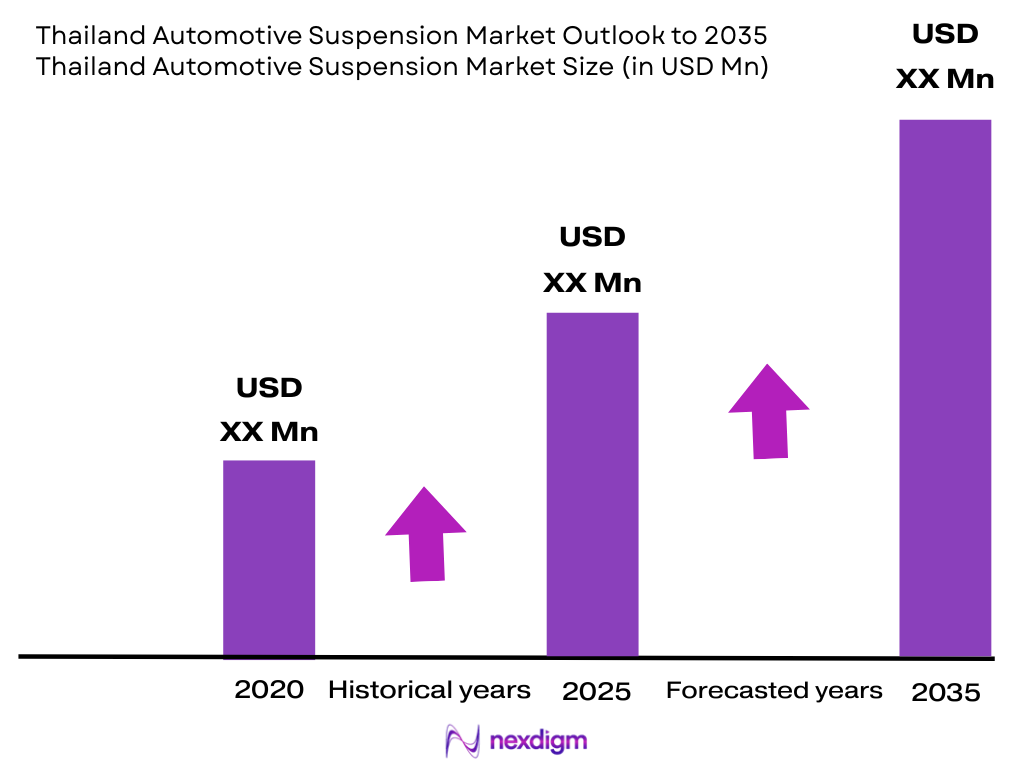
The Thailand Automotive Suspension Market is valued at approximately USD ~ million, supported by the country’s large automotive manufacturing base, replacement demand and export-oriented vehicle production. Thailand produced 1,468,997 motor vehicles in the latest annual benchmark, compared with a materially higher production base in the preceding period, while domestic vehicle sales reached 572,675 units and exports reached 1,019,213 units. Suspension demand is consequently supported by OEM production, replacement cycles and export vehicle fitment. Rayong, Chonburi, Chachoengsao, Samut Prakan and Bangkok dominate the Thailand Automotive Suspension Market because these locations concentrate vehicle assemblers, Tier-1 suppliers, suspension manufacturers, industrial estates and aftermarket distribution. Rayong hosts ZF Chassis System operations and BYD’s new manufacturing facility, while Chonburi hosts Öhlins Asia. Thailand’s population reached approximately 71.62 million people, while the country produced 1,468,997 vehicles and exported more than 1.01 million vehicles, strengthening these industrial corridors as suspension production and distribution centres.
Thailand is one of Southeast Asia’s most developed automotive manufacturing ecosystems, with substantial capability in vehicle assembly, components, chassis systems, metal forming, rubber products and export logistics. The automotive and auto-parts industry accounted for 8.2 units out of every 100 units of industrial-sector GDP, 2.0 units out of every 100 units of total GDP and 15.6 units out of every 100 units of total export value in the Bank of Thailand’s industry assessment, while direct automotive employment was estimated at roughly 500,000–600,000 workers. This industrial depth gives the suspension market an unusually strong OEM and export component compared with many neighbouring markets.
Market Segmentation
By Vehicle Type
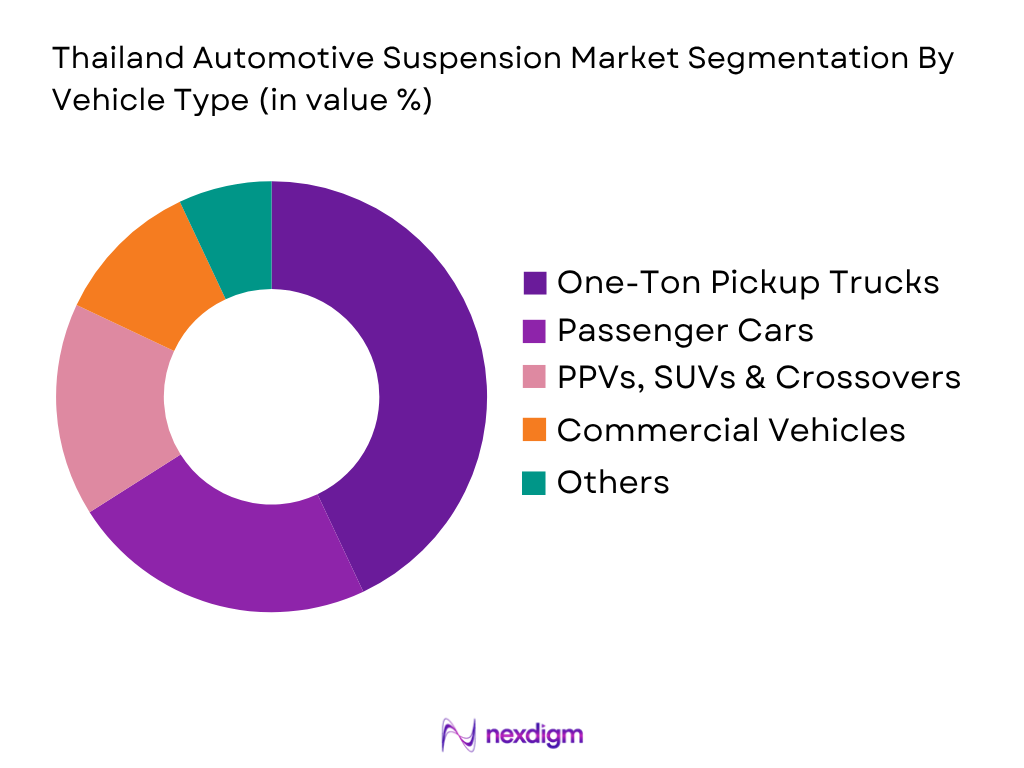
The Thailand Automotive Suspension Market is segmented into one-ton pickup trucks, passenger cars and eco-cars, pickup passenger vehicles and SUVs, commercial vehicles, and battery/hybrid electric vehicles. One-ton pickups hold the dominant analytical share because Thailand remains a major manufacturing and export hub for pickup platforms. Pickup suspension typically carries greater component content than compact passenger vehicles because load-bearing applications require robust front control arms, heavy-duty dampers and rear leaf-spring systems. Pickups are also widely used commercially and recreationally, creating substantial aftermarket demand for replacement shocks, reinforced leaf springs, stabiliser components and off-road upgrades. Thailand’s export orientation strengthens this segment further because locally produced pickups are shipped to markets in Oceania, the Middle East and other ASEAN countries. Passenger cars remain important through conventional, hybrid and EV production, while PPVs and SUVs create higher-value ride-control opportunities involving coil springs, multi-link suspension and premium dampers.
By Suspension Technology
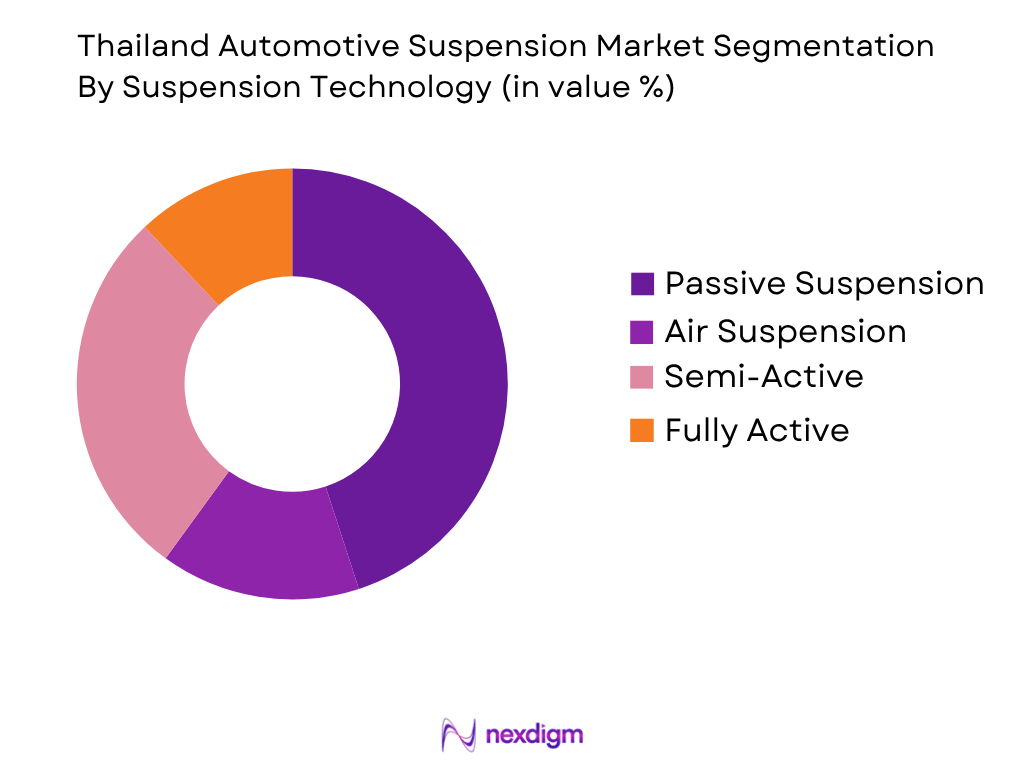
The Thailand Automotive Suspension Market is segmented into passive suspension, semi-active/electronic suspension, air suspension and fully active suspension. Passive suspension remains dominant because most locally manufactured pickups, passenger cars, commercial vehicles and mainstream SUVs use hydraulic or gas-charged dampers combined with conventional coil or leaf springs. Thailand’s manufacturing ecosystem is particularly strong in mechanically engineered suspension products that can be produced at high volumes for domestic and export platforms. However, electronic suspension is becoming more strategically significant as premium vehicles, hybrids and EVs increase in local production. ZF’s current chassis portfolio includes conventional dampers, semi-active dampers and active suspension technologies, while Thailand’s accelerating EV-manufacturing transition creates a pathway for higher-value electronically integrated chassis systems. The movement toward heavier battery-electric platforms should increase demand for precise damping control, lightweight suspension components and vehicle-motion-control technologies.
Competitive Landscape
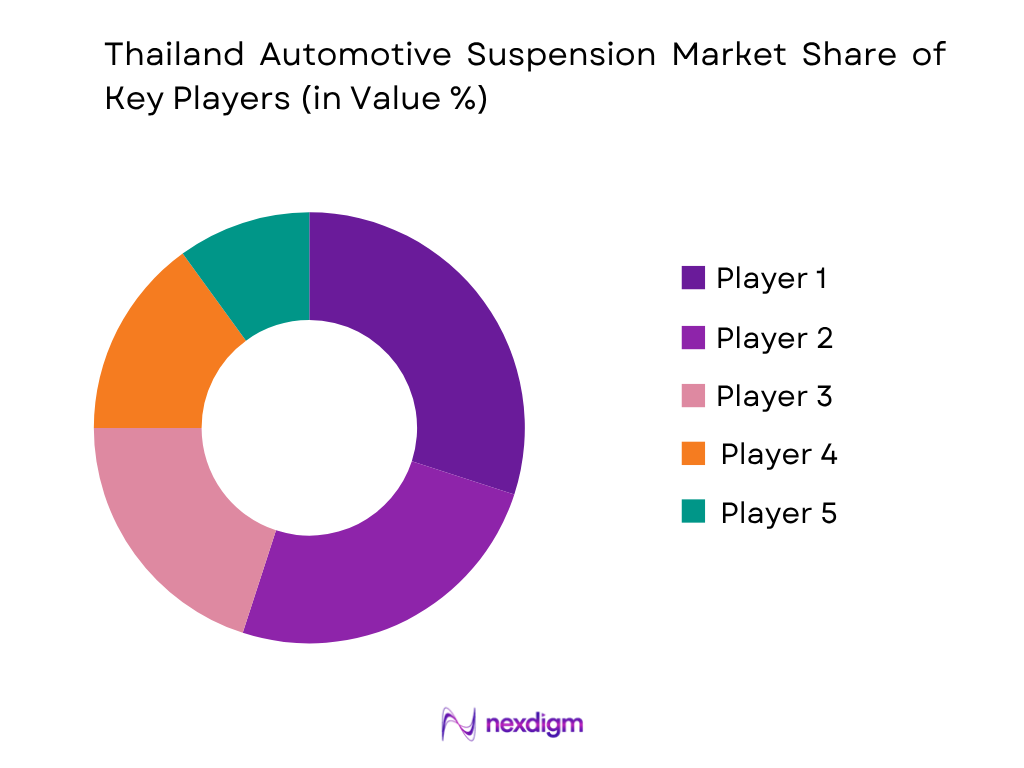
The Thailand Automotive Suspension Market features a combination of global Tier-1 suspension suppliers, Japanese damper manufacturers, Thai automotive component companies and premium performance brands. KYB benefits from Thailand’s strong Japanese OEM base and broad shock-absorber relevance. ZF operates dedicated chassis facilities in Rayong and offers conventional, semi-active and active vehicle-motion technologies. Somboon Advance Technology represents the local component-manufacturing ecosystem, while Öhlins maintains an Asia operation in Chonburi focused on advanced suspension. Astemo combines Showa heritage with suspension and broader chassis-system capability.
| Major Player | Establishment Year | Headquarters | Core Suspension Portfolio | Thailand Manufacturing / Operational Footprint | Pickup & Commercial Vehicle Capability | Electronic / EV Suspension Capability | OEM / Export Relevance | Aftermarket Position |
| KYB Corporation | 1919 | Tokyo, Japan | ~ | ~ | ~ | ~ | ~ | ~ |
| ZF Friedrichshafen AG | 1915 | Friedrichshafen, Germany | ~ | ~ | ~ | ~ | ~ | ~ |
| Somboon Advance Technology | 1962 heritage | Samut Prakan, Thailand | ~ | ~ | ~ | ~ | ~ | ~ |
| Öhlins Racing | 1976 | Upplands Väsby, Sweden | ~ | ~ | ~ | ~ | ~ | ~ |
| Astemo Ltd. / SHOWA-TOKICO | 2021 current structure | Tokyo, Japan | ~ | ~ | ~ | ~ | ~ | ~ |
Thailand Automotive Suspension Market Analysis
Growth Drivers
Deep Automotive Manufacturing Base and One-Ton Pickup Suspension Demand
Thailand’s automotive suspension industry benefits from one of ASEAN’s deepest vehicle-manufacturing and component-supply ecosystems, creating simultaneous demand for original-equipment shocks, struts, coil springs, leaf springs, stabilizer systems, control arms, bushings and aftermarket replacements. Thailand manufactured approximately 1.47 million motor vehicles in 2024, while more than 1.01 million vehicles were exported, demonstrating that suspension demand is connected not only to domestic vehicle consumption but also to vehicles assembled locally for international markets. One-ton pickups are especially important because Thailand is a major production base for pickup platforms supplied to ASEAN, Australia, the Middle East and other destinations. Pickup architecture creates substantially different suspension requirements from compact passenger vehicles: high payload capacity requires reinforced rear leaf springs, durable dampers, strong bushings and robust front independent suspension components, while pickup passenger vehicles require improved ride tuning without sacrificing chassis durability. The Federation of Thai Industries reported 426,719 passenger cars produced during January–September 2024 alone, demonstrating that suspension demand is diversified beyond pickups into sedans, hybrids and emerging battery-electric passenger cars. Thailand’s macroeconomic scale supports the industrial ecosystem. World Bank data show the Thai economy generated approximately USD 526.4 billion of GDP in 2024, while the population reached 71,619,863 people, providing a substantial domestic mobility and labour base. The World Bank subsequently recorded GDP of USD 577.01 billion in 2025 and GDP per capita of approximately USD 8,056.6, strengthening the economic environment supporting vehicle ownership, maintenance, freight movement and component manufacturing. Thailand’s automotive supply chain is unusually relevant to suspension because the Bank of Thailand identifies automobiles and automotive parts as a major industrial activity employing roughly 500,000–600,000 workers directly, with a wider employment footprint potentially considerably larger when supporting industries are included. Suspension manufacturers benefit from proximity to stamping, forging, casting, machining, rubber-compounding and spring-steel suppliers, allowing components to be sourced and assembled within established automotive clusters in Rayong, Chonburi, Chachoengsao, Samut Prakan and Ayutthaya. Local production also creates economies of scale for shock absorbers and springs that can serve both OEM programmes and independent replacement channels. Even where domestic vehicle sales weaken temporarily, locally produced suspension components remain linked to export manufacturing. The Bank of Thailand noted that automotive exports experienced weakness during parts of 2024, particularly passenger cars and pickups, yet pickup exports subsequently improved toward ASEAN markets. This production-export linkage means suspension demand is more diversified than a purely domestic aftermarket. For suppliers, the strongest opportunities remain platform-specific dampers, pickup leaf springs, complete strut assemblies, control arms and increasingly modular chassis systems that can be supplied directly to vehicle assemblers while also generating replacement demand as the installed fleet ages.
Electrification, Hybridisation and Expansion of Advanced Chassis Content
The transition toward battery-electric and hybrid vehicle production is creating a second structural growth driver for the Thailand Automotive Suspension Market because electrified vehicles require different spring rates, damper characteristics, axle-load management and chassis-control strategies from conventional internal-combustion vehicles. Thailand introduced the EV 3.5 programme in 2024, covering the 2024–2027 period and linking incentives for imported electric vehicles with local-production requirements. The programme requires manufacturers participating through imported vehicles to progressively manufacture vehicles in Thailand, with the local-production obligation becoming more demanding in 2026, directly encouraging automotive suppliers to establish local capabilities rather than depend indefinitely on imported finished vehicles. Thailand already possessed a substantial EV customer base entering this transition: 76,000 battery-electric vehicles were sold in 2023, and momentum continued into 2024 as multiple global and Chinese OEMs expanded manufacturing investments. By September 2025, more than 238,000 EVs had been registered under the EV 3 and EV 3.5 schemes, while approved investments across Thailand’s EV supply chain had reached approximately THB 140 billion by October 2025. The country also had 7,096 DC fast chargers operating by September 2025, providing infrastructure supporting greater EV utilisation. This shift matters directly for suspension manufacturers because battery packs add significant mass below the passenger compartment, altering sprung mass, axle loads and vertical body dynamics. Conventional suspension components can therefore require modified coil-spring rates, stronger bushings, more precise damper calibration and lighter control arms to offset battery-related mass. Electric SUVs and larger EVs strengthen this requirement further because high curb weight is combined with larger wheels and higher performance capability. Battery-electric drivetrains also reduce engine and exhaust noise, making road impact, bushing vibration and damper friction more noticeable inside the cabin; this increases the value of NVH-optimised bushings, top mounts and electronically controlled damping. Thailand’s manufacturing ecosystem is capable of supporting this shift because existing chassis suppliers can move from conventional hydraulic dampers toward semi-active systems, electronic valves, ride-height sensors and vehicle-motion-control software. Macroeconomic indicators also support the investment cycle. World Bank data show Thailand’s economy expanded by 2.5 units for every 100 units of output in 2024, and current-dollar GDP increased further into 2025, reaching USD 577.01 billion. Foreign direct investment remained an important economic component, with World Bank data showing net FDI inflows equivalent to approximately 3.3 units per 100 units of GDP in 2024, providing a supportive environment for multinational EV and component investment. The shift also creates opportunity for established Thai metalworking and rubber-component suppliers. Lightweight aluminium knuckles, forged control arms, EV-calibrated coil springs, precision bushings and integrated suspension modules offer a path for existing Tier-2 companies to move into higher-value EV platforms. Consequently, electrification is expanding Thailand’s suspension opportunity not merely through additional vehicles but through higher engineering content per vehicle and greater localisation requirements.
Market Challenges
Domestic Automotive Weakness and Exposure to Vehicle-Production Cycles
A major challenge for Thailand’s automotive suspension suppliers is the sensitivity of demand to vehicle-production cycles, domestic purchasing power and export-market conditions. Thailand remains a major automotive manufacturing location, but the Bank of Thailand reported that domestic automobile sales had been weakening since the end of 2023 because of slower income recovery among financially vulnerable households, tighter financing conditions and industry-specific pressures. This matters directly to suspension suppliers because lower domestic vehicle sales reduce immediate OEM demand for locally fitted shocks, struts, springs and chassis components, while also slowing the rate at which new vehicle cohorts enter the future replacement market. The Federation of Thai Industries reported passenger-car production of 426,719 units during January–September 2024, while total motor-vehicle production ultimately reached roughly 1.47 million units for 2024, demonstrating considerable scale but also substantial utilisation risk for plants designed around much larger historical production volumes. Monthly production fell to 104,878 vehicles in December 2024, illustrating how significantly production schedules can adjust when OEM demand and export orders soften. The Bank of Thailand also reported weaker automotive exports during parts of 2024, including reduced passenger-car and pickup shipments to ASEAN and Australia. Because many suspension suppliers operate as nominated Tier-1 or Tier-2 manufacturers linked to individual platforms, falling production of a specific pickup, sedan or SUV can reduce plant utilisation quickly. The challenge is particularly acute for component companies that have invested in model-specific stamping dies, forging tools, spring forming lines, damper assembly systems or dedicated quality-control equipment. Unlike independent aftermarket suppliers that can serve a diversified vehicle parc, an OEM supplier may rely heavily on several vehicle programmes and production schedules determined by automakers. Thailand’s macroeconomic environment explains part of the domestic demand pressure. Although the World Bank reported GDP growth of 2.5 units per 100 units of output in 2024, growth remained moderate relative to faster-expanding ASEAN economies. The population was approximately 71.62 million, but Thailand also faces demographic ageing and high household leverage, which can affect purchases of durable goods such as automobiles. The World Bank’s latest data place GDP at USD 577.01 billion in 2025, while GDP growth was approximately 2.4 units per 100 units, indicating continued economic expansion but not a broad-based automotive boom. Suspension manufacturers therefore face a difficult capacity-management requirement: they must maintain enough scale to supply export-oriented OEMs while avoiding excessive dependence on any single domestic model or powertrain architecture. Diversification across pickup trucks, passenger vehicles, hybrids, EVs, commercial vehicles and aftermarket replacement parts becomes increasingly important. Companies with both OEM and aftermarket exposure can use replacement shocks, bushings and springs to offset fluctuations in new-vehicle production. Suppliers concentrated solely on legacy internal-combustion platforms face substantially higher cyclicality because a production downturn can coincide with automakers redirecting future investment toward electrified vehicles. The structural challenge is therefore not merely temporary weakness in automotive sales; it is the need to manage production volatility while simultaneously funding the technological transition required for the next generation of suspension systems.
Supplier Transition from Mechanical Components to EV and Software-Integrated Chassis Systems
Thailand’s second major challenge is technological rather than purely cyclical. The country has a highly developed supplier ecosystem built around internal-combustion passenger vehicles and one-ton pickups, but future suspension systems increasingly combine mechanical components with electronics, sensors, control software and EV-specific engineering. The Bank of Thailand has explicitly identified the automotive industry’s transition toward EV production as a structural adjustment requiring changes in business models and manufacturing processes. This transition affects suspension companies because passive hydraulic shocks, steel control arms and conventional springs can be manufactured using mature industrial processes, whereas semi-active dampers and vehicle-motion-control systems require precision electronic valves, sensors, embedded control logic, high-speed communication with vehicle controllers and sophisticated validation equipment. In addition, EV chassis components must manage greater vehicle mass while automakers simultaneously seek to reduce overall weight. This requires advanced high-strength steel, aluminium castings and forgings, improved elastomer compounds and increasingly optimised component geometry. EV 3.5 intensified the timeline for this transition when it took effect in 2024, and local-production obligations become more demanding in 2026, creating pressure on suppliers to qualify for new platforms quickly. By September 2025, more than 238,000 EVs had been registered under the EV incentive programmes, while cumulative approved EV supply-chain investment reached approximately THB 140 billion by the end of October. This means the transition is no longer hypothetical: conventional suppliers increasingly compete for capital, engineers and OEM nominations against companies entering Thailand specifically for electrified platforms. Legacy suppliers must therefore make decisions about which capabilities to retain and which to upgrade. Leaf springs and conventional pickup dampers will continue to have substantial demand because Thailand’s existing fleet and export programmes remain large, yet capital must simultaneously be allocated to EV-compatible spring calibration, aluminium suspension arms, electronic damping and software diagnostics. The challenge extends to the workforce. Thailand’s automotive sector directly employs roughly 500,000–600,000 workers, according to the Bank of Thailand’s industry assessment, meaning technological upgrading affects a large industrial labour pool. Mechanical technicians and production engineers require additional competency in mechatronics, electronic validation, data analysis and software-linked chassis functions. Macroeconomic conditions make this investment discipline important. World Bank data indicate current GDP of approximately USD 577.01 billion in 2025, while GDP per capita was around USD 8,056.6. Thailand therefore has significant industrial capacity, but individual domestic suppliers may still have more limited access to capital and engineering resources than multinational Tier-1 competitors. Foreign investment helps close this technology gap, with World Bank data showing FDI net inflows equivalent to approximately 3.3 units per 100 units of GDP in 2024, yet foreign OEM expansion can also increase competitive pressure on traditional suppliers if new entrants bring their established supplier networks with them. Thai suspension manufacturers consequently need OEM certification, automated production, advanced test systems and foreign technical partnerships to remain relevant. The market challenge is ultimately a race between platform transition and supplier upgrading: companies that adapt quickly can participate in EV and hybrid suspension localisation, while those remaining concentrated on low-value mechanical components face potential erosion of future OEM content.
Market Opportunities
Localisation of EV Suspension, Lightweight Chassis Components and Electronic Damping
Thailand’s rapid localisation of battery-electric vehicle production creates a substantial forward-looking opportunity for suspension suppliers because current EV investment is creating a new generation of locally assembled vehicles requiring chassis components designed around battery weight, different axle loads and digitally controlled vehicle dynamics. The opportunity is supported by current rather than speculative demand indicators. Thailand’s EV 3.5 package began in 2024, linking incentives to local production, while the government’s rules require participating manufacturers to substantially increase local vehicle output from 2026 onward. By September 2025, more than 238,000 electric vehicles had been registered under the EV 3 and EV 3.5 programmes, and approved investment across the EV supply chain had reached approximately THB 140 billion by October 2025. Thailand also had 7,096 DC fast chargers in operation by September 2025, demonstrating that EV usage and supporting infrastructure have already reached meaningful scale. For suspension suppliers, local vehicle production creates several distinct opportunities. Battery-electric cars and SUVs require higher-capacity springs because the traction battery adds considerable mass, but simply increasing spring stiffness can reduce ride quality; precise coordination between spring rate, damper force and bushing compliance is therefore required. Semi-active dampers can address this compromise by varying damping force according to vehicle speed, road input and driver mode. Electronic ride-control systems can additionally coordinate vertical body movement with braking, steering and powertrain torque, increasing the value of each suspension module. Lightweighting creates another opportunity. Aluminium control arms, forged links, hollow stabiliser bars and lightweight knuckles can reduce unsprung mass and partly offset battery weight, improving both ride quality and energy efficiency. Thailand’s existing metal-forming, machining and casting supplier base gives the country a practical foundation for localising these components rather than importing complete suspension systems. Current macroeconomic conditions support continued industrial investment. World Bank data show Thailand generated roughly USD 526.4 billion of GDP in 2024, and the economy grew to USD 577.01 billion in 2025. Foreign direct investment net inflows were equivalent to approximately 3.3 units per 100 units of GDP in 2024, reflecting continued international commitment to Thai manufacturing. The opportunity also extends beyond mass-market passenger EVs. Thailand’s historical dominance in pickup manufacturing means the country has an engineering base capable of developing electric pickup suspension. An electrified one-ton pickup requires unusually demanding chassis optimisation because payload capacity, off-road durability and battery mass must coexist. Suppliers that master reinforced springs, lightweight control arms, electronically controlled dampers and battery-compatible chassis packaging could therefore develop components suitable not only for domestic programmes but also for export vehicles manufactured in Thailand. The strongest strategic position is likely to belong to companies that integrate mechanical manufacturing with mechatronic capability, producing not only shocks and springs but complete corner modules, electronic dampers and validated chassis assemblies.
Export-Oriented Pickup Suspension, Aftermarket Upgrades and Supplier Joint Ventures
Thailand’s large pickup and automotive-export ecosystem creates another major opportunity because suspension companies can serve three overlapping demand channels: original equipment for vehicles assembled domestically, replacement parts for Thailand’s installed fleet and specialist suspension exported with or independently of locally manufactured pickups and PPVs. Thailand exported more than 1.01 million vehicles in 2024, while total production reached around 1.47 million vehicles, meaning most suspension production incorporated into Thai-built vehicles ultimately serves international markets as well as domestic users. Pickup exports are particularly important because one-ton trucks produced in Thailand operate in demanding environments including Australian highways and off-road conditions, Middle Eastern heat and load cycles, and commercial applications across ASEAN. These operating environments support differentiated products such as high-capacity monotube dampers, remote-reservoir shock absorbers, progressive or reinforced leaf springs, uprated bushings and stabiliser systems. Thailand already has a specialist performance-suspension ecosystem, meaning suppliers can pursue higher engineering content rather than competing only in economy replacement products. The opportunity is reinforced by the country’s broad manufacturing workforce and supplier network. The Bank of Thailand estimates that the automotive industry directly employs around 500,000–600,000 people, while established clusters in Rayong, Chonburi, Chachoengsao and Samut Prakan provide access to machining, forging, casting, rubber compounding and export logistics. Laem Chabang and Eastern Economic Corridor infrastructure further enable rapid export of finished vehicles and components. Export-market weakness during portions of 2024 demonstrates the need for diversification, but it also strengthens the case for developing suspension products that can be sold independently of OEM production schedules through global aftermarket channels. Thailand’s macroeconomic base provides scale for this transition: World Bank data record a population of 71,619,863 people in 2024, GDP of approximately USD 526.4 billion, and further GDP expansion to USD 577.01 billion in 2025. The economy’s large manufacturing footprint provides domestic demand for commercial transport as well as the industrial capacity required for export. Joint ventures represent an additional opportunity because Thai component companies possess strong manufacturing knowledge while global suspension suppliers bring electronic damping, premium ride-control technology and international OEM access. BOI policy during 2024–2026 has emphasised automotive supplier upgrading, EV manufacturing and local production, creating a supportive framework for technology partnerships. Thai companies can therefore move from contract manufacture of metal suspension parts into co-developed chassis systems. Priority areas include electronically adjustable pickup dampers, lightweight forged control arms, advanced bushings, integrated front corner modules and commercial-vehicle air suspension. Independent aftermarket distribution provides another route because Thailand has a substantial domestic culture of pickup modification, off-road preparation and performance tuning. Heavy-duty suspension packages can address commercial users carrying payloads, while premium dampers and adjustable systems can serve lifestyle pickups and PPVs. As the fleet transitions toward hybrid and electric drivetrains, aftermarket suppliers can extend these offerings to heavier electrified platforms rather than abandon their established pickup expertise. The combination of local manufacturing, export logistics, specialist aftermarket demand and technology partnerships gives Thailand an opportunity to evolve from a high-volume suspension production location into a regional centre for engineered ride-control products.
Future Outlook
The Thailand Automotive Suspension Market is expected to expand at approximately ~ CAGR during 2026–2035. Growth should increasingly shift from conventional volume-led suspension toward higher-content systems associated with hybrid vehicles, EVs, advanced chassis control and locally produced next-generation vehicles. Thailand’s extensive existing supply chain should allow suspension companies to serve both domestic OEMs and export platforms. Electric vehicle manufacturing is one of the clearest structural changes. BYD opened its Rayong facility in July 2024, creating an eventual annual production capability of 150,000 vehicles. Thailand’s EV 3.5 framework also links imported EV incentives with local-production commitments, which should progressively increase demand for locally sourced chassis and suspension components. The transition is broader than Chinese EV manufacturers. Mercedes-Benz has assembled electric vehicles and batteries in Thailand since before the current investment cycle, while BMW began construction of a EUR 42 million next-generation battery plant in Rayong and planned locally made EV production. This means Thailand’s suspension market will increasingly need to support premium EVs as well as mass-market battery-electric platforms. The Board of Investment is simultaneously promoting automation and robotics for both conventional and electric automotive manufacturing. This is important for suspension suppliers because electronically controlled dampers, precision-machined control arms and lightweight chassis structures require tighter dimensional control, automated testing and more advanced assembly than conventional low-complexity parts.
Major Players
- KYB Asian Pacific Corporation Limited
- ZF Group / ZF Chassis System Thailand
- Somboon Advance Technology Public Company Limited
- Astemo Ltd. / SHOWA–TOKICO
- Öhlins Racing / Öhlins Asia
- Tenneco / Monroe Ride Solutions
- HL Mando Corporation
- BWI Group
- thyssenkrupp BILSTEIN
- YSS Thailand
- Sogefi Group
- BENTELER International
- Magna International
- TEIN Inc.
- Eibach
Key Target Audience
- Automotive Suspension and Chassis Component Manufacturers
- Vehicle OEMs and Automotive Assemblers
- Tier-1 and Tier-2 Automotive Component Suppliers
- Automotive Parts Importers, Exporters and Distributors
- Pickup, Commercial Vehicle and Fleet Operators
- Automotive Dealer, Workshop and Performance Suspension Networks
- Investments and Venture Capitalist Firms
- Government and Regulatory Bodies (Thailand Board of Investment, Ministry of Industry, Department of Land Transport, Thai Industrial Standards Institute, Eastern Economic Corridor Office and Ministry of Commerce)
Research Methodology
Step 1: Identification of Key Variables
The initial phase involves constructing an ecosystem map covering Thailand’s vehicle OEMs, Tier-1 suspension suppliers, local component manufacturers, export-oriented assemblers, distributors, workshops and fleet operators. Core variables include vehicle production, domestic sales, exports, pickup share, suspension architecture, component content per vehicle, replacement frequency and EV penetration.
Official data from the Federation of Thai Industries, Bank of Thailand, Thailand Board of Investment and international macroeconomic databases are used to establish the manufacturing and vehicle-demand baseline. Particular attention is given to one-ton pickups, PPVs, passenger cars, hybrids and EVs because their suspension requirements vary materially.
Step 2: Market Analysis and Construction
The top-down model begins with Thailand’s automotive manufacturing, domestic sales and vehicle-export activity before isolating the share attributable to suspension and chassis components. The bottom-up model calculates shock absorbers, struts, springs, control arms, bushings and electronic components by vehicle type and production channel.
Thailand’s 1,468,997 locally produced vehicles, 572,675 domestic vehicle sales and 1,019,213 exported vehicles provide the principal production-side framework. Aftermarket requirements are separately modelled using the installed vehicle parc, vehicle age and replacement cycles.
Step 3: Hypothesis Validation and Expert Consultation
Market hypotheses are validated through computer-assisted telephone interviews with vehicle assemblers, suspension manufacturers, Tier-1 suppliers, distributors, independent workshops, pickup-performance specialists and commercial fleet operators.
These interviews validate OEM sourcing structures, pickup suspension content, damper replacement frequency, local-content levels, spring and control-arm sourcing, export requirements, EV suspension specifications and price-tier preferences. Primary findings are used to refine both the OE and replacement-market calculations.
Step 4: Research Synthesis and Final Output
The final stage triangulates primary interviews with FTI production data, BOI industrial-policy information, Bank of Thailand automotive assessments, OEM announcements and suspension supplier disclosures. Market estimates are developed independently by vehicle type, component, technology and demand channel.
The forecast framework incorporates domestic vehicle production, exports, EV localisation, hybrid production, electronic suspension adoption, pickup demand and aftermarket replacement. Separate scenarios are created for passive components and higher-value electronically controlled suspension systems to capture Thailand’s ongoing technology transition.

- Executive Summary
- Research Methodology (Market Definitions and Assumptions, Abbreviations, Automotive Suspension Market Boundary, Top-Down Market Sizing, Bottom-Up Vehicle Production and Parc Modelling, Suspension Content per Vehicle, Domestic Vehicle Sales Assessment, Vehicle Production Assessment, Export Vehicle Assessment, OEM Fitment Analysis, Aftermarket Replacement-Cycle Assessment, Pickup and PPV Assessment, Passenger Car Assessment, EV Suspension Assessment, Commercial Vehicle Assessment, Suspension Component Production Assessment, Supplier Interviews, Distributor and Workshop Interviews, Demand-Side Assessment, Supply-Side Assessment, Data Triangulation, Forecasting Framework, Scenario Analysis, Limitations and Future Conclusions)

- Definition and Scope
- Market Evolution and Industry Genesis
- Evolution of Automotive Suspension Technology
- Thailand Automotive Manufacturing Ecosystem
- Thailand Automotive Parts and Component Ecosystem

- Growth Drivers (Automotive Production Base, One-Ton Pickup Manufacturing, Vehicle Exports, Local Parts Ecosystem, EV Investment, Hybrid Production, Replacement Demand, Commercial Vehicle Usage)
- Market Challenges (Vehicle Production Cyclicality, EV Transition, Supplier Investment Requirements, Price Competition, Chinese OEM Entry, Electronic Complexity, Skill Requirements, Export Dependence)
- Market Opportunities (EV Suspension, Hybrid Suspension, Pickup Electrification, Localisation, Electronic Damping, Performance Suspension, Export Manufacturing, Joint Ventures)
- Market Trends (Electrification, Hybridisation, Electronic Damping, Lightweighting, Smart Manufacturing, Pickup Customisation, Vehicle Motion Control, Supplier Consolidation)
- SWOT Analysis
- Porter’s Five Forces Analysis
- PESTLE Analysis

- By Market Value (2020-2025)
- By Suspension Component Units (2020-2025)
- By Shock Absorber and Strut Units (2020-2025)

- By Suspension Technology (In Value %)
Passive Suspension Systems
Semi-Active Suspension Systems
Fully Active Suspension Systems
Air Suspension Systems
Adaptive Air Suspension - By Component Type (In Value %)
Shock Absorbers
Struts
Complete Strut Assemblies
Coil Springs
Leaf Springs - By Vehicle Type (In Value %)
Compact Passenger Cars
Mid-Size Passenger Cars
Eco-Cars
SUVs and Crossovers
Pickup Passenger Vehicles
One-Ton Pickup Trucks - By Demand Type (In Value %)
Original Equipment Fitment
Original Equipment Service Replacement
Independent Aftermarket Replacement
Fleet Preventive Maintenance
Wear-and-Tear Replacement - By Region (In Value %)
Bangkok Metropolitan Region
Chonburi
Rayong
Samut Prakan
Ayutthaya

- Market Share of Major Players by Market Value
- Cross Comparison Parameters (Thailand OEM–Pickup–PPV–Passenger Vehicle Platform Coverage, Shock–Strut–Spring–Chassis Component Portfolio Breadth, Local Manufacturing–Plant–R&D Footprint in Thailand, One-Ton Pickup and Heavy-Duty Suspension Capability, EV–Hybrid–Electronic Damper Technology Readiness, Thai OEM–Tier-1–Aftermarket Distribution Reach, Domestic Content–Export Capability–ASEAN Supply Integration, Engineering–Testing–Vehicle Motion Control Capability)
- SWOT Analysis of Major Players
- Detailed Profiles of Major Companies
KYB Asian Pacific Corporation Limited
ZF Group / ZF Chassis System Thailand
Somboon Advance Technology Public Company Limited
Astemo / SHOWA–TOKICO
Öhlins Racing / Öhlins Asia
Tenneco / Monroe Ride Solutions
HL Mando Corporation
BWI Group
thyssenkrupp BILSTEIN
YSS Thailand
Sogefi Group
BENTELER International
Magna International
TEIN Inc.
Eibach

- Ride Comfort Requirements
- Pickup Load-Carrying Requirements
- PPV Ride and Handling Requirements
- Passenger Vehicle Comfort Expectations
- SUV Ground-Clearance Requirements

- By Market Value (2026-2035)
- By Suspension Component Units (2026-2035)
- By Shock Absorber and Strut Units (2026-2035)


 Request a Sample
 Ask for Customization
 Get a Quote
 Enquire Now