

 Download PDF
Market Overview
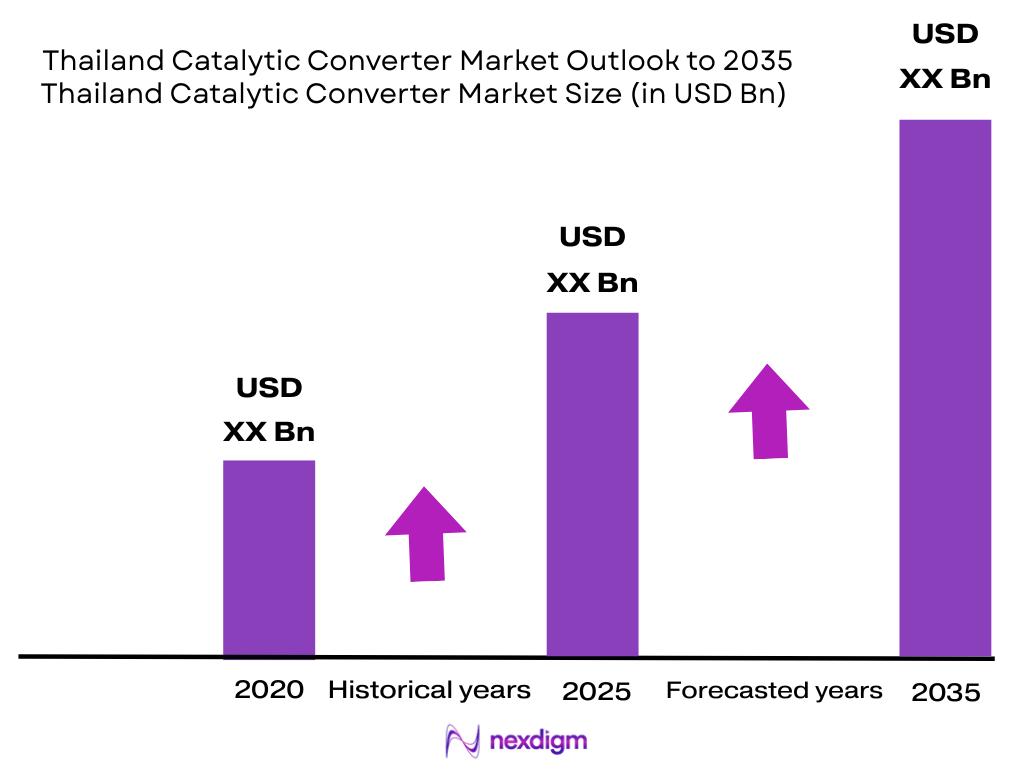
The Thailand Catalytic Converter Market is valued at USD ~ billion, supported by one of Southeast Asia’s largest automotive manufacturing bases. Vehicle production moved from 1,841,663 units to 1,468,997 units across the latest two completed annual observations, while domestic vehicle sales moved from 775,780 units to 572,675 units. Despite lower production, Thailand’s pickup, passenger-car, motorcycle and export-manufacturing ecosystems sustain substantial OEM and aftermarket catalyst demand. Rayong, Chonburi, Chachoengsao, Bangkok, Prachinburi and Ayutthaya dominate Thailand’s Catalytic Converter Market because they combine automotive assembly, Tier-1 suppliers, component manufacturing, workshops and export logistics. The underlying automotive ecosystem produced 1,841,663 vehicles before output shifted to 1,468,997, while sales moved from 775,780 to 572,675 units. Rayong is particularly important because both BASF’s emissions-catalyst operation and Cataler Thailand’s automotive and motorcycle catalyst plant are located there.
Market Segmentation
By Vehicle Type
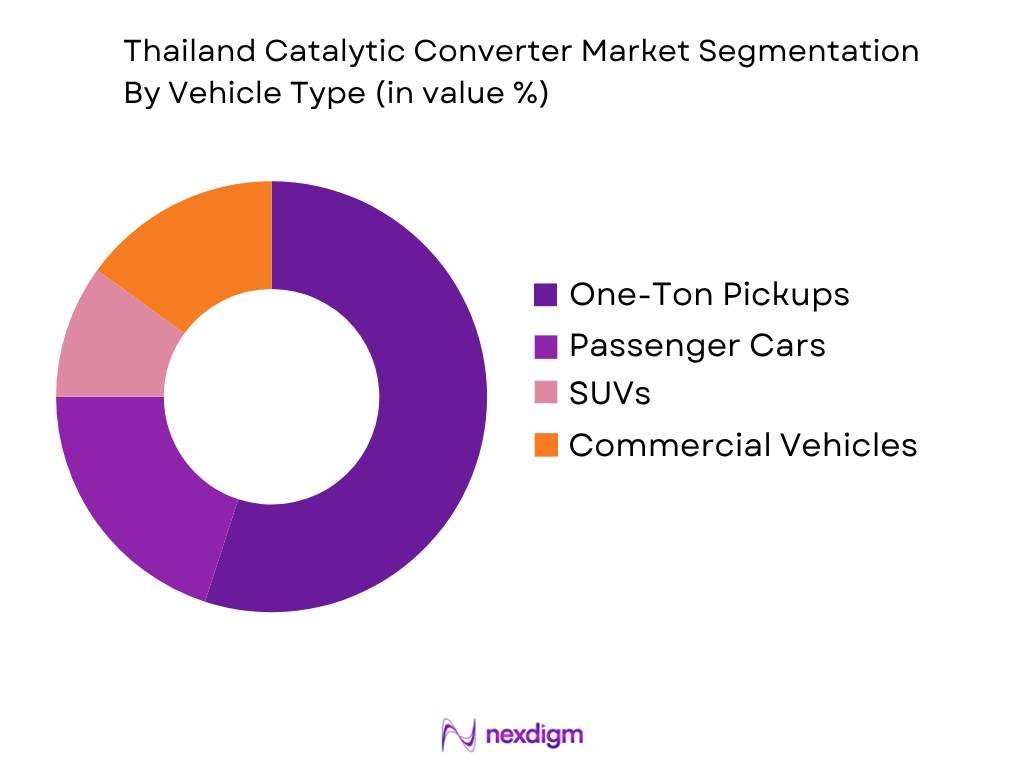
The Thailand Catalytic Converter Market is segmented into one-ton pickup trucks, passenger cars, SUVs and pickup passenger vehicles, motorcycles and scooters, light commercial vehicles, and medium/heavy commercial vehicles. Pickup trucks dominate market value because Thailand has developed a globally significant pickup manufacturing and export ecosystem. Diesel pickups require oxidation catalysts and, on newer platforms, can employ more complex DOC-DPF-SCR aftertreatment architectures, increasing emissions-control content per vehicle. Thailand’s production structure historically emphasizes pickups alongside passenger cars, while export specifications require increasingly stringent emissions control. High-mileage domestic pickups also create aftermarket replacement demand through thermal ageing, substrate contamination, exhaust damage and sensor-related catalyst-efficiency faults. Although motorcycles can exceed pickups in catalyst-unit volume, their individual substrates and precious-metal content are smaller. Passenger vehicles remain important through conventional petrol and increasingly hybrid configurations, but pickups combine high domestic penetration, export production and comparatively high-value diesel aftertreatment.
By Powertrain Type
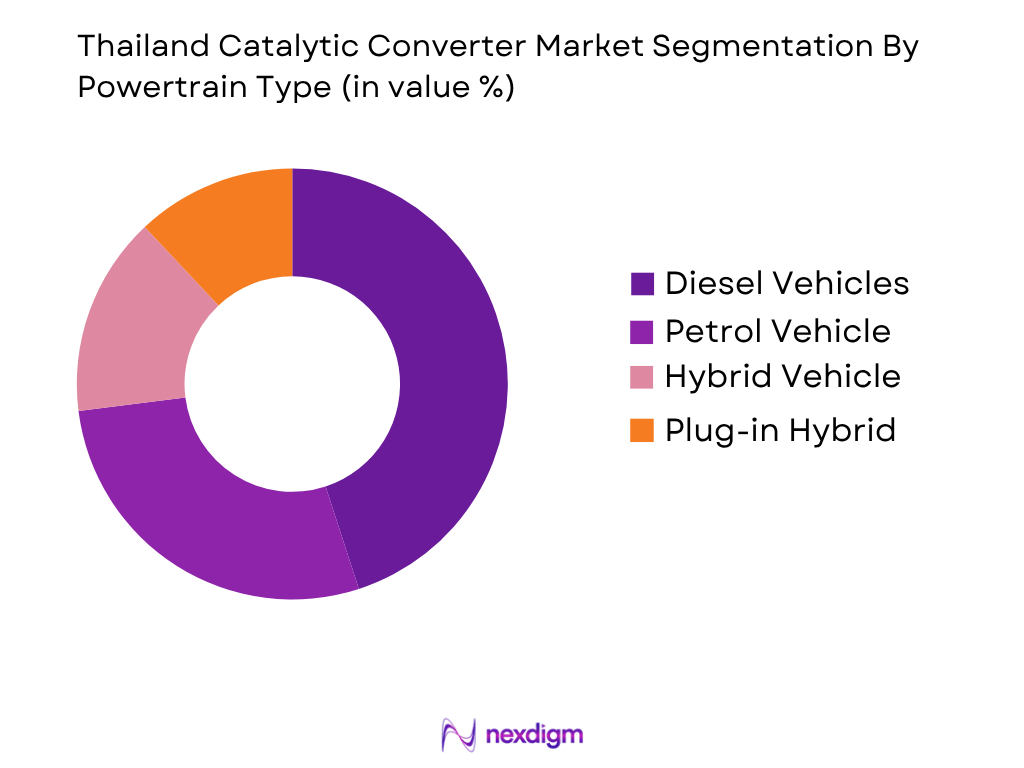
The Thailand Catalytic Converter Market is segmented into conventional diesel, conventional petrol, full-hybrid electric, plug-in hybrid, mild-hybrid and other combustion-based powertrains. Conventional diesel vehicles dominate market value, principally because one-ton pickups form an important part of Thailand’s domestic and export automotive industry. Diesel aftertreatment can incorporate platinum-containing oxidation catalysts and integrated particulate/NOx-control systems, giving these applications higher emissions-control content than basic gasoline systems. Petrol vehicles remain significant through passenger cars and motorcycles, while hybrids are becoming strategically more important as Thai policy supports localized electrified-vehicle production. Hybrid vehicles preserve catalytic-converter demand because they retain combustion engines, although repeated engine stop-start cycles create greater requirements for rapid catalyst light-off, thermal retention and oxygen-storage performance. Fully battery-electric vehicles, in contrast, eliminate catalytic converters completely and represent the principal long-term substitution risk.
Competitive Landscape
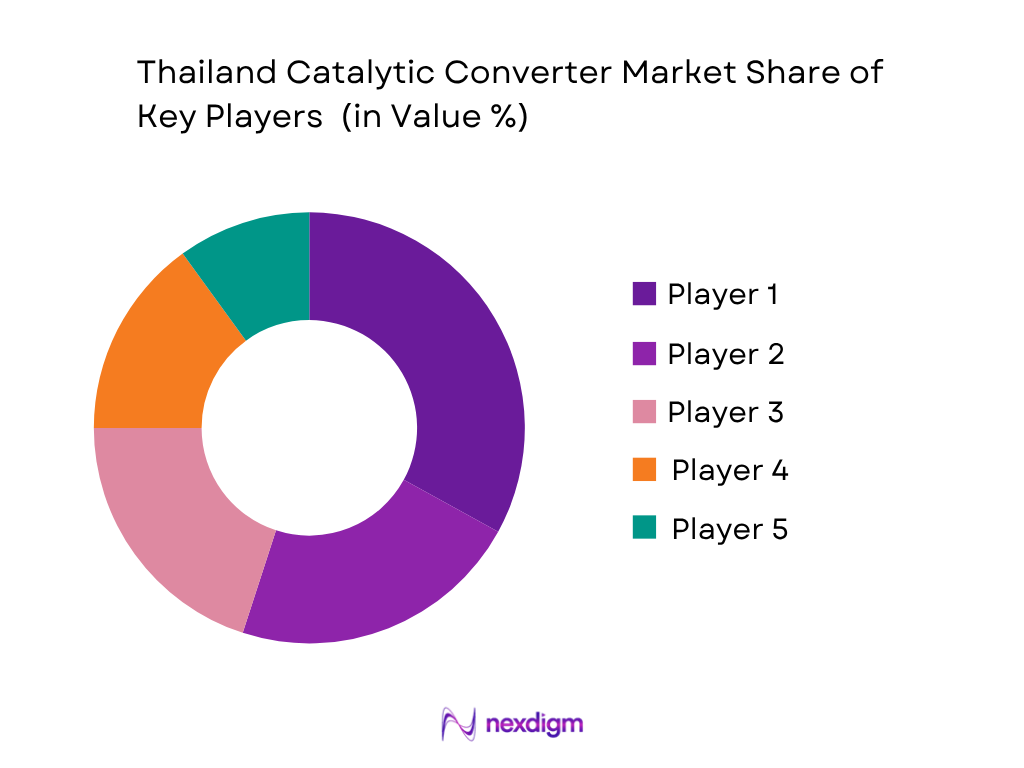
Thailand’s competitive landscape differs from many ASEAN markets because the country possesses local emissions-catalyst manufacturing capability, not merely imported finished converters. BASF operates mobile-emissions catalyst production in Rayong, while Cataler Thailand manufactures both automotive and motorcycle catalysts at the Eastern Seaboard Industrial Estate. This local manufacturing footprint is supported by global substrate, precious-metal, exhaust-system and Tier-1 suppliers serving Thailand’s large vehicle-production base.
| Major Player | Establishment | Headquarters / Thailand Base | Core Offering | Petrol Catalyst Capability | Diesel Capability | Motorcycle Capability | Local Manufacturing | PGM / Materials Capability |
| BASF ECMS | BASF roots: 1865 | Ludwigshafen / Rayong | ~ | ~ | ~ | ~ | ~ | ~ |
| Cataler Thailand | 1996 | Rayong, Thailand | ~ | ~ | ~ | ~ | ~ | ~ |
| Umicore | Roots: 1805 | Belgium / Thailand presence | ~ | ~ | ~ | ~ | ~ | ~ |
| Tenneco / Walker | 1940 | USA / regional supply | ~ | ~ | ~ | ~ | ~ | ~ |
| DENSO Corporation | 1949 | Kariya, Japan / ASEAN network | ~ | ~ | ~ | ~ | ~ | ~ |
Thailand Catalytic Converter Market Analysis
Growth Drivers
Euro 6 Compliance and Thailand’s Large ICE Automotive Manufacturing Base
Thailand’s transition to Euro 6 vehicle standards from 2024 is a direct structural driver for catalytic converters because tighter limits on particulate matter, nitrogen oxides, hydrocarbons and carbon monoxide require higher-efficiency three-way catalysts and more sophisticated diesel aftertreatment. The Pollution Control Department reported in 2026 that adoption of Euro 6 since 2024 had reduced particulate emissions from newer vehicles by roughly half, strengthening the technical case for higher cell-density substrates, optimized washcoats and accurately calibrated platinum-group-metal loadings. This regulation applies within an unusually large automotive production ecosystem. Federation of Thai Industries data show that Thailand produced 1,468,997 motor vehicles in 2024, following a much larger production base of 1,841,663 units in 2023. Even with the production adjustment, Thailand continues to manufacture very large numbers of passenger cars, one-ton pickups, pickup passenger vehicles and commercial vehicles carrying catalytic converters or integrated DOC-DPF-SCR systems. The export orientation makes catalyst demand broader than domestic vehicle sales alone: Thai vehicle platforms must meet emissions specifications required by destination markets, creating demand for multiple catalyst calibrations, substrate configurations and PGM formulations from the same manufacturing platform. Thailand’s manufacturing depth also distinguishes it from import-led ASEAN catalyst markets. BOI documentation identifies more than 2,300 automotive supply-chain producers and between 800,000 and 900,000 workers supporting the automotive ecosystem, providing the industrial base for exhaust fabrication, converter canning, sensor integration and OEM validation. Local catalyst capability is reinforced by established facilities in Rayong, where mobile-emissions catalyst production supplies both domestic and regional automotive programmes. Euro 6 particularly supports higher-value diesel aftertreatment because Thailand remains closely associated with one-ton pickup manufacturing; these vehicles can require oxidation catalysts, particulate-filter integration and selective catalytic reduction rather than a simple standalone converter. Petrol passenger cars and motorcycles likewise need rapid-light-off three-way catalysts containing palladium and rhodium. The macroeconomic backdrop supports continued automotive industrial activity despite slower domestic growth. The IMF estimates Thailand’s real GDP expanded 2.5 in 2024 and 2.1 in 2025, while its latest 2026 country profile places projected real GDP growth at 1.9 and the population at 71.56 million. World Bank data place Thailand’s nominal GDP at USD 577.01 billion in 2025, with GDP per capita of USD 8,056.6, demonstrating the scale of the economy supporting local automotive production, fleet ownership and servicing. For catalytic-converter suppliers, the relevant opportunity is therefore not simply vehicle-volume expansion; tighter emission standards increase the amount of catalyst engineering required per surviving combustion platform. Close-coupled placement, better thermal durability, lower light-off temperatures, oxygen-storage materials and integration with particulate and NOx control become increasingly important. As Thailand simultaneously produces vehicles for domestic use and export, Euro 6 compliance sustains demand for locally engineered, homologated emissions-control systems even while the country’s overall powertrain mix changes.
Rapid Hybrid Adoption Preserving Catalytic-Converter Content During Electrification
Thailand’s rapid hybridization is another major growth driver because hybrid electric vehicles retain gasoline engines and catalytic converters while introducing more complex exhaust-temperature and emissions-management requirements than conventional ICE vehicles. Thailand’s Board of Investment reported that electrified-vehicle registrations expanded strongly through 2024–2025 and that hybrid electric vehicles became the largest electrified registration category in 2025, ahead of battery-electric vehicles. The policy significance is substantial because the government is deliberately supporting HEV, PHEV and mild-hybrid production alongside BEVs rather than pursuing an exclusively battery-electric transition. In July 2024, the National Electric Vehicle Policy Committee approved a hybrid-manufacturing support package expected to attract THB 50 billion in new investment, requiring participating manufacturers to make at least THB 3 billion of qualifying new investment during the specified investment window. The programme was subsequently broadened to mild hybrids, with participating manufacturers and affiliates required to make at least THB 1 billion of new investment by 2026 and at least THB 5 billion cumulatively over the applicable programme period. This matters directly to catalytic-converter suppliers because every HEV or PHEV built with an internal-combustion engine requires functional aftertreatment even when part of the driving cycle is completed electrically. Hybrid duty cycles can make catalyst engineering more demanding: when the engine shuts down during electric propulsion, exhaust temperature declines; on restart, the catalyst must quickly return to an efficient conversion window. This increases the importance of close-coupled placement, low-thermal-mass ceramic substrates, improved ceria-zirconia oxygen-storage materials and highly dispersed palladium-rhodium coatings. The opportunity extends to major Japanese OEM programmes. In 2025 Mazda announced an additional THB 5 billion investment to turn Thailand into an electrified compact-SUV production hub, with targeted production of 100,000 units annually for domestic and export markets. Such investments preserve combustion-engine catalyst demand while moving it toward technically higher-value hybrid platforms. Thailand’s broader automotive supply chain provides an established localization environment: BOI reported more than 2,300 supply-chain producers, allowing hybrid catalyst manufacturers to integrate with local exhaust suppliers, sensors, ECU systems and vehicle assembly. Macroeconomic conditions suggest a slower but still functioning investment environment. The IMF reports real GDP growth of 2.5 in 2024 and 2.1 in 2025, with its July 2026 country profile showing projected growth of 1.9 in 2026. World Bank data show nominal GDP of USD 577.01 billion in 2025, while foreign direct investment inflows were equivalent to 3.3 on its latest indicator basis, demonstrating Thailand’s continued role as an international manufacturing destination. Hybridization therefore gives catalyst suppliers a defensible transition segment between conventional ICE and BEVs. Instead of disappearing immediately, catalyst demand migrates toward vehicles requiring more precise thermal management, faster light-off and tighter integration with powertrain control. The strongest suppliers will be those able to provide platform-specific hybrid catalyst technologies to Thai OEM plants serving both domestic buyers and export markets.
Market Challenges
Accelerating Battery-Electric Vehicle Adoption Eliminating Exhaust Aftertreatment
Battery-electric vehicle adoption is the largest structural challenge to Thailand’s Catalytic Converter Market because a BEV contains no combustion engine, exhaust manifold, oxygen sensor, diesel oxidation catalyst, three-way catalyst or SCR system. Official Board of Investment data show the speed of substitution: 70,582 new BEV passenger cars were registered in 2024, while another 57,289 BEV passenger cars were registered during the first half of 2025 alone. By mid-2025, Thailand already had approximately 203,000 BEV passenger cars, 71,900 electric motorcycles, 3,800 electric buses and trucks, and around 1,000 electric three-wheel tuk-tuks operating on the road. Every one of these vehicles represents the permanent elimination of catalytic-converter fitment from that powertrain. The effect is particularly important in Thailand because electrification is not limited to imported vehicles; local production is expanding rapidly under EV3 and EV3.5. BOI reported that 26 manufacturers were participating in the incentive schemes, while domestic production commitments under EV3.5 require compensatory local output linked to earlier imported vehicles. By 2026, BOI reported 18 BEV projects representing about THB 39.5 billion of investment and more than 370,000 units of annual domestic production capacity. This represents a direct substitution threat to traditional catalyst OEM fitment because each BEV produced on a line that could otherwise produce a petrol, diesel or hybrid vehicle removes the catalyst, sensors, exhaust piping and related control systems from the vehicle bill of materials. Infrastructure development reinforces the permanence of the shift. Thailand had 3,720 charging stations operating by March 2025 with 11,622 installed chargers, including 6,524 DC fast chargers. The EV supply-chain programme expanded further, with BOI reporting investment in infrastructure expected to support more than 22,900 charging stations nationwide, including more than 10,000 high-speed DC charging locations or installations under promoted projects. Electric motorcycles pose another challenge because Thailand has historically been a large motorcycle-manufacturing market; electrification therefore threatens high-volume compact catalytic-converter demand as well as passenger-car catalysts. The macroeconomic environment indicates that this substitution is occurring despite slower overall economic growth rather than because of an economic boom. IMF estimates place real GDP growth at 2.5 in 2024, 2.1 in 2025, and around 1.9 in 2026 on the latest country profile. World Bank data place nominal GDP at USD 577.01 billion in 2025 and the population at 71.62 million, supporting a large mobility market capable of shifting technologies at scale. For catalyst suppliers, the financial impact extends beyond lost original-equipment fitment. A BEV also eliminates future catalyst replacement, lambda-sensor replacement, exhaust diagnostics and end-of-life catalyst recovery associated with that vehicle. Suppliers therefore face a progressively shrinking addressable base in pure ICE programmes and must increase exposure to hybrids, export-market combustion platforms, commercial diesel aftertreatment and PGM recycling. Companies with large motorcycle-catalyst or petrol passenger-car portfolios face the greatest long-term substitution exposure because these applications can electrify more quickly than high-load diesel fleets.
Contraction in Conventional Vehicle and Pickup Production Pressuring OEM Catalyst Volumes
Weakness in Thailand’s conventional vehicle-production cycle creates a second market-specific challenge because catalytic-converter OEM demand is directly tied to the number and mix of ICE vehicles leaving Thai assembly plants. Federation of Thai Industries data show that vehicle production fell from 1,841,663 units in 2023 to 1,468,997 units in 2024, reducing the number of OEM exhaust-aftertreatment systems required even before accounting for the growing BEV share. Monthly FTI data illustrate the pressure within 2024: production was 133,690 units in February, 116,289 units in June, 124,829 units in July, 119,680 units in August, and 104,878 units in December. These figures matter for the catalytic-converter industry because Thailand’s ICE ecosystem has historically depended heavily on one-ton pickups and other diesel platforms carrying comparatively high-value aftertreatment. When pickup output contracts, catalyst suppliers lose not only unit volume but also some of the more technically valuable diesel oxidation catalyst, particulate-filter and SCR-related content. Domestic vehicle purchasing has also been constrained by tight credit conditions and high household indebtedness, factors highlighted by the IMF in its 2025 Article IV assessment. The IMF states that credit growth remained constrained and financial conditions tight, while economic growth slowed from 2.5 in 2024 to 2.1 in 2025. The organization’s latest 2026 country profile places projected real GDP growth at 1.9, illustrating continued macroeconomic moderation. World Bank reporting similarly highlights weakening consumption and investment pressures, while its current data show a Thai population of around 71.62 million and GDP per capita of USD 8,056.6 in 2025. For catalyst manufacturers, production volatility creates several operational complications. Catalyst coating lines and converter canning operations require long OEM qualification cycles and platform-specific tooling, meaning a sudden fall in platform output can leave underutilized capacity that cannot easily be redirected to another vehicle. Diesel pickup converters also differ substantially from motorcycle or hybrid three-way catalysts in substrate volume, precious-metal composition and thermal requirements, limiting immediate production flexibility. Export dependence adds further sensitivity because Thailand’s automotive industry supplies markets across Asia, Oceania, the Middle East and other regions. BOI materials identify automobiles and parts as Thailand’s leading export category and more than 2,300 companies in the supporting supply chain, so weakening vehicle exports can transmit rapidly through catalyst, substrate, exhaust and sensor suppliers. The market challenge is therefore not simply fewer cars sold domestically; it is a broader mix shift from high-content diesel and petrol platforms toward BEVs combined with cyclically lower ICE output. Catalyst suppliers need more flexible manufacturing, diversified OEM customers and stronger aftermarket exposure to buffer production volatility. Hybrid programmes partially mitigate the problem because they retain catalytic converters, but they require different light-off and thermal-management technologies. In the medium term, suppliers that remain concentrated on conventional diesel pickups without hybrid, export or replacement portfolios face the highest utilization and revenue risk.
Market Opportunities
Localized Hybrid and Euro 6 Catalyst Technology for Thailand’s Automotive Supply Chain
Thailand’s most immediate catalytic-converter opportunity is the localization of higher-value Euro 6 and hybrid catalyst systems within its existing automotive manufacturing cluster. The country already possesses a substantial technical foundation: BOI identifies more than 2,300 automotive supply-chain producers and 800,000–900,000 workers, while automobiles and automotive parts remain strategically important manufacturing and export products. Euro 6 implementation from 2024 raises the technical bar for every combustion platform that remains in production. Government reporting in 2026 states that the switch to Euro 6 since 2024 has materially reduced particulate emissions from new vehicles, demonstrating that tighter control is already changing real-world emissions performance. For local catalyst producers, this creates demand for higher cell-density ceramic substrates, improved washcoat dispersion, faster light-off, optimized PGM loading and better integration with particulate and NOx treatment. The hybrid transition adds an even more attractive application. Thailand’s EV Board approved HEV production incentives in 2024 intended to trigger THB 50 billion of new investment, with eligible manufacturers required to make at least THB 3 billion in new Thai investment under the original scheme. The expanded mild-hybrid programme subsequently required at least THB 1 billion of investment by 2026 and THB 5 billion cumulatively over the broader investment period for eligible manufacturers and affiliates. Mazda separately announced more than THB 5 billion of additional investment in 2025 to make Thailand an electrified compact-SUV hub, targeting 100,000 units of production per year for Thailand and export destinations. These investments create future vehicle programmes in which catalytic converters remain essential. Hybrid aftertreatment requires faster activation after repeated engine-off periods and tighter coordination between catalyst temperature, battery state and engine restart. This favors suppliers able to offer thin-wall substrates, low-thermal-mass converters and oxygen-storage materials calibrated specifically for hybrid duty cycles. Thailand also has an existing catalyst-manufacturing cluster in Rayong and the Eastern Economic Corridor, meaning higher-value coating and converter assembly need not be built from scratch. The macroeconomic context further supports localization as an industrial strategy. IMF data show economic growth of 2.5 in 2024 and 2.1 in 2025, with projected growth around 1.9 in 2026, while World Bank data put nominal GDP at USD 577.01 billion in 2025. In a slower-growth economy, increasing local content can be more attractive than relying heavily on imported finished catalyst assemblies because localization supports employment, supply security and OEM responsiveness. The opportunity extends beyond Thai domestic sales: a locally manufactured Euro 6 or hybrid catalyst can be integrated into vehicles exported throughout ASEAN, Oceania and other markets. Thailand’s existing supply-chain density means suppliers can co-locate with exhaust canning, sensor, ECU and vehicle-assembly operations, shortening development cycles and improving platform-specific validation. Thus, while BEVs reduce the overall combustion opportunity, the remaining ICE content can become technically richer and more locally embedded.
PGM Recovery and Export-Oriented Aftertreatment as ICE Vehicles Transition Out of the Fleet
Thailand’s second major opportunity is to combine its export-oriented automotive base with structured recovery of platinum-group metals from spent catalytic converters, allowing the industry to capture value both when catalyst-equipped vehicles are produced and when they are retired. Thailand produced 1,468,997 vehicles in 2024, giving catalyst manufacturers a large ongoing flow of OEM substrates and converter assemblies despite the decline from the prior production peak. The country’s automotive supply chain includes more than 2,300 producers, and BOI describes automobiles and parts as a leading export industry, making Thailand well positioned to manufacture Euro 6 catalyst systems not only for local vehicles but for export platforms requiring different aftertreatment calibrations. At the same time, electrification is beginning to generate a large future stream of end-of-life combustion components. BOI reported 70,582 new BEV passenger-car registrations in 2024, followed by 57,289 during the first half of 2025, while the operating fleet already included 203,000 BEV passenger cars, 71,900 electric motorcycles and 3,800 electric buses and trucks. As BEVs replace older petrol and diesel vehicles, the outgoing ICE vehicles contain catalytic converters carrying recoverable platinum, palladium and rhodium. Instead of allowing those units to move through fragmented scrap channels, Thailand can develop organized collection from authorized workshops, dismantlers, fleet depots, motorcycle service centres and vehicle recyclers. Each converter can be classified by vehicle platform, substrate type and likely PGM composition before being consolidated for decanning, sampling, assay and refining. This is strategically valuable because Thailand imports much of its primary PGM exposure while simultaneously generating secondary PGM-bearing materials from a mature ICE fleet. A closed-loop system can return recovered precious metals into new catalyst coatings, reducing dependency on primary supplies and improving material security for domestic manufacturers. The opportunity also supports the aftermarket. As conventional vehicle production declines, millions of existing pickups, passenger cars, motorcycles and commercial vehicles remain catalyst-equipped and require replacement through their remaining service lives. A workshop can install an emissions-compliant direct-fit converter while retaining the failed unit as a recoverable core, creating revenue from both replacement and recycling. The macroeconomic environment favors higher-value circular manufacturing rather than commodity-only scrap processing. World Bank data show Thai GDP of USD 577.01 billion in 2025, GDP per capita of USD 8,056.6, and a population of approximately 71.62 million. The IMF reports growth of 2.1 in 2025 and a projected 1.9 in 2026, reinforcing the importance of productivity-enhancing industrial activities rather than relying solely on rapid domestic demand expansion. Thailand’s positioning between mature Japanese ICE/hybrid supply chains and rapidly expanding Chinese BEV production creates a particularly useful transition window: the country can continue exporting sophisticated Euro 6 and hybrid catalysts while simultaneously building a secondary PGM recovery ecosystem from retiring combustion vehicles. Suppliers that combine catalyst manufacturing, spent-converter purchasing, assay capability and regional refining partnerships can therefore capture value throughout the full catalyst lifecycle rather than treating electrification solely as a loss of future demand.
Future Outlook
The Thailand Catalytic Converter Market is forecast to expand at ~ CAGR during 2026–2035 under the requested placeholder framework. Growth will not be uniform: conventional ICE OEM demand faces electrification pressure, while Euro 6 systems, hybrids, pickup-truck aftertreatment, motorcycle catalysts, exports and replacement converters provide more defensible demand pools. Thailand’s automotive manufacturing scale remains the market’s central foundation. Vehicle production totaled approximately 1.47 million units in 2024, compared with roughly 1.84 million units in 2023. Around 1 million vehicles were exported in 2024, demonstrating that catalyst demand is driven not only by domestic vehicle purchases but also by emissions systems incorporated into Thailand-built vehicles destined for foreign markets. This export dimension is especially important because tighter destination-market emissions standards increase catalyst complexity. Suppliers based in Thailand can therefore manufacture systems calibrated not just for Thai regulations but also for ASEAN, Australian, Middle Eastern and other export requirements. Thailand’s adoption of Euro 6 vehicle standards from 2024 further strengthens demand for advanced aftertreatment with higher conversion efficiency, improved cold-start performance and tighter control of particulate and gaseous emissions.
Hybridization should become one of the market’s most important transition opportunities. Thailand’s policy framework differentiates hybrids, mild hybrids and battery-electric vehicles through excise and investment incentives, while manufacturers such as Honda have reorganized Thai production around increased hybrid output. Unlike BEVs, hybrids still require three-way catalytic converters. Frequent engine shutdown and restart can increase the need for low-light-off washcoats, close-coupled substrates and improved thermal management. The domestic catalyst-manufacturing ecosystem is another structural advantage. BASF’s Rayong operations provide mobile-emissions catalyst production, while Cataler Thailand operates an integrated catalyst business covering gasoline, diesel and motorcycle applications. Cataler also produces metal-honeycomb systems for motorcycles and general-purpose engines. This makes Thailand better positioned than purely import-dependent ASEAN markets to localize technology upgrades as emission standards tighten. Pickup trucks should remain a high-value catalyst segment even if domestic vehicle sales fluctuate. Thailand’s pickup sector is strongly linked to both manufacturing and exports. Newer diesel pickups require oxidation catalysts and increasingly integrated particulate/NOx-control technologies, while high-mileage older pickups create replacement demand. Domestic sales fell substantially to 572,675 vehicles in 2024, from 775,780 in 2023, highlighting near-term pressure from credit conditions, but the installed pickup fleet and export-production base remain substantial. The principal long-term challenge is BEV manufacturing and adoption. Thailand has attracted major EV investment, including BYD’s Rayong facility with planned annual production capability of 150,000 vehicles. Each battery-electric vehicle removes not only the OEM catalytic converter but also future exhaust replacement, oxygen-sensor and spent-catalyst recycling opportunities associated with that vehicle.
Major Players
- BASF Environmental Catalyst and Metal Solutions
- Cataler (Thailand) Co., Ltd.
- Umicore
- Tenneco / Walker Emissions Control
- FORVIA Clean Mobility
- Purem by Eberspächer
- Futaba Industrial
- Sango Co., Ltd.
- DENSO Corporation
- NGK Insulators
- IBIDEN
- Corning Incorporated
- Johnson Matthey
- BOSAL
- Magna Flow
Key Target Audience
- Automotive Catalytic Converter and Exhaust-System Manufacturers
- Passenger Vehicle, Pickup Truck and Motorcycle OEMs
- Automotive Tier-1 and Tier-2 Component Manufacturers
- Automotive Parts Distributors and Aftermarket Workshop Networks
- Commercial Fleet, Logistics and Pickup Fleet Operators
- Platinum-Group-Metal Suppliers, Refiners and Automotive Recyclers
- Investments and Venture Capitalist Firms
- Government and Regulatory Bodies (Thailand Board of Investment, Thai Industrial Standards Institute, Department of Land Transport, Pollution Control Department, Excise Department)
Research Methodology
Step 1: Identification of Key Variables
The initial phase constructs an ecosystem map covering catalyst manufacturers, passenger-car and pickup OEMs, motorcycle manufacturers, Tier-1 exhaust suppliers, ceramic substrate companies, PGM suppliers, distributors, workshops and recyclers. Critical variables include vehicle production, export volume, pickup share, powertrain, emission standard, catalyst count, PGM loading, substrate configuration and replacement lifecycle.
Special emphasis is placed on the Eastern Economic Corridor because Rayong and neighboring automotive provinces contain a significant concentration of vehicle, catalyst and component manufacturing.
Step 2: Market Analysis and Construction
The top-down model starts with national vehicle production and allocates units by passenger car, pickup truck, SUV/PPV, motorcycle and commercial vehicle. The model then distinguishes conventional petrol, diesel, hybrid, plug-in hybrid and BEV powertrains, excluding BEVs from catalyst fitment.
The bottom-up assessment examines BASF and Cataler manufacturing, Tier-1 exhaust suppliers, OEM fitment, export programmes, direct-fit aftermarket demand and high-mileage pickup replacement. Production and aftermarket demand are treated separately to prevent double counting.
Step 3: Hypothesis Validation and Expert Consultation
Market hypotheses are validated through CATIs with catalyst manufacturers, OEM procurement teams, Tier-1 suppliers, exhaust workshops, automotive-parts distributors, pickup fleets and recycling companies.
Interviews investigate Euro 6 catalyst specifications, pickup DOC/DPF configurations, motorcycle catalyst demand, hybrid light-off challenges, PGM loading, local-versus-imported substrates and the impact of BEV production on future catalyst volumes.
Step 4: Research Synthesis and Final Output
The final phase triangulates vehicle-production statistics, export activity, emissions regulation, automotive localization, supplier capability and industry interviews. Market demand is segmented by converter type, vehicle type, powertrain, fitment, emissions standard, substrate, catalyst composition, source of demand and region.
Forecast scenarios incorporate ICE production, pickup exports, hybrid adoption, Euro 6 penetration, EV substitution, motorcycle electrification, PGM supply, catalyst recycling and Thailand’s evolving role as an ASEAN automotive manufacturing hub.

- Executive Summary
- Research Methodology (Market Definitions and Assumptions, Abbreviations, Catalytic Converter Market Boundary, Passenger Car-Pickup-Motorcycle Parc Mapping, Converter-per-Vehicle Assessment, OEM Production Mapping, Export Vehicle Catalyst Content, Powertrain Mapping, Replacement Cycle Analysis, Emission Standard Assessment, Catalyst Loading Analysis, PGM Consumption Mapping, Market Sizing Approach, Top-Down Analysis, Bottom-Up Analysis, Demand-Side Assessment, Supply-Side Assessment, OEM-Tier-1-Catalyst Manufacturer Interviews, Distributor and Workshop Interviews, Recycler Interviews, Data Triangulation, Forecasting Framework, Scenario Analysis, Limitations and Future Conclusions)

- Definition and Scope
- Evolution of Automotive Catalytic Emission Control in Thailand
- Thailand Automotive Manufacturing and Export Ecosystem
- Evolution from Euro 4 to Euro 5/Euro 6 Vehicle Emission Standards
- Passenger Vehicle Three-Way Catalyst Ecosystem

- Growth Drivers (Large Automotive Manufacturing Base, Export-Oriented Catalyst Fitment, Pickup Truck Production, Motorcycle Production, Euro 6 Compliance, Hybrid Vehicle Production, Established Catalyst Manufacturing Cluster, Extensive Automotive Aftermarket)
- Market Challenges (Rapid BEV Adoption, Declining ICE Production Mix, PGM Supply Exposure, Export Market Volatility, Intense Automotive Price Competition, Catalyst Technology Complexity, Ageing Legacy Vehicle Parc, Aftermarket Quality Variability)
- Market Opportunities (Hybrid Catalysts, Pickup Diesel Aftertreatment, Motorcycle Catalysts, Export-Market Euro 6 Systems, PGM Recycling, Advanced Low-PGM Catalysts, Localized Catalyst R&D, ASEAN Catalyst Export)
- Market Trends (Euro 6 Catalyst Upgrade, Hybrid Low-Light-Off Systems, PGM Thrifting, Close-Coupled Catalysts, Local Catalyst Manufacturing, Export-Oriented Calibration, Direct-Fit Aftermarket Growth, Recycled-PGM Utilization)
- Technology Substitution Risk (Battery-Electric Cars, Electric Pickups, Electric Motorcycles, Electric Buses, Hybridization, Fuel-Cell Vehicles)
- SWOT Analysis
- Porter’s Five Forces Analysis
- PESTLE Analysis

- By Market Value (2020-2025)
- By Catalytic Converter Unit Volume (2020-2025)
- By OEM-Fitted Converter Volume (2020-2025)

- By Converter Type (In Value %)
Three-Way Catalytic Converters
Motorcycle Catalytic Converters
Close-Coupled Catalytic Converters
Manifold-Integrated Catalytic Converters
Underfloor Catalytic Converters - By Vehicle Type (In Value %)
Passenger Cars
One-Ton Pickup Trucks
Double-Cab Pickups
Pickup Passenger Vehicles
SUVs and Crossovers - By Powertrain Type (In Value %)
Conventional Petrol Vehicles
Conventional Diesel Vehicles
Full Hybrid Electric Vehicles
Plug-in Hybrid Electric Vehicles
Mild Hybrid Vehicles - By Sales Channel (In Value %)
Automotive OEMs
Motorcycle OEMs
Tier-1 Exhaust-System Suppliers
Authorized Dealer Networks
Independent Automotive Parts Distributors - By Region (In Value %)
Bangkok Metropolitan Region
Eastern Economic Corridor
Central Thailand
Northeastern Thailand
Northern Thailand

- Market Share of Major Players by Value
- Cross Comparison Parameters (Thailand/ASEAN Vehicle Application Coverage, Passenger-Pickup-Motorcycle-Hybrid Catalyst Portfolio Breadth, Local Catalyst Manufacturing and Coating Footprint, Platinum-Palladium-Rhodium Formulation Capability, Euro 6 and Export-Market Compliance Capability, Ceramic/Metallic Substrate and Wash coat Engineering Capability, OEM-Tier-1-Aftermarket Distribution Reach, PGM Recycling and Closed-Loop Material Capability)
- SWOT Analysis of Major Players
- Detailed Profiles of Major Companies
BASF Environmental Catalyst and Metal Solutions
Cataler (Thailand) Co., Ltd.
Umicore
Tenneco / Walker Emissions Control
FORVIA Clean Mobility
Purem by Eberspächer
Futaba Industrial
Sango Co., Ltd.
DENSO Corporation
NGK Insulators
IBIDEN
Corning Incorporated
Johnson Matthey
BOSAL
MagnaFlow

- Passenger Vehicle OEM Procurement
- Pickup Truck OEM Procurement
- Motorcycle OEM Procurement
- Hybrid Vehicle OEM Procurement
- Tier-1 Exhaust Supplier Procurement

- By Market Value (2026-2035)
- By Catalytic Converter Unit Volume (2026-2035)
- By OEM-Fitted Converter Volume (2026-2035)


 Request a Sample
 Ask for Customization
 Get a Quote
 Enquire Now