

 Download PDF
Market Overview
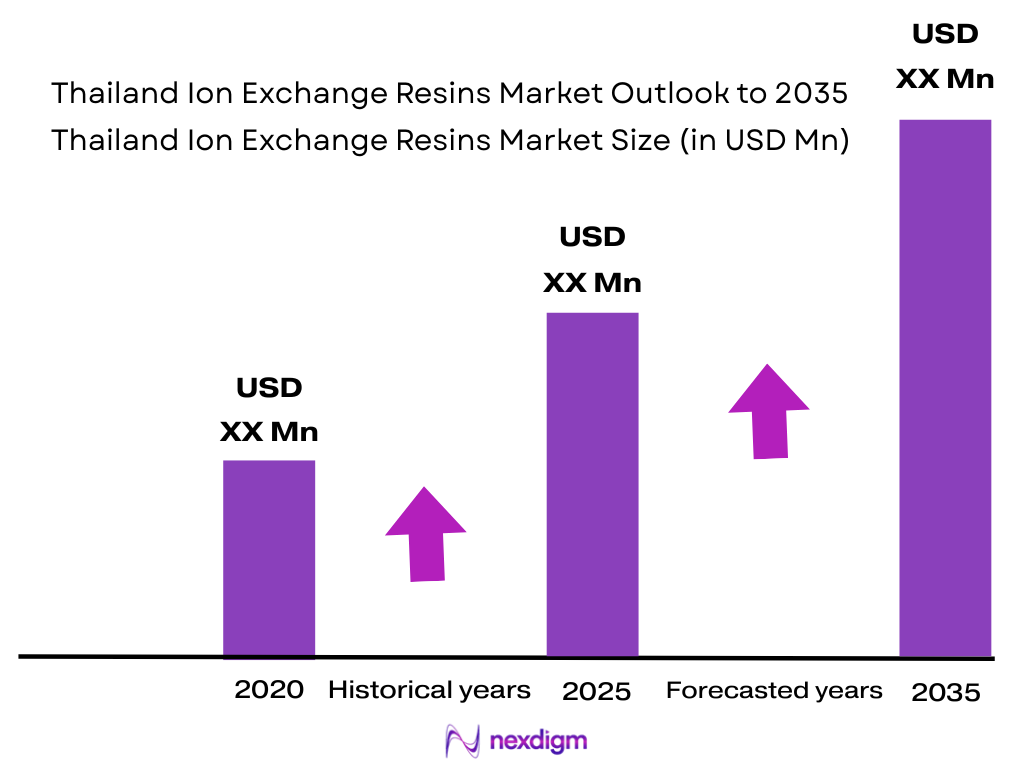
The Thailand Ion Exchange Resins Market is valued at approximately USD ~XX million, with demand driven by industrial water treatment, demineralization, process purification and recurring resin replacement. WITS records HS 391400 imports moving from USD 29.81 million and 9.15 million kg in the preceding comparable period to USD 25.63 million and 8.36 million kg in the latest period, confirming the market’s substantial reliance on imported polymer-based ion exchangers.
Demand is concentrated around Bangkok, Chonburi, Rayong, Chachoengsao and Ayutthaya, supported by electronics, petrochemicals, automotive, food processing and industrial estates requiring treated process water. Thailand’s E&E manufacturing base recorded USD 97.94 billion in production and USD 74.36 billion in exports in the preceding period, while the latest electronics exports reached THB 1.86 trillion and semiconductor exports reached THB 436 billion. China, the United States, Germany, India and Japan dominate resin supply because of established production capabilities and distributor networks.
Market Segmentation
By Resin Type
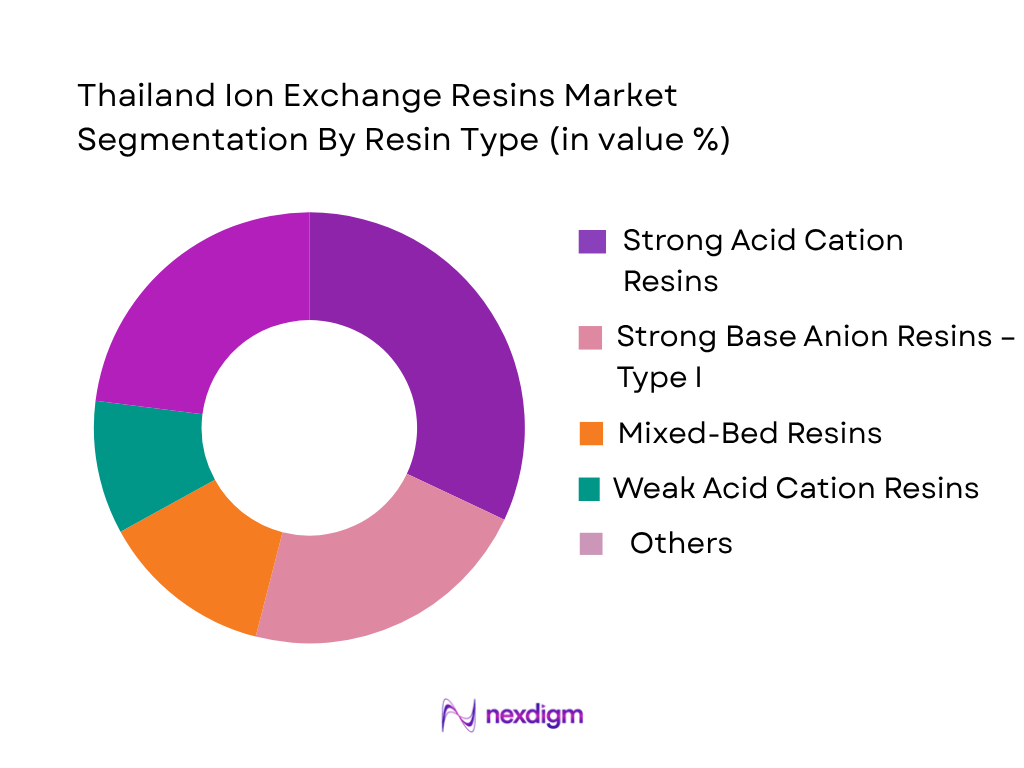
The Thailand Ion Exchange Resins Market is segmented by resin type into strong acid cation, weak acid cation, strong base anion Type I, strong base anion Type II, weak base anion, mixed-bed and specialty resins. Strong acid cation resins dominate this segmentation, primarily because they form the core treatment media for hardness removal, sodium-cycle softening, hydrogen-cycle demineralization and boiler-feedwater preparation across Thailand’s broad industrial base. Their extensive application in food processing, chemicals, petrochemicals, power utilities, automotive manufacturing and general industrial water systems creates a larger installed resin-bed base and recurring replacement requirement. Strong acid cation resins are also commonly paired with strong base anion resins in conventional demineralization trains. Their relatively mature technology, broad supplier availability and compatibility with standard regeneration infrastructure further strengthen their position. DuPont specifically identifies strong acid cation resins among its principal products for industrial softening and demineralization applications.
By Application
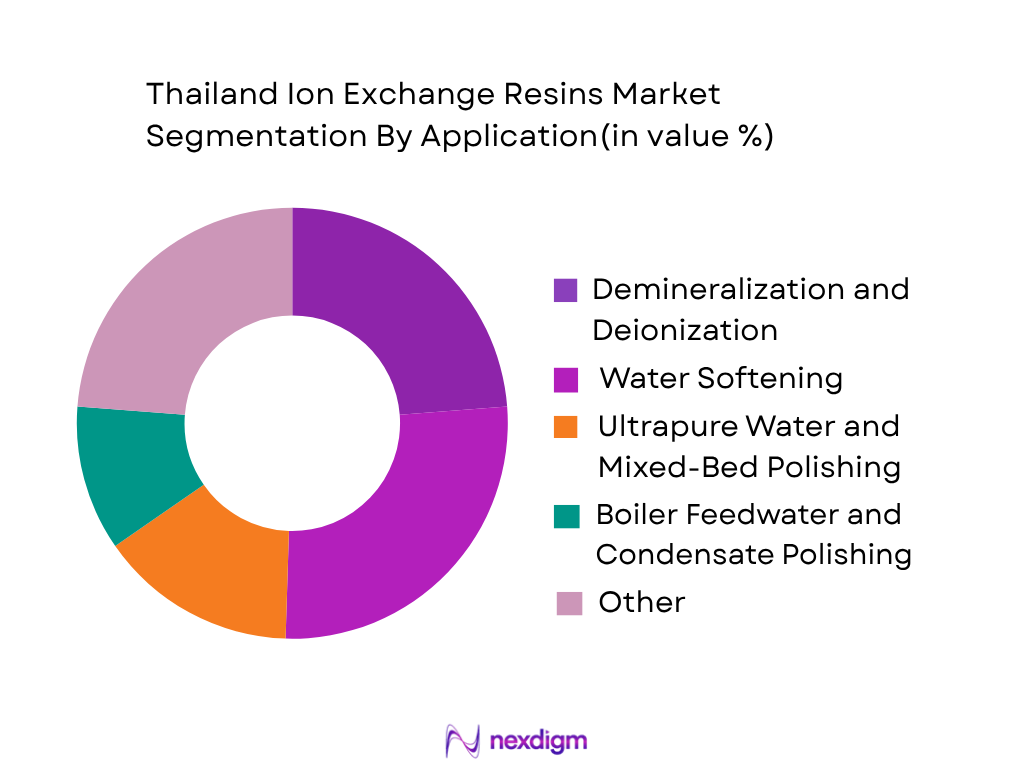
The Thailand Ion Exchange Resins Market is segmented by application into water softening, demineralization and deionization, ultrapure-water polishing, boiler-feedwater and condensate treatment, wastewater treatment and reuse, food and pharmaceutical purification, and specialty separation. Water softening holds the dominant application position, reflecting the extensive use of strong acid cation resins for hardness control before boilers, cooling systems, RO units and industrial process equipment. Thailand’s manufacturing-heavy economy creates a large addressable base of factories requiring consistent process-water quality and scale prevention. Softening systems are also operationally straightforward, widely understood by local water-treatment contractors and supported by an established replacement-resin channel. Demineralization remains another major demand pool, while ultrapure-water applications are becoming strategically more important as Thailand expands electronics, semiconductor, PCB and advanced manufacturing investment. BOI data demonstrates the scale and continued development of the country’s electrical and electronics manufacturing ecosystem.
Competitive Landscape
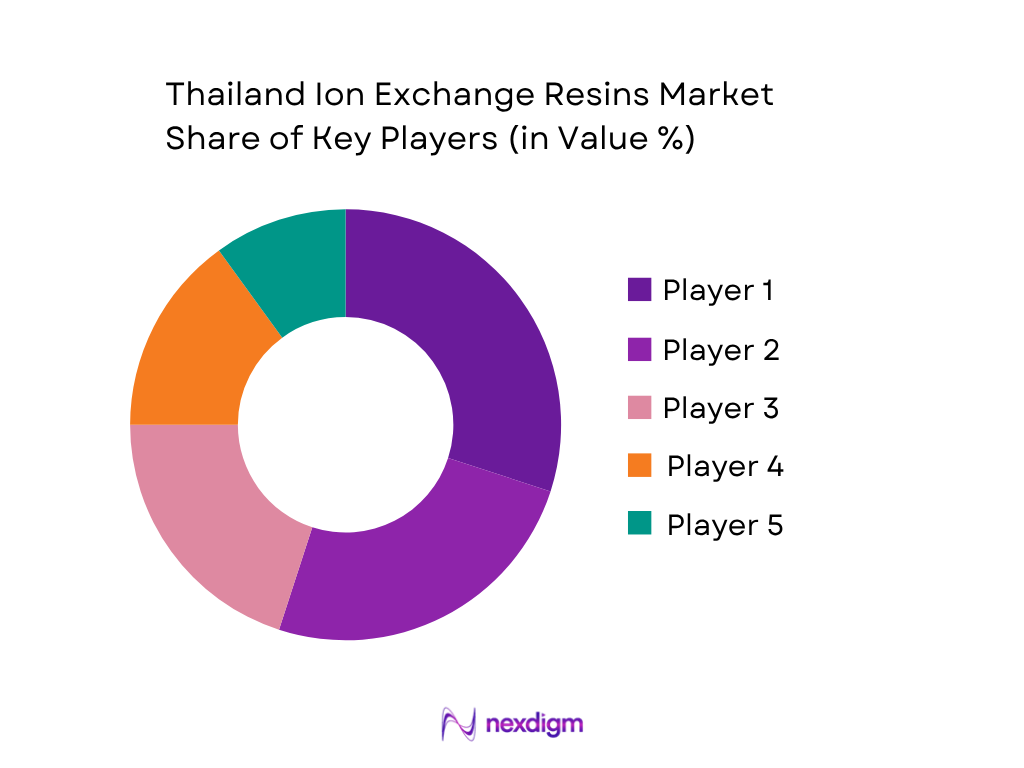
The Thailand Ion Exchange Resins Market has a combination of established multinational resin manufacturers and Asian suppliers serving customers primarily through importers, authorized distributors, water-treatment OEMs and engineering companies. Competition extends beyond resin price to exchange capacity, bead uniformity, chemical stability, regeneration efficiency, low-TOC performance, service life and technical support. Global brands such as DuPont, LANXESS, Purolite/Ecolab, Mitsubishi Chemical and Samyang are especially relevant where industrial users require qualified, performance-critical or high-purity grades.
| Company | Establishment | Headquarters | Principal Resin Brand | Resin Portfolio | High-Purity / UPW Capability | Major Thailand-Relevant Applications | Technology Positioning | Market Route |
| DuPont de Nemours, Inc. | 1802 roots | Wilmington, Delaware, USA | ~ | ~ | ~ | ~ | ~ | ~ |
| LANXESS AG | 2004 | Cologne, Germany | ~ | ~ | ~ | ~ | ~ | ~ |
| Purolite / Ecolab | 1981 | King of Prussia, Pennsylvania, USA | ~ | ~ | ~ | ~ | ~ | ~ |
| Mitsubishi Chemical Corporation | 1933 roots | Tokyo, Japan | ~ | ~ | ~ | ~ | ~ | ~ |
| Samyang Corporation | 1924 | Seoul, South Korea | ~ | ~ | ~ | ~ | ~ | ~ |
Thailand Ion Exchange Resins Market Analysis
Growth Drivers
Expansion of Electronics and Advanced Manufacturing
Thailand’s expanding electronics and advanced-manufacturing ecosystem is strengthening the requirement for ultrapure water, deionization and polishing systems that use ion exchange resins. Thailand’s Board of Investment reported that electronics exports reached THB 1.86 trillion in 2024, while semiconductor exports totaled THB 436 billion. Investment-promotion applications in semiconductor and advanced-electronics industries reached 406 projects with THB 610 billion of combined investment during 2022–2024, demonstrating the scale of manufacturing capacity entering the country. PCB and PCBA investment also remained active, with 27 applications representing THB 36.04 billion during the first five months of 2024. These facilities require stringent control of sodium, silica, boron, metals and other ionic impurities during wafer, PCB and electronic-component processing, directly supporting demand for strong-base anion, strong-acid cation, mixed-bed and ultrapure-water-grade resins. The broader macroeconomic environment also provides an industrial base for this demand: World Bank data places Thailand’s 2024 GDP at USD 526.52 billion, while manufacturing value added reached THB 2.803 trillion in constant local-currency terms. These indicators support continued resin consumption across new installations and existing high-purity-water treatment systems.
Large Industrial Water Treatment and Replacement Base
Thailand’s extensive network of industrial estates, petrochemical complexes, power facilities, automotive plants and processing industries creates recurring demand for ion exchange resins used in softening, demineralization, boiler-feedwater preparation and condensate polishing. The Industrial Estate Authority of Thailand reported that Map Ta Phut Industrial Estate received 65,936,013 cubic metres of raw water in 2024, illustrating the substantial scale of water-intensive industrial operations in one of the country’s most important petrochemical clusters. The same authority reported 7,724,103 cubic metres of treated wastewater at Map Ta Phut, alongside 3,868,997 cubic metres at Lat Krabang and 3,500,769 cubic metres in the Northern Region under relevant operating arrangements. Such water volumes require continuous treatment infrastructure in which ion exchange remains relevant for hardness removal, demineralized process water and final polishing. Thailand’s wider economic base reinforces this recurring demand: World Bank data records USD 526.52 billion of GDP in 2024 and GDP per capita of USD 7,346.6. Because ion exchange resins progressively lose effective operating capacity through fouling, oxidation and mechanical degradation, Thailand’s large installed industrial-water base generates repeat replacement requirements independent of entirely new plant construction.
Market Challenges
Heavy Dependence on Imported Ion Exchange Resins
Thailand’s ion exchange resin supply chain remains highly dependent on overseas manufacturing, exposing industrial buyers and distributors to international logistics, supplier concentration and inventory risks. World Bank WITS trade statistics show that Thailand imported exactly 8,357,170 kilograms of HS 391400 polymer-based ion exchangers in 2024. China supplied 6,444,170 kilograms, while Germany supplied 513,717 kilograms, the United States 443,118 kilograms, India 417,376 kilograms, Japan 170,515 kilograms and France 190,307 kilograms. This sourcing structure is particularly important for Thai water-treatment EPCs and industrial users because resin changes can be operationally critical; delays in obtaining a qualified strong-base anion, mixed-bed, chelating or ultrapure-water grade can affect treatment-system availability. The macroeconomic environment also increases the importance of supply resilience. World Bank data records Thailand’s GDP at USD 526.52 billion in 2024, while foreign direct investment inflows were equivalent to 2.7 points of GDP, indicating substantial integration with international capital and supply chains. Consequently, local stocking, multiple-country qualification, distributor inventory depth and alternative approved suppliers remain essential procurement considerations for the Thai ion exchange resin ecosystem.
High Technical Burden of Industrial Water and Wastewater Treatment
Ion exchange resin performance in Thailand is constrained by demanding industrial-water conditions and the operational complexity of maintaining resin beds across large treatment systems. Industrial Estate Authority of Thailand data illustrates the magnitude of treatment loads: Map Ta Phut handled 7,724,103 cubic metres of treated wastewater in 2024, while Lat Krabang handled 3,868,997 cubic metres, the Northern Region 3,500,769 cubic metres, and Samut Sakhon approximately 2,787,177 cubic metres. Industrial wastewater streams may contain hardness ions, metals, suspended matter, organics and process contaminants that can foul resin beads, reduce exchange capacity or increase regeneration frequency unless adequate pretreatment is maintained. These conditions make resin selection and operating discipline particularly important in petrochemical, metal-processing, food, electronics and utility applications. Thailand’s large manufacturing platform magnifies this technical requirement: World Bank statistics place manufacturing value added at THB 2.803 trillion in constant local-currency terms in 2024, while GDP reached USD 526.52 billion. Maintaining water quality across such a broad industrial base requires skilled system operation, resin condition monitoring, pretreatment optimization, regeneration management and timely replacement, creating a technical barrier for end users seeking consistent resin performance.
Market Opportunities
Ultrapure-Water Resin Demand from Semiconductor and Electronics Investment
Thailand’s rapidly expanding semiconductor, PCB and advanced-electronics manufacturing pipeline creates a substantial future opportunity for ultrapure-water-grade ion exchange resins, mixed-bed polishing media and low-leachable specialty products. The Thailand Board of Investment reported 407 electrical and electronics investment applications representing THB 231.7 billion in 2024. Semiconductor and advanced-electronics investment applications accumulated to 406 projects with THB 610 billion of investment during 2022–2024, while PCB and PCBA applications recorded 27 projects worth THB 36.04 billion during the first five months of 2024. Electronics exports reached THB 1.86 trillion in 2024, including semiconductor exports of THB 436 billion, establishing a sizeable current industrial foundation for future high-purity-water demand. Semiconductor and electronic-component production requires extremely low ionic contamination, making mixed-bed polishing, strong-base anion resins and carefully conditioned cation resins relevant downstream of membrane treatment. World Bank data also records Thailand’s 2024 GDP at USD 526.52 billion and manufacturing value added at THB 2.803 trillion in constant terms, supporting continued industrial investment. These conditions favor suppliers able to provide qualified high-purity resin, local inventory, application engineering and performance diagnostics.
Industrial Wastewater Reuse and Specialty Resin Applications
Thailand’s existing wastewater-treatment volumes create a strong foundation for future adoption of ion exchange resins in industrial water reuse, selective contaminant removal and final polishing. Industrial Estate Authority of Thailand figures show that Map Ta Phut treated 7,724,103 cubic metres of wastewater in 2024, Lat Krabang treated 3,868,997 cubic metres, the Northern Region handled 3,500,769 cubic metres, and Bangpoo processed more than 1,222,974 cubic metres. These current treatment volumes demonstrate a substantial stream of industrial water that can support deeper purification technologies where reuse specifications require removal of residual hardness, ammonium, metals, boron or other ionic contaminants. Selective chelating and macroporous resins can also complement conventional precipitation and membrane systems where low residual contaminant concentrations or resource recovery are required. The opportunity is reinforced by Thailand’s large industrial economy: World Bank data records USD 526.52 billion of GDP in 2024, GDP per capita of USD 7,346.6, and manufacturing value added of THB 2.803 trillion in constant local-currency terms. This manufacturing intensity supports future demand for resin technologies that enable closed-loop water management, polishing after reverse osmosis, wastewater recovery and targeted removal of process contaminants.
Future Outlook
The Thailand Ion Exchange Resins Market is forecast to expand at approximately ~X.X% CAGR during 2026–2035. Growth is expected to be supported by expansion of electronics and advanced manufacturing, stricter process-water specifications, industrial water recycling, replacement of exhausted resin beds and investment in higher-performance purification technologies. Premium mixed-bed, ultrapure-water, uniform-particle-size and selective resins are expected to progressively increase their strategic relevance alongside conventional softening and demineralization products.
Thailand’s electronics industry represents a particularly important future demand catalyst. The BOI has identified electronics as a priority investment sector, with semiconductor assembly, testing, PCB production, electronic components and advanced manufacturing forming important areas of investment. Electronics exports have reached THB 1.86 trillion, while semiconductor exports reached THB 436 billion, demonstrating the size of the industrial ecosystem capable of supporting higher-purity process-water demand.The Eastern Economic Corridor, covering Chachoengsao, Chonburi and Rayong, will remain strategically important. The region combines petrochemical, automotive, electronics, energy and advanced-manufacturing activity with major industrial estates and infrastructure. BOI investment rules specifically identify these three provinces as the geographic core of the EEC.
Major Players
- DuPont de Nemours,
- Ecolab Inc.
- LANXESS AG – Lewatit™
- Mitsubishi Chemical Group Corporation – DIAION™
- Samyang Corporation – TRILITE™
- Thermax Limited – Tulsion™
- Ion Exchange (India) Limited – INDION™
- Sunresin New Materials Co., Ltd.
- ResinTech, Inc.
- Jacobi Carbons Group / Jacobi Resins
- Jiangsu Suqing Water Treatment Engineering Group
- Anhui Sanxing Resin Technology Co., Ltd.
- Pure Resin Co., Ltd.
- Zhejiang Zhengguang Industrial Co., Ltd.
- Hebi Higer Chemical Co., Ltd.
Key Target Audience
- Ion Exchange Resin Manufacturers
- Ion Exchange Resin Importers and Authorized Distributors
- Industrial Water Treatment EPC Companies and System Integrators
- Electronics, Semiconductor and High-Purity Manufacturing Companies
- Petrochemical, Chemical, Power and Large Industrial Water UsersFood, Beverage,
- Pharmaceutical and Biopharmaceutical Manufacturer
- Investments and Venture Capitalist Firms
- Government and Regulatory Bodies (Thailand Board of Investment, Industrial Estate Authority of Thailand, Department of Industrial Works, Pollution Control Department)
Research Methodology
Step 1: Identification of Key Variables
The initial phase involves developing a complete ecosystem map of the Thailand Ion Exchange Resins Market, covering resin producers, foreign suppliers, importers, distributors, EPC contractors, system integrators and industrial end users. Desk research identifies the primary market variables, including resin type, exchange capacity, application, end-user industry, import source, pricing, installed-bed volume, replacement frequency and regeneration behavior.
Step 2: Market Analysis and Construction
Historical market demand is reconstructed using both top-down and bottom-up techniques. The top-down model assesses HS 391400 imports, industrial activity and major water-treatment applications, while the bottom-up model examines resin consumption by application, estimated installed-bed volumes, replacement cycles, distributor throughput and project demand. WITS trade statistics provide an important external benchmark because Thailand is substantially dependent on imported polymer-based ion exchangers.
Step 3: Hypothesis Validation and Expert Consultation
Market hypotheses are validated through computer-assisted telephone interviews and structured discussions with resin manufacturers, distributors, water-treatment EPC companies, industrial water specialists and procurement executives. Interviews test assumptions related to product preference, resin replacement intervals, average selling prices, regeneration practices, supplier qualification, distributor margins and the relative demand intensity of power, electronics, petrochemicals, food processing and other end-use industries.
Step 4: Research Synthesis and Final Output
The final stage triangulates trade data, primary interviews, supplier information, industrial production indicators and project-level demand evidence. Bottom-up consumption estimates are reconciled against import volumes and supplier-side findings, while forecast assumptions are linked to industrial investment, installed-base replacement and high-purity water requirements. The resulting model produces market value, volume, segmentation, competitive positioning and long-term demand scenarios for the Thailand Ion Exchange Resins Market.

- Executive Summary
- Research Methodology (Market Definition and Scope, Ion Exchange Resin Classification, Market Boundary Assessment, Abbreviations, Market Sizing Methodology, Top-Down Market Estimation, Bottom-Up Market Validation, Demand-Side Assessment, Supply-Side Assessment, Import-Based Market Reconstruction, Distributor Sales Assessment, Installed Resin Bed Assessment, Resin Replacement Cycle Analysis, End-User Consumption Assessment, Industrial Water Treatment Project Mapping)

- Definition and Scope
- Evolution of Thailand Ion Exchange Resins Industry
- Ion Exchange Resin Industry Genesis and Market Development
- Thailand Ion Exchange Resins Industry Ecosystem Analysis
- Thailand Ion Exchange Resins Value Chain Analysis
- Thailand Ion Exchange Resins Supply Chain Analysis
- Domestic Manufacturing versus Imported Resin Supply Landscape

- Market Growth Drivers (Expansion of Electronics and Electrical Manufacturing, Increasing Ultrapure Water Requirements, Growth of Petrochemical and Chemical Processing Facilities, Rising Industrial Water Treatment Investment, Expansion of Automotive and Advanced Manufacturing, Growing Food and Beverage Processing Industry)
- Market Challenges (High Dependence on Imported Resins, Foreign Exchange Exposure, Resin Price Volatility, Competition from Reverse Osmosis and Electrodeionization, Resin Fouling from Organic and Metal Contaminants, Regeneration Chemical Cost, Disposal of Spent Regenerants, Technical Skill Requirements)
- Market Opportunities (Ultrapure Water Resins for Electronics Manufacturing, Electronics Grade Mixed Bed Resins, Industrial Wastewater Recycling, Heavy Metal and Selective Contaminant Resins, High-Purity Pharmaceutical Resins, Food and Beverage Purification Resins, Condensate Polishing Resins)
- Market Trends (Shift from Commodity to High-Performance Resins, Adoption of Uniform Particle Size Resins, RO–Ion Exchange Hybridization, Growth of Mixed Bed Polishing, Increasing Demand for Low-Leachable and Low-TOC Resins, Electronics Grade Resin Qualification)
- Regeneration Economics Analysis
- SWOT Analysis of Major Players
- Porter’s Five Forces Analysis
- PESTLE Analysis

- By Market Value (2020-2025)
- By Consumption Volume (2020-2025)
- By Average Selling Price (2020-2025)
- By Import Value (2020-2025)
- By Import Volume (2020-2025)
- By Installed Resin Bed Volume (2020-2025)
- By Fresh Resin Consumption versus Replacement Resin Demand (2020-2025)

- By Resin Type
Strong Acid Cation Resins
Weak Acid Cation Resins
Strong Base Anion Resins – Type I
Strong Base Anion Resins – Type II
Weak Base Anion Resins
Mixed Bed Resins
Chelating Resins
Selective Ion Exchange Resins
Adsorbent and Specialty Separation Resins
Ultrapure Water Grade Resins
Food and Pharmaceutical Grade Resins
Condensate Polishing Resins - By Polymer Matrix
Styrene-Divinylbenzene Resins
Acrylic Resins
Polystyrenic Resins
Macroporous Resins
Gel-Type Resins
Specialty Polymeric Matrices - By Application
Water Softening
Demineralization and Deionization
Condensate Polishing
Ultrapure Water Production
Boiler Feedwater Treatment
Process Water Purification
Drinking and Municipal Water Treatment
Wastewater Treatment and Water Reuse
Heavy Metal Removal
Boron and Selective Contaminant Removal
Food and Beverage Purification
Pharmaceutical Purification and Separation
Biopharmaceutical Process Water Treatment
Chemical Processing and Catalysis
Metal Recovery and Hydrometallurgy - By Supply Source
China
Japan
United States
Germany
India
South Korea
Other European Markets
Other Asia-Pacific Markets
Domestic and Locally Repacked Supply - By Geography
Bangkok Metropolitan Region
Eastern Economic Corridor
Rayong Petrochemical and Energy Cluster
Chonburi Automotive and Electronics Cluster
Chachoengsao Advanced Manufacturing Cluster
Central Thailand
Ayutthaya Electronics and Industrial Cluster
Pathum Thani Industrial and Food Processing Cluster
Northern Thailand
Northeastern Thailand
Southern Thailand
Other Industrial Estates and Manufacturing Clusters

- Market Share Analysis of Major Players
- Cross Comparison Parameters (Product Portfolio Breadth, Ion Exchange Capacity and Resin Performance Range, Ultrapure Water and Electronics Grade Capability, Thailand Distributor and Inventory Coverage, Industrial and Food-Pharmaceutical Application Coverage, Resin Qualification and Technical Support Capability, Price Positioning and Total Cost of Ownership, Regeneration Efficiency and Expected Resin Service Life)
- Competitive Benchmarking Analysis (Product Innovation Capability, Pricing Strategy, Thailand Market Presence, Supply Chain Efficiency, Customer Base Strength, Product Grade Coverage, Application-Specific Resin Capability, Distribution and Technical Service Strength)
- SWOT Analysis of Major Players
- Pricing Analysis (Cation Resin Pricing, Anion Resin Pricing, Mixed-Bed Resin Pricing, Chelating Resin Pricing, Ultrapure Water Grade Premium, Country-of-Origin Price Differential, Distributor Margin, Bulk Procurement Pricing)
- Major Companies
DuPont de Nemours, Inc. – AmberLite™
Ecolab Inc. / Purolite – Purolite™
LANXESS AG – Lewatit™
Mitsubishi Chemical Group Corporation – DIAION™
Samyang Corporation – TRILITE™
Thermax Limited – Tulsion™
Ion Exchange (India) Limited – INDION™
Sunresin New Materials Co., Ltd.
ResinTech, Inc.
Jacobi Carbons Group / Jacobi Resins
Jiangsu Suqing Water Treatment Engineering Group
Anhui Sanxing Resin Technology Co., Ltd.
Pure Resin Co., Ltd.
Zhejiang Zhengguang Industrial Co., Ltd.
Hebi Higer Chemical Co., Ltd.

- Procurement Behavior Analysis
- Buyer Preference Assessment
- Import Dependency and Sourcing Analysis
- Pricing Sensitivity Analysis
- Thailand Ion Exchange Resins Supply-Demand Analysis
- Domestic Resin Availability and Distribution Assessment
- Import Dependency Analysis
- Domestic Consumption Assessment

- By Market Value (2026-2035)
- By Consumption Volume (2026-2035)
- By Average Selling Price (2026-2035)
- By Import Value (2026-2035)
- By Import Volume (2026-2035)
- By Installed Resin Bed Volume (2026-2035)
- By Fresh Resin Consumption versus Replacement Resin Demand (2026-2035)


 Request a Sample
 Ask for Customization
 Get a Quote
 Enquire Now