

 Download PDF
Market Overview
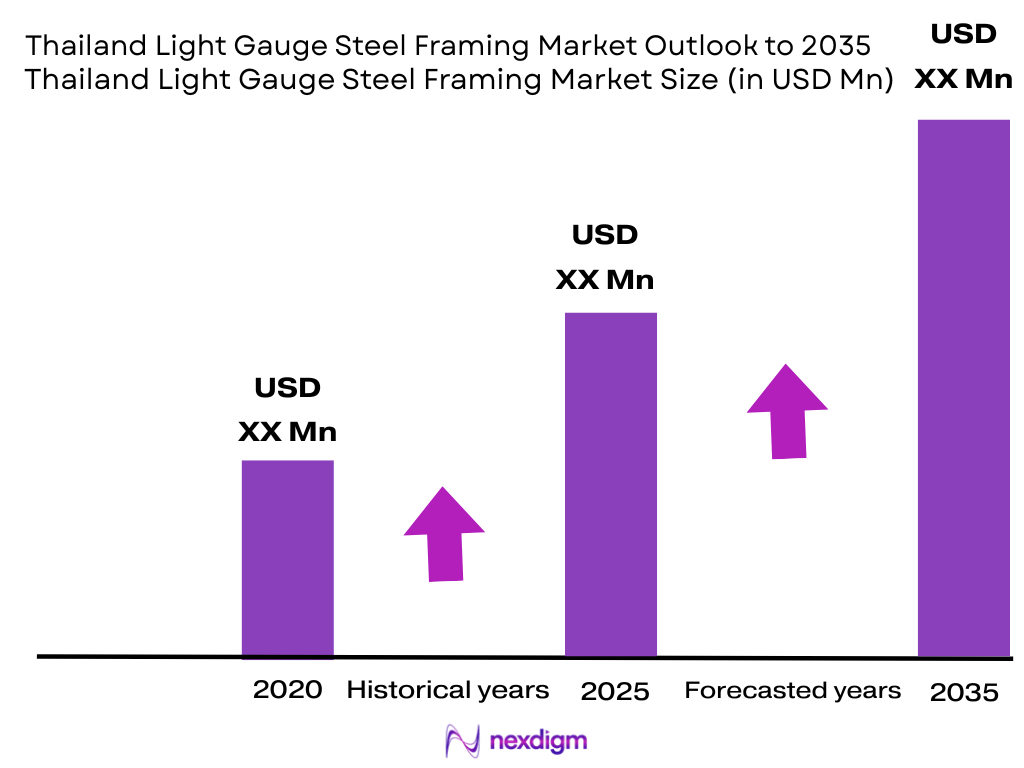
The Thailand Light Gauge Steel Framing Market is valued at approximately ~ million, supported by prefabricated construction, industrial building development, housing activity, and demand for faster dry-construction systems. Thailand recorded approximately 60.85 million square metres of new building construction area in the preceding reporting period, while the subsequent period recorded approximately 52.10 million square metres. LGSF benefits from factory prefabrication, dimensional consistency, termite resistance, and rapid on-site installation. Bangkok, its surrounding metropolitan provinces, the Central Region, and the Eastern industrial corridor represent the principal demand centres for Thailand Light Gauge Steel Framing. The Central Region recorded about 19.54 million square metres of new building area in one reporting period, while Bangkok and surrounding provinces accounted for substantial residential and commercial construction volumes. These locations benefit from concentrated property development, factories, warehouses, logistics facilities, skilled contractors, steel-processing infrastructure, and access to prefabrication facilities.
Market Segmentation
By Frame Application
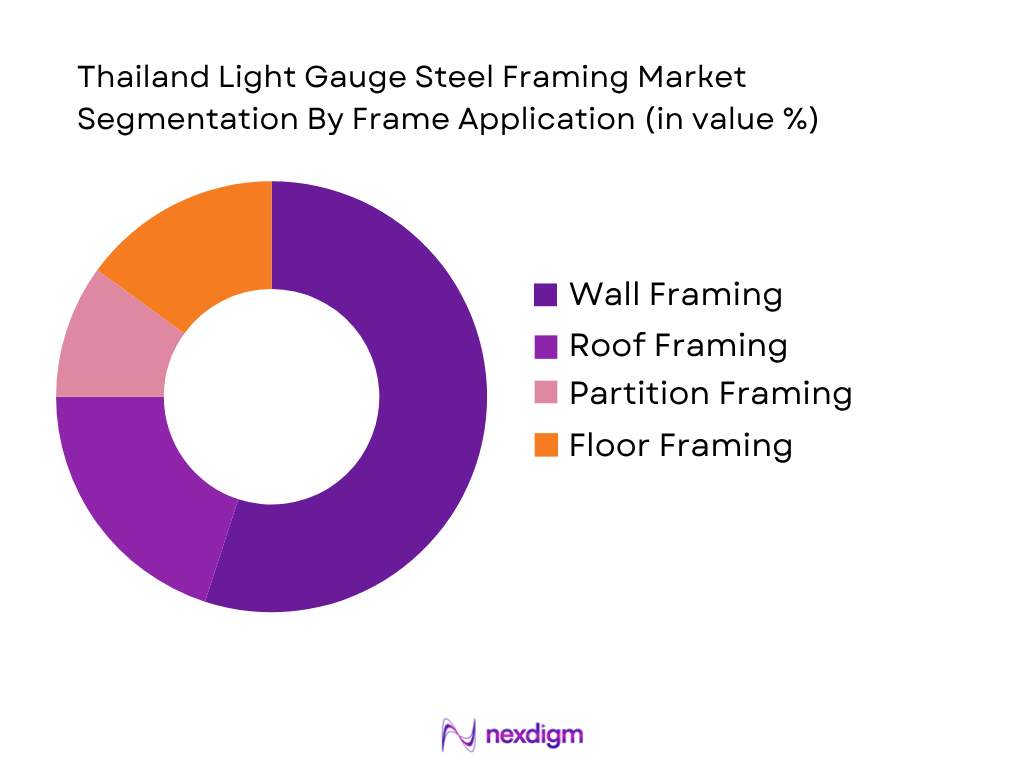
The Thailand Light Gauge Steel Framing Market is segmented by frame application into wall framing, roof trusses and roof framing, floor framing, and complete structural framing systems. Recently, wall framing represents the dominant placeholder segment because light-gauge load-bearing and non-load-bearing walls can address residential, modular, commercial, and low-rise building requirements while reducing dependence on wet construction. Prefabricated C-sections can be engineered and cut before reaching the project site, supporting repeatability and shorter installation schedules. Thailand already has commercially available LGSF systems incorporating load-bearing wall framing, roof structures, floors, and associated components. Local systems also use high-strength coated steel and accommodate internal MEP routing, fibre-cement boards, lightweight concrete panels, insulation, and façade finishes. This versatility strengthens wall framing’s applicability across detached houses, villas, resorts, worker accommodation, modular buildings, offices, and selected institutional projects.
By End-Use Building Type
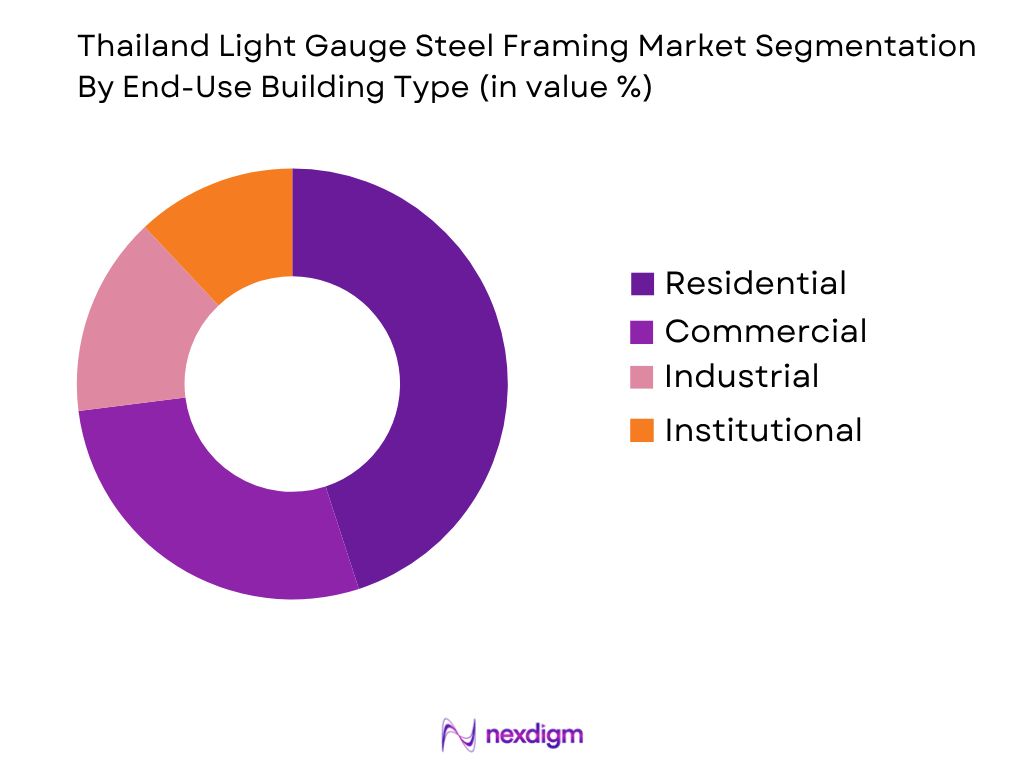
The Thailand Light Gauge Steel Framing Market is segmented by end-use into residential buildings, commercial buildings, industrial and warehouse buildings, hospitality buildings, and institutional/modular buildings. Recently, residential construction represents the dominant placeholder segment because low-rise houses, villas, extensions, resort residences, and modular homes are particularly compatible with lightweight prefabricated steel systems. Thailand’s official construction statistics show residential buildings forming the largest category of permitted construction units, providing a broad addressable construction base. LGSF additionally addresses characteristics important in Thailand, including termite resistance, dimensional stability, lightweight handling and reduced dependence on timber framing. Prefabrication also allows structural components to arrive at site ready for assembly, which can improve schedule control where labour availability and site congestion are constraints. Suppliers operating in Thailand explicitly position light-gauge framing for residential and light-commercial construction, reinforcing residential buildings as a core application.
Competitive Landscape
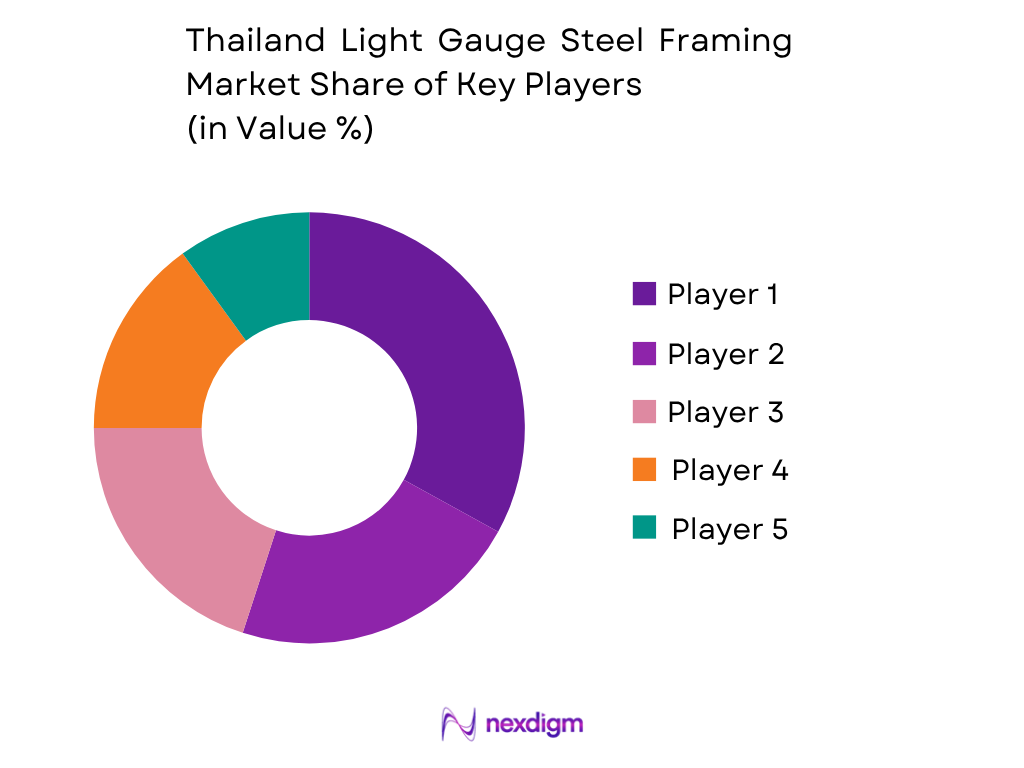
The Thailand Light Gauge Steel Framing Market combines specialized LGSF contractors, domestic cold-formed steel processors, prefabricated-building companies, and international steel-building technology providers. Competition centres on engineering capability, coated-steel specifications, roll-forming accuracy, structural-design integration, prefabrication, erection speed, project customization, and nationwide project execution. Thailand-based suppliers increasingly compete by providing integrated design-to-installation solutions rather than supplying profiles alone. BlueScope Lysaght, for example, manufactures light-gauge structural components in Thailand, while specialized providers offer complete LGSF and modular building solutions.
| Major Player | Establishment | Headquarters / Key Base | LGSF Offering | Steel / Structural Capability | Design Capability | Prefabrication | Key End Uses | Thailand Presence |
| NS BlueScope Lysaght Thailand | Thailand operations since 1988 | Pathum Thani, Thailand | ~ | ~ | ~ | ~ | ~ | ~ |
| LGS Solutions | — | Bangkok, Thailand | ~ | ~ | ~ | ~ | ~ | ~ |
| Steel Builder Thailand | — | Ayutthaya, Thailand | ~ | ~ | ~ | ~ | ~ | ~ |
| SEICO Thailand | — | Thailand operations | ~ | ~ | ~ | ~ | ~ | ~ |
| Ecolit Thailand | 2008* | Thailand operations | ~ | ~ | ~ | ~ | ~ | ~ |
Thailand Light Gauge Steel Framing Market Analysis
Growth Drivers
Expansion of Industrial Estates, Data Centers and Advanced Manufacturing Facilities
Thailand’s accelerating industrial and digital infrastructure pipeline is creating a broader construction base for light gauge steel framing, particularly for factory offices, utility buildings, equipment enclosures, warehouses, worker facilities and modular support structures where speed and dry construction are important. The Thailand Board of Investment reported 68 industrial estates across 16 provinces in its 2024 investment materials, supported by major logistics corridors and deep-sea ports. Digital-sector applications also reached 150 projects representing THB 243.3 billion of pledged investment in 2024. Momentum strengthened further in 2025, when the BOI received 3,370 investment applications valued at THB 1,876,653 million. These investments increase requirements for rapid industrial building deployment and repeatable construction systems. Thailand’s broader economic base also supports this activity: the World Bank recorded a population of around 72 million people and GDP per capita of USD 7,346.62 in 2024, while GDP reached USD 577.01 billion in 2025. Light gauge steel framing can benefit because industrial developers increasingly require dimensionally accurate partitions, mezzanine support structures, equipment rooms and prefabricated wall-and-roof assemblies that can be erected without extensive wet trades. The concentration of advanced manufacturing and digital facilities around Bangkok, Chon Buri, Rayong and other industrial provinces consequently creates a sizeable addressable construction pipeline for cold-formed steel framing suppliers.
Recovery in Construction Activity and Growing Urban Building Requirements
Thailand’s construction environment has strengthened after the weakness experienced in early 2024, providing a more supportive backdrop for prefabricated steel-based building systems. The National Economic and Social Development Council reported that the construction sector returned to expansion across 2024 and accelerated further during 2025, with activity supported particularly by government and infrastructure construction. By the first quarter of 2026, construction remained on an expansionary path, while private construction also continued to increase. Absolute macroeconomic scale is substantial: the World Bank reports USD 577.01 billion of GDP and GDP per capita of USD 8,056.6 for Thailand in 2025, while the IMF reports a national population of 71.56 million people in 2026. This construction and population base supports ongoing requirements for residential extensions, commercial buildings, industrial facilities, hospitality projects, schools, healthcare buildings and mixed-use developments. Light gauge steel framing is particularly relevant where developers need lighter structural loads, controlled factory fabrication, fast enclosure, reduced on-site material handling and compatibility with gypsum board, insulation and façade systems. Thailand’s dense urban construction environment also places increasing importance on solutions that minimise storage space and shorten structural installation sequences. Consequently, the combination of active public construction, industrial expansion and continued urban building activity provides a practical demand foundation for light gauge steel framing rather than relying solely on conventional masonry and reinforced-concrete infill systems.
Market Challenges
Weakness in Parts of the Residential and Private Real-Estate Pipeline
A key challenge for Thailand’s light gauge steel framing industry is uneven demand across residential and privately financed property construction. Light gauge steel framing can penetrate housing, apartments, low-rise commercial properties and internal wall systems, but these applications depend heavily on developer confidence and availability of property finance. Bank of Thailand data show that outstanding pre-finance lending for residential real estate stood at THB 363,413 million in the fourth quarter of 2024, compared with THB 370,735 million in the first quarter of the same year, illustrating restrained financing conditions across part of the development market. The Bank of Thailand also reported THB 2.66 trillion of cumulative loans under targeted financial-assistance measures in early 2025, demonstrating the scale of household and borrower balance-sheet pressures affecting domestic demand. The central bank additionally noted that Bangkok and surrounding areas experienced weaker residential activity in late 2024, affecting both low-rise housing and condominiums. These conditions matter directly for light gauge steel framing because residential developers generally adopt alternative construction technologies most rapidly when project pipelines are expanding and capital turnover is strong. With tighter financing, developers may delay new projects, reduce specification changes, continue using familiar concrete-and-masonry methods or limit investment in prefabrication equipment. Suppliers therefore need to diversify beyond housing into factories, warehouses, data centers, healthcare, hospitality and government-linked projects rather than depending exclusively on residential adoption.
Technical Capability and Skilled Installation Constraints
The technical nature of light gauge steel framing creates another challenge because successful projects require accurate structural engineering, roll-forming, connection detailing, corrosion protection, fire-performance design, moisture control and disciplined installation rather than simple substitution of steel studs for masonry. Thailand’s rapidly expanding investment pipeline can intensify pressure on these specialised capabilities. The Board of Investment recorded 3,370 promoted-investment applications valued at THB 1,876,653 million in 2025, covering digital infrastructure, electronics, advanced manufacturing and other construction-intensive sectors. Thailand also already hosts 68 industrial estates across 16 provinces, meaning LGSF suppliers must support geographically dispersed projects rather than a single construction cluster. For framing contractors, errors in screw spacing, track anchorage, bracing, sheathing, openings or galvanised coating specification can reduce structural performance and undermine confidence among architects and developers. Light steel structures also require appropriate design for Thailand’s humid tropical conditions, wind exposure and interfaces with waterproofing and external cladding systems. The challenge is therefore not simply the number of available construction workers but the availability of personnel capable of reading cold-formed-steel shop drawings, operating roll-forming systems, coordinating mechanical and electrical penetrations, and executing engineered connections consistently. Without stronger installer training and standardised detailing, developers may continue selecting reinforced concrete, masonry or hot-rolled structural steel because those systems have larger established contractor ecosystems. Expanding engineering support, installer certification and factory-quality control is therefore critical for broader LGSF adoption.
Market Opportunities
Data Center and High-Technology Building Construction
Thailand’s rapidly expanding data-center pipeline creates a significant future opportunity for light gauge steel framing suppliers because these projects generate demand not only for primary data halls but also for administrative areas, control rooms, service buildings, internal partitions, plant enclosures, security facilities and modular ancillary structures. Current investment commitments provide a measurable demand foundation. In 2024, the Board of Investment approved a THB 2.54 billion data-center project at Nava Nakorn Industrial Estate in Pathum Thani with approximately 25 MW of IT load. The digital sector recorded 150 investment applications valued at THB 243.3 billion during the same period. In 2026, another approved Tier 3 data-center development in Rayong involved THB 23.7 billion of investment and approximately 203 MW of IT load. These facilities require highly coordinated construction schedules and significant amounts of non-load-bearing framing, equipment separation, service corridors and dry-wall assemblies. Light gauge steel framing is positioned to benefit because components can be roll-formed to predetermined dimensions, delivered in sequenced packages and integrated with insulation, fire-rated boards and building-services penetrations. The opportunity also extends into nearby utility buildings, temporary project facilities and subsequent campus expansion. With data-center development concentrated in industrial estates where repeatable design and rapid construction are commercially important, suppliers that can provide engineered framing packages, BIM-compatible detailing and certified fire-rated wall systems can build a stronger position in Thailand’s next generation of industrial construction.
Prefabrication and Industrialized Construction for Thailand’s Investment Pipeline
Thailand’s large pipeline of manufacturing, logistics and technology investment creates an opportunity for light gauge steel framing to move beyond conventional internal partitions toward panelised walls, modular buildings, factory offices, accommodation units, rooftop additions and complete low-rise structures. The Board of Investment reported 3,370 investment applications worth THB 1,876,653 million in 2025, while a 2026 acceleration initiative selected 80 large projects with a combined value exceeding THB 480 billion for expedited implementation. These projects are concentrated in sectors including data centers, clean energy, electric vehicles and printed circuit boards, all of which require supporting buildings and fast project mobilisation. Thailand’s existing industrial infrastructure—68 industrial estates in 16 provinces—provides a ready geographic network where standardized framing systems can be fabricated centrally and delivered to multiple construction sites. The World Bank’s reported USD 577.01 billion economy in 2025 further demonstrates the scale of the national industrial base supporting construction demand. For LGSF suppliers, the most attractive future position is likely to be integrated prefabrication rather than commodity stud supply. Companies can combine cold-formed steel design, roll-forming, panel assembly, sheathing, insulation, MEP openings and digital fabrication into factory-produced packages. This approach can reduce dependency on wet construction processes while improving dimensional consistency and making repetitive structures easier to replicate across industrial campuses. Partnerships with modular contractors, industrial-estate developers and international technology investors could therefore expand LGSF use substantially across Thailand’s non-residential building pipeline.
Future Outlook
The Thailand Light Gauge Steel Framing Market is expected to expand at approximately ~ CAGR during 2026–2035, supported by increasing acceptance of prefabricated and modular construction, demand for shorter construction cycles, and continued development of residential, industrial, logistics, hospitality, and commercial buildings. Future adoption will increasingly depend on integrated digital design, automated roll forming, standardized connections, corrosion-resistant coated steel, and factory-controlled component production. A major opportunity lies in shifting LGSF from individual roof and wall components toward complete engineered building envelopes and structural kits. Thailand already has commercially available systems combining walls, roofs, floors, framing and cladding, providing a foundation for broader modularization. Factory prefabrication can support tighter dimensional tolerances, standardized quality and reduced site work, while lightweight members simplify transportation and handling. Industrial and logistics construction represents another important pathway. Cold-formed steel and pre-engineered systems are already marketed in Thailand for industrial, commercial, agricultural and multipurpose structures. Growth in factories, warehouses, logistics facilities and supporting buildings can encourage hybrid construction in which heavier primary steel structures are combined with light-gauge secondary framing, walls, mezzanines and roofing systems.
Major Players
- NS BlueScope Lysaght Thailand
- NS BlueScope Thailand
- LGS Solutions
- Steel Builder Thailand
- SEICO Thailand
- Ecolit Thailand
- Thai Villa Group
- Pebsteel Thailand
- TMT Steel Public Company Limited
- Thai Koon Steel Group
- Cotco Metal Works
- FRAMECAD
- Howick Ltd
- Scottsdale Construction Systems
- Knauf Thailand
Key Target Audience
- Light Gauge Steel Framing Manufacturers
- Cold-Formed and Coated Steel Manufacturers
- Prefabricated and Modular Building Developers
- Residential, Industrial and Commercial Real Estate Developers
- EPC Contractors and Steel Building Fabricators
- Investments and Venture Capitalist Firms
- Building Material Distributors and Construction-System Suppliers
- Government and Regulatory Bodies (Department of Public Works and Town & Country Planning, Thai Industrial Standards Institute, Ministry of Industry, Board of Investment of Thailand)
Research Methodology
Step 1: Identification of Key Variables
The initial phase involves constructing the Thailand Light Gauge Steel Framing Market ecosystem covering coated-steel suppliers, roll formers, framing-system providers, fabricators, contractors, developers and end users. Key variables include steel thickness, coating specification, frame application, building type, project area, framing intensity, prefabrication penetration, domestic production and imported framing technology.
Step 2: Market Analysis and Construction
Historical construction activity is assessed alongside building permits, floor area, cold-formed steel availability and the adoption of prefabricated construction. The top-down approach evaluates addressable construction activity, while the bottom-up approach analyses framing volumes, average steel intensity, supplier throughput and project-level utilization to establish a consistent market model.
Step 3: Hypothesis Validation and Expert Consultation
Market hypotheses are validated through computer-assisted telephone interviews with steel-frame manufacturers, structural engineers, fabricators, contractors, developers and material suppliers. Discussions focus on actual LGSF adoption, material specifications, residential versus non-residential demand, procurement practices, competitive positioning, installation constraints and the transition from conventional construction toward factory-produced framing systems.
Step 4: Research Synthesis and Final Output
Primary findings are triangulated with government construction statistics, company disclosures, steel-industry information and project-level evidence. Supplier-side estimates are reconciled against demand from residential, commercial, industrial, hospitality and modular applications. The final framework provides market sizing, segmentation, competition analysis and long-term forecasts while avoiding double counting between component suppliers, fabricators and turnkey building-system providers.

- Executive Summary
- Research Methodology (Market Definition and Scope, Abbreviations, Light Gauge Steel Framing Boundary, Cold-Formed Steel Classification, Top-Down Market Sizing, Bottom-Up Steel Consumption Analysis, Project Pipeline Assessment, Building Floor-Area Mapping, Steel Consumption per Square Meter, Roll-Forming Capacity Mapping, Manufacturer Interviews, Contractor Interviews, Architect and Structural Engineer Interviews, Distributor Assessment, Primary Research Approach, Secondary Research Framework, Data Triangulation, Forecasting Framework, Scenario Analysis, Limitations and Future Conclusions)

- Definition and Scope
- Evolution of Light Gauge Steel Framing in Thailand
- Transition from Conventional Masonry and Reinforced Concrete to Lightweight Framing
- Evolution of Prefabricated and Off-Site Construction
- Light Gauge Steel Manufacturing Ecosystem

- Growth Drivers (Urban Housing Demand, Construction Labour Constraints, Faster Project Delivery, Prefabrication Adoption, Industrial Expansion, Hospitality Development, Termite Resistance, Construction Waste Reduction)
- Market Challenges (Steel Price Volatility, Engineering Awareness, Installer Skills, Corrosion Risk, Thermal Bridging, Fire Assemblies, Contractor Familiarity, Traditional Construction Preference)
- Market Opportunities (Panelized Housing, Modular Hotels, Industrial Facilities, Healthcare Modules, Educational Buildings, Renovations, Coastal Systems, Automated Fabrication)
- Market Trends (BIM Integration, CAD-to-Machine Production, Panelization, Modularization, High-Strength Steel, ZAM Coatings, Dry Construction, Digital Fabrication)
- SWOT Analysis
- Porter’s Five Forces Analysis
- PESTLE Analysis

- By Market Value (2020-2025)
- By Steel Consumption Volume (2020-2025)
- By LGS Framing Volume (2020-2025)

- By Frame Application (In Value %)
Wall Framing
Roof Framing
Floor Framing
Complete Structural Framing Systems - By End-Use Sector (In Value %)
Residential Construction
Single-Family Housing
Townhouses
Villas
Low-Rise Apartments - By Project Type (In Value %)
Greenfield Construction
Building Extensions
Building Renovation
Vertical Expansion
Roof Replacement and Addition - By Region (In Value %)
Bangkok Metropolitan Region
Central Thailand
Eastern Thailand
Northern Thailand
Northeastern Thailand

- Market Share of Major Players by Value
- Cross Comparison Parameters (Roll-Forming Production Capability, Profile and Steel Gauge Range, Galvanized/Advanced Coating Specification, BIM and Design-to-Fabrication Integration, Panelized and Modular System Capability, Residential–Commercial–Industrial Application Coverage, Installation Capacity and Project Lead-Time Capability, Thailand Geographic and Contractor Network Reach)
- SWOT Analysis of Major Players
- Detailed Profiles of Major Companies
LGS Solutions Co., Ltd.
Ecolit Thailand
Steel Solutions Thailand
NS BlueScope Thailand / Lysaght
Hadley Group Thailand
PD House / PD Steel House
PEB Steel Buildings
FRAMECAD
Scottsdale Construction Systems
Howick Ltd.
EPACK Prefab
Karmod Prefabricated Technologies
JinKai Building Materials
PTH House
DTH Prefab

- Housing Developers
- Private Homebuilders
- Hotel and Resort Developers
- Commercial Property Developers
- Industrial Estate Developers

- By Market Value (2026-2035)
- By Steel Consumption Volume (2026-2035)
- By Installed LGS Area (2026-2035)


 Request a Sample
 Ask for Customization
 Get a Quote
 Enquire Now