

 Download PDF
Market Overview
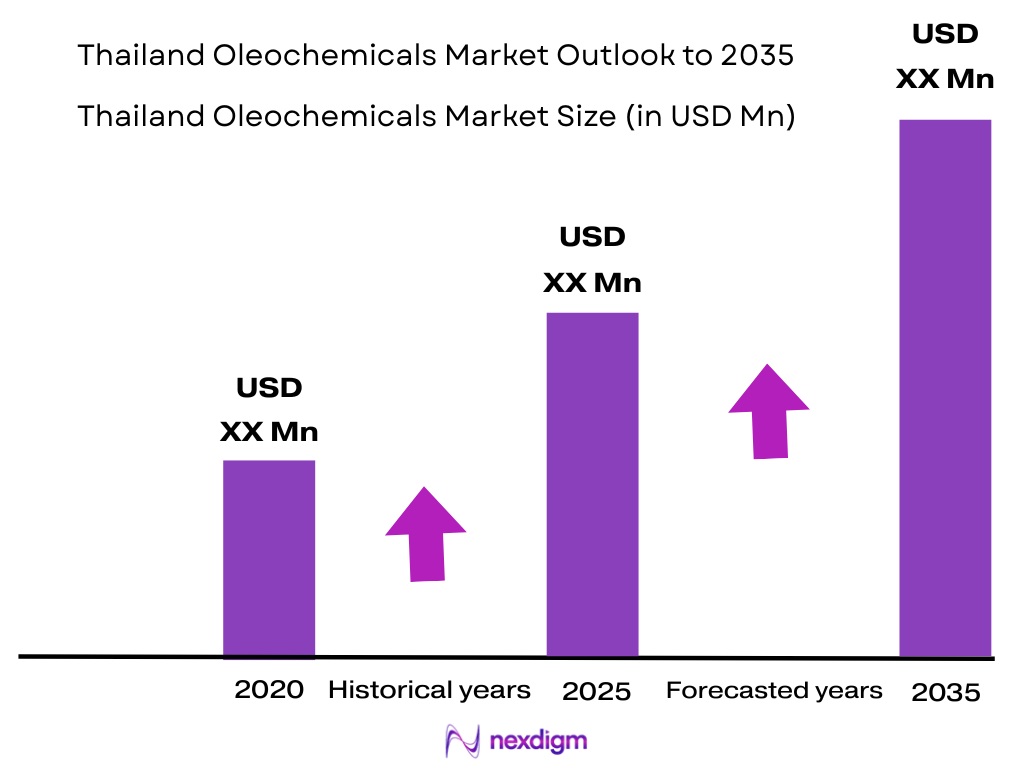
The Thailand oleochemicals market is valued at USD 1.18 billion in 2024, supported by strong availability of palm-based feedstock, increasing production of fatty acids, fatty alcohols, glycerin, and methyl esters, and rising adoption of renewable chemicals across personal care, detergents, food processing, pharmaceuticals, and industrial applications. The market was valued at USD 1.12 billion in 2023, with growth driven by expanding downstream chemical manufacturing, increasing demand for biodegradable ingredients, and Thailand’s position as a regional bio-based chemical manufacturing hub. Global oleochemicals demand continues to expand due to increasing substitution of petrochemical-based products with renewable alternatives. Thailand’s oleochemicals industry is concentrated around major agricultural and industrial clusters. Southern Thailand dominates as the primary feedstock region due to extensive oil palm cultivation and crude palm oil availability, which supports production of palm-derived oleochemicals. Bangkok and surrounding industrial provinces act as commercial and distribution centers, while Rayong and the Eastern Economic Corridor (EEC) contribute through advanced chemical processing infrastructure, export connectivity, and downstream manufacturing capabilities. Thailand’s integration between agriculture, refining, and chemical processing strengthens its position within Southeast Asia’s oleochemical ecosystem.
Market Segmentation
By Product Type
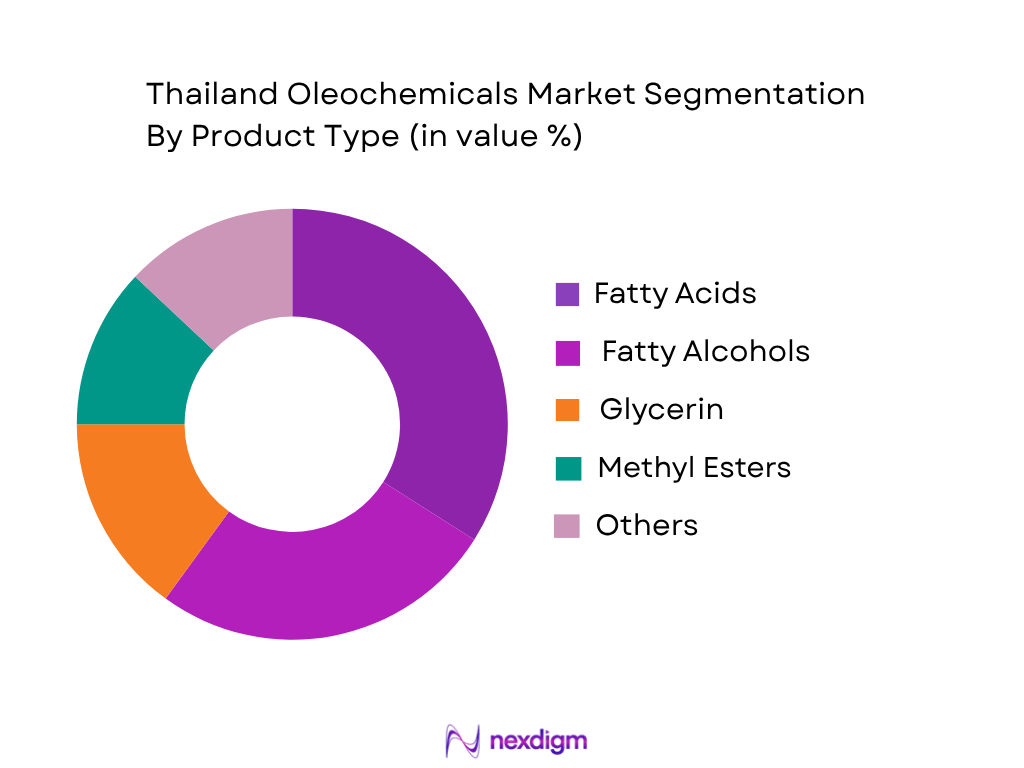
Thailand oleochemicals market is segmented by product type into fatty acids, fatty alcohols, glycerin, methyl esters, fatty acid esters, surfactants, and specialty oleochemicals. In 2024, fatty acids accounted for the largest market share at approximately 34%, supported by their extensive application as intermediate raw materials for soaps, detergents, cosmetics, lubricants, food additives, and industrial chemicals. Thailand’s palm oil processing ecosystem provides a stable supply of oleic acid, stearic acid, lauric acid, and other fatty acid derivatives. Fatty acids also serve as essential inputs for producing downstream products such as surfactants, emulsifiers, and esters, making them a critical component of Thailand’s oleochemical value chain. Fatty alcohols represented the second-largest category due to rising demand from personal care and home care manufacturers.
By Application
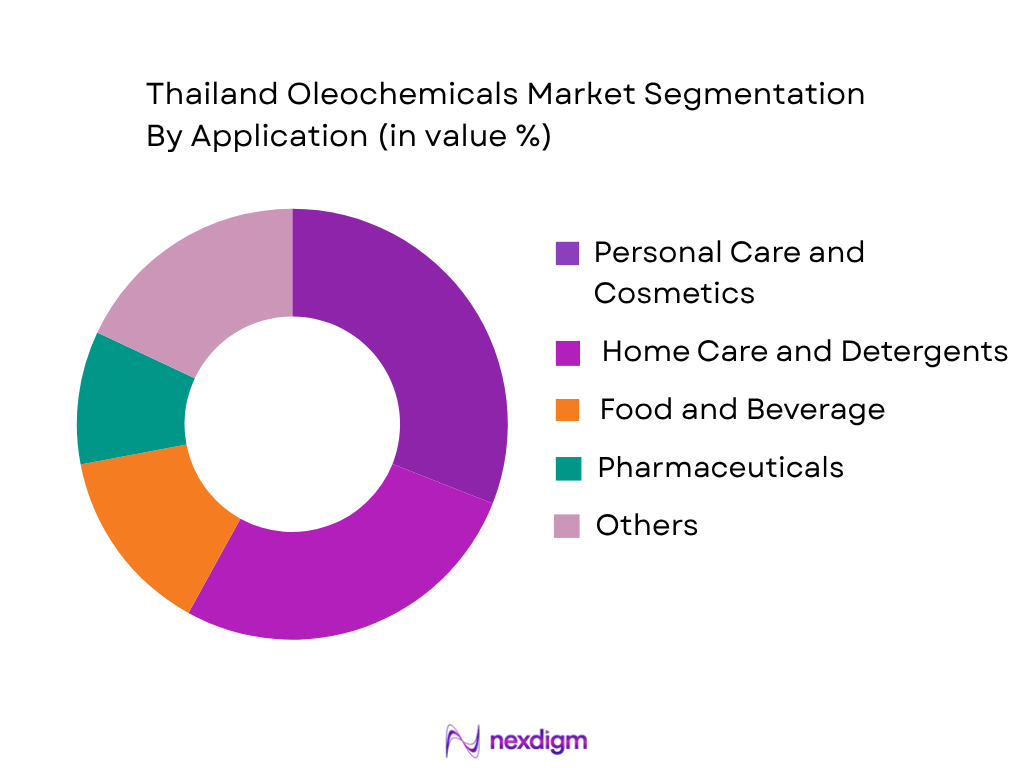
Thailand oleochemicals market is segmented by application into personal care and cosmetics, home care and detergents, food and beverages, pharmaceuticals, industrial lubricants, polymers, agrochemicals, and textiles. In 2024, personal care and cosmetics accounted for the largest market share at approximately 31%, driven by increasing demand for natural-based ingredients, sustainable surfactants, emollients, and conditioning agents. Thailand’s expanding beauty and personal care manufacturing sector has increased consumption of oleochemical derivatives due to their biodegradability and compatibility with premium cosmetic formulations. Home care and detergent applications accounted for approximately 27% share due to the widespread use of fatty alcohol-based surfactants in cleaning products. Pharmaceutical and food applications are also expanding due to demand for high-purity glycerin and specialty derivatives.
Competitive Landscape
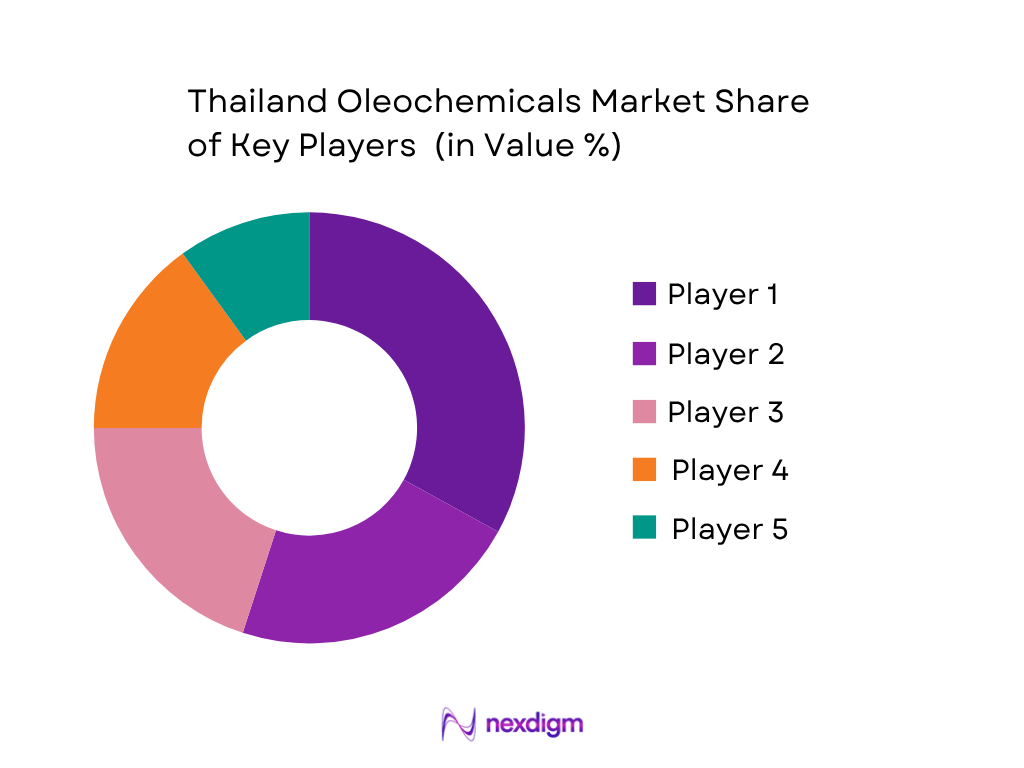
The Thailand oleochemicals market is moderately consolidated, with competition driven by integrated palm-based production capabilities, manufacturing scale, export networks, sustainability certifications, and specialty chemical development. Major players include Thailand-based producers and multinational oleochemical companies with regional manufacturing operations. These companies compete through product diversification, renewable feedstock utilization, and expansion into higher-value specialty oleochemical applications.
| Company | Establishment Year | Headquarters | Key Product Portfolio | Production Capability | Feedstock Integration | Major End-Use Industries | Sustainability Initiatives |
| Global Green Chemicals PCL | 2007 | Thailand | ~ | ~ | ~ | ~ | ~ |
| Wilmar International Limited | 1991 | Singapore | ~ | ~ | ~ | ~ | ~ |
| KLK OLEO | 1991 | Malaysia | ~ | ~ | ~ | ~ | ~ |
| Oleon | 2000 | Belgium | ~ | ~ | ~ | ~ | ~ |
| Emery Oleochemicals | 2008 | Malaysia/USA | ~ | ~ | ~ | ~ | ~ |
Thailand Oleochemicals Market Analysis
Growth Drivers
Abundant Palm Oil Feedstock Availability
Thailand’s oleochemicals industry benefits from its strong domestic palm oil ecosystem, which provides a renewable feedstock base for manufacturing fatty acids, fatty alcohols, glycerin, methyl esters, and other oleochemical derivatives. Thailand recorded approximately 6.0 million tonnes of crude palm oil production in 2024, supported by around 6.1 million rai of oil palm cultivation area, according to the Office of Agricultural Economics (OAE), Thailand. The country’s palm oil supply chain is concentrated in southern provinces such as Krabi, Surat Thani, Chumphon, and Nakhon Si Thammarat, enabling oleochemical producers to maintain access to locally sourced raw materials. Thailand’s agricultural sector remains an important economic contributor, with agriculture accounting for approximately 8.6% of Thailand’s GDP in 2024, according to the World Bank, highlighting the significance of agricultural commodities such as palm oil. The availability of domestic palm derivatives supports integrated oleochemical production, reduces dependence on imported feedstock, and strengthens Thailand’s position as a regional producer of renewable chemical ingredients. Growing demand for sustainable alternatives in personal care, home care, and industrial applications continues to increase the strategic importance of palm-based oleochemical production.
Expansion of Palm-Based Oleochemical Production
Thailand’s oleochemical manufacturing sector is expanding through investments in integrated facilities capable of converting palm oil derivatives into higher-value chemical intermediates. The country has strengthened its bio-based chemical ecosystem through industrial clusters, particularly in the Eastern Economic Corridor (EEC), where chemical processing infrastructure supports downstream industries. Thailand’s industrial sector contributed approximately 35% of GDP in 2024, according to the World Bank, reflecting the country’s strong manufacturing foundation for chemical and processing industries. The government’s Bio-Circular-Green (BCG) Economy Model has prioritized renewable resource utilization, with Thailand allocating more than THB 50 billion under various BCG-related development initiatives, according to Thailand’s National Science, Technology and Innovation Policy Office. Palm-based oleochemical production aligns with this strategy by converting agricultural resources into higher-value products such as specialty esters, surfactants, and pharmaceutical-grade glycerin. Increasing investment in biotechnology, renewable chemicals, and sustainable manufacturing is encouraging producers to move beyond commodity oleochemicals toward specialty applications with higher industrial relevance. This transition supports Thailand’s ambition to become a regional hub for bio-based chemical manufacturing within ASEAN.
Market Challenges
Palm Oil Price Volatility
Thailand’s oleochemicals industry remains exposed to fluctuations in palm oil availability and international agricultural commodity movements because palm oil derivatives represent the primary raw material base for many oleochemical products. Thailand produced approximately 3.2 million tonnes of crude palm oil consumption demand in 2024, according to the Office of Agricultural Economics, while domestic production continues to depend on climatic conditions, plantation productivity, and agricultural cycles. Weather-related disruptions, including irregular rainfall patterns and climate variability, can affect oil palm yields and create supply uncertainty for oleochemical manufacturers. According to the World Bank’s 2024 climate indicators, Thailand remains vulnerable to climate-related agricultural impacts due to its dependence on natural resource-based industries. The country’s agriculture sector employed approximately 30% of Thailand’s workforce in 2024, according to World Bank data, demonstrating the economic importance and sensitivity of agricultural supply chains. Feedstock instability can influence production planning, inventory management, and long-term procurement strategies for oleochemical manufacturers. Companies operating in Thailand increasingly need to strengthen supply chain resilience through diversified sourcing, plantation productivity improvements, and sustainable agricultural practices.
Sustainability Certification Requirements
Increasing sustainability expectations from global consumer goods manufacturers create compliance challenges for Thailand’s oleochemical producers, particularly regarding responsible palm oil sourcing, traceability, and environmental standards. International buyers increasingly require certified sustainable feedstock as part of their procurement policies, encouraging producers to adopt standards such as RSPO certification and improved supply chain transparency. Thailand had approximately 1.3 million hectares of oil palm cultivation area in 2024, according to the Office of Agricultural Economics, making sustainable plantation management critical for maintaining export competitiveness. Thailand has also committed to reducing greenhouse gas emissions intensity under its climate framework, with the country targeting carbon neutrality by 2050 and net-zero greenhouse gas emissions by 2065, according to Thailand’s Office of Natural Resources and Environmental Policy and Planning. Compliance with sustainability requirements requires investment in certification systems, plantation monitoring, waste management, and environmentally efficient production technologies. Smaller producers may face difficulties implementing these systems due to technical and financial limitations. As international markets increasingly emphasize sustainable chemicals, maintaining certification compliance will remain a key operational requirement for Thailand’s oleochemical industry.
Market Opportunities
Expansion of Specialty Oleochemicals
Thailand’s oleochemicals industry has significant opportunities to expand into specialty chemical applications by leveraging its agricultural resources and existing chemical manufacturing capabilities. Demand for specialty oleochemicals is increasing as industries seek renewable ingredients with enhanced functional properties for cosmetics, pharmaceuticals, food processing, and industrial formulations. Thailand’s personal care and cosmetics sector continues to provide a strong downstream opportunity, with the country recording approximately USD 1.6 billion in cosmetic exports in 2024, according to the Department of International Trade Promotion (DITP), Thailand. Specialty oleochemicals such as emulsifiers, esters, and high-purity glycerin are increasingly used in premium formulations requiring renewable and biodegradable ingredients. Thailand’s manufacturing sector contributed approximately 35% of GDP in 2024, according to the World Bank, providing a strong industrial base for developing advanced chemical processing capabilities. The country’s BCG Economy Model also promotes value-added utilization of agricultural resources, encouraging industries to move from basic commodity processing toward higher-value bio-based products. Investment in specialty oleochemical production, research capabilities, and application-specific solutions can help Thai manufacturers capture opportunities across regional and international markets.
Bio-Based Surfactant Demand
Growing adoption of environmentally responsible cleaning and personal care products is creating opportunities for Thailand’s oleochemical producers to expand bio-based surfactant manufacturing. Oleochemical-derived surfactants are increasingly preferred due to their renewable origin, biodegradability, and compatibility with sustainable product formulations. Thailand’s household consumption base provides a strong foundation for demand growth, with the country having a population of approximately 71 million people in 2024, according to World Bank data, supporting continuous demand for home care and consumer products. The personal care and household chemical industries are also supported by Thailand’s manufacturing ecosystem, where industrial production remains a key contributor to economic activity. Thailand exported approximately USD 10 billion worth of chemical products in 2024, according to Ministry of Commerce Thailand trade data, reflecting the country’s established chemical trade capabilities. The shift toward green formulations among multinational consumer goods companies is encouraging manufacturers to adopt renewable surfactant technologies based on fatty alcohols and fatty acid derivatives. Expanding bio-based surfactant production provides opportunities for Thailand to strengthen its role as a sustainable chemical supplier within ASEAN and global markets.
Future Outlook
The Thailand oleochemicals market is expected to demonstrate steady expansion during the forecast period, supported by increasing demand for renewable chemicals, sustainable product formulations, and growth across personal care, home care, pharmaceutical, and industrial applications. The transition toward bio-based alternatives from petrochemical ingredients will remain a key growth catalyst. The Thailand oleochemicals market is projected to grow at a CAGR of 6.8% during 2026-2035, reaching an estimated market size of USD 2.18 billion by 2035. Growth will be supported by specialty oleochemical development, export expansion, sustainable palm-based production, and increasing investment in advanced chemical processing.
Major Players
- Global Green Chemicals Public Company Limited
- Wilmar International Limited
- KLK OLEO
- Oleon
- Emery Oleochemicals
- BASF
- Evonik Industries
- Croda International
- Musim Mas
- Sime Darby Oils
- Stepan Company
- Vantage Specialty Chemicals
- IOI Corporation Berhad
- Kao Corporation
- Godrej Industries
Key Target Audience
- Oleochemical manufacturers and integrated chemical producers
- Palm oil processing companies
- Personal care and cosmetics manufacturers
- Detergent and home care product manufacturers
- Pharmaceutical ingredient manufacturers
- Food ingredient manufacturers
- Investments and venture capitalist firms (Green Chemistry Investment Funds, Renewable Chemical Investment Firms)
- Government and regulatory bodies (Ministry of Industry Thailand, Department of Industrial Works, Ministry of Agriculture and Cooperatives Thailand)
Research Methodology
Step 1: Identification of Key Variables
The initial phase involves developing a comprehensive ecosystem map covering palm oil producers, oleochemical manufacturers, downstream industries, distributors, and regulatory authorities operating within Thailand. Extensive secondary research is conducted through company disclosures, government databases, trade statistics, chemical industry publications, and proprietary market intelligence sources to identify major market variables.
Step 2: Market Analysis and Construction
This phase involves analyzing historical market data including production capacity, product volumes, consumption patterns, pricing trends, import-export movements, and application demand. A bottom-up approach is applied by evaluating company-level production capabilities, revenue contributions, and product portfolios to construct market estimates.
Step 3: Hypothesis Validation and Expert Consultation
Market assumptions are validated through discussions with industry participants including oleochemical producers, palm oil processors, chemical distributors, and downstream manufacturers. Expert consultations provide operational insights regarding capacity utilization, pricing dynamics, raw material availability, competitive positioning, and future growth opportunities.
Step 4: Research Synthesis and Final Output
The final stage integrates primary and secondary research findings through data triangulation. Market segmentation, competitive benchmarking, future forecasts, and strategic recommendations are developed after validating supply-side production trends with demand-side consumption patterns.

- Executive Summary
- Research Methodology (Market Definition and Scope, Oleochemicals Industry Classification, Primary and Secondary Research Framework, Market Sizing Methodology, Top-Down Market Assessment, Bottom-Up Market Assessment, Demand-Side Analysis, Supply-Side Analysis, Raw Material Availability Assessment, Production Capacity Mapping, Industry Expert Interviews, Trade Flow Analysis, Import-Export Data Analysis, Competitive Benchmarking Framework, Forecasting Model, Data Validation and Triangulation, Research Limitations)

- Definition and Scope
- Oleochemicals Industry Evolution and Development Timeline
- Thailand Oleochemicals Industry Ecosystem Analysis
- Oleochemicals Value Chain Analysis
- Thailand Oleochemicals Supply Chain Analysis
- Role of Thailand in Southeast Asian Oleochemicals Market Landscape
- Thailand Oleochemicals Production Hub Analysis

- Growth Drivers (Abundant Palm Oil Feedstock Availability, Expansion of Palm-Based Oleochemical Production, Rising Personal Care Manufacturing, Growth of ASEAN Chemical Trade, Increasing Demand for Renewable Chemicals, Bio-Based Product Adoption, Export-Oriented Manufacturing Advantage)
- Market Challenges (Palm Oil Price Volatility, Sustainability Certification Requirements, Feedstock Supply Fluctuation, Competition from Indonesia and Malaysia, Energy Cost Pressure, Specialty Chemical Technology Constraints)
- Market Opportunities (Expansion of Specialty Oleochemicals, Sustainable Palm Derivative Development, Green Chemical Adoption, Bio-Based Surfactant Demand, Pharmaceutical Grade Glycerin Growth, Export Expansion to ASEAN Markets)
- Market Trends (Clean Beauty Ingredient Adoption, Renewable Chemical Transition, RSPO Certified Oleochemical Demand, Bio-Based Surfactant Innovation, Integrated Palm Biorefinery Development, Circular Economy Practices)
- Government Policies and Regulatory Framework (Thailand Palm Oil Development Policies, Bioeconomy Initiatives, Industrial Chemical Regulations, Environmental Compliance Standards, Hazardous Substance Regulations, Sustainability Certification Requirements)
- SWOT Analysis
- Porter’s Five Forces Analysis
- PESTLE Analysis

- By Market Value
- By Production Volume
- By Consumption Volume
- By Average Selling Price
- By Export Revenue Contribution
- By Domestic Consumption Contribution

- By Product Type (In Value %)
Fatty Acids
Fatty Alcohols
Glycerin
Methyl Esters
Fatty Acid Esters
Surfactants and Derivatives
Specialty Oleochemicals
Other Oleochemical Intermediates - By Raw Material Source (In Value %)
Crude Palm Oil (CPO)
Palm Kernel Oil (PKO)
Coconut Oil
Soybean Oil
Animal Fat Feedstock
Other Renewable Feedstocks - By Application (In Value %)
Personal Care and Cosmetics
Home Care and Detergents
Food and Beverage Industry
Pharmaceuticals - By Production Process (In Value %)
Hydrolysis Process
Fat Splitting Process
Hydrogenation Process
Esterification Process
Transesterification Process
Fractionation Process
Specialty Chemical Modification Process - By Grade Type (In Value %)
Industrial Grade Oleochemicals
Cosmetic Grade Oleochemicals
Pharmaceutical Grade Oleochemicals
Food Grade Oleochemicals
Specialty High-Purity Oleochemicals - By Distribution Channel (In Value %)
Direct Industrial Sales
Chemical Distributors
Specialty Chemical Suppliers
Online B2B Platforms
Export Trading Companies
Thailand Oleochemicals Market Regional Analysis

- Market Share Analysis of Major Players (By Revenue, Production Capacity, Product Portfolio, Application Segment, Export Volume)
- Cross Comparison Parameters (Production Capacity, Oleochemical Product Portfolio Breadth, Fatty Acid Manufacturing Capability, Fatty Alcohol Production Capacity, Glycerin Refining Capacity, Palm-Based Feedstock Integration Level, Export Market Presence, Sustainability Certification Portfolio)
- Pricing Analysis (By Product Category, Grade Type, Application Segment, Domestic vs Export Pricing)
- Major Companies Profiled
Wilmar International Limited
IOI Corporation Berhad
KLK OLEO
Emery Oleochemicals
Oleon
BASF
Evonik Industries
Croda International
Sime Darby Oils
Musim Mas
Thai Oleochemicals Company
Vantage Specialty Chemicals
KLK Emmerich
Azelis
Stepan Company

- End-User Industry Demand Assessment
- Consumption Pattern Analysis
- Demand Drivers by End-Use Industry
- Industrial Buyer Purchasing Behavior
- Raw Material Preference Analysis
- Product Specification Requirement Analysis
- Sustainability Preference Assessment

- By Market Value
- By Production Volume
- By Consumption Volume
- By Average Selling Price
- By Export Revenue Contribution
- By Domestic Consumption Contribution


 Request a Sample
 Ask for Customization
 Get a Quote
 Enquire Now