

 Download PDF
Market Overview
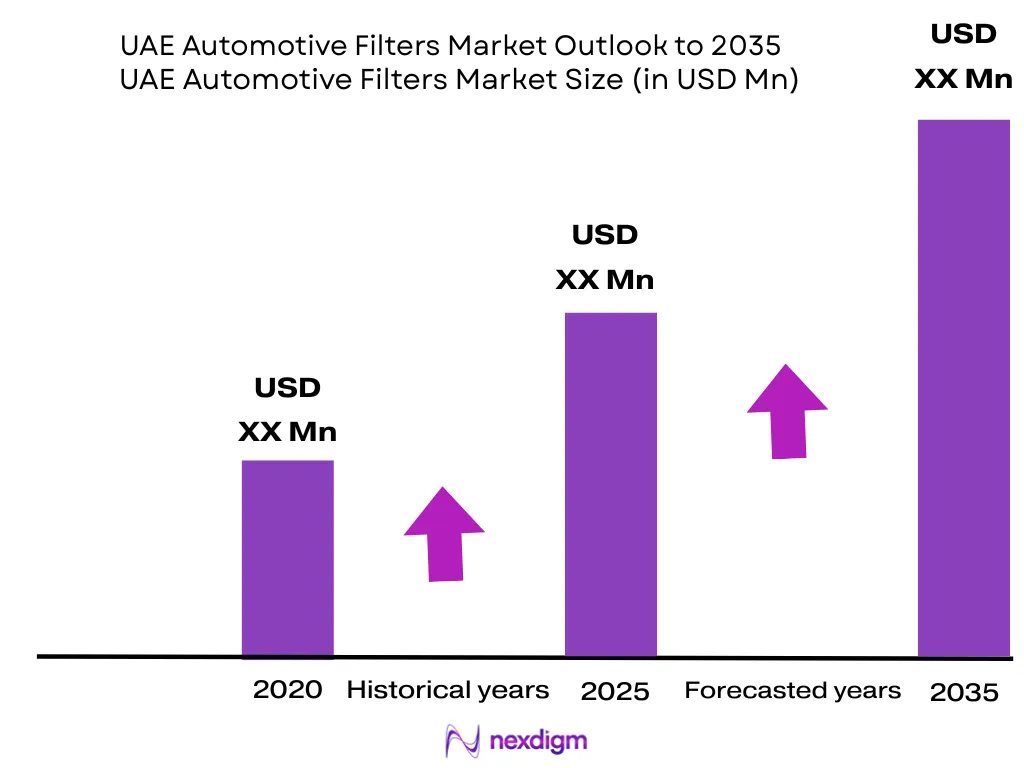
The UAE Automotive Filters Market is valued at approximately ~ million, compared with ~ million in the preceding reporting period. Demand is supported by an expanding vehicle population, high private-car usage, intensive taxi and rental-fleet operations, and recurring severe-duty maintenance. Dubai’s electric-vehicle population alone exceeded 34,970 units, supported by more than 740 public charging points. Desert dust, high temperatures, turbocharged engines, commercial activity, and preventive servicing sustain replacement demand. Dubai, Abu Dhabi, and Sharjah dominate the UAE Automotive Filters Market because they combine the country’s largest vehicle populations, dealership networks, parts warehouses, workshops, taxi fleets, logistics operations, and industrial activity. Dubai functions as the principal automotive trading and re-export hub through Jebel Ali, Ras Al Khor, Al Quoz, and Deira. Abu Dhabi generates premium passenger, government, oilfield, and construction-fleet demand, while Sharjah supports independent garages, parts traders, and commercial-vehicle servicing. The UAE automotive filters market covers filtration components installed in passenger cars, SUVs, pickups, vans, trucks, buses, luxury vehicles, off-highway equipment, hybrid vehicles, battery-electric vehicles, and specialist oilfield fleets. Products include engine-air filters, oil filters, fuel filters, cabin-air filters, transmission filters, hydraulic filters, crankcase filters, coolant filters, diesel particulate filters, gasoline particulate filters, urea filters, air-dryer cartridges, battery-cooling filters, and thermal-management filtration.
Market Segmentation
By Filter Type
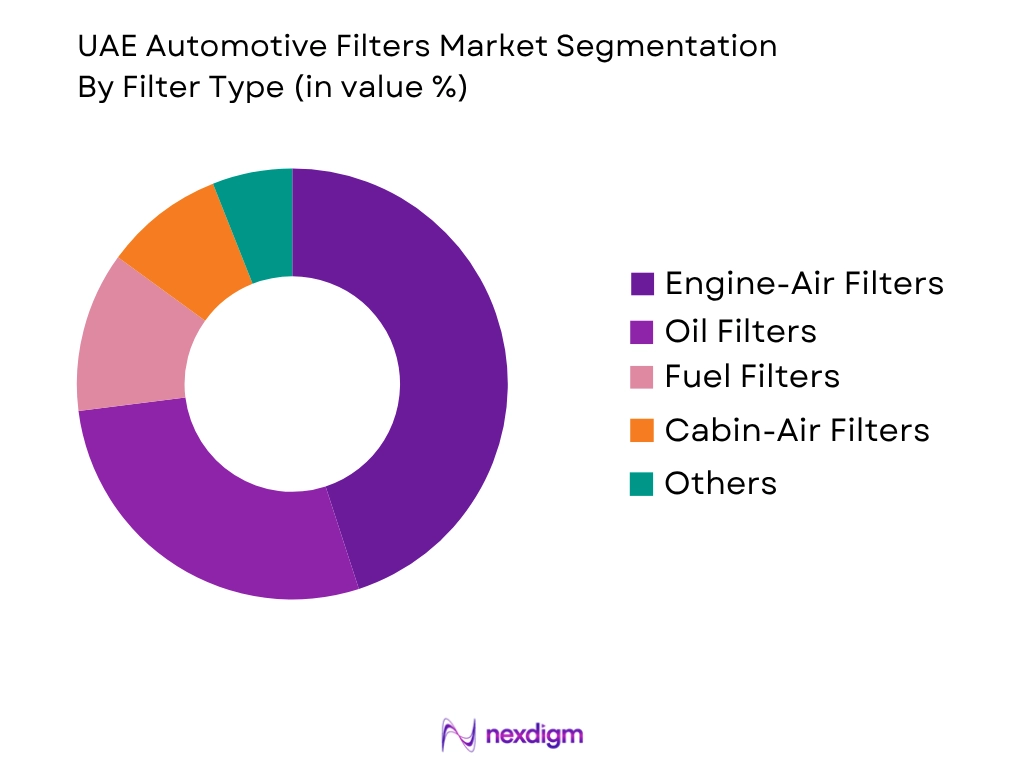
By filter type, the UAE Automotive Filters Market is segmented into engine-air filters, oil filters, cabin-air filters, fuel filters, transmission and hydraulic filters, emission-control filters, and electric-vehicle or other filtration products. Engine-air filters hold the dominant market share because the UAE’s desert environment causes greater exposure to sand and fine airborne dust than most automotive markets. Passenger cars, SUVs, pickups, trucks, buses, construction machinery, and oilfield equipment all require protection against abrasive particles. SUVs and off-road vehicles may encounter concentrated sand exposure during desert driving, while urban vehicles accumulate fine dust through daily traffic and roadside construction. Commercial and off-highway equipment commonly use primary and safety elements, radial-seal filters, or cyclonic pre-cleaners. Restricted airflow can reduce engine performance, increase fuel consumption, raise soot generation, and place additional stress on turbochargers. These operating conditions support shorter inspection intervals and demand for high-capacity synthetic or nanofibre media.
By Vehicle Type
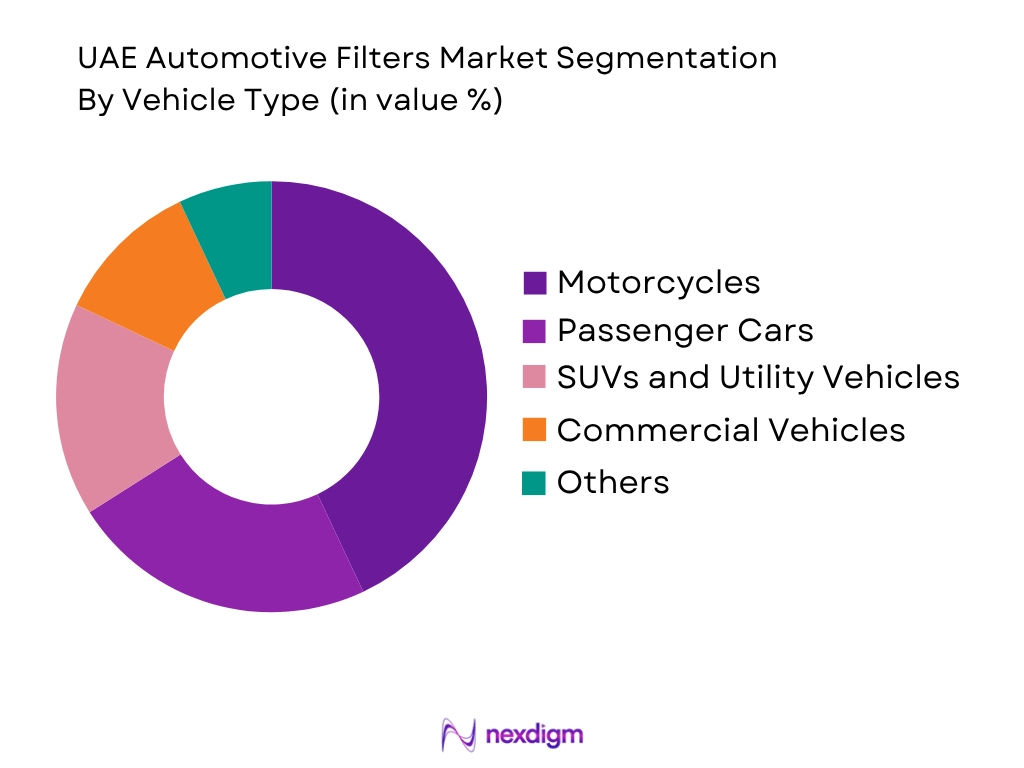
By vehicle type, the UAE Automotive Filters Market is segmented into passenger cars, SUVs and crossovers, luxury and performance vehicles, light commercial vehicles, heavy commercial vehicles, buses, off-highway equipment, and electric vehicles. SUVs and crossovers hold the dominant market share, supported by their widespread use among private owners, rental companies, government organisations, construction businesses, and desert-tour operators. SUVs frequently use larger petrol or diesel engines, turbochargers, advanced cabin systems, automatic transmissions, and all-wheel-drive architectures, producing multiple filtration revenue streams per vehicle. Desert driving and high ambient temperatures intensify air-filter, oil-filter, cabin-filter, and transmission-fluid maintenance. Premium SUVs also support higher-value activated-carbon cabin filters, synthetic-media oil filters, genuine dealer parts, and model-specific service kits. Passenger cars remain the largest broad installed category, but SUVs generate higher average filter expenditure because of engine size, severe-duty use, and premium product selection.
Competitive Landscape
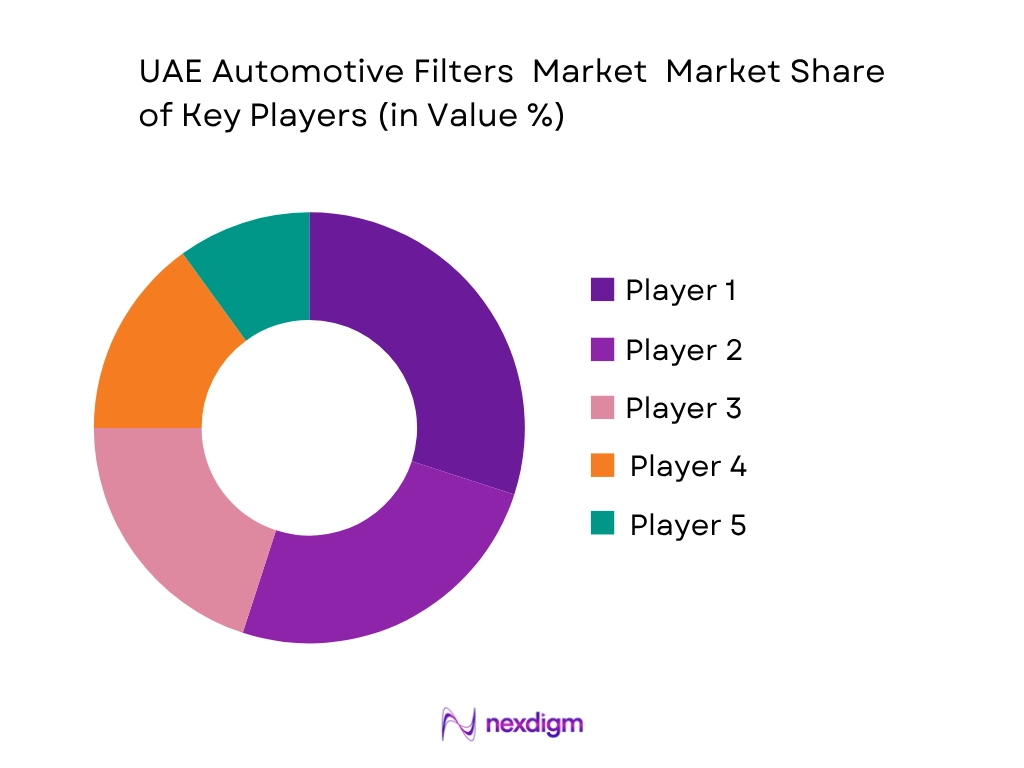
The UAE Automotive Filters Market is led by multinational filtration specialists, European and Japanese automotive suppliers, heavy-duty filter brands, and regional distributors. MANN+HUMMEL, Bosch, MAHLE, Donaldson, and DENSO compete through broad vehicle coverage, OEM-grade products, advanced media, technical catalogues, and established Middle East distribution. The wider aftermarket remains fragmented because these brands compete against genuine dealer parts, private labels, low-cost Asian imports, performance filters, and grey-market products.
| Company | Establishment Year | Headquarters | Core Filter Portfolio | Vehicle Coverage | UAE Channel Position | Severe-Duty Capability | Media Capability | EV Readiness |
| MANN+HUMMEL | 1941 | Ludwigsburg, Germany | ~ | ~ | ~ | ~ | ~ | ~ |
| Robert Bosch | 1886 | Gerlingen, Germany | ~ | ~ | ~ | ~ | ~ | ~ |
| MAHLE | 1920 | Stuttgart, Germany | ~ | ~ | ~ | ~ | ~ | ~ |
| Donaldson Company | 1915 | Bloomington, Minnesota, United States | ~ | ~ | ~ | ~ | ~ | ~ |
| DENSO | 1949 | Kariya, Japan | ~ | ~ | ~ | ~ | ~ | ~ |
UAE Automotive Filters Market Analysis
Growth Drivers
Desert Dust Exposure and Severe-Duty Vehicle Maintenance
The UAE’s desert climate creates unusually demanding operating conditions for automotive filtration systems. Fine sand and airborne dust enter engine-intake and cabin-ventilation systems, increasing loading on engine-air and cabin-air filters and requiring frequent inspection. Vehicles operating around construction sites, quarries, oilfields, desert-tour routes, and inter-emirate highways face particularly severe exposure. Poorly maintained engine-air filters can restrict airflow, increase turbocharger stress, and raise soot formation, while ineffective cabin filters reduce HVAC airflow and permit dust penetration. These conditions support demand for reinforced pleats, radial-seal designs, safety elements, cyclonic pre-cleaners, synthetic media, nanofibre coatings, and fine-dust cabin filters. The underlying economy supports sustained vehicle activity: the UAE’s real GDP reached approximately AED 1.776 trillion in 2024, while non-oil GDP amounted to about AED 1.342 trillion. Transport and storage was the fastest-growing major activity, supported by 147.8 million airport passengers, construction, tourism, trade, and logistics. The IMF projects real GDP growth of 3.1% in 2026, consumer-price growth of 2.5%, and a population of 11.465 million. These indicators support continued private mobility, fleet operation, construction activity, and preventive servicing, sustaining replacement demand for air, oil, fuel, cabin, hydraulic, and heavy-duty filters.
Expansion of Logistics, Construction, Tourism, and Commercial Fleets
The UAE’s expanding non-oil economy supports high utilisation of vans, trucks, buses, taxis, rental cars, construction machinery, port equipment, and oilfield vehicles. These applications require multiple filtration components, including fuel-water separators, engine-air filters, lube filters, coolant filters, crankcase filters, hydraulic filters, air-dryer cartridges, and emission-control filters. Commercial vehicles operating in stop-start delivery cycles or carrying heavy loads experience greater heat, dust ingestion, lubricant degradation, and fuel-system stress than privately operated cars. The Federal Competitiveness and Statistics Centre reported that transport and storage recorded the strongest sectoral expansion in 2024, while the wider non-oil economy reached approximately AED 1.342 trillion. The UAE Railway Programme involves an investment of AED 50 billion, connects major industrial and logistics centres, and is expected to create economic opportunities valued at AED 200 billion. Although rail will absorb part of long-distance freight movement, road vehicles will remain essential for first-mile, last-mile, port, warehouse, airport, and construction logistics. The IMF’s 2025 Article IV assessment projects real GDP growth of 5.0% in 2026, with non-hydrocarbon output increasing by 4.6% and hydrocarbon output by 6.3% under that forecast vintage. Continued tourism, construction, logistics, and energy activity therefore supports recurring filter replacement and creates demand for fleet-maintenance contracts, mobile servicing, and condition-based filtration management.
Market Challenges
Electric Vehicle Adoption and Declining Conventional Filter Content
Increasing electric-vehicle adoption creates a structural challenge for suppliers concentrated in engine-air, oil, fuel, crankcase, and exhaust-filtration products. A battery-electric vehicle does not require a combustion-air filter, engine-oil filter, petrol or diesel fuel filter, crankcase separator, or tailpipe particulate filter. Dubai’s electric-vehicle population exceeded 34,970 vehicles in October 2024, while the public charging network provided more than 740 charging points. By the end of the first half of 2025, the emirate had more than 40,600 electric vehicles and over 1,270 charging points, illustrating the speed at which the future service population is changing. This transition does not eliminate filtration demand, but it redirects expenditure toward activated-carbon cabin filters, battery-cooling filters, vent membranes, electric-drive lubrication filters, desiccant systems, and thermal-management fluid filtration. Suppliers must therefore maintain broad inventories for the existing petrol, diesel, hybrid, and commercial-vehicle parc while investing in lower-volume EV-specific applications. This creates tooling, catalogue, and stock-allocation complexity. The IMF projects a UAE population of 11.465 million and consumer-price growth of 2.5% in 2026, while the latest country page projects real output growth of 3.1%. Automotive demand should remain healthy, but manufacturers and distributors that fail to rebalance portfolios may face declining replacement frequency in traditional product categories.
Import Dependence, Counterfeit Products, and Fitment Complexity
The UAE automotive filter market depends heavily on imported finished filters, media, housings, seals, adhesives, and metal components. This exposes distributors to freight disruption, currency movements, shipping delays, supplier concentration, and inventory risks. The market also serves an unusually diverse vehicle parc containing Japanese, Korean, European, American, Chinese, and GCC-specification models, including luxury cars, supercars, pickups, SUVs, trucks, buses, and heavy equipment. Filters may differ by engine code, production location, model year, transmission, climate package, and emission specification. Incorrect fitment can cause oil leakage, fuel restriction, air bypass, reduced HVAC flow, warning lights, or engine damage. Counterfeit and grey-market products add another layer of risk because packaging can resemble premium brands while the internal media, bypass valves, seals, or adhesives fail to meet required specifications. The UAE’s large trading and re-export ecosystem increases the number of brands and SKUs circulating through local warehouses. The IMF projects nominal GDP of approximately USD 621.55 billion in 2026, indicating a large commercial base, but distributor profitability can still be affected by slow-moving inventory and price competition. Organised suppliers must invest in VIN-based catalogues, GCC fitment databases, QR authentication, tamper-resistant packaging, technician training, and same-day warehouse fulfilment. Strong technical documentation and accredited conformity testing are also important for reducing product-liability and warranty exposure.
Market Opportunities
Premium Cabin-Air Filtration for Dust, Odours, and Continuous HVAC Use
Cabin-air filtration represents a major opportunity because it remains relevant across petrol, diesel, hybrid, and battery-electric vehicles. UAE vehicles operate air-conditioning systems for much of the year, creating continuous airflow through cabin filters and increasing exposure to road dust, fine sand, pollen, traffic pollutants, construction particles, and odours. Standard particulate filters can be upgraded to activated-carbon, antimicrobial, allergen-reduction, electrostatic, and multilayer designs. Luxury vehicles, taxis, limousines, ride-hailing fleets, rental cars, buses, and electric vehicles offer particularly attractive applications because passenger comfort and interior air quality influence service decisions. Dubai’s EV population exceeded 34,970 vehicles in October 2024, while 16,828 customers had used the EV Green Charger initiative by the end of September and approximately 31,674 megawatt-hours of electricity had been supplied through the programme. These vehicles continue to require cabin filtration even though they eliminate conventional engine filters. The UAE’s population is projected by the IMF at 11.465 million in 2026, while nominal GDP is projected at approximately USD 621.55 billion, supporting a sizeable premium-consumer base. Suppliers can commercialise this opportunity through fine-dust filters, activated-carbon product tiers, seasonal inspection campaigns, digital replacement reminders, fleet subscriptions, and verified performance claims covering particle capture, gas adsorption, airflow resistance, and service life.
Connected Severe-Duty Filtration and Regional Re-Export Services
The UAE can become a regional centre for connected filtration, fleet service, and specialised filter distribution. Construction, logistics, oilfield, port, municipal, and heavy-equipment fleets require reliable filtration because unexpected downtime can disrupt high-value operations. Air-filter restriction sensors, fuel-water detection, oil-condition monitoring, differential-pressure measurement, and telematics can support condition-based replacement rather than fixed calendar servicing. This allows operators to avoid both premature filter changes and failures caused by overloaded media. The UAE Railway Programme’s AED 50 billion investment and expected AED 200 billion in economic opportunities will support industrial, logistics, and infrastructure activity, creating associated demand for road vehicles, material-handling equipment, construction machinery, and maintenance services. Dubai’s port, free-zone, warehousing, and trading infrastructure also enables suppliers to stock multi-brand filters and re-export them across the Gulf, Africa, and South Asia. The UAE’s real GDP reached approximately AED 1.776 trillion in 2024, with transport and storage leading sectoral growth. Suppliers can use this active operating base to offer automatic replenishment, kilometre-based contracts, mobile technicians, DPF cleaning, filter-core exchange, and remote monitoring dashboards. Companies combining severe-duty media, broad cross-reference catalogues, local inventory, and digital fleet analytics can move beyond one-time component sales toward recurring cost-per-kilometre and equipment-availability agreements.
Future Outlook
The UAE Automotive Filters Market is forecast to expand at approximately ~XX% CAGR during the forecast period. Growth will be supported by vehicle ownership, tourism and rental fleets, commercial logistics, construction activity, desert operating conditions, cabin-air-quality awareness, and increasing demand for technologically advanced filter media. The market will experience a gradual shift from conventional engine filtration toward premium cabin, severe-duty commercial, hybrid, and electric-vehicle applications. Petrol and diesel vehicles will remain the principal replacement base, but EV adoption will increasingly influence product development and distributor inventories. Desert-dust exposure will remain the defining market characteristic. Suppliers are expected to develop filters with greater dust-holding capacity, reinforced pleat structures, high-quality seals, synthetic layers, and nanofibre coatings. Cyclonic pre-cleaners and restriction-monitoring systems will gain relevance in off-road, construction, quarrying, and oilfield applications.
Major Players
- MANN+HUMMEL Middle East
- Robert Bosch Middle East
- MAHLE Aftermarket Middle East
- DENSO Middle East and North Africa
- Donaldson Middle East
- Parker Hannifin Middle East
- Atmus Filtration Technologies
- Hengst Filtration
- UFI Filters Middle East
- Sogefi Filtration
- Sakura Filters
- Fleetguard
- Baldwin Filters
- K&N Engineering
- Alco Filters
Key Target Audience
- Automotive filter and filtration-module manufacturers
- Passenger, luxury, commercial, and electric-vehicle manufacturers
- Automotive-parts importers, distributors, and re-exporters
- Authorised dealerships, quick-service centres, and independent garages
- Logistics, taxi, rental, bus, construction, and oilfield fleets
- Filter-media, activated-carbon, housing, seal, and monitoring-sensor suppliers
- Investments and venture capitalist firms
- Government and regulatory bodies (Ministry of Industry and Advanced Technology, Ministry of Energy and Infrastructure, Roads and Transport Authority, Abu Dhabi Mobility, Dubai Municipality, Environment Agency–Abu Dhabi, and Emirates Authority for Standardization-related conformity functions)
Research Methodology
Step 1: Identification of Key Variables
The first phase constructs an ecosystem map covering filtration manufacturers, importers, distributors, dealerships, workshops, fleets, regulators, and recyclers. Core variables include the vehicle parc, propulsion mix, annual mileage, dust exposure, filter content per vehicle, service intervals, product tier, and re-export contribution.
Step 2: Market Analysis and Construction
Historical registration, import, servicing, fleet, and workshop data are compiled. Top-down analysis assesses filtration revenue within the wider automotive-parts ecosystem, while bottom-up analysis applies vehicle populations, filters per vehicle, severe-duty replacement intervals, channel markups, and average selling values.
Step 3: Supply-Side Assessment
Suppliers are evaluated by portfolio breadth, regional warehousing, GCC fitment, heavy-duty capability, media technology, distributor reach, and re-export exposure. Product catalogues, trade listings, company disclosures, conformity records, and private-label participation are assessed to reconstruct organised supply.
Step 4: Demand-Side Assessment
Passenger owners, luxury-car users, SUV owners, garages, taxi operators, rental fleets, logistics companies, oilfield contractors, and construction fleets are assessed by mileage, duty cycle, dust exposure, maintenance behaviour, brand preference, and price sensitivity.

- Executive Summary
- Research Methodology (Market Definitions and Assumptions, Automotive Filter Market Boundary, Abbreviations, Market Sizing Approach, Top-Down Analysis, Bottom-Up Analysis, Vehicle Parc–Based Demand Modelling, Filter Replacement Interval Assessment, OEM Installation Assessment, Aftermarket Sell-Out Assessment, Fleet Maintenance Assessment, Import and Re-Export Assessment, Primary Industry Interviews, Data Triangulation, Forecasting Framework, Limitations and Future Conclusions)

- Definition and Scope
- Market Evolution and Industry Genesis
- Timeline of Major Industry Developments
- Automotive Filtration Technology Evolution
- Passenger Vehicle, Commercial Vehicle and Off-Highway Filtration Ecosystem

- Growth Drivers (High Vehicle Ownership, SUV and Luxury Vehicle Penetration, Severe Dust Exposure, Commercial Fleet Utilisation, Preventive Maintenance, Cabin Air Quality Demand)
- Market Challenges (EV Transition, Import Dependence, Counterfeit Products, Fitment Complexity, Extended Service Intervals, Price Competition)
- Market Opportunities (Premium Cabin Filtration, Severe-Duty Air Filters, Connected Fleets, EV Thermal Management, Re-Export, Sustainable Materials)
- Market Trends (Digital Fitment, Premium Cabin Filtration, Severe-Duty Media, Connected Maintenance, Sustainable Design, Omnichannel Retail)
- Government Regulations (Vehicle Emission Standards, GCC Conformity, Product Safety, Vehicle Inspection, Waste Management, Import Compliance)
- SWOT Analysis
- Porter’s Five Forces Analysis
- PESTLE Analysis

- By Market Value (2020-2025)
- By Filter Unit Sales (2020-2025)
- By Original Equipment Revenue (2020-2025)

- By Filter Type (In Value %)
Engine Air Filters
Oil Filters
Fuel Filters
Cabin Air Filters
Transmission Filters - By Vehicle Type (In Value %)
Passenger Cars
Sports Utility Vehicles
Crossovers
Luxury Vehicles
Supercars and Performance Vehicles
Pickup and Utility Vehicles - By Sales Channel (In Value %)
Vehicle Manufacturers
Tier-One Filtration System Suppliers
Authorised Vehicle Dealerships
Company-Owned Service Networks
National Automotive Parts Distributors
Regional Automotive Parts Distributors - By Emirate (In Value %)
Dubai
Abu Dhabi
Sharjah
Ajman
Ras Al Khaimah
Fujairah
Umm Al Quwain


- Individual Passenger Car Owner Analysis
- SUV and Off-Road Vehicle Owner Analysis
- Luxury and Performance Vehicle Owner Analysis
- Battery Electric Vehicle Owner Analysis
- Hybrid Vehicle Owner Analysis
- Diesel Vehicle Owner Analysis

- By Market Value (2026-2035)
- By Filter Unit Sales (2026-2035)
- By Original Equipment Revenue (2026-2035)


 Request a Sample
 Ask for Customization
 Get a Quote
 Enquire Now