

 Download PDF
Market Overview
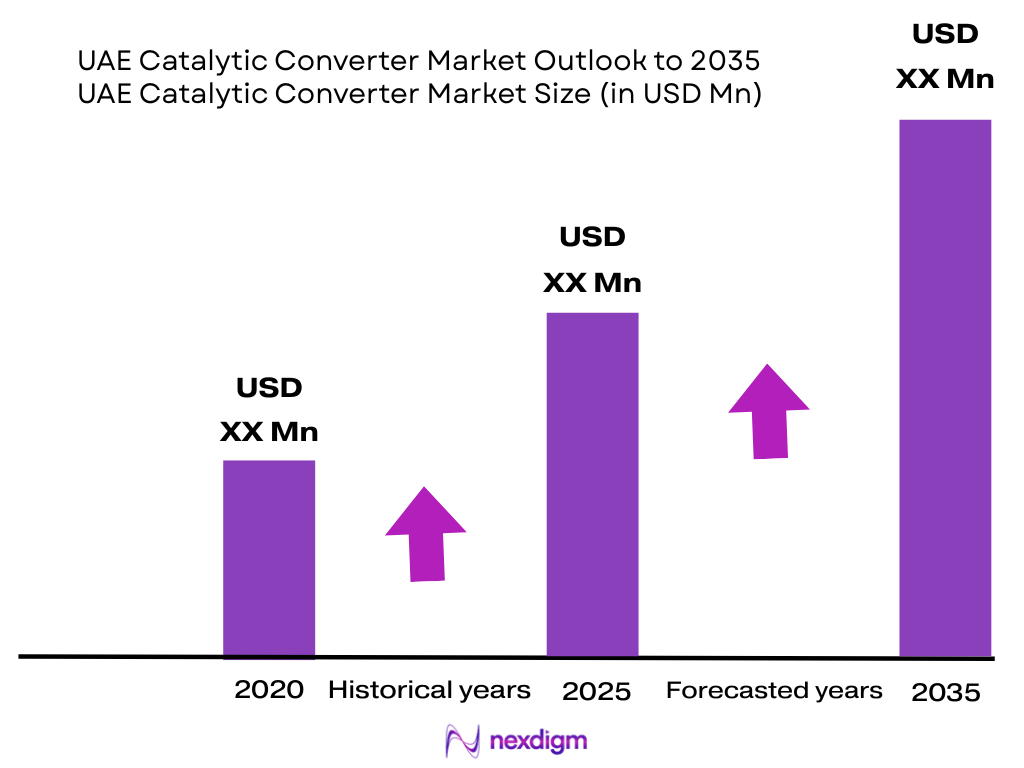
The UAE Catalytic Converter Market is valued at USD ~ million, supported by a large petrol-powered passenger-car, SUV, pickup, luxury-vehicle, taxi and commercial-fleet base. The UAE already had 81,000 electric and hybrid vehicles on its roads in the preceding observation, while electric and hybrid models subsequently represented almost 26% of new vehicle sales. This transition supports hybrid catalyst demand while the much larger combustion-vehicle parc sustains three-way catalyst replacement and servicing. Dominant Geographic Markets: Dubai, Abu Dhabi and Sharjah dominate the UAE Catalytic Converter Market because they concentrate vehicle registrations, luxury cars, SUVs, commercial fleets, garages, testing centres and automotive-parts distribution. Dubai alone recorded 702 million public-transport, shared-mobility and taxi journeys in the preceding annual period, increasing to 747.1 million, illustrating the intensity of road-mobility operations requiring extensive fleet maintenance. Dubai also functions as the UAE’s principal automotive-parts distribution and re-export hub, while Abu Dhabi has substantial government, corporate and taxi fleets.
Market Segmentation
By Vehicle Type
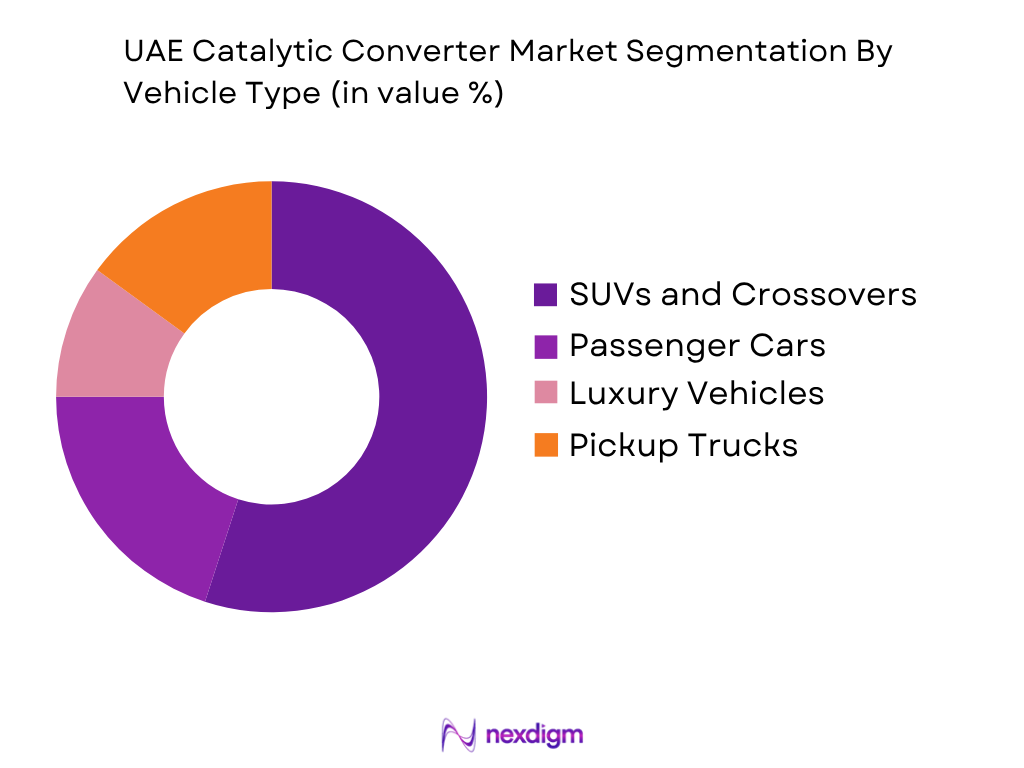
The UAE Catalytic Converter Market is segmented into passenger cars, SUVs and crossovers, pickup trucks, premium and luxury vehicles, light commercial vehicles, and medium/heavy commercial vehicles. SUVs and crossovers dominate the market by value in the report model because the UAE vehicle mix contains substantial numbers of large petrol-powered Japanese, American and European SUVs operating with V6, V8 and turbocharged engines. These vehicles can use larger catalyst substrates, twin-bank exhaust layouts and multiple catalytic-converter bricks, increasing catalyst content per vehicle relative to compact passenger cars. High ambient temperatures, highway operation and intensive air-conditioning loads also place durability requirements on substrates, washcoats, heat shields and precious-metal formulations. Premium SUVs additionally create attractive aftermarket replacement demand because vehicle owners frequently retain OEM-equivalent emissions functionality rather than fitting low-specification universal units. The UAE’s high-income economy reinforces demand for these higher-content vehicle categories: World Bank data place GDP at USD 552.32 billion and GDP per capita at USD 50,273.5.
By Powertrain Type
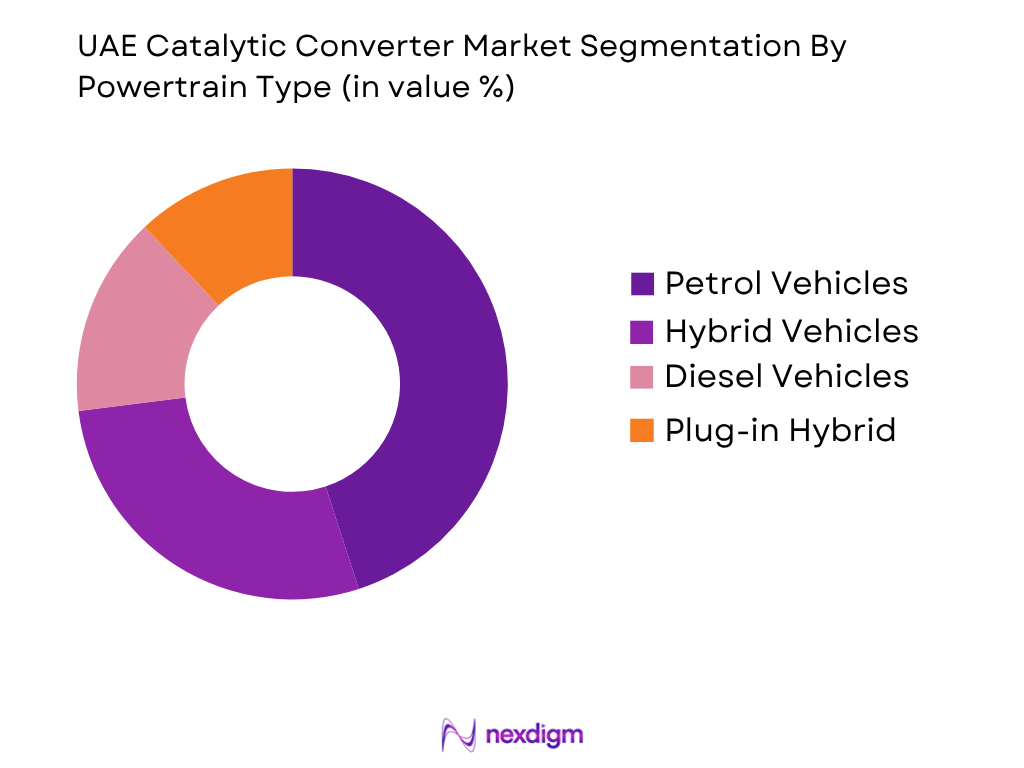
The UAE Catalytic Converter Market is segmented into conventional petrol vehicles, petrol hybrids, plug-in hybrids, diesel vehicles and other combustion-based powertrains. Conventional petrol vehicles dominate current catalytic-converter demand because the country retains a large installed base of gasoline-powered cars, SUVs and pickups requiring three-way catalysts for simultaneous control of hydrocarbons, carbon monoxide and nitrogen oxides. However, hybrids are becoming strategically more important. The Ministry of Energy and Infrastructure reported 81,000 electric and hybrid vehicles on UAE roads by mid-2023, while electric and hybrid vehicles represented almost 26% of total car sales in 2024. Hybridization preserves catalytic-converter demand because HEVs and PHEVs retain combustion engines, but introduces more demanding thermal-management conditions from repeated engine stop-start cycles. This supports low-light-off catalysts, close-coupled architecture, oxygen-storage materials and vehicle-specific PGM formulations even as conventional ICE demand gradually moderates.
Competitive Landscape
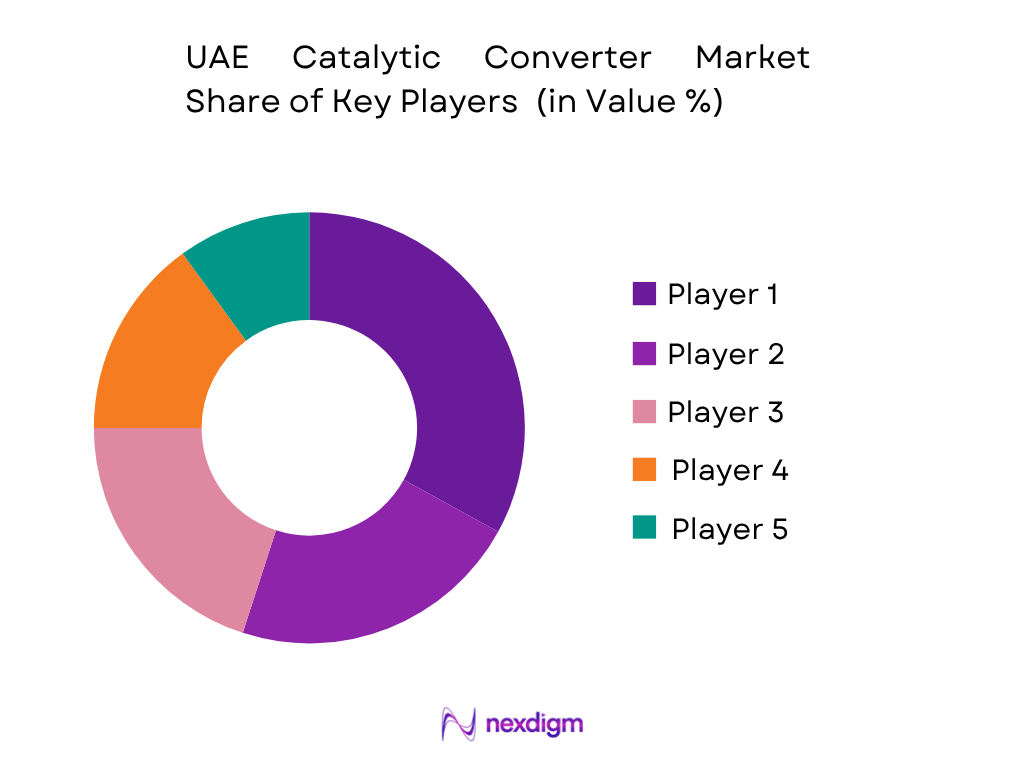
The UAE Catalytic Converter Market is supplied primarily through international catalyst-technology companies, global exhaust-system Tier-1 suppliers, OEM dealer networks and imported aftermarket brands rather than a large domestic catalyst-coating industry. Tenneco/Walker, FORVIA Clean Mobility, BASF Environmental Catalyst and Metal Solutions, Umicore and BOSAL represent important competitive benchmarks spanning complete converters, emissions-system integration, precious-metal chemistry, recycling and aftermarket coverage. Competition in the UAE depends heavily on Japanese, American and European vehicle application breadth; thermal durability; direct-fit availability; OBD compatibility; and rapid inventory access through Gulf distribution channels. BASF ECMS, for example, provides gasoline and diesel mobile-emissions catalysts alongside full-loop PGM management and recycling services.
| Major Player | Establishment | Headquarters | Core Offering | UAE/GCC Application Coverage | PGM/Catalyst Capability | Substrate & Thermal Capability | OEM/Aftermarket Position | Recycling Integration |
| Tenneco / Walker | 1940 | Northville, Michigan, USA | ~ | ~ | ~ | ~ | ~ | ~ |
| FORVIA Clean Mobility | 2022 | Nanterre, France | ~ | ~ | ~ | ~ | ~ | ~ |
| BASF ECMS | BASF roots 1865 | Iselin, New Jersey, USA | ~ | ~ | ~ | ~ | ~ | ~ |
| Umicore | 1805 roots | Brussels, Belgium | ~ | ~ | ~ | ~ | ~ | ~ |
| BOSAL | 1923 | Lummen, Belgium | ~ | ~ | ~ | ~ | ~ | ~ |
UAE Catalytic Converter Market Analysis
Growth Drivers
Large Petrol, SUV and Commercial Vehicle Base Supporting Replacement Demand
The UAE’s large combustion-powered vehicle ecosystem remains a fundamental growth driver for catalytic converters because petrol cars, SUVs, pickups, taxis, rental vehicles and commercial fleets continue to require three-way catalysts or diesel oxidation catalysts throughout their operating lives. The economic foundation supporting this vehicle-intensive mobility model is substantial: World Bank data place UAE GDP at USD 552.32 billion, GDP per capita at USD 50,273.5 and real GDP growth at 4.0 in 2024. The IMF separately reported that economic activity remained robust, with growth driven by domestic activity and moderated inflation; its 2025 Article IV work subsequently estimated 4.0 economic growth for 2024, followed by stronger expansion as non-hydrocarbon sectors and oil production increased. These macroeconomic conditions support vehicle ownership, premium-car purchases, road logistics and intensive fleet utilization. The catalytic-converter implications are particularly important in Dubai, Abu Dhabi and Sharjah, where vehicle fleets contain substantial numbers of large petrol SUVs and pickups with V6, V8 and turbocharged engines. Such platforms frequently use twin-bank exhaust arrangements, close-coupled catalysts and additional underfloor catalyst bricks, meaning one vehicle can create considerably more catalyst content than a compact passenger car. Commercial mobility adds a second layer of demand. The Ministry of Energy and Infrastructure introduced federal heavy-vehicle requirements supported by 24 smart electronic gates, while the federal framework allows qualifying heavy vehicles up to 65 tonnes, illustrating the continuing scale and formalization of road-freight operations. High-mileage logistics vehicles subject oxidation catalysts and wider exhaust-aftertreatment systems to continuous thermal cycling and loading, eventually supporting replacement activity. Dubai’s vehicle-ownership framework further reinforces the aftermarket because RTA verifies both valid insurance and valid technical inspection before vehicle registration renewal. This means ageing combustion vehicles cannot rely indefinitely on deteriorated exhaust systems if defects compromise roadworthiness or inspection compliance. Catalyst substrates can degrade through thermal ageing, engine misfires, excessive oil consumption, coolant contamination, rich combustion and physical monolith cracking; large-engine vehicles operating in Gulf heat can face particularly demanding thermal conditions. For the UAE Catalytic Converter Market, therefore, the growth mechanism extends far beyond new-vehicle fitment. The combination of a high-income economy, extensive petrol vehicle population, large-engine vehicle preferences, intensive fleet use and formal technical-inspection processes creates persistent demand for direct-fit converters, manifold assemblies, oxygen-sensor-compatible systems and premium OEM-equivalent replacement products.
Hybridization Preserving Catalyst Demand During the UAE’s Electrification Transition
Hybridization represents another strong growth driver for the UAE Catalytic Converter Market because it reduces fuel consumption without eliminating the internal-combustion engine or exhaust-aftertreatment system. The Ministry of Energy and Infrastructure reported that the UAE ranked first in the Middle East during 2024 for the share of electric and hybrid vehicles in new-car sales, with the combined category reaching almost 26 out of every 100 vehicles sold. This follows an earlier installed base of 81,000 electric and hybrid vehicles recorded on UAE roads, demonstrating that electrified mobility had already moved beyond a niche segment before the latest sales acceleration. For catalytic-converter manufacturers, the distinction between a battery-electric vehicle and a hybrid is critical. A BEV eliminates the exhaust system completely, while a full hybrid or plug-in hybrid still uses a petrol engine and therefore requires a three-way catalytic converter to oxidize carbon monoxide and hydrocarbons while reducing nitrogen oxides. Hybrid operating cycles can make catalyst engineering more demanding because the engine frequently shuts down while the electric motor propels the vehicle, allowing exhaust temperatures to fall. When the engine restarts, the catalyst must return quickly to its effective operating window. This increases the technical importance of close-coupled placement, reduced substrate thermal mass, high oxygen-storage capacity, advanced ceria-zirconia washcoats and optimized palladium-rhodium formulations. Dubai’s commercial mobility strategy further strengthens this bridge-market opportunity. RTA’s environmental fleet roadmap sets a path toward 70 green limousine vehicles out of every 100 in 2025 and 90 out of every 100 in 2026, with its long-term mix explicitly including hybrid vehicles alongside fully electric units. Hybrid taxis and limousines are especially relevant because their high annual mileage creates demanding thermal cycles and eventual service or replacement requirements for aftertreatment hardware. The macroeconomic setting provides additional support. World Bank data show UAE output of USD 552.32 billion in 2024, while the IMF’s 2025 assessment expected economic expansion to strengthen following 4.0 growth in 2024, driven by diversified non-hydrocarbon sectors and higher hydrocarbon output. This environment supports continued fleet renewal and adoption of advanced powertrains rather than a rapid collapse in vehicle demand. For the catalyst industry, hybridization therefore offers a valuable transitional segment: conventional petrol vehicles may gradually lose new-registration share, but hybrid SUVs, luxury cars, taxis and crossovers can preserve catalytic-converter installation while simultaneously increasing performance requirements. Suppliers able to offer low-light-off three-way catalysts, high-temperature-resistant substrates and vehicle-specific direct-fit systems for Toyota, Lexus, Hyundai, Kia and premium hybrid platforms can participate in electrification rather than merely being displaced by it.
Market Challenges
Battery-Electric Vehicle Expansion Removing Catalytic Converters from the Powertrain
Battery-electric vehicle adoption is the clearest structural challenge facing the UAE Catalytic Converter Market because an all-electric powertrain does not contain an internal-combustion engine and therefore has no exhaust manifold, catalytic converter, oxygen sensor or downstream exhaust aftertreatment. The federal government is actively accelerating this transition. The Ministry of Energy and Infrastructure reported that EVs accounted for 13 out of every 100 new cars sold in 2023, while the country’s EV policy ecosystem planned deployment of 100 UAEV chargers during 2024 and 1,000 chargers in total by 2030. The following year, the combined electric-and-hybrid share reached almost 26 vehicles per 100 new-car sales, indicating a rapid shift in powertrain choice. The government also intends electric and hybrid vehicles to represent 50 out of every 100 vehicles sold by 2050, underscoring the long-term nature of the transition. For catalyst suppliers, however, only the hybrid component preserves exhaust-aftertreatment demand; each pure BEV removes the catalytic converter entirely. This substitution has a larger lifetime impact than the initial lost OEM sale suggests. A petrol SUV sold today can create revenue from the original catalyst, oxygen-sensor diagnostics, potential catalyst-efficiency repairs, eventual aftermarket replacement and end-of-life PGM recovery. A battery-electric SUV generates none of those catalyst-related revenue streams. The threat is therefore strongest in premium and urban vehicle segments where UAE consumers can absorb new technology rapidly. Dubai’s commercial fleet transformation adds another example: the city’s limousine roadmap moves toward 70 green vehicles per 100 in 2025 and 90 in 2026, with full electrification representing a growing share of that fleet. Similar electrification across taxis, corporate fleets and government vehicles would progressively reduce high-mileage converter replacement demand. The challenge arises within an economy capable of financing the transition. World Bank data record USD 552.32 billion of GDP and USD 50,273.5 GDP per capita in 2024, while the IMF expects UAE real GDP expansion to accelerate from 4.0 in 2024 to stronger subsequent growth. High purchasing power, infrastructure investment and government incentives therefore make EV substitution more credible than in markets where charging and affordability remain major barriers. The immediate impact will nevertheless be gradual because the installed fleet remains heavily combustion-powered, and SUVs, pickups, commercial trucks and hybrids can remain catalyst-equipped for many years. The strategic challenge for converter manufacturers is consequently portfolio management: capacity dedicated solely to conventional petrol applications faces declining long-term new-fitment opportunity, while hybrid catalysts, high-mileage replacement systems, large SUV direct-fit products, commercial diesel aftertreatment and PGM recovery offer more defensible exposure.
Imported Converter and PGM Dependence Combined with Extreme Thermal Operating Conditions
The UAE Catalytic Converter Market also faces a structural challenge from its dependence on imported catalytic-converter technology and platinum-group metals, combined with an operating environment that places unusually high thermal demands on emissions-control systems. Modern three-way converters rely on palladium and rhodium, while diesel oxidation catalysts frequently use platinum-containing formulations; these materials are sourced through globally concentrated mining, refining and catalyst-manufacturing networks rather than a large domestic UAE primary-PGM supply chain. The UAE therefore depends heavily on international suppliers for coated substrates, complete direct-fit converters, catalyst chemistry and application-specific exhaust assemblies. The technical burden is amplified by climate. Large petrol engines, extended motorway operation, heavy air-conditioning loads, towing and high ambient temperatures can increase underbody and engine-bay heat exposure. A converter already operates at several hundred degrees during normal emissions treatment; repeated high-load operation can accelerate washcoat ageing, substrate deterioration and precious-metal sintering if the product is inadequately specified. This makes UAE aftermarket quality particularly important: an under-loaded or poorly canned universal converter may physically fit but can deteriorate faster or trigger OBD catalyst-efficiency codes if conversion performance fails to match vehicle requirements. The market’s unusually diverse imported vehicle parc compounds the application problem. Garages must service Japanese SUVs, American pickups, European luxury vehicles, Korean crossovers and an expanding Chinese vehicle population, all with different engine families, oxygen-sensor positions, converter dimensions and thermal-management strategies. RTA’s renewal framework requires valid technical inspection before applicable Dubai vehicle registrations can be renewed, creating an additional need for repair shops to identify the correct emission-system part rather than install an arbitrary exhaust component. The wider transport sector also includes heavy vehicles subject to formal federal operating rules and a maximum permitted weight of 65 tonnes, meaning catalyst or diesel-aftertreatment systems on commercial vehicles can experience sustained high load. Macroeconomic conditions make supply continuity commercially important: the World Bank reports USD 552.32 billion GDP in 2024, while the IMF recorded continuing robust domestic activity and contained inflation. A large, high-value automotive aftermarket cannot easily substitute technically advanced catalysts when global supply is disrupted. For distributors, this creates inventory risk because high application diversity requires many direct-fit SKUs, yet each SKU may serve only a comparatively narrow make-engine-model group. For manufacturers, it creates pressure to balance PGM loading, thermal durability and competitive affordability while maintaining OBD compatibility. The companies best positioned to manage this challenge are those with broad Gulf inventories, accurate VIN or engine-based product matching, high-temperature catalyst engineering and secure global PGM sourcing.
Market Opportunities
Hybrid SUVs, Premium Cars and High-Mileage Fleet Catalysts Creating a Higher-Technology Demand Pool
The most attractive forward opportunity for the UAE Catalytic Converter Market lies in high-value catalyst applications that remain combustion-dependent even as electrification progresses, particularly hybrid SUVs, premium cars, taxis and high-mileage commercial fleets. Current government data demonstrate that the transition is already underway: electric and hybrid vehicles together reached almost 26 out of every 100 new cars sold in 2024, while the UAE previously had 81,000 electric and hybrid vehicles operating on its roads. Crucially, hybrids retain a petrol engine and catalytic converter, meaning electrification within this category does not eliminate aftertreatment demand. Instead, it changes the engineering requirement. A hybrid SUV may switch repeatedly between electric and combustion propulsion, creating repeated catalyst cooling and reheating cycles. This rewards low-light-off formulations, close-coupled substrates, high oxygen-storage capacity and washcoats engineered for rapid conversion after engine restart. The UAE’s vehicle mix further enhances the opportunity because SUVs and premium cars frequently use larger engines, twin exhaust banks and multiple catalyst bricks. One V6 or V8 luxury SUV can therefore carry substantially more catalyst substrate and PGM content than a small sedan. Fleet utilization increases the aftermarket potential. Dubai’s limousine transition targets 70 green vehicles out of every 100 in 2025 and 90 in 2026, and hybrids represent an important part of the approved transitional fleet composition. These vehicles operate at far greater mileage than normal privately owned cars, accelerating oxygen-sensor, exhaust and catalyst ageing cycles. The opportunity extends into registration-linked repairs. RTA verifies technical inspection and insurance before vehicle ownership renewal, meaning a high-mileage vehicle with a deteriorated exhaust system may require corrective work before continued legal operation. Macroeconomic strength provides a favorable customer base for premium replacements rather than lowest-cost products. World Bank figures show UAE GDP of USD 552.32 billion and GDP per capita of USD 50,273.5 in 2024, while IMF analysis expects economic momentum to strengthen further after the same period. For suppliers, the growth opportunity therefore lies in precision rather than undifferentiated volume. Direct-fit converters for Lexus, Toyota, Mercedes-Benz, BMW, Ford, Chevrolet/GMC and other SUV-heavy brands; hybrid-specific catalyst systems; high-temperature formulations; and complete manifold-to-converter assemblies can command stronger strategic value than basic universal converters. Digital VIN matching and engine-family cataloguing can further reduce installation errors. As the UAE gradually electrifies, companies that concentrate on combustion applications with greater remaining lifetime value—hybrid SUVs, premium multi-catalyst architectures and intensive fleet use—can continue expanding within the portion of the vehicle parc where aftertreatment remains technologically essential.
Formal Spent-Converter Collection, PGM Recovery and UAE Re-Export Hub Development
A second major opportunity lies in building a more organized spent-catalytic-converter recovery and regional redistribution ecosystem around the UAE’s established automotive trading infrastructure. Every failed or end-of-life converter from a petrol, hybrid or diesel vehicle contains a recoverable catalyst substrate incorporating platinum-group metals such as platinum, palladium and rhodium. The UAE’s large imported vehicle parc, high vehicle turnover, repair-shop ecosystem and role as a Gulf automotive-parts hub provide the basic feedstock conditions needed to aggregate these units. The opportunity becomes strategically more important as electrification expands because the installed ICE and hybrid parc becomes a finite but valuable source of secondary PGM material. Rather than treating a replaced converter as ordinary exhaust scrap, specialized collectors can trace the vehicle application, separate high-PGM SUV and luxury converters, assay the ceramic or metallic monolith and route material to accredited regional or international refiners. This can create an additional revenue stream for garages, dismantlers and parts distributors while reducing the dependence of catalyst supply chains on newly mined material. The broader UAE logistics environment is well suited to such aggregation. Dubai’s transport and digital infrastructure handles enormous transaction volumes: RTA reported 679.6 million digital transactions during 2024, including 13.4 million smart-application transactions, demonstrating the sophistication of the emirate’s digital transport ecosystem. Similar digital traceability could be applied to high-value automotive scrap, connecting vehicle registration or VIN information to converter collection and downstream processing. The federal transport system also formalized heavy-vehicle operations through 24 smart electronic gates, demonstrating that road and logistics activity is increasingly monitored through technology. The macroeconomic foundation is likewise favorable for specialized recycling investment: World Bank data show USD 552.32 billion GDP in 2024, and the IMF expects economic growth to strengthen from 4.0 in 2024 as diversified non-hydrocarbon activity expands. This provides a strong industrial-services and logistics environment for PGM collection, assay and export. The opportunity also fits the UAE’s wider circular-economy direction. The country is already developing end-of-life battery recycling infrastructure alongside its EV transition, illustrating policy and industrial interest in recovering strategic mobility materials rather than relying entirely on primary imports. For catalytic converters specifically, a defensible business model could combine GCC-wide procurement of spent converters, classification by make and engine, digital chain-of-custody records, controlled decanning, assay, bulk consolidation and export to established PGM refiners. Distributors could operate a closed-loop replacement program in which workshops receive new direct-fit converters while surrendering spent units. Such a system would improve traceability, reduce leakage into informal scrap channels and allow the UAE to leverage its existing role as a regional automotive-parts and re-export hub.
Future Outlook
The UAE Catalytic Converter Market is forecast to expand at ~ CAGR during 2026–2035 under the placeholder scenario. Near- and medium-term demand should remain supported by the large petrol vehicle parc, SUV and luxury-car concentration, hybrid adoption, vehicle inspection requirements, ageing imported vehicles and regional automotive-parts distribution. Over the longer term, battery-electric adoption will progressively reduce new catalytic-converter fitment. Hybridization will be one of the most important bridge opportunities. The UAE Ministry of Energy and Infrastructure reported that electric and hybrid vehicles accounted for almost 26% of total new car sales in 2024, placing the UAE first in the Middle East on that measure. Hybrids continue to require catalytic converters because they retain petrol engines, but frequent engine cycling can make low-temperature conversion and catalyst heat retention more difficult. This supports advanced three-way catalysts, low-thermal-mass substrates and close-coupled designs. Vehicle inspection will support the replacement market. Dubai RTA requires valid technical inspection as part of relevant vehicle-ownership renewal processes, connecting vehicle roadworthiness with continued registration. A deteriorated emissions system, check-engine condition or exhaust defect can therefore generate repair activity before registration renewal. This favors direct-fit converters with correct oxygen-sensor positions and vehicle-specific exhaust geometry over improvised replacements. SUVs, pickups and premium cars create above-average catalyst content. Large V6 and V8 petrol engines commonly use twin exhaust banks and multiple catalyst bricks. In a market with strong Japanese SUV, American pickup and European premium-vehicle penetration, suppliers able to hold direct-fit applications across Toyota/Lexus, Nissan/Infiniti, Ford, Chevrolet/GMC, Mercedes-Benz, BMW and other imported platforms can capture higher-value replacement events. Electric mobility creates the principal structural counterforce. The National Electric Vehicles Policy establishes a federal framework for charging infrastructure and EV ecosystem development. The UAE also plans for electric and hybrid vehicles to represent 50% of vehicles sold by 2050, while MoEI has expanded the UAEV charging initiative and enabled additional electric-mobility partnerships through 2026. PGM recycling can become strategically more relevant as converters from the installed ICE parc enter replacement and end-of-life cycles. Global catalyst companies such as BASF ECMS already operate closed-loop PGM systems covering precious-metal supply, catalyst manufacture and recovery from spent automotive catalysts. For the UAE, formal collection can leverage the country’s vehicle-dismantling, scrap-trading, port and re-export infrastructure to aggregate spent converters for regional or international refining.
Major Players
- Tenneco / Walker Emissions Control
- FORVIA Clean Mobility
- Purem by Eberspächer
- BOSAL
- MagnaFlow
- BASF Environmental Catalyst and Metal Solutions
- Umicore
- Johnson Matthey
- Corning Incorporated
- DENSO Corporation
- Cataler Corporation
- NGK Insulators
- IBIDEN
- Futaba Industrial
- Sango Co., Ltd.
Key Target Audience
- Catalytic Converter and Automotive Exhaust-System Manufacturers
- Automotive OEMs and GCC Vehicle Importers
- Automotive Spare Parts Distributors and Re-Exporters
- Authorized Dealers, Multi-Brand Garages and Exhaust Specialists
- Taxi, Rental, Logistics and Commercial Fleet Operators
- Platinum-Group-Metal Refiners and Automotive Recyclers
- Investments and Venture Capitalist Firms
- Government and Regulatory Bodies (Ministry of Energy and Infrastructure, Ministry of Industry and Advanced Technology, Dubai Roads and Transport Authority, Abu Dhabi Mobility)
Research Methodology
Step 1: Identification of Key Variables
The first stage maps OEM dealers, vehicle importers, catalyst manufacturers, exhaust-system suppliers, distributors, garages, fleet operators, testing centres and recyclers active in the UAE Catalytic Converter Market. Critical variables include the petrol vehicle parc, SUV and pickup penetration, converters per vehicle, hybridization, vehicle age, PGM loading, imported application coverage and technical-inspection exposure.
Secondary research combines federal mobility policy, RTA inspection requirements, macroeconomic indicators, vehicle-technology information and catalyst-company disclosures. Japanese, American, European, Korean and Chinese vehicle applications are mapped separately because converter configuration and aftermarket availability differ materially.
Step 2: Market Analysis and Construction
The top-down approach begins with the addressable petrol, hybrid and diesel vehicle population and applies converter content according to engine architecture, vehicle segment and powertrain. SUVs, pickups and premium multi-bank engines are separately modeled because they can contain multiple catalysts and higher catalyst content per vehicle.
The bottom-up approach maps direct-fit and universal converter portfolios, OEM dealer replacements, garage demand, distributor inventories and imported aftermarket supply. UAE-local demand is separated from Dubai-based re-export flows to avoid inflating domestic market consumption.
Step 3: Hypothesis Validation and Expert Consultation
Market hypotheses are validated through CATIs with automotive-parts distributors, OEM service networks, independent garages, exhaust specialists, fleet operators, vehicle inspectors and recyclers. Interviews assess converter failure frequency, direct-fit availability, P0420/P0430 diagnostics, inspection-driven replacement, desert heat exposure and brand/application preferences.
Additional validation focuses on GCC-specification versus imported vehicle applications, SUV and luxury-vehicle catalyst content, hybrid thermal management and PGM recovery. Conflicting market inputs are triangulated against government and primary supplier information.
Step 4: Research Synthesis and Final Output
The final stage triangulates vehicle-parc assessment, macroeconomic conditions, catalyst technology, distributor inventories, regulatory inspection requirements and primary interviews. The UAE Catalytic Converter Market is segmented by converter type, vehicle type, powertrain, fitment, compliance regime, substrate, PGM composition, vehicle origin, channel and emirate.
Forecast scenarios incorporate vehicle ageing, hybrid growth, BEV substitution, SUV retention, fleet usage, inspection activity, PGM availability, recycling and GCC re-export. Base-case, accelerated-EV, hybrid-led and high-age aftermarket scenarios are evaluated.

- Executive Summary
- Research Methodology (Market Definitions and Assumptions, Abbreviations, Catalytic Converter Market Boundary, UAE Vehicle-Parc Mapping, Emirate-Level Vehicle Demand Mapping, Converter-per-Vehicle Analysis, Powertrain Mapping, OEM Fitment Assessment, Aftermarket Replacement Analysis, Vehicle Inspection Failure Mapping, PGM Loading Assessment, Import and Re-Export Mapping, Market Sizing Approach, Top-Down Analysis, Bottom-Up Analysis, Demand-Side Assessment, Supply-Side Assessment, OEM/Distributor/Garage Interviews, Recycler Interviews, Data Triangulation, Forecasting Framework, Scenario Analysis, Limitations and Future Conclusions)

- Definition and Scope
- Evolution of Automotive Catalytic Emission Control in the UAE
- Evolution of Petrol Three-Way Catalyst Technology
- Development of Vehicle Emission Inspection and Registration Compliance
- Catalytic Converter Role in Petrol, Hybrid and Diesel Powertrains

- Growth Drivers (Large Petrol Vehicle Parc, High SUV and Pickup Penetration, Premium Vehicle Catalyst Content, Mandatory Vehicle Inspection, Imported Used Vehicle Base, Hybrid Vehicle Growth, Large Automotive Aftermarket, Fleet Maintenance Demand)
- Market Challenges (Battery-Electric Vehicle Adoption, PGM Import Dependence, Extreme Heat Exposure, Counterfeit and Low-Quality Parts, Application Complexity, Performance Exhaust Modifications, Imported Converter Dependency, Limited Local Catalyst Manufacturing)
- Market Opportunities (Hybrid Catalysts, High-PGM SUV Replacement, Direct-Fit Imported Vehicle Coverage, Inspection-Driven Replacement, High-Temperature Catalyst Technology, PGM Recycling, Regional Re-Export, Digital VIN-Based Application Matching)
- Market Trends (Close-Coupled Catalysts, High-Temperature Washcoats, PGM Thrifting, Direct-Fit Premium Vehicle Converters, Hybrid Thermal Management, Online Parts Distribution, Converter Traceability, Recycled-PGM Usage)
- SWOT Analysis
- Porter’s Five Forces Analysis
- PESTLE Analysis

- By Market Value (2020-2025)
- By Catalytic Converter Unit Volume (2020-2025)
- By OEM-Fitted Converter Volume (2020-2025)

- By Converter Type (In Value %)
Three-Way Catalytic Converters
Close-Coupled Catalytic Converters
Manifold-Integrated Catalytic Converters
Underfloor Catalytic Converters
Diesel Oxidation Catalysts - By Vehicle Type (In Value %)
Passenger Cars
Sport Utility Vehicles
Crossovers
Pickup Trucks
Premium and Luxury Vehicles - By Powertrain Type (In Value %)
Conventional Petrol Vehicles
Petrol Hybrid Vehicles
Plug-in Hybrid Vehicles
Diesel Vehicles
Alternative-Fuel Internal Combustion Vehicles - By Sales Channel (In Value %)
OEM Dealer Networks
Authorized Service Centres
Independent Automotive Parts Distributors
Multi-Brand Garages
Exhaust and Performance Specialists - By Emirate (In Value %)
Dubai
Abu Dhabi
Sharjah
Ajman
Ras Al Khaimah

- Market Share of Major Players by Value
- Cross Comparison Parameters (UAE/GCC Vehicle Application Coverage, SUV-Pickup-Luxury Vehicle Converter Portfolio Breadth, Platinum-Palladium-Rhodium Catalyst Formulation Capability, High-Temperature Substrate and Wash coat Durability, OBD/Oxygen-Sensor and Vehicle-Specific Compatibility, UAE/GCC Distributor and Inventory Footprint, OEM-Dealer-Garage-Fleet Channel Reach, PGM Recycling and Closed-Loop Material Capability)
- SWOT Analysis of Major Players
- Detailed Profiles of Major Companies
Tenneco / Walker Emissions Control
FORVIA Clean Mobility
Purem by Eberspächer
BOSAL
MagnaFlow
BASF Environmental Catalyst and Metal Solutions
Umicore
Johnson Matthey
Corning Incorporated
DENSO Corporation
Cataler Corporation
NGK Insulators
IBIDEN
Futaba Industrial
Sango Co., Ltd.

- OEM Dealership Procurement
- Authorized Service Centre Procurement
- Independent Garage Procurement
- Exhaust Specialist Procurement
- Premium Vehicle Workshop Demand

- By Market Value (2026-2035)
- By Catalytic Converter Unit Volume (2026-2035)
- By OEM-Fitted Converter Volume (2026-2035)


 Request a Sample
 Ask for Customization
 Get a Quote
 Enquire Now