

 Download PDF
Market Overview
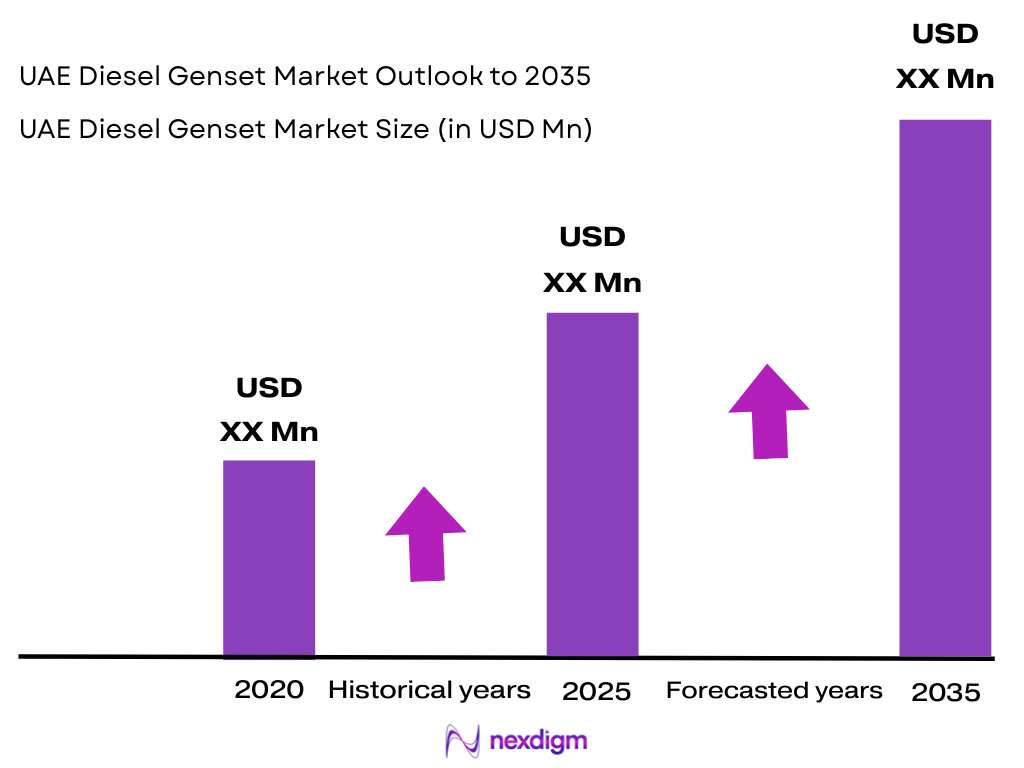
The UAE Diesel Genset Market is valued at approximately USD ~ million, compared with USD ~ million in the preceding annual benchmark, supported by expanding logistics, workshops, vehicle storage and industrial infrastructure. Jebel Ali handled 616,000 vehicles in the earlier benchmark, while DP World’s Dubai terminals subsequently handled a record 1.3 million vehicles, demonstrating the expanding physical ecosystem requiring warehouses, PDI centers, workshops, security systems and standby electrici Dubai and Abu Dhabi dominate the UAE Diesel Genset Market because they combine ports, free zones, vehicle logistics, trading, industrial facilities and service infrastructure. Dubai’s gateway is centered on Jebel Ali, where vehicle flows expanded materially, while Abu Dhabi’s KEZAD operates a dedicated zone and Global Auto Hub for manufacturers, parts companies, distributors and aftermarket providers. These concentrations create recurring generator demand across workshops, warehouses, vehicle yards, PDI facilities and industrial operations. The UAE Diesel Genset Market covers stationary and mobile diesel generator sets used across vehicle assembly and modification facilities, component operations, dealerships, workshops, commercial fleet depots, logistics centers, pre-delivery inspection facilities, vehicle storage compounds and spare-parts warehouses. Diesel gensets perform emergency standby, temporary, prime and project-support functions where operations require continuity for HVAC, workshop equipment, compressed air, lighting, security systems, IT platforms, fire systems and material-handling infrastructure.
Market Segmentation
By Power Rating
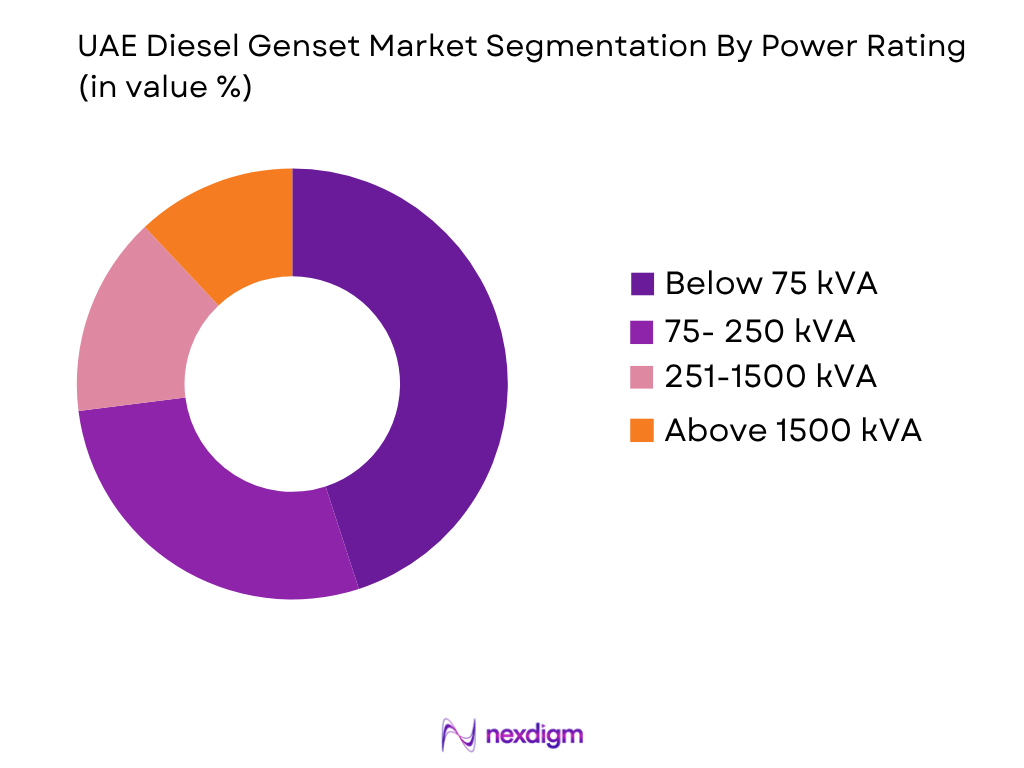
The UAE Diesel Genset Market is segmented into below 75 kVA, 75–250 kVA, 251–500 kVA, 501–1,000 kVA and above 1,000 kVA. The 75–250 kVA segment holds the dominant market share in the analytical model because the UAE ecosystem contains a large base of workshops, dealer facilities, vehicle inspection sites, warehouses, PDI centers and fleet-maintenance depots rather than only large vehicle factories. These facilities need enough capacity to support lifts, compressors, workshop machinery, HVAC, lighting, fire systems and IT without requiring multi-megawatt generation. Larger 501 kVA-plus sets remain important for major logistics compounds, industrial facilities and centralized warehouse utilities. The prevalence of silent and weather-protected packages is also significant because many installations are located within developed industrial or commercial zones where acoustic control, compact footprints and high-ambient performance are critical selection criteria.
By End-User Facility
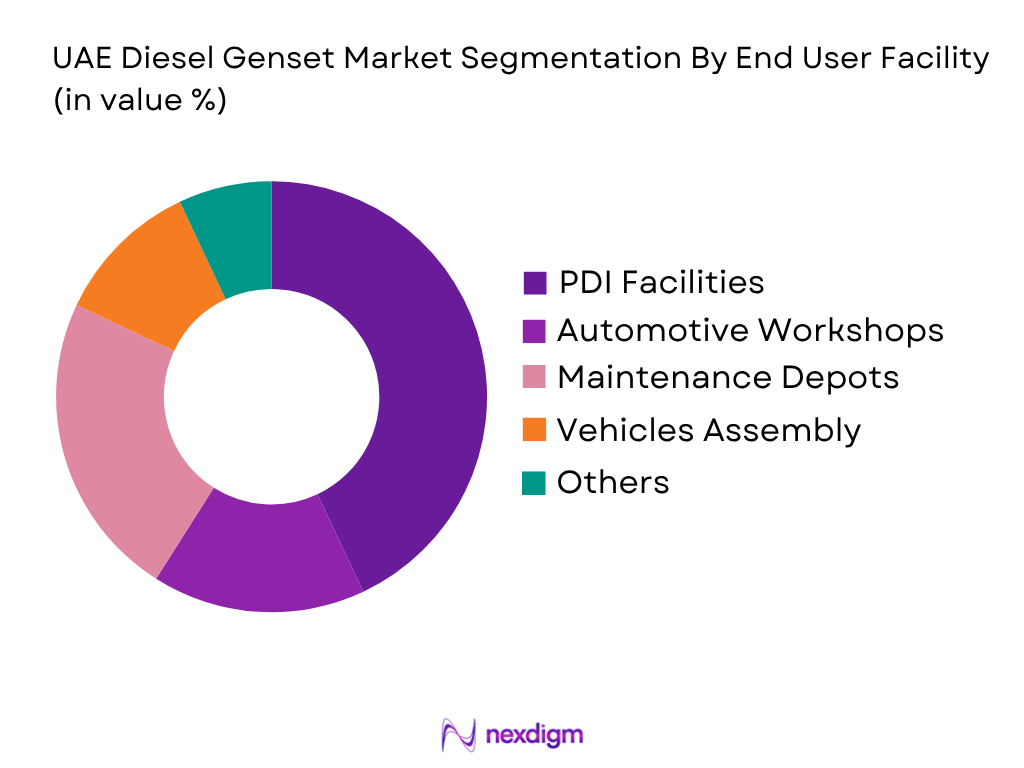
The UAE Diesel Genset Market is segmented into logistics and PDI facilities, dealerships and workshops, fleet-maintenance depots, vehicle assembly/modification facilities and spare-parts warehouses. logistics and PDI facilities dominate the analytical market share, reflecting the UAE’s position as a vehicle import, storage, distribution and re-export center. DP World’s Dubai terminals handled a record 1.3 million vehicles, while Abu Dhabi’s Global Auto Hub is designed as an integrated export and distribution platform. These facilities require dependable power for security, surveillance, yard lighting, warehouse systems, PDI equipment, administration, air conditioning and emergency services. Dealership and workshop demand is more fragmented but creates a broad installed base of smaller gensets. Assembly, conversion and specialty-vehicle operations generally require higher-capacity systems but represent fewer individual sites.
Competitive Landscape
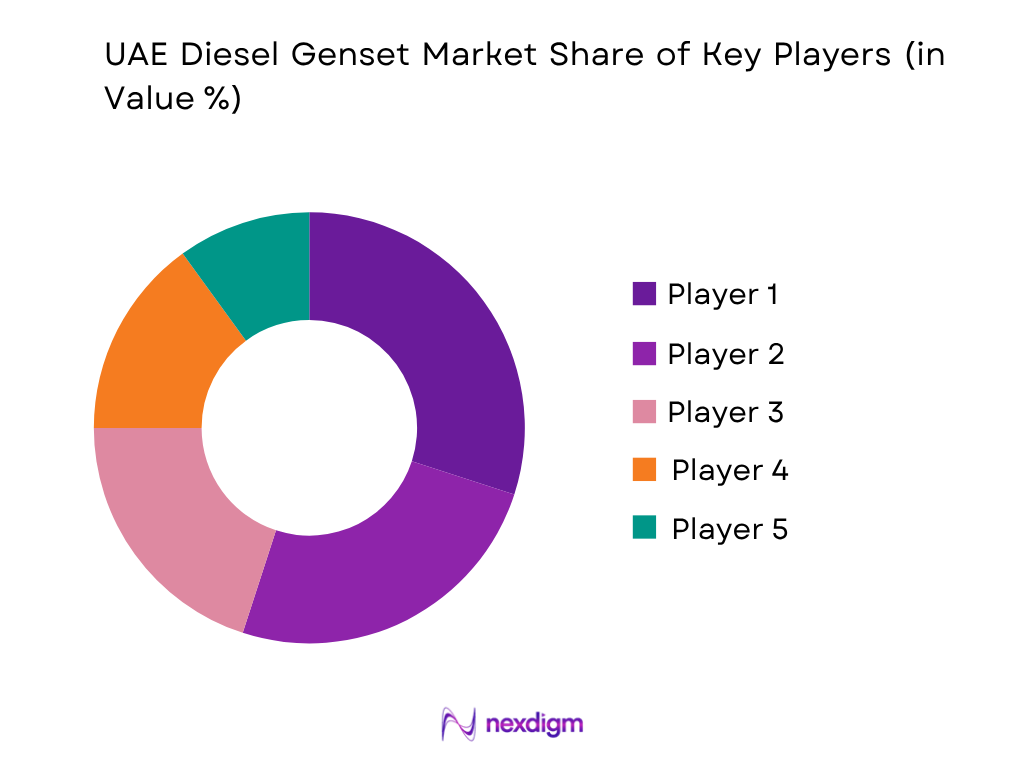
The UAE Diesel Genset Market combines global generator OEMs with established regional distributors, engineering companies and rental-power providers. Cummins maintains a direct regional presence through Cummins Arabia, Caterpillar is represented by Al-Bahar, Rolls-Royce Power Systems operates a Middle East entity in Dubai, and Atlas Copco maintains its Power Technique operation in Al Quoz alongside an Abu Dhabi rental presence. FG Wilson additionally competes through its global dealer model and a product heritage closely linked with Middle Eastern power-generation applications.
| Company | Established | Headquarters | Diesel Genset Range Position | UAE Presence / Channel | -Relevant Applications | High-Ambient Capability | Controls / Integration | Service Proposition |
| Cummins Inc. | 1919 | Columbus, Indiana, USA | ~ | ~ | ~ | ~ | ~ | ~ |
| Caterpillar Inc. | 1925 | Irving, Texas, USA | ~ | ~ | ~ | ~ | ~ | ~ |
| FG Wilson | 1966 | Northern Ireland, UK | ~ | ~ | ~ | ~ | ~ | ~ |
| Rolls-Royce Power Systems – mtu | 1909 heritage | Friedrichshafen, Germany | ~ | ~ | ~ | ~ | ~ | ~ |
| Atlas Copco Group | 1873 | Stockholm, Sweden | ~ | ~ | ~ | ~ | ~ | ~ |
UAE Diesel Genset Market Analysis
Growth Drivers
Expansion of Logistics, Vehicle Handling and Distribution Infrastructure
The expansion of the UAE’s logistics ecosystem is directly increasing the number of facilities requiring emergency and temporary diesel power. DP World handled 1.3 million vehicles across its Dubai terminals in 2024, compared with 616,000 vehicles handled at Jebel Ali Port in 2023, demonstrating the rapid scaling of vehicle import, storage, inspection, preparation and re-export activity. In the first half of 2025 alone, Jebel Ali Port handled 545,000 vehicles, while a new 2.6 million-square-foot vehicle storage yard added 13,000 car-equivalent units, taking total storage capacity to 75,000 units. Such expansion creates diesel genset requirements across pre-delivery inspection facilities, workshops, yard lighting, access-control systems, security infrastructure, IT systems, warehouses, fire pumps and temporary construction locations. The wider economy provides a supportive operating backdrop: World Bank data place UAE GDP at USD 552.32 billion in 2024 and GDP per capita at USD 50,273.5, while the IMF recorded real economic expansion of 4.0% in 2024. For genset suppliers, growing vehicle throughput increases the physical footprint of operations even where grid electricity remains the primary supply. Diesel generators therefore retain an important role as contingency power for high-throughput logistics operations where equipment outages can interrupt vehicle processing, customs handling, storage security or PDI activities.
Industrialization of Manufacturing, Warehousing and Free-Zone Infrastructure
Increasing -related industrialization in Abu Dhabi and Dubai supports diesel genset demand beyond traditional dealerships and workshops. KEZAD’s Global Auto Hub covers approximately 3.3 million square metres, providing an integrated environment for trade, distribution and supporting services. KEZAD also signed an agreement in 2024 for an advanced manufacturing facility covering 30,000 square metres, while Autoterminal Khalifa Port added 90,000 square metres of vehicle-yard capacity during 2024 to accommodate increasing Ro-Ro traffic. Industrial development continued in 2025, when KEZAD’s Economic Cities & Free Zones cluster delivered 146,000 square metres of additional warehouse capacity. These assets create generator applications in manufacturing utilities, warehouses, vehicle-preparation areas, workshops, security installations and temporary commissioning activities. Macroeconomic conditions reinforce the investment environment: the World Bank records UAE output at USD 552.32 billion in 2024, while the IMF estimated real GDP growth at 4.0% in 2024 and reported continuing strength in non-hydrocarbon economic activity. diesel gensets benefit specifically because industrial facilities require resilient electrical architecture even when generator utilization hours remain limited. High UAE ambient temperatures further increase the operational importance of continuous HVAC, ventilation, server systems and safety equipment, making high-temperature-rated standby generators, automatic transfer switches and properly engineered cooling systems relevant components of industrial infrastructure.
Market Challenges
Exceptionally High Grid Reliability Limits Routine Diesel Genset Utilization
A major challenge for the UAE Diesel Genset Market is the extremely high reliability of utility electricity in Dubai, one of the country’s largest demand centers. Dubai Electricity and Water Authority recorded only 0.94 customer minutes lost per customer during 2024, improving further to 0.82 minutes during 2025, or approximately 49 seconds annually. DEWA’s electricity transmission and distribution losses were only 2 units per 100 units supplied in both periods, reflecting a highly efficient grid. By the end of 2024, DEWA operated 17,179 MW of electricity-generation capacity and served more than 1.27 million customer accounts. This level of grid performance reduces the requirement for diesel gensets to operate frequently and limits opportunities for prime-power applications within established districts. workshops, logistics facilities and dealerships therefore generally procure generators as insurance against low-frequency but operationally disruptive events rather than as regular power sources. This increases customer emphasis on lifecycle reliability, rapid automatic starting, maintenance quality and equipment availability instead of operating-hour economics alone. The macroeconomic environment remains strong, with World Bank data recording UAE GDP of USD 552.32 billion in 2024, meaning customers have access to increasingly sophisticated alternatives such as UPS systems and battery storage. Diesel genset suppliers consequently face pressure to demonstrate resilience value in a market where utility outages are already exceptionally short.
Energy Transition and Increasing Competition from Cleaner Backup Technologies
The UAE’s accelerating clean-energy transition presents a structural challenge for conventional diesel gensets, particularly among multinational groups with internal decarbonization requirements. The Ministry of Energy and Infrastructure reported that UAE clean-energy investments exceeded AED 45 billion in 2024. In Dubai, clean electricity generation capacity reached 3,060 MW by the end of 2024 within a total installed generation base of 17,179 MW. By January 2025, clean energy accounted for roughly 20 units out of every 100 units of Dubai’s installed energy mix, while DEWA continued investment in battery storage, smart grids and green hydrogen. The authority’s smart-grid program carries total investment of AED 7 billion, supporting automated fault detection, remote control and faster restoration of utility service. These developments increase competitive pressure on standalone diesel backup systems because logistics centers and industrial facilities can increasingly assess solar generation, battery energy storage, UPS equipment and digitally managed hybrid systems. The challenge does not eliminate diesel generators: batteries are suited to instantaneous ride-through, whereas generators can provide prolonged emergency output. However, generator suppliers must reposition diesel equipment as one component of an integrated resilience architecture. World Bank data showing UAE GDP of USD 552.32 billion in 2024 indicate an economy capable of investing in advanced energy technologies, making simple low-specification generator offerings progressively less differentiated.
Market Opportunities
Digital, High-Ambient and Hybrid Diesel Genset Solutions
Technological modernization creates an important future growth avenue for diesel genset suppliers because the UAE combines extreme operating conditions with increasingly sophisticated industrial infrastructure. DEWA’s smart-grid program involves AED 7 billion of investment, while its network serves more than 1.27 million customer accounts and operates 17,179 MW of generating capacity, demonstrating the scale and digital sophistication of the electricity environment into which private backup systems must integrate. Diesel gensets serving warehouses, PDI centers, workshops and vehicle logistics facilities can therefore differentiate through remote controllers, IoT gateways, automatic fault alerts, fuel monitoring, battery monitoring, automatic transfer switches and synchronization systems rather than engine specifications alone. The technical opportunity is particularly strong for high-ambient packages incorporating oversized radiators, enhanced airflow, heavy-duty filtration and temperature-resistant starting systems suitable for outdoor UAE installations. Hybridization is another opportunity: combining a battery system with a diesel genset allows instantaneous response from storage while preserving diesel capacity for longer interruptions. The supporting industrial base is substantial; DP World handled 1.3 million vehicles in Dubai during 2024, meaning increasingly large compounds require security, lighting, IT, HVAC and workshop continuity. World Bank data record UAE GDP at USD 552.32 billion in 2024, reinforcing the country’s ability to adopt premium digitally integrated infrastructure. Suppliers able to package diesel generation with controls, BESS integration and remote lifecycle services are therefore positioned for higher-value applications.
Hub Expansion, Replacement Demand and Temporary-Power Applications
Expansion of specialized infrastructure provides a second major opportunity for UAE diesel genset suppliers, particularly in Dubai and Abu Dhabi. KEZAD’s Global Auto Hub encompasses approximately 3.3 million square metres, while the wider Rahayel community covers approximately 4 square kilometres. At Jebel Ali, DP World added a 2.6 million-square-foot vehicle storage yard in 2025, increasing storage capacity by 13,000 car-equivalent units to 75,000 units. The port processed 545,000 vehicles during the first six months of 2025, showing continued utilization of the infrastructure added around handling. Abu Dhabi’s logistics infrastructure is expanding in parallel: Autoterminal Khalifa Port added 90,000 square metres of yard capacity in 2024, while KEZAD delivered 146,000 square metres of new warehouse capacity in 2025 across its economic-zone platform. These current assets support future diesel genset demand through several channels: permanent standby systems for warehouses and workshops, temporary generators during construction and commissioning, rental units during maintenance shutdowns, and replacement of aging generator fleets in established compounds. World Bank data show UAE GDP at USD 552.32 billion in 2024, while IMF reporting indicates continued strength in the non-hydrocarbon economy. For genset suppliers, the opportunity therefore extends beyond greenfield hardware sales toward rental fleets, annual maintenance contracts, ATS retrofits, remote monitoring, cooling-system upgrades and emergency replacement services across an expanding infrastructure base.
Future Outlook
The UAE Diesel Genset Market is expected to expand at a forecast CAGR of approximately ~ during 2026–2035, supported by continued development of logistics hubs, vehicle warehousing, workshops, fleet infrastructure and specialized industrial facilities. Growth is expected to remain concentrated in Dubai and Abu Dhabi. Jebel Ali continues to strengthen its role as a regional gateway, while KEZAD’s dedicated ecosystem provides space for vehicle manufacturers, parts suppliers, distributors and aftermarket operators. These clusters create generator demand not only through large industrial sites but also through warehouses, PDI centers, vehicle yards and ancillary service facilities. Replacement will become increasingly important as older generators installed across established workshops, warehouses and compounds reach lifecycle renewal points. Replacement purchases are likely to favor digital controllers, improved cooling systems, quieter canopies, remote monitoring and more advanced ATS configurations. Another structural shift will be the integration of battery energy storage with conventional gensets. Cummins commissioned a 422 kWh / 200 kW BESS at its Dubai facility, demonstrating a regional application in which battery storage reduced diesel-generator operating hours while retaining generator-backed resilience. The example illustrates how diesel gensets may increasingly operate as long-duration or contingency assets rather than the sole source of backup power.
Major Players
- Cummins Inc. / Cummins Arabia
- Caterpillar Inc. / Al-Bahar
- FG Wilson
- Rolls-Royce Power Systems – mtu
- Atlas Copco Group
- HIMOINSA
- Rehlko
- Mitsubishi Heavy Industries Engine & Turbocharger
- Yanmar Holdings Co., Ltd.
- Denyo Co., Ltd.
- Doosan Bobcat
- Baudouin
- Perkins-Powered Generator Assemblers
- Jubaili Bros
- Khonaysser Group
Key Target Audience
- Dealership and Workshop Groups
- Vehicle Logistics, PDI and Warehousing Operators
- Assembly, Modification and Specialty Vehicle Companies
- Commercial Fleet and Fleet-Maintenance Operators
- Diesel Generator Manufacturers, Distributors and Rental Power Companies
- EPC, MEP and Critical-Power Infrastructure Companies
- Investments and Venture Capitalist Firms
- Government and Regulatory Bodies (Ministry of Industry and Advanced Technology, Ministry of Energy and Infrastructure, Dubai Municipality, Dubai Civil Defence, Abu Dhabi Civil Defence Authority, KEZAD Group and Jebel Ali Free Zone Authority)
Research Methodology
Step 1: Identification of Key Variables
The research begins by mapping the UAE Diesel Genset Market ecosystem, covering generator OEMs, engine manufacturers, distributors, rental companies, groups, logistics operators, workshops, fleet depots and industrial zones. Critical variables include genset rating, operating mode, facility type, installed base, replacement age, high-ambient configuration, service requirement and procurement channel.
Step 2: Market Analysis and Construction
Historical demand is assessed through combined top-down and bottom-up approaches. The top-down process evaluates UAE diesel-generator supply and isolates -related consumption, while the bottom-up approach maps major logistics compounds, dealerships, workshops, fleet facilities and industrial sites. Installed generator capacity, replacement activity, new facility additions and average equipment configurations are triangulated.
Step 3: Hypothesis Validation and Expert Consultation
Market hypotheses are validated through computer-assisted telephone interviews with generator distributors, rental-power providers, MEP engineers, facility managers, fleet operators and generator service companies. Interviews assess preferred kVA ranges, operating modes, generator age, brand selection, high-temperature performance, maintenance requirements, replacement triggers, service response expectations and procurement criteria.
Step 4: Research Synthesis and Final Output
Primary findings are reconciled with UAE logistics, trade, industrial-zone and macroeconomic data to finalize the model. The forecast incorporates infrastructure expansion, generator replacement, logistics throughput, rental-power requirements, technology substitution and battery-storage integration. Final outputs are segmented by power rating, facility type, emirate, procurement mode and competitive positioning.

- Executive Summary
- Research Methodology (Market Definitions and Assumptions, Diesel Genset Market Boundary, Abbreviations, Top-Down Market Sizing, Bottom-Up Facility Mapping, Facility Census, Distributor Shipment Assessment, Import-Based Supply Analysis, Installed-Base Estimation, Replacement-Cycle Analysis, Demand-Side Assessment, Supply-Side Assessment, Generator OEM and Distributor Interviews, Facility Interviews, Rental Fleet Assessment, Price Benchmarking, Data Triangulation, Forecasting Framework, Scenario Analysis, Limitations and Future Conclusions)

- Definition and Scope
- Market Evolution and Industry Genesis
- Evolution of Backup Power Requirements across UAE Infrastructure
- UAE Manufacturing and Mobility Ecosystem
- Passenger and Commercial Vehicle Assembly Ecosystem

- Growth Drivers (Logistics Expansion, Industrial Free-Zone Development, Vehicle Fleet Growth, Workshop Expansion, Critical-Power Requirements, Fleet Maintenance Infrastructure, Re-Export Activity)
- Market Challenges (Grid Reliability, Diesel Emissions, Fuel Storage, Noise Requirements, Generator Utilization, Capital Intensity, Alternative Backup Systems)
- Market Opportunities (Logistics Hubs, Replacement Market, Rental Power, Hybrid Systems, Remote Monitoring, High-Ambient Packages, Service Contracts)
- Market Trends (Digital Controllers, Remote Monitoring, High-Ambient Cooling, Silent Canopies, Modular Paralleling, BESS Integration, Predictive Maintenance)
- SWOT Analysis
- Porter’s Five Forces Analysis
- PESTLE Analysis

- By Market Value (2020-2025)
- By Unit Shipments (2020-2025)
- By Installed Genset Base (2020-2025)

- By Power Rating (In Value %)
Below 75 kVA
75–250 kVA
251–500 kVA
501–1,000 kVA
Above 1,000 kVA - By End-User Facility (In Value %)
Vehicle Assembly Facilities
Commercial Vehicle and Bus Assembly Facilities
Specialty Vehicle and Body-Building Facilities
Components Manufacturing Facilities
EV Assembly and Battery Facilities - By Application (In Value %)
Assembly and Production Lines
Vehicle Paint and Body Shops
Welding and Fabrication Operations
Machine Shops
Vehicle Testing Equipment - By Emirate (In Value %)
Dubai
Abu Dhabi
Sharjah
Ras Al Khaimah
Ajman

- Market Share of Major Players by Market Value
- Cross Comparison Parameters (Diesel Genset kVA Portfolio Coverage, UAE Installed References, High-Ambient Cooling and Derating Capability, Local Distributor and Service Network Reach, Generator Stock and Spare Parts Availability, Silent/Containerized Package Capability, ATS–Synchronization–Remote Monitoring Integration, AMC and Emergency Response Capability)
- SWOT Analysis of Major Players
- Detailed Profiles of Major Companies
Cummins Inc. / Cummins Arabia
Caterpillar Inc. / Al-Bahar
FG Wilson
Rolls-Royce Power Systems – mtu
Atlas Copco Group
HIMOINSA
Kohler / Rehlko
Mitsubishi Heavy Industries Engine & Turbocharger
Yanmar Holdings Co., Ltd.
Denyo Co., Ltd.
Doosan Bobcat
Baudouin
Perkins-Powered Generator Assemblers
Jubaili Bros
Khonaysser Group

- Installed Diesel Genset Fleet Assessment
- Average Genset Capacity per Facility
- Average Number of Gensets per Site
- Annual Operating Hours
- Testing and Exercise Frequency

- By Market Value (2026-2035)
- By Unit Shipments (2026-2035)
- By Installed Genset Base (2026-2035)


 Request a Sample
 Ask for Customization
 Get a Quote
 Enquire Now