

 Download PDF
Market Overview
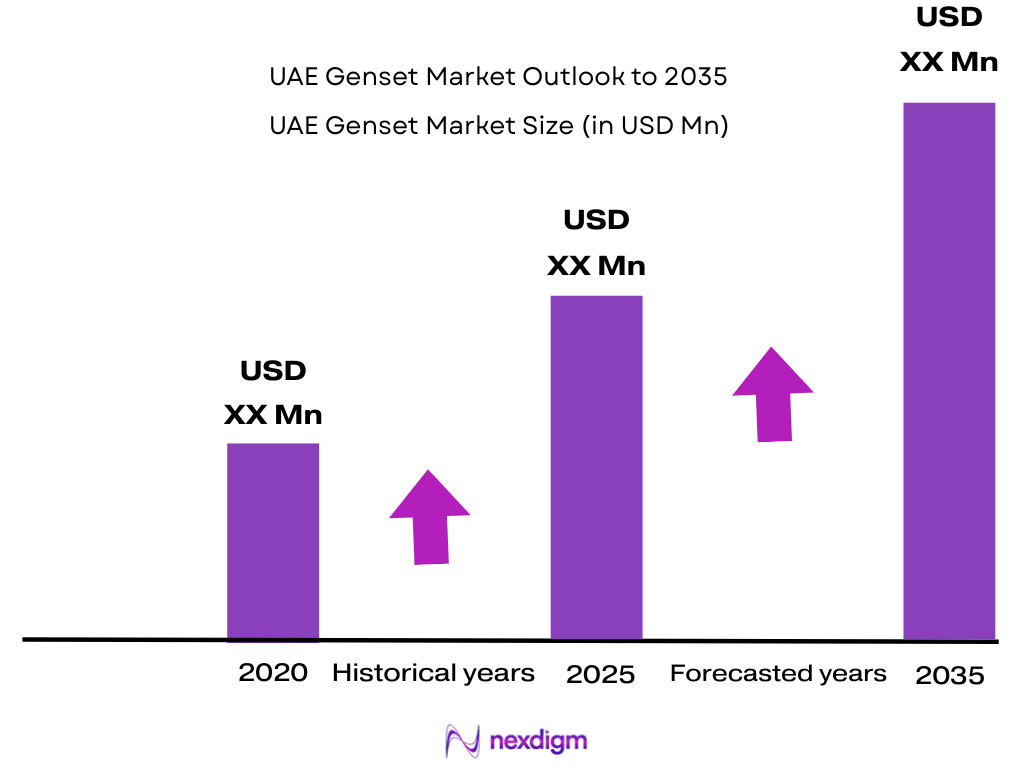
The UAE Genset Market is valued at approximately ~ million, supported by expanding electricity requirements, construction activity and demand for dependable standby and mobile power. Dubai electricity consumption increased from 56,516 GWh to 59,594 GWh, while peak electricity demand reached 10.76 GW. Large commercial facilities, construction projects, transport infrastructure, workshops, fleet facilities and temporary operating sites therefore sustain requirements for diesel, petrol and gas-powered gensets. Dubai and Abu Dhabi dominate UAE automotive genset demand because they combine large infrastructure pipelines, logistics assets, data-intensive commercial facilities, industrial establishments and high electricity loads. Dubai’s electricity demand reached 59,594 GWh, while Abu Dhabi’s demand-response programme achieved an average peak reduction of 106 MW and maximum reduction of 210 MW across participating facilities. These operating environments support standby generators, rental fleets, mobile gensets and high-capacity power systems for business continuity.
Market Segmentation
By Power Rating
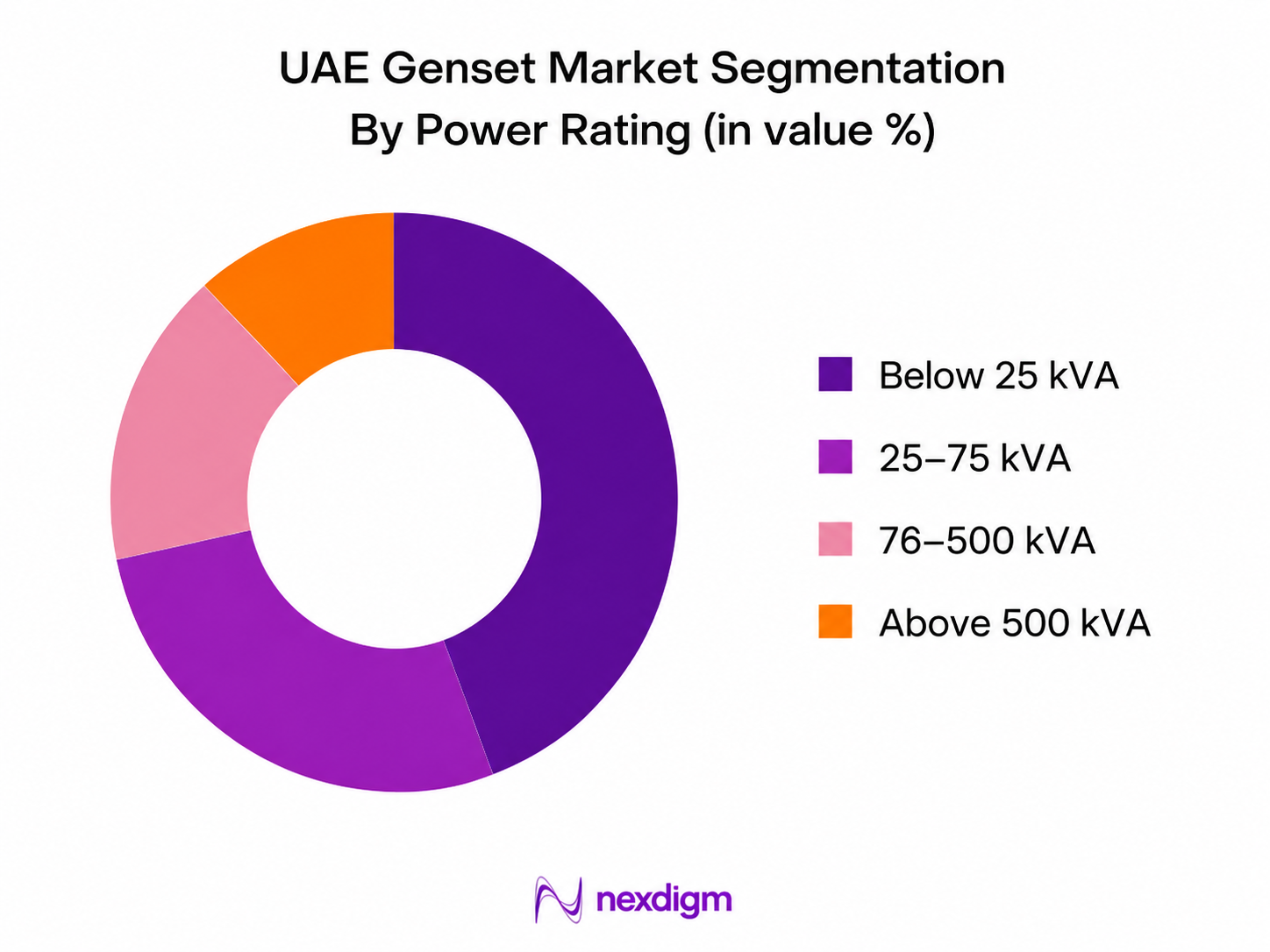
The UAE Genset Market is segmented into below 25 kVA, 25–75 kVA, 76–200 kVA, 201–500 kVA and above 500 kVA gensets. Recently, the 76–200 kVA segment has a dominant market position because it serves a broad middle range of construction, workshop, logistics, commercial-building and temporary-power applications. These units provide considerably more operating flexibility than small portable generators while remaining easier to transport and deploy than large stationary power systems. The segment is especially relevant to contractors operating tower cranes, lighting systems, pumps, temporary offices and site equipment, as well as vehicle workshops and logistics yards requiring backup power. UAE infrastructure activity provides an important demand base: the Ministry of Energy and Infrastructure has identified a pipeline of 127 security, educational, service and road projects under its federal infrastructure programme. This range of project environments supports medium-capacity rental and standby gensets that can be deployed repeatedly across sites.
By Application
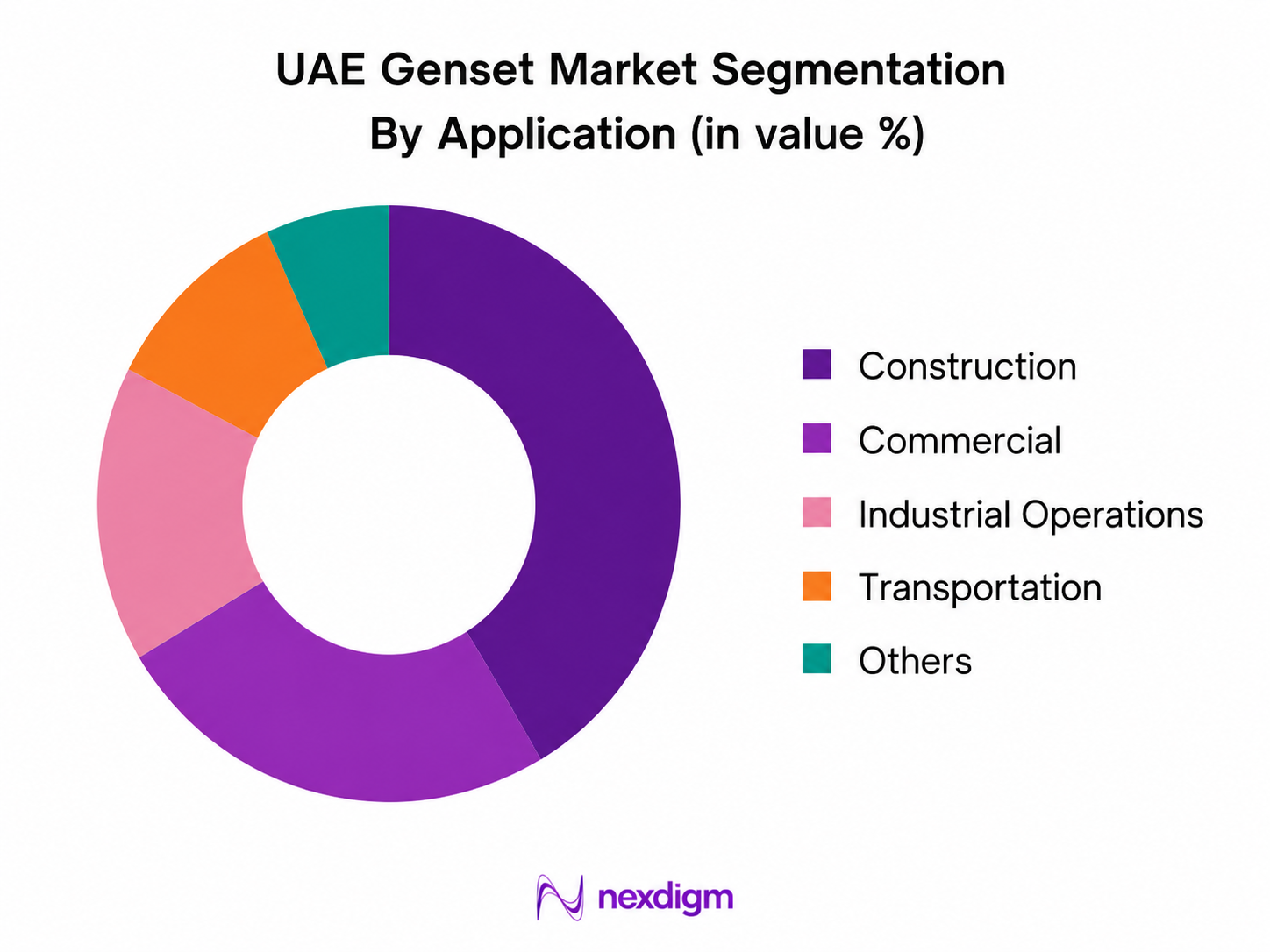
The UAE Genset Market is segmented into construction and infrastructure, commercial facilities, industrial operations, automotive workshops and dealerships, transportation and logistics, and residential or small-business backup. Construction and infrastructure applications hold the dominant market position because temporary power remains essential before permanent grid connections become available and during expansion, testing and commissioning activities. Generator sets operate site offices, lighting towers, pumps, fabrication equipment, cooling systems and safety infrastructure across complex projects. The UAE Ministry of Energy and Infrastructure has outlined 127 federal projects spanning roads, service facilities, education and security infrastructure, while official national-account data identifies construction as one of the country’s major economic activities. Dubai’s increasing electricity consumption further illustrates the intensity of infrastructure and built-environment activity. Rental companies particularly benefit because contractors can shift generator fleets between sites rather than maintaining permanently installed capacity after project completion.
Competitive Landscape
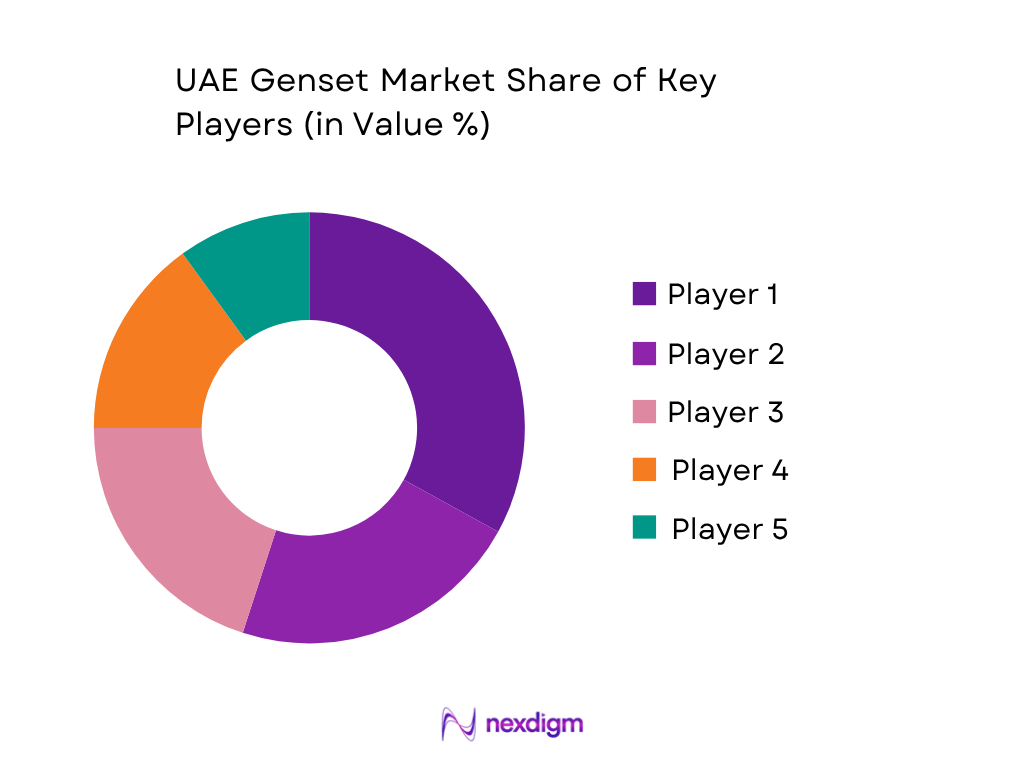
The UAE Genset Market is characterized by global engine and generator manufacturers supported by regional distributors, assemblers, rental fleets and specialised power-system integrators. Caterpillar operates through Al-Bahar, which has supplied, installed and maintained generator systems for major UAE infrastructure including Dubai Metro. Cummins offers integrated gensets covering a broad capacity range, while FG Wilson maintains a long-standing Dubai presence. Perkins-powered generator manufacturing is also established locally through UAE OEM relationships, strengthening domestic assembly and aftermarket support.
| Major Player | Establishment Year | Headquarters | Power Range Capability | Primary Fuel Platforms | UAE Distribution / Service | Mobile & Standby Capability | Control System Capability | Key UAE Strength |
| Cummins | 1919 | Columbus, Indiana, USA | ~ | ~ | ~ | ~ | ~ | ~ |
| Caterpillar | 1925 | Irving, Texas, USA | ~ | ~ | ~ | ~ | ~ | ~ |
| FG Wilson | 1966 | Northern Ireland, UK | ~ | ~ | ~ | ~ | ~ | ~ |
| Perkins | 1932 | Peterborough, UK | ~ | ~ | ~ | ~ | ~ | ~ |
| Kohler Energy / Rehlko | 1873 | Wisconsin, USA | ~ | ~ | ~ | ~ | ~ | ~ |
UAE Genset Market Analysis
Growth Drivers
Large-Scale Construction and Infrastructure Development Driving Mobile Power Requirements
The UAE Genset Market is strongly supported by sustained construction, transport-infrastructure and real-estate development, where mobile and towable generator sets provide temporary electricity before permanent grid connections become operational and support equipment, lighting, pumps, site offices, workshops and maintenance activities. The World Bank recorded UAE GDP at USD 552.32 billion in 2024, with GDP per capita at USD 50,273.5, demonstrating the economic scale supporting infrastructure investment. The IMF subsequently identified construction, tourism, public expenditure and real estate among the principal contributors to continued non-hydrocarbon activity. Construction activity is especially relevant to automotive gensets because road-mobile generator trailers and compact portable units can be redeployed between infrastructure sites, unlike permanently installed standby systems. Dubai’s Roads and Transport Authority awarded an AED 700 million Al Khail Road improvement contract covering 3,300 metres of bridges and 6,820 metres of road works, illustrating the magnitude of individual projects requiring temporary site electricity, machinery support and mobile maintenance infrastructure. Dubai also approved the AED 30 billion Tasreef drainage project, involving tunnels and pumping-related infrastructure designed to handle more than 20 million cubic metres of water per day. Such tunnelling, drainage and civil-engineering activity creates practical applications for mobile generators supporting pumps, ventilation, lighting, tools and emergency site operations. Construction momentum remained visible into 2025, when the RTA awarded the AED 1.5 billion Al Fay Street Development Project, covering 13,500 metres of bridges and 12,900 metres of roads, while Dubai’s five-year internal-road programme allocated AED 3.7 billion for development across residential and industrial areas. The programme includes 92 km of roads scheduled in Nadd Hessa and Al Awir during 2026, following 83 km completed across multiple locations during 2023 and 2024. These projects create demand not simply for fixed backup power but specifically for transportable gensets that contractors can move between road corridors, tunnelling locations, labour compounds, temporary workshops and equipment yards. Dubai’s manufacturing sector also generated approximately AED 10.6 billion in Q2 2024, while transportation and storage generated AED 15.85 billion, reinforcing the industrial and logistical activity surrounding construction and equipment deployment. Automotive genset suppliers can therefore target contractors, equipment-rental fleets, road-maintenance companies, utility contractors, event infrastructure operators and industrial project developers with units designed for rugged mobility, long operating hours and rapid refuelling. Demand is particularly relevant for compact petrol generators used for tools and light-duty applications and larger towable units where mobility between job sites is critical. Manufacturers able to provide weather-resistant enclosures, wheel kits, trailer configurations, automatic voltage regulation, electric starting and easy service access can align products with the UAE’s construction environment. Government-funded infrastructure, expanding private real-estate development and industrial-project activity collectively create a recurring replacement and fleet-expansion requirement for mobile temporary-power equipment. Principal supporting sources are the World Bank, International Monetary Fund, Dubai Roads and Transport Authority and Government of Dubai Media Office.
Expansion of Logistics, Transport and High-Uptime Commercial Operations
The growth of transport, logistics, industrial parks, warehousing and commercial operations is another major driver of the UAE Genset Market because these activities require dependable temporary and emergency electricity across vehicle depots, loading areas, roadside maintenance operations, mobile workshops and geographically distributed logistics facilities. Dubai’s transportation and storage sector generated approximately AED 15.85 billion in Q2 2024, while manufacturing generated AED 10.6 billion and electricity, gas, water and waste-management activities generated approximately AED 4 billion during the same quarter. These figures demonstrate the scale of operating environments in which continuity of electrical supply is essential for communications, lighting, refrigeration, workshops, security equipment and maintenance infrastructure. The broader macroeconomic environment reinforces this demand. The World Bank placed UAE economic output at USD 552.32 billion in 2024, and the IMF reported that non-hydrocarbon activity continued to be supported by construction, tourism, financial services and public expenditure. Dubai’s attraction of 1,117 Greenfield FDI projects in 2024, compared with lower project activity in the preceding period, also demonstrates continued formation of new business and industrial locations. The city recorded 1,826 announced FDI projects overall and an estimated AED 52.3 billion in FDI capital during the year. Many incoming industrial, logistics and commercial facilities require temporary power during construction and commissioning before their full utility systems are available. The opportunity continues into industrial estates. Dubai’s National Industries Park reported more than AED 1 billion in new projects during 2025, leased more than 7 million square feet of land, and supported a tenant base exceeding 400 companies and 24,700 jobs. These facilities include manufacturing, automotive, electronics and construction-related operations, sectors where mobile generators can support commissioning, shutdown maintenance, emergency response and field operations. Automotive gensets are particularly valuable to logistics and fleet organisations because a generator installed on a trailer, service truck or dedicated support vehicle can be dispatched to stalled equipment, temporary depots or remote work areas rather than requiring the affected equipment to be moved to a powered facility. UAE logistics infrastructure also operates across ports, free zones, warehouses, airports, industrial corridors and cross-emirate road networks, creating a geographically dispersed customer base for mobile power. Compact petrol-powered units remain suitable where operators prioritise portability, rapid deployment and comparatively light loads, while larger mobile units support commercial maintenance operations and temporary depots. The country’s high level of economic activity also increases the financial cost of downtime, particularly for temperature-sensitive goods, automated warehouses and distribution facilities. This encourages organisations to maintain contingency equipment even where grid reliability is generally strong. Genset vendors can differentiate through fleet-ready units with hour meters, remote monitoring, automatic shutdown functions, rugged frames, wheel kits and quick-connect electrical interfaces. Rental companies represent another channel because construction firms and logistics operators may need additional temporary power only during commissioning, seasonal operations or infrastructure disruptions. The combination of USD 552.32 billion in national economic output, AED 15.85 billion in quarterly Dubai transport and storage activity, 1,826 announced Dubai FDI projects, and more than 400 companies at National Industries Park demonstrates the commercial operating base supporting mobile genset demand. Principal supporting sources are the World Bank, International Monetary Fund, Dubai Department of Economy and Tourism, Dubai Media Office and National Industries Park.
Market Challenges
High Grid Reliability and Rapid Expansion of Clean Power Reducing Routine Backup Dependence
One of the principal structural challenges for the UAE Genset Market is the country’s advanced electricity infrastructure and accelerating clean-power investment, which limits the frequency with which businesses and households need conventional fuel-powered generators for routine backup. The World Bank records 100% electricity access in the UAE in 2024, meaning genset suppliers cannot rely on widespread grid-connection deficits as a core demand driver. Unlike emerging markets where generators frequently serve as primary or near-primary electricity sources, UAE gensets are predominantly required for temporary construction applications, specialised mobile operations, emergency preparedness and selected off-grid locations. This fundamentally narrows addressable usage hours for conventional petrol or diesel systems. At the same time, substantial utility investments are improving the diversity and resilience of centralized electricity supply. Dubai Electricity and Water Authority reported 2,860 MW of operating generation capacity at the Mohammed bin Rashid Al Maktoum Solar Park during 2024, with another 2,033 MW under construction. The site’s concentrated-solar-power system includes thermal energy-storage capacity of 5,907 MWh, creating dispatchable renewable power that can support electricity availability beyond daylight operating periods. Continued investment in solar, hydroelectricity, battery storage and green hydrogen creates competitive pressure on combustion-based backup systems because major commercial customers increasingly assess standby power equipment in the context of sustainability and carbon-reduction strategies. This challenge is particularly relevant to gensets used by large corporations, industrial parks, government entities and hospitality operators, where environmental reporting can influence capital-purchase decisions. The UAE’s wider economy also has sufficient financial resources to adopt alternative technologies. World Bank data shows GDP per capita at USD 50,273.5 in 2024, allowing businesses and property owners greater capacity to invest in battery energy storage, solar-plus-storage systems and hybrid power configurations rather than selecting basic petrol generators solely because of lower technical complexity. The clean-energy ecosystem expanded further into 2025, when energy projects displayed at WETEX included battery-storage initiatives measured in hundreds of megawatts and more than a thousand megawatt-hours, underscoring the increasing commercial viability of storage-based alternatives. For automotive genset suppliers, the result is a shift from broad backup-power selling toward specific applications where batteries remain constrained by duration, mobility, charging infrastructure or heavy starting loads. Construction sites, road crews, field servicing, remote events and temporary pumps remain viable applications because equipment can be redeployed and refuelled quickly, but static commercial backup may increasingly face competition from batteries or hybrid systems. Petrol gensets are especially exposed because smaller units often overlap directly with portable battery power stations in low-load applications such as electronics, lighting and communications. Suppliers therefore need to strengthen differentiation around sustained runtime, rapid refuelling, mechanical robustness, high surge capability and mobility. They may also need to integrate gensets into hybrid architectures rather than positioning them exclusively as stand-alone systems. In a country with 100% electricity access, thousands of megawatts of solar generation and expanding energy-storage investment, future genset demand will depend increasingly on mission-specific requirements rather than electricity scarcity. Principal supporting sources are the World Bank, Dubai Electricity and Water Authority and Government of Dubai Media Office.
Emissions, Noise, Fuel Handling and Operating-Environment Compliance
Environmental compliance and operational restrictions create another important challenge for the UAE Genset Market because generator suppliers must increasingly accommodate tighter sustainability expectations, building-performance standards and emissions-conscious procurement practices. The Ministry of Energy and Infrastructure introduced the National Green Certificates Program in July 2024, establishing standards around building energy efficiency, water management and other sustainability criteria. Although the programme is not limited to generators, it contributes to a broader operating environment in which building owners, contractors and government-linked projects increasingly evaluate temporary and backup power equipment according to environmental performance. This matters because conventional petrol and diesel gensets produce localized carbon dioxide, nitrogen oxides, hydrocarbons and noise, particularly when operating for extended periods around construction camps, residential developments or enclosed commercial sites. The challenge is intensified by continued investment in low-carbon electricity. DEWA reported 2,860 MW of operational solar capacity at the Mohammed bin Rashid Al Maktoum Solar Park in 2024 and 2,033 MW under construction, highlighting the country’s broader transition toward cleaner energy technologies. Companies purchasing mobile generators therefore face growing pressure to demonstrate that combustion-based equipment is used efficiently and only where necessary. Fuel logistics create additional constraints. Gensets require safe storage, handling and refuelling procedures, especially in high-temperature outdoor environments where fuel volatility, ventilation and fire safety become important considerations. Petrol-powered units present particularly significant handling requirements because gasoline is more volatile than diesel. Contractors must maintain suitable containers, avoid refuelling hot engines and prevent generator exhaust from accumulating around workers or temporary buildings. Noise is another practical issue because mobile gensets frequently operate near residential developments, events, hotels, roadside work areas or urban construction sites. This increases demand for acoustic enclosures and low-noise engine designs, but those features can increase weight, cooling complexity and maintenance requirements. The UAE’s construction programme magnifies the importance of compliance because large projects take place inside densely developed urban areas. Dubai’s AED 1.5 billion Al Fay Street project includes 13,500 metres of bridges and 12,900 metres of roads, while the AED 633 million Al Mustaqbal Street development includes bridges, tunnels and construction close to major commercial districts. Generator vendors serving such projects must provide equipment that can function in constrained urban environments without excessive acoustic or exhaust impacts. High ambient temperatures create another technical layer because cooling systems, lubricants, batteries and electrical components must remain reliable during prolonged outdoor operation. Dust intrusion can accelerate filter loading and impair cooling, requiring robust air filtration and service access. These conditions mean low-cost standard generator platforms may be less suitable than equipment specifically configured for Middle Eastern environments. The World Bank’s USD 552.32 billion UAE GDP figure underscores that buyers operate in a relatively high-income economy where lifecycle reliability and compliance can outweigh minimum purchase specifications. Consequently, suppliers must invest in acoustic engineering, efficient combustion, automatic shutdown systems, spill containment, improved filtration and fleet-maintenance support. Environmental and operational standards therefore raise barriers to entry while shifting procurement toward higher-quality equipment rather than undifferentiated generators. Principal supporting sources are the World Bank, UAE Ministry of Energy and Infrastructure, Dubai Electricity and Water Authority and Government of Dubai Media Office.
Market Opportunities
Hybrid Gensets, Remote Monitoring and Advanced Mobile Power Systems
The strongest technology-led opportunity in the UAE Genset Market lies in combining conventional generators with batteries, advanced controls and remote monitoring rather than competing directly against electrification. Current infrastructure and energy data supports this direction. Dubai’s Mohammed bin Rashid Al Maktoum Solar Park had 2,860 MW of operating capacity in 2024, while its thermal energy-storage system provides 5,907 MWh of storage capability, demonstrating the country’s established acceptance of generation-plus-storage architectures. This creates an environment in which contractors and commercial users are increasingly familiar with hybrid power concepts. Mobile genset suppliers can transfer the same principle to smaller automotive and trailer-mounted systems by combining a petrol or diesel engine generator with lithium-ion batteries, smart inverters and load-management controllers. Such systems allow the engine to operate closer to efficient load points while batteries handle low-load periods, short-duration peaks and silent operation requirements. Construction and infrastructure activity provides an immediate installed application base. Dubai’s five-year internal road-development programme has an allocation of AED 3.7 billion, while 92 km of internal roads are scheduled for construction across Nadd Hessa and Al Awir in 2026. Road contractors, equipment fleets and mobile service teams operating across these sites require electricity for tools, lighting, communications and temporary workstations, making hybrid mobile units commercially relevant. Remote monitoring represents another opportunity because the UAE has a digitally advanced commercial environment and geographically distributed assets. IoT-enabled gensets can transmit fuel levels, running hours, load, battery voltage, temperature, maintenance alerts and fault codes to fleet-management platforms. Rental companies can use these systems to optimise fleet utilisation and preventive maintenance, while construction contractors can reduce the need for technicians to visit individual units merely to check operating condition. The opportunity is supported by high-value economic activity. World Bank data places UAE GDP at USD 552.32 billion in 2024, while Dubai attracted 1,826 announced FDI projects and AED 52.3 billion in estimated FDI capital during the same year. New industrial, logistics, technology and real-estate facilities create a customer base more receptive to connected equipment than purely mechanical generators. Advanced systems can also help address emissions and noise constraints. Battery assistance allows engines to shut down during low-load conditions rather than idling continuously, while users can programme quiet operating windows around residential or hospitality locations. Solar charging can further extend off-grid operating periods for instrumentation, telecommunications or security loads. Genset manufacturers can therefore reposition products as integrated mobile-energy platforms combining engine generation, energy storage, inverter electronics, automatic transfer functions and digital monitoring. This creates opportunities for higher-value equipment sales, software subscriptions, remote service contracts and predictive maintenance rather than competing entirely on generator output. The technology can also reduce fuel-handling frequency at remote locations, an important benefit under the UAE’s high-temperature operating conditions. Suppliers with strong dealer support and telematics capabilities can target equipment-rental businesses, contractors, logistics fleets, utilities, event operators and emergency-response organisations. The market opportunity is based on existing conditions rather than speculative future adoption: the UAE already operates large-scale solar and storage assets, deploys billions of dirhams in infrastructure projects and attracts more than a thousand new Greenfield investment projects annually. These conditions favour connected, hybrid and digitally managed mobile power equipment. Principal supporting sources are the World Bank, Dubai Electricity and Water Authority, Dubai Roads and Transport Authority and Dubai Department of Economy and Tourism.
Construction, Climate-Resilience and Temporary Emergency-Power Applications
The UAE’s expanding investment in climate resilience, drainage, road infrastructure and new urban districts creates a significant future-growth opportunity for automotive gensets used for temporary and emergency applications. The opportunity is particularly evident following the expansion of large-scale stormwater and infrastructure programmes. Dubai approved the AED 30 billion Tasreef rainwater-drainage project in 2024, designed to increase drainage-network capacity and handle more than 20 million cubic metres of water per day through an advanced tunnel-based system. Infrastructure of this type requires temporary electrical support during tunnelling, pump commissioning, drainage works, emergency intervention and maintenance. Mobile generators provide a practical contingency because they can be transported rapidly to pumping stations, flooded work zones, road projects and temporary command sites without waiting for new utility connections. Dubai’s road programme offers another substantial customer base. RTA’s AED 700 million Al Khail Road project incorporates 3,300 metres of bridges and 6,820 metres of road works, while the later AED 1.5 billion Al Fay Street programme incorporates 13,500 metres of bridges and 12,900 metres of roads. The internal-road programme adds another AED 3.7 billion of planned work, with 92 km of roads scheduled across selected communities in 2026. These projects support demand for trailer-mounted and portable gensets across lighting towers, dewatering systems, temporary traffic-management equipment, field workshops, welding, site accommodation and communications. Climate-resilience spending also broadens genset applications beyond routine construction. Extreme rainfall events, temporary utility isolation, damaged distribution assets and emergency pumping operations create periods when mobility is more valuable than permanently installed generation. Government agencies, municipal contractors and civil-defence support teams can position mobile power units strategically and dispatch them according to incident requirements. The country’s economic scale provides resources to maintain such contingency fleets. The World Bank valued UAE GDP at USD 552.32 billion in 2024, while the IMF highlighted sustained non-hydrocarbon activity supported by infrastructure, construction and public expenditure during 2025. Continued investment was also visible in 2026 when Dubai Municipality awarded five infrastructure contracts valued at AED 2.5 billion, serving 30 areas covering approximately 430 million square metres. For genset manufacturers, this indicates an opportunity to design products around emergency mobility rather than conventional fixed backup alone. Relevant configurations include towable units with integrated fuel tanks, compact petrol generators for rapid-response teams, sound-attenuated units for residential zones, mobile units integrated with pumps and lighting, and hybrid gensets capable of operating with batteries during low-noise periods. Rental companies can build dedicated emergency fleets because government contractors and private operators may prefer temporary access to equipment rather than owning sufficient units for rare peak requirements. Suppliers can additionally offer readiness inspections, fuel-management programmes, remote monitoring and preventive-maintenance contracts to ensure units start immediately after long standby periods. Climate resilience, infrastructure construction and rapid-response operations therefore provide a credible growth pathway even as grid electricity becomes cleaner and more reliable. The commercial logic rests not on weak grid access but on the value of movable, dispatchable electricity precisely where fixed infrastructure is unavailable, damaged or still under construction. Principal supporting sources are the World Bank, International Monetary Fund, Government of Dubai Media Office, Dubai Roads and Transport Authority and Dubai Municipality.
Future Outlook
The UAE Genset Market is expected to expand at approximately ~ CAGR during 2026–2035, with demand increasingly shifting from conventional standalone generator supply toward integrated resilience systems. Growth will be supported by continuing construction, logistics expansion, industrial facilities, commercial real estate and critical infrastructure requiring dependable standby power. At the same time, improving grid capability will make simple outage protection insufficient as a competitive proposition. Generator suppliers are therefore expected to differentiate through automatic transfer systems, remote monitoring, synchronisation, fuel optimisation and hybrid battery-genset integration. Environmental policy will progressively influence product selection. Abu Dhabi is developing demand-response and grid-flexibility programmes, while UAE energy policy is focused on efficiency and decarbonisation, increasing the attractiveness of lower-emission generators and hybridised power systems. High ambient temperatures will remain a crucial engineering consideration. Generator systems operating in the UAE require cooling packages, derating analysis, dust protection, heavy-duty filtration and enclosure designs suitable for demanding desert conditions.
Major Players
- Cummins
- Caterpillar
- FG Wilson
- Perkins
- Kohler Energy / Rehlko
- Rolls-Royce Power Systems / mtu
- Atlas Copco
- HIMOINSA
- Generac
- Mitsubishi Heavy Industries
- Yanmar
- Pramac
- Aksa Power Generation
- Baudouin
- Doosan Bobcat
Key Target Audience
- Generator set manufacturers and assemblers
- Generator rental and temporary-power companies
- Construction and infrastructure developers
- Industrial, manufacturing and logistics facility operators
- Automotive workshops, dealerships and fleet service centres
- Power-system distributors and electrical equipment suppliers
- Investments and venture capitalist firms
- Government and regulatory bodies (UAE Ministry of Energy and Infrastructure, Dubai Electricity and Water Authority, Abu Dhabi Department of Energy, Emirates Water and Electricity Company)
Research Methodology
Step 1: Identification of Key Variables
The initial phase develops an ecosystem map covering UAE generator manufacturers, international OEMs, local assemblers, rental operators, construction contractors, industrial facilities, logistics operators and electrical-system integrators. Research identifies market-defining variables including kVA rating, standby versus prime duty, annual operating hours, fuel type, load factor, installation type, cooling configuration, enclosure specification, automatic transfer requirements and remote-monitoring capability.
Step 2: Market Analysis and Construction
Historical UAE genset demand is constructed through a combination of top-down and bottom-up approaches. Construction activity, infrastructure expenditure, commercial electricity consumption and industrial development are assessed alongside supplier portfolios, rental fleets and generator capacity bands. Dubai electricity consumption reaching 59,594 GWh and peak demand of 10.76 GW provide macro-level evidence of increasing electricity intensity, while project pipelines provide a basis for evaluating temporary-power applications.
Step 3: Hypothesis Validation and Expert Consultation
Market hypotheses are validated through CATIs and structured interviews with generator distributors, contractors, rental companies, MEP engineers, facility managers and generator maintenance specialists. Discussions evaluate preferred kVA ranges, standby-versus-prime utilisation, brand-selection criteria, engine origin, fuel efficiency, cooling requirements, service intervals, rental utilisation, parts availability, automatic transfer systems and demand for remote monitoring.
Step 4: Research Synthesis and Final Output
The final phase triangulates demand-side installation evidence with manufacturer, distributor and rental-company supply information. Major infrastructure references, generator product ranges and local assembly capabilities are cross-checked against construction and electricity indicators. Caterpillar’s Dubai Metro installations, Cummins’ integrated product architecture, FG Wilson’s UAE presence and local Perkins-powered manufacturing provide supply-side reference points for building a consistent competitive and market-sizing framework.

- Executive Summary
- Research Methodology (Market Definitions and Assumptions, Generator Set Scope and Exclusions, kVA-to-kW Conversion Framework, Top-Down Power Equipment Assessment, Bottom-Up Genset Installation Mapping, Import and Distributor Assessment, OEM Shipment Analysis, Rental Fleet Assessment, End-User Interviews, EPC and Facility Manager Interviews, Data Triangulation, Forecasting Framework, Limitations and Future Conclusions)

- Definition and Scope
- Market Evolution and Industry Genesis
- Evolution of Standby, Prime and Rental Power Requirements
- Generator Industry Value Chain Analysis
- Generator Supply Chain and Import Ecosystem

- Growth Drivers (Construction and Infrastructure Development, Data Centre Capacity Expansion, Oil & Gas Operations, Critical Facility Backup Requirements, Temporary Power Demand)
- Market Challenges (Grid Reliability, Fuel Consumption, Emissions, Noise, Maintenance Complexity, Alternative Power Technologies)
- Market Opportunities (Hybrid Gensets, Battery Integration, Data Centres, Rental Power, Remote Monitoring, Sustainable Fuels)
- Market Trends (Hybrid Power, Modular Gensets, Synchronisation, Remote Monitoring, Low-Noise Designs, Fuel Optimisation)
- Government Regulations and Technical Standards (DEWA Requirements, Electrical Installation Standards, Environmental Compliance, Noise Requirements, Fuel Storage, Fire Safety)
- SWOT Analysis
- Porter’s Five Forces Analysis
- PESTLE Analysis

- By Market Value (2020-2025)
- By Generator Units Sold and Installed (2020-2025)
- By Installed Generator Capacity (2020-2025)

- By Fuel Type (In Value %)
Diesel Generator Sets
Petrol/Gasoline Generator Sets
Natural Gas Generator Sets
Dual-Fuel Generator Sets
Hybrid Generator–Battery Energy Storage Systems - By Power Rating (In Value %)
Up to 10 kVA
Above 10–75 kVA
Above 75–375 kVA
Above 375–750 kVA
Above 750–2,000 kVA - By Emirate (In Value %)
Dubai
Abu Dhabi
Sharjah
Ajman
Ras Al Khaimah
Fujairah

- Market Share of Major Players
- Cross Comparison Parameters (Power Rating Portfolio, Fuel Technology Mix, Prime/Standby/Rental Application Coverage, Generator Fuel Efficiency, Acoustic Enclosure Capability, Emissions Compliance Capability, ATS/Synchronisation/Digital Control Capability, UAE Dealer and After-Sales Service Footprint)
- SWOT Analysis of Major Players
- Detailed Profiles of Major Companies
Caterpillar / Al-Bahar
Cummins Arabia
FG Wilson Engineering FZE
Atlas Copco
Aggreko
Byrne Equipment Rental
Bahmani General Trading
AKSA Power Generation
Rehlko Power Systems
Rolls-Royce Power Systems / mtu
Generac Power Systems
Jubaili Bros
Kirloskar Oil Engines / Kirloskar DMCC
Al Faris Group
HIMOINSA

- Construction and Infrastructure Users
- Data Centres and Telecom Users
- Oil & Gas and Industrial Users
- Commercial and Hospitality Users
- Healthcare and Critical Infrastructure Users
- Critical Load Prioritisation

- By Market Value (2026-2035)
- By Generator Unit Demand (2026-2035)
- By Installed Generator Capacity (2026-2035)


 Request a Sample
 Ask for Customization
 Get a Quote
 Enquire Now