

 Download PDF
Market Overview
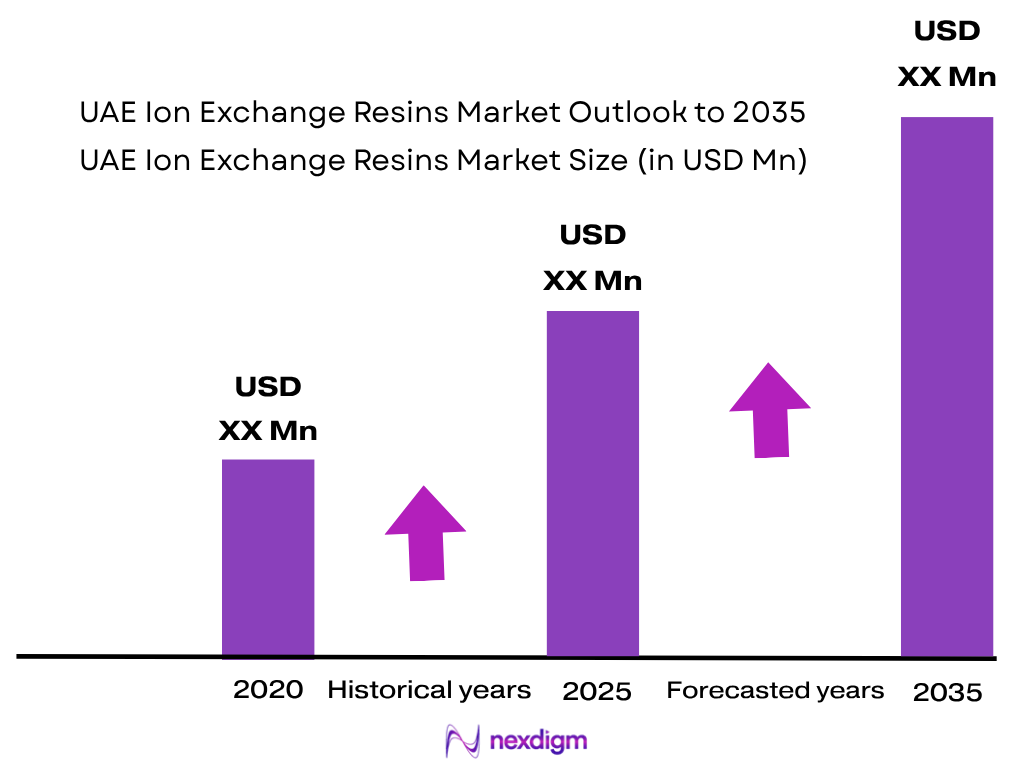
The UAE ion exchange resins market is valued at USD ~ million, supported by demand for water softening, demineralization, condensate polishing, industrial process water and high-purity water treatment. Underlying water-treatment intensity is substantial: Dubai’s desalinated-water production increased from 143.31 billion imperial gallons to 150.48 billion imperial gallons, while installed desalination capacity stood at 495 million imperial gallons per day. This infrastructure, alongside industrial water requirements, supports recurring resin replacement and polishing demand.
Abu Dhabi and Dubai form the principal demand centers because of their concentration of desalination, power generation, oil and gas, petrochemicals, manufacturing and large-scale water infrastructure. Abu Dhabi’s manufacturing value increased from approximately AED 101 billion to AED 111.6 billion, while Dubai’s manufacturing output increased from AED 36.56 billion to AED 37.57 billion. Dubai also operates 495 MIGD of desalination capacity, strengthening recurring requirements for industrial water treatment and downstream polishing technologies.
Market Segmentation
By Resin Type
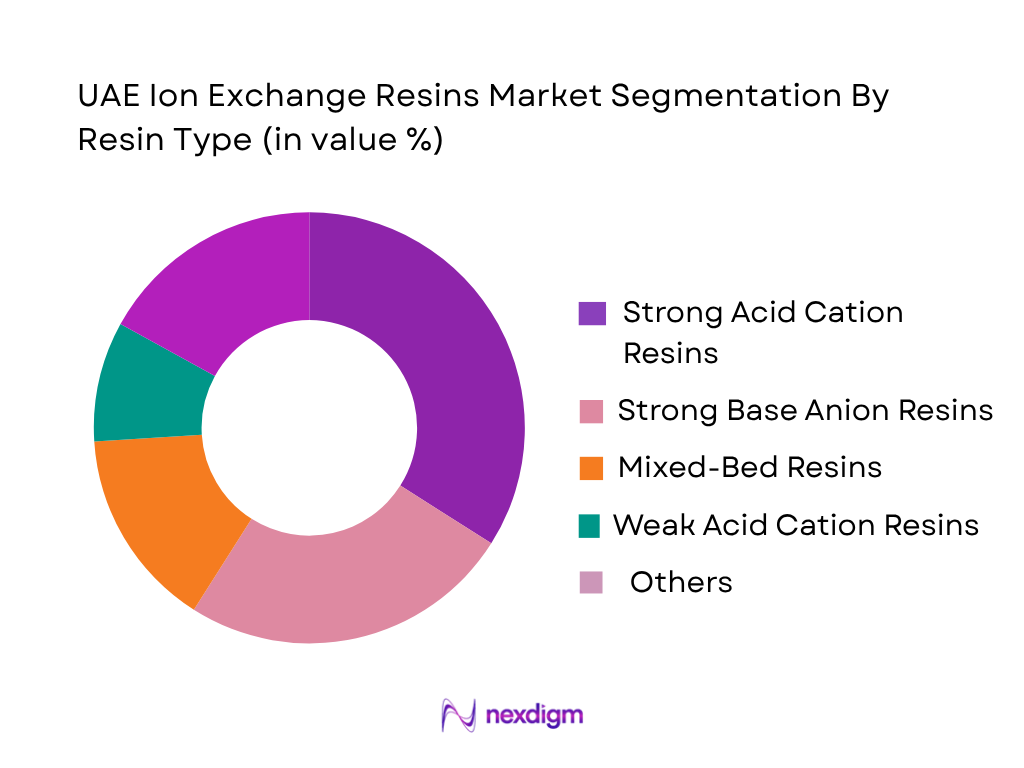
The UAE ion exchange resins market is segmented by resin type into strong acid cation (SAC), weak acid cation (WAC), strong base anion (SBA), weak base anion (WBA), mixed-bed, chelating and specialty/selective resins. Cation exchange resins dominate the market, consistent with published market evidence identifying cationic resin as the largest revenue-generating product category. Their position is supported by extensive water-softening and demineralization requirements across commercial facilities, utilities, boiler-feed-water systems, industrial plants and process-water installations. SAC resins are particularly suited to hardness removal and primary demineralization stages and consequently have a large installed replacement base. The UAE’s hot climate, substantial cooling requirements, desalination-dependent water system and extensive industrial infrastructure create recurring demand for treated utility water. Mixed-bed and high-purity grades occupy smaller volumes but command stronger technical positioning in polishing, pharmaceutical, power-generation and high-purity applications.
By Application
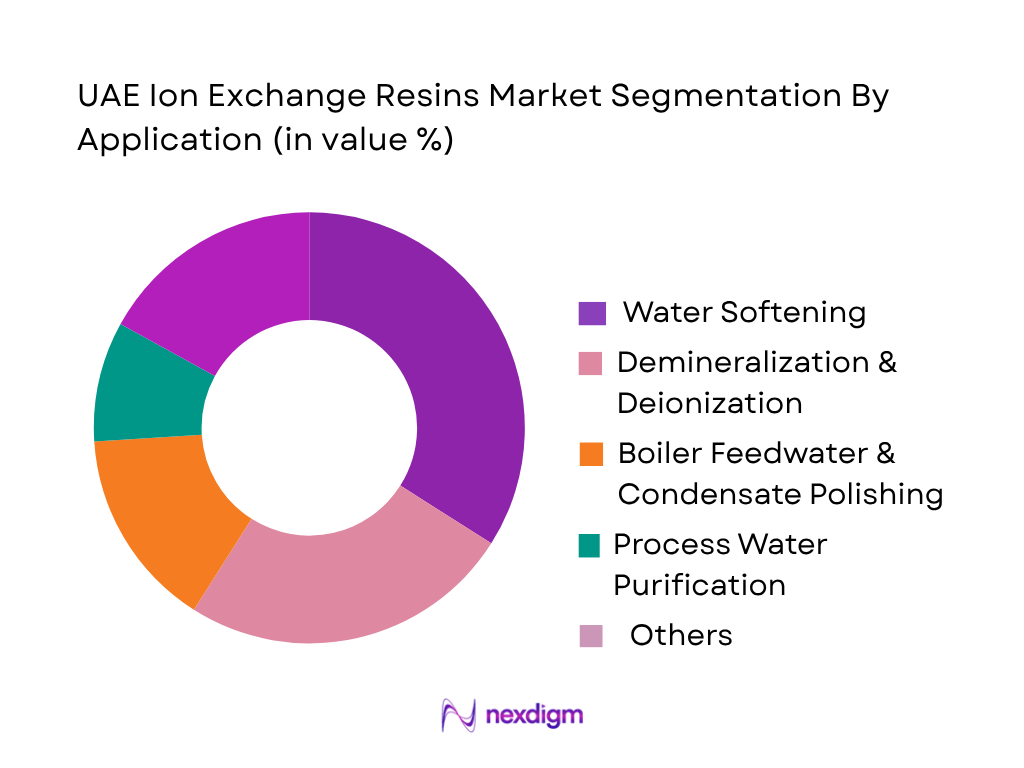
The UAE ion exchange resins market is segmented by application into water softening, demineralization and deionization, condensate polishing, ultrapure-water production, boiler-feed-water treatment, process-water purification, wastewater treatment and reuse, and selective contaminant removal. Water softening and demineralization represent the dominant application cluster because ion exchange is extensively incorporated into industrial utility-water systems and as a polishing technology alongside membrane treatment. Dubai alone produced 150.48 billion imperial gallons of desalinated water while operating 17,179 MW of installed electricity-generation capacity, illustrating the scale of water and power infrastructure supporting treatment requirements. Resin demand also benefits from oil and gas, petrochemical, food-processing and manufacturing installations where controlled hardness, conductivity and ionic composition are important. Condensate polishing and high-purity applications are comparatively specialized but can generate premium demand because resin performance, ionic leakage and service reliability are more stringent.
Competitive Landscape
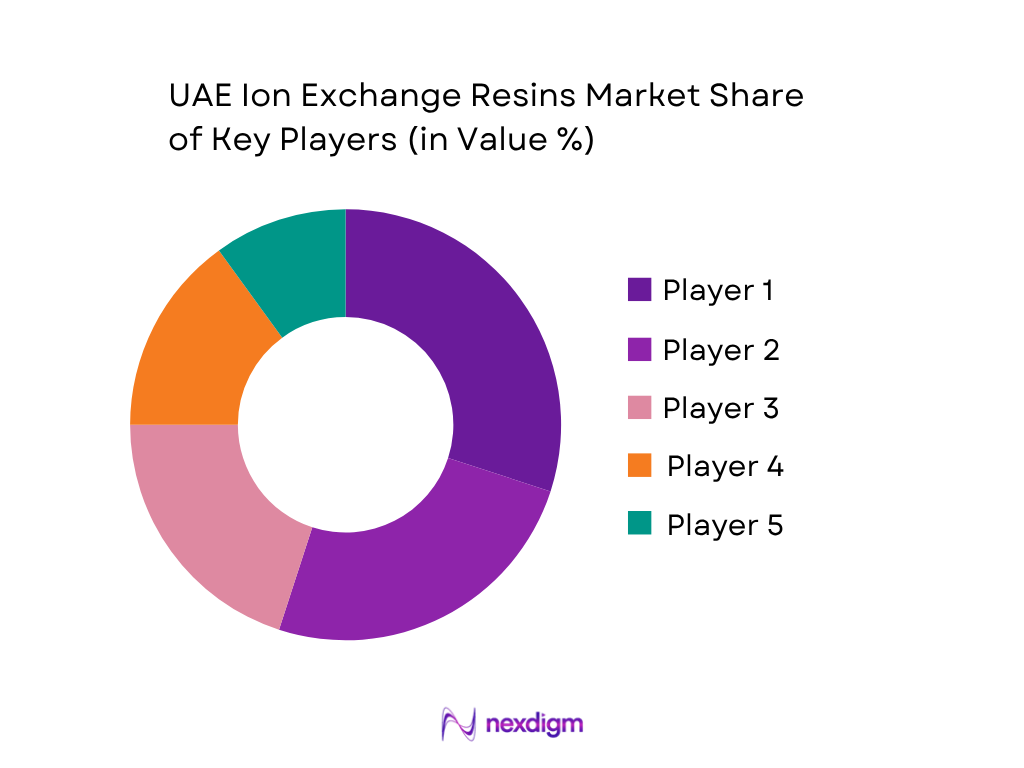
The UAE ion exchange resins market is primarily supplied by international resin manufacturers operating through regional distributors, water-treatment EPC companies, system integrators and direct industrial relationships. Competition extends beyond resin price to exchange capacity, mechanical stability, regeneration efficiency, low-leachable performance, availability of specialized grades, local inventory and technical assistance. Major global portfolios include AmberLite, Lewatit, Purolite, DIAION and TRILITE. Suppliers capable of supporting desalination-linked polishing, industrial demineralization, condensate polishing and high-purity applications are particularly relevant to the UAE customer base.
| Major Player | Establishment | Headquarters | Principal Resin Brand | Core Resin Portfolio | High-Purity Capability | Key UAE-Relevant Applications | Specialty Resin Capability | Competitive Positioning |
| DuPont | 1802 | Wilmington, USA | ~ | ~ | ~ | ~ | ~ | ~ |
| LANXESS | 2004 | Cologne, Germany | ~ | ~ | ~ | ~ | ~ | ~ |
| Purolite / Ecolab | 1981 | Pennsylvania, USA | ~ | ~ | ~ | ~ | ~ | ~ |
| Mitsubishi Chemical Group | 1933* | Tokyo, Japan | ~ | ~ | ~ | ~ | ~ | ~ |
| Samyang Corporation | 1924 | Seoul, South Korea | ~ | ~ | ~ | ~ | ~ | ~ |
UAE Ion Exchange Resins Market Analysis
Growth Drivers
Expansion of Desalination and High-Specification Water Treatment Infrastructure
The UAE ion exchange resins market is supported by the scale of desalination and potable-water infrastructure, where ion exchange resins are used in water softening, demineralization, condensate treatment and post-RO polishing. Dubai Electricity and Water Authority reported 150.478 billion imperial gallons of desalinated-water production in 2024, compared with 143.309 billion imperial gallons in 2023, while installed desalination capacity stood at 495 million imperial gallons per day. Peak daily water demand reached 455.067 million imperial gallons, and average daily demand reached 413.865 million imperial gallons. DEWA also recorded 6,413.95 million cubic metres of seawater withdrawal, demonstrating the scale of feedwater processed through the emirate’s water infrastructure. Water-storage capacity reached 1,002 million imperial gallons, while water-transmission pipelines included 1,463 kilometres of 1,200-mm pipelines. These operating volumes support recurring requirements for ion-removal, demineralization and polishing systems rather than representing only new-project demand. The wider economic base reinforces these requirements: World Bank data place UAE GDP at USD 552.32 billion and GDP per capita at USD 50,273.5 in 2024, indicating the economic capacity to sustain capital-intensive utility and industrial water-treatment infrastructure.
Expansion of Power, Hydrocarbon and Industrial Process-Water Requirements
Industrial and utility activity is another important driver for UAE ion exchange resin consumption because power plants, refineries, petrochemical complexes and manufacturing facilities require controlled-quality boiler feedwater, condensate, cooling-system makeup water and process water. DEWA generated 59.19 TWh of electricity in 2024 and operated 17,179 MW of installed generation capacity, including major thermal generation assets associated with high-purity water-treatment requirements. At the national level, IMF data indicate crude-oil production of approximately 2.9 million barrels per day in 2024, while ADNOC Refining’s Ruwais refinery operates with crude-processing capacity of 922,000 barrels per day. Such large continuous-process facilities require water-treatment systems capable of limiting hardness, silica and dissolved ionic contaminants that can affect boilers, steam cycles, heat-transfer equipment and downstream process units. The industrial demand environment is reinforced by the UAE’s AED 1.78 trillion GDP at constant prices, with manufacturing output forming a significant component of national economic activity. World Bank data further record a national population of 10,986,400 in 2024, expanding the domestic infrastructure base served by utilities and industrial producers. These operating conditions sustain resin replacement, mixed-bed polishing and demineralization requirements across the installed industrial base.
Market Challenges
Heavy Dependence on Imported Ion Exchange Resins and International Supply Chains
The UAE ion exchange resins market remains strongly exposed to overseas manufacturing because commercial resin supply is sourced from international production centers and subsequently distributed through UAE importers, chemical distributors and water-treatment companies. World Integrated Trade Solution data based on UN Comtrade show that suppliers from France shipped 334,002 kg, China shipped 996,927 kg, India shipped 232,792 kg, Italy shipped 284,934 kg, and Romania shipped 78,501 kg of HS 391400 ion-exchange products to the UAE in 2024. South Korea supplied another 15,250 kg, while the Netherlands supplied 11,215 kg. This geographically dispersed sourcing structure creates operational exposure to international shipping, supplier lead times, customs clearance and inventory availability, particularly for specialized mixed-bed, high-purity, chelating and application-specific grades that cannot always be substituted immediately. The broader macroeconomic trade environment demonstrates how internationally integrated the UAE supply chain is: IMF data recorded approximately USD 368 billion of goods imports in 2024, while central-bank gross foreign assets stood at approximately USD 199.7 billion. For resin buyers, dependable local stocks and multiple qualified supply sources therefore remain critical procurement considerations, especially for emergency replacement and process-critical applications.
Resin Performance Stress from High Water Throughput and Challenging Feedwater Conditions
Ion exchange resin performance in the UAE must be maintained under intensive water-treatment operating conditions, creating challenges related to fouling, ionic loading, regeneration effectiveness and service life. DEWA reported 6,413.95 million cubic metres of seawater withdrawal in 2024, while desalinated-water production reached 150,478 million imperial gallons and peak daily demand reached 455.067 million imperial gallons. DEWA’s groundwater analysis also reports approximately 1,500 mg/L total dissolved solids, illustrating the high ionic content encountered in some UAE raw-water sources before treatment. Potable-water specifications require substantially controlled final-water chemistry; DEWA reported typical treated-water conductivity of 393 µS/cm, total dissolved solids of 216 mg/L, total hardness of 61.3 mg/L, calcium hardness of 41 mg/L and alkalinity of 51.4 mg/L. Ion exchange systems used for further softening, demineralization or high-purity polishing must therefore maintain predictable exchange capacity and leakage performance under substantial throughput. Resin fouling, oxidation, attrition and inadequate regeneration can increase replacement requirements and compromise treated-water specifications. The challenge exists within a large economy: World Bank data put UAE GDP at USD 552.32 billion in 2024, meaning treatment reliability is important across extensive utility, industrial and commercial infrastructure rather than isolated facilities.
Market Opportunities
Expansion of High-Purity Polishing and Hybrid RO–Ion Exchange Applications
A major opportunity for the UAE ion exchange resins market lies in positioning ion exchange as a polishing technology alongside reverse osmosis rather than only as a conventional standalone demineralization solution. DEWA operated 68 million imperial gallons per day of reverse-osmosis desalination capacity in 2024, alongside 427 million imperial gallons per day of multi-stage flash capacity, creating an established membrane-treatment base where downstream ion exchange can be used when tighter conductivity, silica or ionic specifications are required. Total desalinated-water output reached 150.478 billion imperial gallons, demonstrating the scale of water passing through treatment infrastructure. The opportunity extends into power and industrial applications: DEWA’s electricity system generated 59.19 TWh and had 17,179 MW of installed generation capacity, where boiler-feed and steam-cycle systems can require high-purity water treatment and condensate polishing. The broader addressable industrial economy is substantial, with UAE GDP at USD 552.32 billion and GDP per capita of USD 50,273.5 in 2024, according to the World Bank. These current operating fundamentals provide a base for greater adoption of mixed-bed, low-leachable, monodisperse and high-purity resin grades in applications demanding treatment beyond primary membrane separation.
Water Reuse, Selective Ion Removal and Resin Service Opportunities
Industrial water reuse and selective contaminant removal provide another development avenue for UAE ion exchange resin suppliers, particularly where conventional filtration or membrane treatment requires an additional polishing stage. Abu Dhabi’s wastewater infrastructure includes 41 treatment plants capable of treating more than 320 million cubic metres of wastewater annually, providing a sizeable existing stream from which higher-value reuse and polishing applications can emerge. Ion exchange resins can support targeted removal of hardness ions, nitrate, heavy metals and other dissolved contaminants when specific treated-water characteristics are required for industrial reuse. Dubai’s water system provides additional scale, with average daily demand of 413.865 million imperial gallons in 2024, peak daily demand of 455.067 million imperial gallons, and reservoir storage capacity of 1,002 million imperial gallons. These operating volumes strengthen the commercial rationale for technologies that enable water recovery, polishing and repeated use within industrial systems. World Bank data record a UAE population of 10,986,400 and GDP of USD 552.32 billion in 2024, supporting sustained municipal and industrial water requirements. This environment creates opportunities not only for fresh resin supply but also for resin testing, bed reclassification, regeneration optimization, replacement planning and application-specific selective resin services.
Future Outlook
The UAE ion exchange resins market is expected to expand at a forecast CAGR of ~X.X% during the forecast period, supported by continuing investment in desalination, industrial water treatment, water reuse, power generation and advanced manufacturing. Dubai plans to expand desalination capacity from 495 MIGD to 735 MIGD, with incremental capacity centered on seawater reverse osmosis. The transition toward membrane desalination does not eliminate ion exchange demand; rather, it creates opportunities in downstream polishing, high-purity treatment and specialized contaminant-removal systems.
Demand is expected to become progressively more performance-oriented. Standard cation and anion resins will remain important for softening and demineralization, while monodisperse, low-TOC, mixed-bed, condensate-polishing, chelating and selective resins should gain relevance in applications where water specifications are more stringent. Industrial expansion is another structural driver. UAE industry contributed approximately AED 197 billion to GDP in the preceding industrial reporting period, while Abu Dhabi manufacturing subsequently reached AED 111.6 billion.
Major Players
- DuPont – AmberLite™
- Ecolab / Purolite – Purolite™
- LANXESS – Lewatit™
- Mitsubishi Chemical Group – DIAION™
- Samyang Corporation – TRILITE™
- Thermax Limited – Tulsion™
- Ion Exchange (India) Limited – INDION™
- Sunresin New Materials
- ResinTech
- Jacobi Group
- Jiangsu Suqing Water Treatment Engineering Group
- Anhui Sanxing Resin Technology Co., Ltd.
- Pure Resin Co., Ltd.
- Zhejiang Zhengguang Industrial Co., Ltd.
- Hebi Higer Chemical Co., Ltd.
Key Target Audience
- Ion Exchange Resin Manufacturers and Specialty Resin Producers
- UAE Ion Exchange Resin Importers, Distributors and Chemical Suppliers
- Water Treatment EPC Companies, OEMs and System Integrators
- Desalination, Power, Oil & Gas, Refining and Petrochemical Operators
Industrial Water, Wastewater Recycling and Resin Regeneration Service Providers
Investments and Venture Capitalist Firms - Government and Regulatory Bodies (Ministry of Energy and Infrastructure, Ministry of Industry and Advanced Technology, Dubai Electricity and Water Authority, Department of Energy – Abu Dhabi,Environment Agency – Abu Dhabi)
- Pharmaceutical, Food & Beverage, Metals, District Cooling and Advanced Manufacturing Companies
Research Methodology
Step 1: Identification of Key Variables
The research begins by constructing the UAE ion exchange resins ecosystem covering global manufacturers, importers, distributors, EPC contractors, system integrators, utilities and industrial consumers. Secondary research identifies critical variables including resin type, installed bed volume, exchange capacity, replacement cycles, import dependency, application mix, pricing, regeneration frequency and end-user water-treatment requirements.
Step 2: Market Analysis and Construction
Historical market construction combines supplier revenues, UAE trade flows, distributor sales, installed treatment systems and application-level resin consumption. Top-down assessment is reconciled against bottom-up calculations based on resin-bed capacity, replacement intervals and new project additions. Import and re-export activity is separately considered because the UAE also functions as a regional distribution hub for chemicals and water-treatment equipment.
Step 3: Hypothesis Validation and Expert Consultation
Market hypotheses are validated through CATIs and structured interviews with resin manufacturers, authorized distributors, water-treatment EPC companies, industrial procurement managers and technical water-treatment professionals. Interviews assess actual resin consumption, brand preference, pricing, replacement behavior, regeneration economics, inventory requirements and supplier qualification criteria, allowing secondary-data assumptions to be challenged and refined.
Step 4: Research Synthesis and Final Output
The final stage triangulates manufacturer, distributor, trade and end-user evidence to establish the market structure. Resin-type and application shares are cross-checked against installed systems and replacement patterns. Forecast scenarios incorporate desalination investment, industrial development, water reuse, technology substitution, resin service-life improvements and pricing trends to produce a validated outlook for the UAE ion exchange resins market.

- Executive Summary
- Research Methodology (Market Definition and Scope, Ion Exchange Resin Classification, Market Boundary Assessment, Abbreviations, Market Sizing Methodology, Top-Down Market Estimation, Bottom-Up Market Validation, Demand-Side Assessment, Supply-Side Assessment, HS Code 391400 Import-Based Market Reconstruction, Re-Export Adjustment, Distributor Sales Assessment, Installed Resin Bed Assessment)

- Definition and Scope
- Evolution and Development of the UAE Ion Exchange Resins Market
- UAE Ion Exchange Resins Industry Ecosystem Analysis
- Domestic Availability versus Imported Resin Supply Landscape
- UAE Ion Exchange Resins Value Chain and Supply Chain Analysis
- Desalination and Industrial Water Treatment Infrastructure Landscape
- Key End-Use Ecosystem: Power, Oil & Gas, Refining, Petrochemicals, and High-Purity Water Treatment

- Growth Drivers (Expansion of Seawater Reverse Osmosis Desalination Capacity, Increasing Demand for Desalination Permeate Polishing, Growth of Power Generation and Boiler Feedwater Treatment Demand, Expansion of Oil & Gas Refining and Petrochemical Operations)
- Market Challenges (High Dependence on Imported Ion Exchange Resins, International Freight and Supply Chain Exposure, Resin Price Volatility, Resin Fouling from Silica Iron and Organic Contaminants, High Acid Caustic and Salt Regeneration Costs, Disposal of Spent Resin and Regeneration Effluent
- Market Opportunities (Condensate Polishing Resins for Power Generation, High-Purity Mixed Bed Resins for Industrial Applications, Desalination Post-Treatment and Polishing Resins, Selective Resins for Boron Silica and Heavy Metal Removal)
- Market Trends (Shift from Commodity to High-Performance Resins, Adoption of Uniform Particle Size and Monodisperse Resins, RO–Ion Exchange–EDI Hybridization, Growth of Mixed Bed Polishing after Reverse Osmosis, Increasing Demand for Low-Leachable and Low-TOC Resins, Longer Resin Life Optimization)
- Regeneration Economics Analysis
- SWOT Analysis of Major Players
- Porter’s Five Forces Analysis
- PESTLE Analysis

- By Market Value (2020-2025)
- By Consumption Volume (2020-2025)
- By Average Selling Price (2020-2025)
- By Import Value (2020-2025)
- By Import Volume (2020-2025)
- By Re-Export Value and Volume (2020-2025)
- By Installed Resin Bed Volume (2020-2025)
- By Fresh Resin Consumption versus Replacement Resin Demand (2020-2025)

- By Resin Type
Strong Acid Cation Resins
Weak Acid Cation Resins
Strong Base Anion Resins – Type I
Strong Base Anion Resins – Type II
Weak Base Anion Resins
Mixed Bed Resins
Chelating Resins
Selective Ion Exchange Resins
Adsorbent and Specialty Separation Resins
Ultrapure Water Grade Resins
Food and Pharmaceutical Grade Resins
Condensate Polishing Resins
Nuclear / High-Purity Specialty Resins - By Polymer Matrix
Styrene-Divinylbenzene Resins
Acrylic Resins
Polystyrenic Resins
Macroporous Resins
Gel-Type Resins
Monodisperse / Uniform Particle Size Resins
Specialty Polymeric Matrices - By Application
Water Softening
Demineralization and Deionization
Condensate Polishing
Ultrapure Water Production
Boiler Feedwater Treatment
Process Water Purification
Desalination Post-Treatment and Polishing
Drinking and Municipal Water Treatment
Wastewater Treatment and Water Reuse
Heavy Metal Removal
Nitrate and Selective Contaminant Removal
Silica Removal and Polishing
Boron and Trace-Ion Removal
Food and Beverage Purification
Pharmaceutical Purification and Separation
Chemical Processing and Catalysis
Metal Recovery and Hydrometallurgy - By End-Use Industry
Municipal Water and Desalination
Power Generation
Oil & Gas
Refining
Petrochemicals and Chemicals
District Cooling
Food and Beverage
Pharmaceuticals and Biotechnology
Healthcare and Laboratories
Metals and Mining
Electroplating and Surface Treatment
Electronics and Advanced Manufacturing
Commercial and Institutional Water Treatment
Industrial Wastewater Treatment and Reuse
Other Process Industries - By Geography
Abu Dhabi
Abu Dhabi City–Mussafah Industrial Cluster
Ruwais Refining and Petrochemical Cluster
Al Taweelah Water and Power Corridor
Al Dhafra Industrial and Utility Cluster
Dubai
Jebel Ali Industrial and Free Zone Cluster
Dubai Industrial City and Dubai South Cluster
Sharjah
Hamriyah Free Zone and Industrial Area Cluster
Ras Al Khaimah
Fujairah
Fujairah Power, Desalination and Oil Storage Cluster
Ajman
Umm Al Quwain

- Market Share Analysis of Major Players
- Cross Comparison Parameters (Product Portfolio Breadth, Ion Exchange Capacity and Resin Performance Range, UAE Distributor and Local Inventory Coverage, Desalination and Industrial Water Application Coverage, Power and Condensate Polishing Capability, High-Purity and Specialty Resin Portfolio, Resin Regeneration and Technical Service Capability, Price Positioning and Total Cost of Ownership)
- Competitive Benchmarking Analysis (Product Innovation Capability, Pricing Strategy, UAE Market Presence, Supply Chain Efficiency, Customer Base Strength, Product Grade Coverage, Application-Specific Resin Capability, Distribution and Technical Service Strength)
- Production and Supply Capacity Benchmarking
- SWOT Analysis of Major Players
- Pricing Analysis
- Detailed Profile of Major Companies
DuPont de Nemours, Inc. – AmberLite™
Ecolab Inc. / Purolite – Purolite™
LANXESS AG – Lewatit™
Mitsubishi Chemical Group Corporation – DIAION™
Samyang Corporation – TRILITE™
Thermax Limited – Tulsion™
Ion Exchange (India) Limited – INDION™
Sunresin New Materials Co., Ltd.
ResinTech, Inc.
Jacobi Carbons Group / Jacobi Resins
Jiangsu Suqing Water Treatment Engineering Group
Anhui Sanxing Resin Technology Co., Ltd.
Pure Resin Co., Ltd.
Zhejiang Zhengguang Industrial Co., Ltd.
Hebi Higer Chemical Co., Ltd.


 Request a Sample
 Ask for Customization
 Get a Quote
 Enquire Now