

 Download PDF
Market Overview
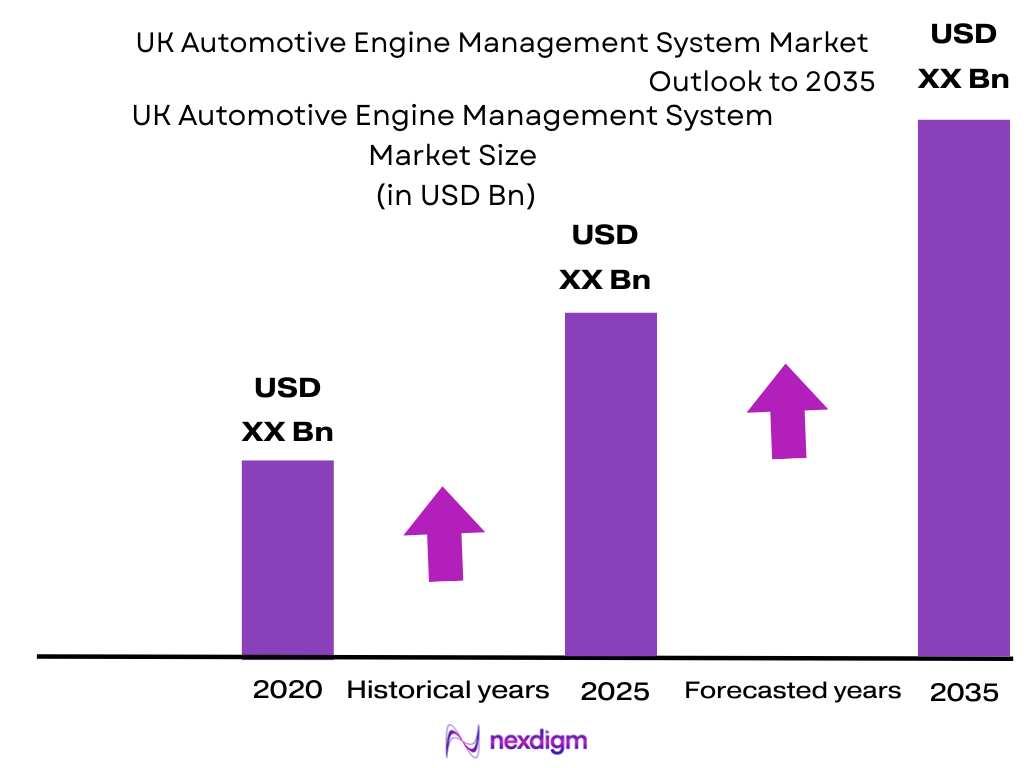
The UK Automotive Engine Management System Market is valued at USD ~ billion, supported by the country’s substantial petrol, diesel and hybrid vehicle base and replacement ecosystem. New-car registrations increased from 1.903 million to 1.953 million, while domestic car production moved from 905,117 units to 779,584 units. Increasing HEV/PHEV adoption, turbocharged engines, GDI, electronic emissions management and an ageing vehicle parc sustain demand for ECUs, sensors, injectors and actuators. Coventry, Birmingham-Solihull, Sunderland, Oxford and the wider West Midlands form important UK demand and engineering clusters because they combine vehicle manufacturing, powertrain engineering, Tier-1 suppliers, aftermarket distribution and specialist automotive electronics capabilities. National vehicle manufacturing shifted from more than 1.02 million cars and commercial vehicles to 905,233 vehicles, while engine production remained measured in millions of units. The UK’s heavily export-oriented automotive manufacturing base also increases requirements for powertrain controls calibrated to multiple destination-market standards.
Market Segmentation
By Component Type
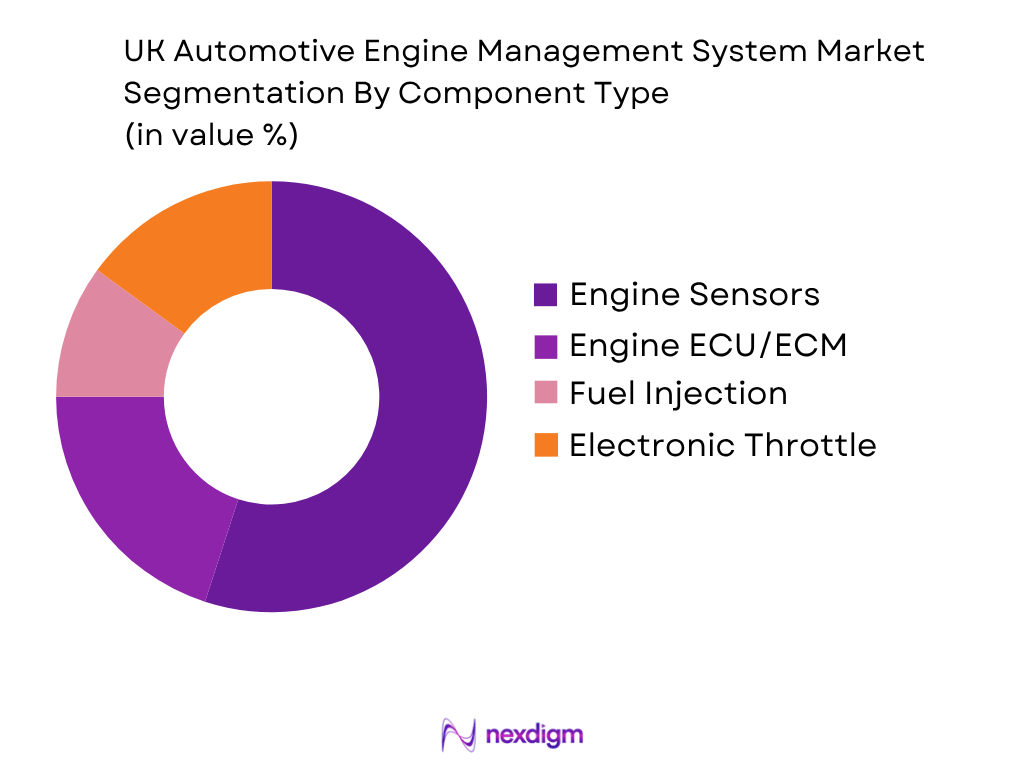
The UK Automotive Engine Management System Market is segmented into engine control units and powertrain control modules, engine sensors, fuel-injection components, ignition-management components, electronic throttle and air-management systems, and other control electronics. Engine sensors represent the largest component opportunity by installed and replacement breadth, because modern petrol, diesel and hybrid engines rely on multiple crankshaft, camshaft, lambda, airflow, pressure, temperature, knock and exhaust sensors. Unlike a central ECU, numerous sensors are installed across a single powertrain and are exposed to heat, vibration, contamination and ageing throughout the vehicle lifecycle. This gives sensors substantial aftermarket relevance alongside OEM fitment. The UK’s ageing vehicle parc strengthens this position: SMMT reports an average car age of 9.5 years, with a large proportion of cars already exceeding a decade in service. ECU/PCM systems nevertheless capture substantial value because they integrate injection, ignition, air-path and emissions functions.
By Powertrain Type
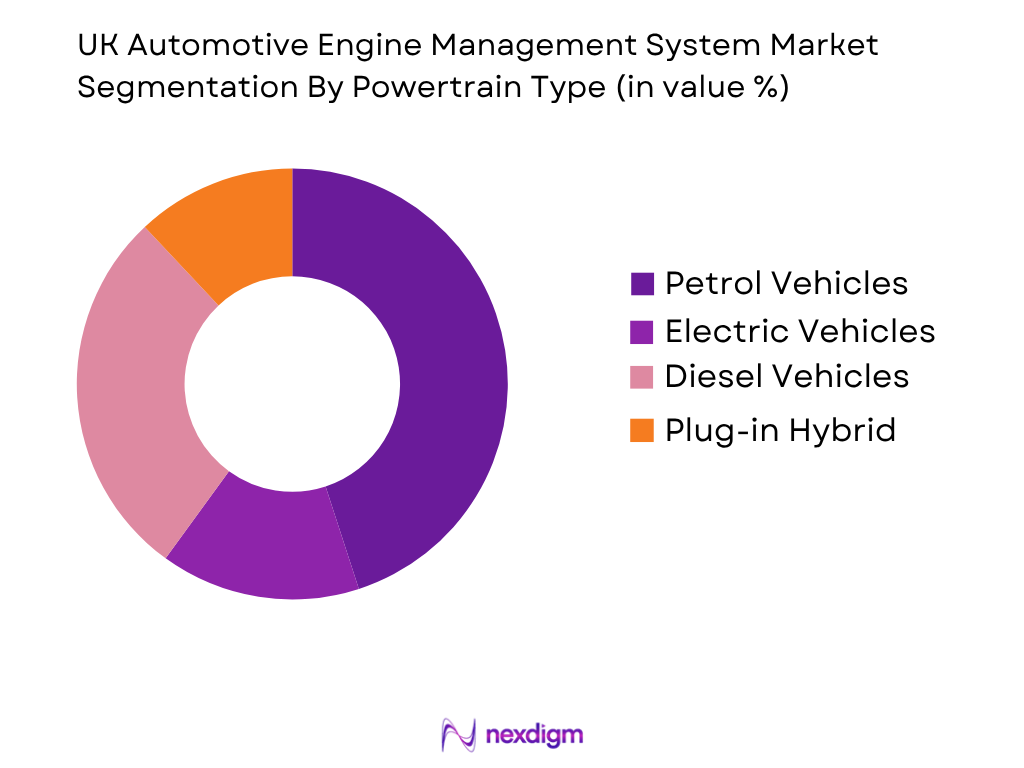
The UK Automotive Engine Management System Market is segmented into conventional petrol, conventional diesel, full-hybrid electric, plug-in hybrid electric and other combustion-based powertrains. Petrol vehicles currently dominate engine-management demand because the UK vehicle parc remains heavily populated by petrol cars. SMMT’s latest Motorparc dataset records approximately 21.16 million petrol cars compared with 11.04 million diesel cars, while HEVs and PHEVs are expanding quickly from smaller installed bases. Petrol powertrains require ECUs, lambda sensors, throttle controls, ignition coils, crank/cam sensors and injection management throughout their service life. HEVs and PHEVs are increasingly important strategically because they preserve the internal-combustion engine while requiring more complex supervisory control, thermal management and repeated engine restart capability. The segment therefore offers greater electronic sophistication even as conventional ICE-only registrations decline.
Competitive Landscape
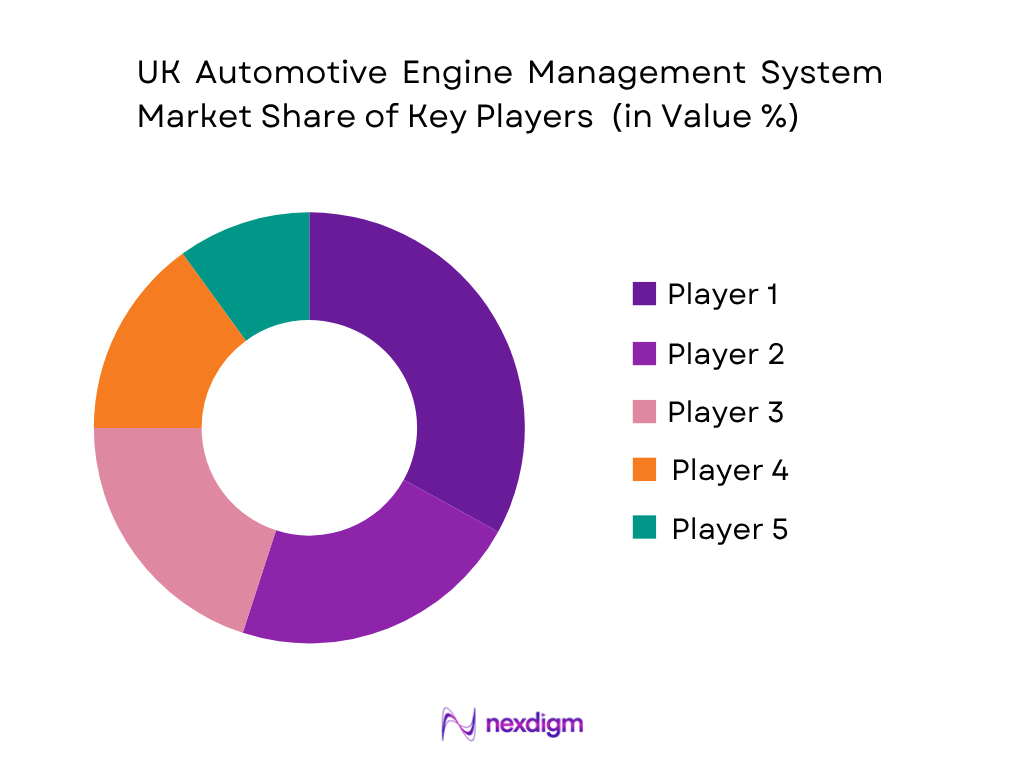
The UK Automotive Engine Management System Market combines global OE powertrain suppliers with major aftermarket engine-management specialists. Bosch and DENSO span engine ECUs, injection and sensing; PHINIA/Delphi combines petrol and diesel fuel systems with engine-management and diagnostic products; BorgWarner participates through ignition, boosting and exhaust-gas management; and Standard Motor Products has strong aftermarket exposure through vehicle-control and replacement electronics. Valeo also maintains a substantial UK aftermarket range covering sensors, coils, injectors, EGR systems and fuel pumps.
| Major Player | Establishment | Headquarters | ECU / Control Capability | Sensor Portfolio | Fuel-System Capability | Hybrid Capability | UK Aftermarket Strength | Diesel / Emissions Capability |
| Robert Bosch GmbH | 1886 | Gerlingen, Germany | ~ | ~ | ~ | ~ | ~ | ~ |
| DENSO Corporation | 1949 | Kariya, Japan | ~ | ~ | ~ | ~ | ~ | ~ |
| BorgWarner Inc. | 1928 | Auburn Hills, USA | ~ | ~ | ~ | ~ | ~ | ~ |
| PHINIA / Delphi | 2023 as independent company | Auburn Hills, USA | ~ | ~ | ~ | ~ | ~ | ~ |
| Standard Motor Products / Intermotor | 1919 | Long Island City, USA | ~ | ~ | ~ | ~ | ~ | ~ |
UK Automotive Engine Management System Market Analysis
Growth Drivers
Tightening Emissions Compliance and Increasing Powertrain-Control Complexity
The tightening UK emissions and type-approval framework is increasing the technical importance of engine control units, lambda and NOx sensors, high-pressure injection, EGR management, electronic throttles, turbocharger actuators and aftertreatment coordination. Great Britain’s Vehicle Emissions Trading Schemes entered operation with headline requirements covering new cars and vans, while the government’s 2024 framework set the zero-emission requirement at 22 new cars in every 100 registrations and 10 new vans in every 100 registrations. For the non-zero-emission vehicles that remain in production, manufacturers must progressively extract greater emissions and fuel-efficiency performance from combustion and hybrid powertrains through electronic control. The regulatory architecture is also becoming technologically more demanding. In 2025, the government consulted on accepting Euro 6e emissions requirements within the GB type-approval system, and in 2026 it proposed moving the minimum emissions standard toward Euro 7, which covers tighter vehicle-emission durability and monitoring requirements. These developments favour increasingly capable ECUs that continuously coordinate fuel pressure, injector timing, ignition, air-fuel ratio, boost pressure, EGR flow and exhaust temperature. Engine-management demand is supported by a substantial domestic automotive production ecosystem: UK factories produced 905,233 vehicles in 2024, including 779,584 cars, meaning hundreds of thousands of locally assembled powertrains required either combustion, hybrid or electrified electronic-control architectures. At the macroeconomic level, World Bank data put UK GDP at roughly USD 3.56 trillion in 2024 and around USD 4.00 trillion in 2025, while GDP per capita reached USD 57,602 in 2025. The IMF reports a UK population of 69.85 million and expects real economic output to expand by about 1.0 in 2026, maintaining a large high-value vehicle and service economy despite relatively moderate growth. For engine-management suppliers, regulation therefore raises value per surviving ICE or hybrid vehicle. A modern controller must process many sensor inputs in milliseconds, maintain catalyst and particulate-filter efficiency, control high-pressure fuel systems, identify emissions-related faults and communicate with transmission, hybrid and thermal controllers. The shift toward Euro 7-type requirements can further support higher-specification pressure, temperature, oxygen and NOx sensing and more sophisticated diagnostic software, making emissions compliance a technology-content driver even as the number of pure ICE vehicles gradually contracts.
Hybrid and Plug-in Hybrid Expansion Sustaining Higher-Value Engine Management
Hybridisation is one of the strongest demand drivers for the UK Automotive Engine Management System Market because HEVs and PHEVs retain the internal-combustion engine while substantially increasing control complexity. Rather than eliminating engine electronics, hybrids add requirements for repeated engine shutdown and restart, torque blending between the motor and combustion engine, battery-state coordination, catalyst-temperature preservation, regenerative-braking interaction and thermal-management optimisation. The scale of this transition is becoming material. SMMT reported that hybrid-electric vehicle registrations continued expanding in 2025, while plug-in hybrids became the fastest-growing major powertrain category; by 2026, the UK car parc contained approximately 1,726,787 HEVs and 941,753 PHEVs, alongside 21,158,516 petrol cars and 11,038,619 diesel cars. This means the country simultaneously supports a large legacy engine-management installed base and a growing pool of electronically more sophisticated hybrid vehicles. UK manufacturing is moving in the same direction. SMMT reported that during the first half of 2025, 160,107 electrified cars were produced domestically, and hybrid, plug-in hybrid and battery-electric vehicles together represented more than two in five vehicles coming off UK production lines. For engine-management suppliers, HEVs and PHEVs are especially attractive because the same vehicle may require an engine ECU, crankshaft and camshaft sensing, direct injection, electronic throttle control, ignition management and oxygen sensing together with a hybrid supervisory controller. Frequent engine restarts also demand precise crank-position identification, immediate fuel-pressure availability and highly calibrated ignition timing to prevent vibration or torque interruption. Thermal management becomes critical because extended electric running can cool the catalytic converter; the ECU must sometimes adjust ignition timing, engine loading or restart sequencing to return the aftertreatment system to an efficient temperature rapidly. The UK’s ageing conventional vehicle fleet provides an additional parallel demand base. SMMT reported an average car age of 9.5 years in 2024, rising to 9.7 years in 2026, while the number of vehicles older than ten years continued increasing. This creates simultaneous OEM demand for sophisticated hybrid controllers and aftermarket demand for replacement sensors, injectors, ignition coils and ECUs on older petrol and diesel vehicles. The macroeconomic backdrop remains large enough to support these overlapping technology cycles: World Bank data show UK GDP approaching USD 4.00 trillion in 2025, and the IMF places the country’s population at 69.85 million in its latest 2026 profile. Hybridisation therefore acts as a bridge rather than simply a transition technology. It allows engine-management suppliers to increase semiconductor and software content per vehicle while preserving combustion-related hardware during the broader move toward zero-emission mobility.
Market Challenges
Zero-Emission Vehicle Transition Removing Conventional Engine-Control Content
The UK’s zero-emission vehicle transition represents the most significant structural challenge for the Automotive Engine Management System Market because each battery-electric vehicle permanently removes most combustion-specific electronic content. A BEV does not require petrol or diesel fuel injectors, spark ignition, crankshaft and camshaft engine-position sensing, mass-air-flow sensing, lambda sensors, turbocharger boost control or a conventional combustion-engine ECU. Government policy accelerates this substitution. The ZEV mandate began with requirements covering 22 zero-emission cars per 100 new-car registrations and 10 zero-emission vans per 100 new-van registrations in 2024, with the regulatory trajectory increasing over subsequent periods. Final government compliance information published in 2026 confirms that both the car and van markets met the 2024 Vehicle Emissions Trading Scheme requirements, demonstrating that the policy is already influencing actual vehicle mix rather than functioning solely as a future target. The shift is increasingly visible in the operating fleet. Current SMMT Motorparc data identify 1,797,681 battery-electric cars in use, compared with 941,753 PHEVs and 1,726,787 HEVs. This distinction is critical to engine-management vendors: HEVs and PHEVs preserve substantial engine-control content, whereas every additional BEV removes it entirely. UK production trends reinforce the threat. Total domestic vehicle output dropped to 905,233 units in 2024 and declined again to 764,715 cars and commercial vehicles in 2025, while production strategy increasingly shifted toward electrified models. Suppliers therefore face both volume pressure and a powertrain mix shift at the same time. A company concentrated in fuel injectors, ignition coils, MAF sensors, throttle bodies or standalone petrol ECUs can lose original-equipment content considerably faster than a diversified electronics supplier. There is also a second architectural threat: software-defined vehicles increasingly consolidate multiple controllers into high-performance domain or central computers, potentially reducing standalone engine-ECU counts even on hybrid vehicles. The economic environment suggests that this transition is structural rather than caused solely by weak demand. World Bank data show UK GDP rising from roughly USD 3.56 trillion in 2024 to approximately USD 4.00 trillion in 2025, while the IMF expects 1.0 real GDP growth in 2026 despite softer near-term conditions. Engine-management suppliers therefore need to support an ageing ICE fleet while simultaneously moving engineering investment toward hybrid control, integrated domain computing and broader vehicle electronics. The difficult part is the overlap: legacy modules and sensors must remain available for millions of existing vehicles even as new-product development shifts toward architectures that contain fewer combustion components.
Declining Domestic Vehicle Output and Increasing Diagnostic Complexity
Lower domestic vehicle production combined with increasing diagnostic and software complexity is another important challenge for UK engine-management suppliers. SMMT reported that total vehicle production fell to 905,233 units in 2024, including 779,584 cars, and then declined further to 764,715 vehicles in 2025 as manufacturers restructured plants, introduced new electrified products and managed weaker export and production conditions. Lower assembly volumes directly reduce OEM demand for locally fitted petrol and diesel engine-control units, injectors, sensors and related components, particularly where production lines migrate toward BEVs. At the same time, the aftermarket is becoming harder to service technically. The UK MOT framework specifically requires inspection of the engine malfunction indicator lamp, commonly called the engine-management light, as well as exhaust-emission performance. This creates demand for repair, but also makes accurate diagnosis critical because a warning lamp can be triggered by faults across oxygen sensors, fuel trim, misfire detection, EGR operation, DPF pressure sensing, NOx sensing, boost control, wiring or ECU software. Modern diesel vehicles add further complexity through SCR/AdBlue control and particulate-filter regeneration, while GDI petrol vehicles require high-pressure fuel-system diagnosis. Hybrid vehicles add high-voltage and supervisory-control interactions that conventional workshop technicians must understand before isolating engine-management faults. Module replacement itself is no longer straightforward: many ECUs require vehicle coding, immobiliser pairing, software flashing or learned-value resets before normal operation. Regulatory enforcement is also becoming more sophisticated. The UK government’s vehicle-standards strategy published in 2024 included work to strengthen enforcement against emissions-related tampering and to expand environmental compliance powers, increasing the importance of correctly functioning diagnostic and emissions-control systems. The challenge is intensified by an ageing parc. Average vehicle age increased from 9.5 years in 2024 to 9.7 years in 2026, and the proportion of cars older than ten years rose from 43.4 cars in every 100 to 45.7 cars in every 100. Older vehicles generate more replacement demand but also create difficulties around obsolete ECUs, discontinued semiconductors, damaged connectors and multiple software revisions. Macroeconomic conditions further pressure the service environment: World Bank data show UK unemployment of 4.7 in 2025, while the IMF expects only about 1.0 real GDP growth in 2026, implying moderate economic expansion rather than a strong volume-driven automotive cycle. Suppliers therefore need extensive technical databases, programming support, broad vehicle coverage and remanufacturing capabilities rather than relying solely on new-component distribution.
Market Opportunities
Hybrid Supervisory Control, Smart Sensors and Software-Defined Powertrain Electronics
The strongest technology opportunity in the UK Automotive Engine Management System Market lies in moving from conventional standalone ECU hardware toward integrated hybrid control, smart sensors and software-defined powertrain electronics. Current UK powertrain data already provide a substantial application base: SMMT records 1,726,787 hybrid-electric cars and 941,753 plug-in hybrids in the operating parc, while manufacturers continue introducing hybrid and PHEV models as transitional alternatives between conventional ICE vehicles and BEVs. Domestic manufacturing provides additional technical relevance. During the first half of 2025, UK factories produced 160,107 electrified cars, with hybrid, PHEV and BEV models together accounting for a large portion of domestic output. Hybrid powertrains create more demanding engine-management requirements than traditional petrol engines because controllers must coordinate combustion torque with motor torque, determine engine start and shutdown timing, manage catalyst temperature after electric-only operation and optimize engine load against battery state. This increases the importance of multicore processors, smart crank and camshaft sensors, wideband lambda sensing, pressure sensors and integrated thermal-management logic. The opportunity extends beyond hardware. Software-defined controllers can combine historically separate engine, transmission and hybrid functions into a single powertrain domain, allowing OEMs to reduce wiring complexity while increasing computational capability. Advanced control algorithms can adapt injection timing, ignition, boost pressure and emissions management according to driver demand, ambient conditions and battery state. Smart sensors can incorporate self-diagnostics and digital signal conditioning, improving failure detection and supporting predictive maintenance. UK emissions regulation reinforces the opportunity. The government consulted during 2025 on incorporating Euro 6e requirements into GB type approval and during 2026 proposed alignment toward Euro 7 for future vehicles, increasing demand for durable sensing, emissions monitoring and sophisticated onboard diagnostics. Current economic indicators provide a substantial industrial foundation: World Bank data place UK GDP at around USD 4.00 trillion in 2025, GDP per capita at USD 57,602, and the population close to 69.5 million, while the IMF puts the 2026 population at 69.85 million. Suppliers that can combine ECU hardware, embedded software, cybersecurity, AUTOSAR architecture and high-precision sensing can therefore position themselves above commodity replacement components. The opportunity is especially attractive because much of the underlying expertise—embedded software, sensor fusion, domain computing and functional safety—can ultimately transfer beyond hybrid engine control into battery-electric propulsion systems. This creates a technology migration path that conventional combustion-only suppliers do not possess.
Ageing ICE Vehicle Parc, MOT Diagnostics and ECU Remanufacturing
The ageing UK petrol and diesel vehicle parc creates a durable aftermarket opportunity for engine-management suppliers even as new-car policy shifts toward zero-emission vehicles. SMMT reported that the average UK car reached 9.5 years of age in 2024, with 43.4 out of every 100 cars already more than ten years old. By 2026, average age had risen to 9.7 years and the over-ten-year group had expanded to 45.7 out of every 100 cars. Current Motorparc data show approximately 21,158,516 petrol cars and 11,038,619 diesel cars still operating, providing an exceptionally large installed base for replacement oxygen sensors, crankshaft and camshaft sensors, MAF/MAP sensors, throttle bodies, ignition coils, injectors, fuel-pressure sensors, EGR controls, DPF pressure sensors, NOx sensors and ECUs. This installed base will not disappear when new ICE registrations decline; vehicles can remain in use for many years, creating a long replacement tail. The UK MOT system makes this opportunity particularly market-specific. DVSA guidance includes inspection of the engine malfunction indicator lamp and exhaust emissions, meaning electronic engine faults can translate directly into repair demand before a vehicle can return to compliant operation. For independent workshops and distributors, this creates demand not only for physical components but also for scan tools, diagnostic databases, ECU programming and technical support. ECU remanufacturing is particularly attractive in older vehicles where new OE modules may be discontinued. A remanufacturing workflow can include core collection, PCB inspection, output-driver repair, memory replacement, solder-joint remediation, calibration reflashing, VIN coding and bench testing. Reconditioning the original or compatible module can extend vehicle life without requiring an entirely new controller. The opportunity also applies to high-value diesel emissions electronics. NOx sensors, EGR actuators, DPF differential-pressure sensors and exhaust-temperature sensors operate in harsh environments and become critical when emissions-related warning lamps are assessed during inspection. The economic environment supports continued vehicle maintenance because households may retain existing vehicles longer during periods of moderate growth. World Bank data place the UK economy at about USD 4.00 trillion in 2025, while the IMF expects GDP growth of about 1.0 in 2026. This combination of a mature economy, slower fleet renewal and an ageing ICE installed base favours aftermarket engine-management demand. Suppliers with broad application coverage, reliable remanufacturing, online catalogue integration and workshop-level diagnostic support can therefore capture value long after the new-car market transitions toward electrification.
Future Outlook
The UK Automotive Engine Management System Market is forecast to expand at ~ CAGR during 2026–2035 under the requested placeholder framework. Market development will be increasingly determined by a transition from conventional petrol/diesel ECUs toward hybrid supervisory control, high-pressure injection, smart sensors, software-defined powertrain control and aftermarket electronics. The most important structural feature is that the UK contains a large legacy combustion fleet even while new-vehicle regulations push rapidly toward zero-emission vehicles. SMMT’s latest parc data identify roughly 36.68 million cars in use, including approximately 21.16 million petrol, 11.04 million diesel, 1.73 million HEV, 941,753 PHEV and 1.80 million BEV cars. Consequently, combustion engine management will remain commercially relevant well beyond the point at which new ICE-only vehicle registrations contract. Age also supports aftermarket demand. The average UK car was 9.5 years old in 2024, and 43.4% of the parc was more than ten years old. By 2026, the average had increased to 9.7 years. Older vehicles create replacement requirements for oxygen sensors, crankshaft and camshaft sensors, MAF/MAP sensors, injectors, ignition coils, throttle bodies and remanufactured ECUs.
Hybridization provides the most attractive bridge between conventional ICE and full electrification. HEVs and PHEVs retain the engine-management stack but require greater control sophistication. Engine controllers must synchronize electric and combustion torque, manage frequent engine starts, optimize catalyst temperature, select efficient engine load points and communicate continuously with battery, inverter and transmission controllers. DENSO’s hybrid architecture, for example, retains engine ECUs, fuel injection and crankshaft sensing, demonstrating why hybrid growth does not eliminate engine-management content. Current UK market direction reinforces this transition. SMMT reports that the latest new-car mix increasingly includes HEVs and PHEVs alongside BEVs, while its 2026 outlook expects plug-in hybrids and hybrids to continue expanding as petrol and diesel registrations contract. The major long-term risk remains the UK ZEV mandate. Government policy requires progressively increasing zero-emission sales and retains the requirement that all new cars and vans become zero-emission by 2035. The government has also reconfirmed the phase-out of new purely petrol and diesel cars from 2030, while allowing specified hybrid pathways through the transition period. Every BEV replacing an ICE-only vehicle removes conventional fuel injection, ignition, engine airflow management and combustion ECU content.
Major Players
- Robert Bosch GmbH / Bosch Mobility
- DENSO Corporation
- AUMOVIO
- PHINIA Inc. / Delphi
- BorgWarner Inc.
- FORVIA HELLA
- Valeo
- Marelli
- Astemo Ltd.
- Schaeffler Group
- Aptiv PLC
- NGK / Niterra
- Standard Motor Products / Intermotor
- Sensata Technologies
- Infineon Technologies
Key Target Audience
- Passenger Car and Light Commercial Vehicle OEMs
- Automotive Tier-1 and Tier-2 Powertrain Suppliers
- Engine ECU, Sensor and Fuel-System Manufacturers
- Motor Factors and Automotive Parts Distribution Networks
- Independent Garage, Fleet Maintenance and ECU Remanufacturing Networks
- Automotive Semiconductor and Embedded Software Companies
- Investments and Venture Capitalist Firms
- Government and Regulatory Bodies (Department for Transport, Driver and Vehicle Standards Agency, Vehicle Certification Agency, Department for Business and Trade)
Research Methodology
Step 1: Identification of Key Variables
The initial phase constructs the UK Automotive Engine Management System ecosystem covering OEMs, ECU suppliers, fuel-system manufacturers, sensor producers, motor factors, garages, remanufacturers and semiconductor vendors. Critical variables include vehicle parc, petrol/diesel/HEV/PHEV penetration, component content per vehicle, engine technology, vehicle age, MOT requirements and replacement cycles.
The process separately identifies OEM fitment and aftermarket demand because UK vehicle production alone does not represent domestic engine-management consumption given the country’s large imported vehicle parc and extensive replacement market.
Step 2: Market Analysis and Construction
Top-down analysis starts with the UK vehicle fleet and allocates catalyst-independent engine-management demand by petrol, diesel, HEV and PHEV powertrain. BEVs are excluded from conventional engine-management fitment and incorporated as a technology-substitution variable.
Bottom-up analysis measures ECU, sensor, injector, ignition, throttle, EGR and exhaust-sensing content across representative powertrains. OEM fitment is reconciled with motor-factor distribution, independent garages and ECU remanufacturing to minimize double counting.
Step 3: Hypothesis Validation and Expert Consultation
Market hypotheses are validated through CATIs with powertrain engineers, Tier-1 suppliers, motor factors, independent workshops, engine specialists, fleet operators and ECU remanufacturers.
Interviews investigate failure rates, MOT-linked repairs, lambda/NOx sensor replacement, ECU coding, diesel aftertreatment diagnostics, hybrid control, parts availability, vehicle-age effects and the competitive position of OE versus aftermarket brands.
Step 4: Research Synthesis and Final Output
The final stage triangulates SMMT vehicle data, government regulation, OEM technology information and primary interviews. Demand is segmented by component, powertrain, vehicle class, injection architecture, application, sales channel, vehicle age and geography.
Forecast scenarios incorporate ZEV-mandate progression, HEV/PHEV adoption, ICE fleet ageing, Euro-related technology requirements, MOT diagnostics, semiconductor supply, ECU consolidation and the movement from hardware-centric engine control toward software-defined powertrain architecture.

- Executive Summary
- Research Methodology (Market Definitions and Assumptions, Abbreviations, Engine Management System Market Boundary, UK Vehicle-Parc Mapping, Powertrain Mapping, ECU-per-Vehicle Assessment, Sensor Content Assessment, Petrol-Diesel-Hybrid Architecture Mapping, OEM Fitment Analysis, Replacement Cycle Assessment, MOT Failure Mapping, Vehicle Age Analysis, Engine Technology Mapping, OBD Fault Mapping, Market Sizing Approach, Top-Down Analysis, Bottom-Up Analysis, Demand-Side Assessment, Supply-Side Assessment, OEM-Tier-1-Distributor-Garage Interviews, Data Triangulation, Forecasting Framework, ZEV Substitution Scenarios, Limitations and Future Conclusions)

- Definition and Scope
- Evolution of Electronic Engine Management in the UK
- Transition from Mechanical Fuel Systems to Electronic Fuel Injection
- Evolution of Petrol and Diesel ECU Architecture
- Evolution of UK On-Board Diagnostics

- Growth Drivers (Hybrid and Plug-in Hybrid Expansion, Euro 6 Compliance, Proposed Euro 7 Alignment, Downsized Turbocharged Petrol Engines, GDI and Dual Injection, Increasing Sensor Content, MOT-Driven Repair Demand, Ageing ICE Vehicle Parc, Software-Defined Powertrain Integration)
- Market Challenges (Battery-Electric Vehicle Substitution, ZEV Mandate, Standalone ECU Consolidation, Semiconductor Dependence, Software Complexity, Cybersecurity Exposure, Skilled Diagnostic Technician Availability, Legacy Diesel Decline, Calibration Fragmentation)
- Market Opportunities (Hybrid Supervisory Control, PHEV Engine Management, Advanced GDI Control, Smart Sensors, NOx and Exhaust Sensors, ECU Remanufacturing, Predictive Diagnostics, Commercial Vehicle Engine Control, Alternative-Fuel Control)
- Market Trends (Petrol-Hybrid Shift, PHEV Growth, Multicore ECUs, AUTOSAR Adoption, Centralised Computing, OTA Calibration, Smart Sensors, Connected Diagnostics, Domain-Controlled Powertrains)
- SWOT Analysis
- Porter’s Five Forces Analysis
- PESTLE Analysis

- By Market Value (2020-2025)
- By Engine Management System Unit Volume (2020-2025)
- By Engine ECU/ECM Volume (2020-2025)

- By Component Type (In Value %)
Engine Control Unit / Engine Control Module
Powertrain Control Module
Hybrid Supervisory Control Module
Fuel Injectors
High-Pressure Fuel Pumps - By Vehicle Type (In Value %)
Hatchbacks and Superminis
Saloon Cars
Crossovers and SUVs
Estate Cars
Premium Passenger Cars - By Powertrain Type (In Value %)
Conventional Petrol Vehicles
Conventional Diesel Vehicles
Full Hybrid Electric Vehicles
Plug-in Hybrid Electric Vehicles
Mild Hybrid Vehicles
LPG and Alternative-Fuel Vehicles - By Application (In Value %)
Fuel Injection Management
Ignition Management
Electronic Throttle Management
Air-Path Management
Turbocharger Boost Management - By Geography (In Value %)
London and South East England
West Midlands
North West England
Yorkshire and the Humber
East Midlands

- Market Share of Major Players by Value
- Cross Comparison Parameters (Engine ECU and Powertrain Controller Portfolio Breadth, Petrol-Diesel-HEV-PHEV Powertrain Coverage, GDI and Common-Rail Fuel-System Capability, Engine Sensor and Actuator Portfolio Depth, Embedded Software-AUTOSAR-Calibration Capability, UK OEM and Vehicle-Platform Coverage, Motor Factor-Garage-Diagnostics-Remanufacturing Reach, Software-Defined Powertrain and Semiconductor Integration Capability)
- SWOT Analysis of Major Players
- Detailed Profiles of Major Companies
Robert Bosch GmbH / Bosch Mobility
DENSO Corporation
AUMOVIO
PHINIA Inc. / Delphi
BorgWarner Inc.
FORVIA HELLA
Valeo
Marelli
Astemo Ltd.
Schaeffler Group
Aptiv PLC
NGK / Niterra
Standard Motor Products / Intermotor
Sensata Technologies
Infineon Technologies

- Passenger Vehicle OEM Procurement
- Premium Vehicle OEM Procurement
- Light Commercial Vehicle OEM Procurement
- Hybrid Vehicle OEM Procurement
- Tier-1 Powertrain Supplier Procurement

- By Market Value
- By Engine Management System Unit Volume
- By Engine ECU/ECM Volume


 Request a Sample
 Ask for Customization
 Get a Quote
 Enquire Now