

 Download PDF
Market Overview
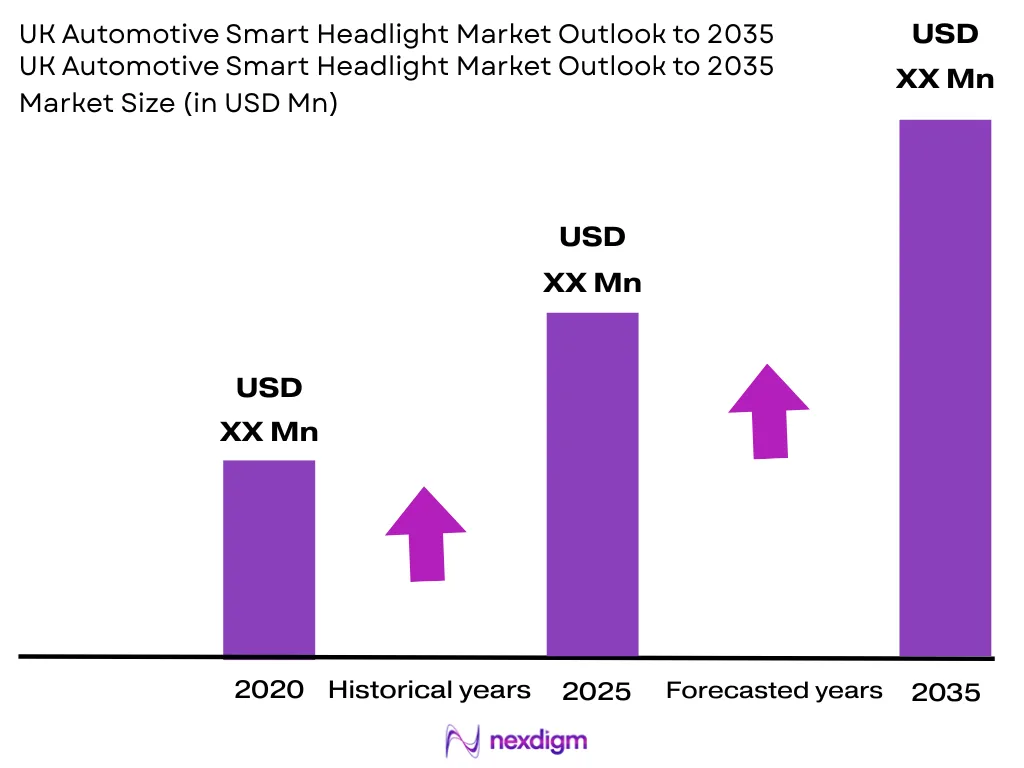
The UK Automotive Smart Headlight Market was valued at USD ~ Million in 2024 and is anticipated to expand at a CAGR of ~% during 2026-2035. The market is primarily driven by growing electric vehicle production at Nissan Sunderland, Jaguar Land Rover, and Stellantis’ Ellesmere Port van plant, rising premium and luxury vehicle output from Jaguar Land Rover, Aston Martin, Bentley, and Rolls-Royce, and the phased adoption of UNECE Regulation 149 permitting matrix and adaptive beam headlamps on UK roads. According to industry estimates, the UK Automotive Smart Headlight Market was valued at approximately USD ~ million in 2025 and is projected to grow at a CAGR of approximately 8.6%, reaching approximately USD ~ billion by 2035, while LED penetration across new light-vehicle registrations exceeded 80% in 2024. Rising Euro NCAP emphasis on advanced lighting performance for top safety ratings and growing integration of smart headlights with Advanced Driver Assistance Systems (ADAS) are generating a step-change in demand across the LED Smart Headlight, Matrix/Pixel LED, and Laser Headlight segments.
Market Segmentation
By Technology
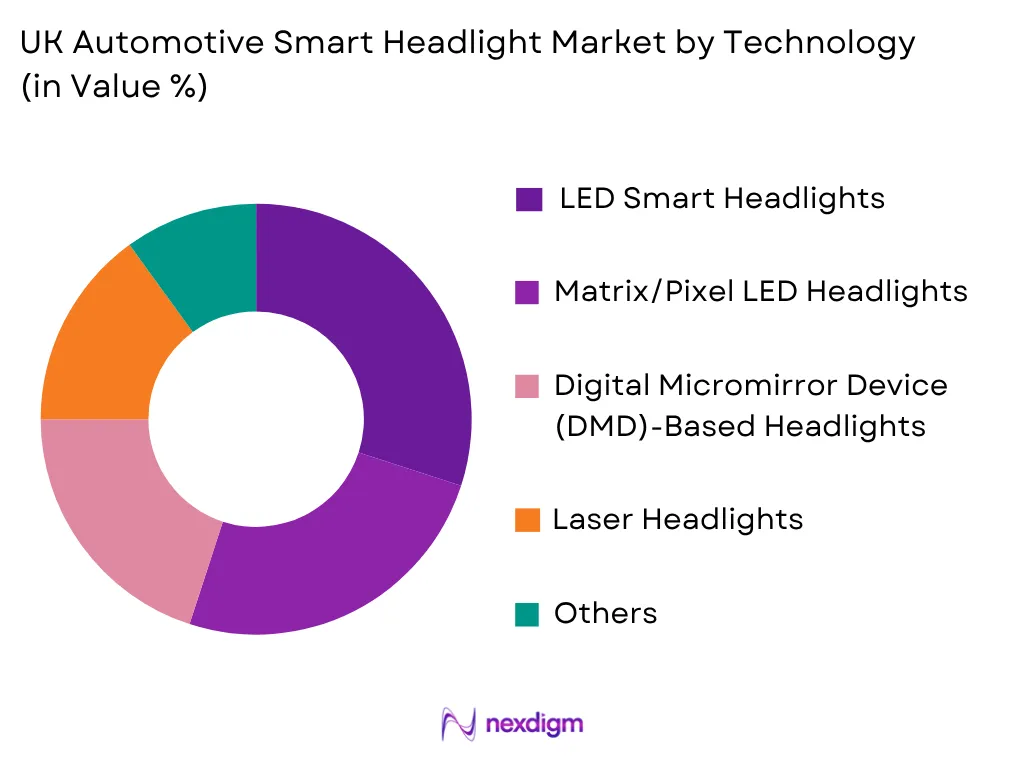
Among these, LED Smart Headlights continue to dominate the UK Automotive Smart Headlight Market, with Wipac Group and Valeo together supplying advanced LED lighting systems to Jaguar Land Rover’s Solihull and Halewood plants and Nissan’s Sunderland facility, supported by over 80% LED penetration across new light-vehicle registrations in 2024. HELLA and Magna International continue to differentiate through Matrix/Pixel LED and Adaptive Front-Lighting System integration, positioning themselves as preferred partners for OEMs seeking ADAS-integrated lighting compliant with UNECE Regulation 149. Koito Manufacturing and ZKW Group have carved out significant share in the Laser Headlight segment through partnerships with premium and luxury vehicle programmes at Bentley, Aston Martin, and Rolls-Royce, which increasingly prioritise extended-range high-beam performance and distinctive signature lighting. Matrix/Pixel LED and Digital Micromirror Device (DMD)-based headlights are gaining increasing importance as OEM partners expand pixel-projection capability, contributing to growing adoption of glare-free high-beam and road-projection communication features across new vehicle programmes.
By Region
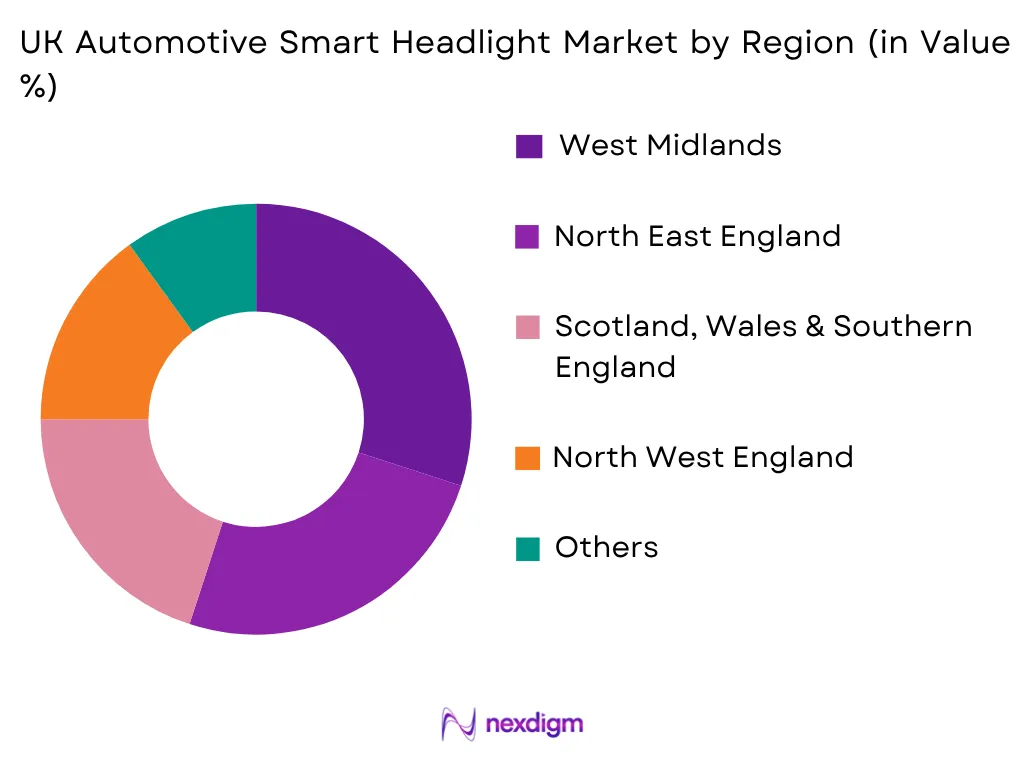
The West Midlands region, anchored by Birmingham, Coventry, and Solihull, remains the largest regional market within the UK Automotive Smart Headlight Market by production volume and revenue, given its concentration of Jaguar Land Rover assembly operations and Tier-1 lighting supplier facilities, including Wipac’s Buckinghamshire operations serving Midlands OEM plants. North East England, centred on Nissan’s Sunderland plant, continues to drive substantial demand as the site’s electric vehicle production ramps up, with Valeo and HELLA scaling regional supply arrangements to serve the facility. North West England, anchored by Stellantis’ Ellesmere Port electric van plant and Merseyside supplier operations, is witnessing steady growth as commercial-vehicle electrification accelerates, while Scotland, Wales, and Southern England maintain a steady aftermarket and premium-vehicle demand base supported by Aston Martin’s Gaydon and St Athan operations and Bentley’s Crewe headquarters.
Competitive Landscape
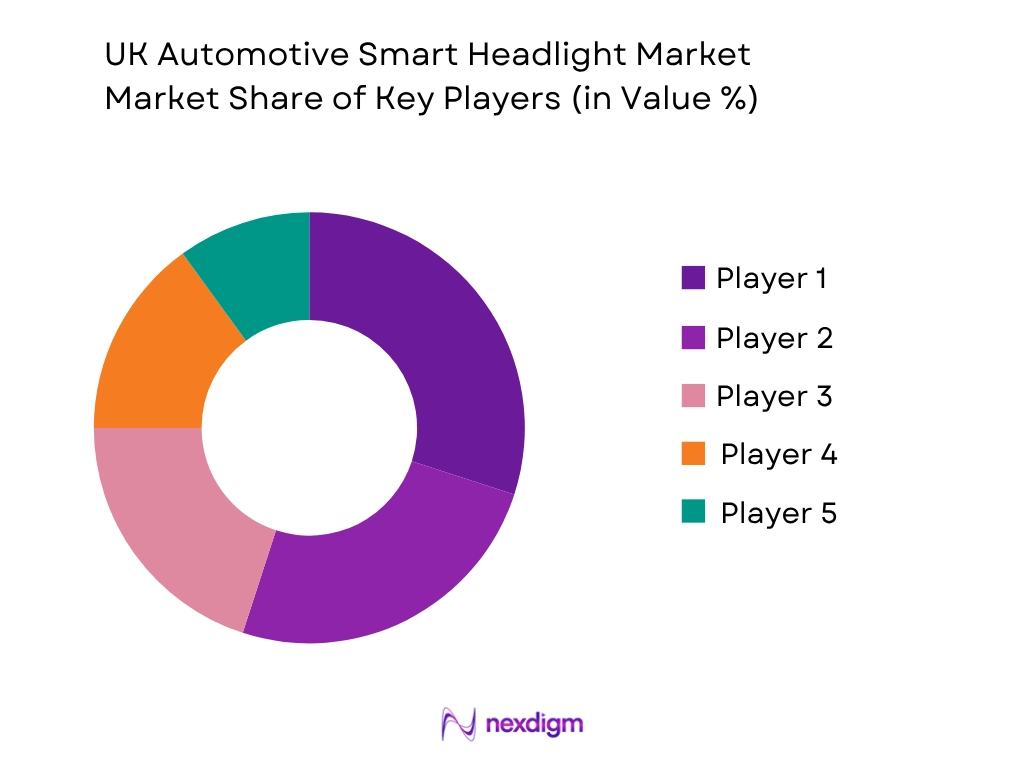
The UK Automotive Smart Headlight Market is highly competitive and moderately consolidated, with Wipac Group, Valeo, HELLA (Forvia), Magna International, and Koito Manufacturing together supplying the substantial majority of smart headlight systems to OEM assembly plants nationwide. Competition is primarily based on ADAS and software integration capability, regulatory compliance with UNECE Regulation 149 and GB type approval requirements, manufacturing and R&D capacity, OEM partnership breadth, and cost competitiveness. Wipac Group maintains a distinctive position as a UK-headquartered specialist supplier with established relationships across Jaguar Land Rover and premium commercial-vehicle programmes, while Valeo and HELLA continue to compete on software and ADAS integration for volume OEM platforms. Koito Manufacturing and ZKW Group target premium and luxury-vehicle programmes with laser headlight technology, while Magna International continues to expand its lighting systems division alongside its broader vehicle systems portfolio. Motherson Group and Britax PMG continue to leverage established UK and European manufacturing footprints to serve both legacy internal-combustion and growing electric-vehicle programmes, while Marelli and Varroc Lighting Systems compete for aftermarket and commercial-vehicle segments across the country.
| Company | Establishment Year | Headquarters | Primary Service Portfolio | Product Portfolio
|
Network Presence | Major End-Use Industries | Key Strategic Focus | Certifications & Compliance |
| Wipac Group Ltd. | 1946 | ~ | ~ | ~ | ~ | ~ | ~ | ~ |
| Valeo SA | 1923 | ~ | ~ | ~ | ~ | ~ | ~ | ~ |
| HELLA GmbH & Co. KGaA (Forvia) | 1899 | ~ | ~ | ~ | ~ | ~ | ~ | ~ |
| Magna International Inc. | 1957 | ~ | ~ | ~ | ~ | ~ | ~ | ~ |
| Koito Manufacturing Co., Ltd. | 1915 | ~ | ~ | ~ | ~ | ~ | ~ | ~ |
UK Automotive Smart Headlight Market Analysis
Growth Drivers
Electric Vehicle Production Growth and UNECE Regulation 149 Adoption
The UK Automotive Smart Headlight Market continues to be shaped decisively by growing electric vehicle production at Nissan Sunderland, Jaguar Land Rover, and Stellantis’ Ellesmere Port van plant, as electric-vehicle programmes increasingly prioritise energy-efficient LED and laser lighting systems that minimise power draw and extend vehicle range compared to legacy halogen systems. The phased adoption of UNECE Regulation 149, which permits matrix and adaptive beam headlamps that automatically adjust high-beam patterns to avoid glare for oncoming and preceding traffic, has further expanded the market’s addressable OEM base across both mainstream and premium vehicle segments. According to industry estimates, the UK Automotive Smart Headlight Market is projected to grow at a CAGR of approximately 8.6% from its 2025 base of approximately USD 615 million, propelled in part by rising Euro NCAP emphasis on headlight performance, which has incentivised automakers to upgrade from halogen to LED and matrix LED lighting systems across new vehicle programmes.
Premium Vehicle Production and Connected Mobility Trials
Rising premium and luxury vehicle production by Jaguar Land Rover, Aston Martin, Bentley, and Rolls-Royce continues to be a critical driver of market expansion, as these manufacturers increasingly specify matrix LED, laser, and OLED lighting systems as standard or optional equipment across their flagship model ranges. Growth of Connected and Automated Mobility (CAM) trial programmes across UK testbeds continues to expand demand for ADAS-compatible, camera-friendly glare-free lighting systems that support autonomous and semi-autonomous driving functions. Growing government emphasis on automotive technology investment through the Advanced Propulsion Centre is further encouraging Tier-1 suppliers to expand UK-based research and manufacturing capacity, illustrating the scale of investment being deployed to support the transition toward advanced automotive lighting.
Market Challenges
Post-Brexit Regulatory Divergence and High System Cost
The UK Automotive Smart Headlight Market faces significant challenges from post-Brexit divergence between GB type approval and EU/UNECE type approval requirements, which continues to create compliance complexity for suppliers seeking to homologate matrix and adaptive lighting systems across both UK and continental European markets. The substantially higher cost of laser and matrix LED headlight systems relative to legacy halogen units constrains adoption among cost-sensitive vehicle segments and limits near-term aftermarket penetration. Right-hand-drive beam pattern homologation complexity continues to require significant testing and certification investment from OEMs and Tier-1 suppliers seeking to introduce ADB-equipped models tailored specifically to UK driving requirements.
Declining Production Volumes and Skills Shortages
Declining UK vehicle production volumes and ongoing supply chain disruption continue to affect production planning and cost stability for Tier-1 lighting suppliers, given broader pressures facing the domestic automotive manufacturing base. Rising energy and manufacturing costs continue to pressure margins across UK-based lighting component production, particularly for suppliers operating energy-intensive LED and laser diode assembly processes. A shortage of advanced lighting electronics engineering skills continues to constrain suppliers’ ability to scale software-integrated lighting development, prompting increased investment in training partnerships with UK universities and engineering institutions.
Market Opportunities
Electric Vehicle Expansion and Connected Mobility Growth
The continued expansion of electric vehicle and gigafactory-linked production presents substantial opportunities for lighting suppliers willing to invest in energy-efficient LED and laser headlight systems tailored to range-sensitive electric-vehicle platforms manufactured across the Midlands and North East England. Growth of Connected and Automated Mobility trial programmes across UK testbeds is expanding the addressable market for lighting suppliers capable of offering ADAS-compatible, camera-friendly glare-free lighting systems alongside standard illumination functions. Rising premium and luxury export demand from Jaguar Land Rover, Aston Martin, and Bentley continues to support sustained investment in matrix LED and laser lighting technology tailored to flagship export model ranges.
OLED Adoption and Government-Backed Manufacturing Investment
The growing adoption of OLED and laser lighting technology in the luxury segment, led by suppliers such as Koito Manufacturing and ZKW Group, presents a significant opportunity for suppliers seeking to differentiate through signature lighting design for premium UK marques. Government Advanced Propulsion Centre funding supporting automotive technology investment presents a significant opportunity for suppliers such as Wipac Group and Britax PMG that maintain established UK-based research and production footprints, positioning them to capture growing demand from OEMs prioritising domestic supply chain resilience. Growth of aftermarket LED retrofit demand, supported by rising consumer awareness of advanced lighting benefits, presents a further opportunity for suppliers expanding compliant retrofit product lines.
Future Outlook
The UK Automotive Smart Headlight Market is expected to witness steady expansion over the forecast period, supported by continued growth in electric vehicle production, phased adoption of UNECE Regulation 149 matrix and adaptive lighting standards, and rising OEM adoption of matrix LED and laser lighting systems across premium and mainstream segments. Continued investment in Digital Micromirror Device pixel-projection technology, OLED lighting, and Software-Defined Vehicle integration is expected to further strengthen the market’s competitive landscape. Growing government emphasis on domestic automotive technology investment and continued expansion of Connected and Automated Mobility trial programmes will continue to reshape investment decisions and competitive dynamics across the industry through 2035.
Major Players
- Wipac Group Ltd.
- Valeo SA
- HELLA GmbH & Co. KGaA (Forvia)
- Magna International Inc.
- Koito Manufacturing Co., Ltd.
- ZKW Group GmbH
- OSRAM Continental GmbH
- Marelli Holdings Co., Ltd.
- Varroc Lighting Systems
- Motherson Group (SMR Automotive)
- Britax PMG (Automotive Lighting Ltd.)
- Grupo Antolin
- Plastic Omnium SE
- Lumileds Holding B.V.
- J.W. Speaker Corporation
Key Target Audience
- Automotive OEMs and Vehicle Assembly Plant Operators
- Tier-1 Automotive Lighting System Suppliers
- Aftermarket Lighting Parts Retailers and Distributors
- Electric Vehicle and Connected/Automated Mobility Technology Developers
- Investment and Venture Capitalist Firms
- Government and Regulatory Bodies (Driver and Vehicle Standards Agency, Vehicle Certification Agency, Department for Transport)
- LED, Laser Diode, and Semiconductor Chip Manufacturers
- ADAS and Autonomous Driving Software Providers
Research Methodology
Step 1: Identification of Key Variables
The research process begins with identifying the complete ecosystem of the UK Automotive Smart Headlight Market, including OEM lighting programmes, Tier-1 lighting suppliers, LED and laser diode component manufacturers, and regulatory authorities. Extensive secondary research is conducted using company annual reports, government publications, regulatory agency disclosures, industry journals, and proprietary databases to determine the variables influencing market demand, pricing, unit shipment volume, and technological developments.
Step 2: Market Analysis and Construction
Historical market information is collected and analysed to estimate market size, unit shipment volume, application-wise demand, and pricing trends. A combination of top-down and bottom-up approaches is used to estimate market revenues and validate segment-level performance. Consumption patterns across OEM programmes, electric-vehicle platforms, and aftermarket channels are evaluated to establish an accurate representation of the industry.
Step 3: Hypothesis Validation and Expert Consultation
The preliminary findings are validated through Computer-Assisted Telephone Interviews (CATIs) and structured discussions with lighting suppliers, OEM procurement managers, regulatory experts, and senior executives operating within the United Kingdom’s automotive lighting industry. These interviews help verify market assumptions, competitive developments, technology adoption trends, pricing dynamics, and future investment opportunities while refining the overall market estimates.
Step 4: Research Synthesis and Final Output
The final stage integrates insights obtained from primary interviews with quantitative information collected through secondary sources. Data triangulation techniques are applied to reconcile differences between supply-side and demand-side estimates, ensuring robust market forecasting. The report is then reviewed through multiple quality assurance checkpoints to deliver a comprehensive analysis covering market size, segmentation, competitive landscape, future outlook, and strategic recommendations for industry stakeholders.

- Executive Summary
- Research Methodology (Market Definitions and Assumptions, Abbreviations, Market Sizing Approach, Top-Down Analysis, Bottom-Up Analysis, Demand-Side Assessment, Supply-Side Assessment, Primary Industry Interviews, Secondary Research Validation, Data Triangulation, Forecasting Framework, Limitations and Future Conclusions)

- Definition and Scope
- Market Evolution and Industry Genesis
- Timeline of Major Industry Developments
- Automotive Smart Headlight Industry Value Chain Analysis
- Supply Chain Analysis

- Growth Drivers (Growth of Electric Vehicle Production at Nissan Sunderland, JLR, and Stellantis Ellesmere Port, Rising Premium and Luxury Vehicle Production by Jaguar Land Rover, Aston Martin, Bentley, and Rolls-Royce, Adoption of UNECE Regulation 149 Enabling Matrix and Adaptive Beam Headlamps, Increasing Euro NCAP Emphasis on Advanced Lighting for Top Safety Ratings, Growth of Connected and Automated Mobility (CAM) Trials, Rising LED Penetration Replacing Halogen Systems)
- Market Challenges (Post-Brexit Divergence Between GB and EU/UNECE Type Approval Requirements, High Cost of Laser and Matrix LED Systems Limiting Uptake Beyond Premium Segments, Declining UK Vehicle Production Volumes and Supply Chain Disruption, Right-Hand-Drive Beam Pattern Homologation Complexity, Rising Energy and Manufacturing Costs, Shortage of Advanced Lighting Electronics Engineering Skills)
- Market Opportunities (Expansion of Electric Vehicle and Gigafactory-Linked Production, Growth of Connected and Automated Mobility Trial Programmes, Rising Premium and Luxury Export Demand from Jaguar Land Rover, Aston Martin, and Bentley, Adoption of OLED and Laser Lighting in the Luxury Segment, Government Advanced Propulsion Centre Funding Supporting Automotive Technology Investment, Growth of Aftermarket LED Retrofit Demand)
- Market Trends (Adoption of Matrix/Pixel LED Headlamps Under UNECE Regulation 149, Growth of Digital Light Communication and Road-Projection Features, Software-Defined Vehicle Integration Enabling Over-the-Air Headlight Updates, Increasing Use of AI-Based Glare and Hazard Detection Algorithms, Consolidation Among Tier-1 Automotive Lighting Suppliers, Growing Localisation of Supply Chains Following Brexit)
- Government Regulations (UNECE Regulation 48 on Installation of Lighting Devices, UNECE Regulation 123 on Adaptive Front-Lighting Systems, UNECE Regulation 149 on LED and Matrix Headlamps, GB Type Approval Scheme Post-Brexit, Road Vehicle Lighting Regulations 1989 (as amended), DVSA MOT Testing Manual Lighting Requirements, Vehicle Certification Agency (VCA) Type Approval)
- Import and Export Analysis (Trade Volume, Major Import Sources, Export Destinations, HS Code Analysis, Trade Balance)
- Infrastructure Availability Analysis (Lighting Component Manufacturing Plant Capacity, LED and Laser Diode Assembly Facilities, Tier-1 Supplier Plant Footprint Across the Midlands and North East, Testing and Homologation Facility Availability, R&D and Photometric Testing Centre Capacity)
- Technology Landscape (LED and Matrix LED Array Technology, Laser Diode Headlight Systems, Digital Micromirror Device (DMD) Pixel Projection, OLED Lighting Technology, ADAS-Integrated Adaptive Driving Beam Software)
- Sustainability Assessment (Energy-Efficient LED and Laser Light Sources, Recyclable Headlamp Housing and Lens Materials, Reduced Power Draw Supporting EV Range, Lifecycle Emissions Reduction from Longer Component Lifespans, End-of-Life Component Recycling Initiatives)
- PESTLE Analysis
- SWOT Analysis
- Porter’s Five Forces Analysis
- Stakeholder Ecosystem
- Competition Ecosystem

- By Market Value (2020-2025)
- By Unit Shipment Volume (2020-2025)
- By Average Selling Price (2020-2025)

- By Technology (In Value %)
LED Smart Headlights
Matrix/Pixel LED Headlights
Laser Headlights
Digital Micromirror Device (DMD)-Based Headlights - By Feature/Function (In Value %)
Adaptive Driving Beam (ADB) / Adaptive Front-Lighting System (AFS)
Automatic High Beam Control
Dynamic Bending / Cornering Light
Glare-Free High Beam Assist - By Vehicle Type (In Value %)
Passenger Cars
Light Commercial Vehicles
Heavy Commercial Vehicles & Trucks
Electric Vehicles - By Sales Channel (In Value %)
OEM (Original Equipment Manufacturer)
Aftermarket - By Region (In Value %)
West Midlands (Birmingham, Coventry, Solihull)
North East England (Sunderland)
North West England (Merseyside, Ellesmere Port)
Scotland, Wales & Southern England

- Market Share of Major Players (By Value, Unit Shipment, Technology, Vehicle Type, Region Served)
- Cross Comparison Parameters (Product Portfolio Breadth, Manufacturing and R&D Capacity, OEM Partnership Coverage, Software and ADAS Integration Capability, Regulatory Compliance Track Record, Customer Base, Innovation & New Product Launch Frequency, Sustainability Initiatives)
- SWOT Analysis of Major Players
- Pricing Analysis by Technology and Vehicle Type
- Manufacturing & R&D Capacity Analysis
- Network Footprint Analysis
- Distribution Network Analysis
- Innovation Benchmarking
- Detailed Profiles of Major Companies
Wipac Group Ltd.
Valeo SA
HELLA GmbH & Co. KGaA (Forvia)
Magna International Inc.
Koito Manufacturing Co., Ltd.
ZKW Group GmbH
OSRAM Continental GmbH
Marelli Holdings Co., Ltd.
Varroc Lighting Systems
Motherson Group (SMR Automotive)
Britax PMG (Automotive Lighting Ltd.)
Grupo Antolin
Plastic Omnium SE
Lumileds Holding B.V.
J.W. Speaker Corporation

- Consumption Pattern Analysis (Unit Shipment Volume, Order Size Distribution, Vehicle Segment Penetration, Seasonal Demand (New Model Year Launches), OEM vs Aftermarket Order Activity)
- Purchasing Criteria (Luminous Output and Beam Quality, Cost per Unit, ADB/AFS Regulatory Compliance, Energy Efficiency and EV Range Impact, Styling and Signature DRL Customisation, Durability and Warranty Coverage)
- Procurement and Supplier Selection Analysis
- OEM-Integrated vs Aftermarket Retrofit Adoption Assessment
- In-House vs Outsourced Lighting System Development Demand
- Product Attribute Preference Analysis (Beam Pattern Precision, Adaptive Driving Beam Capability, Energy Efficiency, Styling Customisation, Software Update Capability, Durability and Thermal Reliability)
- Consumer Reliability Expectations
- Pain Point Analysis
- Decision-Making Process

- By Market Value (2026-2035)
- By Unit Shipment Volume (2026-2035)
- By Average Selling Price (2026-2035)


 Request a Sample
 Ask for Customization
 Get a Quote
 Enquire Now