

 Download PDF
Market Overview
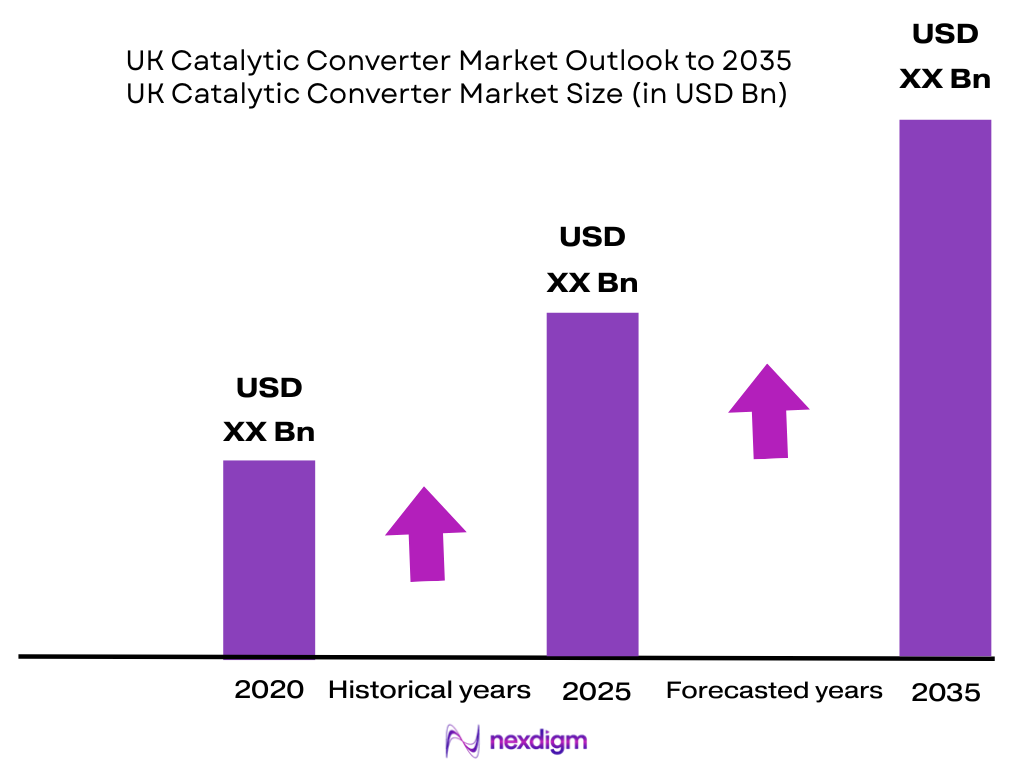
The UK Catalytic Converter Market is valued at ~ billion, supported by a large petrol, hybrid, plug-in hybrid, van, and legacy diesel vehicle parc requiring emissions aftertreatment and replacement. First-time vehicle registrations increased from 2.535 million to 2.605 million, while the total licensed vehicle base reached 41.7 million. The average licensed car age also reached 10 years, supporting ongoing replacement demand from higher-mileage combustion vehicles. London, South East England, West Midlands, North West England, Yorkshire, Scotland, and major urban areas such as Birmingham and Manchester dominate UK catalytic-converter demand because they combine dense vehicle populations, MOT networks, garages, fleets, and parts distribution. Zero-emission vehicle stock increased from roughly 1.02 million to 1.394 million, while petrol and hybrid vehicles remained the majority of road vehicles, sustaining converter demand despite accelerating electrification.
Market Segmentation
By Converter Type
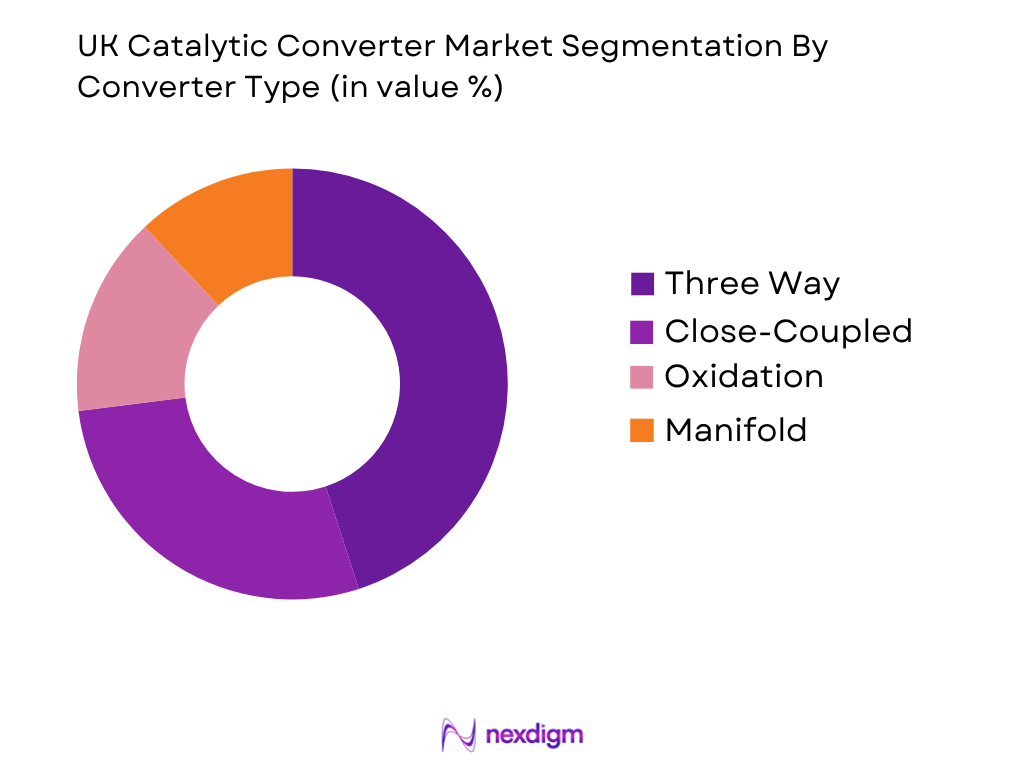
The UK Catalytic Converter Market is segmented into three-way catalytic converters, close-coupled converters, oxidation catalytic converters, manifold-integrated converters, underfloor converters, and multi-brick catalyst systems. Three-way catalytic converters dominate the report model because petrol-powered vehicles remain a major component of the UK vehicle parc, while full hybrids and plug-in hybrids also retain petrol engines and catalytic aftertreatment. Three-way catalysts simultaneously reduce nitrogen oxides and oxidise hydrocarbons and carbon monoxide using platinum-group-metal chemistry, typically involving palladium, rhodium and platinum. Their relevance extends from conventional hatchbacks and SUVs to hybrid vehicles requiring rapid catalyst light-off following repeated engine shutdowns and restarts. The large installed petrol and hybrid vehicle base, combined with MOT emissions compliance and the ageing of the UK car parc, supports recurring three-way catalyst replacement demand even as new zero-emission registrations increase.
By Powertrain Type
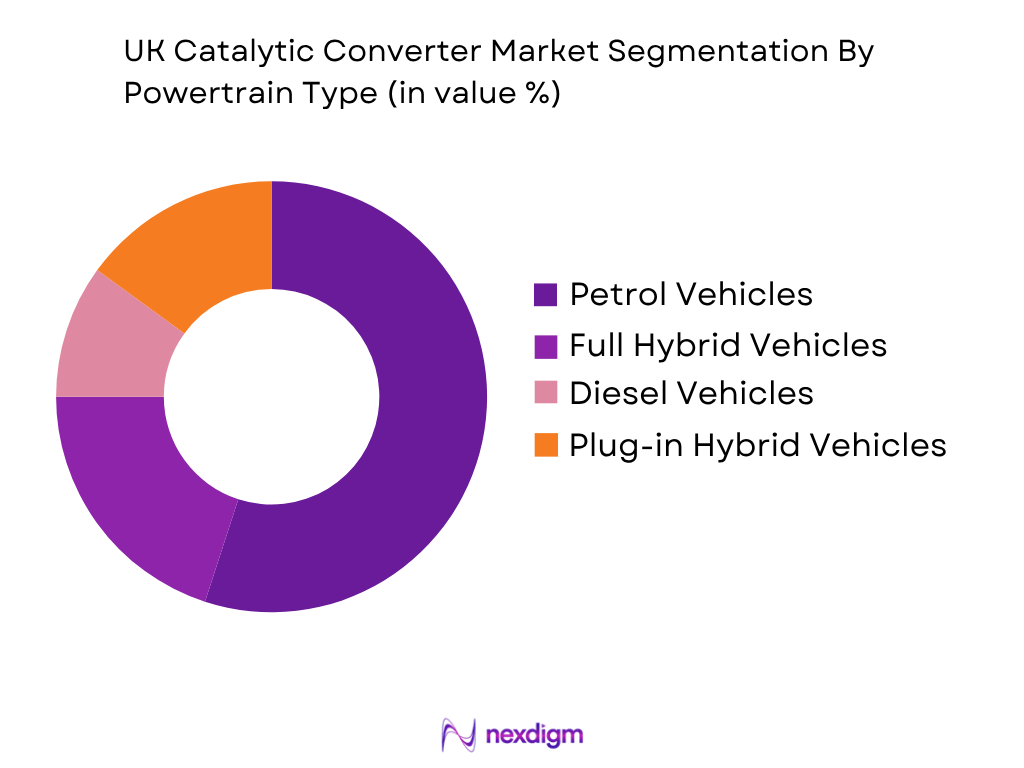
The UK Catalytic Converter Market is segmented into conventional petrol vehicles, full hybrid vehicles, plug-in hybrids, diesel vehicles, and other combustion-based powertrains. Conventional petrol vehicles dominate the report model because they still account for a very large share of the operational vehicle fleet and require catalytic converters throughout their useful lives. At the same time, hybrids are becoming strategically more important because they retain internal-combustion engines while benefiting from electrification. New petrol-car registrations stood at 750,000 in the latest relevant annual observation before falling to 610,000 subsequently, while both hybrid and plug-in hybrid registrations continued increasing. This transition supports a shift in converter technology rather than an immediate disappearance of catalyst demand: hybrids still require advanced three-way catalysts, oxygen-storage materials, and thermal-management strategies to control emissions when engines repeatedly restart after electrically powered driving periods.
Competitive Landscape
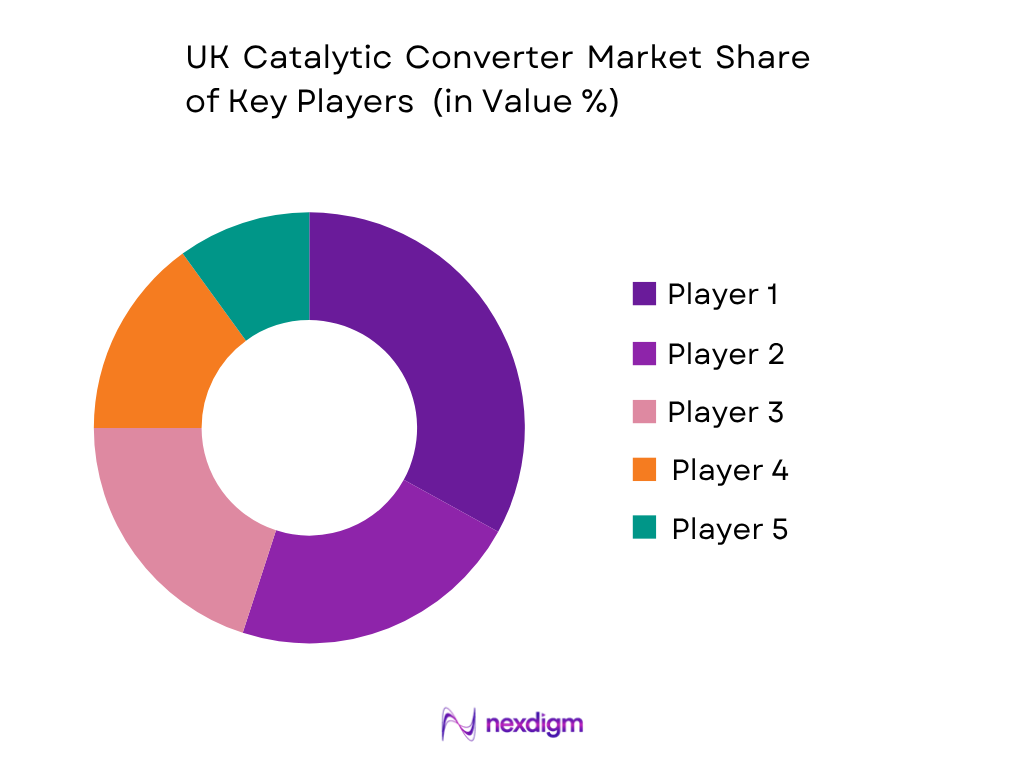
The UK Catalytic Converter Market contains a mix of specialist aftermarket manufacturers, integrated exhaust-system suppliers, and global catalyst-technology companies. BM Catalysts, Klarius, European Exhaust & Catalyst, Johnson Matthey, and FORVIA occupy different parts of the value chain ranging from type-approved direct-fit replacement products to catalyst chemistry and OEM emissions systems. Competition increasingly depends on vehicle-application coverage, type approval, fit accuracy, PGM optimization, substrate and washcoat engineering, next-day availability, and technical support to garages and motor factors. BM Catalysts positions itself as a major European aftermarket hot-end emissions manufacturer, while Klarius offers more than 11,000 emissions-control parts and EEC supplies more than 10,000 catalytic-converter applications.
| Major Player | Establishment | Headquarters | Converter Portfolio | Type-Approval Coverage | PGM / Catalyst Capability | Manufacturing Capability | Aftermarket Reach | Technical Differentiation |
| BM Catalysts | 1980s-era corporate roots | Mansfield, Nottinghamshire | ~ | ~ | ~ | ~ | ~ | ~ |
| Klarius Products | Modern business built on long UK exhaust heritage | Cheadle, Staffordshire | ~ | ~ | ~ | ~ | ~ | ~ |
| European Exhaust & Catalyst | 1990s-era aftermarket specialist | Denmead, Hampshire | ~ | ~ | ~ | ~ | ~ | ~ |
| Johnson Matthey | 1817 | London, UK | ~ | ~ | ~ | ~ | ~ | ~ |
| FORVIA Clean Mobility | FORVIA formed 2022 | Nanterre, France | ~ | ~ | ~ | ~ | ~ | ~ |
UK Catalytic Converter Market Analysis
Growth Drivers
Large Ageing Petrol and Hybrid Vehicle Parc Supporting Replacement Demand
The large and increasingly mature combustion-powered vehicle parc remains a fundamental growth driver for the UK Catalytic Converter Market because petrol cars, hybrids, plug-in hybrids, vans and other internal-combustion vehicles retain exhaust aftertreatment throughout their operational lives. Department for Transport and DVLA statistics show that the UK had 41.7 million licensed vehicles at the end of 2024, including 33.97 million road-using cars and 4.79 million light goods vehicles; the total licensed fleet subsequently increased to 42.3 million vehicles at the end of 2025, including 34.49 million road-using cars and 4.88 million light goods vehicles. The average licensed UK car had also reached 10 years of age in 2024, compared with 8 years five years earlier, materially enlarging the population entering higher-mileage repair cycles. Catalytic converters deteriorate through repeated thermal cycling, oil or coolant contamination, misfires, physical monolith damage and declining precious-metal activity, meaning the ageing fleet supports replacement even when new conventional ICE registrations weaken. The addressable stock remains overwhelmingly combustion-dependent: only 1.394 million licensed zero-emission vehicles were recorded at the end of 2024, rising to 2.012 million at the end of 2025, leaving tens of millions of vehicles with combustion engines or hybridized engines requiring emissions-control equipment. The aftermarket is reinforced by the MOT framework. DVSA requires testers to examine visible emissions-control equipment and reject relevant vehicles first used on or after 1 September 2002 when original equipment such as a catalytic converter is missing, obviously modified or obviously defective. Replacement parts are also regulated: vehicles registered on or after 1 March 2001 must use a type-approved replacement catalytic converter, preventing the aftermarket from substituting a simple empty exhaust section when catalyst efficiency deteriorates. The 2024 macroeconomic backdrop supports the size of this servicing ecosystem. The IMF recorded UK nominal GDP at approximately GBP 2,756 billion, real GDP growth of 0.7, average CPI inflation of 2.7, and unemployment of 4.2 in its 2024 Article IV framework. These conditions underpin a mature national automotive-service infrastructure of franchised dealers, independent garages, MOT centres, motor factors and exhaust specialists. For catalytic-converter suppliers, therefore, demand is increasingly linked to the installed vehicle base rather than solely to new-car assembly: as millions of older petrol and hybrid vehicles remain in service, direct-fit application coverage, type approval, diagnostic compatibility and rapid distribution become central competitive advantages.
Hybridisation and Stronger In-Use Emissions Enforcement Sustaining Advanced Catalyst Requirements
The transition from conventional petrol vehicles toward hybrids creates a second market-specific growth driver because hybridisation reduces fuel use without eliminating the catalytic converter. Department for Transport statistics show conventional petrol-car registrations falling from 750,000 in 2024 to 610,000 in 2025, while both hybrid and plug-in hybrid registrations continued to increase. At the same time, overall car registrations rose from 2.000 million to 2.071 million, indicating that the powertrain mix is changing rather than the UK automotive market disappearing. Hybrid vehicles remain technologically important for catalytic-converter manufacturers because their petrol engines repeatedly shut down and restart as propulsion switches between electric and combustion operation. Each restart can expose the catalyst to lower exhaust temperatures, increasing the importance of rapid light-off, close-coupled catalyst positioning, oxygen-storage materials, thin-wall substrates and carefully optimized palladium-rhodium or multi-PGM formulations. This creates scope for greater catalyst sophistication per combustion vehicle even while pure petrol registrations decline. Government policy also provides a defined transitional role for hybrids. In April 2025, the UK government confirmed that from 2030, new cars must either be hybridised in some form or be zero-emission, rather than permitting new vehicles powered solely by conventional internal-combustion engines. This means advanced catalytic aftertreatment can remain relevant within the new-vehicle market during the transition period, particularly for full hybrids and plug-in hybrids. The regulatory environment for in-use vehicles is simultaneously becoming more stringent. In July 2026, the Department for Transport launched proposals to strengthen rules requiring vehicles in Great Britain to maintain the emissions-control performance that applied when they were manufactured and first registered. The consultation states that road vehicles are the single largest source of nitrogen oxides and proposes updating Regulation 61A so emissions-control systems continue operating to their legally required standard throughout vehicle life. The proposal is especially relevant to catalytic converters because existing legislation has not fully kept pace with Euro 5, Euro 6 and Euro VI vehicles. Stronger in-use enforcement would increase the importance of maintaining or replacing failed catalysts rather than allowing degraded systems to remain in service. The macroeconomic foundation remains substantial: IMF figures for 2024 put nominal GDP at GBP 2,756 billion, unemployment at 4.2, and average inflation at 2.7, while the World Bank records GDP per capita of USD 57,602 in 2025. Taken together, hybridisation and stronger lifecycle emissions enforcement shift the UK catalytic-converter opportunity toward technologically demanding, regulation-led applications. Suppliers with hybrid-specific thermal management, Euro-compliant catalyst formulations, extensive type-approved portfolios and accurate vehicle-application databases can capture value even as traditional petrol-only platforms decline.
Market Challenges
Rapid Zero-Emission Vehicle Expansion Eliminating Catalytic Converter Content
Battery-electric and other zero-tailpipe-emission vehicles represent the most significant structural challenge to the UK Catalytic Converter Market because they require no exhaust manifold catalyst, three-way converter, diesel oxidation catalyst or platinum-group-metal exhaust aftertreatment. Department for Transport data show that the UK’s licensed zero-emission vehicle population rose from 1.394 million at the end of 2024 to 2.012 million at the end of 2025, while road-using zero-emission vehicles increased to 1.874 million. New zero-emission car registrations reached 473,226 units in 2025, compared with 381,869 units in 2024, and another 138,000 zero-emission cars were registered during January-March 2026 alone. Every battery-electric car replacing a petrol or hybrid model removes not only one original catalytic-converter installation but also the associated lifetime opportunity for replacement converters, oxygen sensors, catalyst-efficiency repairs and end-of-life converter recycling. The impact compounds over time because a conventional vehicle can generate aftermarket converter demand years after first registration, whereas a BEV creates no exhaust-aftertreatment demand at any point in its service life. Government policy deliberately accelerates this substitution. The UK’s ZEV mandate established a statutory trajectory toward increasing zero-emission new-car and van sales, and in April 2025 the government reconfirmed that cars powered solely by conventional internal-combustion engines will no longer qualify for normal new-car sales from 2030; by 2035, the policy direction is toward fully zero-emission new vehicles. This structural change is already visible in conventional fuel registrations. New petrol cars declined from 750,000 in 2024 to 610,000 in 2025, even while total new car registrations increased to 2.071 million, showing that electrified alternatives are taking an increasingly large share of incremental fleet additions. The existing parc provides a long runway rather than an immediate collapse: the UK still had more than 41 million road-using vehicles in 2025, and most retained a combustion component. However, the market mix will progressively move away from OEM new-fitment volume toward ageing-fleet replacement, hybrid applications and recycling. This transition occurs within an economy that remains able to finance technological replacement; the IMF recorded nominal GDP of GBP 2,756 billion and real GDP growth of 0.7 in 2024, while the World Bank reported GDP of around USD 4 trillion and GDP per capita of USD 57,602 in 2025. For converter manufacturers, this creates strategic capacity risk. Plants, tooling, type-approval portfolios and SKU inventories built around conventional petrol applications have progressively shorter new-fitment lifecycles. The strongest protection is diversification toward hybrids, high-age aftermarket vehicles, commercial applications and precious-metal recovery rather than relying on perpetual expansion of conventional ICE converter volumes.
Type-Approval Complexity, PGM Supply Exposure and Compliance Burden
The UK Catalytic Converter Market also faces significant technical and operating complexity arising from strict replacement-part regulation and dependence on platinum-group metals. UK government guidance requires replacement catalytic converters installed on vehicles registered on or after 1 March 2001 to be type-approved, while supplying a non-type-approved converter for such vehicles is illegal. This makes aftermarket converters fundamentally different from generic exhaust pipes: manufacturers must match products to defined vehicle applications, maintain approval markings and ensure sufficient emission-control performance. The complexity is magnified by the scale and diversity of the installed parc. At the end of 2024 there were 33.967 million road-using cars, 4.790 million light goods vehicles and 518,000 heavy goods vehicles; by the end of 2025 these counts had increased to 34.485 million cars, 4.880 million light goods vehicles and 520,000 heavy goods vehicles. These vehicles span different engine capacities, turbocharging strategies, Euro standards, lambda-sensor configurations, catalyst locations, hybrid architectures and exhaust layouts. A supplier seeking broad aftermarket coverage consequently needs thousands of vehicle-specific applications or carefully validated universal converters. Regulatory scrutiny is also increasing. The 2026 government consultation on in-use emissions proposes stronger obligations to ensure emissions-control systems continue satisfying the legal standard applicable at manufacture, closing gaps that currently affect newer Euro-standard vehicles. Material exposure adds another layer of complexity because catalytic converters rely on platinum-group metals such as platinum and rhodium. The UK’s updated Critical Minerals technical annex published in January 2026 includes platinum-group metals among materials requiring strategic attention and projects PGM requirements under several long-term demand scenarios, reinforcing concerns around supply resilience. Government supply-chain analysis published in 2026 also states that the UK will remain reliant on imports for critical minerals, leaving domestic industries exposed to international disruptions. The operational consequences span procurement, working capital, catalyst formulation and recycling. Manufacturers must carefully optimize precious-metal loading while still passing emissions and durability requirements; excessive thrifting risks inadequate conversion efficiency, while unnecessarily high loading increases material exposure. Recycling is strategically useful but tightly regulated. An Environment Agency prosecution concluded in 2024 after investigators found an illegal operator had sold at least 71 tonnes of catalytic converters for recycling without the required environmental permit, illustrating the scale and regulatory sensitivity of spent-converter handling. Macroeconomic conditions add pressure to manage these costs efficiently: the IMF’s 2024 framework recorded average inflation of 2.7, real GDP growth of 0.7 and nominal GDP of GBP 2,756 billion. The market therefore rewards scale and technical integration. Companies combining catalyst chemistry, homologation, application databases, PGM sourcing, recycling relationships and nationwide motor-factor distribution are better equipped to absorb compliance complexity than small suppliers competing solely on manufacturing or catalogue price.
Market Opportunities
Hybrid-Specific Catalysts and High-Age Vehicle Aftermarket Replacement
The most credible future opportunity for the UK Catalytic Converter Market lies in serving the overlap between an ageing combustion-vehicle fleet and rising hybrid adoption. Current government data provide a sizeable installed foundation: the UK had 41.7 million licensed vehicles at the end of 2024, increasing to 42.3 million in 2025, while the average licensed car was already 10 years old in 2024. Older vehicles progressively enter the period in which catalyst-efficiency degradation, exhaust corrosion, oxygen-sensor faults, oil consumption and thermal damage can generate P0420/P0430-type diagnostic events and MOT emissions failures. Because vehicles registered on or after 1 March 2001 require type-approved replacement catalytic converters, this ageing stock translates into a regulated aftermarket opportunity rather than merely demand for low-cost generic exhaust components. DVSA further requires relevant vehicles first used on or after 1 September 2002 to fail inspection where visible original emissions-control equipment is missing, obviously modified or obviously defective, helping preserve replacement demand when converters reach end of life. Hybridisation extends this opportunity rather than eliminating it. New petrol-car registrations declined from 750,000 in 2024 to 610,000 in 2025, but Department for Transport data show both full-hybrid and plug-in-hybrid registrations continuing to rise. These vehicles still require catalytic converters but impose different engineering requirements because the combustion engine repeatedly turns off and restarts. Suppliers can therefore differentiate through low-light-off catalysts, reduced thermal mass, improved oxygen-storage capacity, close-coupled configurations and application-specific PGM formulations. Government policy also preserves a defined transitional role for hybrid vehicles: from 2030, new cars must be hybridised in some form or zero-emission, meaning hybrids can continue generating new catalyst installations while petrol-only platforms decline. The opportunity becomes larger when distribution is considered. Independent garages and MOT centres require direct-fit products that can be identified quickly from registration or VIN data, installed without extensive fabrication and verified against type-approval documentation. Digital application matching can therefore become a competitive asset alongside catalyst chemistry. The macroeconomic environment supports continuing vehicle maintenance rather than rapid scrappage of the entire older fleet. The IMF recorded nominal UK GDP of GBP 2,756 billion, unemployment of 4.2 and average inflation of 2.7 in its 2024 framework, while World Bank data show GDP per capita at USD 57,602 in 2025. For converter suppliers, the strategic opportunity is consequently to shift from broad conventional new-fitment dependence toward dense coverage of high-age petrol vehicles, hybrid-specific applications and type-approved direct-fit replacement. This can extend market relevance well beyond the point at which pure-ICE new registrations become structurally constrained.
Closed-Loop PGM Recycling and Converter Traceability
Platinum-group-metal recovery and regulated catalytic-converter recycling provide another substantial future opportunity because the UK already possesses a large stock of PGM-bearing vehicles while government policy increasingly emphasizes critical-mineral resilience and circularity. The installed vehicle base reached 41.7 million licensed vehicles in 2024 and 42.3 million in 2025, meaning millions of existing converters will eventually leave service through scrappage, mechanical failure or exhaust-system replacement. Each spent converter contains a ceramic or metallic substrate coated with catalyst material incorporating valuable platinum-group metals, allowing end-of-life units to become secondary feedstock rather than simple automotive waste. UK government strategy explicitly supports this direction. The January 2026 Critical Minerals technical annex lists platinum-group metals among the country’s strategically important materials, while the UK Critical Minerals Strategy emphasizes increased recovery, reuse, recycling and resource efficiency to reduce pressure on primary mineral supply. The opportunity is particularly relevant because government analysis acknowledges that the UK will continue relying on imported critical minerals and therefore remains exposed to international supply-chain disruptions. Domestic closed-loop recycling can mitigate this exposure by collecting spent converters from authorized treatment facilities, garages and dismantlers; decanning or processing the monolith; assaying its PGM content; refining the recovered metals; and returning them to catalyst production or other industrial applications. The UK already has established technical capability: government material on critical minerals has identified Johnson Matthey as a major global recycler of platinum-group metals with facilities in the UK, demonstrating an existing domestic industrial base for secondary refining. At the same time, recent enforcement demonstrates why traceability is essential. An Environment Agency case concluded in 2024 after an operator was found to have handled and sold at least 71 tonnes of catalytic converters without an environmental permit; confiscation proceedings in 2025 identified criminal benefits of more than GBP 4.3 million for both the company and its director. These figures illustrate both the material value contained in spent converters and the need for controlled, auditable recycling channels. The opportunity therefore extends beyond metallurgical recovery into serialisation, provenance documentation, authorized collector networks and digital chain-of-custody systems. Legitimate converter manufacturers and recyclers can create closed-loop programs in which garages receive compliant new converters while spent units are simultaneously collected for regulated PGM recovery. This model helps stabilize material sourcing and can reduce leakage into unauthorized scrap channels. The economic backdrop supports investment in domestic processing: the IMF placed UK nominal GDP at GBP 2,756 billion in 2024, while the World Bank reports an economy of roughly USD 4 trillion in 2025. As BEV adoption gradually reduces new catalyst production, maximizing value from the enormous existing ICE and hybrid converter stock can become a more important part of industry economics, making recycling integration one of the strongest defensive growth opportunities in the UK catalytic-converter value chain.
Future Outlook
The UK Catalytic Converter Market is forecast to expand at ~ CAGR during 2026–2035 under the placeholder forecast framework. Growth will increasingly shift away from broad new-ICE vehicle fitment toward hybrid vehicles, ageing-parc replacement, MOT-related compliance, type-approved direct-fit products, and precious-metal recycling. The market will therefore become more aftermarket- and lifecycle-oriented even as conventional petrol and diesel registrations decline. Hybrid vehicles represent an important bridge segment. Government vehicle statistics show both hybrid and plug-in hybrid registrations continuing to rise while conventional petrol registrations decline. Hybrid engines still require catalytic converters, but their frequent shutdown and restart cycles place greater emphasis on low-light-off temperatures, thermal retention, oxygen-storage capacity, and close-coupled catalyst placement. This can increase technical sophistication even as engine operating time declines. The aftermarket will remain structurally important because the average UK licensed car reached 10 years of age in the latest annual dataset, compared with 8 years five years earlier. Older vehicles are more exposed to catalyst degradation arising from thermal cycling, oil contamination, ignition misfires, substrate deterioration, and exhaust leaks. Where a catalyst fails, garages must install a compliant replacement rather than simply removing the emissions-control device.
Major Players
- BM Catalysts
- Klarius Products
- European Exhaust & Catalyst
- EuroFlo
- Bosal
- FORVIA Clean Mobility
- Eberspächer
- Tenneco / Walker
- Johnson Matthey
- BASF Environmental Catalyst and Metal Solutions
- Umicore
- Cummins Emission Solutions
- Corning Incorporated
- Katcon
- DCL International
Key Target Audience
- Catalytic Converter and Exhaust Aftertreatment Manufacturers
- Automotive OEMs and Tier-1 Exhaust-System Suppliers
- Motor Factors and Automotive Parts Distributors
- Independent Garages, MOT Centres and Exhaust Specialists
- Platinum-Group-Metal Refiners and Catalytic Converter Recyclers
- Fleet Operators and Vehicle Service Networks
- Investments and Venture Capitalist Firms
- Government and Regulatory Bodies (Department for Transport, Driver and Vehicle Standards Agency, Vehicle Certification Agency, Driver and Vehicle Licensing Agency, Environment Agency)
Research Methodology
Step 1: Identification of Key Variables
The initial phase develops an ecosystem map covering catalyst producers, converter manufacturers, substrate suppliers, PGM refiners, OEMs, motor factors, garages, MOT centres, dismantlers, and recyclers. Critical variables include petrol and hybrid vehicle parc, average vehicle age, converter count per vehicle, type approval, Euro standard, MOT exposure, replacement frequency, PGM loading, and ZEV substitution. Government vehicle licensing datasets, MOT requirements, replacement-converter regulations, company catalogues, and emissions-control technical documentation are used to define the market boundary. Petrol three-way catalysts, diesel oxidation catalysts, DPF-related aftertreatment, and purely non-catalyst exhaust components are separated to avoid double counting.
Step 2: Market Analysis and Construction
The top-down model begins with the UK licensed ICE and hybrid vehicle parc, annual first registrations, average vehicle age, and converter architecture by powertrain. Replacement-eligible populations are calculated using vehicle age, typical catalyst lifecycle, MOT emissions exposure, and type-approved application requirements. The bottom-up model maps converter SKUs, direct-fit and universal applications, motor-factor distribution, garage replacement volumes, OEM fitment, and recycled catalyst flows. Volumes are reconciled between manufacturers, distributors, garages, and recyclers so that a single converter is not counted multiple times.
Step 3: Hypothesis Validation and Expert Consultation
Market hypotheses are validated through CATIs and structured interviews with converter manufacturers, exhaust suppliers, motor factors, garages, MOT testers, fleet operators, and precious-metal recyclers. Interviews focus on replacement frequency, direct-fit versus universal demand, type-approval requirements, petrol versus hybrid mix, diagnostic failure codes, and product availability. Expert consultation also evaluates PGM exposure, converter theft, application complexity, vehicle age, and the effect of ZEV adoption on replacement demand. Assumptions that conflict with government licensing or approval data are revalidated before finalisation.
Step 4: Research Synthesis and Final Output
The final phase triangulates vehicle-parc statistics, regulatory information, application-level product mapping, company disclosures, and primary interviews. Demand is segmented by converter type, powertrain, vehicle type, fitment, emission standard, substrate, PGM composition, channel, and region. Forecast scenarios incorporate petrol-parc decline, hybrid expansion, BEV adoption, average vehicle age, MOT replacement, type-approved product penetration, PGM recycling, and vehicle scrappage. Base-case, accelerated-ZEV, hybrid-led, and high-age aftermarket scenarios are constructed to test long-term resilience

- Executive Summary
- Research Methodology (Market Definitions and Assumptions, Catalytic Converter Market Boundary, Abbreviations, UK Vehicle-Parc Mapping, Fuel-Type Mapping, Converter-per-Vehicle Assessment, OEM Fitment Analysis, Replacement Cycle Analysis, MOT Failure Mapping, Type-Approval Assessment, PGM Loading Analysis, Market Sizing Approach, Top-Down Analysis, Bottom-Up Analysis, Demand-Side Assessment, Supply-Side Assessment, Manufacturer Interviews, Motor-Factor and Garage Interviews, Recycler Assessment, Data Triangulation, Forecasting Framework, Scenario Analysis, Limitations and Future Conclusions)

- Definition and Scope
- Evolution of Catalytic Emissions Control in the UK
- Transition from Two-Way to Three-Way Catalytic Converters
- Evolution of Euro Emissions Standards and Catalyst Technology
- Catalytic Converter Role in Petrol, Hybrid and Diesel Powertrains

- Growth Drivers (Large Petrol and Hybrid Vehicle Parc, MOT Compliance, Vehicle Ageing, Type-Approved Replacement Demand, Hybrid Expansion, OBD Catalyst Monitoring, Garage Replacement Demand, PGM Recycling)
- Market Challenges (ZEV Expansion, Declining New Petrol Registrations, PGM Supply Exposure, Type-Approval Complexity, Non-Compliant Parts, Converter Theft, High Application Complexity, Diesel Decline)
- Market Opportunities (Hybrid Catalyst Systems, High-Mileage Replacement, Direct-Fit Type-Approved Products, MOT-Driven Replacement, PGM Recycling, Converter Traceability, Low-PGM Catalyst Formulations, Digital Registration-Based Product Matching)
- Market Trends (PGM Thrifting, Platinum-Palladium Substitution, Close-Coupled Catalysts, Hybrid Thermal Management, High-Cell-Density Substrates, Type-Approved Direct-Fit Expansion, Recycled PGM Adoption, Digital Application Catalogues)
- SWOT Analysis
- Porter’s Five Forces Analysis
- PESTLE Analysis

- By Market Value (2020-2025)
- By Catalytic Converter Unit Volume (2020-2025)
- By OEM-Fitted Converter Volume (2020-2025)

- By Converter Type (In Value %)
Three-Way Catalytic Converters
Close-Coupled Catalytic Converters
Underfloor Catalytic Converters
Oxidation Catalytic Converters
Manifold-Integrated Catalytic Converters - By Vehicle Type (In Value %)
Passenger Cars
Sport Utility Vehicles and Crossovers
Light Commercial Vehicles
Vans
Medium Commercial Vehicles - By Powertrain Type (In Value %)
Conventional Petrol Vehicles
Full Hybrid Petrol Vehicles
Plug-in Hybrid Petrol Vehicles
Diesel Vehicles
Alternative-Fuel ICE Vehicles - By Sales Channel (In Value %)
OEM Vehicle Fitment
OEM Dealership Replacement
OES Aftermarket
National Motor Factors
Independent Automotive Parts Distributors - By Region (In Value %)
London
South East England
East of England
South West England
West Midlands

- Market Share of Major Players by Value
- Cross Comparison Parameters (UK Type-Approved Vehicle Application Coverage, Direct-Fit and Universal Converter Portfolio Breadth, Platinum-Palladium-Rhodium Catalyst Technology Capability, Ceramic/Metallic Substrate and Washcoat Engineering Capability, Euro-Standard and OBD Compatibility, UK Manufacturing/Distribution Footprint, Motor-Factor and Garage Network Reach, PGM Recycling and Closed-Loop Material Capability)
- SWOT Analysis of Major Players
- Detailed Profiles of Major Companies
BM Catalysts
EuroFlo
Klarius Products
EEC / European Exhaust & Catalyst
Bosal
FORVIA Clean Mobility
Eberspächer
Tenneco / Walker
Johnson Matthey
BASF Environmental Catalyst and Metal Solutions
Umicore
Cummins Emission Solutions
Corning Incorporated
Katcon
DCL International

- Automotive OEM Procurement
- Tier-1 Exhaust Supplier Procurement
- National Motor Factor Demand
- Independent Distributor Demand
- Garage Procurement

- By Market Value (2026-2035)
- By Catalytic Converter Unit Volume (2026-2035)
- By OEM-Fitted Converter Volume (2026-2035)


 Request a Sample
 Ask for Customization
 Get a Quote
 Enquire Now