

 Download PDF
Market Overview
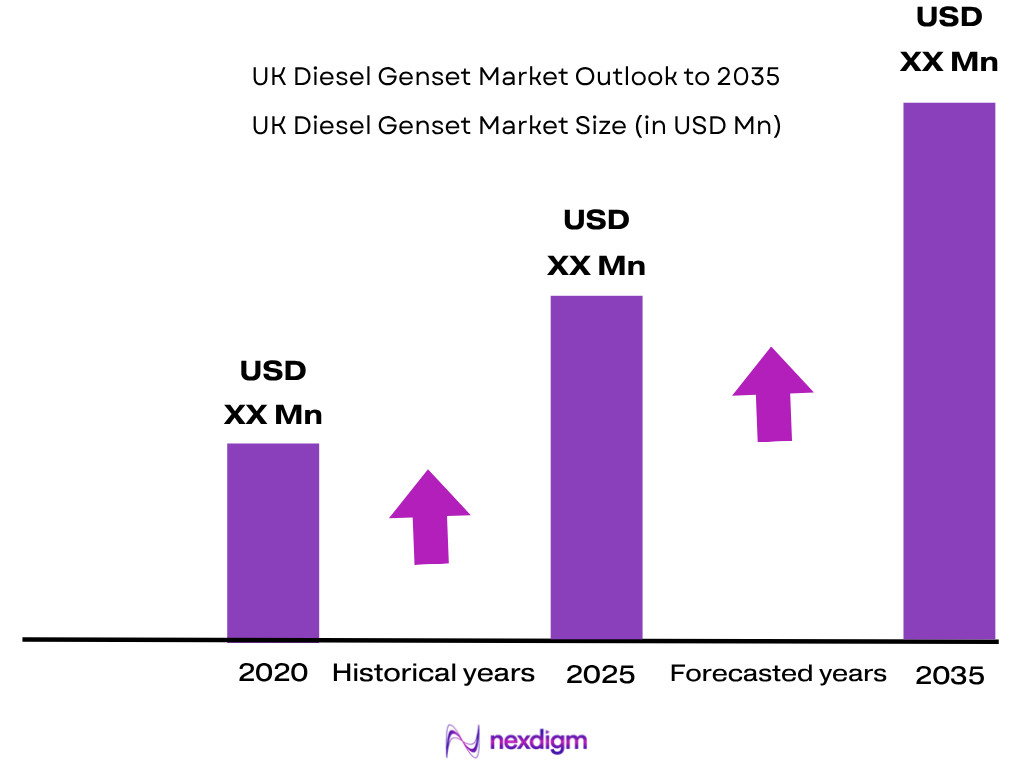
The UK Diesel Genset Market is valued at approximately ~ million, supported by construction, data centres, healthcare, industrial facilities, telecom infrastructure and temporary-power applications. Great Britain’s construction new-work value increased from £138.780 billion to £140.684 billion, while annual new construction orders reached £71.707 billion. Around 370,770 registered construction firms and 1.4 million construction employees reinforce demand for mobile, standby and prime diesel generation equipment. London, the South East, Midlands and major North West industrial corridors represent important UK diesel genset demand centres because of dense construction activity, data-centre clusters, hospitals, commercial buildings and critical infrastructure. London is particularly significant for mission-critical backup generation: an Environment Agency permit for a London data centre covers 16 emergency diesel generators with 86.6 MWth aggregate thermal input. Nationwide construction activity also expanded from £138.780 billion to £140.684 billion, supporting mobile-power deployment.
Market Segmentation
By Power Rating
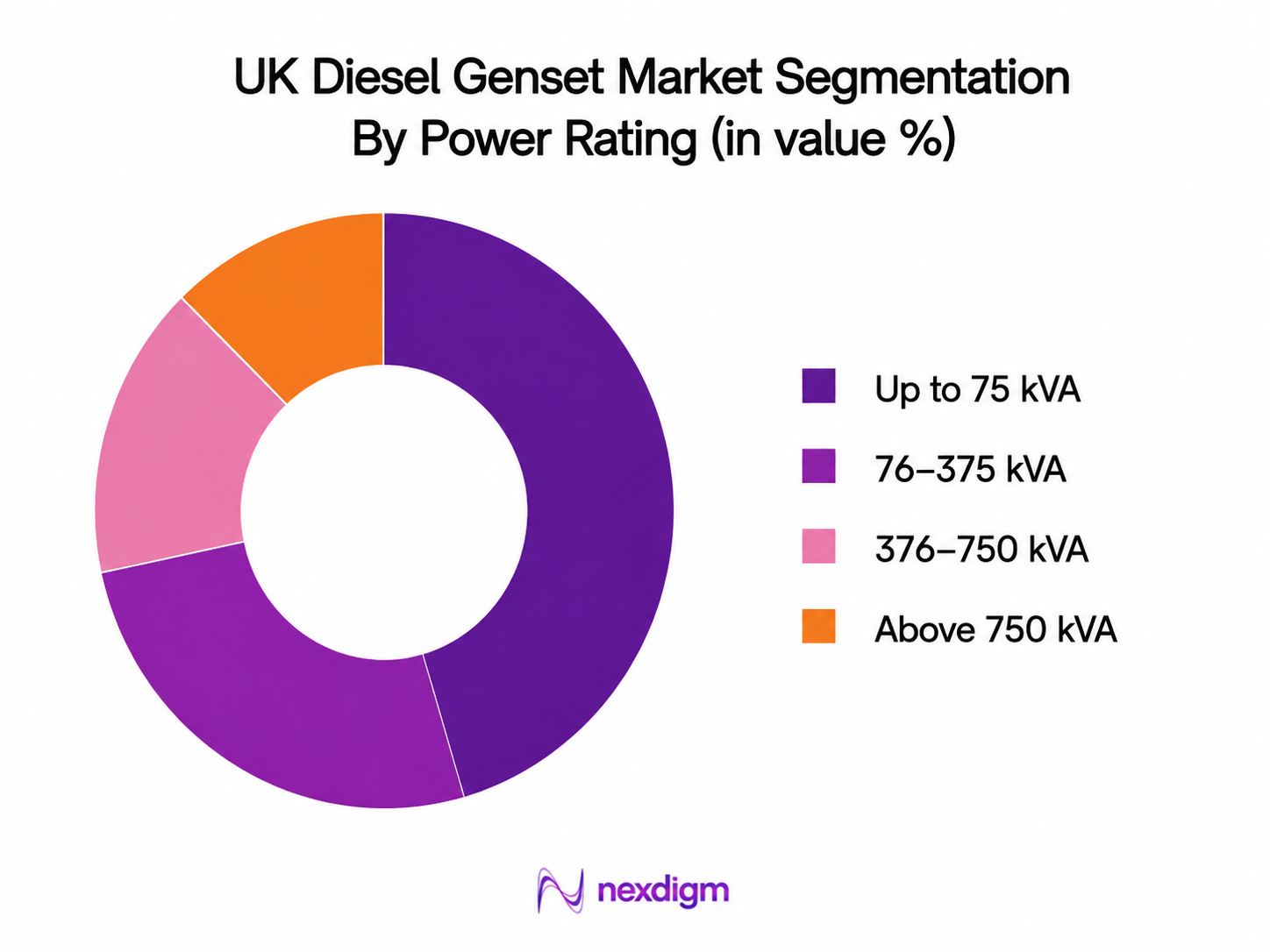
The UK Diesel Genset Market is segmented into up to 75 kVA, 76–375 kVA, 376–750 kVA and above 750 kVA. The 76–375 kVA category holds the dominant market position because it addresses a broad spectrum of construction sites, commercial facilities, temporary industrial loads, small healthcare facilities, telecom installations and rental applications. This rating range provides sufficient output for multi-equipment sites while remaining transportable and comparatively straightforward to deploy. Construction is an especially important demand base, with Great Britain supporting 370,770 registered construction enterprises. Suppliers such as FG Wilson offer diesel products across a very broad 6.8–2,500 kVA spectrum, while Aggreko’s UK rental fleet includes diesel units from 30 kVA into multi-megawatt configurations. This product breadth demonstrates why mid-range systems sit at the intersection of stationary standby and temporary mobile demand.
By Application
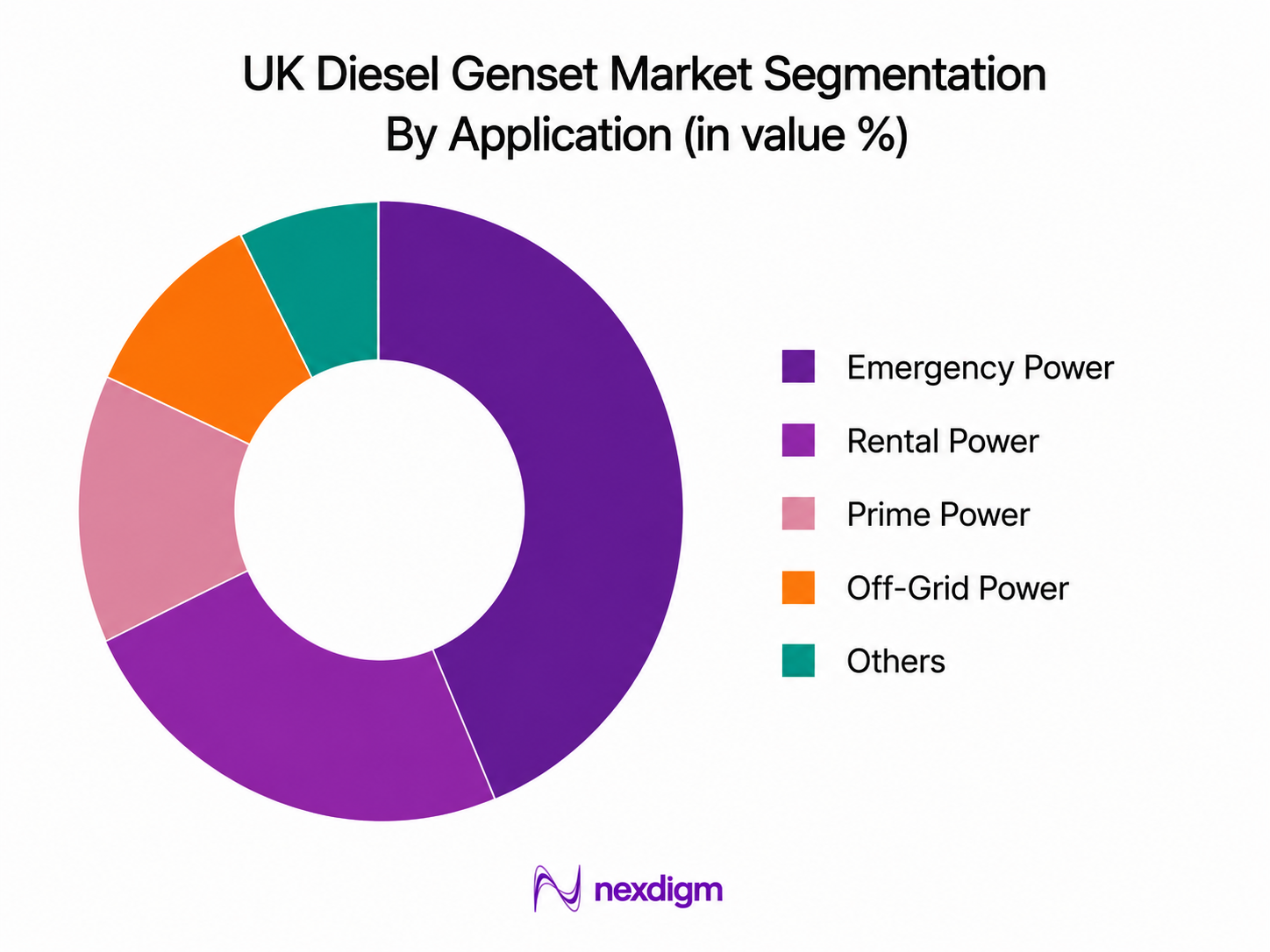
The UK Diesel Genset Market is segmented into standby power, prime power, temporary/rental power and continuous/off-grid power. Standby power dominates this segmentation because UK hospitals, data centres, airports, commercial buildings and other mission-critical facilities require immediately available generation when grid supply fails. Environment Agency documentation for one London data centre records 16 standby diesel generators with approximately 86.6 MWth combined thermal input, specifically intended to provide electricity during National Grid supply failure. Cummins also identifies hospitals and data centres as mission-critical UK power-generation applications, while FG Wilson markets large generator sets for data centres, factories, airports, hospitals and retail facilities. Diesel remains suited to standby applications because engines can start rapidly, generators can carry significant loads and fuel can be stored on site. The category therefore combines high-value large gensets with smaller commercial emergency-power installations.
Competitive Landscape
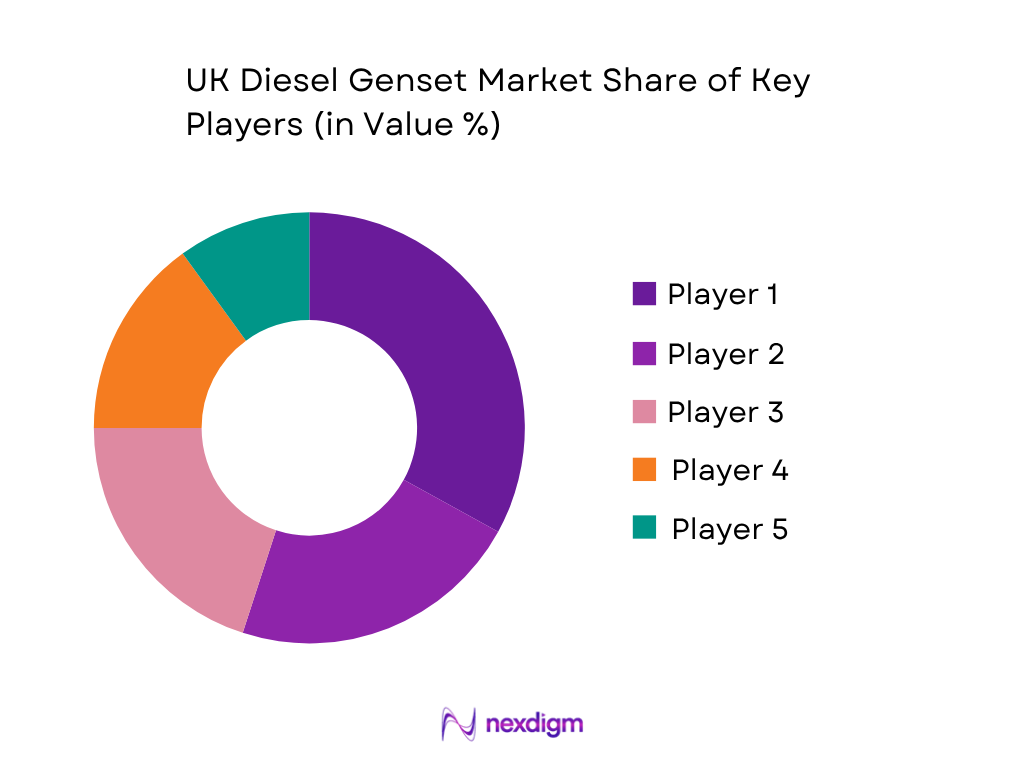
The UK Diesel Genset Market contains global engine and generator manufacturers alongside strongly established rental-power specialists. Cummins, Caterpillar, FG Wilson and Atlas Copco compete through broad diesel-generator portfolios, while Aggreko has a particularly strong temporary-power model. Competitive differentiation increasingly involves kVA coverage, Stage V availability, fuel efficiency, HVO compatibility, acoustic performance, remote monitoring, service capability and the ability to integrate diesel generation with batteries or other distributed-energy technologies.
| Major Player | Established | Headquarters | Diesel Power Coverage | Key Application | Mobile / Rental Capability | Stage V / Low-Emission Offering | Digital Controls / Monitoring | UK Service Position |
| Cummins | 1919 | Indiana, USA | ~ | ~ | ~ | ~ | ~ | ~ |
| Caterpillar | 1925 | Texas, USA | ~ | ~ | ~ | ~ | ~ | ~ |
| FG Wilson | 1966 | Northern Ireland, UK | ~ | ~ | ~ | ~ | ~ | ~ |
| Atlas Copco | 1873 | Nacka, Sweden | ~ | ~ | ~ | ~ | ~ | ~ |
| Aggreko | 1962 | Glasgow, UK | ~ | ~ | ~ | ~ | ~ | ~ |
UK Diesel Genset Market Analysis
Growth Drivers
Expansion of Data Centres and Critical Digital Infrastructure
Expansion of UK data-centre capacity is strengthening demand for high-capacity diesel generator sets because data centres require independent emergency power capable of supporting servers, cooling systems, network infrastructure and essential building services when utility electricity is interrupted. The UK government designated data centres as critical national infrastructure in 2024, placing their resilience importance alongside essential energy, water and emergency-service systems. The scale of development is becoming materially relevant to diesel genset suppliers. A 2026 Environment Agency permit application for a proposed Buckinghamshire data-centre campus specifies 57 diesel-fired emergency generators, while another proposed UK data-centre development incorporates 36 containerised backup generators plus additional house generators. These installations illustrate why individual hyperscale campuses can generate orders for dozens of high-output generator sets rather than single units. The underlying pipeline is also substantial. Ofgem reported contracted electricity-demand connection offers increasing from 41 GW in November 2024 to 125 GW in June 2025, with data-centre projects accounting for a significant portion of that increase. This rapidly expanding demand queue indicates a growing installed base of facilities requiring engineered emergency-generation packages, automatic transfer systems, fuel storage, paralleling controls, acoustic enclosures and emissions-management equipment.
Infrastructure Construction and Temporary Power Requirements
UK infrastructure and construction activity provides a second major demand foundation for diesel generator sets because construction sites, civil-engineering works, rail projects, utility upgrades and remote infrastructure locations frequently need temporary electricity before permanent grid connections become available. Office for National Statistics data shows that new infrastructure construction work had a total value of £33.9 billion in 2024 and increased to £37.3 billion in 2025. The 2025 increase was supported by greater work across water, sewerage and electricity infrastructure, areas in which temporary power is frequently needed for pumps, lighting, compressors, control systems, welfare units and construction machinery. ONS also reported that total construction new orders increased by £2.447 billion in the first quarter of 2025 compared with the preceding quarter, with infrastructure and private industrial work making significant contributions. By 2026, construction activity remained sizeable: ONS recorded another quarterly increase in total construction output during the first quarter, while repair and maintenance continued supporting contractor workloads. Diesel gensets are particularly suitable for these environments because construction users require equipment that can operate independently of fixed electricity connections and withstand dust, vibration, weather exposure and repeated movement between sites. Unlike permanent standby installations, mobile and rental generators on construction projects can accumulate extended operating hours, raising the importance of engine durability, fuel efficiency, service intervals and spare-parts availability. Generator sets serving tower cranes, temporary compounds, tunnelling works, rail possessions and utility projects may also operate alongside battery storage, lighting towers and load-management systems, making system integration an increasingly important product attribute. The UK’s infrastructure programme reinforces the opportunity for equipment rental companies and generator manufacturers. ONS reported £37.3 billion of new infrastructure construction in 2025, with electricity, water and sewerage projects accounting for a substantial component of work. Electricity-network expansion is especially relevant because projects building the future grid paradoxically require temporary generation while substations, transmission assets and permanent electrical connections are under construction.
Market Challenges
Tightening Stage V Emission and Urban Air-Quality Requirements
Tightening emissions regulations represent one of the principal challenges for the UK Diesel Genset Market because modern diesel generators must deliver high reliability while complying with increasingly demanding limits for particulate matter, nitrogen oxides and other combustion pollutants. The UK Vehicle Certification Agency states that engines used in non-road mobile machinery and sold in the UK generally require Stage V type approval, subject to specified exemptions and transitional provisions. Diesel-powered mobile generators used on construction sites fall within this regulatory environment, requiring manufacturers to integrate technologies including diesel particulate filters, selective catalytic reduction, diesel oxidation catalysts and sophisticated engine-management systems. These after-treatment systems improve emissions performance but add technical complexity, increase packaging requirements and create additional maintenance considerations compared with older mechanically controlled generator engines. The challenge is particularly significant in London, one of the country’s largest markets for construction and temporary power. Current London guidance requires generators brought onto regulated non-road mobile machinery sites to meet stringent emissions requirements, and the city’s framework moves toward Stage V across London from January 2030, followed by zero-emission machinery from January 2040. Even before those later milestones, practical guidance already specifies Stage V requirements for generators in relevant areas. This direction of travel affects purchasing decisions being made during the 2024–2026 period because rental companies and construction contractors typically keep capital equipment for multiple years. A fleet operator purchasing a generator today must therefore consider whether it will remain deployable on regulated sites throughout its economic operating life.
Decarbonisation, Grid Modernisation and Competition from Battery-Based Backup Systems
UK decarbonisation policy creates a structural challenge for diesel generator demand because public policy increasingly favours low-carbon electricity, battery storage, renewable generation and reduced dependence on combustion equipment. The country nevertheless remains one of the world’s largest developed economies, with World Bank data showing approximately USD 4 trillion in GDP, 69.487 million residents and full electricity access across the population. A highly electrified economy requires reliable backup power, but it also creates significant political and commercial pressure to reduce local emissions from conventional diesel equipment. This makes the UK diesel genset market increasingly dependent on applications where diesel’s reliability, energy density and runtime remain difficult to replace. Government policy illustrates this tension. The Clean Power framework is designed to accelerate electricity-network development and renewable power integration, while grid-connection reforms are intended to release very large quantities of network capacity for strategically important projects. Government documentation indicates that connection reforms could potentially release around 500 GW of capacity from the existing queue. Faster and more reliable permanent grid connections can reduce the duration for which some construction, industrial and commercial projects require temporary diesel generation. At the same time, battery energy-storage systems are increasingly capable of handling short-duration backup, peak shaving and low-load periods that historically would have required diesel generators. This particularly affects small and medium generator applications where several hours of battery runtime may be commercially feasible.
Market Opportunities
High-Efficiency Stage V, Hybrid and Digitally Monitored Diesel Generator Systems
A major opportunity in the UK Diesel Genset Market lies in replacing older generator fleets with Stage V-compliant, digitally managed and hybrid-ready equipment. The opportunity is grounded in the present equipment environment rather than speculative future demand. UK Vehicle Certification Agency requirements mean newly supplied non-road mobile machinery engines generally need Stage V approval, immediately creating a technology replacement requirement wherever operators continue using diesel generation. London applies particularly demanding requirements to construction-site generators, making modern emissions-compliant fleets increasingly necessary for rental companies serving major urban projects. Suppliers capable of combining Stage V engines with efficient after-treatment, low-load management and reliable control systems can therefore capture replacement demand from contractors that need equipment suitable for regulated sites. Current construction activity provides a sizeable installed application base for these products. ONS reports that new infrastructure construction amounted to £33.9 billion in 2024 and £37.3 billion in 2025. Infrastructure categories including electricity, water and sewerage require temporary generation during construction, commissioning and maintenance, while broader construction output continued expanding through 2025 and into 2026. This creates an existing operating environment in which generator fleet owners can adopt more advanced machines immediately rather than waiting for new market formation.
Data-Centre Resilience and Large Multi-Generator Backup Installations
The rapid expansion of UK data-centre infrastructure creates a substantial opportunity for manufacturers of large industrial diesel generator systems, particularly suppliers capable of delivering multiple synchronised units with advanced controls and environmental-compliance support. The opportunity is already visible in current 2024–2026 project data. Data centres were designated critical national infrastructure in 2024, formalising their strategic importance to the British economy and public services. Ofgem subsequently recorded contracted demand connection offers rising from 41 GW in November 2024 to 125 GW in June 2025, with data-centre applications contributing substantially to the expansion. The scale of this connection pipeline demonstrates the large amount of digital infrastructure currently seeking electricity capacity and therefore the potential requirement for emergency generation. Individual projects illustrate the generator intensity of this development. A proposed Environment Agency-permitted campus in Buckinghamshire incorporates 57 ultra-low-sulphur diesel-fired backup generators. Another proposed UK data-centre installation specifies 36 containerised diesel generators, accompanied by additional smaller generators serving ancillary functions. These are not small retail generator applications; they represent complex power plants requiring engine-generators, cooling, exhaust systems, bulk fuel storage, automatic transfer equipment, synchronisation switchgear, control software, acoustic attenuation and environmental permitting. A single hyperscale campus can consequently represent dozens of individual genset sales plus a long-term service opportunity.
Future Outlook
The UK Diesel Genset Market is expected to expand at approximately ~ CAGR during 2026–2035, although the composition of demand will change significantly. Conventional diesel generation will remain important for emergency resilience, construction, data centres, healthcare and remote temporary power, but customers will place increasingly greater emphasis on emissions performance and operating efficiency. Growth will increasingly favour Stage V diesel generators, HVO-compatible equipment, battery-integrated gensets and intelligent load-management systems rather than basic conventional generator packages. London already applies emission-stage requirements to non-road mobile machinery, including generator engines, making emissions compliance increasingly important for construction and rental fleets. Mission-critical infrastructure will provide another stable demand base. The Environment Agency continues to process data-centre facilities incorporating substantial emergency diesel-generation capacity, illustrating the continuing role of gensets where grid interruption cannot be tolerated. Diesel generators are therefore likely to remain embedded in resilience architecture even while their annual operating hours are minimized. Temporary power will simultaneously become more hybridised. Rental suppliers can combine appropriately sized diesel generators with battery energy-storage systems, lowering generator running hours during variable-load applications. Diesel gensets are consequently expected to evolve from standalone power sources toward dispatchable components within integrated temporary-energy systems.
Major Players
- Cummins
- Caterpillar
- FG Wilson
- Atlas Copco
- Aggreko
- Rehlko Power Systems
- Pramac
- Generac
- HIMOINSA
- JCB Power Products
- Mitsubishi Heavy Industries
- Yanmar
- Denyo
- Volvo Penta
- Rolls-Royce Power Systems / mtu
Key Target Audience
- Diesel genset manufacturers and power-system integrators
- Generator rental and temporary-power providers
- Data-centre developers and mission-critical infrastructure operators
- Construction and civil-engineering contractors
- Hospitals, airports, telecom operators and industrial facility owners
- Diesel-engine, alternator, switchgear and generator-control suppliers
- Investments and venture capitalist firms
- Government and regulatory bodies (Department for Energy Security and Net Zero, Environment Agency, Greater London Authority, Vehicle Certification Agency, Ofgem)
Research Methodology
Step 1: Identification of Key Variables
The initial phase involves constructing an ecosystem map covering UK diesel genset manufacturers, engine suppliers, alternator manufacturers, system integrators, rental fleets, construction users, data centres, healthcare institutions and distributors. Key variables include kVA rating, standby and prime ratings, engine displacement, operating hours, fuel consumption, emission stage, rental utilisation and installed redundancy architecture.
Step 2: Market Analysis and Construction
Historical demand is assessed using both top-down and bottom-up frameworks. Construction activity, critical-infrastructure investment and temporary-power requirements are mapped against generator deployment by power rating and application. Supplier portfolios, UK manufacturing or assembly capacity, rental-fleet positioning and distribution channels are analysed to reconcile equipment demand with supply-side capabilities.
Step 3: Hypothesis Validation and Expert Consultation
Market hypotheses are validated through CATIs and structured consultations with generator manufacturers, rental companies, electrical contractors, data-centre operators, construction companies and facility managers. Discussions focus on typical kVA selection, standby redundancy, runtime, Stage V compliance, HVO adoption, maintenance requirements and customer movement toward battery-assisted temporary-power systems.
Step 4: Research Synthesis and Final Output
The final stage triangulates primary interviews with ONS construction statistics, Environment Agency generator permits, Ofgem electricity-network information and product specifications from major genset suppliers. Bottom-up installed-unit assumptions are reconciled with manufacturer power ranges, rental-fleet availability and application-specific demand to develop the final market structure and forecast framework.

- Executive Summary
- Research Methodology (Market Definitions and Assumptions, Diesel Genset Scope Definition, kVA-Based Market Sizing, Top-Down Power Equipment Assessment, Bottom-Up Unit Shipment Assessment, Installed Base Analysis, Replacement Cycle Assessment, Rental Fleet Assessment, Primary Interviews with Genset OEMs and Rental Operators, Distributor Validation, End-User Demand Assessment, Data Triangulation, Forecasting Framework, Limitations and Future Conclusions)

- Definition and Scope
- Market Evolution and Industry Genesis
- Development of UK Diesel Backup Power Infrastructure
- Diesel Generator Industry Business Cycle
- Generator Manufacturing, Assembly and Import Ecosystem

- Growth Drivers (Data Centre Backup Power Capacity, Construction Activity, Critical Infrastructure Resilience, Grid Interruption Risk, Telecom Network Uptime, Hospital Emergency Power Requirements)
- Market Challenges (Diesel Emissions, Fuel Storage, Engine Loading, Noise Limits, Maintenance Requirements, Capital Intensity, Environmental Compliance)
- Market Opportunities (HVO, Hybrid Power, Data Centres, Battery Integration, Remote Monitoring, Stage V Replacement)
- Market Trends (HVO Compatibility, Digital Controls, Remote Telematics, Hybridisation, Modular Data Centre Power, High-Density Power Output)
- Government Regulations (Stage V NRMM, Environmental Permitting, Emergency Backup Engine Operation, London NRMM LEZ, Noise Regulation, Fuel Storage, Air Quality Compliance)
- SWOT Analysis
- Porter’s Five Forces Analysis
- PESTLE Analysis

- By Market Value (2020-2025)
- By Unit Shipments (2020-2025)
- By Installed Capacity (2020-2025)


- Market Position of Major Players
- Cross Comparison Parameters (Diesel Genset Power Range, Stage V-Compliant Portfolio, HVO Compatibility, Fuel Consumption and Runtime, Acoustic Performance, Load Acceptance Capability, Remote Monitoring and Control Capability, UK Dealer and Service Network)
- SWOT Analysis of Major Players
- Detailed Profiles of Major Companies
FG Wilson — Caterpillar
Cummins Power Generation
Caterpillar Electric Power
JCB Power Products
Rehlko Power Systems
Rolls-Royce Power Systems / mtu
Atlas Copco Power Technique
HIMOINSA
Pramac
Aksa Power Generation
Genesal Energy
PowerLink UK
Morris Site Machinery
MHM Group
Stephill Generators

- Data Centre Power Requirement Analysis
- Hospital and Healthcare Backup Power Analysis
- Construction Site Generator Demand Analysis
- Manufacturing Facility Backup Power Analysis
- Telecommunications Backup Power Analysis

- By Market Value (2026-2035)
- By Unit Shipments (2026-2035)
- By Installed Capacity (2026-2035)


 Request a Sample
 Ask for Customization
 Get a Quote
 Enquire Now