

 Download PDF
Market Overview
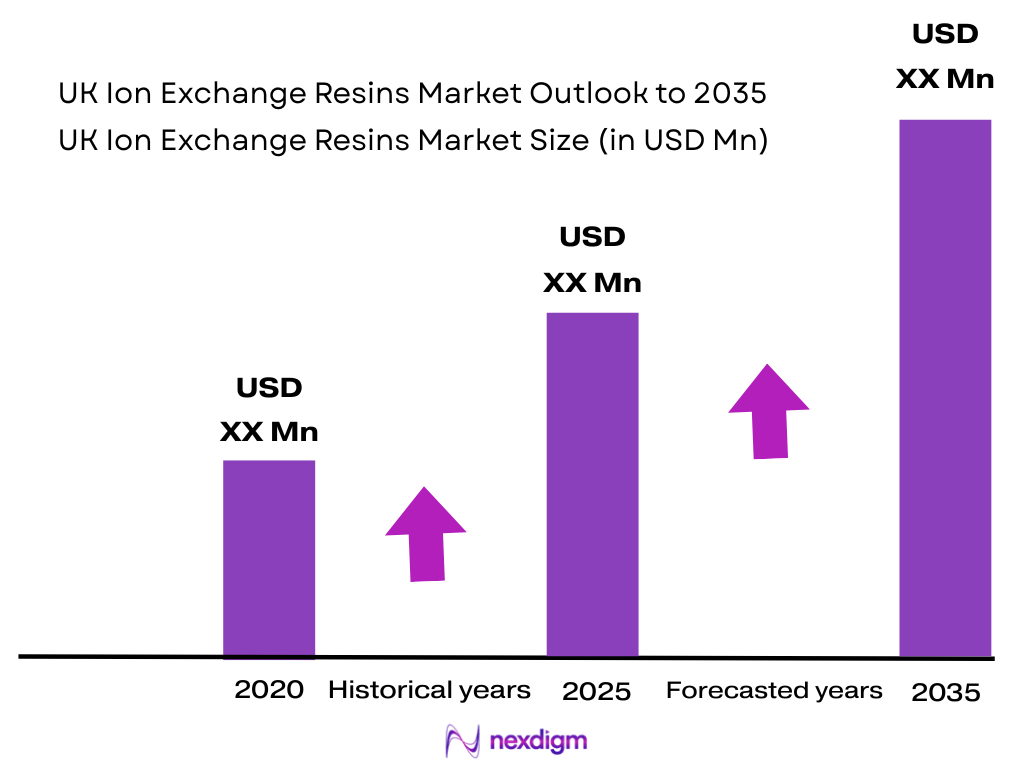
The UK Ion Exchange Resins Market generated USD 80.7 million in 2024, according to published market data, with demand supported by water treatment, power generation, pharmaceuticals, chemicals and high-purity industrial applications. The market had an established base during the preceding historical period, while imports of ion-exchange resins increased 24.75% in 2024, indicating stronger procurement activity. Cationic resins were the leading product category, reflecting extensive use in softening, demineralization, and industrial water purification.
London, the Southeast, Northwest, Midlands, Scotland and Wales represent important demand centers because of their concentration of water utilities, pharmaceutical manufacturing, chemical processing, power infrastructure and advanced manufacturing. UK pharmaceutical manufacturing generated £24.264 billions of chain-volume output in 2024, compared with £23.758 billion in 2023, while manufacturing output overall declined 0.7% in 2024. Water infrastructure is another major demand base, with Ofwat approving £104 billion of expenditure for England and Wales over the subsequent five-year regulatory period, including major investment in resilience and water infrastructure.
Market Segmentation
By Resin Type
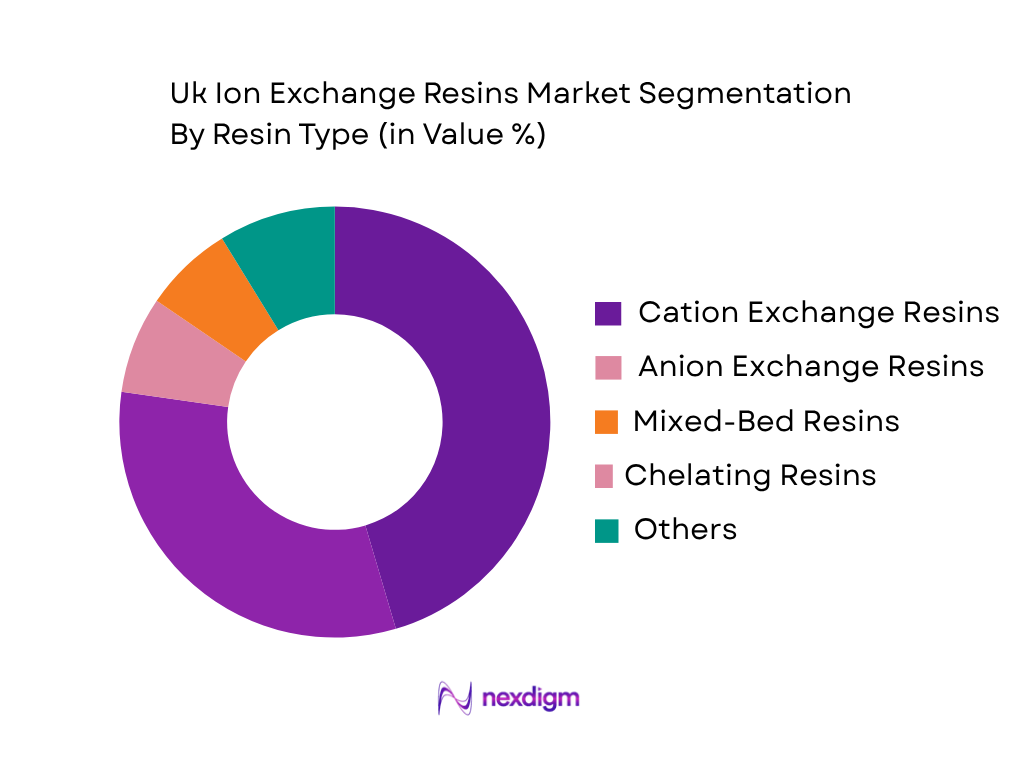
The UK Ion Exchange Resins Market is segmented into cation exchange resins, anion exchange resins, mixed-bed resins, chelating resins, amphoteric resins and specialty resins. Cationic resins dominate because of their broad deployment in water softening, demineralization, deionization and industrial process-water treatment. Published UK market data identifies cationic resins as the largest product segment, accounting for 48.7% of market revenue. Their widespread use across municipal and industrial systems gives them a broader installed base than specialized chelating and amphoteric chemistries. Cation resins also form a fundamental component of multi-stage demineralization systems, where they operate alongside anion and mixed-bed media. The UK’s large water-infrastructure investment cycle provides an additional replacement and modernization demand base. Ofwat’s approved investment program includes £104 billion of expenditure, with major allocations for resilience, supply infrastructure, environmental improvement and water recycling. Ion-exchange resin suppliers can therefore benefit from both new treatment capacity and replacement requirements within existing systems.
By Application
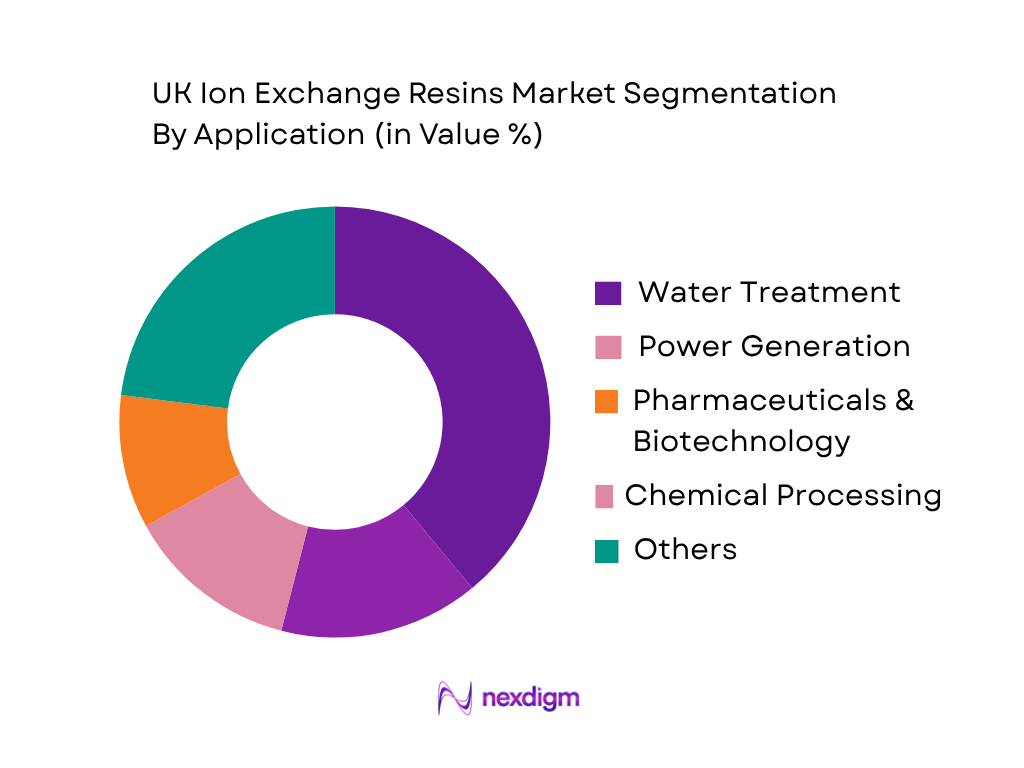
The UK Ion Exchange Resins Market is segmented by application into water treatment, power generation, pharmaceuticals and biotechnology, chemical processing, food and beverage, semiconductor and electronics, mining and hydrometallurgy, nuclear power, oil and gas, and industrial wastewater treatment. Water treatment represents the dominant application because ion exchange is established across softening, deionization, demineralization and contaminant removal. UK regulatory requirements reinforce this application: the Drinking Water Inspectorate states that ion-exchange resins used for drinking-water treatment require approval under the relevant Regulation 31 framework. The regulator requires manufacturers to provide information including resin type, bed capacity, operating flow rate, empty-bed contact time, regenerant type and rinse-water volume. PFAS is an additional treatment consideration, with UK water companies required to monitor PFAS and incorporate risks into water-safety assessments. The DWI reported more than 1 million PFAS analyses submitted since monitoring began in 2021, demonstrating the scale of contaminant surveillance. Water companies also face substantial infrastructure investment requirements, supporting demand for new treatment systems, resin replacement and advanced treatment media.
Competitive Landscape
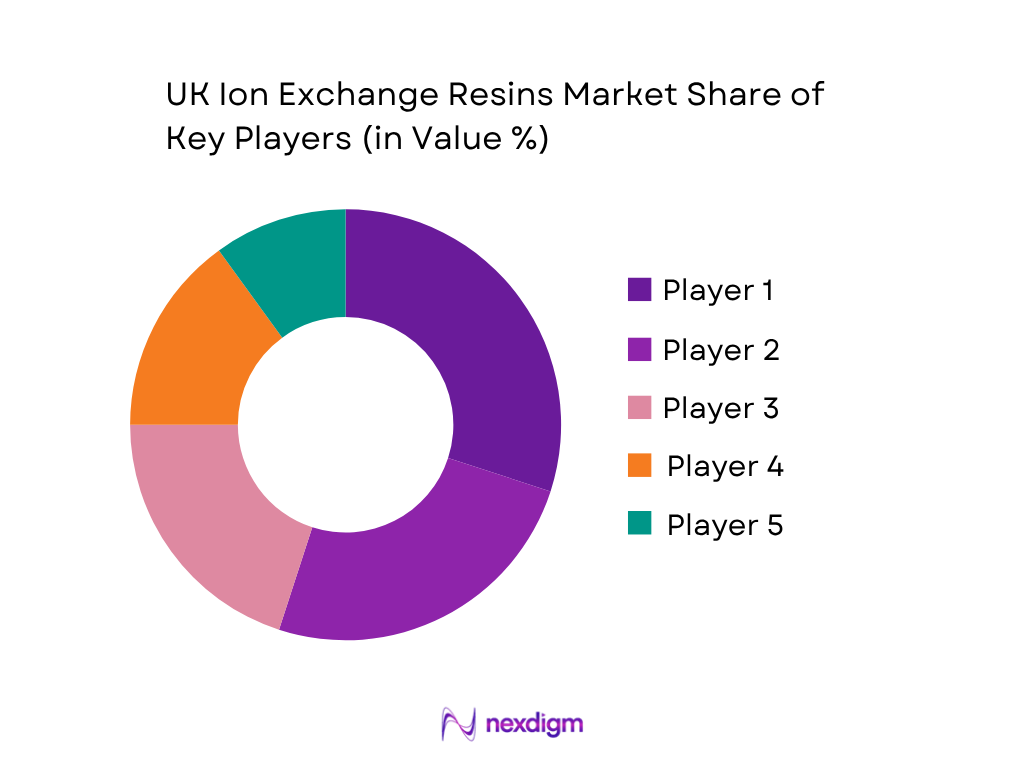
The UK Ion Exchange Resins Market is characterized by global resin manufacturers, European specialty-chemical producers, water-treatment companies and specialized resin suppliers. Competition is determined by resin chemistry, exchange capacity, application performance, regulatory approval, regeneration capability and technical support. The market also has a significant import component: UK ion-exchange-resin imports increased 24.75% in 2024, highlighting the importance of international suppliers and European trade flows. Regulatory qualification provides an additional competitive barrier because resins intended for applicable drinking-water uses must satisfy UK approval requirements.
| Company | Establishment | Headquarters | Major Resin Portfolio | Key UK Application | Specialty Capability | UK Market Position | Service Capability |
| DuPont | 1802 | Wilmington, USA | ~ | ~ | ~ | ~ | ~ |
| Purolite | 1981 | King of Prussia, USA | ~ | ~ | ~ | ~ | ~ |
| LANXESS | 2004 | Cologne, Germany | ~ | ~ | ~ | ~ | ~ |
| Mitsubishi Chemical Group | 1933 | Tokyo, Japan | ~ | ~ | ~ | ~ | ~ |
| Thermax | 1966 | Pune, India | ~ | ~ | ~ | ~ | ~ |
UK Ion Exchange Resins Market Analysis
Growth Drivers
Aging Water Infrastructure, PFAS Monitoring and Industrial Water Reuse
The UK Ion Exchange Resins Market is supported by the scale of water-infrastructure renewal and increasing treatment requirements across England and Wales. Ofwat’s 2024 Price Review allocated £104 billion for water-company expenditure, including £44 billion for new infrastructure and resources and £60 billion for operating and maintaining existing water and sewage networks. The programme includes 8,445 km of water mains scheduled for improvement and 30 major water-resource projects, creating recurring requirements for water-treatment equipment and ion-exchange media. PFAS monitoring is adding a further treatment requirement: UK water companies conducted more than 770,000 individual PFAS analyses in 2024, while more than 2.3 million analyses had been completed cumulatively by 2025. The DWI’s PFAS framework covers 48 PFAS parameters and uses 3 concentration-based risk tiers, increasing the need for contaminant-specific treatment assessment. Ion exchange is relevant to softening, demineralisation, nitrate removal, PFAS removal and polishing applications where dissolved ionic contaminants need selective removal. Industrial water reuse further broadens the addressable base as manufacturers seek greater process-water recovery and lower freshwater dependence. Ofwat’s programme also includes £2 billion of development funding intended to unlock £50 billion of major water-supply projects. These investments create opportunities for new treatment systems, resin replacement, regeneration services and higher-performance media across municipal and industrial facilities.
Pharmaceutical Manufacturing, Semiconductor Technology Development and High-Purity Water Requirements
The UK Ion Exchange Resins Market is also supported by pharmaceutical production, advanced semiconductor development and applications requiring tightly controlled ionic purity. ONS data shows UK pharmaceutical-product manufacturing output at £24.264 billion in 2024, compared with £23.758 billion in 2023, providing a substantial industrial base requiring purified water, process-water treatment and separation technologies. Semiconductor development provides a separate high-purity opportunity. The UK Government’s semiconductor strategy is backed by up to £1 billion of investment over a decade, with £200 million allocated for the 2023-2025 period. During 2024, the government announced £11 million for each of 2 Innovation and Knowledge Centres focused on silicon photonics and compound semiconductors, alongside £4.8 million for semiconductor-skills projects. A further £16.6 million was allocated for semiconductor equipment supporting advanced chip packaging and testing. These investments strengthen UK capabilities in compound semiconductors, photonics and advanced electronics, where manufacturing and research facilities require tightly controlled process water. Ion exchange resins can form part of deionisation, mixed-bed polishing and ultrapure-water treatment trains serving these facilities. The opportunity also extends to pharmaceutical-grade water, biotechnology and laboratory applications, where resin purity, extractables, ionic capacity and regeneration characteristics are critical. Increasing technical requirements therefore support movement toward high-purity, uniform-particle and application-specific resins rather than solely conventional commodity grades.
Market Challenges
Import Dependency, Resin Fouling, Regeneration Chemical Consumption and Spent Resin Management
The UK Ion Exchange Resins Market faces structural supply-chain and operating challenges because resin performance depends heavily on feedwater chemistry, regeneration requirements and availability of specialised products. The UK’s position as an importer of specialised ion-exchange media exposes buyers to international manufacturing capacity, logistics and currency-related procurement risks. At the treatment-system level, fouling from organic matter, suspended solids, iron, manganese, silica and other contaminants can reduce exchange capacity and increase regeneration frequency. Regeneration requires chemicals such as acids, caustic soda or brine depending on resin chemistry, while the resulting regenerant stream requires controlled treatment or disposal. These requirements become more demanding in high-purity applications because small levels of ionic contamination can affect pharmaceutical processing, electronics manufacturing and laboratory water systems. Regulatory qualification can add another layer of complexity. In December 2024, the Drinking Water Inspectorate issued an update extending the required approval period for certain non-Regulation-31-approved ion-exchange resins to 31 December 2025, citing the availability of designated testing laboratories. The DWI also requires users to demonstrate that treated water remains compliant where relevant products are not listed as approved. This makes product qualification, testing capacity and regulatory documentation important commercial considerations for suppliers. For PFAS applications, spent resin creates an additional management challenge because contaminants captured from water become concentrated in the exhausted media. Consequently, suppliers increasingly need to address resin lifetime, regeneration efficiency, waste handling and regulatory compliance alongside basic exchange capacity.
PFAS Short-Chain Removal Complexity, Membrane Competition and Regulatory Qualification Requirements
PFAS treatment presents a technically demanding challenge for the UK Ion Exchange Resins Market because treatment performance varies according to contaminant chemistry, competing ions and organic matter. The DWI reported more than 770,000 PFAS analyses across England and Wales during 2024, with more than 1.8 million analyses conducted cumulatively since 2012 in the corresponding annual reporting dataset. The monitoring framework uses 3 PFAS tiers, with Tier 1 below 0.01 µg/L, Tier 2 below 0.1 µg/L, and Tier 3 at or above 0.1 µg/L. This creates a technically differentiated market in which resin suppliers need to demonstrate removal performance rather than simply offer generic anion-exchange capacity. Short-chain PFAS can be more difficult to retain than longer-chain compounds, while natural organic matter and competing anions can influence resin utilisation and breakthrough. Ion exchange also competes with granular activated carbon and membrane technologies, particularly reverse osmosis and nanofiltration, which can be incorporated into multi-barrier treatment systems. The choice between technologies depends on feedwater composition, treatment objectives, waste-management requirements and lifecycle performance. Regulatory qualification is another barrier: the DWI’s Regulation 31 framework requires appropriate evidence for products used in applicable drinking-water treatment processes. The December 2024 DWI update specifically addressed ion-exchange-resin approval and testing requirements. For suppliers, this creates additional laboratory-validation, documentation and compliance requirements before specialised products can be adopted at regulated drinking-water facilities. Sources: Drinking Water Inspectorate; Environment Agency.
Market Opportunities
PFAS-Selective Resins, Pharmaceutical-Grade Resins and Advanced Water-Purification Systems
The UK Ion Exchange Resins Market has an opportunity to shift toward higher-selectivity media as PFAS monitoring, water-quality regulation and advanced treatment requirements become more technically demanding. During 2024, UK water companies conducted more than 770,000 PFAS analyses, while the DWI’s wider database contained more than 1.7 million analyses since 2012 in its England reporting. The monitoring programme covers 48 named PFAS compounds and categorises detected substances through 3 risk tiers. This creates a technical basis for developing selective resins targeting PFAS alongside conventional applications such as nitrate, sulphate, arsenic and other ionic contaminants. The opportunity is strengthened by Ofwat’s £104 billion water-sector investment programme, including £44 billion of new infrastructure and resources. Ofwat subsequently identified additional treatment expenditure associated with DWI requirements for PFAS, demonstrating that contaminant-specific treatment is being incorporated into regulated infrastructure programmes. Pharmaceutical-grade resins represent another premium application. UK pharmaceutical-product manufacturing output reached £24.264 billion in 2024, creating a sizeable domestic industrial base requiring purified and process water. Specialty resins with controlled extractables, high chemical stability, consistent particle-size distribution and strong regeneration characteristics can target these higher-specification systems. Advanced suppliers can therefore move beyond conventional softening applications toward PFAS-selective media, high-purity pharmaceutical resins and integrated treatment systems. The combination of regulatory monitoring, infrastructure investment and high-purity manufacturing requirements creates a pathway for technically differentiated resin products.
Semiconductor-Grade Ultrapure Water, Industrial Water Reuse, Nuclear Treatment and Critical-Mineral Recovery
The UK Ion Exchange Resins Market has an opportunity to expand into specialised industrial applications supported by government investment in advanced manufacturing, energy security and water resilience. The UK semiconductor strategy provides up to £1 billion of government support over a decade, including £200 million for 2023-2025, while 2024 programmes allocated £22 million across 2 Innovation and Knowledge Centres and £16.6 million for advanced semiconductor equipment. These initiatives strengthen domestic semiconductor and compound-semiconductor capabilities where high-purity water and tightly controlled ionic contamination can be important to fabrication and research processes. Water reuse offers another opportunity: Ofwat’s infrastructure programme includes £104 billion of expenditure and a pipeline of £50 billion in major water-resource projects, supporting technologies that improve treatment efficiency and water resilience. Nuclear applications provide a further specialised market for ion exchange because selective removal of dissolved ionic species is required in reactor and auxiliary water systems, while spent-resin management is an important operational consideration. Critical-mineral recovery represents a longer-term specialty opportunity for chelating and selective resins designed to capture specific metal ions from aqueous streams. The commercial opportunity is not limited to primary extraction; selective ion exchange can potentially support recovery from process liquors and industrial waste streams. Together, advanced semiconductor manufacturing, water reuse, nuclear treatment and selective mineral recovery broaden the UK market beyond conventional municipal softening and demineralisation toward technically specialised, higher-value applications.
Future Outlook
The UK Ion Exchange Resins Market is expected to expand through the convergence of water-infrastructure investment, stricter contaminant monitoring, pharmaceutical manufacturing and industrial water-purification requirements. Ofwat’s final determinations provide £104 billion of expenditure for England and Wales, including £12 billion for storm-overflow projects, £6 billion for nutrient-pollution upgrades and £2 billion of development funding for major water-supply infrastructure. PFAS monitoring is creating additional demand for advanced treatment technologies. UK water companies have submitted more than 1 million PFAS analyses to the Drinking Water Inspectorate since October 2021. Pharmaceutical manufacturing also provides a high-purity application base, with UK pharmaceutical output reaching £24.264 billion in 2024. The market is expected to see increased adoption of high-capacity cation and anion resins, PFAS-selective media, mixed-bed systems, pharmaceutical-grade resins, uniform-particle media and regeneration-efficient formulations.
Major Players
- DuPont Water Solutions
- Purolite
- LANXESS
- Mitsubishi Chemical Group
- ResinTech
- Ecolab
- Veolia Water Technologies
- SUEZ Water Technologies & Solutions
- Kuraray
- Samyang Corporation
- Thermax
- Jacobi Carbons
- Ion Exchange
- Ovivo
- DOW
Key Target Audience
- Ion Exchange Resin Manufacturers and Specialty Resin Producers
- Municipal Water Utilities and Industrial Water-Treatment Operators
- Pharmaceutical and Biotechnology Manufacturing Companies
- Power Generation and Nuclear Industry Operators
- Chemical, Food & Beverage and Industrial Processing Companies
- Semiconductor and Electronics Manufacturing Companies
- Investments and Venture Capitalist Firms
- Government and Regulatory Bodies (Drinking Water Inspectorate, Environment Agency, Ofwat, Department for Environment, Food & Rural Affairs, Scottish Environment Protection Agency)
Research Methodology
Step 1: Identification of Key Variables
The initial phase establishes a UK-specific ion-exchange-resin ecosystem covering resin manufacturers, importers, distributors, water utilities, industrial users, pharmaceutical manufacturers and regulators. Key variables include resin chemistry, exchange capacity, application demand, regeneration requirements, replacement cycles, PFAS treatment requirements and regulatory qualification.
Step 2: Market Analysis and Construction
Historical data is compiled by resin type, application and end-use industry. The model incorporates published market revenue, UK import trends and official water-sector investment data. Import growth of 24.75% in 2024 is used as an indicator of changing procurement requirements and international supply dependence.
Step 3: Hypothesis Validation and Expert Consultation
Market hypotheses are validated through discussions with resin manufacturers, water utilities, treatment-system integrators, pharmaceutical producers, power operators and industrial chemical users. Interviews assess resin selection, regeneration cycles, replacement frequency, technical specifications, supplier qualification and emerging PFAS-treatment requirements.
Step 4: Research Synthesis and Final Output
The final stage triangulates market revenue, resin imports, application demand and downstream industrial indicators. Official regulatory information from DWI and Ofwat is combined with industry data to establish the market structure. The final model separates conventional water-treatment resin demand from specialty PFAS, pharmaceutical, electronics and nuclear applications.

- Executive Summary
- Research Methodology (Market Definition and Scope, UK Ion Exchange Resin Taxonomy, Resin Chemistry Classification, Functional Group Mapping, Market Sizing Framework, Top-Down Analysis, Bottom-Up Analysis, Domestic Supply Assessment, Import Dependency Assessment, Demand-Side Assessment, Supply-Side Assessment, Water-Treatment Application Mapping, Industrial End-Use Assessment, Primary Industry Interviews, Trade-Flow Validation, Data Triangulation, Forecasting Framework, Scenario Analysis, Assumptions and Limitations)

- Definition and Scope
- UK Ion Exchange Resin Industry Evolution and Technology Development
- Ion Exchange Resin Manufacturing and Conversion Process
- Ion Exchange Resin Value Chain Analysis
- UK Ion Exchange Resin Supply Chain Analysis

- Growth Drivers (Aging Water Infrastructure, PFAS Monitoring and Remediation, Industrial Water Reuse, Pharmaceutical Manufacturing, Power-Generation Water Treatment, Semiconductor Technology Development, High-Purity Water Requirements, Nuclear Industry Requirements)
- Market Challenges (Import Dependency, Resin Fouling, Regeneration Chemical Consumption, Spent Resin Management, Raw-Material Volatility, PFAS Short-Chain Removal Complexity, Membrane Technology Competition, Regulatory Qualification Requirements)
- Market Opportunities (PFAS-Selective Resins, Pharmaceutical-Grade Resins, Semiconductor-Grade Ultrapure Water, Industrial Water Reuse, Nuclear Water Treatment, Specialty Chelating Resins, Critical-Mineral Recovery, Resin Regeneration Services, Advanced Water-Purification Systems)
- Market Trends (PFAS-Selective Media, High-Capacity Resins, Uniform Particle Size Technology, Macroporous Resin Adoption, High-Purity Pharmaceutical Resins, Single-Use Resin Systems, Resin Regeneration and Reuse, Hybrid Membrane-Ion Exchange Systems)
Regulatory and Standards Landscape (Drinking Water Inspectorate, Environment Agency, Regulation 31, UK REACH, Environmental Permitting Regulations, Water Industry Regulations, Chemical Safety, Waste Regulations) - SWOT Analysis
- Porter’s Five Forces Analysis
- PESTLE Analysis

- By Market Value (2020-2025)
- By Resin Consumption Volume (2020-2025)
- By Domestic Production Volume (2020-2025)
- By Import Volume (2020-2025)
- By Export Volume (2020-2025)
- By Replacement Resin Volume (2020-2025)
- By Regenerated Resin Volume (2020-2025)
- By Average Realized Selling Price (2020-2025)
- By Application Revenue (2020-2025)

- By Resin Type (In Value %)
Cation Exchange Resins
Anion Exchange Resins
Mixed-Bed Ion Exchange Resins
Chelating Ion Exchange Resins
Amphoteric Ion Exchange Resins
Specialty Ion Exchange Resins - By Application (In Value %)
Water Treatment
Power Generation
Pharmaceuticals and Biotechnology
Chemical Processing
Food and Beverage
Semiconductor and Electronics
Mining and Hydrometallurgy
Nuclear Power
Oil and Gas
Industrial Wastewater Treatment - By End-Use Industry (In Value %)
Municipal Water Utilities
Industrial Water Treatment
Electric Utilities
Pharmaceutical Manufacturing
Biotechnology
Chemical Manufacturing
Food and Beverage Processing - By Physical Form (In Value %)
Gel-Type Resins
Macroporous Resins
Uniform Particle Size Resins
Powdered Ion Exchange Resins
Specialty Porous Resins - By Functional Group (In Value %)
Sulfonic Acid
Carboxylic Acid
Quaternary Ammonium
Tertiary Amine
Chelating Functional Groups
Mixed Functional Groups - By Regeneration Method (In Value %)
Hydrochloric Acid Regeneration
Sulfuric Acid Regeneration
Sodium Hydroxide Regeneration
Sodium Chloride Regeneration
Chemical Regeneration and Reuse
Single-Use Ion Exchange

- Market Share of Major Players (By Revenue, Volume, Resin Type, Application, End-Use Industry, Grade, Distribution Channel)
- Cross Comparison Parameters (Ion Exchange Resin Portfolio Breadth, Total Exchange Capacity, PFAS-Selective Resin Capability, Pharmaceutical-Grade Resin Capability, Ultrapure-Water Resin Capability, Manufacturing and Supply Capacity, UK Regeneration-Service Coverage, Technical Support and Application-Engineering Capability)
- SWOT Analysis of Major Players
- Detailed Profiles of Major Companies
DuPont Water Solutions
Purolite
LANXESS
Mitsubishi Chemical Group
ResinTech
Ecolab
Veolia Water Technologies
SUEZ Water Technologies & Solutions
Kuraray
Samyang Corporation
Thermax
Jacobi Carbons
Ion Exchange
Ovivo
DOW

- Buyer Segmentation
- Procurement Behaviour
- Supplier Selection Criteria
- Buyer Pain Points
- Technology Adoption Assessment
- Replacement and Repurchase Behaviour

- By Market Value (2026-2035)
- By Resin Consumption Volume (2026-2035)
- By Domestic Production Volume (2026-2035)
- By Import Volume (2026-2035)
- By Export Volume (2026-2035)
- By Replacement Resin Volume (2026-2035)
- By Regenerated Resin Volume (2026-2035)
- By Average Realized Selling Price (2026-2035)
- By Application Revenue (2026-2035)


 Request a Sample
 Ask for Customization
 Get a Quote
 Enquire Now