

 Download PDF
Market Overview
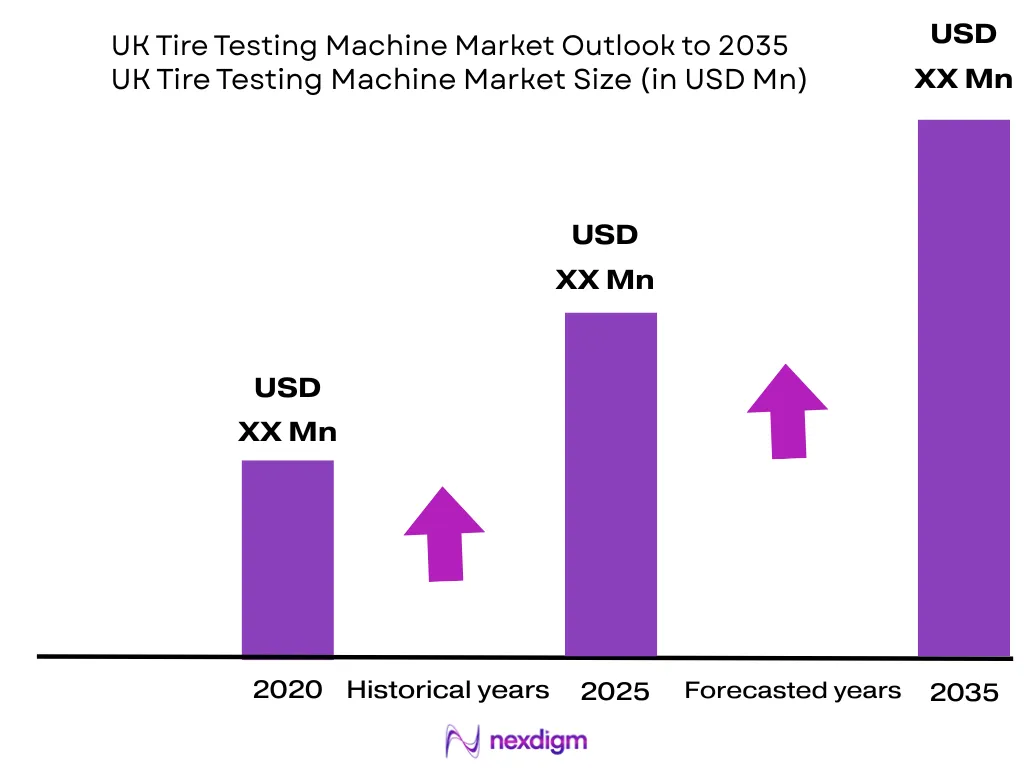
The UK Tire Testing Machine Market is valued at approximately ~ million, compared with ~ million in the preceding reporting period. Demand is driven by vehicle type approval, tyre-labelling verification, automotive engineering, electric-vehicle development, motorsport, production quality control, and laboratory replacement. UK new-car registrations reached 1,952,778 units, while battery-electric registrations reached approximately 382,000 units, increasing requirements for high-load endurance, rolling-resistance, wear, noise, force-and-moment, and wet-grip testing. The West Midlands, Warwickshire, Coventry, Northamptonshire, Oxfordshire, Bedfordshire, Essex, the North East, and South Wales dominate the UK Tire Testing Machine Market. These locations concentrate automotive manufacturers, engineering centres, proving grounds, motorsport companies, component suppliers, universities, and specialist laboratories. HORIBA MIRA’s 850-acre technology park strengthens the Midlands testing cluster, while Motorsport Valley supports advanced tyre modelling, transient-force measurement, simulation, and high-performance vehicle programmes. The UK tire testing machine market covers equipment, integrated laboratories, software, sensors, calibration, maintenance, and retrofit services used to test passenger-car, SUV, van, truck, bus, motorcycle, motorsport, aircraft, off-highway, retreaded, run-flat, smart, and non-pneumatic tyres. Key machine categories include endurance testers, high-speed systems, rolling-resistance machines, tyre-uniformity equipment, force-and-moment rigs, flat-belt systems, wear simulators, noise-testing installations, dynamic balancers, X-ray machines, shearography equipment, and laser geometry systems.
Market Segmentation
By Machine Type
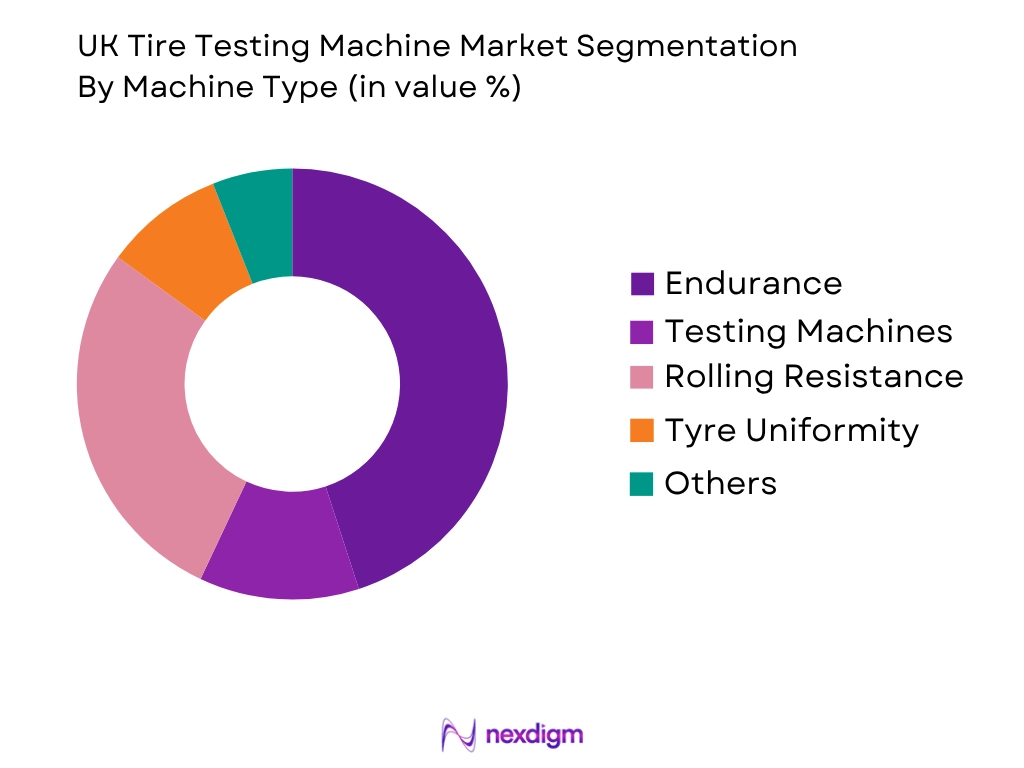
By machine type, the UK Tire Testing Machine Market is segmented into endurance and high-speed machines, rolling-resistance machines, force-and-moment systems, tyre-uniformity machines, non-destructive inspection equipment, wet-grip and surface-testing systems, dynamic balance and geometry machines, and specialty systems. Endurance and high-speed testing machines hold the dominant market share because durability validation is required throughout tyre design, type approval, production transfer, material substitution, and failure investigation. These machines expose tyres to controlled combinations of speed, vertical load, inflation pressure, temperature, and test duration. Passenger, high-performance, van, commercial, and EV tyres require different drum sizes, safety enclosures, spindle capacities, and automated failure-detection routines. Multi-station systems improve laboratory throughput, while environmental chambers support hot- and cold-condition validation. High-speed systems also require strong containment, precise speed stability, remote control, and continuous temperature monitoring. Their broad use across compliance, product development, motorsport, original-equipment approval, and production validation supports the segment’s dominant revenue position.
By End User
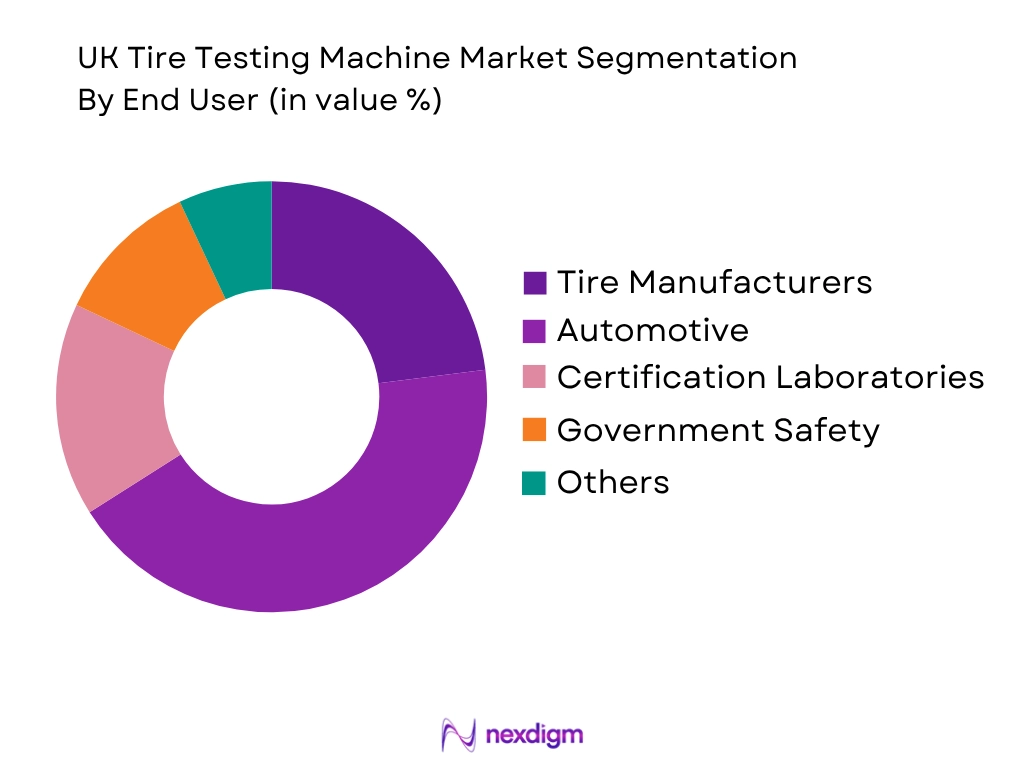
By end user, the UK Tire Testing Machine Market is segmented into automotive manufacturers, tyre manufacturers, independent testing laboratories, motorsport organisations, government and type-approval bodies, component suppliers, research organisations, retreaders, and proving-ground operators. Automotive manufacturers and engineering organisations hold the dominant market share because the UK has a substantial vehicle-development ecosystem despite having a more limited domestic tyre-manufacturing footprint than several larger producing countries. Vehicle manufacturers require tyre data for steering, ride, braking, electronic stability control, range efficiency, noise, chassis simulation, advanced driver-assistance systems, and homologation. They use physical tests internally and through specialist laboratories such as HORIBA MIRA and Smithers. Electric vehicles further increase testing requirements because tyre behaviour influences energy consumption, range, cabin noise, high-load durability, and wear. Motorsport organisations generate additional demand for transient force, high-speed uniformity, thermal, compound, and tyre-model data. This engineering-led market structure makes vehicle development and outsourced laboratories particularly important equipment buyers and users.
Competitive Landscape
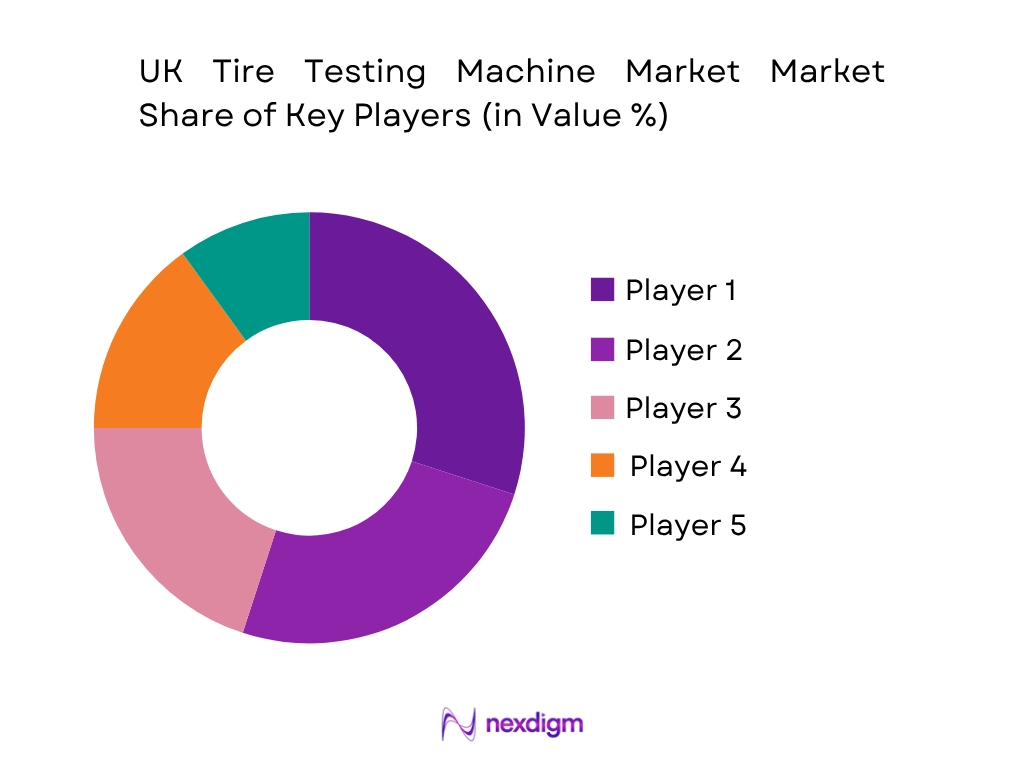
The UK Tire Testing Machine Market combines global machine manufacturers, UK engineering centres, independent testing laboratories, production-equipment specialists, and instrumentation suppliers. Competition is based on measurement accuracy, recognised test-method compatibility, tyre-size capability, automation, laboratory integration, calibration, software, engineering support, and lifecycle service. HORIBA MIRA and Smithers primarily compete through engineering and testing services, although their facilities influence machine demand and technical specifications. MTS supplies physical test systems and controls, while Kokusai and Micro-Poise focus heavily on laboratory or production-line tyre machinery. The relatively small number of large customers means suppliers require strong relationships, specialist applications knowledge, and long-term support capability.
| Company | Established | Headquarters | Core Capability | Tyre Applications | Measurement Focus | Automation Capability | UK Market Position | Digital Capability |
| HORIBA MIRA | 1946 | Nuneaton, UK | ~ | ~ | ~ | ~ | ~ | ~ |
| Smithers | 1925 | Akron, United States | ~ | ~ | ~ | ~ | ~ | ~ |
| MTS Systems | 1966 | Eden Prairie, United States | ~ | ~ | ~ | ~ | ~ | ~ |
| Kokusai | 1969 | Indianapolis, United States | ~ | ~ | ~ | ~ | ~ | ~ |
| Micro-Poise Measurement Systems | 1928 | Streetsboro, United States | ~ | ~ | ~ | ~ | ~ | ~ |
UK Tire Testing Machine Market Analysis
Growth Drivers
Tyre Labelling, Type Approval and Market-Surveillance Testing
The UK Tire Testing Machine Market is supported by statutory requirements for measuring rolling resistance, wet grip and external rolling noise across passenger-car, light-commercial and heavy-commercial tyres. The Vehicle Certification Agency states that tyre labels communicate fuel efficiency, wet-grip performance and measured external noise, requiring manufacturers and distributors to maintain defensible technical classifications. The Driver and Vehicle Standards Agency’s vehicle market-surveillance programme tested 10 tyre models in 3 tyre sizes, producing 30 tyre variants covering SUV, high-performance and people-carrier applications. Each variant was assessed against the label’s 3 principal parameters: wet grip, rolling resistance and noise. Such verification creates demand for calibrated rolling-resistance drums, wet-braking instrumentation, reference tyres, noise-measurement systems, environmental monitoring and secure data reporting. The requirement extends beyond initial product development because construction changes, compound substitutions and new size introductions can alter measured performance. UK automotive activity provides an additional testing base: manufacturers produced 905,233 vehicles, including 779,584 cars, while the new-car market registered 1,952,778 units. These volumes support continuing tyre approval, benchmarking, production-quality and replacement-product testing across laboratories, vehicle manufacturers and specialist engineering organisations.
Electric-Vehicle and Advanced Vehicle Engineering Requirements
Electric-vehicle development is increasing demand for tyre-testing machines capable of handling higher vertical loads, immediate drive torque, regenerative braking and stricter rolling-resistance targets. UK battery-electric registrations reached approximately 382,000 vehicles, within a total new-car market of 1,952,778 units. This expanding installed base requires tyre manufacturers and vehicle engineers to validate high-load durability, tread wear, longitudinal stiffness, force and moment, heat build-up, rolling resistance, interior noise and contact-patch behaviour. Battery mass raises loading on the tyre structure, while rapid motor torque increases stresses during acceleration. Reduced propulsion noise also makes tread impact, cavity resonance and road excitation more perceptible, strengthening demand for acoustic and vibration systems. The UK’s vehicle-engineering base remains export-oriented: the country exported GBP 9.0 billion of cars to the United States alone, supporting continued investment in internationally compliant product development and validation. Physical tire data are also required for virtual vehicle models used in steering, ride, braking, stability control and autonomous-driving simulation. Laboratories therefore need multi-axis flat-belt machines, high-speed endurance rigs, rolling-resistance systems, pressure mapping, thermal imaging and high-bandwidth acquisition platforms capable of converting measured tyre behaviour into simulation-ready datasets.
Market Challenges
High Capital Requirements and Limited Domestic Procurement Scale
Tire-testing machinery requires substantial expenditure on supporting infrastructure in addition to the test machine. High-speed endurance cells need reinforced foundations, containment structures, remote operator rooms, electrical drives, cooling, ventilation, compressed air, pressure-control equipment and automated emergency shutdown. Rolling-resistance laboratories require tightly controlled temperatures, tyre conditioning, drum-loss correction, reference correlation and high-resolution force or torque measurement. Wet-grip facilities require dedicated tracks, water-delivery infrastructure, surface monitoring, braking instrumentation and repeatable environmental procedures. These investments are difficult to justify for customers with irregular test volumes. The domestic procurement base is also concentrated among a relatively small group of automotive manufacturers, independent laboratories, motorsport organisations and research centres. UK vehicle production declined to 905,233 units, including 779,584 cars, even as commercial-vehicle output recorded growth, creating uncertainty around laboratory expansion schedules. Wider manufacturing conditions were also mixed: total UK manufacturers’ product sales reached GBP 452.2 billion, down by GBP 14.5 billion from GBP 466.7 billion. Capital-equipment purchases can consequently be deferred when manufacturers prioritise model-transition spending, plant conversion or working capital. Suppliers must therefore offer modular machines, staged upgrades, equipment leasing, retrofit programmes and outsourced testing options to reduce customers’ initial investment burden.
Calibration Complexity and Shortage of Multidisciplinary Engineering Skills
Reliable tyre testing depends on highly specialised personnel who understand tyre mechanics, control engineering, instrumentation, statistics, regulatory procedures and test-to-simulation correlation. A force-and-moment machine may measure 6 components simultaneously: longitudinal, lateral and vertical forces together with aligning, overturning and rolling moments. Rolling-resistance systems require correction for drum diameter, parasitic losses, pressure, speed, temperature and reference-tyre behaviour. Wet-grip testing adds surface friction, water depth, tyre conditioning, vehicle control and environmental variation. Any unresolved calibration error can invalidate compliance claims or produce misleading parameters for vehicle models. Skilled personnel must also maintain servo-hydraulic actuators, electric drives, load cells, torque transducers, speed encoders, pressure sensors, data-acquisition units and machine-safety systems. The challenge is intensified by fluctuating manufacturing activity. ONS reported that monthly production output fell in 3 consecutive months, including declines of 0.3, 0.6 and 0.4 percentage points across the observed sequence, leaving output at its lowest level since May 2020. Such instability can restrict recruitment and training budgets while increasing reliance on external service engineers. Proprietary controls and discontinued components further complicate legacy-machine support, encouraging laboratories to retain obsolete software or inconsistent measurement architectures across multiple test cells.
Market Opportunities
Automated, Connected and AI-Enabled Tyre Testing Laboratories
The UK has an opportunity to expand automated laboratories that combine robotic tyre handling, digital test recipes, machine condition monitoring and artificial-intelligence-based defect inspection. Automated cells can manage rim mounting, inflation, conditioning, loading, testing, marking, sorting and report generation with less operator intervention. This is particularly valuable for endurance tests that run over extended cycles and for production systems requiring consistent throughput. X-ray, shearography, laser geometry and machine-vision equipment generate large image datasets that can be analysed for belt displacement, trapped air, cord irregularity, bead defects, foreign material and tread separation. Connected sensors can also monitor spindle vibration, bearing temperature, belt alignment, hydraulic pressure and load-cell drift, allowing predictive maintenance before machine failure. The wider UK manufacturing base provides a substantial addressable environment: domestic manufacturers recorded product sales of GBP 452.2 billion, while machinery and transport equipment remained central to UK production and trade. Automotive export activity includes GBP 9.0 billion of cars shipped to the United States, demonstrating the importance of globally validated engineering performance. Suppliers can build recurring revenue through cloud-based test management, cybersecurity upgrades, digital-twin integration, remote diagnostics, annual software licences and multiyear calibration contracts rather than relying solely on one-time machine sales.
Tyre-Wear Emissions, Sustainable Materials and Next-Generation Testing
Growing attention to non-exhaust particulate emissions creates an opportunity for tyre-wear, abrasion and particle-measurement systems. UK transport statistics recorded 6.8 kilotonnes of PM2.5 from tyre and brake wear, compared with 5.3 kilotonnes in the historical reference period, while exhaust-related PM2.5 declined to 1.6 kilotonnes from 23.2 kilotonnes. As exhaust emissions fall, tyre, brake and road-wear particles become more prominent within transport policy and product development. Tire manufacturers therefore need laboratory methods that quantify tread mass loss, airborne particles, particle-size distribution, surface abrasion, temperature, load, torque and driving-cycle effects. Electric vehicles make this opportunity more relevant because battery mass and rapid torque can influence wear even when tailpipe emissions are absent. New equipment may combine road-wheel or flat-belt simulation with particle collection, optical counting, gravimetric analysis and real-time thermal measurement. Sustainable compounds containing recycled rubber, silica, bio-based materials and alternative reinforcing fillers also require comparative validation for wear, wet grip, rolling resistance and durability. Machine suppliers can work with vehicle manufacturers, laboratories and universities to create modular abrasion platforms, controlled road-surface replication, digital wear models and testing-as-a-service programmes. Current government data provide a measurable environmental basis for future laboratory investment without relying on speculative forecasts.
Future Outlook
The UK Tire Testing Machine Market is forecast to expand at approximately ~XX% CAGR during the forecast period. Development will be supported by electrification, tyre-labelling compliance, market-surveillance testing, virtual vehicle engineering, motorsport, automation, and replacement of ageing test systems. Battery-electric vehicles will reshape tyre-testing requirements. UK battery-electric car registrations reached approximately 382,000 units, while the total new-car market reached almost 1.953 million units. Battery vehicles represented 19.6% of registrations, creating more engineering programmes for high-load, high-torque, low-rolling-resistance, low-noise, and wear-resistant tyres. Electric vehicles are generally heavier than equivalent combustion models and can apply rapid torque at the tyre contact patch. Testing laboratories therefore require higher vertical-load capability, transient longitudinal-force measurement, regenerative-braking simulation, thermal monitoring, tread-wear analysis, and accurate footprint mapping. Because electric powertrains generate less propulsion noise, external and interior tyre noise becomes more prominent in customer-perceived vehicle refinement. Rolling-resistance testing will remain a major opportunity. Tyre labels classify fuel efficiency through rolling-resistance performance, while wet grip and external noise are also communicated to buyers. Equipment must maintain controlled temperature, tyre pressure, load, speed, drum condition, and machine-loss correction to identify relatively small differences between products.
Major Players
- MTS Systems
- HORIBA MIRA
- Smithers
- Applus+ IDIADA
- A&D Technology
- ZF Test Systems
- Kokusai
- Micro-Poise Measurement Systems
- Instron
- TMSI
- Hofmann Maschinen- und Anlagenbau
- Leonardo Automation
- Akron Standard
- Kobe Steel
- Larsen & Toubro Rubber Processing Machinery
Key Target Audience
- Tyre manufacturers and retread producers
- Automotive, electric-vehicle and commercial-vehicle manufacturers
- Independent tyre-testing and type-approval laboratories
- Motorsport teams and high-performance engineering suppliers
- Tyre machinery, instrumentation and automation integrators
- Tyre compound, sensor and smart-tyre developers
- Investments and venture capitalist firms
- Government and regulatory bodies (Driver and Vehicle Standards Agency, Vehicle Certification Agency, Department for Transport, Office for Product Safety and Standards, Health and Safety Executive, and United Kingdom Accreditation Service)
Research Methodology
Step 1: Identification of Key Variables
The first phase maps machine suppliers, tyre companies, automotive OEMs, laboratories, regulators, motorsport organisations, calibration providers, software suppliers, and engineering integrators. Variables include machine type, load, speed, installed base, test method, automation, utilisation, price, end user, and replacement cycle.
Step 2: Market Analysis and Construction
Historical equipment procurement, vehicle production, EV registrations, tyre-label testing, type-approval activity, laboratory investment, retrofits, and maintenance revenue are compiled. Top-down analysis allocates testing-equipment expenditure, while bottom-up analysis aggregates machine installations, selling prices, software, calibration, and service income.
Step 3: Supply-Side Assessment
Suppliers are assessed by test-system portfolio, maximum load and speed, tyre envelope, measurement accuracy, automation, regulatory compatibility, UK service coverage, software, calibration support, custom engineering, and installed-base references.
Step 4: Demand-Side Assessment
Automotive OEMs, tyre manufacturers, laboratories, motorsport companies, government bodies, retreaders, and compound developers are evaluated by test volume, machine utilisation, outsourcing, capital budget, approval requirements, turnaround needs, and confidentiality requirements.

- Executive Summary
- Research Methodology(Market Definitions and Assumptions, Abbreviations, Tire Testing Machine Market Boundary, Capital Equipment Revenue Recognition, Installed Base Assessment, New Machine Shipment Assessment, Retrofit and Modernisation Assessment, Top-Down Analysis, Bottom-Up Analysis, Demand-Side Assessment, Supply-Side Assessment, Tyre Manufacturing and Laboratory Mapping, Primary Industry Interviews, Machine Price Benchmarking, Data Triangulation, Forecasting Framework, Limitations and Future Conclusions)

- Definition and Scope
- Market Evolution and Industry Genesis
- Timeline of Major Industry Developments
- Evolution from Mechanical Tyre Test Rigs to Automated Multi-Axis Test Systems
- UK Tyre Testing Machine Industry Business Cycle

- Growth Drivers (UNECE Compliance, Tyre Labelling Verification, EV Development, Production Automation, Wet-Grip Testing, Laboratory Modernisation)
- Market Challenges (High Capital Cost, Limited Domestic Tyre Production, Calibration Complexity, Skills Availability, Machine Downtime, Technology Obsolescence)
- Market Opportunities (EV High-Load Tyres, Automated Inspection, Smart Tyres, Digital Twins, Retread Testing, Testing Services)
- Market Trends (Automation, Electrification, Multi-Axis Testing, AI Inspection, Virtual Engineering, Connected Laboratories)
- Government Regulations and Industry Standards (GB Type Approval, UNECE Requirements, Tyre Labelling, Market Surveillance, Calibration, Laboratory Accreditation)
- SWOT Analysis
- Porter’s Five Forces Analysis
- PESTLE Analysis

- By Market Value (2020-2025)
- By New Machine Sales Value (2020-2025)
- By Retrofit and Modernisation Value (2020-2025)


- Market Share of Major Players (By Value, Unit Shipments, Machine Type, End User, Application)
- Cross Comparison Parameters (Machine Portfolio Breadth, Maximum Tyre Load and Speed Envelope, Force–Moment–Rolling Resistance Measurement Accuracy, GB Type Approval–UNECE–ISO Test Method Compatibility, Flat-Belt–Drum–Uniformity–Inspection Technology Capability, Automation–Robotic Handling–Data Acquisition–Digital Twin Integration, UK Installed Base–Field Service–Calibration–Spare Parts Coverage, EV–Commercial Vehicle–Smart Tyre–Non-Pneumatic Tyre Testing Readiness)
- SWOT Analysis of Major Players
- Detailed Profiles of Major Companies
MTS Systems
HORIBA MIRA
Smithers
Applus+ IDIADA
A&D Technology
ZF Test Systems
Kokusai
Micro-Poise Measurement Systems
Instron
TMSI
Hofmann Maschinen- und Anlagenbau
Leonardo Automation
Akron Standard
Kobe Steel
Larsen & Toubro Rubber Processing Machinery

- Tyre Manufacturer Analysis
- Passenger Vehicle OEM Analysis
- Electric Vehicle Manufacturer Analysis
- Commercial Vehicle OEM Analysis
- Independent Testing Laboratory Analysis

- By Market Value (2026-2035)
- By New Machine Sales Value (2026-2035)
- By Retrofit and Modernisation Value (2026-2035)


 Request a Sample
 Ask for Customization
 Get a Quote
 Enquire Now